Concert guide: 13–19 November

A curated list of upcoming concerts. See also the Australian Music Centre concert calendar and the New Music Network concert series.

Thursday 14 November. The ACO perform Rautavaara’s A Finnish Myth and a new work by G. Fröst at Newcastle City Hall, NSW, 7:30pm. Repeat 17 and 18 November, The Arts Centre, Melbourne.

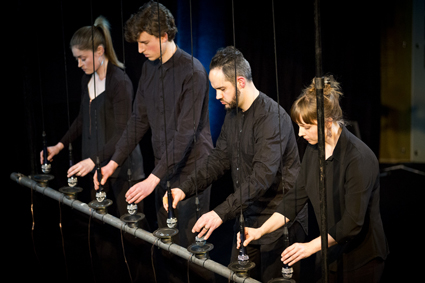
Friday 15 November. Ensemble Offspring and percussion soloist Claire Edwardes perform an immense programme of works by John Luther Adams, Larry Polansky, John Zorn, Chris Adler, Bryn Harrison, Richard Pressley, Nicholas Peters, João Oliviera, Elena Kats-Chernin, Erik Griswold, Kate Moore, Jane Stanley and Matthew Shlomowitz at the Campbelltown Arts Centre, NSW, 8pm.

Saturday 16 November. Luke Howard presents “Sun, Cloud” at Conduit Arts, Fitzroy, Vic, 9:45pm.

Sunday 17 November. Chris Rainier performs works by Harry Partch, the Wonderland Spiegeltent, Docklands, Vic. 7pm.

Monday 18 November. Syzygy Ensemble perform Mantovani, Gordon, Cashian and Norman at 6pm. Melbourne recital Centre, 6pm.

Callum G’Froerer presents his final ANAM fellowship concert including Morton Feldman’s “The Viola in My Life” and works by Cat Hope, Eres Holz and Luciano Berio at the Northcote Uniting Church, Vic, 7pm.

Partial Durations is a Matthew Lorenzon/RealTime project.

Arcko Symphonic Ensemble, X-ray Baby

Arcko Symphonic Ensemble, photo by Langdon Rodda

Arcko Symphonic Ensemble
X-ray Baby
Northcote Town Hall
2 November 2013

Framed by the quirky trompe-l’oeil interior of the Northcote Town Hall, X-ray Baby is a testament to the Arcko Symphonic Ensemble’s philosophy of performing new works by its own members, re-presenting old works from its own repertoire and giving previously premiered works a new lease on life.

Most new orchestral works are never heard beyond their premiere due to the prohibitive cost of convening a large ensemble. Composers, audiences and critics alike risk a shallow appreciation of these nuanced compositions and—unless something goes astonishingly wrong or right—judging individual performances is difficult. Arcko are committed to remedying this situation by giving new large-scale works a second hearing. If a second hearing helps audiences and performers better understand a piece—to hear what has stayed the same—it also provides an opportunity for audiences to tune into what has changed around the piece since its last performance.

Of all the orchestral works premiered in Melbourne recently, Annie Hsieh’s Icy Disintegration is probably the least in need of repeated performance to be understood. The piece is explicitly programmatic, rallying swelling tam-tam rolls, blaring brass sections and shimmering strings to paint the serenity of the Ross Sea, the appearance of cracks and fissures in the Ross Ice Shelf, the immense calving event that produced B-15 ( the largest free-floating object in the world), the break-up of the iceberg into smaller bergs and floes and a scene of nostalgic calm. But never has a piece sounded so urgent in the Northcote Town Hall. Recent reports from the Intergovernmental Panel on Climate Change and the United Nations Environment Program have reiterated what we have known for a long time now—that there’s a rather high chance the climate is warming helped along by human-caused carbon emissions—with the addition of some startlingly short time frames for urgent action to avoid widespread, catastrophic damage to human and animal life. With a binding international agreement on carbon emissions unlikely to be reached any time soon, Hsieh’s earsplitting timpani and brass calving event sounds more like the projected cries of hundreds of millions of climate refugees. Her racing, diverging string “fissures” mimic the current political prevarication around this fairly reliable threat to civilisation. But anyway, Hsieh is being bombastic because, as everybody knows, most of the lost ice actually silently melts away from underneath the Antarctic ice shelves.

From the global to the minuscule, Kate Neal’s Particle Zoo II draws inspiration from the mysterious world of subatomic particles. Like the scientists at CERN researching the Higgs boson, composers know that notes cannot easily be reduced to a single point on a page. A note is at once a a point and an envelope of different characteristics. Neal plays with this ambiguity in Particle Zoo II, contrasting a pointillistic piano part with legato accompaniment in the chamber orchestra. The consonant orchestral texture of polyrhythms and arpeggios provides a space within which the virtuosic solo piano (performed by Joy Lee) wanders. Short, tumbling lines and small clusters provide a dazzling array of clashing musical trajectories. The effect would have been improvised or speech-like  were it not for Lee’s poise and concentration, which left no doubt that she was dealing with a challenging and precisely notated score.

In Caerwen Martin’s X-ray Baby performers are asked to interpret graphic scores based on x-rays and ultrasounds of her baby. An episodic construction made the pocket-sized piece a gratifying study in graphic score interpretation. Sul tasto string glissandi conjure the curves of the womb and foetus in an ultrasound. Key clatter and toneless breath from the winds and brass sounds like static interference in the image. Trilling glissandi sound like a nausea I shall never experience and a climax on tam-tam leaves behind a single, pure flute tone. The ensemble evidently enjoyed playing—and playing with—a work celebrating an important event in the life of one of their fellow players.

Partial Durations is a Matthew Lorenzon/RealTime project.

Concert guide: 6–12 November

A curated list of upcoming concerts. See also the Australian Music Centre concert calendar and the New Music Network concert series.

Friday 8 November. Aurora New Music presents Global City at the Joan Sutherland Performing Arts Centre, Penrith, NSW, 8pm.

Saturday 9 November. The Melbourne Composers’ League present a concert of works by Andrián Pertout, Maria Grenfell, Brendan Colbert, Paul Moulatlet, Eve Duncan and Haydn Reeder. Trinity Uniting Church, Brighton, 3pm.

Topology and Speak Percussion “get together over the Cuban Missile Crisis and throw a bunch of genres into the blender” at the Brisbane Powerhouse, 7:30pm.

Brett Dean‘s Ariel’s Music for solo clarinet and orchestra will be performed by the Tasmanian Symphony Orchestra alongside Bruch’s Concerto for viola and clarinet featuring Paul and Brett Dean as soloists.

Sunday 10 November. Percussionist Claire Edwardes presents a series of new works for solo percussion commissioned from Peter McNamara, Erik Griswold and Matthew Shlomowitz. Campbelltown Arts Centre, NSW, 2pm.

Jenny Barnes, Ren Walters and Niharika Senapati show off their incredible semi-improvised vocal, guitar and dance skills at Longplay bar, Fitzroy, VIC, at 7:30pm.

The Astra Chamber Music Society (cheers all round) present works by Lawrence Whiffin, Dan Dediu, Martin Friedel, Graham Hair, Keith Humble and Helen Gifford with Craig Hill at the North Melbourne Town Hall, 5pm.

World’s Only Magazine

World's Only, Issue Three, cover by Dave Boyce
World’s Only, Issue Three, cover by Dave Boyce

World’s Only Magazine
Issue Three

The third issue of Sydney-based contemporary arts magazine World’s Only provides an intimate window into the lives and practices of artists, composers, bands and producers.

Horse MacGyver, introduced as “one of the most elusive musicians on the internet,” speaks to Cormack O’Connor through vocal distortion and ponders the motives of self-destructive rock idols, emotion and innovation in programming and how terrible the name “witch-house” is.

New York-based sound artist Tristan Perich tells editor Megan Alice Clune how playing the piano as a child inspired him to explore mathematics and discrete systems. Helped along by his parents’ love of Philip Glass, he developed an appreciation for the simple mathematical rations of polyrhythms, as well as the theorems of Alan Turing and Kurt Gödel. Perich also discusses his installation Microtonal Wall at MoMA and his work as a visual artist, including Machine Drawings for computer-controlled felt-tip pen.

A photographic interlude by Samuel Hodge takes the reader backstage at fashion label Romance Was Born’s Spring/Summer 2013 show.

Violinist and composer Caroline Shaw discusses her energetic Partita for Eight Voices, being a multi-tasking perfomer-composer, working with Glasser and John Cale and the effect of winning the Pulitzer on one’s culinary talents.

Glasser (Cameron Mesirow) describes the process of writing her new album Interiors, including its various architectural and urban influences.

With the glossy centrefolds of a coffee table magazine and the personal tone of a zine, World’s Only is essential reading for those interested in—or just curious about—contemporary art music.

Partial Durations is a Matthew Lorenzon/RealTime project.

Concert guide: 30 October–5 November

A curated list of upcoming concerts. See also the Australian Music Centre concert calendar and the New Music Network concert series.

Wednesday 30 October. The Melbourne Art Song Collective perform Vaughan Williams’ Songs of Travel alongside the new cycle Sojourn by Dermot Tully. Melbourne Recital Centre, 6pm.

Thursday 31 October. The Australia Quartet celebrates Halloween 2013 with Schoenberg’s Transfigured Night in a new arrangement by Sydney-based composer, Barton Staggs, and a world premiere and performance by Elena Kats-Chernin of her Scherzino arranged for four hands.

James Rushford and Joe Talia perform at Long Play, Fitzroy, VIC, at 8pm with Yuko Kono.

Friday 1 November. David Lockeridge performs the new marimba concerto “Scenes from the Caucasus” Gerard Brophy at the Newcastle Conservatorium of Music, NSW, 2:30pm.

Synergy Percussion present their new program Bespoke for Air: New Thoughts in Sound for Radio at the Bon Marche Studio at the University of Sydney, 7:30pm. James Humberstone, Kate Moore, Julian Day and Evan Mannell have responded to the brief by Synergy, APRA and ABC Classic FM for pieces “that go to record fluently but look striking live.”

Saturday 2 November. Portland Upwelling Festival Artist in Residence, Vincent Giles, presents a multi-speaker sound installation on the Portland foreshore during the festival in response to the marine phenomenon called the Bonney Upwelling. The sound installation runs most of the day.

The Aether Instrumental Quintet première a new work by Gerard Brophy at Sandgate Town Hall, Brisbane, QLD, at 7:30pm.

Chronology Arts commissioned five composers (Leah Barclay, Hayden Woolf, Chris Williams, Annie Hui-Hsin Hsieh and Tristan Coelh)  to respond to the eighteenth-century Sanskrit poem Bodhasara by Narahari in a translation by Grahame and Jennifer Cover. Downstairs Theatre, Seymour Centre, NSW, 8pm. Repeat Saturday 2 November.

Or, you could hear saxophonist and composer Sandy Evans collaborate with tabla player Bobby Singh in The Sound Lounge of the Seymour Centre, NSW, at 8:30pm.

The Arcko Symphonic Ensemble perform Caerwen Martin’s new piece X-Ray Baby alongside works by Kate Neal, Annie Hsieh and Felipe d’Aguiar. Northcote Town Hall, 7:30pm.

Sunday 3 November. Students from ANAM perform works by J.S. Bach and Australian composers Hughes, Smith, Sitsky and Goldmann at Stones of the Yarra Valley, Coldstream, VIC (approximately one hour from Melbourne), 11am.

Heartswin, Donna Hewitt, Tony Osborne and Gail Priest perform at the last Pretty Gritty of the year—a celebration of contemporary vocal music at 107 Projects, Redfern, NSW.

Ros Bandt presents her new sound work based on twelve months working with a box-ironbark with the permission of Uncle Brien Nelson, Jaara Jaara Elder. Her radiophonic work will be spread through the bush and include sound recordings from underwater, in the air and the sounds of multi-cultural musicians. Meet at Fryerstown School, Fryerstown, VIC, at 3:30pm to walk to the installation site.

Monday 4 November. Adelaide’s The Firm presents Leigh Harrold performing minimalism-inflected solo piano works by Phillip Glass, Quentin Grant and Raymond Chapman-Smith. Elder Hall, SA, 9:30pm.

Partial Durations is a Matthew Lorenzon/RealTime project.

Concert guide: 23–29 October

A curated list of upcoming concerts. See also the Australian Music Centre concert calendar and the New Music Network concert series.

Wednesday 23 October. Halcyon perform songs by Andrew Schultz, Gordon Kerry, Paul Stanhope, Stephen Adams, Elliott Gyger, Ross Edwards, Gillian Whitehead and Andrew Ford to raise money for “Kingfisher,” a commission of 23 new art songs by Australian composers. Museum of Contemporary Art, The Rocks, NSW, 7pm.

Thursday 24 October. Ken Murray and The University Guitar Ensemble première Richard Charlton’s Other Dimensions at Melba Hall, Parkville, VIC, at 7:30pm.

Friday 25 October. German baritone Guillermo Anzorena, Australian pianist Michael Kieran Harvey and cellist Judith Hamann perform James Hullick’s post-apocalyptic chamber opera Bruchlandung at the Iwaki Auditorium, Southbank, VIC, 7:30pm.

Tura New Music’s Crossing Roper Bar Tour comes to Hearson’s Cove, Karratha, WA, at 7pm. Features Wagilak Songmen from Ngukurr, Arnhem Land; Stephen Pigram and members of the Australian Art Orchestra.

The Queensland Symphony Orchestra perform the first symphony by Mark Isaacs amongst works by Pärt and Britten. South Bank, Brisbane, QLD, 7pm.

Saturday 26 October. Ensemble Gombert perform Melbourne composer Vaughan McAlley’s 40-part motet Omnes angeli amongst others by Tallis and Carver at The Dome, 333 Collins st, Melbourne, VIC, 8pm.

Sunday 27 October. The Melbourne Composers League and the Grainger Wind Symphony present a concert of music for wind ensemble by composers from Melbourne, plus a guest work from Japan. Richmond Town Hall, VIC, 3pm.

The Zephyr Quartet perform concert works by film composers Rota, Korngold and Herrmann, as well as a new work by Adelaide-born composer Alies Sluiter. The Promethean, Adelaide, SA, 7pm.

Tura New Music’s Crossing Roper Bar Tour comes to Novotel Ningaloo Resort, Exmouth, WA at 7pm. Features Wagilak Songmen from Ngukurr, Arnhem Land; Stephen Pigram and members of the Australian Art Orchestra.

Tuesday 29 October: Tura New Music’s Crossing Roper Bar Tour arrives in Perth to the State Theatre Centre. Features Wagilak Songmen from Ngukurr, Arnhem Land; Stephen Pigram and members of the Australian Art Orchestra.

Partial Durations is a Matthew Lorenzon/RealTime joint project.

Speak Percussion, The Black of the Star

Speak Percussion, photo by Jeff Busby

Speak Percussion
The Black of the Star
Deakin Edge
Melbourne Festival
16 October, 2013

More than any other twentieth-century work inspired by our scientific understanding of the natural world, Gérard Grisey’s Le Noir de l’étoile [The Black of the Star] continues to capture our imaginations. Perhaps this is because Grisey made sure to embed the mythology of the work’s scientific conceit in the piece itself. Once captivated, the audience are auditory pioneers at the unstable intersection of technology and science.

Le Noir de l’étoile begins with a ponderous voice reciting the words of Jean-Pierre Luminet, an astrophysicist and poet. The voice describes the remarkable discovery of pulsars, the “fantastic compact residue created by the supernova explosions that long ago disintegrated the massive stars.” Who could not wonder at these super-dense masses of neutrons only thirty kilometres in diameter but with the mass of the sun? As the voice explains with fairy-tale cadence, “A thimble of the material from one of these stars would weigh one hundred billion tonnes on Earth.” Unlike their larger cousins the black holes, pulsars are brought down—and perhaps this is their appeal—to human dimensions by the fact that they revolve with the relatively musical frequency of between hundreds of times a second and once every ten seconds. Emitting two beams of light they are, as Luminet puts it, “Like great lighthouses in the heavens, … cosmic clocks marking out their seconds.”

Spaced around the steel and glass mezzanine of Deakin Edge, Speak Percussion were suspended in front of the night sky behind six gleaming percussion batteries. After Luminet’s introduction lulls the audience into expectant wonder, Ughetti begins a gentle pulse on a floor tom. This pulse is eventually taken up at different tempi in other batteries, creating a captivating constellation of musical pulsars. An interjection on wood-blocks also echoes around the room like the light and radio waves that take thousands of years to traverse the galaxy. At other times a roaring snare roll passes between the percussionists and a loud, lone tom strike gives momentary focus to the bewildering sound-scape. The introduction helps give rise to these astronomical metaphors, even though, as Speak Percussion’s Artistic Director Eugene Ughetti explains, the first half was originally composed as Tempus ex machina, a work concerned not with pulsars but with time and space more generally.

The second half of the performance features two pulsar signals, one of which has an Australian provenance. The first is from the Vela pulsar, discovered by scientists at the University of Sydney in 1968, which spins at a rate of 11 times per second. This pulsar is only observable in the Southern Hemisphere and for Speak Percussion’s performance the CSIRO provided a new recording of the pulsar by George Hobbs. Ughetti claims (and I could only get away with this in a journalistic context) that the original recording used by Grisey was made by pulsar expert Dick Manchester, who worked at the Parkes observatory in the late 1960s. The signal sounds like a repeated, clipping sample of static, not unlike something one would hear in a Drum and Bass track.

The second pulsar provides a low, “whumping” sound at a rate of 1.4 rotations per second. For the work’s première in 1991, the signal from this pulsar was broadcast live into the auditorium from the Nançay radio astronomy station in Sologne. Unfortunately, a live broadcast of the Vela pulsar was unavailable for the Deakin Edge performance as the pulsar is not visible at this time of year. At Deakin Edge both signals were diffused by the team of Lawrence Harvey from RMIT’s SIAL Sound Studio.

When the initial metrical spatialisation gives way to the recordings of pulsars, the players are given more elaborate rhythmic phrases. It is as though, after imitating the pulsars (and theatrically conjuring them into the room), the ensemble begins to play along with them. The individuality of the performers comes out, with Ughetti’s dynamic sensitivity and Schack-Arnott’s improvisatory fluidity. But the point of these two sections may not be so much a contrast between machinic imitation and human inventiveness as a contrast between technology and science. While the technology of radio telescopes enabled us to hear the pulsars, scientific conjecture allowed us to interpret and understand them. As Luminet writes in the introduction:

In the electromagnetic tornado given out by a pulsar, the radio waves emitted represent only a whisper, and it is this that is picked up by the instruments. For an astronomer, it is like trying to understand the way a large machine in a factory works by listening merely to the few muffled noises that escape from it. The energy collected is infinitesimal… In 50 years of observations, all the energy gathered by all the radio telescopes in the world is less than that you need to turn a single page of your programme.

In a world where government-funded university science departments pursue narrow techno-industrial aims and objective research centers of global relevance have to be crowd-funded, Le Noir de l’étoile reminds us of the importance of big science—internationally-coordinated, large-scale investigation into the very large, the very small and the very distant—to our cultural and spiritual identity. By 2019 Western Australia and eight countries in southern Africa will be home to the Square Kilometre Array, the world’s largest and most sensitive radio telescope (actually an array of thousands of radio receptors spaced over thousands of kilometres). The SKA will be fifty times more sensitive and will be able to produce surveys of regions of the sky 10,000 times faster than any other existing instrument. We can barely predict what data we will gather, but when we do I hope our scientific and creative imaginations will up to the task of interpreting and understanding it.

Partial Durations is a Matthew Lorenzon/RealTime joint project.

Concert guide: 16–22 October

A curated list of upcoming concerts. See also the Australian Music Centre concert calendar and the New Music Network concert series.

Wednesday 16 October: Speak Percussion perform Grisey’s intergalactic percussion work Le Noir de l’étoile at Deakin Edge, VIC, at 8pm.

Thursday 17 October: The Australian String Quartet‘s National Composers’ Forum culminates in a public performance of six new works for string quartet by Jesse Budel (SA), Julian Day (NSW), William Jeffery (NSW), Natalie Nicolas (NSW), Sebastian Phlox (SA) and Timothy Shawcross (VIC). Elder Hall, SA, 8pm.

Friday 18 October: Jon Rose presents “Spin: The Canberra Pursuit,” a performance-installation of junk percussion powered by hacked bicycles. Yes, please. TAMS depot, Fyshwick, ACT, 6pm.

Pianist Ian Holtham presents four world premiere works by Barry Conyngham, Elliott Gyger, Mark Clement Pollard and Stuart Greenbaum that were written in response to Schubert’s iconic last piano Sonata. Melba Hall, VIC, 6:30pm.

WASO present WA composer James Ledger’s new violin concerto alongside works by Strauss, Ravel and Stravinsky. Perth Concert Hall, WA, 7:30pm. Repeat Saturday 19 October.

Saturday 19 October: Tura New Music’s Crossing Roper Bar tour comes to the Moonlight Bay Suites, Broome, WA, to present the collaboration between the Australian Art Orchestra and the Young Wägilak Group from Ngukurr in Arnhem Land. 7pm.

ARCKO Symphonic Ensemble revisit two works from previous years (Brendan Colbert’s ….floating in the void… and Roger Smalley’s Strung Out) along with Barry Conyngham’s Sky and the premiere of a new work for string orchestra by Melbourne composer Lisa Illean. Fitzroy Town Hall, VIC, 7:30pm. Repeat Sunday 20 October, 3pm.

Sunday 20 October: How could you pass up the Melbourne Bassoon Quartet with a blurb like this?: “My life-long companion, the Heckel bassoon, is worth a fortune nowadays. I can’t just let it rot in its box, so I have started playing again, practice every day, reformed the Melbourne Bassoon Quartet (again), in which I play the fourth bassoon part – yes, I’m 84 and I can manage it.

There is no money in it for any of the bassoonists, it’s all just for the love of playing chamber music. The program is all my own music: The Adventures of Sebastian the Fox always brings the house down, and there are homages to Victor Bruns and William Waterhouse, two old bassoonist friends of mine, both much more famous than me, dead now, but fondly remembered by me. And we play Rush for an encore. I hope we get that far.” (George Dreyfus)

Monday 21 October: Andrew Ford’s “Once upon a time there were two brothers … ” for solo flute/narrator and Ford’s string quartet Cradle Song performed by the Shanghai string quartet. Also, Penderecki and Haydn.

Partial Durations is a Matthew Lorenzon/RealTime joint project.