Australian musicians recognised at Darmstadt

A big congrats to Phoebe Green, Joshua Hyde and Alex Raineri for winning prizes at this year’s Darmstadt International Summer Course. That’s three Australians out of eight individual awards. Ashley Fure from the United States (composition) and Distractfold Ensemble from Great Britain have been awarded the prestigious Kranichstein Music Prize.

Until next year! Can’t wait to catch up with returning Darmstadters at the Bendigo International Festival of Exploratory Music next month.


Partial Durations is a Matthew Lorenzon/RealTime joint project.

Partial Durations to live-blog Bendigo International Festival of Exploratory Music

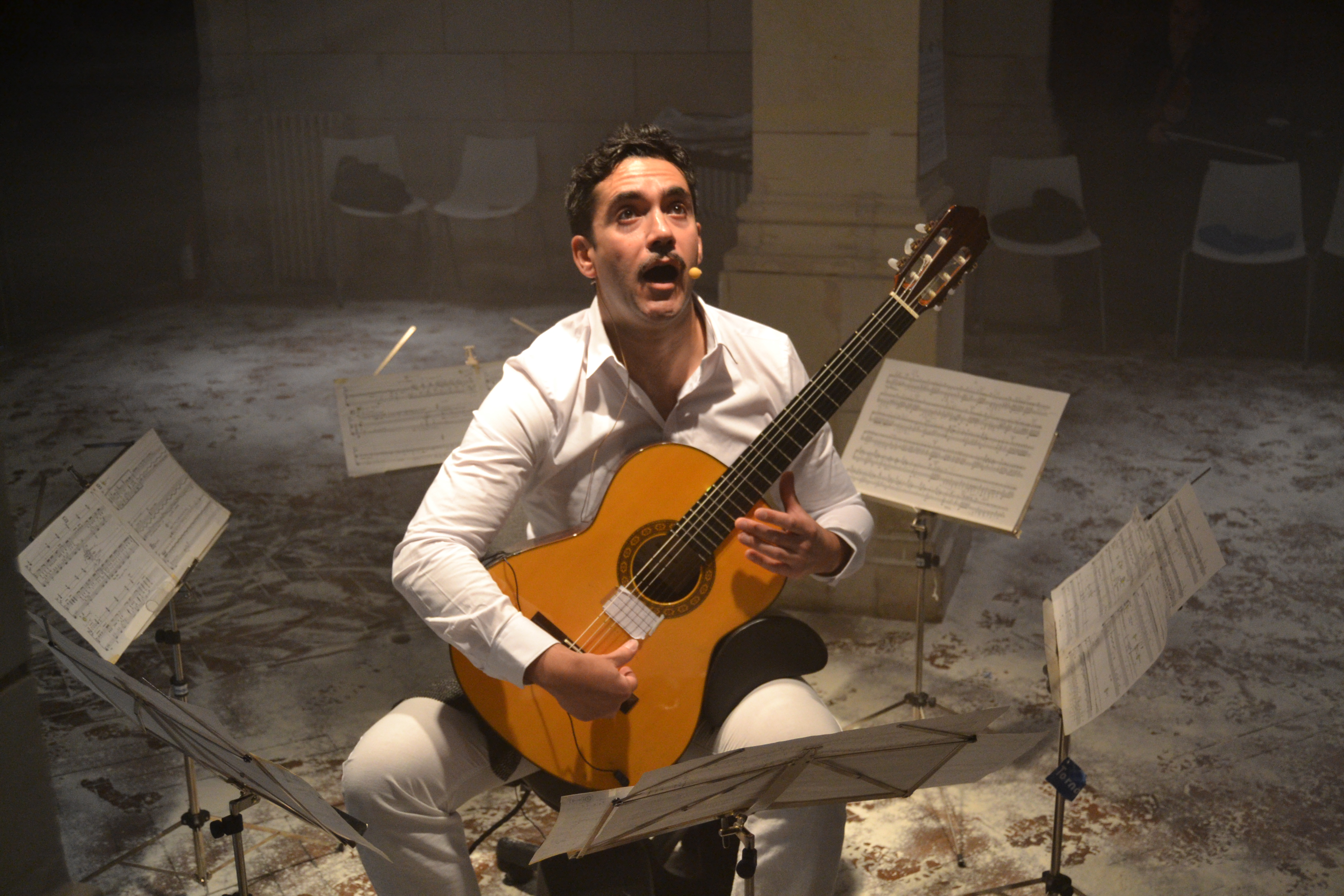
Mauricio Carrasco in Arturo Corrales's BUG. Photo by Gonzalo Garzo Fernández
Mauricio Carrasco in Arturo Corrales’s BUG. Photo by Gonzalo Garzo Fernández

I am very proud to announce that Partial Durations will be covering the entirety of the Bendigo International Festival of Exploratory Music from 5–7 September. Intense and focused, the festival promises to be not just a concert series, but a point of convergence for some of Australia and the world’s finest musical minds. I look forward to seeing you all pedaling around in Mauricio Kagel’s Eine Brise for 111 bicycles, sitting in on rehearsals with the Argonaut Ensemble, catching a rare performance of Stockhausen’s Sirius or milling around installations by Julian Day and Dale Gorfinkel. There are performances by Geneva’s Ensemble Vortex and the Argonaut Ensemble under the baton of Maxime Pascal. Some local favourites will also appear including Golden Fur, Judith Hamann, Zubin Kanga and Anna McMichael. There will be a formidable series of talks and lectures to get you thinking, including legendary musicologist Richard Toop, flautist Eric Lamb and clarinettist Ashley Smith, along with panel discussions on “Duration and Durability” and technology in composition.

For those interested in music writing, I will also provide the festival’s first “fringe event,” a short talk about cultural economy and artistic value in Australian music journalism (but which is just called, given my propensity for naming things (I must never have a child) “The How and Why of Music Writing”). This will take place at the Bendigo library at 10am, Saturday 6 December, before the Wired colloquium. I particularly hope to see you there for some funny stories and (I’ll do my best) penetrating insights.

Partial Durations is a RealTime/Matthew Lorenzon joint project.
So much New Music in RealTime 122

The latest issue of RealTime is brimming with contemporary music. Greg Hooper has reviewed a concert by the hyperactive and hypertalented Syzygy Ensemble for DeClassifiedMusic in Brisbane, including works by Ives, Romitelli and David Dzubay. Hooper has also been able to get along to Kupka’s Piano‘s farewell gig (works by Murail, Eötvös, Lim, Kurtag and Dean) before half of them moved to Belgium and they all nipped over to Darmstadt for a spell. Clinton Green has written on the Liquid Architecture festival, including an interview on sound art with Danni Zuvela and Susan Phillipz. Chris Reid has reported back from a concert of music by Karlheinz Stockhausen composed during May 1968, which was directed by Stephen Whittington at Adelaide University. For the annual music education piece I review Peter Tregear’s essay “Enlightenment or Entitlement.” I also review Inverse Spaces: Elizabeth Welsh and Kim Tan’s concert of spatially-oriented works by Clementi, Scelsi, Nono, Donatoni and Hosokawa.


Corrected: Art Music Award finalists announced

The annual Art Music Award finalists have been announced at a gala event in Melbourne. We can hope to see such contemporary music luminaries as Mary Finsterer, Elliott Gyger, Matthew Hindson, Andrew Ford, Brett Dean and Cat Hope amongst the final recipients. It is great to see some younger artists nominated as well, including Eve Klein, Tilman Robinson and Annie Hsieh. Speak Percussion and Ensemble Offspring have also been nominated.

I am particularly glad to see Gyger’s Inferno nominated, which will be performed by Michael Kieran Harvey in Melbourne next month. Congratulations to all and good luck!


This page has been corrected. A previous version claimed that the winners of the Art Music Awards had been announced. It is of course only the finalists who have been announced.

Partial Durations is a RealTime/Matthew Lorenzon joint project.
Plexus: Medley Recital Series

Plexus
Medley Hall Recital Series
1 June, 2014

Programme:
Jennifer Higdon, DASH
Charles Hoag, SweetMelancholy(lostyourdolly)SlowDragRag
Ian Whitney, Tanzendanses
Iain Grandage, The Keep
Charles Ives, Largo
Paul Dean, Fragmented Journeys

Plexus’ first concert at Medley Hall gives me the opportunity to introduce both a new ensemble and a new venue to Partial Durations. Though new to this site, both have fascinating histories that informed a multifaceted night of contemporary music. Plexus follow the instrumentation of the Verdehr Trio founded in 1972: violin, clarinet and piano. They also follow the Verdehr tradition of commissioning new work for the (now not so) neglected ensemble. The Verdehr Trio commissioned works by some of the most important composers of the late twentieth century, including the well-known Australians composers Peter Sculthorpe and Barry Conyngham.

Now a standard piece of repertoire, Jennifer Higdon’s DASH offered plenty of opportunities for the ensemble to show off. Rushing syncopations between the violin (Monica Curro) and clarinet (Philip Arkinstall) and siren-like rhythmic ostinati in the piano (Stefan Cassomenos) create a charged atmosphere that culminates in hockets between the instruments like the flashing lights of police cars. From the beginning it was evident that Plexus do not hold back, even in a room as small and live as Medley Hall.

After charging the room with this incredible sound, Plexus moved on to an older Verdehr commission: Charles Hoag’s SweetMelancholy(lostyourdolly)SlowDragRag. The piece is absolutely charming, demonstrating a refined compositional culture that plays on tropes and clichés with absolute self-aware mastery. The heads, moments of great jubilation, separate darker, brooding movements.

Iain Grandage provided the ensemble with an excerpt from his opera The Keep, which is partly an attempt to rediscover the folk tales of Grandage’s Anglo-Celtic heritage. Grandage is certainly not the first Australian composer to attempt this reconnection through music (I’m thinking of Fritz Hart and Percy Grainger). Would it be completely amiss to say that we witness this phenomenon at times of great uncertainty about Australia’s future? This is certainly not to say that Grandage shares any of Hart or Grainger’s views, but at times when the contingency of belonging in Australia is laid bare by political or environmental crisis, people start searching inwards as well as outwards for a sense of stability.

Cassomenos, speaking with much character and equal portions of false modesty explained playing Charles Ives’ Largo for violin, clarinet and piano as “like early music.” The funny thing is that Ives’ music can so often sound like the newest thing on the programme. The room really came into its own with this piece. Arkinstall’s perfectly-voiced clarinet line embraced the audience and Curro was able to make the most of the piece’s final, transcendent violin note.

In keeping with the philosophy of the ensemble, the concert included a recent commission by an Australian composer: Paul Dean’s Fragmented Journeys. Originally intended as a joke (is there a more worn-out journalistic cliché than talking about musical “journeys”?), the piece did in fact end up reflecting four journeys that the composer and his friends had variously taken. The first movement, “Fraught,” was particularly welcome as the first example of a “flat” texture in the whole concert. That is to say, the instruments were given equal importance, whereas elsewhere there was generally a principal voice and accompaniment. Here one found a punctum from the piano here, a warble from the clarinet there, or some frenetic scrubbing from the violin. The movement gains momentum, but is spiky from beginning to end, like rolling down a hill of thistles. I think this fits the description Dean provides of the movement depicting “a journey which I just didn’t want to take!” “An Unwanted Disturbance” is really quite iike DASH until the clarinet (piloted expertly by Arkinstall, though you’d want to, playing a piece of Dean’s in front of the man) enters and climbs ever higher and louder. “A Turn for the Worse” depicts a visit to a nursing home, and judging from the creepy piano noodling and see-sawing violin Dean felt a little uneasy from the start. When the booming piano chords and screeching clarinet enter, one knows that the situation only deteriorated. Given these experiences I can only suggest that Dean restrict himself to musical journeys from here on.

Medley Hall could well be the most unique music venue in Melbourne. Since its construction in 1893 on one of the most affluent streets in Melbourne (it was built for the widow of an arms dealer), it has variously been an Arbitration Office, an Italian club (hosting weekly boxing matches), home of a vigneron who graced one of the stained-glass windows with a bullet hole, the set of a Nicolas Cage film and, now, a residential college. Craftsmen and materials for the ornate Victorian Baroque parlor used for concerts, as well as the rest of the mansion, were imported from Italy. Just saying, if you are looking for a space for your next chamber music concert, Medley would be a great place to start. As to Plexus, I can only look forward to their next forty years of activity.


Partial Durations is a Matthew Lorenzon/RealTime joint project.

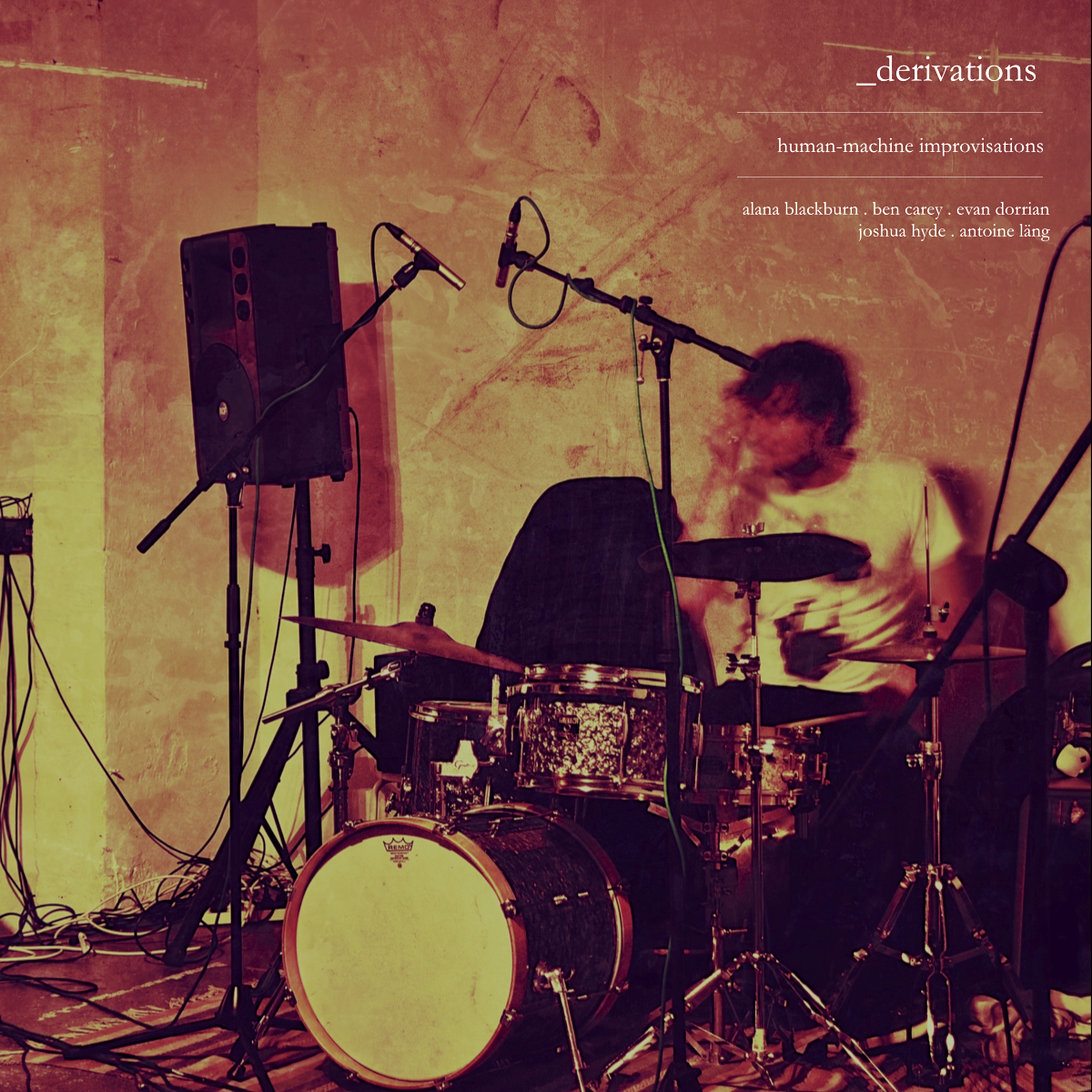
Benjamin Carey et al.: _derivations

_derivations cover. Image courtesy of the artist.

Benjamin Carey, Alana Blackburn, Evan Dorrian, Joshua Hyde and Antoine Läng
_derivations
Integrated Records

Encounters between computers and improvising musicians can be overwhelmingly one-way. The instrumentalist begins playing. Their sound is recorded, transformed and spewed back into the space. A secondary level of input, in the form of buttons or foot pedals, allow the performer to trigger pre-programmed transformations. To minimise the disturbance of controlling the system, a second performer may operate the signal processor. How can an improvisational logic be programmed into the computer itself? How can a signal processing system not just play back to, but play with an instrumentalist? These are some questions that Benjamin Carey asked when he started working on the _derivations system in 2010.

The _derivations system analyses a musical performance in real time and creates a database of musical gestures based on that performance and, if the performer wishes, on previous performances as well. As in “traditional” electroacoustic improvisation, the program’s response is to transform and play elements of the recorded performance. Carey’s innovation is in the semi-autonomous actions the program makes in response  the live performance. _derivations tracks both the volume and spectral content of a live phrase. The statistical reduction of this phrase is then stored for comparison with later phrases and also for comparison with the phrases that _derivations itself plays. _derivations can respond through several channels or modules at once and all of these channels are listening to each other, generating results that are truly difficult to predict and so, from the performer’s point of view, semi-autonomous. Like a live performer, the modules are also conscious of when other modules are playing and so play in a broadly contrapuntal manner. _derivations can therefore “play with itself” without the performer playing at all.

What influence does the performer have in programming the system before the performance? The performer chooses a range for the lengths of phrases _derivations plays and also for their frequency of overlapping. This overlapping or density can also vary throughout a performance according to a preset trajectory.

The results, six of which have been recorded for Carey’s new album on Integrated Records, are remarkable in expanding the often linear and binary (multiply the same sort of sound as the performer or contrast starkly) of improvising laptop artists. The sessions feature drum-kit, recorder, saxophone and voice alone or in ensembles, performed by Alana Blackburn, Evan Dorrian, Joshua Hyde, Antoine Läng and Carey. They are miniature snapshots of rich sonic worlds, like intricate landscape dioramas. “Tactility” uses a library of sounds of a recorder, contrasting trills, low portamenti, flutter tonguing, melodic flurries and humming fields of sound. Without being able to see the performer and with the relatively restrained range of the digital sound transformations,  it is sometimes difficult to tell the system’s contributions from those of the performer. There is an insect-like autonomy-within-limits to the improvisations, which are constantly piquing the ears with new and only-just-unexpected sounds.

None of the recordings are longer than ten minutes and they give the impression that the program has a fairly static formal imagination. It is clear that the program treats the statistical data of each sample like a “point” or “molecule” in its system, much like the first serial composers. It would be great to hear the program extended to achieve a “molar” level of autonomous, large-scale organisation that might count the equivalent of one track of _derivations as a unit in itself.

You, too can have a play with _derivations here.

Partial Durations is a Matthew Lorenzon/RealTime project.

Austin Buckett: Grain Loops

Cover of Grain Loops by Austin Buckett. Image courtesy of artist.

Austin Buckett
Grain Loops
Room40
Album review by Henry Andersen

Anything repeated enough times comes to seem different. When a scratch on a vinyl record creates a locked groove, the resultant loop of sound pulls itself away from the normal tension and release of the music around it. The natural choreography of the stylus is disrupted. (Imagine the stylus as Sisyphus pushing his boulder up the hill, only to have it fall back down each day. In this moment, Camus will tell us, “[o]ne must imagine Sisyphus happy.”) If you’ve ever left a locked groove playing for some time, or fallen asleep to the clicks and pops of a stylus on the cardboard centre of an LP, then you’ll know that there is joy to be found in stripping away the narrative function of music and letting it go nowhere for a little while.

Grain Loops is the latest LP from Sydney based composer and sound artist Austin Buckett. Though the album is released on vinyl, the loops from which it is constructed are digital, not analogue. That is, they have been made by cutting and repeating digital waveforms recorded by Buckett during a residency in Banf, Canada.  All of the recordings are made by passing sandpaper over the surface of four snare drums. This techniques is a favourite of Bucket’s, for the rich variation in noise colour that it can create. In most circumstances, the detail of this coloration would pass unnoticed but on Grain Loops with each snippet of sound bracketed by repetitions of itself, the finer details of the sound (call them grains if you like) suddenly become magnified. Hear that filter-like effect in the left channel? no? listen again. and again. and again.

The album’s drive to repetition is carried by its macro-structure as well. There are a total of 30 tracks – each track lasts for exactly one minute and is made of one loop (of around 1-5 seconds) repeated to fill its allotted, one-minute bracket. The decision to have each track last one minute seems quite arbitrary (for me it could have been longer) but the decision to keep each track at equal proportions to its neighbours is vital. Even as the sonic qualities and groove of each track change, the essential concept is repeated – like 30 manifestations of a single idea or 30 photographs of a single object. You could think of the form of the whole album as something like a ‘theme and variations’ – only without the theme. The album doesn’t have an ‘original theme’ in any traditional sense (proven by the fact that the album’s tracks could easily be shuffled without upsetting the form). If there is an ‘original theme’ it is the concept and it isn’t heard so much as it is hinted at by the common factors that span each variation.

If there is a chance to escape modernism’s morbid obsession with progress, it is through repetition. Anything that loops back on itself can’t be moving foreward. We can forget that grand narrative for a little while and just enjoy the feeling of going nowhere (what could be more comforting, and more endless, than the sound of windscreen wipers in a  storm?). As each track of Grain Loops plays, even as we know it will only last a minute, it feels like it could play forever – has played forever. It seems to stretch past the horizon in every direction. And then, all of a sudden, we are back where we started – with Sisyphus, the stylus and the locked groove. Anything repeated enough times takes comes to seem different…

By Henry Andersen

Partial Durations is a RealTime/Matthew Lorenzon joint project.
Speak Percussion: 8th Taiwan International Percussion Convention

Speak Percussion
8th Taiwan International Percussion Convention
National Concert Hall, Taipei
27 May 2014
Review by Alistair Noble

Program:
Thomas Meadowcroft, Cradles
Anthony Pateras, Hypnagogics
Matthew Shlomowitz, Popular Contexts Volume 6
Simon Løffler, b

The Taiwan International Percussion Convention is a triennial event begun in 1993, the creation of Ju Tzong-Ching and supported by his own ensemble, the Ju Percussion Group. In 2014, the 8th iteration of the convention hosts 10 ensembles and 10 soloists from 14 countries around the world. The convention is titled ‘Taiwan’, rather than ‘Taipei’ for good reason, as it aims to bring percussion performances to venues around the island over a 10 day period, with the international and local performers undertaking tours to venues in Taipei, Taichung, Tainan, Kaohsiung, Hsinchu, Yilan, Changhua, Chiayi and Taitung. In terms of organisation, logistics and finance, this is a monumental undertaking, a music festival that has moved beyond the local to operate on a national front. Certainly, it serves to illustrate the extraordinary commitment and energy that can sometimes be brought to artistic endeavours in Taiwan, and the size of audiences seems to indicate that the convention organisers have been able to tap into a deep well of support at the community level.

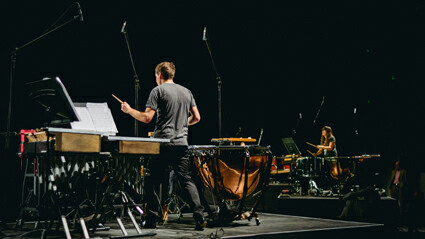
Among the international guests at the 2014 convention are Speak Percussion from Melbourne, represented for this performance by Eugene Ughetti (artistic director), Matthias Schack-Arnott, Leah Scholes, and lighting designer Travis Hodgson. Australian fans will know this group for their polished and dedicated performances of works by contemporary European and Australian composers in particular. It is satisfying to see the group, with its flexible ensemble membership, making a strong impression at major international events like TIPC and MaerzMusik in Berlin.

Speak Percussion are more than just a virtuoso ensemble. They display a lively good taste in repertoire, and a strong commitment to the communication of their love and fascination for this music. They have a distinctive style of performance, combining a genuine jouissance with an unassumingly Australian theatricality, that brings to life even music that might seem alarming or pretentious in other hands.

In the cavernous space of the National Concert Hall in Taipei, I worried that the ensemble would be somewhat overwhelmed by the scale of the architecture, and that the audience might be small. On both counts, my fears were proven wrong. The hall filled rapidly with a large and enthusiastic audience, and the ensemble quickly took control of the stage and compelled attention by simply sounding terrific. Travis Hodgson’s lighting effectively transformed the gigantic space into something psychologically more intimate, with the performers lit only by narrow spotlights and the auditorium otherwise in complete darkness. A group of catholic nuns occupied the row in front of me—contemporary music fans? Or aunts and cousins of the convention organiser? I imagine them having a percussion ensemble in the convent and rehearsing Ionisation after Matins.

The concert opened with Thomas Meadowcroft’s Cradles (2013), a wonderful piece for two percussionists and Wurlitzer e-piano. The beautiful, chilled-out sound of the Wurlitzer (played by Leah Scholes) is the foundation for a work that contains a wealth of brilliant details. The two percussionists make use of a great raft of instruments, including finger cymbals, plastic castanets, Japanese toy drums, small shell chimes, medium shell chimes, a cluster of small Korean bells, and Chinese bells. The main work for the duo, however, is in playing the two reel-to-reel tape machines—pulling the unspooled tape by hand through the machines to create a complex and varied music of gurgles, rattles and chirps that is exhilarating and expressive, amusing and richly colourful. It’s as though Gregor Samsa (the post-rock band, not the character in Kafka’s story) were collaborating with 1950s Stockhausen, which is to say that Meadowcroft’s distinctive music is both intelligent and gorgeous. You can hear a recording of another performance of the work here.

Hypnagogics (2005), an 8-minute piece for a solo percussionist by Berlin-based Australian composer Anthony Pateras, is a richly rewarding, almost symphonically-textured work. This is surprising in some ways because the score calls for a carefully limited range of ultra-high pitched ‘micro instruments’—tiny little pits of wood, metal, skin, ceramic and glass—together with tinnitus (actually pre-recorded high-pitched electronics). This arresting palette of sounds becomes slowly more sinister as the music progresses, and then finally simply captivating. It is a clever and finely-crafted piece that rewards repeat listening. Matthew Shlomovitz spoke at Darmstadt in 2012 about the relation between musical material, and the engaged process of composing with, or investigating that material, proposing that ‘[o]ne way in which music might become critical is through investigating its own substance’. Pateras’ Hypnagogics would serve as a fine example of this notion in theory, except that the reality of the music is so much more than this. Eugene Ughetti, as the soloist, gave a brilliant and compelling performance. Have a listen here.

Matthew Shlomovitz’s four-movement suite Popular Contexts Volume 6 (2013), is a work for drum kit, vibraphone, midi keyboard and laptop (i.e. samples). It started very promisingly, rocking along happily. The nuns in front were tapping their feet and nodding appreciatively. And it continued more or less like that, for four inscrutably shapeless movements. It is fun music, and I really wanted to like it, but despite an excellent, energetic performance, something just doesn’t feel right. In another context, I might love it: it would be perfect music for a nightclub—a hip, glossy, fashion-magazine kind of bar, where you and I could sit in the corner and drink, watching the rich gangsters and the smart models. Or it might be a movie soundtrack–the scene set it in the same bar, overlooking the bay in Hong Kong, with John Travolta as a Russian oligarch who always wears dark glasses because he’s actually a vampire (you knew that, right?), drinking excellent, icy vodka to match his fine suit.

Like even the best movie soundtrack, however, this music is a bit long-winded and tedious in concert. It is stylish and cool (in a slightly irritating way at times), but ultimately insubstantial. As the piece wore on, the nuns withdrew into a more meditative state, perhaps saying some quiet rosaries or simply praying for it to stop. It would have sounded better if we were drunk. Get me a vodka.

The concert finished with a work titled simply b (2002) by young Danish composer Simon Løffler. Scored for three musicians, three neon lights, effect pedals and a loose jack cable, this might at first seem like a daft idea for a piece—but it sounded wonderful. The players knock out complex rhythms on the effect pedals while the loose jack cable. . . well, it does what loose jack cables do, crackling and humming, and the blinding neon lights flicker on and off in the darkened auditorium generating electro-magnetic interference (sometimes magnified by the performers grabbing hold of the lights and each other to make a direct-circuit contact). It is a thunderously exhilarating, dangerous piece, with a powerful theatrical element. In addition to the superficial thrills, on a deeper level the work is a superb critique (in the sense of compositional investigation) of some unlikely materials. The nuns were perched on the edge of their seats, eyebrows bristling with excitement and electro-static energy.

Alistair Noble

Speak Percussion are also performing:

7.30pm, 30 May 2014
Chiayi Performing Arts Center, Chiayi, Taiwan, R.O.C.

7.30pm, 31 May 2014
Performance Hall of Cultural Bureau, Hsinchu County, Taiwan, R.O.C.

2.30pm, 1 June 2014
Yuanlin Performance Hall, Changhua, Taiwan, R.O.C.

http://speakpercussion.com/


Partial Durations is a RealTime/Matthew Lorenzon joint project.