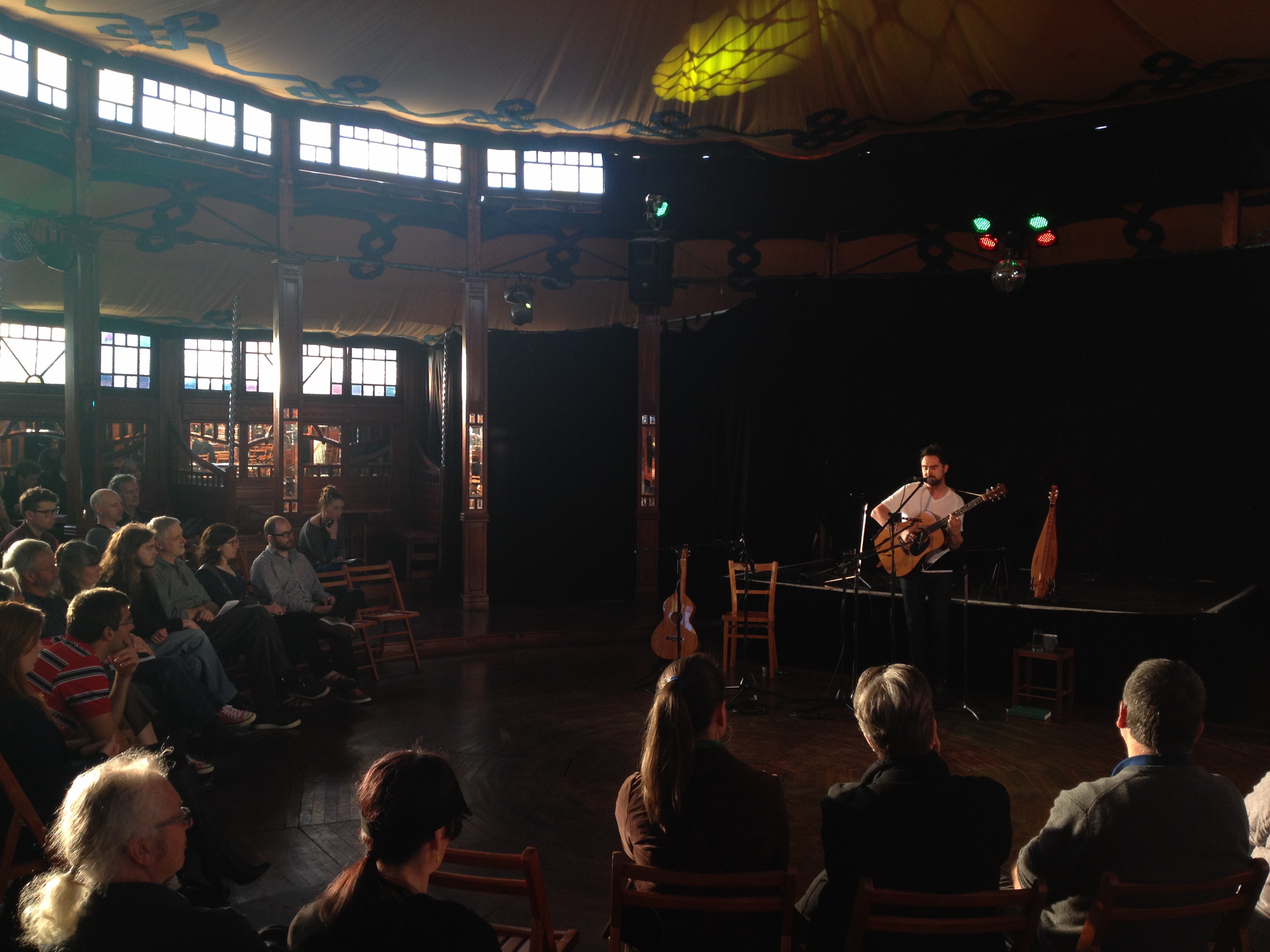
Chris Rainier at the “Melba” Spiegeltent. Photo by Matthew Stanton
Chris Rainier
I was a Bum Once Myself: The Boxcar Revelations of Harry Partch
Wonderland Spiegeltent
17 November, 2013
It just so happens that the quickest way from my house to the Wonderland Spiegeltent is the Capital City Bike Trail. The path winds alongside the weeds and algae of Railway Canal, through the underpass with its collection of burnt-out sofas and past the humming towers of the electricity substation. Dark tunnels “subject to flooding” dip under weirs before spitting you out at a six-lane freeway crossing: the mouth of the Melbourne Docklands. The Docklands are a monument to the hubris of Melbourne’s property boom, having little to show for a decade of furious development but a warren of empty apartment blocks and shopping precincts blaring music to nobody. Nowhere is the emptiness felt as keenly as Wonderland, the tiny amusement park wedged between the Melbourne Star (a gigantic ferris wheel built to rival the London Eye, but left motionless since buckling in the summer heat in 2008) and Costco. I could not imagine a better venue for Chris Rainier’s resurrection of the music journal Harry Partch kept while homeless in 1930s America.
Today Partch is best known for his experiments in microtonal tunings and adaptation of instruments to divide the octave into 42 microtones. As in many ancient and non-Western cultures, Partch did not use the extra tones as discrete pitches, but to add nuance and alter the temperament of his otherwise tonal and modal music. In order to perform Partch’s works, Rainier enlisted the help of Preston-based luthier James Mumford to re-fret an acoustic guitar in the style of one of Partch’s early modified instruments.
The altered tuning and fretting of Rainier’s guitar allowed him to reproduce the songs and speech patterns jotted down by Partch on his travels. Partch was studying “hobo speech” as opposed to art music speech and in doing so provided a remarkable document of his time. In “Eight hitchhiker’s inscriptions from a highway railing in Barstow, California,” Partch sets the haiku-like narratives of down-and-out life to his own jagged, colouristic guitar accompaniment. It’s fascinating to think of that ephemeral graffiti about handouts, joblessness, sex, hunger and humour making it all the way to the Dockland streets, which, though empty for different reasons, may serve as portents of depressions to come.
While many people are familiar with Partch’s combination of notated declamation and sparse accompaniment, few know that he also wrote pop songs for money in the late 1920s. Rainier began the concert with “My Heart Keeps Beating Time,” a lilting tune from 1929 that wouldn’t have been out of place crooned over the radio. Rainier used this tune as a thread throughout the concert, performing its 1935 revision as a precursor to his affecting performance of Partch’s “Letter from Hobo Pablo.”
Diary fragments read throughout the performance painted the portrait of a peculiarly self-pitying man at once bemoaning his condition and his traveling companions while reveling in his isolation and proclaiming that “life is too short to spend time with important people.” Partch never seemed to lose this obnoxious, almost adolescent anti-establishment posturing, proclaiming his distance from Western music while using its oldest modes and his ear for a good hook. It is to Rainier’s credit that he was able to present such a three-dimensional image of the composer. Rainier’s soulful performance of these little-known works by Partch is the most engaging and seamless combination of research and performance I have ever witnessed on a concert stage.
Partial Durations is a Matthew Lorenzon/RealTime joint project.
Bodhasāra, Chronology Arts & New Music Network. Photo Hospital Hill
Over at RealTime Keith Gallasch reviews Chronology Arts’ new project Bodhasāra, featuring new works composed by five Australian composers on Hindu texts.
Partial Durations is a Matthew Lorenzon/RealTime joint project.
Wednesday 11 December: Kynan Tan‘s installation Perspectives [macro] continues at Free Range Gallery, Perth. Tan uses self-constructed computer programs to develop audio-visual material derived from data sets, archived footage, computer-generated imagery and synthesised sound. Installation continues until 14 December.
Friday 13 December. Kim Tan, Lizzy Welsh, Alexander Garsden and Peter de Jager perform Oscillations, their first concert collaborating on contemporary works for baroque instruments. Northcote Uniting Church, Vic, 7:30pm.
Saturday 14 December: Speak Percussion’s artistic director Eugene Ughetti performs a concert of solo works by Australian composers Liza Lim, Anthony Pateras, James Rushford, Thomas Meadowcroft and Alex Garsden at the Melbourne Recital Centre Salon, 6pm.
Monday 16 December: The newly-formed contemporary classical music and performance ensemble Cathexis (a bit of a super-group featuring Peter de Jager, Matthias Schack-Arnott, Callum G’Froerer, Lina Andonovska and Renae Shadler) perform works by Liza Lim, James Rushford and Australian premières of works by Cecilia Arditto and Stephen Feigenbaum. Fortyfive Downstairs, Melbourne, Vic, 8pm.
Partial Durations is a Matthew Lorenzon/RealTime joint project.
Wednesday 4 December. Margaret Cameron‘s Opera for a Small Mammal plays at La Mama, Carlton, Vic, at 6:30pm. I shall just reproduce the fine summary below:
Scraps of The Faerie Queen, Henry Purcell’s 1692 operatic adaptation of A Midsummer Night’s Dream, resound. Regina Josefine del Mouse lives in the theatre, in the castles and forests of dramatic literature. She is the Mouse Queen. Her tail glints with thieveries from philosophy, Franz Kafka, Lewis Carroll, Beat Poet Michael McClure, Gertrude Stein and other scholarly bits and pieces. Her dominion is the lowercase letters of art (not the uppercase citadel of Art) and Her audience is the community of Mouse People who live in the dark behind the scenes. With an Elizabethan extravagance and classical economy, depending upon the musical and rhetorical powers of poetry, huffing and puffing theatre-dust from the questions of self and Art, She issues a decree on the artistic nature of Matter.
The Song Company perform Christmas songs by Ross Edwards and Christopher Willcock at the Melbourne Recital Centre, 6pm.
Sound artist Kynan Tan‘s installation Perspectives [macro] continues at Free Range Gallery, Perth. Tan uses self-constructed computer programs to develop audio-visual material derived from data sets, archived footage, computer-generated imagery and synthesised sound. In this installation Tan explores the concept of a massive network of singular points as viewed from a singular perspective. The idea that constantly and unendingly, each individual within any given network or system is at once exerting and receiving a gravitational force in space-time on each other point within the system. Continues until 14 December.
Thursday 5 December. Forest Collective perform Evan Lawson’s second opera Calypso at the Rosina Auditorium, Abbotsford Convent, Vic, from 7:30pm. Performances also on Friday 6 December at 7:30pm and Saturday 7 December at 5pm and 8:30pm.
Warren Burt, Stelarc and Paul Doornbusch participate in a panel discussion on “Tone Scientists: Sound art and cutting-edge science” at West Space Gallery, Vic, at 7:30pm as part of the More Talk, Less Action series curated by Greg Wadley.
Friday 6 November. Marcus Whale curates a night of pop-performance art and experimental sound works at Firstdraft Depot, NSW, from 7pm. Entry fee of $5 comes with a free sausage.
Saturday 7 December. Miriam Gordon-Stewart performs a programme of early twentieth-century repertoire at Scots Church, Melbourne, at 7pm. With recitations from the journal of her grandmother Eileen Robbins by Susan Bullock.
The Grevillea Ensemble perform a new song cycle based on poems by Percy Bysshe Shelley by Katia Beaugeais at The Flute Tree, Leichhardt, NSW, from 3pm. Composer’s talk at 2:30pm.
The musics of Peter Sculthorpe, Brenton Broadstock, Ross Edwards, Paul Grabowsky, Iain Grandage, Stuart Greenbaum, Maria Grenfell, Matthew Hindson, Elena Kats-Chernin, Graeme Koehne, Paul Stanhope and Nigel Westlake have found their rightful place in a recording designed to lull children to sleep. Hear the Tasmanian Symphony Orchestra launch the remarkable recording for the Hush Music Foundation at the Federation Concert Hall, Hobart, 7:30pm.
Partial Durations is a Matthew Lorenzon/RealTime joint project.
Songs for Robbie
Saturday 7 December
Scots Church, Melbourne
Miriam Gordon-Stewart, soprano
Kate Golla, piano
With readings from the memoirs of Eileen Robbins by Susan Bullock
Berlin-based soprano Miriam Gordon-Stewart took a break from singing Sieglinde in The Ring to discuss her upcoming recital at Scots Church, Songs for Robbie.
There have already been some excellent interviews on your upcoming recital Songs for Robbie in Limelight and on The Music Show, but could you please tell us again how you found the memoirs of your grandmother Eileen Robbins?
I knew that Gran was doing some writing when she was about eighty. She lived to 101, so this was quite a long time before she died. My mother thought it would be good for her because she was physically quite incapacitated. She couldn’t stand up or walk very easily, she had quite bad hearing throughout her life and her vision was going, but her mind was still extremely active. My mother said, “Why don’t you write some things? You’re a lovely writer, write a journal.” I didn’t hear much more about it and never saw any evidence of it. But when I was in Australia about a year ago I was locked out of my brother’s house and he sent me a text saying there was a spare key in the shed (I won’t tell you where he lives, because then you could break in). So I went looking for the key and in the process found a box labelled “Gran’s stuff.” I opened it up and the memoir was in there, a manila folder containing foolscap papers written in fountain pen.
Did you immediately grasp the significance of the document?
I thought I’d read it because it could be fun, but then I realised it was a full-scale memoir. It is incomplete, covering only birth until her mid-twenties, so 1906 until the early thirties, but the detail of that period is extraordinary. As with many older people, her memory of that period was more sharply in focus than what happened yesterday. She could remember the names of eight of her neighbour’s siblings, what they used to wear and the conversations they had. She has a beautiful natural writing style, but also the historical period it covers is fascinating: Two World Wars and the transformation of the small village where she grew up into a larger village and then a town. Langley used to be a very small village and is now more a part of Slough. I thought it a really important historical document.
I thought, since we already know a bit about your grandmother’s audition at the West End and her experience singing at military hospitals from the earlier interviews, we could talk about the music you have chosen to perform in your recital. How did you go about finding music to go with this memoir?
It went the other way around actually. I always had it in mind to do something with the memoir, but I didn’t know what. I decided to do a recital during this period and it just happened that I wanted to do repertoire from the early twentieth century. There’s a bunch of things that I’ve wanted to do for ages. Whenever anyone who is into recital repertoire has heard me sing they’ve said, “You have to do the Berg Early Songs.” Knoxville: Summer of 1915 by Samuel Barber is basically every American singer’s favourite piece. People aren’t as familiar with it here, but I think they see its value as an extended reverie about a time and place. Viktor Ullmann is a composer who has not been performed much in Australia at all. His Sämtliche Lieder album was published relatively recently. His compositions are broken into several periods, firstly when he was in Vienna with Schoenberg and Zemlinsky and learned amazing things about writing for the voice, as all those guys did, then he went to Prague and was working in the Prague opera. He was then transported to the Theresienstadt ghetto, which I visited over the summer, and he wrote a lot of music there, as well as performing it and writing criticism in the prison camp. His writing style, understandably, then became way more complex and his poetry became a lot darker. It’s incredible music and I think people will really respond to it.
And a work by Margaret Sutherland?
The Sutherland was disappointingly difficult to get hold of, but I found the music to be really stunning. She wrote a series of songs to the poetry of John Shaw Nielson. I don’t know if people study him in school now, I certainly didn’t, but I would consider him Australia’s wartime poet. Everything I have read is extraordinary, beautiful, pastoral. He grew up in rural South Australia and was a working man building roads and writing poetry in his spare time. He’s our Auden, basically. I wanted something Australian because I wanted to represent a few different perspectives from that period, especially during the war. So we get an English, an American and an Australian perspective.
Would your grandmother have sung any of this repertoire?
No, she had singing lessons, which, from the descriptions in her memoir were really excellent singing lessons, but classical training was not a part of her culture. I guess people may have been studying with instrumental teachers who just happened to live in her town, but her life revolved around the church and around fundraising for the hospital and various other charitable circles, so most of the time she was studying with someone from the church. She learned to sing hymns and was then introduced to music hall repertoire, which she loved. She loved singing the bawdy stuff and entertaining soldiers. She auditioned for a West End show and could have gone down a whole other path. I thought of programming some of that repertoire, but ultimately I don’t love it when classical singers do recitals of repertoire that comes from another technical place. I don’t think anyone wants to pay to hear me sing musical songs. I think I have something else to offer in a recital.
Some of the repertoire, such as the Barber and Sutherland, is retrospective as well.
You have described elsewhere the profound emotional effect on your grandmother when she learned to focus on communicating the meaning of the text when singing and that you have also had this experience. Are there lines of text in these songs that you particularly enjoy singing?
Definitely Barber’s Knoxville. It is a story. It is somebody sitting on a porch and reminiscing. They are carried back to childhood and are a child again at certain moments, but with an adult’s perspective on childhood as well. It is almost too painful to sing. I have spoken to other singers about this, who say, “I’m going to be a mess when you sing it.” There is one phrase in particular which breaks everybody. It’s like the final scene in Die Walküre. It took me ages to be able to sing it because it means so much. The poet, James Agee, talks about this feeling at the end of the day in Tennessee, though it could be Melbourne or Adelaide where I grew up just as easily, where your parents are spreading quilts on the grass that has started to go damp and you’re sitting out on these quilts talking about nothing. He says, “my father has drained, now he has coiled the hose” and I thought “oh yes, the necessity of coiling the hose,” I think that is something every Australian kid can remember. Little things like that transport you back. Of course you have to go back there when you are rehearsing and you think “I have to cut the piece” because you are sobbing every time, but once you transcend that and get yourself out of the way, then it becomes very special, it becomes for the audience and not just self-indulgence.
Are all of the songs about remembering in one way or another?
No, they are not all about memory. Some of the Berg are and some of the Ullmann are, but others are about questioning the nature of existence. One of the Ullmann songs begins, more or less, with the question “What is life all about?” For me, that’s less about childhood memory than it is about humility. How do I sing this song as a middle-class Australian woman who has never been forced to question whether she is going to live another week? We probably all should ask this question, but I have never been forced to. But he wrote the song for a female voice and art outlives its circumstances, so how do you go about that knowing the situation that he was in? Having had a very visceral experience of where he was when he wrote it, which, to this day radiates such evil that I couldn’t even open the car door to get out and look at it.
So there is a juxtaposition of remembering the past and questioning the future from that time. This seems entirely appropriate for a Ring month. And several times in your grandmother’s life she would not have known what would happen next week.
Yes, I think dreams became more short-term. This is why I am hesitant to say that my grandmother’s wildest dream was to become a famous opera singer. I don’t think that was an option for her. It was a moment in time in which a door opened for her that could have led to another life. Then it closed, so it was just enough for her to lurch momentarily in that direction. But that sense of “well, if I work hard enough I could work my way out of my circumstances,” that probably didn’t exist as much back then. If the circumstances as a whole changed, with unionisation, development, if jobs were created for you, or another war provided your father with employment for a time, then your circumstances changed, but she was a very working class girl at that time and couldn’t change her situation much through sheer effort. Inasmuch as she could, she changed other people’s circumstances a lot by singing in concerts, raising money, writing to aristocracy, getting cheques. She was as effective as a woman could be.
Dreams were shorter-term and more essential: I want enough to provide for and have a family. Maybe I want to meet someone I can love. I want to be a good Christian. But these things come full circle and maybe we are going back to that now. I really hope we are. The move towards localisation may move towards a change in dreams. Maybe people won’t hope for world domination, but want a farm and make goat’s cheese.
Says the opera singer flying in from Berlin.
I’m not part of your generation. I’m still clinging desperately to my hedonistic dreams with bloodied stumps for fingers.
Partial Durations is a Matthew Lorenzon/RealTime joint project.
Thursday 14 November. The ACO perform Rautavaara’s A Finnish Myth and a new work by G. Fröst at Newcastle City Hall, NSW, 7:30pm. Repeat 17 and 18 November, The Arts Centre, Melbourne.
Friday 15 November. Ensemble Offspring and percussion soloist Claire Edwardes perform an immense programme of works by John Luther Adams, Larry Polansky, John Zorn, Chris Adler, Bryn Harrison, Richard Pressley, Nicholas Peters, João Oliviera, Elena Kats-Chernin, Erik Griswold, Kate Moore, Jane Stanley and Matthew Shlomowitz at the Campbelltown Arts Centre, NSW, 8pm.
Saturday 16 November. Luke Howard presents “Sun, Cloud” at Conduit Arts, Fitzroy, Vic, 9:45pm.
Sunday 17 November. Chris Rainier performs works by Harry Partch, the Wonderland Spiegeltent, Docklands, Vic. 7pm.
Monday 18 November. Syzygy Ensemble perform Mantovani, Gordon, Cashian and Norman at 6pm. Melbourne recital Centre, 6pm.
Callum G’Froerer presents his final ANAM fellowship concert including Morton Feldman’s “The Viola in My Life” and works by Cat Hope, Eres Holz and Luciano Berio at the Northcote Uniting Church, Vic, 7pm.
Partial Durations is a Matthew Lorenzon/RealTime project.
Arcko Symphonic Ensemble
X-ray Baby
Northcote Town Hall
2 November 2013
Framed by the quirky trompe-l’oeil interior of the Northcote Town Hall, X-ray Baby is a testament to the Arcko Symphonic Ensemble’s philosophy of performing new works by its own members, re-presenting old works from its own repertoire and giving previously premiered works a new lease on life.
Most new orchestral works are never heard beyond their premiere due to the prohibitive cost of convening a large ensemble. Composers, audiences and critics alike risk a shallow appreciation of these nuanced compositions and—unless something goes astonishingly wrong or right—judging individual performances is difficult. Arcko are committed to remedying this situation by giving new large-scale works a second hearing. If a second hearing helps audiences and performers better understand a piece—to hear what has stayed the same—it also provides an opportunity for audiences to tune into what has changed around the piece since its last performance.
Of all the orchestral works premiered in Melbourne recently, Annie Hsieh’s Icy Disintegration is probably the least in need of repeated performance to be understood. The piece is explicitly programmatic, rallying swelling tam-tam rolls, blaring brass sections and shimmering strings to paint the serenity of the Ross Sea, the appearance of cracks and fissures in the Ross Ice Shelf, the immense calving event that produced B-15 ( the largest free-floating object in the world), the break-up of the iceberg into smaller bergs and floes and a scene of nostalgic calm. But never has a piece sounded so urgent in the Northcote Town Hall. Recent reports from the Intergovernmental Panel on Climate Change and the United Nations Environment Program have reiterated what we have known for a long time now—that there’s a rather high chance the climate is warming helped along by human-caused carbon emissions—with the addition of some startlingly short time frames for urgent action to avoid widespread, catastrophic damage to human and animal life. With a binding international agreement on carbon emissions unlikely to be reached any time soon, Hsieh’s earsplitting timpani and brass calving event sounds more like the projected cries of hundreds of millions of climate refugees. Her racing, diverging string “fissures” mimic the current political prevarication around this fairly reliable threat to civilisation. But anyway, Hsieh is being bombastic because, as everybody knows, most of the lost ice actually silently melts away from underneath the Antarctic ice shelves.
From the global to the minuscule, Kate Neal’s Particle Zoo II draws inspiration from the mysterious world of subatomic particles. Like the scientists at CERN researching the Higgs boson, composers know that notes cannot easily be reduced to a single point on a page. A note is at once a a point and an envelope of different characteristics. Neal plays with this ambiguity in Particle Zoo II, contrasting a pointillistic piano part with legato accompaniment in the chamber orchestra. The consonant orchestral texture of polyrhythms and arpeggios provides a space within which the virtuosic solo piano (performed by Joy Lee) wanders. Short, tumbling lines and small clusters provide a dazzling array of clashing musical trajectories. The effect would have been improvised or speech-like were it not for Lee’s poise and concentration, which left no doubt that she was dealing with a challenging and precisely notated score.
In Caerwen Martin’s X-ray Baby performers are asked to interpret graphic scores based on x-rays and ultrasounds of her baby. An episodic construction made the pocket-sized piece a gratifying study in graphic score interpretation. Sul tasto string glissandi conjure the curves of the womb and foetus in an ultrasound. Key clatter and toneless breath from the winds and brass sounds like static interference in the image. Trilling glissandi sound like a nausea I shall never experience and a climax on tam-tam leaves behind a single, pure flute tone. The ensemble evidently enjoyed playing—and playing with—a work celebrating an important event in the life of one of their fellow players.
Partial Durations is a Matthew Lorenzon/RealTime project.
Friday 8 November. Aurora New Music presents Global City at the Joan Sutherland Performing Arts Centre, Penrith, NSW, 8pm.
Saturday 9 November. The Melbourne Composers’ League present a concert of works by Andrián Pertout, Maria Grenfell, Brendan Colbert, Paul Moulatlet, Eve Duncan and Haydn Reeder. Trinity Uniting Church, Brighton, 3pm.
Topology and Speak Percussion “get together over the Cuban Missile Crisis and throw a bunch of genres into the blender” at the Brisbane Powerhouse, 7:30pm.
Brett Dean‘s Ariel’s Music for solo clarinet and orchestra will be performed by the Tasmanian Symphony Orchestra alongside Bruch’s Concerto for viola and clarinet featuring Paul and Brett Dean as soloists.
Sunday 10 November. Percussionist Claire Edwardes presents a series of new works for solo percussion commissioned from Peter McNamara, Erik Griswold and Matthew Shlomowitz. Campbelltown Arts Centre, NSW, 2pm.
Jenny Barnes, Ren Walters and Niharika Senapati show off their incredible semi-improvised vocal, guitar and dance skills at Longplay bar, Fitzroy, VIC, at 7:30pm.
The Astra Chamber Music Society (cheers all round) present works by Lawrence Whiffin, Dan Dediu, Martin Friedel, Graham Hair, Keith Humble and Helen Gifford with Craig Hill at the North Melbourne Town Hall, 5pm.
The third issue of Sydney-based contemporary arts magazine World’s Only provides an intimate window into the lives and practices of artists, composers, bands and producers.
Horse MacGyver, introduced as “one of the most elusive musicians on the internet,” speaks to Cormack O’Connor through vocal distortion and ponders the motives of self-destructive rock idols, emotion and innovation in programming and how terrible the name “witch-house” is.
New York-based sound artist Tristan Perich tells editor Megan Alice Clune how playing the piano as a child inspired him to explore mathematics and discrete systems. Helped along by his parents’ love of Philip Glass, he developed an appreciation for the simple mathematical rations of polyrhythms, as well as the theorems of Alan Turing and Kurt Gödel. Perich also discusses his installation Microtonal Wall at MoMA and his work as a visual artist, including Machine Drawings for computer-controlled felt-tip pen.
A photographic interlude by Samuel Hodge takes the reader backstage at fashion label Romance Was Born’s Spring/Summer 2013 show.
Violinist and composer Caroline Shaw discusses her energetic Partita for Eight Voices, being a multi-tasking perfomer-composer, working with Glasser and John Cale and the effect of winning the Pulitzer on one’s culinary talents.
Glasser (Cameron Mesirow) describes the process of writing her new album Interiors, including its various architectural and urban influences.
With the glossy centrefolds of a coffee table magazine and the personal tone of a zine, World’s Only is essential reading for those interested in—or just curious about—contemporary art music.
Partial Durations is a Matthew Lorenzon/RealTime project.





 Partial Durations