All posts by matthewlorenzon

Unknown's avatar

About matthewlorenzon

I'm a Melbourne-based musicologist and music-writer interested in contemporary music, music theory and philosophy.

Eine Brise Bendigo: A call for bikes

It may seem counter-intuitive, but Victoria does not actually have the most cyclists per capita in Australia. That award goes, according to the 2013 Australian Cycling Participation survey, to the Northern Territory, which has the highest percentage of regular cyclists in both metropolitan and regional areas. The NT is followed closely by the ACT, with its novel footpath-riding laws and network of bike paths. Canberra could not, however, be considered Australia’s most “bike-friendly” city. From my own personal survey (though I have never been cycling in Darwin), I can claim that Melbourne is the city where you are least likely to have a bottle, a handful of fast food wrappers, or abuse hurled at you. It might be said that Melbourne’s attitude to cycling is more passionate than it is widespread and if, like me, you form part of the immense cross-section of people who both love cycling and love contemporary music, then you are thinking about how to get your bike to the Bendigo International Festival of Exploratory Music on Friday.

If you hadn’t thought about the ease of coasting between venues on your own two-wheeled steed, then there is another reason to do so. BIFEM will be hosting a performance of Mauricio Kagel’s work for 111 bicycles, Eine Brise.The “Transient Action” requires the riders to form a single, noisy peloton and careen through the streets performing pre-established sequences of sounds including ringing bells, whistling and so on. Unfortunately the organisers are a little short of the desired number, though the performance can still go ahead with reduced forces.

If you’d like to participate, sign up here. The only commitment required from you is to attend a rehearsal at 1pm on Sunday at the Tom Flood velodrome (which will be very close to the action on your bike). This is one hour before the performance wreaks its ecstatic havoc upon the city of Bendigo.

Now, to the problem of getting your beloved bicycle to Bendigo. The good news is that bikes can travel free on VLine trains from Melbourne. The bad news is that the trains running to Bendigo have limited space for bikes and there could be a glut of Brisers on Friday morning. I would therefore like to ask anybody driving to Bendigo with spare room on their bike rack or ute (you’re taking your ute to BIFEM, right?) to please offer that space to cyclists, perhaps in the comments below, who might otherwise not be able to participate.

I hope to see and hear you in the Eine Brise peloton!

Liam Flenady on Darmstadt

Over at Usage and Continuation, composer Liam Flenady has been reflecting with his usual incisiveness upon his sojourn at Darmstadt, where a spate of works under the “New Conceptualist” moniker were garnering general disapproval. In Flenady’s words:

This movement seems to think music can be rescued by spectacle (going by the name, here, of ‘concept’ or even ‘Gehalt’). In general I found these pieces devoid of much musical interest or political worth. Where ‘politics’ has entered it has been negative and simplistic and centred on what could be called ‘middle class alienation’ (usually via technology).  seeking to repoliticise music through spectacle  sound decidedly worthless.

I can’t comment on the works myself, having not been there, but how much these works depart from previous outbursts of situationism, “stage-action,” or a good deal of the music theatre in Europe over the past forty years remains to be seen. I understand the movement received an implicit critique from Lachenmann during his lecture as a regression to musical “idiocy.” A discussion panel “New Conceptualism: A Dead End or a Way Out?” from 4 August can be streamed here. Flenady’s response sums up my own doubts:

Firstly, while I agree with Small that the essence of music is performance (and therefore participation), and that music needs to go beyond its alienated concert-hall-existence to deal with politics and to set bodies in motion, the essence of modern art music as alienated cannot be wished away. Moreover, Adorno was quite right, music must subtract itself as far as possible to gain some degree of truth. Attempts to go beyond art music’s abstraction in the modern context will more often than not lapse into semblance and spectacle – all the more insidious in that it feigns to be reappropriating its outside.

So I’m further convinced of the necessity of abstract chamber music.

Stefan Cassomenos plays Carl Vine

Medley Hall. Photo by Matthew Lorenzon

On Sunday night I had the pleasure of once again hearing Stefan Cassomenos perform to a packed Medley Hall salon. The concert served as a test-run for a series of concerts Cassomenos will be giving in Germany following his Second Grand Prize in the International Telekom Beethoven Piano Competition last year. He was pleased to announce that he has been expressly invited to perform Carl Vine’s Toccatissimo, the idea being that while audiences were interested in a little contemporary Australian music, they wouldn’t want more than five minutes of it! The piece is frightfully clever, moving from sweeping gestures across the piano worthy of Prokofiev, to ticklish pointillistic passages, all while being invaded by awkward, tumbling, loping themes.


Partial Durations is a Matthew Lorenzon/RealTime joint project.

Australian musicians recognised at Darmstadt

A big congrats to Phoebe Green, Joshua Hyde and Alex Raineri for winning prizes at this year’s Darmstadt International Summer Course. That’s three Australians out of eight individual awards. Ashley Fure from the United States (composition) and Distractfold Ensemble from Great Britain have been awarded the prestigious Kranichstein Music Prize.

Until next year! Can’t wait to catch up with returning Darmstadters at the Bendigo International Festival of Exploratory Music next month.


Partial Durations is a Matthew Lorenzon/RealTime joint project.

Partial Durations to live-blog Bendigo International Festival of Exploratory Music

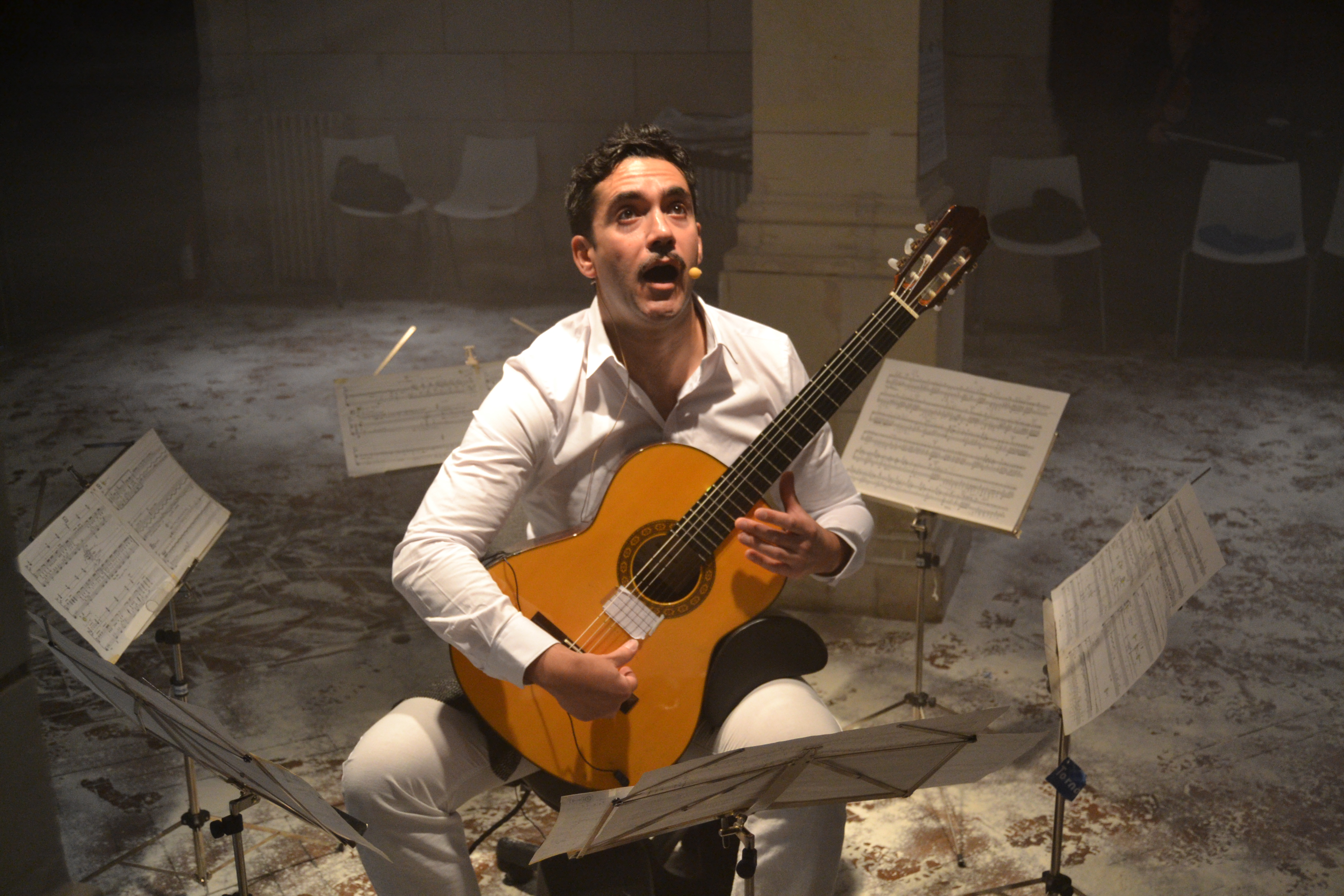
Mauricio Carrasco in Arturo Corrales's BUG. Photo by Gonzalo Garzo Fernández
Mauricio Carrasco in Arturo Corrales’s BUG. Photo by Gonzalo Garzo Fernández

I am very proud to announce that Partial Durations will be covering the entirety of the Bendigo International Festival of Exploratory Music from 5–7 September. Intense and focused, the festival promises to be not just a concert series, but a point of convergence for some of Australia and the world’s finest musical minds. I look forward to seeing you all pedaling around in Mauricio Kagel’s Eine Brise for 111 bicycles, sitting in on rehearsals with the Argonaut Ensemble, catching a rare performance of Stockhausen’s Sirius or milling around installations by Julian Day and Dale Gorfinkel. There are performances by Geneva’s Ensemble Vortex and the Argonaut Ensemble under the baton of Maxime Pascal. Some local favourites will also appear including Golden Fur, Judith Hamann, Zubin Kanga and Anna McMichael. There will be a formidable series of talks and lectures to get you thinking, including legendary musicologist Richard Toop, flautist Eric Lamb and clarinettist Ashley Smith, along with panel discussions on “Duration and Durability” and technology in composition.

For those interested in music writing, I will also provide the festival’s first “fringe event,” a short talk about cultural economy and artistic value in Australian music journalism (but which is just called, given my propensity for naming things (I must never have a child) “The How and Why of Music Writing”). This will take place at the Bendigo library at 10am, Saturday 6 December, before the Wired colloquium. I particularly hope to see you there for some funny stories and (I’ll do my best) penetrating insights.

Partial Durations is a RealTime/Matthew Lorenzon joint project.

So much New Music in RealTime 122

The latest issue of RealTime is brimming with contemporary music. Greg Hooper has reviewed a concert by the hyperactive and hypertalented Syzygy Ensemble for DeClassifiedMusic in Brisbane, including works by Ives, Romitelli and David Dzubay. Hooper has also been able to get along to Kupka’s Piano‘s farewell gig (works by Murail, Eötvös, Lim, Kurtag and Dean) before half of them moved to Belgium and they all nipped over to Darmstadt for a spell. Clinton Green has written on the Liquid Architecture festival, including an interview on sound art with Danni Zuvela and Susan Phillipz. Chris Reid has reported back from a concert of music by Karlheinz Stockhausen composed during May 1968, which was directed by Stephen Whittington at Adelaide University. For the annual music education piece I review Peter Tregear’s essay “Enlightenment or Entitlement.” I also review Inverse Spaces: Elizabeth Welsh and Kim Tan’s concert of spatially-oriented works by Clementi, Scelsi, Nono, Donatoni and Hosokawa.


Corrected: Art Music Award finalists announced

The annual Art Music Award finalists have been announced at a gala event in Melbourne. We can hope to see such contemporary music luminaries as Mary Finsterer, Elliott Gyger, Matthew Hindson, Andrew Ford, Brett Dean and Cat Hope amongst the final recipients. It is great to see some younger artists nominated as well, including Eve Klein, Tilman Robinson and Annie Hsieh. Speak Percussion and Ensemble Offspring have also been nominated.

I am particularly glad to see Gyger’s Inferno nominated, which will be performed by Michael Kieran Harvey in Melbourne next month. Congratulations to all and good luck!


This page has been corrected. A previous version claimed that the winners of the Art Music Awards had been announced. It is of course only the finalists who have been announced.

Partial Durations is a RealTime/Matthew Lorenzon joint project.

Plexus: Medley Recital Series

Plexus
Medley Hall Recital Series
1 June, 2014

Programme:
Jennifer Higdon, DASH
Charles Hoag, SweetMelancholy(lostyourdolly)SlowDragRag
Ian Whitney, Tanzendanses
Iain Grandage, The Keep
Charles Ives, Largo
Paul Dean, Fragmented Journeys

Plexus’ first concert at Medley Hall gives me the opportunity to introduce both a new ensemble and a new venue to Partial Durations. Though new to this site, both have fascinating histories that informed a multifaceted night of contemporary music. Plexus follow the instrumentation of the Verdehr Trio founded in 1972: violin, clarinet and piano. They also follow the Verdehr tradition of commissioning new work for the (now not so) neglected ensemble. The Verdehr Trio commissioned works by some of the most important composers of the late twentieth century, including the well-known Australians composers Peter Sculthorpe and Barry Conyngham.

Now a standard piece of repertoire, Jennifer Higdon’s DASH offered plenty of opportunities for the ensemble to show off. Rushing syncopations between the violin (Monica Curro) and clarinet (Philip Arkinstall) and siren-like rhythmic ostinati in the piano (Stefan Cassomenos) create a charged atmosphere that culminates in hockets between the instruments like the flashing lights of police cars. From the beginning it was evident that Plexus do not hold back, even in a room as small and live as Medley Hall.

After charging the room with this incredible sound, Plexus moved on to an older Verdehr commission: Charles Hoag’s SweetMelancholy(lostyourdolly)SlowDragRag. The piece is absolutely charming, demonstrating a refined compositional culture that plays on tropes and clichés with absolute self-aware mastery. The heads, moments of great jubilation, separate darker, brooding movements.

Iain Grandage provided the ensemble with an excerpt from his opera The Keep, which is partly an attempt to rediscover the folk tales of Grandage’s Anglo-Celtic heritage. Grandage is certainly not the first Australian composer to attempt this reconnection through music (I’m thinking of Fritz Hart and Percy Grainger). Would it be completely amiss to say that we witness this phenomenon at times of great uncertainty about Australia’s future? This is certainly not to say that Grandage shares any of Hart or Grainger’s views, but at times when the contingency of belonging in Australia is laid bare by political or environmental crisis, people start searching inwards as well as outwards for a sense of stability.

Cassomenos, speaking with much character and equal portions of false modesty explained playing Charles Ives’ Largo for violin, clarinet and piano as “like early music.” The funny thing is that Ives’ music can so often sound like the newest thing on the programme. The room really came into its own with this piece. Arkinstall’s perfectly-voiced clarinet line embraced the audience and Curro was able to make the most of the piece’s final, transcendent violin note.

In keeping with the philosophy of the ensemble, the concert included a recent commission by an Australian composer: Paul Dean’s Fragmented Journeys. Originally intended as a joke (is there a more worn-out journalistic cliché than talking about musical “journeys”?), the piece did in fact end up reflecting four journeys that the composer and his friends had variously taken. The first movement, “Fraught,” was particularly welcome as the first example of a “flat” texture in the whole concert. That is to say, the instruments were given equal importance, whereas elsewhere there was generally a principal voice and accompaniment. Here one found a punctum from the piano here, a warble from the clarinet there, or some frenetic scrubbing from the violin. The movement gains momentum, but is spiky from beginning to end, like rolling down a hill of thistles. I think this fits the description Dean provides of the movement depicting “a journey which I just didn’t want to take!” “An Unwanted Disturbance” is really quite iike DASH until the clarinet (piloted expertly by Arkinstall, though you’d want to, playing a piece of Dean’s in front of the man) enters and climbs ever higher and louder. “A Turn for the Worse” depicts a visit to a nursing home, and judging from the creepy piano noodling and see-sawing violin Dean felt a little uneasy from the start. When the booming piano chords and screeching clarinet enter, one knows that the situation only deteriorated. Given these experiences I can only suggest that Dean restrict himself to musical journeys from here on.

Medley Hall could well be the most unique music venue in Melbourne. Since its construction in 1893 on one of the most affluent streets in Melbourne (it was built for the widow of an arms dealer), it has variously been an Arbitration Office, an Italian club (hosting weekly boxing matches), home of a vigneron who graced one of the stained-glass windows with a bullet hole, the set of a Nicolas Cage film and, now, a residential college. Craftsmen and materials for the ornate Victorian Baroque parlor used for concerts, as well as the rest of the mansion, were imported from Italy. Just saying, if you are looking for a space for your next chamber music concert, Medley would be a great place to start. As to Plexus, I can only look forward to their next forty years of activity.


Partial Durations is a Matthew Lorenzon/RealTime joint project.