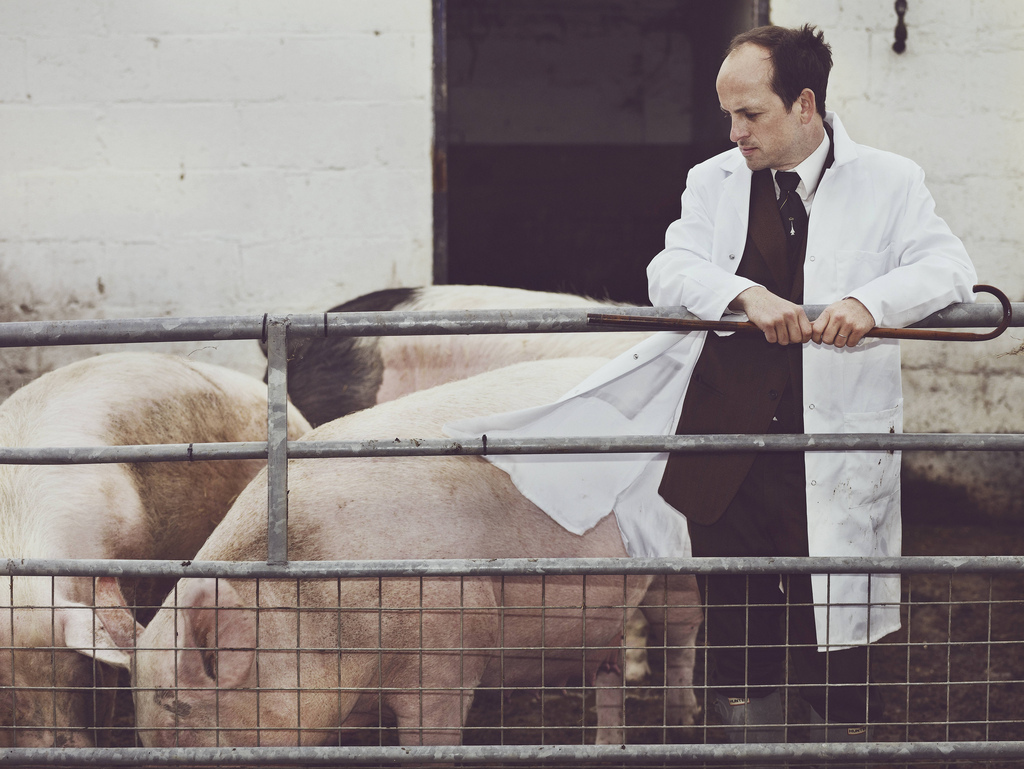
Matthew Herbert and the Empty Instrument

Image courtesy of Melbourne Recital Centre
Matthew Herbert. Image courtesy of Melbourne Recital Centre

An interview with the DJ, composer and Creative Director of the BBC Radiophonic Workshop Matthew Herbert is always interesting to read. He may question the role of factory settings in a sampler, describe the musical potential of a pencil, criticise the volume and redundancy of music on iTunes or define the bpm of his plumbing. He has also formulated some of these attitudes into a loosely prescriptive “Personal Contract for the Composition of Music (Incorporating the Manifesto of Mistakes),” found on his website and in his concert programs.

Alongside these technological and musical pronouncements are ideas about the political or ethical engagement of his music. The album One Pig (to be performed live at the Metropolis New Music Festival on 13 April) is sampled from the 20-week life cycle of a pig destined for the table. The soon-to-be-released End of Silence (Metropolis, 12 April) is based on a recording from the war in Libya in 2011. What is the relationship of these two bodies of statements and how do they come together in his musical works? In Herbert’s albums, music and ethics function like the two independent hemispheres of the brain, with the technology of the sampler acting as the corpus callosum making them appear as one walking, talking, contradictory being.

Herbert’s statements on technology show how the sampler clarified his relationship to music on the one hand and found sounds on the other. In a recent interview, Herbert described his Damascean encounter with the Casio FZ-1, a sampler with a microphone input. Instead of using the prefabricated sounds of the sampler, he recorded himself biting an apple:

“I pitched it down three octaves or so and, for the first time, I heard the world slowed down. I heard a noise that was way more engaging on a philosophical level than anything I’d ever heard before. […] I suddenly realised the sampler was an empty instrument. If you write music on a piano or a French horn, it will always sound a certain way – like a piano or a French horn. But the sound of the apple wasn’t like anything else I’d heard. I realised the sampler was just a tool. All it says to you is, ‘What do you want to do with me? What sounds do you want to make?’ With the sampler, I could make music with the world.”

A musician could just as easily have fetishised sound and said that the sampler was purely a tool for its exploration. On the other hand, they could have ignored the sampler’s microphone all together and focus on its musical properties. Herbert’s realisation that the sampler was an “empty instrument” both opened the way to his ethical engagement with pigs and jet fighters and allowed for his exploration of electronic music in night clubs and on the radio. As his biography states, Herbert’s ethical relation to sound is about bringing the sounds of the darker, problematic corners of the world into visceral contact with the listener:

“When everything I read politically and watch and hear has been absorbed, there comes a point where you must feel it viscerally. Otherwise you are closed to the horrors of it and thus closed to the possibility of action, closed to the idea that you could make a difference or could have prevented the outcome. This internalising of the struggle, the friction, the melancholy I feel should be at the emotional core of the work. After all, I am making music and not writing a newspaper article. But with the invention of the sampler, I can now explicitly root my work in the literal, critical present. I can describe the real in the frame of the imaginary.”

However, one rarely experiences horror when listening to Herbert’s music. One feels uneasy listening to a drum made from a pig you just heard being born. However, this unease requires the knowledge of what you are listening to in order to be effective. Divorced from its context Herbert’s music is eminently listenable. Instead of bringing horror to our speakers, Herbert’s music is gently thought-provoking propaganda.

You might say that the musical side of Herbert’s work does not follow the full consequences of its ethical side. Then again, would you want it to? Would we like another Survivor from Warsaw (or in this case,  A Survivor from Woolworths, or A Survivor from Ras Lanuf) where music strives to be the equal of its subject?
Metropolis: Matthew Herbert, One Room

One Room
Matthew Herbert
Metropolis New Music Festival
8 April

The Melbourne Recital Centre’s Made of Music commission asks musicians to engage with the Elisabeth Murdoch Hall and the hoop pine from which it is made. Using technology developed by the Vienna-based artist Bartholomäus Traubeck, data about the ring width, colour and texture of a slice of hoop pine is given to the composer for sonification. Inspired by the ephemeral nature of live performance, Matthew Herbert’s response to this brief was to sample previous recordings made in the hall and combine them with harmonic material derived from the hoop pine data.

Dressed in white dress shirts and bow ties, Herbert and his four musical helpers triggered fragments of piano, strings and winds with an electronic drum kit, hacked game controller and a contraption using a sprung cord for pitch modulation. The origins of most sounds were obscured by the short sample time and processing, though faint echoes of choirs, traditional Chinese instruments, bells and an infamous cougher from a Ravel concert came through the mix. The ensemble grooved and glitched through a series of percussive and ambient atmospheres before driving to a booming finish with the help of what sounded like a mighty double bass sample. The harmonic material played on a piano melded smoothly into the sometimes late-romantic, sometimes ambient-jazzy soundscape.

One Room is the first and least political of Herbert’s three concerts at the Melbourne Recital Centre. The remaining two, The End of Silence (12 April) and One Pig (13 April) will see similar operations performed upon very different sound sources: Sebastien Meyer’s sound recording of being bombed by a pro-Gaddafi plane in Libya in 2011 and the twenty-week life cycle of a pig. Over the next two days I will be exploring Matthew Herbert’s musical rationale in these pieces and taking a look at his self-restraining “Personal Contract for the Composition of Music (Incorporating the Manifesto of Mistakes).”

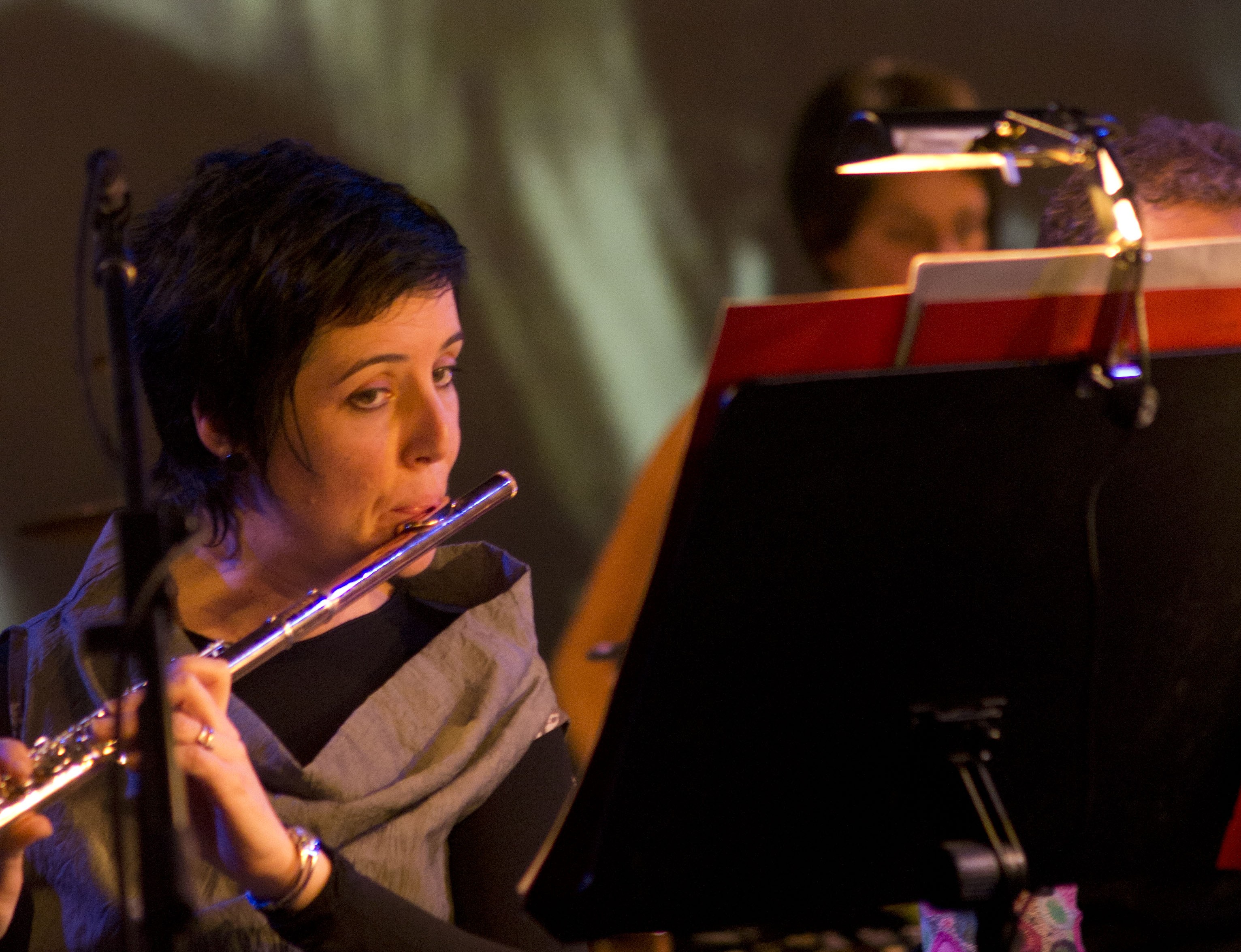
Metropolis: Ensemble Offspring, Posh Playground

Photo by Oliver Miller
Lamorna Nightingale. Photo by Oliver Miller

Posh Playground
Ensemble Offspring
Metropolis New Music Festival
8 April

The Metropolis New Music Festival got off to a playful start with Ensemble Offspring in the salon of the Melbourne Recital Centre. Posh Playground explores the work of a circle of UK-based composers deploying minimal pitch and rhythmic material in theatrical and playful ways. For example, the scores of Matthew Shlomowitz’s Letter Piece 8 (Sit up Stand Down) are sequences of letters for which the performer determines the corresponding actions or sounds. Lamorna Nightingale, Jason Noble and Claire Edwardes chose a suitable vocabulary of arm-waves, trills and toots to fill out the score, giving the piece, in keeping with the program’s title, the rhythm and look of a children’s game.

Laurence Crane’s Three Melodies and Two Interludes is an exercise in extended ternary form given a haunting character by the modal melodies of the alto flute and the dirge-like accompaniment of the vibraphone.

Bryn Harrison’s Five Miniatures in Three Parts contrasted planes of soft modal colour, leading well into the gesturally frantic but formally static Reeling for clarinet and hi-hat by Christopher Fox.

The children’s games returned with Jennifer Walshe’s EVERYTHING YOU OWN HAS BEEN TAKEN TO A DEPOT SOMEWHERE, consisting of eleven short theatrical scenes employing party horns, glitter, bubble blowers and a computer game on an iphone. The scenes, with names like “Study Hard & Work Like Killers” and “FACE! HANDS! FACE! HANDS!” reminded me of the UK’s Forced Entertainment, except that Forced Entertainment are funnier and have a knack of giving the seemingly-redundant new meaning throughout the duration of a performance. Perhaps EVERYTHING YOU OWN should be three hours long.

Posh Playground made me question the value of commentary in concerts, which I am usually in favour of. Ensemble Offspring speak well and succinctly, providing commentary on each piece before playing it. Such commentary could be grouped in sections or come after the piece to improve the flow of the program. The program was a welcome introduction to a subtle and beautiful body of work.

Forest Collective, Shared Sounds

2013 0407 Shared SoundsShared Sounds
Forest Collective
Abbotsford Convent
7 April 2013

For their 2013 season the multi-arts Forest Collective bring chamber music, visual art, theatre and opera to the sprawling Abbotsford Convent. Opening the season is Shared Sounds, a juxtaposition of established and emerging British and Australian composers. Alongside this explicit rationale is the concert’s implicit exploration of the organic and the elemental.

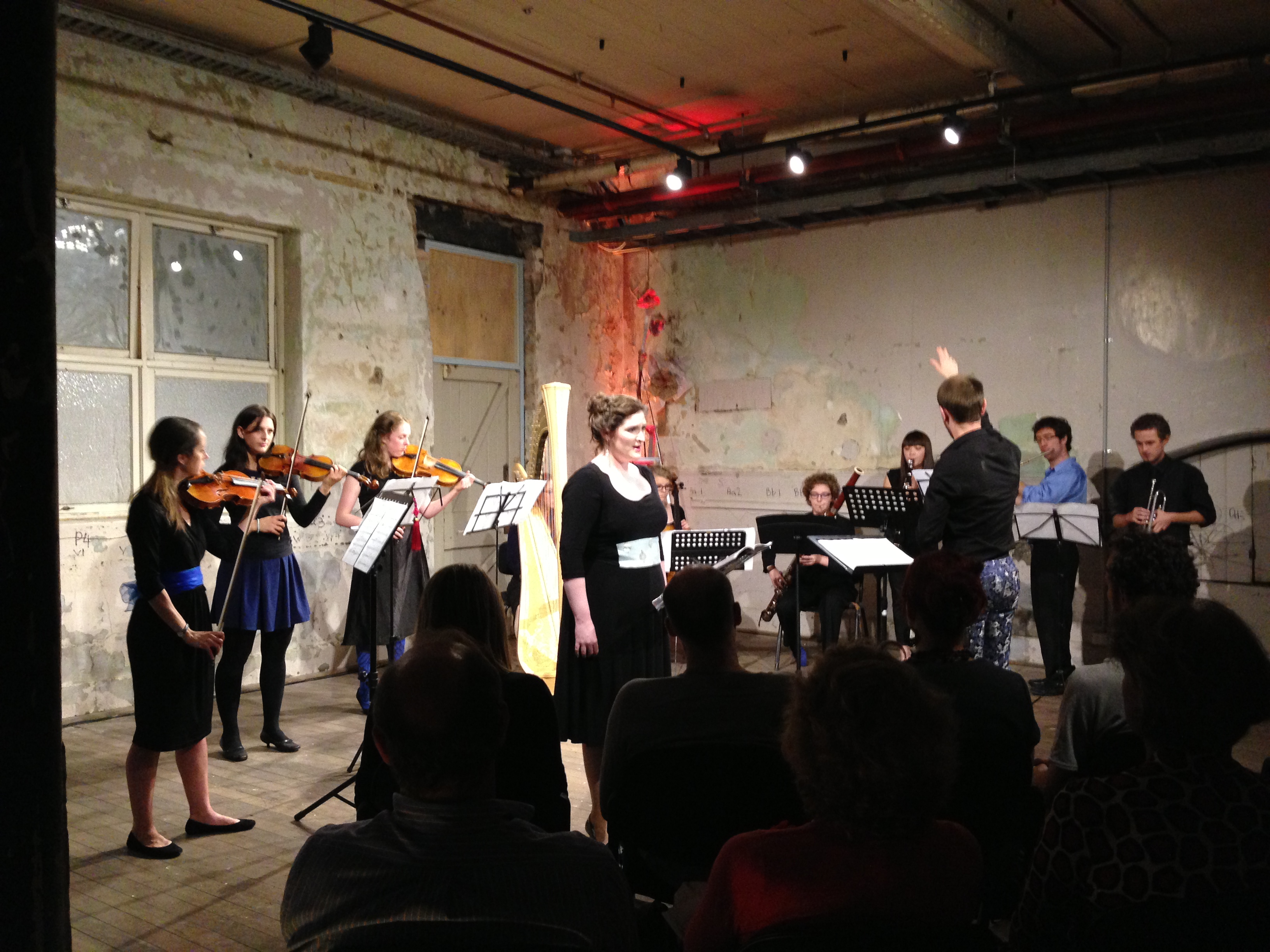
Stephanie Osztreicher transformed the peeling walls of the convent’s Industrial School into a tulgey wood of ladders, music stands, paper flowers and projections as the evening’s autumn storm rolled overhead. Travelling to the concert, the rising smell of “petrichor” (meaning “dry earth,” a term coined by Australian scientists to describe the smell of rain after a dry spell) was an olfactory prelude to the rain-themed music of the Forest Collective’s ensemble in residence of the same name (Jess Fotinos, harp, Alexina Hawkins, viola, Rowan Hamwood, flute).

Fotinos and Daniel Todd (tenor) opened the concert with the spiritual transformations of St. Narcissus into tree, fish, girl and dancer in Britten’s Canticle No. 5 for tenor and harp. Britten’s evocative harp writing was juxtaposed with May Lyon’s own mercurial word painting in A Dream Within a Dream, based on a poem by Edgar Allen Poe.

The ritual continued with Benjamin Harrison’s improvisation for solo trumpet, a masterful exploration of whistling wind, echoing brays and muted flatulence.

A sequence of chamber works by Barry Conyngham, Conyngham’s teacher Toru Takemitsu, Mark-Anthony Turnage, Johanna Selleck and Evan Lawson highlighted the strength of the “collective” as an ensemble, corralled and conducted by Lawson. A highlight for me was Turnage’s Three Farewells for flute, clarinet, harp and string quartet. Lush harmonies and timbres filled the concrete chamber before clearing for a pointed and intimate encounter with Hawkins’ viola solo, with grumbling accompaniment from Ayrlie Lane’s cello.

While not quite the “interactive chamber music experience” promised by the season program, Shared Sounds plunges the audience into a rich atmosphere of water, wind and trees deserving of the collective’s name. The program also demonstrated a continuing interest among young composers in finding new effects and manners of working with text within an extended-tonal style.