Cathexis: Attacca

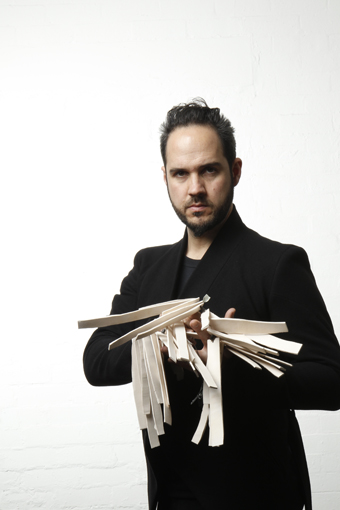
Cathexis, photo by Asher Floyd

Attacca
Cathexis
Northchote Town Hall
26 February, 2014

“Attacca” will be familiar to musicians as the performance marking to move on to the next movement without pause. Melbourne’s newest contemporary music ensemble Cathexis took the direction as inspiration for an immersive performance experience combining music, lighting, sound design and stagecraft.

Entering the Northcote Town Hall’s West Wing performance space, the audience is surrounded by  red light and swirling, pealing tones. Joe Talia’s sound design and Bronnwyn Pringle’s lighting provided continuity between the repertoire.

Joe Talia’s four-channel atmosphere reached a climax and abruptly cut out, at which point Peter de Jager launched into Michael Hersch’s Vanishing Pavilions #34. Thundering chords and descending runs alternated with serene counterpoint and a glistening, high melody.

While Hersch’s work rumbled away at one end of the room, the rest of the ensemble crept into a corner and prepared a swift volta into a bar of Valentin Silvestrov’s Trio for flute, celesta and trumpet. No sooner had they stopped than Matthias Schack-Arnott was starkly lit sitting on a balloon.

So began the most anticipated piece of the evening, Luke Paulding’s breath transmuted into words transmuted into breath, a piece based on sounds lifted from gay pornography. Schack-Arnott squeaked and popped balloons to the gentle moaning of an accompanying tape track. He then rubbed, shook and pummeled his array of unconventional percussion instruments as things heated up. The tape track was no match for the colour of the percussion setup, however, and interesting contrasts or correspondences failed to emerge. Considering that they can accompany some of the most sublime moments of our lives, it is remarkable how limited and monotonous the sounds of sex can be. It was perhaps for this reason that the most effective moments were those where the percussionist focused on one, repetitive sound, such as the opening solo or the squelching of a couple of plastic pigs in water at the end.

Cat Hope’s Black Disciples takes the symbol of the Chicago street gang Black Disciples, “III”, and turns it on its side to represent a polyphony of three voices. The work is haunting, with three low voices droning into microphones, their sometimes-distorting, saturated tones melding with the static of radios. Cloaked in hoodies and huddled in the dark, the work raises the issue of cultural appropriation that has recently re-risen (indeed it never went away) in the contemporary art world with an address by TextaQueen at Gertrude Contemporary Art Space. Further urgency is given to this topic by the fact that people in Australia will soon have the perfect right to appropriate whatever they want to whatever offensive ends they wish. The use of “primitivist,” African-American and orientalist musical tropes by white, western composers is as common and uninterrogated today as it was at the dawn of the twentieth century.

However, having cried “appropriation” at every opportunity ever since I learned the word, I now try to distinguish between engagement and appropriation. Learning is a process full of gauche mistakes and I would hate to see someone’s attempts to understand another culture stifled because of their unknowing misuse of that culture’s symbols. Musicians adopting another culture’s symbols need to make a few things clear: What do they think they are appropriating and how and why are they altering it? How do they think members of the appropriated culture would respond to the work? Hope’s borrowings are in fact minimal and, while offering her an inspiration, do not necessarily add to the audience’s enjoyment of the work. It seems to me that Hope adopts only the symbol “III”  from the Black Disciples. The close-held microphones are taken from hip-hop culture more generally, though they produced a distinct musical effect, and the costuming and manner of presentation was probably an addition by Cathexis. Hope then transforms these appropriations through her own noise art aesthetic into a sort of metal/fantasy Gregorian chant, the effect of which is transfixing, whether one knows about the Black Disciples or not. As to the community’s response and the musician’s eventual edification, this would requires a dialogue that members of the appropriated cultures may prefer not to engage in. As TextaQueen points out, people of colour shouldn’t have to dish out this education for free.

Beat Furrer’s Presto for flute was a tour de force for Lina Andonovska, who stalked the score like a lioness. The mosaic patterns between the piano and flute, where the flute “filled in” the piano’s rests, were coordinated to produce a single, carefully-honed, variegated surface. The voices found their independence joyful abandon and Andonovska seemed to relish the opportunity to blast out a series of impossibly loud, long notes.

Cathexis contribute to a tendency in contemporary music for ensembles to adorn their performances with production values that create a sense of continuity and spectacle. While this is often welcome, I am not sure that a seamless performance is always a better one. Nor do the gravitas sound and lighting provide the desired continuity. This is ultimately a job for the concert’s curator in finding convincing links and contrasts between works, an excellent example of which was the unity in variety of the Elision Ensemble’s recent concert at Melba Hall.

Great results for Australian contemporary classical in the latest OzCo round

We ought to have a lot to hear from Australian composers over the next year with Australia Council for the Arts grants being awarded to Stephen Adams, David Chisholm, Melody Eotovos, Alex Pozniak, Katy Abbott, Luke Jaaniste, Aristea Mellos, Ross Edwards, and Elena Kats Chernin.

The Bendigo International Festival of Exploratory Music and the Adelaide Contemporary Music Festival have also been awarded funding, providing the rest of us with vital windows into the broader contemporary music world.

After a series of incredibly well-researched surveys of global contemporary music culture, the emerging ensemble Kupka’s Piano will present their new program “il faut être” at the Judith Wright Centre of Contemporary Arts and we will also hear from electroacoustic warhorses David Chesworth and Sonia Leber.

More details here, here and here.

Congratulations to all!

Eugene Ughetti: Australian Percussion Solos

 Eugene Ughetti courtesy of the artist
Eugene Ughetti
courtesy of the artist

I recently reviewed Eugene Ughetti’s series of Australian Percussion Solos for RealTime. In true Ughetti fashion, the works commissioned by Ughetti paint a unique portrait of Australian composition (not least because half the composers now live overseas). They also raise questions about funding cycles and audiences. What do we, as listeners, want out of a new work? Exactly how do we want to be challenged?

Jon Rose kicks off RealTime’s new initiative RealTime Talk

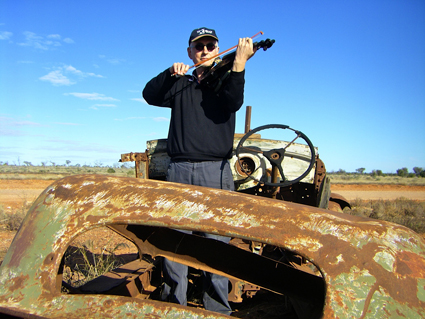
Jon Rose. Photo by Hollis Taylor

It is hard to think of a contemporary Australian composer who has made as unique and sustained a contribution to Australian music as Jon Rose. As anyone who has seen him play live will know, he is also a great speaker. Who better to kick off RealTime’s new discussion blog RealTime Talk with a post about those issues of the day, the internet, technology and privacy?

Partial Durations is a Realtime/Matthew Lorenzon joint project.

3 Shades Black: Homophonic

Three Shades of Black.
3 Shades Black. Photo by Nick Moulton

3 Shades Black
Homophonic
La Mama Theatre, Carlton
Midsumma Festival
24–25 January, 2014

Melbourne-based ensemble 3 Shades Black are presenting Homophonic, a programme of music by queer composers as part of the Midsumma Festival. Now in its third year, director Miranda Hill and composer David Chisholm spoke to Partial Durations about the concert’s origins and inspirations.

After researching the history of LGBT composers, Hill was struck by the elision of queer identities in the classical canon. “I read a lot about Tchaikovsky, Poulenc, Britten and Copland, all of these big names that have been straight-washed by the establishment. You can’t go and hear Mahler’s Symphony No. 10—with those big chords because he found out his wife was cheating—without seeing a reference to Alma, but I’ve never seen a reference to the young boy to whom Tchaikovsky’s Symphony No. 6 was dedicated to.”

From this historical base, 3 Shades Black struck out to discover living LGBT composers. “We have a policy of always including at least one local and one woman composer. The programme this year is a watershed for having so many fabulous local composers. We’ve had two new pieces written for the show by Wally Gunn and Naima Fine, who also wrote for us in the first concert. It’s nice to come back and build a relationship with composers.”

As well as building relationships with composers, the concerts have enabled 3 Shades Black to engage with a broader audience than the usual art music crowd. “The concerts are an ‘in’ for many people who wouldn’t normally go out of their way to hear New Music, but who come and love it. Who couldn’t love Luke Paulding’s quartet Her Sparkling Flesh in Saecular Ectstasy?”

If one isn’t immediately enraptured by Paulding’s rich timbral cascades, the lives and circumstances of the composers can help audiences relate to the music. 3 Shades Black will play The March of the Women by turn-of-the-century composer Ethel Smyth. “She was a suffragette rabble-rouser,” explains Hill. “She’s the only female composer to have had an opera performed at the Met. But we couldn’t find much of her music. I think you have to know someone who knows someone. We are performing March of the Women, a suffragette anthem, because it has a great story: She was arrested for smashing windows as part of a suffragette protest. The conductor Sir Thomas Beecham turned up to see how she was doing in prison. The warden said ‘Oh yes, she’s doing fine, go and have a look.’ All the suffragettes who were in the prison at the time were marching around the parade yard singing March of the Women and she was upstairs in her cell conducting them with her toothbrush. Everyone has stories like that. There are stories like that about Tchaikovsky and his letters to his brother Modest. Virgil Thomson once said something like ‘You can be a twelve-tone composer and you can be gay, but you can’t be both.'”

While the anecdotal lives of composers may appear a flippant or secondary interest, they dispel essentialist notions of a “queer” musical style. For instance, we can assume Thomson was being ironic when he said that you can’t be both a twelve-tone composer and gay, as he was speaking to Ben Weber, a gay twelve-tone composer. The “queerness” of a composition is understood, rather, by the way in which it affirms or contradicts gendered and sexualised tropes such as Thomson’s cliché about the straightness of twelve-tone music. The composer David Chisholm, who is also contributing to Homophonic, said as much in the comments of his interview published in the Australian Music Centre’s Resonate magazine in 2007. The composer Matthew Hindson pressed Chisholm to identify characteristics of “queer” and “postcolonial” music, presumably sensing the fallibility of any attempt to find musical universals that fall under either label. Chisholm clarified that “queer” and “postcolonial” were labels for strategies more than immutable musical qualities. At one point, for Chisholm, this meant introducing the music of the club scene into his “classical” compositions, though for many years Chisholm has been more interested in exploring the bonds of community in the face of death.

Chisholm’s The Arrival is a memorial piece commissioned by a member of the ensemble. “A lot of work I have done since very early on has been memorial-based, looking at requiem forms and the idea of memory, as well as remembering particular people. I lost my mum when I was twenty-three, followed by a string of deaths very close to me. You have to become adept at that in some way.”

While Chisholm explores the tropes and forms of memorial pieces, he reimagines them from a secular perspective. “I was struck that in all of the experiences I had with death, people were always commemorating with the vestiges of Catholicism or Christianity more broadly, but in very secular spaces like crematoriums. People modified and created their own rituals without really knowing the original rituals. These rituals were as much for the living as they were for the dead.”

Chisholm’s memorial will be only one sound among many, as Hill explains, “If you come to the concert you will find that every piece sounds different, from some things that are traditionally beautiful to some things that are quite hard to access. But one thing I can say is that there is a real sense of fun in a lot of this music and a sense maybe even of rebellion. There is a a sense of levity and thinking outside of the box. Wuorinen’s piece for double bass, violin and congas is crazy. It is extreme, contemporary music where my part changes clef four times every bar, but it has a real groove to it.”

Homophonic is on at La Mama, Carlton, at 7:30pm on the 24th and 25th of January.

Partial Durations is a RealTime/Matthew Lorenzon joint project.

Kim Tan, Lizzy Welsh, et al. : Oscillations

Kim Tan, Lizzy Welsh, Peter de Jager and Alexander Garsden
Oscillations
Northcote Uniting Church
13 December

Kim Tan and Lizzy Welsh’s new duo explores contemporary music on baroque instruments. Baroque violin and flute is a magical combination, with the brightness of the former complementing the mellow tones of the latter. In their first concert, Tan and Welsh team up with virtuoso keyboardist Peter de Jager and composer Alexander Garsden for an exchange between diverse sound worlds.

Peter de Jager’s Prelude explores baroque gesture in the semi-improvised form of a Prelude. The trio of harpsichord, violin and flute begin in a state of gestural unison, with De Jager playing dense trills in the middle of the keyboard. Within this sparkling, rumbling cloud of sound the violin natters away with snatches of diatonic melodic fragments, while the dark flute plays a warbling ostinato. The violin gestures become more protracted as the piece progresses, with arpeggios and repetitive string crossings. The harpsichord also becomes more individuated, with chords and recognisable ornaments. Occasionally the flute and violin take leave of the trio texture for an episode in imitation, riffing on murmurs and double-dotted passages. De Jager progresses around the harpsichord, taking a grand tour of its registers, manuals and stops. The violin and flute are given a similarly thorough working-through, with moments for sautillé bowing and playing from the fingerboard to the bridge. Tan’s control of the baroque flute provided a broad, warm sonority sadly absent from Australian contemporary music. Hopefully many commissions will follow.

Two works by Clarence Barlow utilised modern instruments, but brought them into contact with drones and improvisations on limited rhythmic and modal resources inspired by Classical Indian music. In Until … Version 7, a guitarist plays a pattern of harmonics in an improvised rhythm and order, while an accompanying electronic drone rises imperceptibly in pitch. Garsden maintained a sense of line in each variation, keeping the audience rapt throughout the entire performance. In this way the audience were able to register the magical effect of the changing harmony of the accompanying drone, which gradually introduced complex harmonic beats to different parts of the guitar’s pattern. Until … Version 8 also uses variations on given sets of pitches and rhythms for a solo instrument, but this time for piccolo (played by Tan). The piccolo and electronic parts combine to produce difference tones in the listener, which at times take on striking melodic independence.

Alexander Garsden’s Law II for baroque violin had its second outing at the Oscillations concert. The piece is at once an accomplished exploration of spectralist compositional techniques and a sinisterly theatrical work. Garsden builds a bewildering electronic track out of analogue synthesis and granulated baroque violin. The teeming soundscape of insect-like chirps projects a Heart of Darkness-like horror as the baroque violin enters doing what it does best: bow sound. The piece proceeds in a series of electroacoustic builds and instrumental responses, with the violin becoming more violent as the piece progresses, until the violin is positively attacked with the side of the bow.

Oscillations presented two contrasting lines between baroque and contemporary music. One the one hand, sound, including timbre and temperament. This perspective resonates with our everyday rapport with baroque music. The early music industry today is in part a set of recording practices highlighting “instrument sound”. After two and a half centuries of equal temperament the range of temperaments used in the baroque is also an entirely appropriate point of fascination. On the other hand, notation, including form and gesture. De Jager’s Prelude was particularly representative of this second line. Many baroque pieces were not written for specific instruments and the refinement of notation and practice in continuo playing ushered in new forms and styles that were only secondarily cemented in a particular instrumental tone colour. This line seems more closely aligned with serial and then complexist composition. It will be interesting to see how these different lines are developed in Tan and Welsh’s future concerts.