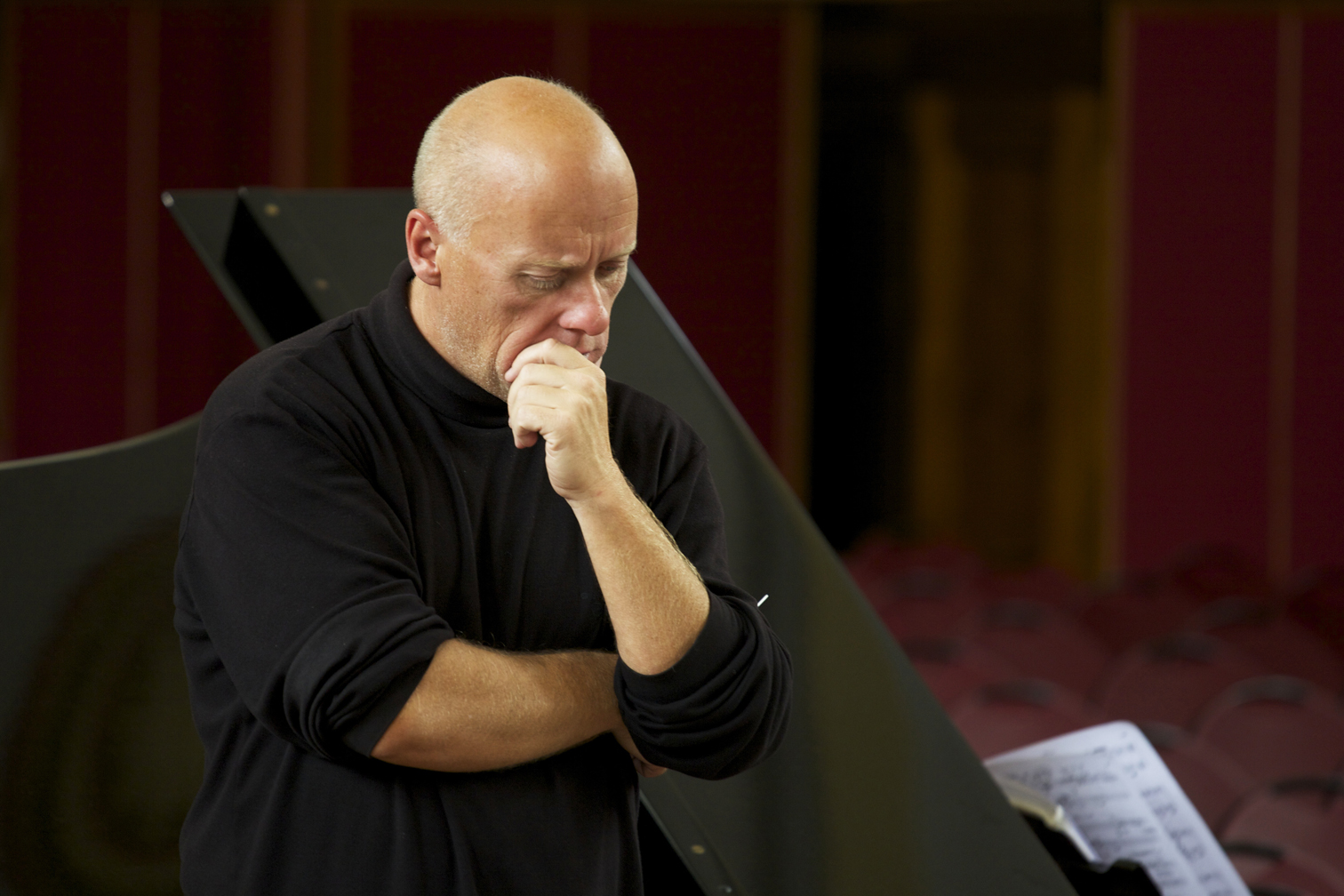
Syzygy Ensemble: Brunswick Beethoven Festival

A piano chord questions the air. A high, fragile melody responds from the cello. The cello tune is less alien than the stone-hard chord, almost speech-like as it rises and falls. The cellist, Blair Harris, has his bow right up on the fingerboard of the instrument, making a thin tone like somebody singing far away. The violin, clarinet and flute join in with a kaleidoscope of contrasting timbres. The violinist (Jenny Khafagi) and cellist lean together in vibrating, fleeting harmony. A tone like brushed steel emerges from the clarinet (Robin Henry) and flute (Laila Engle). The sonic pairings of wood and steel disintegrate in a flutter of trills. By taking the concentrated tone of the solo cello as a starting point and then introducing an array of contrasting sounds, Kerry opens out a timbral space with palpable depth. The piano part (performed by Leigh Harrold) prods the sonic perimeter, both a part of it and apart from it. The piece is Gordon Kerry’s Making Signs, my most exciting concert experience of the year so far (though it is a little early to start making claims like that). Syzygy Ensemble recently performed the piece for the second time at the Brunswick Uniting Church among a programme of works by Roger Smalley, Annie Hsieh, Luke Hutton and Brett Dean. The five members of Syzygy have honed Making Signs so carefully that the texture is thick with edges and layers, each sound delineated from its neighbours like grains of sand under a microscope. What a perfect piece for an ensemble whose name implies an alignment or union of distinct elements not through synthesis, but through Frankenstein-style juxtapositions and superpositions.

Making Signs was originally commissioned by Julian Burnside for Syzygy’s “Grammar” concert, one of a series exploring the three disciplines of the medieval trivium: grammar, logic and rhetoric. Kerry, now pushing into his fifties, has had plenty of time to think about musical grammar. He was born into the generation that reacted against Darmstadt-style musical modernism as it was taught in Australia well into the 1980s. Indeed, the piano chords at the beginning of Making Signs are from Winter Through Glass, a serialist piece from 1980 that Kerry calls his first “grown-up” composition. As the years passed, many of his contemporaries retreated into a hazy Australiana, nostalgically painting the landscape with the post-impressionist techniques of this time last century. Kerry kept his teeth, which are bared to the gums in Making Signs, at least for a little while. As the piece progresses, the audience becomes aware that they are no longer hearing a timbral kaleidoscope, but a sort of tonal grammar.

Like watching a minute hand move on a clock, one is unsure of exactly when the coupling and uncoupling of instrumental timbres takes a back seat to harmony. With the benefit of a score one can see the clear juxtaposition—indeed the syzygy—of episodes based on clear horizontal lines on the one hand and gestural effects on the other. The experience in the concert hall is more gradual, like a theme in a poem dawning on you after several readings. Once you notice it, you see how it permeates the entire structure of the work. Except for the serial piano chords, Making Signs is based on a bespoke mode not unlike those used by the composer Olivier Messiaen. Some conventional tonal chords can be carved out of Kerry’s mode and the instruments make their way through it in a style resembling traditional counterpoint. Kerry’s use of the mode is evidence that he is not immune from the reactive pathos of his generation. The piece ends with the entire ensemble see-sawing, running and leaping across the mode in a way that would not be out of place at the end of a blockbuster Christmas film. They roughly outline an F# Minor chord that resolves dutifully to a G chord, albeit tinged with augmented uncertainty and a nice raised seventh. Despite some kitsch moments, the mode gives an especially vibrant quality to the timbral kaleidoscope of the opening. However, it doesn’t seem to be the most important aspect of this jagged introduction. The piece achieves a strange alchemy by creating a continuum between two qualitatively different ways of making signs: through instrumental timbre and through harmony. And yet, both ways of making signs seem to “work” equally (even if I would argue that the first works “more” than the second).

All of the works on Syzygy’s programme were well chosen for their rhetorical power. Hsieh’s clarinet, piano, violin and cello quartet Towards the Beginning is probably the most programmatically ambitious, attempting to tell a story of cosmic birth, life, catastrophe and death. A expectant cloud of harmonics and trills coalesces into searching lines. A thunderous piano climax gives way to chaotic multiphonics and tremoli. At the end of the piece, the piano creeps back in, cowed and conciliatory. The piece was composed in 2010, before Hsieh moved away for further study. While I was not thrilled to hear another primordial soup piece, Towards the Beginning showcases Hsieh’s gift for instrumental writing. From the cosmic to the painfully individual, Luke Hutton’s Fregoli Delusion explores the disorder of the same name where one identifies multiple people as the same person. The piece is perfect for Engle’s highly characterised flute playing. In contrast to her recent performances of Jennifer Higdon’s athletic flute solo Rapid Fire, the flute of Fregoli Delusion is somewhat sombre, creeping along suspiciously and starting with skittish paranoia. Syzygy brought out the character in Smalley’s Trio for Clarinet, Viola and Piano. The opening, I am led to believe it is called “Blooded room,” features leaping rhythmic counterpoint that is inexplicably humorous. The ensemble also brought out the expansive second section and the piece’s absolutely thrilling climax where each instrument comes into its own. Brett Dean’s Old Kings in Exile, the audience was told, rewards multiple listenings. Having heard Syzygy perform the piece twice now, I have learnt to appreciate the mysterious first movement, “Night Music,” with its groaning drum skins and long, winding flute lines. The “Double Trio,” a reference to Carter’s Triple Duo, is a scintillating battle of trills. I wonder whether the piece lacks immediacy. The music never seems to leave a foreground-background frame like a marionette theatre with “incidental” percussion effects and obvious points of focus. I will have to hear it again.

Syzygy Ensemble
Brunswick Beethoven Festival
Brunswick Uniting Church
18 February 2015
Gordon Kerry, Making Signs; Roger Smalley, Trio for Clarinet, Viola and Piano; Annie Hsieh, Towards the Beginning; Luke Hutton, Fregoli Delusion; Brett Dean, Old Kings in Exile.

I discuss Gordon Kerry’s Making Signs further in the upcoming first issue of the contemporary art magazine Fine Print.

Partial Durations is a RealTime/Matthew Lorenzon joint project.

Earth Dances: Music in Search of the Primitive

Earth Dances. Cover by Peter Long. Courtesy of Black Inc.

Earth Dances: Music in Search of the Primitive
Andrew Ford
Black Inc.

Andrew Ford’s Earth Dances explores the ways in which musicians from diverse genres and backgrounds have sought to “rough up” their music. Sometimes the most simple premises are the most interesting, as Ford’s wide-eyed incursions into rock, pop, classical and contemporary art music show. Ford interleaves fascinating interviews with contemporary composers with his own essays on the body, percussion, the voice, drones and childhood.

Ford works every canonical composition you could reasonably expect into the book. The Rite of Spring gets its obligatory half a chapter, though Ford goes beyond merely discussing Stravinsky’s “sophisticated aping of violence.” Ford is more interested in the difficulties this violence posed for an early twentieth-century ballet. He discusses Stravinsky’s dissatisfaction with its ending and the work’s adherence to a balanced form that recognises the diminishing returns of extreme dynamics.

As well as canonical works, the book is brimming with idiosyncratic references that bring out Ford’s personal tastes. Earth Dances opens with the example of Elliott Carter’s A Symphony of Three Orchestras, where Carter appears to sabotage the refinement of his own work with a brutal orchestral meltdown. This example brought to mind another case of musical self-sabotage, the beginning of the Rautavaara Harp Concerto, where the giant orchestral boot crushes the fledgling opening theme several times with exceptional cruelty. Some days you have to skip it. At the opposite end of the classical-popular divide Ford discusses the appeal of anti-folk singer Daniel Johnston, as well as Robert Davidson’s viral setting of Julia Gillard’s misogyny speech Not Now, Not Ever. The book’s great strength is Ford’s dexterity in jumping from example to example, which inspires the reader to situate their own musical world between intellectual and corporeal poles.

The interviews with Richard Barrett, Martin Bresnick, Karin Rehnqvist, Liza Lim, Pauline Oliveiros and Brian Eno  present valuable variations on the book’s theme. Barrett compares his found musical materials to Andy Goldworthy’s land art. Martin Bresnick describes his Opere della musica povera, which are materially basic but not musically poor. Rehnqvist discusses her connection to Swedish herding calls, which she discovered during her conservatorium training. Lim raises the politics of the fetish of traditional musics. She recognises that

‘tradition’ quite often has a past that’s in collusion with slavery, genocide, colonialism and so on. The romance of nationalism often denies the ugly parts of history but, more worryingly, turns a blind eye to how that past continues to reach out and affect the present and shape continuing conditions of power. Cultural matters are intimately political! (146)

I like this term, “intimately” political where many would reach for “inherently” or “fundamentally,” implying an interactive duality between musical and political interests. Pauline Oliveiros discusses the practice of “deep listening” and Brian Eno recounts the adventure of American minimalism’s response to European modernism.

The book’s all-encompassing theme threatens to be its most unsatisfying feature. Earth Dances contains as many examples of musicians see-sawing between intellectual and corporeal modes of composition as it does explanations of why they do it. According to Ford, a composer may rough-up their music to serve a dramatic imperative, to serve humanist or nationalist ideologies, to shock or to reinvent their practice. One important reason is left out: to make a buck. While Ford acknowledges that the corporeal, “primitive” musical pole exists between quotation marks, defined through its contrast with Western ideals of refinement and civilisation, there is no real discussion (outside of Lim’s remarks) of issues of cultural appropriation and exploitation, of the refinement in the “primitive” and so on. To be fair, many have written that book before and I am just as interested in the formal yo-yo of music history as the West’s bloody-minded fascination with its Others. All the same, Ford could have acknowledged the thorny political issues that arise when, for instance, Paul Simon sells a bazillion copies of an album featuring recordings of black musicians in Johannesburg made under anti-apartheid sanctions.

Ford could also have made more of the contradictions between different forms of the corporeal aesthetic pole. As Bresnick’s musica povera shows, simple does not necessarily equal rough. Is American minimalism a simplification, refinement or a roughing-up of a previous aesthetic? Ford frequently returns to the idea one veers toward the “primitive” pole to make way for renewal. If so, then has minimalism led to formal recomplexification, or is it a musical apotheosis? I like to imagine a four-phase cycle with the destruction of a “rough” aesthetic making way for simplicity, from which a new phase of construction begins leading to complexity, but can such a cycle really be found in anybody’s practice?

Ford bookends Earth Dances by associating his intellectual/corporeal divide with the structural anthropologist Claude Lévi-Strauss’ book The Raw and the Cooked. In one sense, this is entirely correct. Structuralism’s gift to musicology has been the idea that music resembles and indeed interprets myth through contrasting and interconnected themes. On the other hand, The Raw and the Cooked presents precisely the opposite theory of musical development to Ford’s yo-yo. In an extended criticism of serialism and musique concrète in the book’s “Overture,” Lévi-Strauss compares music to a language because they are both based on shared, limited sets of elements. Just as all English speakers recognise the same few phonemes, we all recognise the same set of pitches related by the hierarchy of overtones. His idea was torn to shreds by successive generations of composers, critics and musicologists. The diversity of temperaments and scales around the world is enough to refute his claim, let alone the genuinely communicative and thrilling experiments of modern music that readers of this blog will be familiar with. Lévi-Strauss admitted that he didn’t like or understand the music of the cultures that he himself studied. But to Lévi-Strauss the “harmonic grid of selection” is immutable and irreplaceable. He did not believe that any amount of roughing up could make way for a new one. This is evidently a live issue, because Ford’s book came out around the same time François Mitterand’s ex-economics adviser and some-time conductor Jacques Attali used Lévi-Strauss’ idea of the harmonic grid to call atonality “musical terrorism” (and this from the author of Noise, a book that crassly equates Western art music’s formal history with the economic stages of historical materialism). It is obscene to compare musical violence to the actual taking of lives (see the interrelated but distinct political and musical priorities above). But Attali raises a valid question: Does musical destruction merely peck around the edges of musical norms, or is it a genuine step in the process of musical innovation?

Rosenberg 3.0: not violin music (book review)

Rosenberg 3.0: not violin music

Curated by Jon Rose

Blurb

Following Pink Violin and Violin Music in the Age of Shopping, not violin music presents the latest scholarship from the rarefied field of Rosenbergology. For those who have not had the pleasure of delving into the intellectual humus of the Rosenberg family tree, the Rosenbergs are a clan of physicists, mathematicians and, of course, violinists who all share the same first initial “J.” The family’s pseudonymous scholars are keen culture critics and dialecticists, ready to lament the decline of Western Civilization while decrying its inherent contradictions. The book revels in collapse and tragedy, beginning with a post-apocalyptic portrait of one Dr Rosenberg reinventing the Doric column and ending with a suicide.

The material form of the book develops this sense of cultural amnesia. It is an unwieldy book, lacking even that most basic of bibliographic conveniences: page numbers. There is no table of contents, nor even a list of contributors. Book sections can only be distinguished by their idiosyncratic typesetting. Each chapter has a different font (though Comic Sans does not make an appearance, I was disappointed to find. Even scientists at CERN use it!). The glossy, low-resolution cover betrays its origins in a print-on-demand self-publishing house. It is, in short, a dysfunctional book.

Which is precisely the point. Contributors were briefed to explore dysfunctionalism as a theme. In one chapter “Dr Robert Ostertag” gives the principle of dysfunctionalism as that “[…] a machine performing a task badly is aesthetically superior to a human performing the task wel.” The phrase is clipped because Ostertag’s responses are subject to Twitter’s 140-character limitation. The book is thus a product of the axiom that cheap-and-quick printing and cut-and-paste formatting are aesthetically superior to more manual production values.

Ostertag’s definition of dysfunctionalism only covers cases where automatism is pitted against human agency in the performance of a given task, such as in the construction of a print-on-demand book. But the cases of dysfunctionalism explored by the contributors are usually those in which a machine poorly translates or transmits human intentions (If I may add my own example, consider the joy derived from watching crappy robots fight each other compared to their better-greased counterparts). For instance, Ostertag cites an installation where Dr Rosenberg attempts to play a violin using ECG data. Another author relates the dysfunctional scenario of a Maoist TED talk by Judd Rosenberg. Plagiarism, new and old violins, jazz clubs, composition competitions and the instrumental innovations of violin metal are also evaluated as dysfunctional mediums.

The authors explore language itself as a dysfunctional medium. Academic language, theory language, art language, even mathematical language (the book is a pleasure for those on hand-waving terms with pure mathematics) all come under parodic scrutiny. One chapter is shockingly written in “Engrish,” with “l”s and “r”s interchanged. Another frequently drops articles. These caricatures of the language of people from Non-English Speaking Backgrounds are made all the more offensive by the use of pseudonyms as dysfunctional names. The pseudonym does not point the reader to any particular context. It is a reader’s dead-end. This is dangerous when a text hinges on irony, on knowing that an author “doesn’t really mean it.”

Dysfunctional names leads to dysfunctional readings, and here I cannot accept that dysfunction aesthetically trumps function. Only after clarifying with Jon Rose that the two chapters in question were indeed written by a Japanese and a Slovakian contributor respectively and that exploring dysfunctional language was an essential part of their brief was I able to read the contributions with any sort of sympathy.

There is yet the disfunctionality of culture critique that plagues the book. Lazy generalisations mar the contributors’ clever jabs at contemporary culture. One author paints a juvenile caricature of the Australian suburbs as a cultural wasteland devoid of music-making. Rosenberg is driven around the suburb of “Roselands” in a taxi and promises to double the fare if he can find somebody performing music. He resorts to door knocking after failing to find music at pubs and malls, but house after house is devoid of music-making. I call this caricature juvenile because I entertained it myself as a teenager in the southern suburbs of Adelaide. But then again, I was playing the cello every day from the back room of our triple-fronted, cream brick home, as were many other kids in the neighbourhood. I lament with the author the steady decline in public musicking since the nineteenth century, but they would better pose the question of why amateur music making is still largely delineated by class rather than shaming the working class, or indeed the economic middle class, for having apparently given up on violins. The Muslim taxi driver in this chapter is also a caricature the purpose of which mystifies me.

Several chapters in the book are quite tasteless, which is again part of the book’s design. In response to my inquiries about the book’s portrayals of class and religion, Rose stressed the point that he exercised no censorship in curating the contributions. Tasteless, too, is the Violin Museum inspiring the contributions, which features several exhibits that cannot be included among the thirty-one pages of pictures of the Museum. The museum, which actually exists, was once situated in the town of Violin in Slovakia. Rose has passed a dragnet through contemporary culture, from the high to the low and the experimental, picking up authentic Rosenberg modified violins and art works, as well as violin-themed nick-knacks and smut. After threats to the museum director’s life, the museum is currently homeless, but will soon be exhibited in Berlin, Bologna and Australia. Whatever the anti-censorship ideals behind the book, the use of dysfunctional names will lead the book to be judged on face value. The book’s irony will be flattened out.

Arcko Symphonic Ensemble: Karlsruhe-Canberra

The Arcko Symphonic Ensemble’s final programme of 2014 delved into the influence of two very different locales upon the ensemble, its conductor Timothy Phillips, and its composers. From Canberra, where a generation or two of composers and pianists have been raised by Larry Sitsky including Alistair Noble, Rohan Phillips and Joy Lee. The State University of Music in Karlsruhe, Germany, also introduced Phillips to Wofgang Rihm and Stephan Schneider.

With its refined swathes of musical texture, Noble’s cycle of three pieces entitled Glasteppich betrays a fascination with the music of Morton Feldman. Glasteppich I was written in Basel, where Noble lived for half a year while researching his searingly acute series of analyses of Feldman’s music. Noble had a folder of left-over sketch material and set about using them to make a new piece. The idea for the piece coalesced when he was examining homemade rugs made from recycled materials in Lenzburg. Inspired by the notion of weaving the different strands of his compositional output together, he imagined a rug made from a material that could be “variously transparent, translucent or opaque” (to quote the programme), such as glass. A few pointers from Beat Furrer later and Noble was ready to deploy his arsenal of weaving, layering, erosion and erasure processes in his Glasteppich or “glass carpet.”

So much for the piece’s origin and inspiration, which are as ordinary as any. Composers (including Feldman) frequently reuse and cobble together old materials. Who hasn’t had a couple of pointers from Beat Furrer? The effect in this case, however, is marvellous. Michael Kieran Harvey gave the piece all the three-dimensional complexity it asks for, with its murky bass tones; lonely, brittle, beating chords and fragments of harmonic voice-leading. I have never seen anybody reach into a piano so insouciantly to pluck out a crystal-clear high tone. There was even something smooth about the way Harvey knocked on the bottom of the piano.

Superb performances were thick on the ground, with Kim Tan’s rendition of Glasteppich II for solo flute. After Glasteppich I, Noble envisioned two pieces that would fold the material inwards and outwards respectively. These pieces became Glasteppich II and III. The in-folded piece for solo flute is extremely dense, challenging the performer’s ability to make sense of the score, which is spread over several staves. Tan’s interpretation also gave the impression of complete control, professing the work with a beautiful agility that was aided by the friendly acoustic of the Northcote Town Hall. Tonal sounds are certainly not out of bounds for Noble, and the appearance of clearly diatonic fragments made for interesting pills within the irregular fabric of the piece. “Balance” and “restraint” are the words that best come to mind to describe Noble’s first two Glasteppich pieces, words that unfortunately cannot be said of the third.

Whereas the textures of the solo Glasteppiche were consistent, Noble took some liberties with Glasteppich III for the Arcko ensemble. A large-scale form emerges when the piano returns in the middle of the piece with material reminiscent of Glasteppich I. In doing so, the audience takes leave of the virtuosically-dark texture established so far. It is hard to explain just how grim this piece is. Eerie close string harmonies meld with the punctual piano and make futile pizzicato interjections. The piece just drifts along in this listless way, with directionless, whole-tone-based chords. It is a piece that benefits from its duration, holding its particular brand of desparation together through the startling appropriateness of each sound. Well there you go, restraint again. And a ternary form can hardly be called unbalanced. It must be said that superlative performances were also the norm here, with the strings in particular placing and shaping each note within the texture like a mournful jewel.

In Wolfgang Rihm’s terrifyingly-loud Chiffre II, the composer takes silence as a positive rather than a negative space, as “to be beaten.” The ensemble strains against the confines of silence in all registers, filling the hall with infernal dotted rhythms, string-scrubbing and endless bass drum and timpani. The piano, when it is heard, sounds absolutely tiny next to the gargantuan ensemble. But whenever a breath is taken, silence flows back in like water.

Stephan Schneider’s The Message is Simple sounds like a 1990s electro hit crossed with the House of Cards theme. It is a political piece of music in a popular idiom. The piece gives the lie to its moral, which is that “There are no borders in music, there are no frontiers in art. As an artist there is no reason to adopt the notion of being protected by borders.” Why is it that a popular idiom signifies borderlessness? Is it because everybody is supposed to like it (they don’t. Even the world of popular music divides itself into limitless antagonistic subgenres)? Or is it because the only borderlessness being advocated today is that of the free-trade agreements that ensure the frictionless passage of goods (and music commodities)? As a composer, of course one may range freely among musical materials, but many electronic music artists would staunchly defend the border between their music and Schneider’s.

Rohan Phillips’ Sarabande has a lot of interesting parts, but hangs together rather loosely. This may be tied to the piece’s composition over a number of years and its inspiration from baroque dance suites with their fleeting characters. It is billed as a piece for piano and small ensemble, though the guitar part (Geoffrey Morris) has a role that at least equals the piano (Joy Lee). I particularly enjoyed the simplicity of the violin part at the beginning, with its single note acting as a pivot for the harmony around it. The cowbells are a playful feature, one of the many almost independent-sounding parts to the piece. I imagined myself lost in a sea of music, invited to listen to one part and then another. In a rare moment of inter-instrumental solidarity the French horn reaches out and continues the resonance of the timpani.

Karlsruhe-Canberra
The Arcko Symphonic Ensemble
Northcote Town Hall
13 December, 2014
Programme: Alistair Noble, Glasteppich I, II, II; Rohan Phillips, Sarabande; Stephan Schneider, The Message is Simple…; Wolfgang Rihm, Chiffre II.

Flooding in the Garden: Benjamin Anderson’s “Mixed Mediums” and Forest Collective’s “The Mingled Yarn”

youphonium
Carolyn Connors and Jenny Barnes in Youphonium. Photo Meghan Scerri.

For three balmy nights the Forest Collective filled the Abbotsford Convent with film, dance and music. The inaugural Flooding in the Garden festival included improvised extended vocals by Jenny Barnes and Carolyn Connors, dance by Elanor Webber, pop-elf William Elm and an independent film series also curated by Webber. The florid programme also included a series of contemporary notated works as part of Forest Collective’s own multi-disciplinary concert and Benjamin Anderson’s bass trombone recital Mixed Mediums.

texture of it
Elanor Webber’s The Texture of It. Photo Meghan Scerri

Moving between the distressed art-deco rooms of the Convent, each new medium was an unexpected delight. William Elm festooned the Rosina Auditorium with fairy lights and lamps for his set of puckish accordion duets. The breathtaking physicality of Webber’s The Texture of It exploded in the Chapel. The venue was lit from inside and outside the building, recreating lighting effects from different times of the day. Rays of afternoon light streamed in through the stained-glass windows, nocturnal lamp-light lit the contorted bodies of the dancers and a diffuse morning glow filled the space. An ensemble including Benjamin Harrison, Rob McDonald and Jennifer Mills performed instrumental textures in tight coordination with the dancers, leaving one guessing where composition left off and improvisation began. Later that night Webber transformed the hall into the Chapel of the Independent Film, with a series of experimental and cine-dance films exploring shape, colour and texture.

Mixed Mediums

mixed mediumsIn Benjamin Anderson’s recital, the audience was confronted with a projection of the movie-star face of General MacArthur and a recording of his 1962 speech to the Corp of Cadets. MacArthur declared the dawn of a “new age”: the space age. So too was it a new age for Australia, one defined by the move away from our traditional British defenders and towards tighter military ties with the United States. Perhaps no moment exemplified this shift more than MacArthur fleeing the Philippines to Australia in 1942. A plaque at a disused railway platform in the miniscule South Australian town of Terowie marks the spot where he famously claimed he would return to the Philippines. He quickly assumed control of the Australian Forces as Supreme Commander of Allied Forces in the South-West Pacific Area, setting up his base in Brisbane. So, this digression argues, we have at least some reason to project this speech in a hall in Melbourne today. Anderson walks in dressed in a military parade uniform and begins playing Robert Erickson’s General Speech. Erickson transcribes MacArthur’s speech for the bass trombone, focussing mainly on the pitch of MacArthur’s voice (admittedly he has to exaggerate, MacArthur’s delivery being fairly monotone). There are scored coughs and sips of water, the only relief from what is a fairly dull setting of the text. The piece was composed in 1969 and I can imagine composers today, with their greater familiarity with extended techniques, would make a more inventive transcription. It would be good to hear several different transcriptions of the speech by different composers, or perhaps transcriptions of a more recent speech by an Australian politician. As the musicologist Linda Kouvaras explored in a recent paper at the Musicological Society of Australia’s annual conference, Youtube is already rife with this sort of musical play. With General Speech, Anderson established a theme of the concert: the bass trombone as caricature. Anderson is a tall young performer with loads of character, making him the ideal performer for these works.

The parodic bass trombone reached its zenith with Andrew Aronowicz’s The Physiology of Taste. Here the bass trombone is the nineteenth-century gastronome Jean-Anthelme Brillat-Savarin as he slurps and degustates his way through his famous treatise The Physiology of Taste. The first movement, “The pleasures of the initial tasting,” consists aptly of tentative, pattering little bursts occasionally punctuated by a sucking smack of the lips. Everything about this movement is about the lips and the tip of the tongue. The second movement, “Relishing the Texture and Composition of the Delicacies” explores longer tones of different timbres, from the purest high note to the instrument’s flatulent bass. It was at this point in the concert that I questioned why I ever go to concerts by established ensembles, younger performers being often more inventive, daring and downright humourous. The third movement, “The Savours,” presents the four tastes: salty, sour, bitter and sweet. Anderson brilliantly executed the dry, shaking, stabbing “puh puh puh” of salt; a puckered and wheezing sourness (exaggerated by a nasal double mute); the cracklingly-low bitterness of espresso coffee (as Brillat-Savarin writes of Melbourne’s favourite way to make coffee: “I have also tried to make coffee in a high pressure boiling apparatus; all I obtained however was a fluid intensely bitter, and strong enough to take the skin from the throat of a Cossack.”). Aronowicz’s depiction of sweetness attempted to reflect “every refinement of temptation” with which, Brillat-Savarin writes, we must use to convince the diner, who has already satisfied their hunger, to indulge. The final movement, “The Irrepressible Urge to Gorge,” represented Brillat-Savarin’s least favourite diner, one who cannot resist overeating and getting drunk. Anderson played higher and louder in between great big gulping sounds. I imagined the waiter in the Monty Python scene (“but it is wafer-thin”) as Anderson finished with a series of tiny toots and then a burp.

In Charles MacInnes’ cirque, “stuck in traffic, an out of work clown tweets about his daily annoyances to a growing audience hungry for the next distraction and amusement.” The impression I got from Anderson’s repeated checking of his phone and restless fidgeting was more of a music student struggling to get down to their daily practice (or perhaps a PhD student writing reviews instead of their thesis).

Character pieces were only one facet of Anderson’s immense programme. Wuorinen’s trio for bass trombone, tuba and double bass ranges between low, pulsing phrases and lyrical episodes exploring the instruments’ baritone registers. The brighter double bass played by Miranda Hill cut through the mellower brass with agile lines. It is a transparent and self-contained chamber work out of place, perhaps welcomely-so, in this character-driven programme.

Elliott Hughes’ Underdogs, with regrets is about iterations of forms, inspired by Jasper Johns’ exhibition “Regrets,” in which he recreated a photograph in multiple mediums. Hughes repeated gestures inspired by Charles Mingus with several different mutes and musical variations. It was not unlike the way one mulls over and replays regrettable moments in different lights. The piece uses subtle and tasteful uses of electronics. The spatialisation of captured trombone sounds expanded slowly over the duration of the piece, subtly producing a chorus of distant-sounding, growling and erupting brass.

Martijn Padding’s Schumann’s Last Procession for bass trombone and harp slowly takes apart a loping, bluesy duet where the two instruments also play a kick drum and a hihat. The piece devolves until all that is left is the percussion and a low, drawn-out note from the trombone. I only learned afterward of the programme: the walks Schumann was allowed to take to the statue of Beethoven in Bonn while he was receiving brutal, experimental treatments at Endenich, Europe’s first psychiatric hospital.

Peter De Jager’s Timescales for solo trombone and lighting design is comfortably dense. I quite liked the choice of hyper-real purple, green and blue lighting for different moments in the piece, not unlike an updated version of Scriabin’s colour organ. In another Scriabin-esque gesture, the piece presents three formal levels depicting cosmic, human and atomic time scales, from drawn-out modal pitches to expressive harmonies to chromatic interjections. In terms of pitch and rhythmic material it was by far the most complex piece on the programme and well deserving (if not requiring) another listen.

The bass trombone rarely receives a whole recital unto itself, though as one audience member mentioned after the show: “I didn’t know what to expect, then I realised it was a music recital.” As the title “Mixed Mediums” further suggests, Anderson’s programme encompassed so much more. Costume, lighting, performative elements and even food (petit fours representing the four flavours were served at interval) contributed to this series of new works by young composers, keeping the audience thinking for the duration of the concert.

The Mingled Yarn

The Mingled Yarn. Photo Meghan Scerri

The mixed-medium theme continued with Forest Collective’s theatre-and-music programme The Mingled Yarn. The five contemporary soliloquies based by Samuel Yeo inspired by characters from Shakespeare’s plays were in turns powerful (Sam Lavery’s Caesar) and hilarious (Julia Lamb’s Juliet). Musically, the Forest Collective took a little time to get their ear in. Was this because of the abrupt beginning, where Lawson walked in and immediately started conducting? It was a clever, informal gesture in the streaming afternoon light of the backstage area of the Rosina Auditorium, but intonation issues plagued William Byrd’s “Kyrie” from the Mass for Three Voices, which was played by violin, viola and cello with occasional humming from the vocalists in the style of John McCaughey. By the time of Evan Lawson’s Winter Canticle, however, the ensemble was focussed and responding well to Lawson’s energetic and inspired conducting. the piece is a reworking of previous material, taking the emotional structure of Shakespeare’s The Winter’s Tale as a formal basis. An introductory episode of drones and vocalises gives way to an astounding rhythmic explosion. The three vocalists declare “Winter!” as febrile string phrases scurry about. The voices speak and whisper phrases from the play in an emotional polyphony, accompanied by energetic scrubbing in the strings. Lawson has learnt well from his twentieth-century heroes including Britten and Vaughan Williams; even at its  dynamic peak the ensemble is always colourful, transparent and mobile. Throughout the concert, the three female vocalists each had their time to shine. Christine Storey’s performance of Flow my Tears was a true interpretation, with an expressive reading of the text and appropriate tempo and use of vibrato. Stefanie Dingnis’ rendition of My Thoughts are Wing’d presented an uncommonly clear and sensitive voice, while Rosemary Ball’s Chant D’Ariel by Arthur Honegger was a tour de force.

The Flooding in the Garden Festival is an excellent way to spend some warm late-spring nights in Melbourne. While the diversity of the programme is appreciated, perhaps the organisation is currently a bit diffuse. A single schedule and map of the Convent would have made planning one’s evenings easier. Here’s hoping this was the first of many.

Flooding in the Garden Festival
Abbotsford Convent
11–13 December, 2014

Peter Dumsday: Ultra-Romantic

imag1303
The view from Kew. You can’t see them very well, but the fruit bats are stepping out for the evening.

Throughout 2015 the virtuosic Peter Dumsday will be exploring the piano sonatas of Aleksandr Skryabin. Of the entire romantic repertoire, this body of work has had perhaps the greatest influence upon twentieth-century music. Skryabin’s later works explore an almost axiomatically-founded harmonic world with an imaginative gift for texture. His earliest sonatas, composed in the early 1890s, show him prodding the boundaries of tonal harmony. In his first programme of the Ascent series, Dumsday separated Skryabin’s first two sonatas with the Bagatelles of that other great alternative to Wagner, Béla Bartók. At the centre of the programme, destroying and recreating the romantic gestures surrounding it, was Australian composer Helen Gifford’s Shiva the auspicious one.

The Stuart & Sons studio grand piano. Note the extended range, fourth pedal and striking grain of the sassafras timber.

Dumsday followed in the footsteps of Melbourne’s Chamber Made Opera in performing within a domestic setting rather than a concert hall. While this is always refreshing for the audience, the real draw card to Tony and Fiona’s remarkable modernist home in Kew was their Stuart & Sons studio grand piano. The banded, blond-wood piano has an extended range and a fourth pedal that brings the hammers closer to the strings for softer playing. The instrument is also not cross-strung allowing, so the theory goes, for a more sustained, singing tone. The silvery treble was particularly noticeable in the first Scriabin sonata, while the end of the Bartok Bagatelles showed off a growling bass.

I must confess that I am eminently unqualified to review this show. First of all I rode to the concert and the enormous hill on Studley Park Road delayed my arrival, meaning that I missed the beginning of the Allegro con fuoco of Scriabin’s first sonata. Then, as Dumsday ventured into the pensive depths of the final Funebre movement, my phone rang at top volume and, startled, I leapt through the nearest door, which proceeded to slam behind me. Cowering in shame behind a garden wall, I missed the applause at the end of the movement and had to sit out the first bracket of Bartók Bagatelles.

Even from my vantage point by a water feature, I could tell that Dumsday’s focus and clarity came to the fore in Bartók’s miniatures. Dumsday brought out a humour in the sprightly Allegretto molto capriccioso too often missed. The highlight of the concert was by far Skryabin’s second sonata, and not just because I heard all of it. From the opening questioning phrases to the andante movement’s glittering, cascading finish (thank you Stuart & Sons!), Dumsday exerted breathtaking control and craft. The Presto gave Dumsday a chance to display what he sees as the key to Skryabin’s music: An especially dextrous left hand; the result of an injury sustained two years before the composition of the second sonata that required the composer to focus exclusively on left-hand technique. In the middle of all this, Gifford’s Shiva stood as a reminder that this tradition of bold, demanding piano music is alive and well today. I’m looking forward to following Dumsday down the Skryabin rabbit-hole over the next twelve months.

Peter Dumsday
Ascent concert series
Concert 1: Ultra-romantic
A private location, shh.
9 December, 2014

Programme: Skryabin, Sonata no. 1 in F minor, Op. 6; Bartók, Bagatelles, Op. 6; Helen Gifford, Shiva the auspicious one; Skryabin, Sonata no. 2 (Sonata-Fantasy) in G-sharp minor, Op. 23.

Partial Durations is a RealTime/Matthew Lorenzon joint project.

Arianna on a Bridge of Stars

Peter de Jager is among the most versatile and virtuosic young Australian pianists, as much at home in a baroque ensemble as he is playing one of Chris Dench’s more difficult works. De Jager is also an imaginative composer, a skill that he showcased in the concert Arianna on a Bridge of Stars by contrasting two brand new works with compositions by Brett Dean and Claudio Monteverdi.

The audience was first serenaded by the French horn of Georgia Ioakimidis-MacDougall, a prolific young performer who is currently completing her fellowship with the Australian National Academy of Music. In the solo horn piece Arianna Meandering, fragments of Monteverdi’s Lamento d’Arianna pass through convoluted chromatic territory, displacing the audience from the MRC salon to another realm. It was an excellent preparation for Dean’s captivating Night Window, which celebrated its twentieth birthday last year. A remarkable aspect of the concert was that the vintage Dean sounded characteristic of De Jager’s spiky, muscular repertoire, while the De Jager sounded like one of Dean’s more moderate contemporary works! Like Carter’s Night Fantasies and Richard Meale’s Incredible Floridas, Night Windows has an unmistakable creative optimism that shines through the musical bureaucracy. Why would someone move on from that? The performance was, of course, the day of Gough Whitlam’s death and I couldn’t help getting a little emotional about the lack of creative vision in both politics and music today. We now find ourselves more in the condition of the piece’s fourth episode, where a bunch of quibbling, nibbling little lines eat away at the piece’s integrity. Towards the end of the piece, a descending line in the bass clarinet and viola reflects one of the most recognisable baroque gestures of mourning and loss. It was a well-placed segue, as Hana Crisp proceeded to sing the Lamento d’Arianna, the only surviving fragment from Monteverdi’s second opera L’Arianna.

The finale was De Jager’s extended work Model Universes. To help follow the piece, De Jager provided the audience with a sheet of notational fragments grouped into five categories: architecture, cosmos, nature, machine and city. Each motif had an evocative label like “serene polygon birds trace arcs through a pearly sky,” “a sculpture forest of towering monoliths,” and my favourite, “wandering the universe on a bridge of stars, passing fountain-like galaxies, each a spray of mint and lime.” Now, it is not impossible that De Jager actually swims in a 256-colour sea-punk sonic fantasy. An apocryphal story: Somebody turns to De Jager and says “I can’t find a harmony for this line.” De Jager responds “you can turn it off?” But some of De Jager’s ideas struggled to convince. I certainly do not have a permanently-harmonising chorus in my head, but I felt that the relationship between the voice and the ensemble suffered from too many long vocal lines over fast-moving instrumental material. The voice rarely joined the fray, leaving it commenting from one side of the room. Or perhaps, continuing the bad-photoshop theme, the voice was awkwardly superimposed over the electric-blue background. On my sheet, I have written ticks all over the “nature” section, in particular the ecstatic polyphony of quaver triplets and crotchet downward glissandi. The gloss reads “a frothing, teeming membrane of cells, splitting, merging, mutating, and eventually bursting after an ambush by an army of phages. The joyful dance of life spirals on.”

Arianna on a Bridge of Stars
The Melbourne Recital Centre
21 October, 2014
Programme: Peter de Jager, Arianna Meandering (WP); Brett Dean, Night Window; Monteverdi, Lamento d’Arianna; Peter de Jager, Model Universes (WP).

Ionisation: Speak Percussion, Kroumata and ANAM musicians

Seeing Speak Percussion take the stage with Sweden’s Kroumata was like seeing the young Australian ensemble face-off with an older, alternate-universe version of themselves. Both ensembles have made their names pioneering works for percussion ensemble with an intensely focussed and physical flair. Both ensembles have also been important in commissioning repertoire by composers from their home countries. The virtuosic students of the Australian National Academy of Music augmented this formidable force to present a programme of overwhelming sonic power. Much of the appeal of percussion music is its sheer volume and ability to saturate a space with sound. It was therefore encouraging to hear a nuanced programme exhibiting the ensemble’s wide range of possible effects.

Sven-David Sandström’s Drums is a shameless example of the former. It is a festival piece, a show-stopper, a blistering demonstration of strength and stamina. I can imagine it launching a car. If that is not enough, then it has a programme! A leader unites a chaotic mob. Once everybody is in lock-step, the leader proceeds to destroy everything. The piece reflects its age, or at least appealed to it, as the piece has been performed more than 200 times. It was was composed in 1980, when there were many more dictators starving and killing their own people than now. Today we know that chaos is also a utopic vision with its own devastating consequences.

It is interesting to note that younger composers rarely try to represent chaos as such, even if only for musical rather than political reasons. Modern ears are always ready to hear the largest possible envelope, and a chaotic field will always sound like one ordered texture among others. There is a push instead towards minimal differences. The world première of Bent Sørensen’s Silence was an excellent example of this approach. The four-movement work explores different ways of barely breaking a silence, including hand-rubbing, rubbing sand blocks, clapping, humming and whistling. The piece seems to say “if you are going to break the silence, you’d better have a good reason.” The textures (when they build), such as sparse clapping and bowed marimbas, have something coded and ceremonious about them. Did anyone else notice that the piece includes the same hand-rubbing pattern as used in the Melbourne-based vocal ensemble Invenio’s song Your Horizon?

Australia was represented by two mainstays of Speak’s repertoire (when they can get a large enough ensemble together!), Anthony Pateras’ Flesh and Ghost and Liza Lim’s City of Falling Angels. City of Falling Angels makes use tremoli across various wooden percussion instruments. It sounds of bones. Rattling rutes and skin drums raise the hair on the back of your neck. It is a dry, forbidding piece. Pateras’ Flesh and Ghost also delights in dry and cutting sounds. This time, cymbal crescendi die away to reveal beds of metallic tinkling. This gesture is then explored in various striking orchestral combinations. I can’t think of a living Australian composer with the same sense for tone-colour as Pateras. Formally it is a one-idea work of the “more time to find something that works” type, such as were discussed in Bendigo a couple of months ago.

Ionisation
Speak Percussion, Kroumata and ANAM musicians
Eugene Ughetti, conductor
South Melbourne Town Hall
19 September, 2014
Edgard Varése, Ionisation
Liza Lim, City of Falling Angels
Sven-David Sandström, Drums
Bent Sørensen, Silence
Anthony Pateras, Flesh & Ghost

Partial Durations is a Matthew Lorenzon/RealTime joint project.

ANAM: Des canyons aux étoiles

Fabian Russell. Photo by Tristan Rebien.

Des canyons aux étoiles
Georgia Ioakimidis-MacDougall
ANAM fellowship concert
South Melbourne Town Hall
26 November, 2014
By Andrew Aronowicz

It’s difficult not to feel an air of ceremony at performances of Messiaen’s music. And I don’t think it’s just due to the overt religious references; it’s because we hardly ever get to hear it live. Messiaen in Melbourne is sadly all too rare a treat, but a treat it was to gather on Sunday evening at the Australian National Academy of Music to hear the 40th anniversary performance of Des canyons aux étoiles…, one of his most sublime orchestral creations.

Written to celebrate the bicentenary of the founding of the United States, the work is at once grand and profoundly intricate in its design. The canyons in question are the majestic gorges and rock formations that define the desert landscapes of Utah. Much of the score’s sparkling edifice suggests these bold, rugged features, constructed from finely wrought orchestral chords, and the angular language of birdsong.

The orchestra for Sunday’s performance was mostly from ANAM’s current cohort, though fleshed out with some friends and local freelancers. The ensemble met the challenges of the work head on, producing a glittering tapestry of sound replete with startling chord changes, dramatic extremes and choruses of sparkling, rustling gestures evoking the birds of Messiaen’s inspiration. At the helm was conductor Fabian Russell, who maintained complete control over the frequently wild score.

Of the 44 individual instrumental parts, four soloists dominate the kaleidoscopic texture of the work, perhaps the most demanding of which is the solo piano. Jacob Abela handled the awe-inspiring complexity of the piano writing with consummate skill and flair, achieving a timbral range befitting the work’s dynamic demands. His performance of Le moqueur polyglotte, a fiendishly challenging catalogue of tricksy Mockingbird calls, was brilliant to behold.

Ben Jacks made a golden sound in his robust performance of the french horn solo. His reading of the Appel interstellaire (Interstellar call) was hauntingly beautiful, and featured a fascinating display of technical wizardry with delicate colour changes and stratospheric exploration of the instruments upper harmonic spectrum (apparently designed to evoke the plaintive cries of wild coyotes). Similarly, Kaylie Melville and Peter Neville each showed expert handling of the intricate rhythms and colours of the solo xylorimba and glockenspiel parts, respectively.

The performance on the whole came off as impressively accomplished, and any ensemble issues were easily forgiven thanks to the dedication and spirit of the players. The work is long (twelve movements and over an hour and a half of the French master’s dazzling colour onslaught), but the sense of cohesion and logic was generally well maintained.

-Andrew Aronowicz

Partial Durations is a Matthew Lorenzon/RealTime joint project.

New Music Up Late has been CUT

We learn from the show’s co-producer Stephen Adams that Australia’s only national radio show dedicated exclusively to contemporary music will not be scheduled next year as a result of the $254 million in cuts to the ABC. Funds will, according to this morning’s spin jam, be reallocated to online new music offerings. Even if this were to eventuate, where will this content come from, seeing as New Music Up Late is fed by ABC Clasic FM’s invaluable live music broadcasts, which have also been cut? New Music Up Late is an essential source of high-profile interviews, well-researched features and bleeding-edge musical content. Australia’s thriving new music scene will be weakened, disintegrated and alienated in its absence.

You can sign a petition to express your disgust for this cowardly attack on all things new and beautiful here.

Partial Durations is a Matthew Lorenzon/RealTime joint project.