Category Archives: Reviews

Partial Durations is a Matthew Lorenzon/RealTime joint project.

Arcko Symphonic Ensemble, X-ray Baby

Arcko Symphonic Ensemble, photo by Langdon Rodda

Arcko Symphonic Ensemble
X-ray Baby
Northcote Town Hall
2 November 2013

Framed by the quirky trompe-l’oeil interior of the Northcote Town Hall, X-ray Baby is a testament to the Arcko Symphonic Ensemble’s philosophy of performing new works by its own members, re-presenting old works from its own repertoire and giving previously premiered works a new lease on life.

Most new orchestral works are never heard beyond their premiere due to the prohibitive cost of convening a large ensemble. Composers, audiences and critics alike risk a shallow appreciation of these nuanced compositions and—unless something goes astonishingly wrong or right—judging individual performances is difficult. Arcko are committed to remedying this situation by giving new large-scale works a second hearing. If a second hearing helps audiences and performers better understand a piece—to hear what has stayed the same—it also provides an opportunity for audiences to tune into what has changed around the piece since its last performance.

Of all the orchestral works premiered in Melbourne recently, Annie Hsieh’s Icy Disintegration is probably the least in need of repeated performance to be understood. The piece is explicitly programmatic, rallying swelling tam-tam rolls, blaring brass sections and shimmering strings to paint the serenity of the Ross Sea, the appearance of cracks and fissures in the Ross Ice Shelf, the immense calving event that produced B-15 ( the largest free-floating object in the world), the break-up of the iceberg into smaller bergs and floes and a scene of nostalgic calm. But never has a piece sounded so urgent in the Northcote Town Hall. Recent reports from the Intergovernmental Panel on Climate Change and the United Nations Environment Program have reiterated what we have known for a long time now—that there’s a rather high chance the climate is warming helped along by human-caused carbon emissions—with the addition of some startlingly short time frames for urgent action to avoid widespread, catastrophic damage to human and animal life. With a binding international agreement on carbon emissions unlikely to be reached any time soon, Hsieh’s earsplitting timpani and brass calving event sounds more like the projected cries of hundreds of millions of climate refugees. Her racing, diverging string “fissures” mimic the current political prevarication around this fairly reliable threat to civilisation. But anyway, Hsieh is being bombastic because, as everybody knows, most of the lost ice actually silently melts away from underneath the Antarctic ice shelves.

From the global to the minuscule, Kate Neal’s Particle Zoo II draws inspiration from the mysterious world of subatomic particles. Like the scientists at CERN researching the Higgs boson, composers know that notes cannot easily be reduced to a single point on a page. A note is at once a a point and an envelope of different characteristics. Neal plays with this ambiguity in Particle Zoo II, contrasting a pointillistic piano part with legato accompaniment in the chamber orchestra. The consonant orchestral texture of polyrhythms and arpeggios provides a space within which the virtuosic solo piano (performed by Joy Lee) wanders. Short, tumbling lines and small clusters provide a dazzling array of clashing musical trajectories. The effect would have been improvised or speech-like  were it not for Lee’s poise and concentration, which left no doubt that she was dealing with a challenging and precisely notated score.

In Caerwen Martin’s X-ray Baby performers are asked to interpret graphic scores based on x-rays and ultrasounds of her baby. An episodic construction made the pocket-sized piece a gratifying study in graphic score interpretation. Sul tasto string glissandi conjure the curves of the womb and foetus in an ultrasound. Key clatter and toneless breath from the winds and brass sounds like static interference in the image. Trilling glissandi sound like a nausea I shall never experience and a climax on tam-tam leaves behind a single, pure flute tone. The ensemble evidently enjoyed playing—and playing with—a work celebrating an important event in the life of one of their fellow players.

Partial Durations is a Matthew Lorenzon/RealTime project.

World’s Only Magazine

World's Only, Issue Three, cover by Dave Boyce
World’s Only, Issue Three, cover by Dave Boyce

World’s Only Magazine
Issue Three

The third issue of Sydney-based contemporary arts magazine World’s Only provides an intimate window into the lives and practices of artists, composers, bands and producers.

Horse MacGyver, introduced as “one of the most elusive musicians on the internet,” speaks to Cormack O’Connor through vocal distortion and ponders the motives of self-destructive rock idols, emotion and innovation in programming and how terrible the name “witch-house” is.

New York-based sound artist Tristan Perich tells editor Megan Alice Clune how playing the piano as a child inspired him to explore mathematics and discrete systems. Helped along by his parents’ love of Philip Glass, he developed an appreciation for the simple mathematical rations of polyrhythms, as well as the theorems of Alan Turing and Kurt Gödel. Perich also discusses his installation Microtonal Wall at MoMA and his work as a visual artist, including Machine Drawings for computer-controlled felt-tip pen.

A photographic interlude by Samuel Hodge takes the reader backstage at fashion label Romance Was Born’s Spring/Summer 2013 show.

Violinist and composer Caroline Shaw discusses her energetic Partita for Eight Voices, being a multi-tasking perfomer-composer, working with Glasser and John Cale and the effect of winning the Pulitzer on one’s culinary talents.

Glasser (Cameron Mesirow) describes the process of writing her new album Interiors, including its various architectural and urban influences.

With the glossy centrefolds of a coffee table magazine and the personal tone of a zine, World’s Only is essential reading for those interested in—or just curious about—contemporary art music.

Partial Durations is a Matthew Lorenzon/RealTime project.

Speak Percussion, The Black of the Star

Speak Percussion, photo by Jeff Busby

Speak Percussion
The Black of the Star
Deakin Edge
Melbourne Festival
16 October, 2013

More than any other twentieth-century work inspired by our scientific understanding of the natural world, Gérard Grisey’s Le Noir de l’étoile [The Black of the Star] continues to capture our imaginations. Perhaps this is because Grisey made sure to embed the mythology of the work’s scientific conceit in the piece itself. Once captivated, the audience are auditory pioneers at the unstable intersection of technology and science.

Le Noir de l’étoile begins with a ponderous voice reciting the words of Jean-Pierre Luminet, an astrophysicist and poet. The voice describes the remarkable discovery of pulsars, the “fantastic compact residue created by the supernova explosions that long ago disintegrated the massive stars.” Who could not wonder at these super-dense masses of neutrons only thirty kilometres in diameter but with the mass of the sun? As the voice explains with fairy-tale cadence, “A thimble of the material from one of these stars would weigh one hundred billion tonnes on Earth.” Unlike their larger cousins the black holes, pulsars are brought down—and perhaps this is their appeal—to human dimensions by the fact that they revolve with the relatively musical frequency of between hundreds of times a second and once every ten seconds. Emitting two beams of light they are, as Luminet puts it, “Like great lighthouses in the heavens, … cosmic clocks marking out their seconds.”

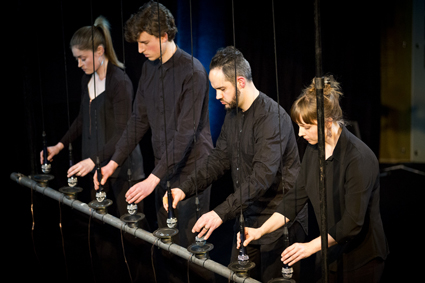
Spaced around the steel and glass mezzanine of Deakin Edge, Speak Percussion were suspended in front of the night sky behind six gleaming percussion batteries. After Luminet’s introduction lulls the audience into expectant wonder, Ughetti begins a gentle pulse on a floor tom. This pulse is eventually taken up at different tempi in other batteries, creating a captivating constellation of musical pulsars. An interjection on wood-blocks also echoes around the room like the light and radio waves that take thousands of years to traverse the galaxy. At other times a roaring snare roll passes between the percussionists and a loud, lone tom strike gives momentary focus to the bewildering sound-scape. The introduction helps give rise to these astronomical metaphors, even though, as Speak Percussion’s Artistic Director Eugene Ughetti explains, the first half was originally composed as Tempus ex machina, a work concerned not with pulsars but with time and space more generally.

The second half of the performance features two pulsar signals, one of which has an Australian provenance. The first is from the Vela pulsar, discovered by scientists at the University of Sydney in 1968, which spins at a rate of 11 times per second. This pulsar is only observable in the Southern Hemisphere and for Speak Percussion’s performance the CSIRO provided a new recording of the pulsar by George Hobbs. Ughetti claims (and I could only get away with this in a journalistic context) that the original recording used by Grisey was made by pulsar expert Dick Manchester, who worked at the Parkes observatory in the late 1960s. The signal sounds like a repeated, clipping sample of static, not unlike something one would hear in a Drum and Bass track.

The second pulsar provides a low, “whumping” sound at a rate of 1.4 rotations per second. For the work’s première in 1991, the signal from this pulsar was broadcast live into the auditorium from the Nançay radio astronomy station in Sologne. Unfortunately, a live broadcast of the Vela pulsar was unavailable for the Deakin Edge performance as the pulsar is not visible at this time of year. At Deakin Edge both signals were diffused by the team of Lawrence Harvey from RMIT’s SIAL Sound Studio.

When the initial metrical spatialisation gives way to the recordings of pulsars, the players are given more elaborate rhythmic phrases. It is as though, after imitating the pulsars (and theatrically conjuring them into the room), the ensemble begins to play along with them. The individuality of the performers comes out, with Ughetti’s dynamic sensitivity and Schack-Arnott’s improvisatory fluidity. But the point of these two sections may not be so much a contrast between machinic imitation and human inventiveness as a contrast between technology and science. While the technology of radio telescopes enabled us to hear the pulsars, scientific conjecture allowed us to interpret and understand them. As Luminet writes in the introduction:

In the electromagnetic tornado given out by a pulsar, the radio waves emitted represent only a whisper, and it is this that is picked up by the instruments. For an astronomer, it is like trying to understand the way a large machine in a factory works by listening merely to the few muffled noises that escape from it. The energy collected is infinitesimal… In 50 years of observations, all the energy gathered by all the radio telescopes in the world is less than that you need to turn a single page of your programme.

In a world where government-funded university science departments pursue narrow techno-industrial aims and objective research centers of global relevance have to be crowd-funded, Le Noir de l’étoile reminds us of the importance of big science—internationally-coordinated, large-scale investigation into the very large, the very small and the very distant—to our cultural and spiritual identity. By 2019 Western Australia and eight countries in southern Africa will be home to the Square Kilometre Array, the world’s largest and most sensitive radio telescope (actually an array of thousands of radio receptors spaced over thousands of kilometres). The SKA will be fifty times more sensitive and will be able to produce surveys of regions of the sky 10,000 times faster than any other existing instrument. We can barely predict what data we will gather, but when we do I hope our scientific and creative imaginations will up to the task of interpreting and understanding it.

Partial Durations is a Matthew Lorenzon/RealTime joint project.

The Safest Ever Show About the World’s Most Dangerous Topic: The Australian Chamber Orchestra’s “The Crowd”

The Crowd
ACO, ANAM and The Consort of Melbourne
Concept by Richard Tognetti
Cinematography by Jon Frank
Directed by Matthew Lutton

In 1960 Elias Canetti published Crowds and Power, a taxonomy of the crowd drawing on anthropology, sociology, philosophy and psychology couched in a stream of lucid, aphoristic prose. Writing in the wake of the Third Reich, Canetti considered the relationship of the spontaneous crowd to the demonic-charismatic leader. He explored, in an unprecedented way, the survivor whose hidden satisfaction provides a new germ of despotic power.

Waving the book around in interviews, the Australian Chamber Orchestra’s Richard Tognetti and the cinematographer Jon Frank promised a fusion of video and music that would address “the gamut of the crowd experience from alienation to the reinforcement of humanity” (to quote the programme). You can imagine my excitement. Finally, Australia’s premier chamber music ensemble would develop a multimedia programme around some historically significant and eminently relevant intellectual grist.

The ACO, students from ANAM and The Consort of Melbourne proved themselves versatile interpreters of the exciting and diverse programme. In perhaps the most interesting exploration of crowd dynamics (because the exploration is immanent to the compositions and the musicians on stage), the orchestra in Ives, Tognetti, Sibelius, Crumb, Schubert, Dean and Shostakovich is whittled down to the intimate quartets, trios and solos of Debussy, Feldman, Leifs and Chopin.

The music aside, the concert was deeply disappointing and even troubling, given the status and resources of the ACO and the Melbourne Festival. Ives’ The Unanswered Question opens beneath Frank’s beautiful, slow-motion footage of street scenes in New York. Faces and gestures emerge from the crowd in high definition and high frame rate detail. The mise-en-scène situates the fundamental antimony of the crowd as that between the unindividuated mass and the feeling individual. The gently emerging voices of Ives’ piece suits the images, but the cinematic gesture is a cliché, giving the impression one is watching Koyaanisqatsi with better music.

Tognetti’s suite (which sounds like something between the Carmina Burana and the soundtrack to The Lord of the Rings) breaks in with thumping timpani beneath a quote from Nietzsche: “In individuals madness is the exception, in groups it is the rule.” Cue footage of Nazi rallies and bodies in concentration camps. The message is clear: Crowds are dangerous. There is nothing in the concert to suggest otherwise, no emancipatory crowd to contrast with the despotic ruler or contemporary political example to put the message into context.

The film then vacillates between interminable footage of football matches, street scenes and images of water, providing a pessimistic and narrow vision of the crowd today. After the tokenistic reference to the political crowd, the real axis of The Crowd is football and nature.

But between the show’s creation in 2010 and reworking in 2013, two important crowd-related events have taken place: The Arab Spring in all its complexity and the increased media hysteria around asylum seekers in all its banal horror. It says something about Australia, about our wilful ignorance of the rest of the world and fear of the crowd that the closest one gets to a spontaneous crowd is a football match or a mosh pit.

We like to talk about crises. Here’s one: The ethico-aesthetic crisis of Australian art music. It is revolting to trot out footage from Nazi Germany and the holocaust in the first five minutes of a concert to demonstrate the violence of the crowd upon the individual—and the charismatic leader upon crowds—and then leave the issue aside for an hour of comic relief. You can’t drop half an H-bomb. The use of images from the Third Reich also suggests that violence is only something that happened overseas and a long time ago. Today it is impossible not to know, despite the current government blackout on the issue, that thousands of people escaping their own crowd-related conflicts are held in woefully inadequate conditions in detention centres in and around Australia. If anything, this issue resonates with Canetti’s ideas about our fear of being touched, the distances we create around ourselves, “invisible crowds” and the self-aggrandising effects of “survival” psychology. Even if it appears impossible to film within these detention centres, surely a clever cinematographer would find ways of referencing the demonisation of this crowd by a few politicians and the media for their own ends.

But wouldn’t that be risky? Wouldn’t that be what crowds are all about?


Partial Durations is a Matthew Lorenzon/RealTime joint project.

Chamber Made Opera: Turbulence

Anneli Bjorasen in Turbulence. Photo by David Young

Chamber Made Opera
Turbulence
Composed by Juliana Hodkinson
Libretto by Cynthia Troup
Melbourne Festival of the Arts
A living room in Northcote

Despite being the closest any of us will come to experiencing a miracle, air travel is marked by boredom and sustained physical discomfort. With its staging of the explosive relationship between a mother and daughter in an apartment only wide enough for five seats and an airline trolley, Chamber Made Opera’s latest Living Room Opera Turbulence explores this banal sort of magic that frames and controls our lives. Composed by Juliana Hodkinson and featuring the versatile voices of Deborah Kayser and Anneli Bjorasen (in her first Chamber Made Opera role), the work is a “first” several times over for the company in its 25th year.

A row of fans along one wall generates a drafty hum that is amplified into an ambient drone by Jethro Woodward’s ever-understated sound design. The audience take their seats, the front row facing a white wall. I wondered where the performance would take place until Bjorasen began to hum, “pshh” and “khh” like the pneumatics of an aircraft beside me. This opening is the first duration piece that I have experienced in a Living Room Opera, providing a welcome contrast to the enchanting kaleidoscopism of previous works. It is also the best environment in which to hear Woodward’s minute control of transparent textures, even in a sound world as saturated as a series of amplified fans. Kayser and Bjorasen’s stereophonic sound effects were a delight, making the central seats the best in the house.

Other sounds endemic to airplanes begin to fill the cabin, such as a baby crying (live and recorded), 1950s cabin announcements and Bjorasen struggling with a packet of nuts. Bjorasen leans as the plane banks to the right, leaving me in an awkward position for several minutes.

Against this background of whirrs, cries and muffled announcements, the opera continues as a duet between mother (Kayser) and daughter (Bjorasen). The couple share text drawn from academic literature on turbulence, the mother singing graciously against a Pocket Piano synthesiser and the daughter growling impetuously into a vintage microphone. The texts provide an underlying theme of chaos and order, along with the observation that “normal times are when disorder wins.” But the opera is set in the 1950s, shortly after the dawn of commercial passenger aviation. Air travel is now more common and accessible than ever before and the world is on average half a degree warmer. We are now faced with the task of explaining the workings of the reading lights and seat levers inside the cabin rather than the turbulent air outside: Why in fact do things work the way they do and why is it so difficult to change our orderly progression towards ecological disaster? Faced with the desertion of our future, are we condemned to sing a solo aria, as does the Kayser when her daughter walks out on her, reminiscing about a “sea as blue as a baby’s eye?” With the sensitivity and warmth of her voice, which it is worth the ticket price just to hear up close, you could imagine Kayser was lamenting the loss of oceans.

As well as introducing a new performer and a new style of chamber opera to Chamber Made fans, the opera is the first Living Room Opera under the new Creative Director Tim Stitz, who made everybody feel welcome before and after the show with a pre-flight talk and post-flight refreshment. Most importantly, Turbulence is the first Living Room Opera to fulfill the company’s claim that the series need not only take place in opulent  living rooms of the Eastern Suburbs. The space is perfectly suited to the opera, or the opera to the space, revealing the incredible power of chamber opera to unite disparate environments through artistic aims.

Turbulence runs until 12 October.