All posts by matthewlorenzon

Unknown's avatar

About matthewlorenzon

I'm a Melbourne-based musicologist and music-writer interested in contemporary music, music theory and philosophy.

Metropolis: Matthew Herbert, The End of Silence

Matthew Herbert
The End of Silence
Metropolis New Music Festival
12 April

The Elisabeth Murdoch Hall at the Melbourne Recital Centre is full of smoke. A pole in the centre of the stage radiates wires to a semicircle of microphone stands by the musicians’ stations including an electronic drum pad, a keyboard and two laptops. Matthew Herbert, Sam Beste, Tom Skinner and Yann Seznec walk on stage in black shirts. Herbert informs us that every sound we are about to hear is made from one six-second recording made by photojournalist Sebastian Meyer of a pro-Gaddafi plane bombing a town (Ras Lanuf) in Libya in 2011. Herbert and his band take their seats and trigger Meyer’s recording.

You can find Meyer’s original recording on his blog. There you can also find a photo of the bomb exploding, which was projected at the end of the concert. As a photojournalist, Meyer tries to communicate the experience of conflict, its noise and movement, to those who were not there. As he says on his blog, the silent stillness of a photograph is an imperfect medium for this task, whereas a sound recording captures the inarticulate suddenness of war, its chaos and sheer, brutal volume.

The last echoes of the raw sample die in the smoky hall. In fact, Herbert loops the few seconds of the bomb falling and exploding several times before fading it out. The task of journalistic communication done (assuming, following Meyer, that the task of photojournalism is to provide as unmediated an account of an experience as possible), what could Herbert’s intentions be in continuing? As I have written earlier, Herbert’s “One” series consists of sounds with ethical implications and ethically “neutral” music united by the technological medium of the sampler. Just as we cannot ignore the origin of the Ras Lanuf sample, nor can we ignore that Herbert’s music is fundamentally dance music to be enjoyed.

The crackle of the distorting tail end of the sample fades, leaving a desolate hum ringing in the hall. Cicada-like chirps punctuate the space. Seznec pulls on the wire running from his station to the central pole to pitch-shift samples from the roar of the bomb, creating layers of swelling white noise.

One becomes aware of a high-pitched tone in the recording. Is it somebody whistling? Does it come from the bomb itself? At a lower pitch it sounds like a scream, that of a woman or a child. It is repeated higher, lower, like a stain on each stretch of white noise triggered by Seznec. From this abstract plane the raw sound of the bomb comes back, threatening the safe enclosure of processed sound.

Skinner plays a pulse like a heart-beat on the electronic drum pad. Then, at once, as if by reflex, the band starts a little head-rock. Beste flicks his head back as waves course through his body. The others gently swing their heads from side to side. More smoke billows into the blue spotlights as Herbert sends two shockingly loud samples of the bomb crashing through the auditorium. The pulse breaks down and a series of gut-moving rumbles assail the audience, rattling the doors of the hall, before breaking up into glitchy static.

The next episodes reference Herbert’s micro-house roots with a menacing industrial flavour. The sample is transformed into metallic squeals, crashes and gong-like tones. A percussive sound like a 44-gallon drum is teased out of the sample  (Ras Lanuf is based around an oil refinery). At times the screaming whistle returns. “Cracks” are lit up in the walls of the hall as the set builds to a thrilling, rhythmic climax. The sounds break apart and all that is left is a low hum. Herbert coughs once and pushes his chair back. A couple of short bows and the photograph of Ras Lanuf fades up on the back wall.

Herbert leaves it up to the audience to determine the relationship between the Ras Lanuf sample and the music. As the program reads, “[o]n first hearing the recording is terrifying, but at the end of the program once Herbert has finished mixing, layering and manipulating the sounds will you still feel the same way?”

There is no doubt that Herbert intends to be critical of the former Gaddafi regime because he says that the Ras Lanuf sample “punctures the safe veneer of distance” between us and the “atrocities committed by dictators in the Arab world during the Arab Spring.” Nevertheless, there is nothing in The End of Silence, neither its militaristic dance beats nor its eerie ambience, to suggest that it is not a paean to the war plane, a song of thanksgiving to pro-Gaddafi forces. We could very well say that it follows in the futurist tradition of praising the power and majesty of the noise of war.

For my own part I reacted differently to the different instruments on stage. Herbert’s exploration of the sonic properties of the original sound seemed to me like an entirely appropriate exercise. He works through the sound like a traumatic event, though purely sonically. I cannot pretend that the force of the sound relates at all to the physical and psychological impact of the original bomb on somebody in Ras Lanuf. Seznec’s tactile manipulation of the sound using the wires strung about the space was similarly interesting as it explored the gestures appropriate to that particular, abstract sound. The visceral pleasure Seznec took in stretching and bending the wires, however, seemed grotesque. A percussive sound may be made from any sample whatsoever and so Skinner’s rhythms seemed completely superfluous. There were moments of unmistakable beauty where a breathy, bass-flute-like tone was played by keyboardist Beste. Those I liked the least.
Metropolis: The Wild, Pornography

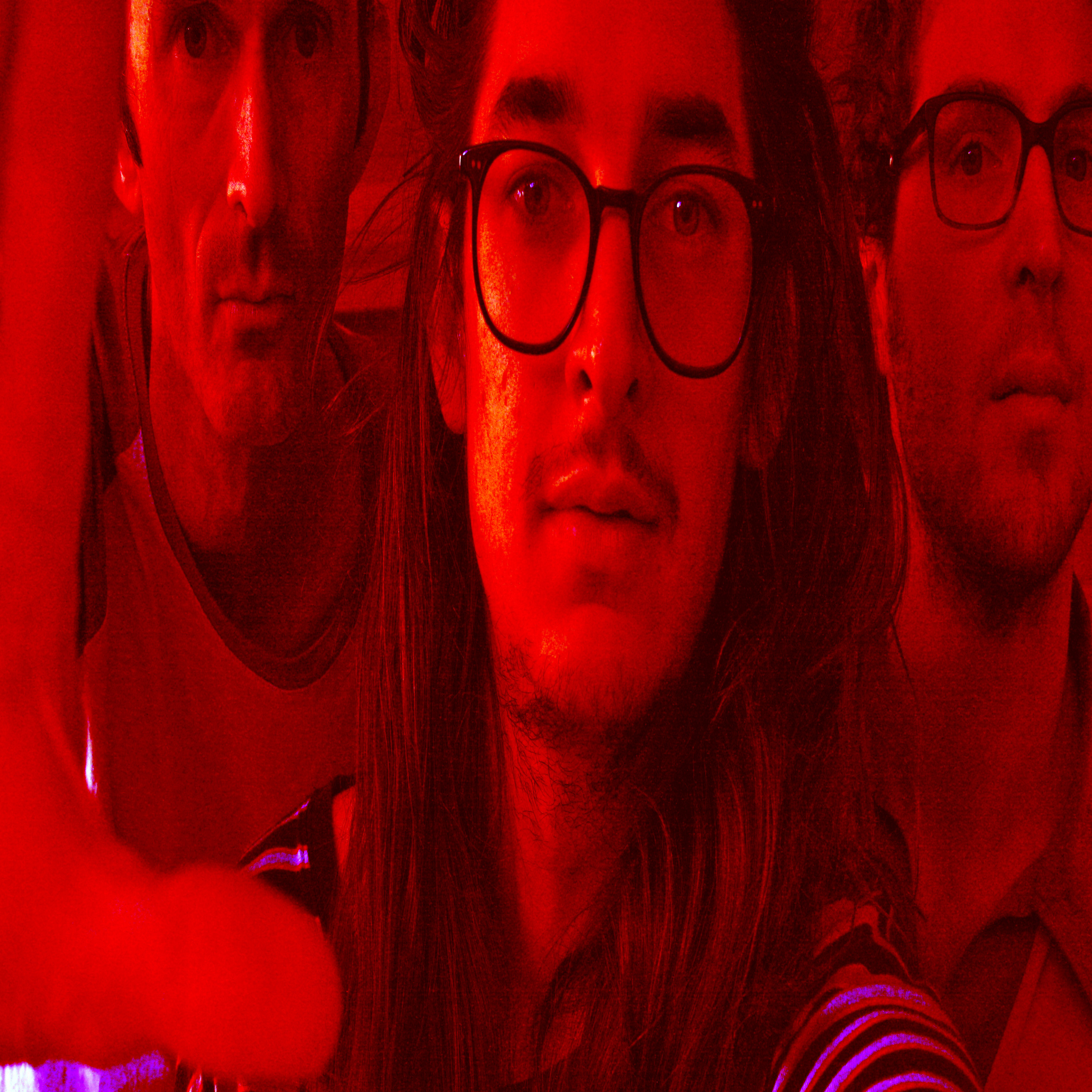
The Wild: Eric Griswold, Ritchie Daniell and Sam Pankhurst. Image courtesy of Melbourne Recital Centre
The Wild: Eric Griswold, Ritchie Daniell and Sam Pankhurst. Image courtesy of the Melbourne Recital Centre

Eric Griswold is not alone when he says that the tribal drums, flanged guitars and beyond-the-grave reverb of The Cure’s 1982 album Pornography “hit a power-spot” in his suburban-adolescent psyche. Even if The Cure’s output was usually boiled down to a few de rigeur tracks on scratched mix-CDs by the time of my own suburban-adolescent encounter with the band, it was—and judging by the audience at last night’s concert, is probably still—an obligatory rite of passage for every disaffected youth. It is then entirely appropriate that Eric Griswold teams up with two younger Brisbane musicians, Ritchie Daniell (drums) and Sam Pankhurst (bass), as The Wild to reimagine the album in an extended piano trio.

To recreate the guitar’s distortion and flanging, Griswold prepared his Yamaha (presumably the Recital Centre didn’t let him near the Steinway!) baby grand with paper and card, holding down the sustain pedal to imitate the echo of Robert Smith’s voice. A range of techniques gives the songs a density not found on the original, relatively transparent recording. In One Hundred Years Griswold plays on a cluster of notes within the range of a fourth (about the width of a hand with the fingers held loosely) , occasionally punctuating the tight, writhing group of notes with higher or lower tones. At other times he uses forearms and palms on the black keys of the piano, creating a broad shimmering surface channeling Debussy more than Smith.

Griswold produces a remarkable polyphonic effect in Siamese Twins by playing on the keys while also plucking strings inside the piano. Pankhurst takes over the chords at this point, which are given a seismic inevitability by the deep tones of the double bass.

The Figurehead is the most conventionally-reproduced of all of the songs, except for a period of knuckle-bashing on the piano. The seeming lack of invention in The Figurehead is more than compensated for in A Strange Day by Daniell’s exciting extended drum kit solos. Bells, cloths, prayer drums, soft mallets, brushes and elbows all come out to create a sputtering, thudding, polymetrical feast, settling into a 120bpm backbeat for only four bars to allow a fragment of the chorus to appear before being swallowed again by the glorious cacophony.

As well as taking the audience on a nostalgic journey, The Wild’s Pornography traces a social path from alternative rock to New Music that has provided contemporary classical music with some of its most active and innovative players. It shows that experimentation with sound sources and musical structures is a common passion from alternative rock to art music, from the suburbs to the city.

Metropolis: Thomas Adès, Life Story

Pablo Picasso, Musiciens aux masques, MoMA. Photo by Rolf Müller. http://en.wikipedia.org/wiki/File:Picasso_three_musicians_moma_2006.jpg

Thomas Adès
Melbourne Symphony Orchestra
Life Story
Metropolis New Music Festival
11 April

All manner of contrabass woodwind came out for the first of Thomas Adès’ three Melbourne concerts. The comical, murky instruments ensured a night of dramatic vocal accompaniment and idiosyncratic instrumental writing. Almost entitled “Some of my Favourite Things,” the concert highlighted Adès’ lifelong interest in light-hearted and miniature forms.

To open the concert, Adès took the opportunity to conduct a piece he has admired since childhood, Stravinsky’s Ebony Concerto, originally composed for Woody Herman’s band The Herd. Members of the Melbourne Symphony Orchestra provided a fine substitute-Herd from the racing, ephemeral time signatures of the opening movement, through the trudging, sorrowful second movement to finale’s pealing sunrise.

From the twentieth-century canon to a contemporary Australian work, Jeanette Little’s Acid Dream had its second charmed outing, this time under Adès’ baton. Inspired by the shifting realities of Philip K. Dick’s novels, the cinematic piece ranges eerie instrumental effects around the fundamental contrast of subterranean contrabassoon with seraphic celesta. The harp contributes a meandering flurry of notes in its highest register like a searching tentacle, over-blown flute notes punctuate the air and I don’t even know where the deflating balloon sound came from.

Two vocal works sung by soprano Hila Plitmann provided the audience with serves of nostalgia and humour. Oliver Knussen’s Hums and Songs of Winnie-the-Pooh is a retreat into the composer’s memories of childhood, with a series of vignettes from A. A. Milne’s famous children’s stories. Words turn to hums and disappear into clouds of instrumental colour, as though into a dream. At times the transformation is explicit, as when Plitmann sings “Climbing and climbing he climbed and climbed,” singing higher and (remarkably) higher herself, until she strikes a small triangle and the flute takes over the last, impossibly high note. Adès’ Life Story is not nearly so innocent, setting Tennessee Williams’ very different bed-time story of what happens after two people have been “to bed together for the first time, without the advantage or disadvantage of any prior acquaintance.”

Nancarrow’s Studies no. 6 and 7, played masterfully by Adès and Zubin Kanga,  were accompanied by Tal Rosner’s and Sophie Clements’ geometric visuals. Nancarrow’s uncharacteristically dreamy Study no. 6 inspired bands of cathode-ray pastel colour that slowly revealed landscapes of hills and telegraph wires from a journey to Mexico, where Nancarrow lived in political exile (and then, after a time, just for fun) from the 1930s.

Study no. 6 by Nancarrow. Video by Sophie Clements and Tal Rosner. Music by Conlon Nancarrow, performed by Thomas Adès. www.sophieclements.com

Study no.7 was accompanied by a delightful design of lines, squares, triangles and circles inspired by Nancarrow’s piano rolls.

Study no. 7 by Nancarrow. Video by Sophie Clements and Tal Rosner. Music by Conlon Nancarrow, performed by player piano. www.sophieclements.com

Adès’ Concerto Conciso is, despite its name, a sort of concerto grosso contrasting a jazz band ripieno with a string quartet concertino. Adès played on this ensemble’s ability to shift between the sound worlds of jazz and late romantic symphonic writing, contrasting grooving percussion and instrumental declamation with icy string tremoli and glacial rising brass lines. The piece made me think of Picasso’s Musiciens aux masques, with Adès as the guitar-playing harlequin sandwiched between the singing monk and the clarinet-playing pierrot.

Matthew Herbert and the Empty Instrument

Image courtesy of Melbourne Recital Centre
Matthew Herbert. Image courtesy of Melbourne Recital Centre

An interview with the DJ, composer and Creative Director of the BBC Radiophonic Workshop Matthew Herbert is always interesting to read. He may question the role of factory settings in a sampler, describe the musical potential of a pencil, criticise the volume and redundancy of music on iTunes or define the bpm of his plumbing. He has also formulated some of these attitudes into a loosely prescriptive “Personal Contract for the Composition of Music (Incorporating the Manifesto of Mistakes),” found on his website and in his concert programs.

Alongside these technological and musical pronouncements are ideas about the political or ethical engagement of his music. The album One Pig (to be performed live at the Metropolis New Music Festival on 13 April) is sampled from the 20-week life cycle of a pig destined for the table. The soon-to-be-released End of Silence (Metropolis, 12 April) is based on a recording from the war in Libya in 2011. What is the relationship of these two bodies of statements and how do they come together in his musical works? In Herbert’s albums, music and ethics function like the two independent hemispheres of the brain, with the technology of the sampler acting as the corpus callosum making them appear as one walking, talking, contradictory being.

Herbert’s statements on technology show how the sampler clarified his relationship to music on the one hand and found sounds on the other. In a recent interview, Herbert described his Damascean encounter with the Casio FZ-1, a sampler with a microphone input. Instead of using the prefabricated sounds of the sampler, he recorded himself biting an apple:

“I pitched it down three octaves or so and, for the first time, I heard the world slowed down. I heard a noise that was way more engaging on a philosophical level than anything I’d ever heard before. […] I suddenly realised the sampler was an empty instrument. If you write music on a piano or a French horn, it will always sound a certain way – like a piano or a French horn. But the sound of the apple wasn’t like anything else I’d heard. I realised the sampler was just a tool. All it says to you is, ‘What do you want to do with me? What sounds do you want to make?’ With the sampler, I could make music with the world.”

A musician could just as easily have fetishised sound and said that the sampler was purely a tool for its exploration. On the other hand, they could have ignored the sampler’s microphone all together and focus on its musical properties. Herbert’s realisation that the sampler was an “empty instrument” both opened the way to his ethical engagement with pigs and jet fighters and allowed for his exploration of electronic music in night clubs and on the radio. As his biography states, Herbert’s ethical relation to sound is about bringing the sounds of the darker, problematic corners of the world into visceral contact with the listener:

“When everything I read politically and watch and hear has been absorbed, there comes a point where you must feel it viscerally. Otherwise you are closed to the horrors of it and thus closed to the possibility of action, closed to the idea that you could make a difference or could have prevented the outcome. This internalising of the struggle, the friction, the melancholy I feel should be at the emotional core of the work. After all, I am making music and not writing a newspaper article. But with the invention of the sampler, I can now explicitly root my work in the literal, critical present. I can describe the real in the frame of the imaginary.”

However, one rarely experiences horror when listening to Herbert’s music. One feels uneasy listening to a drum made from a pig you just heard being born. However, this unease requires the knowledge of what you are listening to in order to be effective. Divorced from its context Herbert’s music is eminently listenable. Instead of bringing horror to our speakers, Herbert’s music is gently thought-provoking propaganda.

You might say that the musical side of Herbert’s work does not follow the full consequences of its ethical side. Then again, would you want it to? Would we like another Survivor from Warsaw (or in this case,  A Survivor from Woolworths, or A Survivor from Ras Lanuf) where music strives to be the equal of its subject?

Metropolis: Matthew Herbert, One Room

One Room
Matthew Herbert
Metropolis New Music Festival
8 April

The Melbourne Recital Centre’s Made of Music commission asks musicians to engage with the Elisabeth Murdoch Hall and the hoop pine from which it is made. Using technology developed by the Vienna-based artist Bartholomäus Traubeck, data about the ring width, colour and texture of a slice of hoop pine is given to the composer for sonification. Inspired by the ephemeral nature of live performance, Matthew Herbert’s response to this brief was to sample previous recordings made in the hall and combine them with harmonic material derived from the hoop pine data.

Dressed in white dress shirts and bow ties, Herbert and his four musical helpers triggered fragments of piano, strings and winds with an electronic drum kit, hacked game controller and a contraption using a sprung cord for pitch modulation. The origins of most sounds were obscured by the short sample time and processing, though faint echoes of choirs, traditional Chinese instruments, bells and an infamous cougher from a Ravel concert came through the mix. The ensemble grooved and glitched through a series of percussive and ambient atmospheres before driving to a booming finish with the help of what sounded like a mighty double bass sample. The harmonic material played on a piano melded smoothly into the sometimes late-romantic, sometimes ambient-jazzy soundscape.

One Room is the first and least political of Herbert’s three concerts at the Melbourne Recital Centre. The remaining two, The End of Silence (12 April) and One Pig (13 April) will see similar operations performed upon very different sound sources: Sebastien Meyer’s sound recording of being bombed by a pro-Gaddafi plane in Libya in 2011 and the twenty-week life cycle of a pig. Over the next two days I will be exploring Matthew Herbert’s musical rationale in these pieces and taking a look at his self-restraining “Personal Contract for the Composition of Music (Incorporating the Manifesto of Mistakes).”

Metropolis: Ensemble Offspring, Posh Playground

Photo by Oliver Miller
Lamorna Nightingale. Photo by Oliver Miller

Posh Playground
Ensemble Offspring
Metropolis New Music Festival
8 April

The Metropolis New Music Festival got off to a playful start with Ensemble Offspring in the salon of the Melbourne Recital Centre. Posh Playground explores the work of a circle of UK-based composers deploying minimal pitch and rhythmic material in theatrical and playful ways. For example, the scores of Matthew Shlomowitz’s Letter Piece 8 (Sit up Stand Down) are sequences of letters for which the performer determines the corresponding actions or sounds. Lamorna Nightingale, Jason Noble and Claire Edwardes chose a suitable vocabulary of arm-waves, trills and toots to fill out the score, giving the piece, in keeping with the program’s title, the rhythm and look of a children’s game.

Laurence Crane’s Three Melodies and Two Interludes is an exercise in extended ternary form given a haunting character by the modal melodies of the alto flute and the dirge-like accompaniment of the vibraphone.

Bryn Harrison’s Five Miniatures in Three Parts contrasted planes of soft modal colour, leading well into the gesturally frantic but formally static Reeling for clarinet and hi-hat by Christopher Fox.

The children’s games returned with Jennifer Walshe’s EVERYTHING YOU OWN HAS BEEN TAKEN TO A DEPOT SOMEWHERE, consisting of eleven short theatrical scenes employing party horns, glitter, bubble blowers and a computer game on an iphone. The scenes, with names like “Study Hard & Work Like Killers” and “FACE! HANDS! FACE! HANDS!” reminded me of the UK’s Forced Entertainment, except that Forced Entertainment are funnier and have a knack of giving the seemingly-redundant new meaning throughout the duration of a performance. Perhaps EVERYTHING YOU OWN should be three hours long.

Posh Playground made me question the value of commentary in concerts, which I am usually in favour of. Ensemble Offspring speak well and succinctly, providing commentary on each piece before playing it. Such commentary could be grouped in sections or come after the piece to improve the flow of the program. The program was a welcome introduction to a subtle and beautiful body of work.

Forest Collective, Shared Sounds

2013 0407 Shared SoundsShared Sounds
Forest Collective
Abbotsford Convent
7 April 2013

For their 2013 season the multi-arts Forest Collective bring chamber music, visual art, theatre and opera to the sprawling Abbotsford Convent. Opening the season is Shared Sounds, a juxtaposition of established and emerging British and Australian composers. Alongside this explicit rationale is the concert’s implicit exploration of the organic and the elemental.

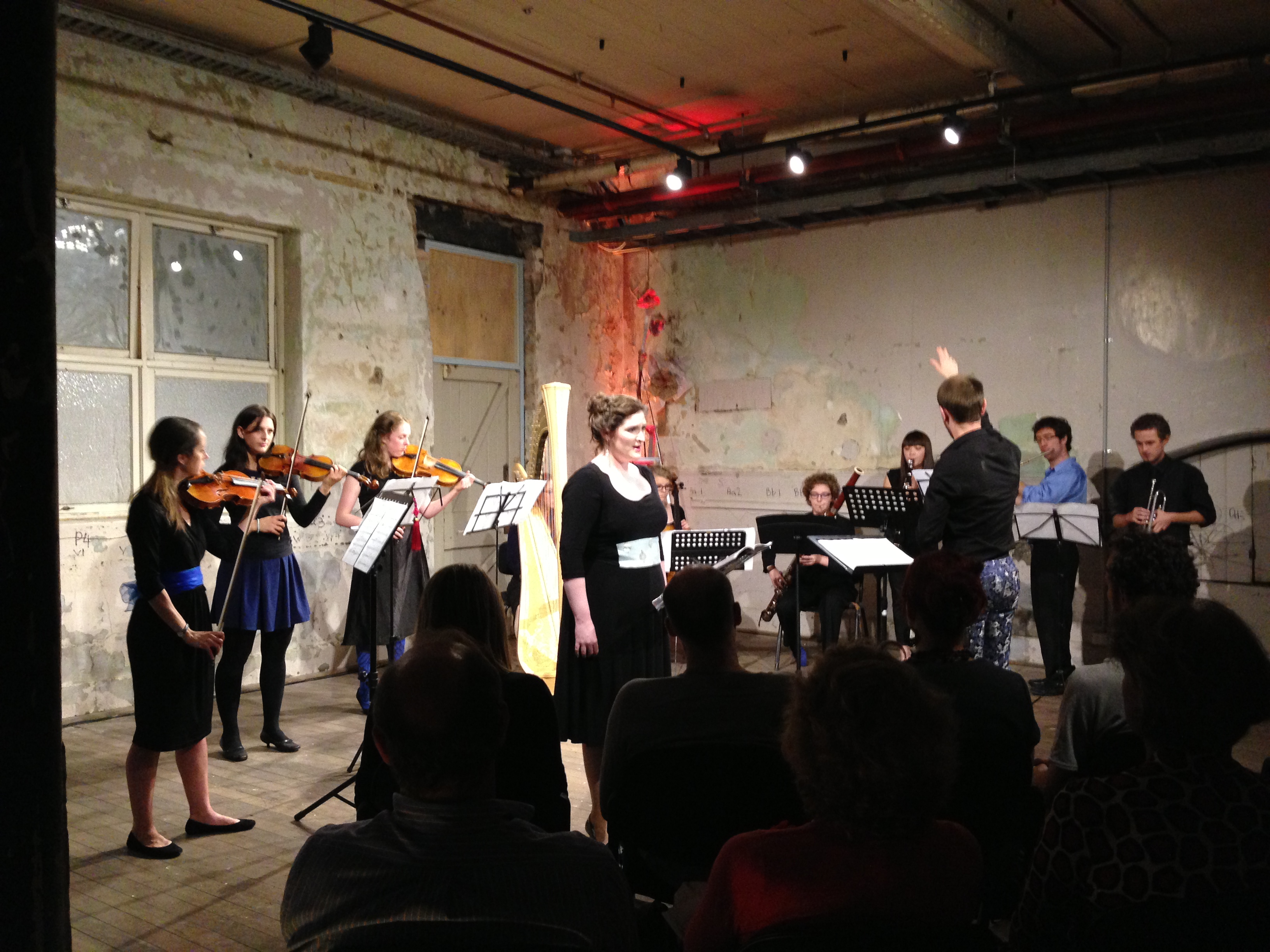
Stephanie Osztreicher transformed the peeling walls of the convent’s Industrial School into a tulgey wood of ladders, music stands, paper flowers and projections as the evening’s autumn storm rolled overhead. Travelling to the concert, the rising smell of “petrichor” (meaning “dry earth,” a term coined by Australian scientists to describe the smell of rain after a dry spell) was an olfactory prelude to the rain-themed music of the Forest Collective’s ensemble in residence of the same name (Jess Fotinos, harp, Alexina Hawkins, viola, Rowan Hamwood, flute).

Fotinos and Daniel Todd (tenor) opened the concert with the spiritual transformations of St. Narcissus into tree, fish, girl and dancer in Britten’s Canticle No. 5 for tenor and harp. Britten’s evocative harp writing was juxtaposed with May Lyon’s own mercurial word painting in A Dream Within a Dream, based on a poem by Edgar Allen Poe.

The ritual continued with Benjamin Harrison’s improvisation for solo trumpet, a masterful exploration of whistling wind, echoing brays and muted flatulence.

A sequence of chamber works by Barry Conyngham, Conyngham’s teacher Toru Takemitsu, Mark-Anthony Turnage, Johanna Selleck and Evan Lawson highlighted the strength of the “collective” as an ensemble, corralled and conducted by Lawson. A highlight for me was Turnage’s Three Farewells for flute, clarinet, harp and string quartet. Lush harmonies and timbres filled the concrete chamber before clearing for a pointed and intimate encounter with Hawkins’ viola solo, with grumbling accompaniment from Ayrlie Lane’s cello.

While not quite the “interactive chamber music experience” promised by the season program, Shared Sounds plunges the audience into a rich atmosphere of water, wind and trees deserving of the collective’s name. The program also demonstrated a continuing interest among young composers in finding new effects and manners of working with text within an extended-tonal style.