All posts by matthewlorenzon

Unknown's avatar

About matthewlorenzon

I'm a Melbourne-based musicologist and music-writer interested in contemporary music, music theory and philosophy.

Johannes Moser, Lutoslawski Cello Concerto

johannesmoser2
Johannes Moser, image courtesy of ANAM.

Johannes Moser, cello
Benjamin Northey, conductor
ANAM Musicians and Orchestra
South Melbourne Town Hall
Friday 24 May

The program is daunting: One of the most famous cello sonatas, followed by one of the most difficult cello concertos, followed by one of the most important chamber works of the past century-and-a-bit. But the cellist is astonishing, the conductor fearless and the orchestra excellent, so what are you going to do?

From the first notes of Shostakovich’s Sonata for cello and piano in D minor it was evident this was to be no ordinary recital—though that’s exactly where half the audience would have heard the famous piece many times. Johannes Moser’s performance began slightly faster than usual, though the tempo didn’t compromise the cellist’s fluid, light articulation. Do not be fooled by the “intense, introverted cellist” promotional photo, Moser plays directly to the audience, making eye contact and even occasionally lunging at them, when the music seems to call for it. The playful first movement made way for the ferocious reeling of the second. Light, brittle spiccato figures stood out like sardonic laughter. The Largo third movement was a testament to good taste. Every line was shaped, every dissonance perfectly stressed as the movement meandered towards its grim conclusion. By contrast, Finale demonstrated the fact that if the melody is simple and repetitive enough you can get away with the most outrageous articulation and dynamics. The audience will fill in the notes they do not hear. As in comedy, it is good to reward the audience for meeting you half way.

The Lutoslawski Cello Concerto is a feat in semi-aleatoric twentieth-century orchestration, with remarkable effects including prickling, teeming clouds of string pizzicati, blaring brass heterophony, unorthodox percussion and woodwind attacks like splattering paint: So much colour from a piece that begins with plodding solo cello Ds marked indifferente. While these sounds are standard New Music fare, the Lutoslawski Cello Concerto never ceases to sound fresh. Part of this currency derives from the dynamic interplay of the soloist and the forest of sounds around them, a dynamic that conductor Benjamin Northey describes as the relationship of the individual and the “oppressive” masses. A problem with this interpretation is that the orchestra only enters tutti in the finale of the piece, an effect made all the more shocking by the fact that the orchestral colours are sparse and individuated up until that point. There is some very obstinate brass throughout, for sure, but there are also some conciliatory woodwind, playful percussion and serene string textures. With its bipolar, paranoid cello, chattering brass returning like a repressed trauma, cast of orchestral characters, “chase scene” and final destruction, the piece would make a good soundtrack for a Hitchcock movie. Both the orchestra and Moser played their parts perfectly, with bow hair flying and barely a musician not short of breath at the end. The audience’s pulses were just as high.

After an interval we were treated to the piece that started it all, Verklärte Nacht by Arnold Schoenberg. Here the ANAM students’ sensitivity and endurance were called upon to sustain Schoenberg’s exposed late-romantic lines. It was for me, as for the rest of the audience in the packed South Melbourne Town Hall, a transfigured night.

Concert guide: 29 May–4 June

A curated list of upcoming concerts. See also the Australian Music Centre concert calendar and the New Music Network concert series.

Saturday 1 June. The Astra Chamber Music Society present paintings and electronic works by Catherine Schieve and Warren Burt, with choral works by Ravel, Robert Carl, Will Ogdon and the rollercoaster of Dan Dediu’s Harmonic Labyrinth and Fugue. At the Meatmarket, North Melbourne, Vic, 5pm. Second show Sunday 2 June.

A programme of Western and non-Western musical and choreographic fusions in The Meander Project at South Melbourne Town Hall, Vic, 6pm. Clarinet, viola and double bass meet shamisen, balafon and classical Indian singing under the direction of ANAM fellow Linda Andonovska. Guzheng meets contemporary dance in a new piece by Mindy Meng Wang and Victoria Chiu.

Monday 3 June. Callum G’Froerer presents new and not-so-new music by Feldman, Saunders, Holz, Lachenmann, Paul and Carter. Improvisations by Callum G’Froerer, trumpet; Jon Heilbron, contrabass; Jenny Barnes, voice and Jon Smeathers, electronics. Hosted at the new warehouse space He & She & The Big Apple on the banks of Merri Creek, Northcote, Vic, 7pm.

Petrichor, Garden of Joy and Sorrow

Petrichor Trio (at the Abbotsford Convent), photo by Jessica King

Petrichor Trio
Conduit Arts
Rowan Hamwood (flute)
Alexina Hawkins (viola)
Jessica Fotinos (harp)
Wednesday 22 May

Petrichor’s recent concert at Conduit Arts found young and established composers alike asking themselves what on earth to do with a harp. Petrichor’s “take no prisoners” style of performance charged the small space of Conduit Arts with an atmosphere of absolute concentration.

Julius Millar’s Two Pieces for Flute, Viola and Harp contrasted a soundscape haunted with apparitions of clusters and string tremoli with a rhythmic piece based around a “ticking” harp ostinato. Sometimes the viola would join the harp in a hocket figure, or soar away on a legato line. Well-developed counterpoint between the flute and viola provided a moment of intense interest that then exploded into a spectacular cacophony on all three instruments.

Barry Conyngham’s Streams cast the harp in a similar role, as the pulsing accompaniment to contrapuntal play between the harp and viola. Conyngham transitions fluidly between such textures and layered trills with swelling dynamics and glorious open chords cut short by the idiomatic harpistic string-clang, which has to be heard to be believed (and if you go to harp concerts, will be believed more often than you wish).

Evan Lawson’s Skinnis for Flute, Viola and Harp (now on its second outing) was the only piece to utilise the harp’s majestic glissandi and full, ringing chords. These kitschy effects were welcome after the crystal-clear articulation and motoric effects of the “bean-counting harp.”

Sofia Gubaidulina’s The Garden of Joy and Sorrow canvassed all of these possibilities for combining flute, viola and harp, then developed many more through a series of vignettes punctuated by spoken German phrases. A particularly fascinating sound was an extremely fast phrase on viola, played with a very fast bow to produce a “squeaky” sound like a tape on fast-forward, above a machine-gun tattoo on the harp with paper woven between the strings.

The program also included a series of solo works including Gordon Kerry’s Antiphon for viola, Salvatore Sciarrino’s Canzona di Ringraziamento for flute and Suart Greenbaum’s Church at Domburg for harp. In all three cases the skill and conviction of these ANAM-trained musicians was in evidence.

Concert guide: 22–28 May

A curated list of upcoming concerts. See also the Australian Music Centre concert calendar and the New Music Network concert series.

Wednesday 22 May. New New Music ensemble Petrichor are performing works by Gubaidulina, Kerry, Aronowicz and Lawson tonight at Conduit Arts, Fitzroy, Vic. 8:30 start.

Thursday 23 May. Drawing on experiences in Australia, Norway and Iceland, Luke Howard presents compositions for electronics, strings, piano and guitars from his album Sun, Cloud at the Melbourne Recital Centre from 7:30pm.

Double bassist John Heilbron curates a night at Conduit Arts, Fitzroy, Vic, from 8:30pm.

Friday 24 May. Cellist Johannes Moser performs, amongst other things, the Lutoslawski Cello Concerto at ANAM, Vic, from 7pm.

Saturday 25 May. Chamber Made Opera Records releases Ida Duelund’s album of Winterreise covers at a living room in Williamstown, Victoria, at 5pm. Concert includes works for piano by Chris Dench performed by Peter de Jager. Address revealed upon booking.

The Australia Ensemble perform works by Sculthorpe, Edwards, Schultz and Munro at 7pm in the Sir John Clancy Auditorium, University of New South Wales. Also, a performance of a new dance collaboration between composer John Peterson and choreographer Sue Healey.

Manteia curate Conduit Arts, Fitzroy, Vic, with John Heilbron from 8pm.

Laura Altman and Monika Brooks perform experimental textures for clarinet and accordion at The Old Darlington School at the University of Sydney, Darlington Campus, from 8pm as part of the New Music Network series.

Sunday 26 May. Sydney’s Volta Collective present works by Russell Phillips, Lachlan Hughes, Martin Sheuregger and Morgan Krauss at South Melbourne Town Hall from 2pm.


Victorian Opera, Nixon in China

Nixon in China, Photo by Martin Philbey
Nixon in China publicity, Photo by Martin Philbey

Nixon in China
Victorian Opera
Her Majesty’s Theatre
16–23 May

Natural minor scales rise ominously beneath a blood-red curtain. Slowly, a chorus in Zhongshan suits emerges from between the fiery drapes and intones Mao Tse-tung’s “Three Rules of Discipline and Eight Points for Attention,” the fundamental guidelines of the Chinese Red Army from 1928. Dropping subito piano and slowly approaching the audience, the chorus chants: “The people are the heroes now, Behemoth pulls the peasant’s plow.”

The awesome serenity of this opening evokes the mythology that China projected both to itself and to the West during the purges of the Cultural Revolution. It was into the long aftermath of this slaughter that Richard Nixon descended in 1972 and introduced a new layer of mediatised, political heroism through the broadcasting of the presidential visit (as Nixon (Barry Ryan) sings, “News has a kind of mystery”). Victorian Opera’s production is faithful to a third layer of mythology—after China’s propaganda and Western mediatisation—that John Adams and Peter Sellars inaugurated in 1987 to reflect the larger-than life image of the figures shown on the receiving end of the television. Victorian Opera’s production achieves a high level of historical accuracy in design and performance, from Mao and Nixon’s covered arm-chairs by set designer Richard Roberts, to Mrs Nixon’s ’70s outfits by costume designer Esther Marie Hayes, to the general recreation at Her Majesty’s Theatre of the opera’s previous incarnations by director Roger Hodgman. Even coming from a generation that didn’t grow up in the shadow of Nixon and Mao, the opera appeared relevant in its presentation of the conflict of humanism and political principle and the mediatisation of politics.

The drama of the first act relies on the audience’s acceptance, through their own experience of the era, of the importance of Nixon’s visit. Today Nixon’s dramatic entry on Air Force One is trivialised somewhat by the knowledge that for many years China and America had been trading table tennis players in an initiative now referred to as “ping-pong diplomacy.” I could certainly have exchanged Nixon and Mao’s duet about government bonds for an operatic game of table tennis. Baritone Bradley Daley expertly embodies the ailing Mao, though his villainous entry to thundering timpani necessarily had to contrast with the footage of Nixon and Mao’s actual meeting, where the Chairman laughs and chatters excitedly and the President smiles and fidgets nervously.

But the opera breaks down its own myths soon enough. The monumental first act, focusing on Nixon and Mao, is juxtaposed with an irreverent, “feminine” second act dealing with the wives of the protagonists, Mrs Nixon and Chiang Ch’ing. Here the true heroine of the opera, Mrs Nixon, presents the fundamental opposition of the opera, which is not Democracy and Communism, but a sort of bleeding-heart humanism and the political principle of equality, an opposition that sees no easy resolution. Mrs Nixon is initially sympathetic to the communist principle of equality, while also upholding man’s liberties. Touring a factory she “forsees a time when luxury dissolves into the air like a perfume” while people are free to speculate on the economy. The casting of Kissinger as the slave driver in Chiang Ch’ing’s revolutionary ballet The Red Detachment of Women quickly puts an end to this dream. Mrs Nixon asks “doesn’t that look like you know who?” as Kissinger (Andrew Collis) rises from his seat and enters the ballet. This leaves an empty seat next to Chiang Ch’ing and the Nixons, a reminder that the roles of oppressed and oppressor are so many places within larger economic and political structures waiting to be filled. The humanist Mrs Nixon does not realise this when she mistakes the play for reality and runs over to the beaten peasant girl. The Nixons exit as the peasant girl is armed and takes aim at the tyrant.

This unresolvable middle ground is also represented by Chinese Premier and peace-broking middleman Zhou Enlai, the only character to escape ridicule. Mao is portrayed as a mildly-expressed lecher, patting his female aide on the knee and referring to Madame Mao as “that tasty little starlet.” Nixon passes Kissinger small change for playing with the “backroom boys.” Tiffany Speight as Pat Nixon and Eva Jinhee Kong as Chiang Ch’ing give such stunning performances that you almost forgive Goodman their shallow characterization as soft-hearted ditz and fanatical harpy.

Not only is the conflict between humanism and political principle a perennial issue, Nixon in China remains relevant because it witnesses the birth of the sort of mediatised politics smothering political debate in Australia today. As Nixon’s speech at the state dinner was transmitted via satellite around the world, so every movement of a leader today is scrutinised and blown out of proportion, leading to the exaggeration of the trivial and the banalisation of the grandiose. As one audience member remarked on leaving the theatre: “Can you imagine someone doing that with Gillard or Abbott?” Actually, after watching the 1971 World Table Tennis Championship, I think I can.

Australia Council recognises scary music

Three proponents of New Music are recipients of this year’s Australia Council for the Arts Creative Fellowships. Percussionist and composer Eugene Ughetti, composer and multimedia artist Robin Fox and composer Amanda Cole feature among the eleven awards of $60,000–$100,000 each.

The awards are notable as recognition by the Australia Council of the situation on the musical ground where ever-increasing audiences have been exposed to and enjoyed “difficult” New and experimental music over the past ten years. This has been thanks to the efforts of a generation of agitators like Ughetti and Fox; ensembles like Ensemble Offspring, Synergy Percussion, Clocked Out and Speak Percussion and festivals like the Totally Huge New Music Festival, Liquid Architecture, Aurora and MONA FOMA. Most importantly, it has only been possible because of the quality and energy of the teachers of all these New Musicians and the composers they have championed—some of the very scariest Darmstadt pedigree and who have not been so lauded—including Keith Humble, Warren Burt, Chris Dench, Lawrence Whiffin, Fritz Hauser, Liza Lim, John McCaughey, Thomas Meadowcroft and Andrian Pertout.

Concert guide: 15–21 May

A curated list of upcoming concerts. See also the Australian Music Centre concert calendar and the New Music Network concert series.

Wednesday 15 May. Composer Leah Barclay leads a musical investigation into water security in India tonight at 6pm with The Dam(n) Project at Ian Hanger Recital Hall, Griffith Conservatorium of Music, QLD. Part of the Encounters: India series.

There will be a cross-cultural exploration of the static and shifting textures of drones at the Conservatorium Theatre, Griffith Conservatorium of Music, QLD. I love this write up on the AMC calendar: “Beginning with the oldest known drone in the world, the didgeridoo, this program is a celebration of string playing, with that prince of cellists, Rohan de Saram, presiding over a veritable palace of cellists. An Indian first half showcases music especially written for Rohan. It is balanced by an Australian second half in which the raw energy of Richard Vella is calmed by the erotic meditations of Peter Schaefer.” Part of the Encounters: India series.

Thursday 16 May. Victorian Opera’s production of one of the twentieth century’s most well-known operas Nixon in China opens tomorrow. They have put together a wonderful and informative web page for the show, which runs until 23 May.

Friday 17 May. As part of a collaboration between UTAS and Stephen F. Austin State University, Nathan Nabb and Christopher Ayer present an evening featuring pieces by UTAS composer Maria Grenfell and SFA’s Stephen Lias. 7:30pm, Hobart Conservatorium Recital Hall, TAS.

Larry Sitsky’s Peal will be performed on the National Carillon around 12pm–3pm in Canberra, ACT. The Canberra International Music Festival is offering a boat cruise with lunch but I suppose you could also just ride one of those covered bicycle carts around Lake Burley Griffin and listen out.

Saturday 18 May. ReFlux: A concert celebrating the 50th anniversary of George Maciunas’ Fluxus Manifesto featuring performance scores by George Brecht, Yoko Ono, George Maciunas, Emmett Williams, as well as new scores by Scott Comanzo (US), Cameron Kennedy, Kim Tan and Matthew Horsley. 2pm at the Rotunda, Queen Victoria Gardens, Southbank, VIC, by donation. BYO chairs, food, pets and whatever. Come prepared to perform …

The Elder Conservatorium’s music ensemble in residence Soundstream Collective will perform Australian composer Cat Hope’s new composition Stella Degradation at the Anne & Gordon Samstag Museum of Art, SA.

Manteia, Marionette

П.O. reads at Conduit Arts.
П.O. reads at Conduit Arts. Photo by Mandy Kitchener.

“marionette”
Manteia
П.O.
ROBA
Conduit Arts
9 May

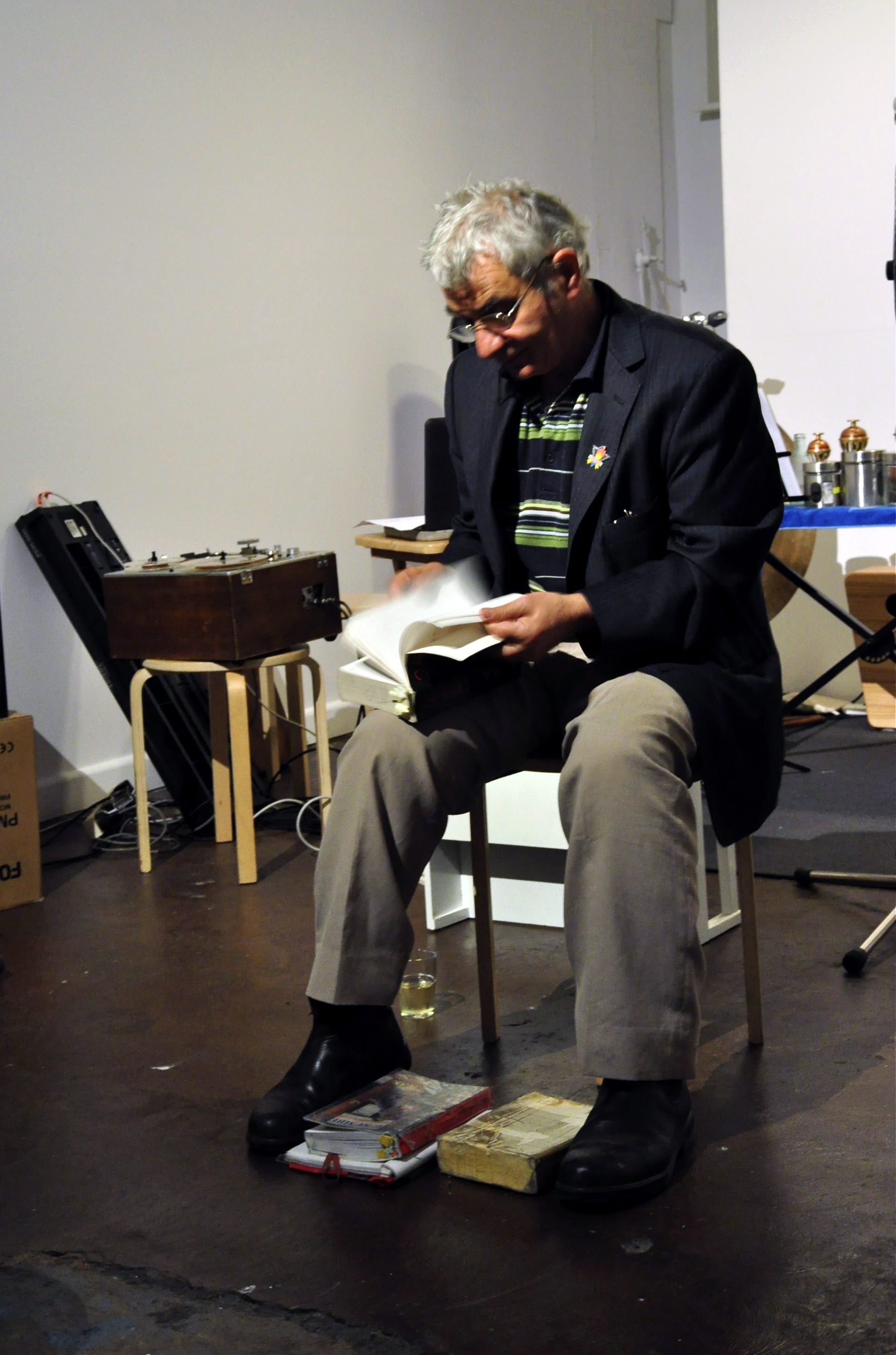
The communication and corruption of biography and autobiography was an accidental theme of Simon Charles’ curated music night at Conduit Arts. When Charles contacted П.O. to read at Melbourne’s newest hybrid arts venue, he didn’t need to give directions. П.O. grew up just across the road, in the few blocks of Fitzroy that eventually made way for the Atherton Gardens housing estate. The audience at Conduit on Thursday night were lucky to hear some of П.O.’s seldom-performed “Fitzroy poems” from 24 Hours, a 740-page poetic record of the neighbourhood in the nineties. In a steady half-shout, П.O. described a walk around the pre-gentrification working class suburb with its cafés, grocery stores and “derros,” relating snatches of dialogue between shopkeepers and passers-by. My favourite moment: On board a tram an old man repeatedly wishes the conductor luck with his 6% pay claim, despite the conductor’s repeated assertion that he isn’t in the Union.

П.O.’s frank delivery and autobiographical psychogeography of Fitzroy couldn’t have contrasted more with Charles’ musical setting of Jessica Wilkinson’s “marionette.” Spanning 100 pages of layered, fragmented and eroded writing and pictures, “marionette” is an obscured biography of the already-obscured life of Hollywood starlet Marion Davies. Through the twisting, fading and cutting of text and images, the book amplifies the themes of decay and silencing inherent in historical materials, as well as the very deliberate manipulation of Davies’ image by the media tycoon William Randolph Hearst. Charles’ setting for sampler, tape and saxophone (Charles) percussion (Matthew Horsely) and two voices (Jessica Wilkinson and Jenny Barnes) adds a new layer to the palimpsest of Davies’ story, drawing inspiration from both the content of Wilkinson’s book and its typographic manipulation.

Jessica Wilkinson and Jenny Barnes perform marionette. Photo by Mandy Kitchener.

A high, wavering tone rose suspended in the narrow white shopfront. With barely enough room for them all, Manteia conjured a much larger space with a soundscape of scraped gongs and sparse vocal clicks. Suddenly the room became closer with the introduction of live and pre-recorded phrases of text overlapping, synchronising and then drawing apart again. Imitating the degraded reels of Davies’ films at the UCLA film archive, Charles hand-manipulated a tape recording of Wilkinson’s poem by slowing, speeding up and stopping the statements that introduced the underlying message of the concert: “We are the puzzle-solvers.”

As yet another form of silencing, Davies suffered from a stutter her whole life. Wilkinson’s textualisation of this stutter in her fragmented and halting text is tranformed into the short, scattered vocal sounds of Charles’ composition. Most of the time this percussive polyphony rises above a shifting bed of more sustained tones produced by the scraped glass and bells of Horsley’s battery, and Charles’ sampler. Like the three-dimensional effect of Wilkinson’s overlapping and untangling text, this distant, transparent texture is then brilliantly juxtaposed with a closer, denser texture where Horsely’s percussive interjections, the text of Charles’ tape and the speakers all brilliantly collide at the same dynamic.

With the instruments dying away or stopping still, the last word of each episode is given to Wilkinson, who delivers punctual cadences like “now you’ve certainly spilled the apple cart” or “you know, the silly stuff.” The text closes the musical movement of each poem while opening up a field of interpretive ambiguity, highlighting the creative friction between textual and musical “openness”. A musical work can be formally closed (it has reached a point of resolution or symmetry, or its development appears exhausted), while its text may remain open, inviting expansion and development. The openness introduced by each of Wilkinson’s closing lines threads the nine poems of “marionette” together into a meandering, stammering, whispering song cycle.

After the juxtaposition of П.O.’s autobiography and the biography of “marionette” I am again inclined to question the role of the artist-provocateur, as I have in relation to Matthew Herbert‘s End of Silence. The problem is that if there is no new historical material, judgement or conclusion in “marionette,” then it just repeats the silencing that it addresses. The tension of “marionette” lies in the audience’s paparazzi-like hunt for glimpses of Davies amongst the flow of corrupted text. As in the gossip columns of the day, only the promise of the “authentic,” unsilenced Davies lures one through the dross, even if it is now a purposely open, fragmented image. Does Wilkinson and Charles’ added noise in the message tell us anything new about Davies or the nature of history? If a certain degree of silencing is inherent in history, then what value can we attribute to the further, creative silencing of historical texts? There is in fact a critique in “marionette.” It is introduced through theoretical terms like “postmodernity” and “sexual politics” scattered through the text. However, left undeveloped as they are (the case would be different if we had the opportunity to read Wilkinson’s exegesis as well, or even had a pre-concert talk), the critical power of these terms is silenced through their aestheticisation.

Concert guide: 8–14 May

A curated list of upcoming concerts. See also the Australian Music Centre concert calendar and the New Music Network concert series.

Thursday 9 May. Manteia will perform Simon Charles’ new work “Marionette” based on poems by Jessica Wilkinson at 8pm at Conduit Arts, Fitzroy, Vic.

Friday 10 May. Brisbane-based New Music ensemble Kupka’s Piano will perform works by contemporary Austrian and German composers as part of their “Giants Behind Us” programme at the Judith Wright Centre of Contemporary Arts, QLD, 7:30pm.

Saturday 11 May. Ida Duelund Hansen offers the second showing of her new works for voice and double bass as support for the Jon Crompton Collective at Conduit Arts, Fitzroy, Vic, 8:3opm.