BIFEM: soundinitiative, The Exhausted (2)

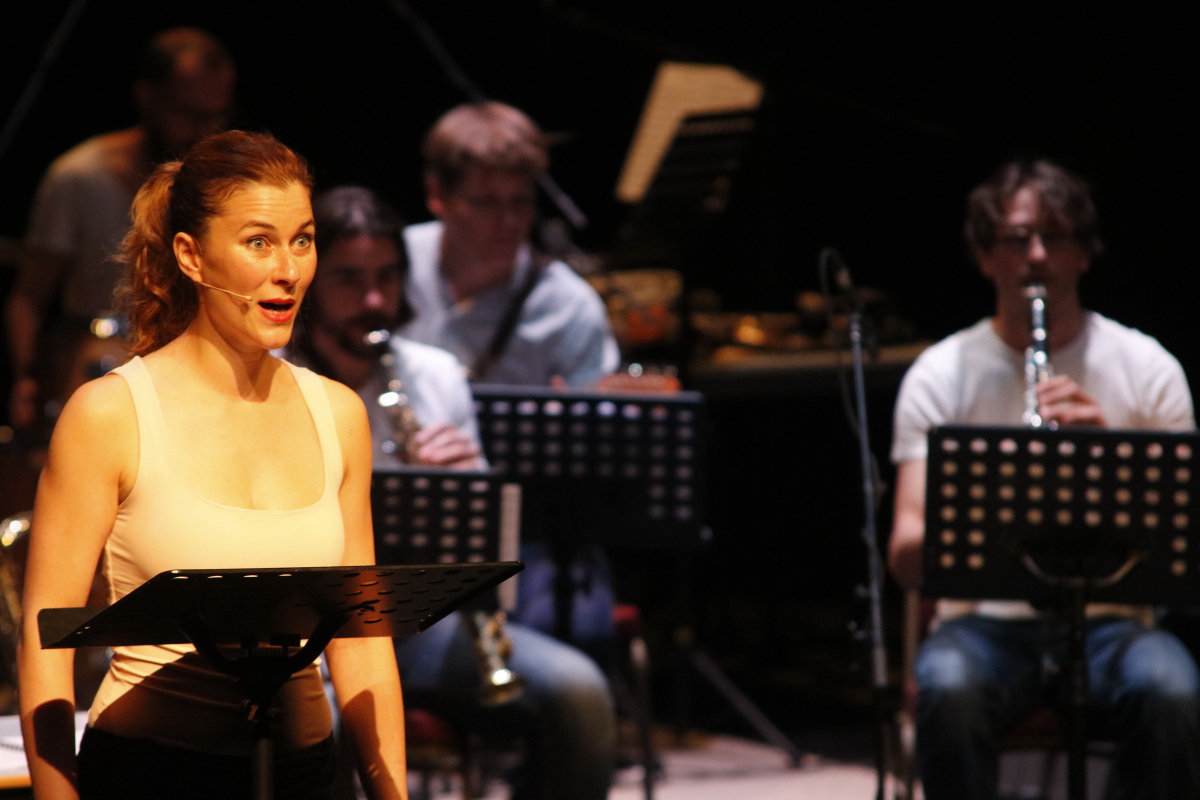
Fabienne Séveillac performs The Exhausted with soundinitiative. Photo by Marty Williams.

Review by Matthew Lorenzon

“Exhausted is so much more than tired” begins Gilles Deleuze’s essay on Samuel Beckett (“The Exhausted,” trans. Anthony Uhlmann, 1995). Tiredness assumes there is more to be done; the exhausted has consumed, expended, or used up all possibilities. Everybody has experienced the former, whereas the latter is the stuff of mathematical definitions. Beckett combines the two. One can exhaust the possible combinations of objects in a series, just as Beckett permutes series of socks, stones, and physical movements in his plays and novels. “Beckett’s great contribution to logic,” Deleuze writes, “is to display that exhaustion (exhaustivity) does not occur without a certain physiological exhaustion.”

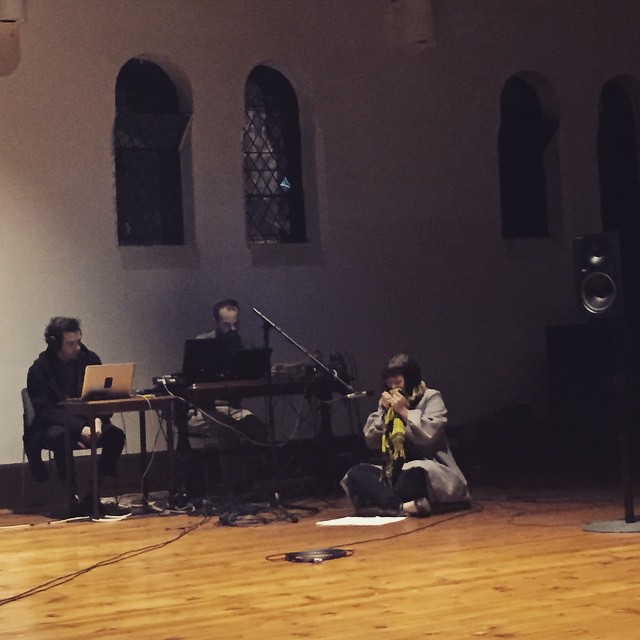
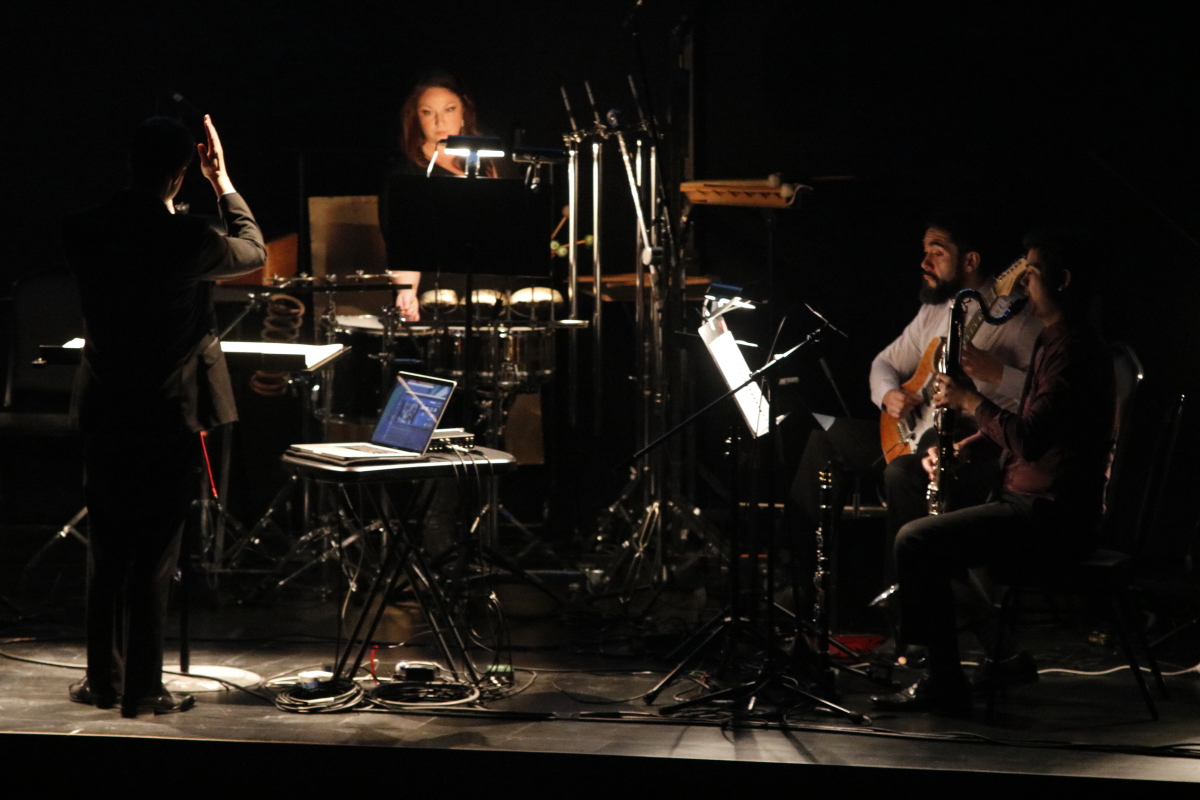
Bernhard Lang’s The Exhausted is a music theatre piece co-commissioned by the young Parisian ensemble soundinitiative for their debut at the Bendigo International Festival of Exploratory Music. Seated expectantly in the Capital Theatre, the audience was initially treated to only a momentary glimpse of the charismatic ensemble. The players wandered on stage, set up their instruments, and promptly exited. The next five minutes saw a constant flow of musicians entering and exiting the stage like waves lapping on the shore. The choreography by Benjamin Vandewalle made the most of the musicians’ natural and untutored movements. These were not actors and dancers striding purposefully on stage, but cellists and flautists repeating the gestural repertoire of the concert hall. The ensemble would stand, sit, slouch, or freeze with the simplicity proper to Beckett’s stage directions. The mezzo-soprano Fabienne Séveillac was no exception, though no other performer was called upon to sing vintage Deleuze upside-down beneath a table.

There is often a tenuous link between compositions and the philosophical texts upon which they are based. It is therefore wonderful to hear a composer developing his work so thoroughly from a single text. Objects on stage including a desk and a grey tape player are drawn directly from Deleuze’s essay. Beethoven’s Ghost Trio and Schubert’s Nacht und Träume feature in Beckett and Deleuze, though the pieces are cleverly introduced not underneath their description in the essay, but under Deleuze’s discussion of Beckett’s play Quad: “Four possible solos all given. Six possible duos all given (two twice). Four possible trios all given twice.”

Despite drawing heavily on Deleuze’s text, Lang has resisted the temptation to interpret Deleuze’s essay literally. He seeks the same nomadic movement of thought from Deleuze’s essay that Deleuze sought in reading Beckett. With all Deleuze’s talk of combinatory mathematics, it would be tempting to write a serial piece or engage in some other form of musical permutation, especially with such direct invitations as Deleuze’s phrase “Watt is the great serial novel.” While there may have been serial moments in the piece, the work seems to build upon the composer’s earlier Deleuze-inspired pieces by looping musical fragments, especially the jazz-inflected grooves of Lang’s student years. The piece, at least on one naïve hearing, plays to the tiredness inherent in repetition while referring obliquely to exhaustion’s formal properties.

Why repetition? A combinatorial sequence repeats the same elements in different ways, but Lang’s repetition is more static. A reader of Deleuze’s Difference and Repetition will recognise that repetition is only possible because of the infinitesimal difference between each iteration. This difference may provide a path past exhaustion. The audience and the performers may realise that there really are tangential possibilities hiding within each musical fragment beyond its combination with others. But repetition is also fatiguing and there is always the possibility that tiredness will win out before exhausted repetition opens a window onto the new.

The Exhausted
Bernhard Lang
soundinitiative
The Bendigo International Festival of Exploratory Music
The Capital Theatre
4 September 2015
Matthew Lorenzon
BIFEM: soundinitiative, The Exhausted (1)

Fabienne Séveillac performs The Exhausted with soundinitiative. Photo by Marty Williams.

Review by Jaslyn Robertson

The première of Austrian composer Bernhard Lang’s new work ‘The Exhausted’ (‘L’Épuisé’) began without music, members of Paris-based ensemble Soundinitiative moving mechanically on stage, then off, then back on again, repeating the process for minutes. The entrance set the scene for the repetitive, robotic nature of the music set to text from an English translation of Gilles Deleuze’s essay on Samuel Beckett.

Mezzo-soprano Fabienne Séveillac leads us through the text staring eerily above the audience, repeating phrases accompanied or followed by a complementary musical idea, opening with ‘exhausted is a whole lot more than tired’. Walking backwards and forwards, standing and sitting at her desk, Séveillac’s movements reinforce the mechanical repetition of her vocal part. At times, the instrumentalists use this sort of repetitive movement as well, cleaning clarinets and checking the alignment of bows. Described as ‘part-concert, part-music theatre’, movement is a significant part of the work. In a particularly haunting moment Séveillac lies herself across the desk until her head falls over the edge and sings, torso and head upside-down, without breaking her forward gaze.

The highlights of the performance occurred when the instrumentalists of Soundinitiative had a chance to show off their abilities. The stirring passion of Joshua Hyde’s saxophone solo over the cacophony of the other musicians mesmirised the audience. Forceful blowing and tongue slaps pierced through the sound in the background and demanded attention. His natural movements added as much to the concert as the repetitive choreographed actions. Hyde’s slow walk towards the audience, eyes closed, engrossed in producing rips of sound, is an equally unforgettable image.

The music of ‘L’Épuisé’ never loses interest, listeners bombarded with fast and marked change with each new phrase. Sections of text, with their allocated musical ideas, are never repeated for more than a minute, most lasting only 20 seconds or less. The majority of Séveillac’s delivery of text lies on the spectrum of speaking, ranging from breathy whispers to loud, robotic instruction. In the rare moments of high register singing, the clarity of her voice rings through the audience accompanied by sparse textures, from the likes of piano, electronic keyboard and glockenspiel. Like searching through radio stations, the rapid change between styles, varied in texture and rhythm, caused the music to never become static. Some ideas were more effective than others. Jazz sections suggested a shared feeling between composer and performers for the idiom that was clear to the audience, unlike the brief diversion into a hip-hop beat which sounded out of place on the instruments available and beneath Séveillac’s voice.

Although entertaining, Lang’s attempt to translate Deleuze’s philosophical ideas into music was sometimes sacrificed in order to create a hyperactive atmosphere that never allowed the audience to look away. The competence of standout musicians saved the work by giving expression to the chaos. The eccentricity of ensemble members gave it life, Venturini at one point climbing atop his piano in a fit of ‘insanity’. Soundinitiative showed technical prowess and bravery in taking on a work that required precision and adaptability in every instrument, with the added challenge of choreography. I can’t imagine many other ensembles that could capture the wild energy of this piece without missing a beat.

The Exhausted
Bernhard Lang
soundinitiative
Bendigo International Festival of Exploratory Music
6 September 2015
Jaslyn Robertson

BIFEM: Argonaut Ensemble, Maudite soit la guerre (2)

Argonaut Ensemble perform Olga Neuwirth's Maudite soit la guerre. Photo by Marty Williams.
Argonaut Ensemble perform Olga Neuwirth’s Maudite soit la guerre. Photo by Marty Williams.

Review by Charles MacInnes

Olga Neuwirth provokes fresh artistic perspectives by combining the new with the old. We see the patchy restoration of the Belgian silent film “Maudite soit la Guerre” (“Accursed be War”, dir. Alfred Machin, 1914), but accept it due to a live music that pits episodic tunefulness against a soundscape of slipping tonal certainty. The trick to understanding this is to place the sound at the focal point of our attention so it becomes the narrative, and the pictures become the incidental.

Music can perform this shift very well because its abstraction leaves you imagining a world beyond the visual. The chamber orchestra replaces the organ accompaniment of old: “You always need to remember the past! That is the only way that we could learn something,” says Neuwirth in an interview with her publisher Ricordi in 2014. As I walk from the Ulumbarra Theatre’s converted gaol toward the Rifle Hotel, I’m already thinking of the Syrians arriving in Europe. Of our collective responsibility. And guilt. Neuwirth is a step ahead because her sound world provides us with a more satisfying ultimate redemption than that of the colourised celluloid.

In the film story itself, Adolph furthers his training as an aviator by visiting a country that looks and feels like Belgium or France. Honky-tonk piano clanks while the harmon-muted brass crack wise and jostle with colleagues as they meet at the airfield. New-fangled flying machines are being inspected, and as the string harmonics are slowly replaced by concentric sustained cowbells, we are taken to the tavern three months hence as Germany declares war.

The declaration means that Adolph and his new friend Sigismond are now enemies. Even though Adolph has fallen in love with Sigismond’s sister Lidia, he must now return to the Vaterland to take up arms. The melodrama thickens; a grave clarinet turns upon itself alongside forward marching brass and above the strata of an elbowing organ and stringed hums. A mistuning of signals is now more pronounced—the sample track and whimsical electric guitar are prompting us to reconsider earlier impressions.

Blood red explosions are sighted through binoculars as the world is turned upside down. Adolph hallucinates that his sweetheart appears as the suddenly more menacing and now armed flying contraptions lurch and veer above. The percussionist stings the enemy with rapid gunfire and a harrowing sequence follows where hot air balloons are attacked, catching fire and eventually caving in on themselves. These are the corpses; war is indeed cursed. Neuwirth tells us with a further splaying of the tonal focus that another pivotal scene is nigh. A telegraph communiqué is sent via elevated strings and leads to the windmill where Adolph is hiding being set ablaze and collapsing. Lover and girlfriend’s brother emerge from the opposing sides and are both slain on the battlefield.

Cut to a year later and the lieutenant who brought the grim tidings to the family is making a play for the now single Lidia. Love is in the air until she spots her lover’s medallion pinned to his uniform. She convulses and contemplates drowning herself but instead retreats to the convent. We hear a veiled Bach chorale (could it be “A Mighty Fortress Is Our God”?) and later a Stravinsky-like “Jesu, Joy…”. By now the sample track and the orchestra are worlds apart and the last vocal echoes shimmer a little longer beyond the church and greenery.

Eric Dudley’s conducting magnificently disguised the presence of his in-ear click track and the Argonaut Ensemble was precise and fluid. I was not convinced that the sound design and amplification recognised the subtle internal dynamics of the acoustic ensemble. The strings and bright percussion occasionally dominated in the mix, leaving some of the delicate muted brass and guitar layers behind. The sophistication of the writing and interpretation created an extraordinarily poignant opening to the 2015 Bendigo International Festival of Exploratory Music.

Maudite soit la guerre: A Film Music War Requiem (2014) by Olga Neuwirth
Argonaut Ensemble conducted by Eric Dudley
Friday 4 September
Ulumbarra Theatre
Bendigo International Festival of Exploratory Music
Charles MacInnes

BIFEM: Argonaut Ensemble, Maudite soit la guerre

Argonaut Ensemble perform Olga Neuwirth's live score to Maudite soit la guerre. Photo by Marty Williams.
Argonaut Ensemble perform Olga Neuwirth’s live score to Maudite soit la guerre. Photo by Marty Williams.

Review by Delia Bartle

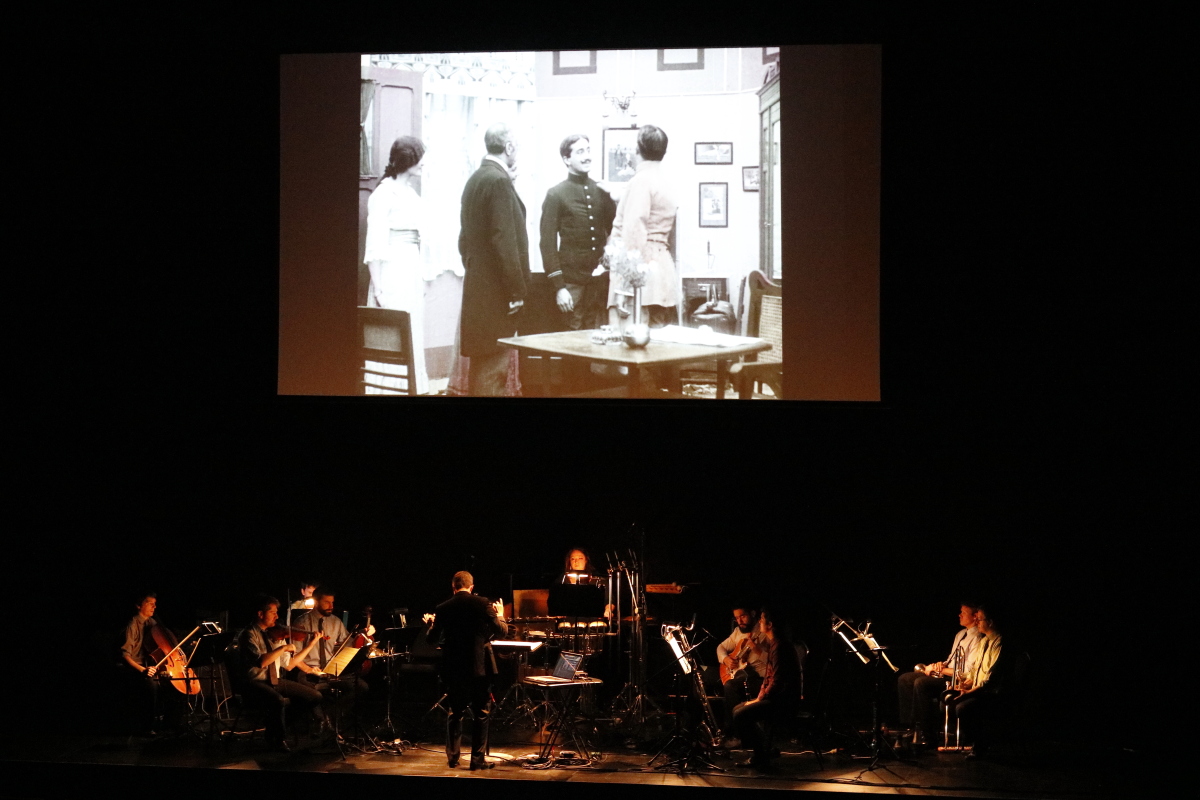
Scenes of war flicker across a screen in a darkened hall. Repetitive percussion drills like gunfire and strains of a honky tonk piano emerge from under shimmering strings. This is the sound of Maudite soit la guerre (War is Hell), one of the first anti-war films. The 1914 motion picture juxtaposes tradition with the unexpected arrival of a mechanical age of war. Similarly, Austrian composer Olga Neuwirth’s live score bridges the divide between conventional instrumentation and innovative performance techniques.

The film interprets the turmoil of war through the narrative of a doomed love story and two rival aviators. Neuwirth was commissioned by Ensemble 2e2m in 2014 to compose a soundtrack and the Argonaut Ensemble interpreted the score with a spellbinding balance of delicacy and vigour.

Eric Dudley conducted with subtle gestures to foster an ensemble dynamic that bristled with energy. Neuwirth’s score is unique as far as film music goes in that the image and sound sometimes do not correlate. At one point a windmill crashes to the ground, but there’s no literal effect to signify this. It was intriguing to witness the way in which our reactions were shaped by what we heard more so than what we saw, in particular when comical salon music drew laughter from the audience while characters on screen were departing for war.

Violinist Zachary Johnston, violist Christian Read and cellist Paul Zabrowarny excelled, playing cowbells as well as their usual instruments. Roughly bowed string motifs and airy harmonics created an electric atmosphere. Trumpeter Tristram Williams and trombonist Benjamin Marks delivered crisp notes before shifting into rich echoes of military fanfare. Marks even picked up a melodica to add comic effect to the already diverse world of sound, and electric guitarist Mauricio Carrasco emulated eerie air raid sirens with rising and sinking glissandos.

Neuwirth draws on a range of textures and instrumentations to create a dramatic mix of electronics, classical instrumentation and film. Maudite soit la guerre predominantly features soundscapes over melodic continuity, often with dense passages of limited dynamic range. Neuwirth’s musical theatre works frequently explore the relationship between collaboration and resistance, and that was identifiable in this performance through the overlapping textures and conflicting musical and visual themes.

The film’s director, Alfred Machin, produced this work with the intent to counteract the typically glamorised war propaganda that saturated society leading into the First World War. Neuwirth says of the film, ‘You always need to remember the past! That is the only way that we could learn something’. The Argonaut Ensemble embraced Neuwirth’s philosophy with this performance that honoured the ANZAC Centenary, reminding us of the harrowing emotions generated by war through the frame of an explorative soundscape.

Argonaut Ensemble
Maudite soit la guerre (War is Hell) – A Film Music War Requiem (2014)
2015 Bendigo International Festival of Exploratory Music
Ulumbarra Theatre, Bendigo
Friday 4 September, 2015

Delia Bartle


Inland 15.3: Your House is the Last Before the Infinite

11892235_10206642613156650_8624964347959993763_n
Alexander Garsden, Rohan Drape, and Jessica Aszodi perform Garsden’s Four suns and a whole sky on fire. Photo by Lloyd Honeybrook.

The Inland concert series explores a musical interior. Like the blend of properties at the center of a colour graph, Inland explores the gradations between notated, improvised, and electroacoustic performances. Concert 15.3 at the Church of all Nations in Carlton explored a single, focussed point of this hinterland, that of static textures developed through layering live and captured sounds.

Samuel Dunscombe’s Unfinished Piece for 27 Clarinets is performed by only three clarinettists, in this case Dunscombe, Aviva Endean, and Michiko Ogawa. The electronic part quickly swells to an atmosphere of drones and squawks. The effect is like listening to a great crowd of people, with half-heard conversations and choruses arising and subsiding from the dense body of sound.

Rohan Drape is largely to blame for the perfectly balanced sound diffusion throughout the concert. In each piece, the electroacoustic part perfectly matched the live performers to the extent that, from my vantage point at the back of the church, they were difficult to distinguish. This was as true for instruments as it was for voices. The collaborative work Four suns and a whole sky on fire amplified and multiplied phonemes and words uttered by the soprano Jessica Aszodi before Drape and Garsden introduced a droning accompaniment.

Jeanette Little’s Barbaric Yawp for Uilleann Pipes was a highlight of the night and not just because it featured an instrument so little-heard in the contemporary music world. Once again, the focus was on the instrument’s polyphonic texture and Matthew Horsley carefully managed the piece’s microtonal pitch bends and shifting drones. The melody, when it arrives, is a bleating, squealing thing that resonated delightfully in the church with a little help from the sound design.

Judith Hamann’s untitled solo cello performance featured a series of expertly-diffused extended cello sounds, my favourite of which was bowed cello spike. The vibrations of the spike were so slow that they formed a rhythm of sussurating sounds accompanied by maritime creaks.

The stage faintly glowed beneath the cross of the Church of All Nations. The semicircle of speakers and microphones formed a sacred space, like prayer or a pulpit, within which the sounds of the performers were amplified. But no god was intended to hear these performances, nor does Inland espouse any particular cosmology. With the concert closely following the Supersense Festival of the Ecstatic and directly preceding the Ballarat Slow Music Festival, I wondered after the intentions of the audience members scattered around on the floor. Why do audiences so desperately want to doze? The society-wide will to relaxation is not just a symptom of our busy, technology-stuffed lifestyles, but of our increasing infantilisation as consumers who can’t be trusted to go to bed on time without the right app.

I recently photographed this ridiculous Qantas ad in an airport.

Photo by Matthew Lorenzon

Needless to say, a world of entertainment is not much use while you are asleep, much less if you are trying to get to sleep on a full stomach. But Qantas wants you to consume even when you are full and asleep. There is nothing new in this. If the pinnacle of luxury is gorging oneself and falling asleep in front of a television, then a good portion of the population lives the dream on a regular basis. This ideal of luxury also informs contemporary music. Where falling asleep in a concert was once seen as a bad thing, the ambient sound artist Robert Rich has been presenting “sleep concerts” for several decades. In contemporary art music, it seems that every few months an audience is invited to lie on cushions or curl up in pods.

Trance, transcendence, non-knowledge, or inner experience have their place and exploring these states of mind may be extremely beneficial to one’s health and well-being, but can’t this happen outside of the concert hall? Old-fashioned though these Enlightenment ideals may be, society extricated itself from the comfort of religious dogma for compelling reasons. Even though the last couple of hundred years of technological advancement may well lead to the doom of Western Civilisation as we know it, we can’t crawl back inside the womb now. I am interested to see what composers will do next, once they get bored of the ersatz-sacred bubble.

I have written several times about David Toop‘s performance at the 2013 Totally Huge New Music Festival, where he brutally interrupted his soporific, crackling sound design with deafening strikes of a snare drum. While this is one of the most appropriate responses to a society falling asleep at the wheel, I must admit that I too lay down for Jessica Aszodi’s closing performance of Morton Feldman’s Three Voices, hoping to see the light.

Unfortunately I missed Aszodi’s performance of Three Voices at the 2013 Bendigo International Festival of Exploratory Music, so I was excited to hear Aszodi’s performance this year. Once again, the projection of Aszodi’s two prerecorded parts was perfectly matched to her live voice, so that one was sometimes at a loss to tell which part she was singing. A short check of the tempo and Aszodi was away, gliding effortlessly through the hour-long performance as though on a cloud. Or perhaps that was the audience, which was utterly transfixed for the duration of a performance that requires such obvious skill and precision. Aszodi’s easy command of such an exposed work made it an otherworldly experience.

Though I finally succumbed to lying on the floor and enjoying the mesmerising refraction of light through half-closed lids, I’m taking a twenty-minute nap before concerts from now on.

Inland 15.3: Your House is the Last Before the Infinite
Church of All Nations, Carlton
24 August 2015

BIFEM Music Reviewers’ Workshop participants announced!

We are proud to announce the five successful applicants for the BIFEM Music Reviewers’ Workshop. We are really happy to have received so many applications of such a high quality from around Australia. These five successful applicants will be writing up a storm during the incredible BIFEM festival.

Charles MacInnes

CM_1

Charles MacInnes is a trombonist, composer, educator and researcher. He has performed with the North German Radio (NDR) Big Band, Australian Opera and Ballet Orchestra, Hamburg State Opera, Australian Art Orchestra, Australian Chamber Orchestra, Melbourne Symphony Orchestra, as well as working as a studio and theatre musician. He has composed works for Melbourne Chamber Choir, violinist Sarah Curro, pianist Michael Kieran Harvey, Australian Brass Quintet, Syzygy Ensemble, Plexus Ensemble and collaborates with artists as a sound designer. Charles has lectured at the Victorian College of the Arts, Australian National University, The University of Melbourne and specialises in creating music workshops for young people. He is currently undertaking a PhD at Monash University on the role of improvisation in new music.

Delia Bartle

Delia Bartle Bio

Delia Bartle is a Hobart-based musician and writer with a keen interest in new and electronic music. In 2014 she was Dux of Hobart College and recipient of an ADF Long Tan Leadership and Teamwork Award. She attended the 2015 Australian Youth Orchestra’s National Music Camp under the tutelage of Julian Day and Alastair McKean in the Words About Music program. She was awarded the 2015 AYO Music Presentation Fellowship to work with ABC Radio National, the Australian Music Centre, Limelight Magazine and the Sydney Symphony Orchestra. She regularly contributes reviews and interviews to Limelight Magazine, Acid Stag, Pilerats and Casual Band Blogger. Her interviewees include Nick Tsiavos, Margaret Leng Tan, Helen Gillet and Natalie Williams.

Simon Eales

image1

Simon is a Melbourne-based writer, poet, and post-graduate student. He has published critical work with Cordite Poetry Review, Rabbit Journal, The Music Magazine, and Don’t Do It Magazine. He recently completed a MA on radical poetics at the University of Melbourne.

Jaslyn Robertson

image

Jaslyn Robertson is a composer and currently studying a Bachelor of Music – Composition at Monash University. She has composed for international performers including ensemble Vortex from Switzerland. She has studied and written about the implications of improvisation in a new music context, development of form in music of the 20th and 21st centuries, and use of unconventional ‘noise’ in music.

Angus McPherson

Angus McPherson - Hi Res

Angus McPherson is a Sydney-based flutist and writer. His articles have appeared in flute magazines and blogs in Australia and overseas including ClassikON and CutCommon. Angus attended the Australian Youth Orchestra’s Words About Music program in 2015. He is currently writing program notes for the Willoughby Symphony Orchestra and working with mentors in the field as winner of the AYO/WSO Fellowship.

Angus is currently completing a PhD in Music at the University of Tasmania. His research focuses on the work of contemporary Hungarian composer Gergely Ittzés. He has performed and taught in Australia, Canada and the UK.

Hold the jokes, you do want to hear nine violas

The ensemble after performing Peter de Jager's Metaphors. Photo by Hank Clifton.
The ensemble after performing Peter de Jager’s Metaphors. Photo by Hank Clifton.

The effervescent violist Xina Hawkins has returned from her stellar international career to present three concerts of music for solo and massed violas at the South Melbourne Town Hall. Peter de Jager, Brett Dean, and Samuel Smith have been engaged to compose for viola ensembles, and if De Jager’s offering is anything to go by, we are in for some valuable new repertoire for an often ignored instrument. But before we heard De Jager’s Metaphors, Hawkins had a few surprises in store.

First up, an imaginative piece for viola and piano by Paul Kerekes. The innocuous-sounding Four Pieces contains four far-from-innocuous movements. The first is inspired by the cartoons of Michael Leunig and features whimsical descending chromatic scales and the sort of minimalist rhythmic pitter-patter associated with innocence and blue skies in film scores. The final cadence leaves us with the pathos that so defines Leunig’s social commentaries. Kerekes gives us more pitter-patter in a movement inspired by hyper-organised supermarkets before moving attacca into “Aviophobia,” a movement depicting the fear of flying. Hawkins dug deep for this one, crafting soaring glissandi over piano tremoli. The final movement is inspired by “Michael Jackson and Ligeti,” a combination that works quite well. Kerekes combines Ligeti’s rolled clusters with syncopated, vamping bass lines. Citing “unfinished business,” Hawkins and Jacob Abela launched into a rendition of “Billie Jean.” The audience clicked out the song’s cross-rhythm and their enjoyment of Hawkins’ performance was evinced by their degree of rhythmic inaccuracy in the chorus.

Hawkins was then joined by double bassist Kinga Janiszewski, percussionist Hamish Upton, and oud player Yuval Ashkar for an extended Taqsim, or improvisation based on Arabic modes. The improvisation included the traditional song “Lamma bada yatathanna,” as well as an original song Marakesh Nights by Ashkar, which were framed by beatific improvisations.

Metaphors

Peter de Jager is the piano virtuoso of his generation. As a composer, too, he exhibits an almost incontinent imagination and creative felicity. I have found that his cellular, fragmented forms do not always amount to more than the sum of their parts. He is a pianist’s composer and the piano part can dominate within his ensemble pieces. The answer, we discovered on Tuesday night, is to take him away from the piano. Metaphors for nine violas presents so many unprecedented textures and effects, as well as familiar sounds presented in a new light. The piece is a beautiful synthesis of inspiration and craft.

The piece’s nine parts may suggest a disjointed series of studies.

Part I:
Ladder
Spheres
Stars
Planes
Particles
Smoke
Song

Part II:
Forest
Fugue, Chorale and Toccata

However, De Jager introduces a sense of continuity by increasing the number of violas in each movement from the microtonal solo “Ladder” to the nonet “Fugue, Chorale and Toccata.” Each movement is a work of astonishing refinement and control. “Stars” is a case in point. Reading the generic description “extremely high harmonics as twinkling points of light” I expected the piece to come and go without too much interest, but no. The three violists appear like a constellation on the far side of the stage from the previous duo. Their harmonics are very close and rhythmically overlapping, as though one were listening to distant interstellar patterns of morse code. The richness of the viola’s harmonics give a personal warmth to these starry sentinels and their peculiar harmony.

The following movement, “Planes,” is another aural delight. The viola quartet play loud, diverging glissandi reminiscent of Xenakis’ Metastaseis. These planes are “connected” by solo scalar runs. At first the planes are low and dense, but soon they rise higher in pitch-space. Then there are more simultaneous planes with multiple scalar stairways leading from them. The effect is extremely visual, and it’s a pleasure to follow De Jager’s Monument Valley-esque world of planes and bridges in the mind’s eye.

The final movement of Part I is a solo melody inspired by traditional Arabic music. The melody shows an intense melodic sensitivity on De Jager’s part, but the background texture is just as striking. I am not sure exactly how it is produced, but the six violas produce a rich, whispering, murmuring background that I had never heard before.

Part II features movements with a more diverse use of texture. “Forest” begins with eight violas playing trills with all fingers on open strings while changing their tone by moving their bows between the fingerboard and the bridge. Once again, De Jager takes a conventional enough technique and uses it to produce a sublime, sussurating effect like wind in the trees. After a while “gnarled branches” jut out of the foliage. The effect was all the more surprising after the long period of static rustling.

The final movement was an experiment in nine voices and three traditional textures. The fugual section lost clarity after five or so entries, not so the super-juicy nine-voice chorale of stacked seconds, which the ensemble balanced finely. The final, hocketing toccata was a great example of ensemble dynamics, with the final chord echoing out beautifully into the South Melbourne Town Hall. I can’t wait to hear what violist and composer Brett Dean (recipient of last night’s Art Music Award for orchestral work of the year) and rising star Samuel Smith have in store.

Xina Hawkins
ANAM Fellowship Recital #1
South Melbourne
Town Hall
Tuesday 11 August

Supersense: Diplopia

Matthias Schack-Arnott's performance of Diplopia captured by a GoPro. Courtesy of the artist.
Matthias Schack-Arnott’s performance of Diplopia captured by a GoPro. Courtesy of the artist.

The Supersense Festival of the Ecstatic hits all the right notes. Intelligent and accessible, the festival takes its place among a growing number of superbly curated and executed contemporary music festivals in Australia. The audience crowds down a stairway into the bowels of the Arts Centre. Coloured lights and ambient sound design herald their entrance into a netherworld of heightened experience. Once inside, the audience has free run of three or so simultaneous acts curated by Sophia Brous and drawn from the world over. The acts are durational, sincere, cross-cultural, and avant-garde, but peppered with high-profile acts presenting more conventional fare. The audiences crowding into the performances on Friday night prove once again that, if presented in an open and enticing light, audiences absolutely love contemporary music. Friday night’s program was underpinned by a three-hour performance of the Javanese Kuda Lumping (Flat Horse) ritual directed by Chunky Move’s founding Artistic Director Gideon Obarzanek with lighting design by Ben Cisterne. The performers, accompanied by an Indonesian music ensemble, danced themselves into trance states before being lifted out of the room by black-clad shamans. The audience could equally attend a performance by Tao Dance Theatre as they twisted and contorted their way through some of the most controlled contact improv I have ever seen. I was particularly interested to see Matthias Schack-Arnott’s new performance Diplopia, which follows his lauded solo percussion projects Fluvial and Chrysalis.

Diplopia (double vision) plays on the simple yet effective idea of attaching a microphone to each wrist of the performer and amplifying them through stereo speakers so that the performer’s hand movements are translated into rhythmic panning effects. Schack-Arnott surrounded himself with cymbals and tam-tams of different sizes, which furnished him with a beautiful array of metallic resonances.

Schack-Arnott began by gently playing a series of mid-range upturned cymbals, moving his arms in circles. The audience was lulled by the gently pulsating hum highlighted by metallic shimmering. Tighter and looser arm circles produced striking phasing effects, while several very slow circles produced a viscous aural effect like smearing clay. By contrast, a wide, fast arc over a single small cymbal would produce a short, clipped yelp. The moment I began wondering what the harmonic, microtonal properties of the cymbal array might be, Schack-Arnott started playing multiple cymbals producing beating, dissonant tones.

Schack-Arnott explored large tamtams, which gave a rather dead bassy hum, and much smaller cymbals whose rhythmic, amplified resonance was almost vocal in timbre. Swelling sine tones based on harmonics of the cymbals were dispelled by immaculately-timed attacks. The higher the pitch of the cymbal, the more complex and interesting the tones, with the higher cymbals accompanied by beating harmonics.

The flowing, rhythmic performance was a perfect opening for Supersense, but I’d like to hear these ideas explored further. What would jagged and irregular movements sound like? What about using only one microphone so that initial attacks were not amplified but their resonances were? How many different tones could one cast one’s hand over before they became indistinguishable? Schack-Arnott has opened up a world of new possibilities.

Matthias Schack-Arnott
Diplopia
Supersense Festival of the Ecstatic
State Theatre Rehearsal Room, Arts Centre Melbourne
Friday 7 August, 2015

Malthouse Theatre: I am a Miracle

I am a Miracle. Photo by Pia Johnson.
Hana Lee Crisp and Bert LaBonté in I am a Miracle. Photo by Pia Johnson.

Marvin Lee Wilson was executed on 7 August 2012 for the murder of a police drug informant. Tested to have an IQ of 61, he should have been ineligible for the death penalty under a United States Supreme Court ruling. Wilson’s IQ test was dismissed as evidence because it was administered by a PhD candidate rather than a clinical psychologist. On this technicality, his execution proceeded. Writer Declan Greene describes I am a Miracle as “a play for” rather than about Wilson, but does he nevertheless range too far from his subject? The play’s two acts provide historical and contemporary snapshots of racial inequality. These vignettes are framed by Bert LaBonté’s impassioned monologues as a sympathetic observer of Wilson’s plight.

Bombast paints a thin veneer over an unsatisfactory ending. As giant incandescent bulbs blind the audience, LaBonté offers a rousing call to arms. He pledges to carry Wilson’s memory to wage cosmic revolution. He wants to undo not just generations, but billions of years of inequality.

Two acts seem too few for a play that addresses universal injustices. The sense of incompleteness is almost musical. Three spotlit narratives of murder and subjugation might have given a better sense of the universality of racial subjugation. As they stand, the two acts seem more like separate plays. Melita Jurisic delivers a grimly humorous story of slavery in a nineteenth-century Dutch colony. In what was a brilliantly sustained escalation of tension, LaBonté plays a mentally ill man falling through the cracks in modern-day Melbourne.

A live musician on stage is a perpetual question for the audience, but director Matthew Lutton made a virtue out of soprano Hana Lee Crisp’s presence. She was never left hanging by the wings, but appears at intervals starkly framed by an arch or in front of a curtain. Lutton describes her as “an archangel of justice,” and her pure renditions of David Chisholm’s settings of biblical text elevates the audience above the play’s worldly themes of inequality, mud, and death. The three actors all lend beautiful and distinctive voices to the stage, which is otherwise suffused with subtle choral textures by sound designer Marco Cher-Gibbard.

Chisholm’s renaissance-style vocal score also raises a question that is held in delicious suspense until we learn of Wilson’s religious faith in Bert LaBonté’s final monologue. Becoming profoundly religious while in prison, Wilson’s final words included:

Take me home, Jesus.
Take me home, Lord.
I ain’t left yet.
Must be a miracle.
I am a miracle.

With every piece of the play’s promotional material foregrounding Wilson, the audience may be surprised by the marginal role of Wilson’s story. As an audience we are always watching LaBonté watch Wilson. We never hear Wilson’s words or learn anything about his life, but are left with the consolation of religion and ambient rage.

I am a Miracle
Written by Declan Greene
Directed by Matthew Lutton
Composition by David Chisholm
Malthouse Theatre
3 August 2015

Justine Anderson’s Signs and Symbols: The story of a maraca

Signs Still 4
Justine Anderson performs Berio’s Sequenza III. Photo by Rachel Edward.

Curated by soprano Justine Anderson, Signs and Symbols explored three little-heard masterpieces inspired by dreams and the unconscious.

New music fans over the age of fifty may be surprised to hear Boulez’s half-hour long serialist saga Le marteau sans maître described as “little-heard.” The chamber work was played to death throughout the seventies as Boulez’s compositional aesthetic cemented itself in composition departments the world over. The stunning work almost disappeared from Australian concert programs over the following decades, though its temporary absence may have had some benefits. When audiences hear the work today, they are no longer hearing a work on a pedestal, but a historical document free of the partisan baggage that accompanied its first performances. Without extended-technique pyrotechnics or electroacoustic sorcery, Le marteau sans maître sounds rather dated. And yet, like an Ars Nova puzzle, one immediately appreciates the work’s fine-grained understatement. Conductor Elliott Gyger lost none of the piece’s precise rhythmic counterpoint. Even René Char’s surrealist poetry is treated less with Pierrot Lunaire melodrama than as the machinations of an impossibly complex piece of clockwork. Anderson’s accuracy and control proved equal to the challenge.

Some sounds just grab you. As the muted ensemble ticked along, I was drawn again and again to a slithering sound emanating from the back of the hall. It was a maraca. Matthias Schack-Arnott would hold it upside down and make circular movements with his arm, causing the grains inside to shoot around the bulb like cyclists around a velodrome. The resulting ear-massage was part autumn leaves, part rain, part chocolate mousse. When he stopped moving the maraca, the grains would take time to roll to a stop. One seemed to hear each grain rolling over the others until finding its perfect resting place in the percussive microcosm. It turns out that this was not just any maraca, but rather a maraca that the Australian percussionist Barry Quinn used when performing similar repertoire with The Fires of London in the 1970s. Perhaps this was the first ever historically-informed performance of this piece.

The audience returned to a drastically rearranged South Melbourne Town Hall for Morton Feldman’s spatialised performance For Franz Kline. The stark, feathered monochrome brush strokes of Kline’s paintings were evoked by the synchronised attacks and indeterminate endings of pitches in the ensemble. Feldman fans may contradict me here, but it was nice to have a Feldmanesque soundwallow after the highly-strung Marteau.

Justine Anderson concluded the concert with Luciano Berio’s solo vocal tour de force, Sequenza III. The work requires power, agility, and loads of character. Anderson provided all three in abundance, sweeping through the hall in Barking Spider Visual Theatre’s reconstruction of Mrs Matilda Butters’ fancy-dress constume of 1866, which was printed with the mastheads of dozens of Victorian newspapers. It is good to see the dress in movement after its first new music appearance with The Sound Collectors earlier in the year. It was even better to hear this vocal masterpiece performed with such flair by one of Australia’s finest new music sopranos.

Signs and Symbols
Curated by Justine Anderson
The South Melbourne Town Hall
29 May 2015

Pierre Boulez, Le marteau sans maître; Morton Feldman, For Franz Kline; Luciano Berio, Sequenza III.