BIFEM: Argonaut Ensemble, Sur Incises

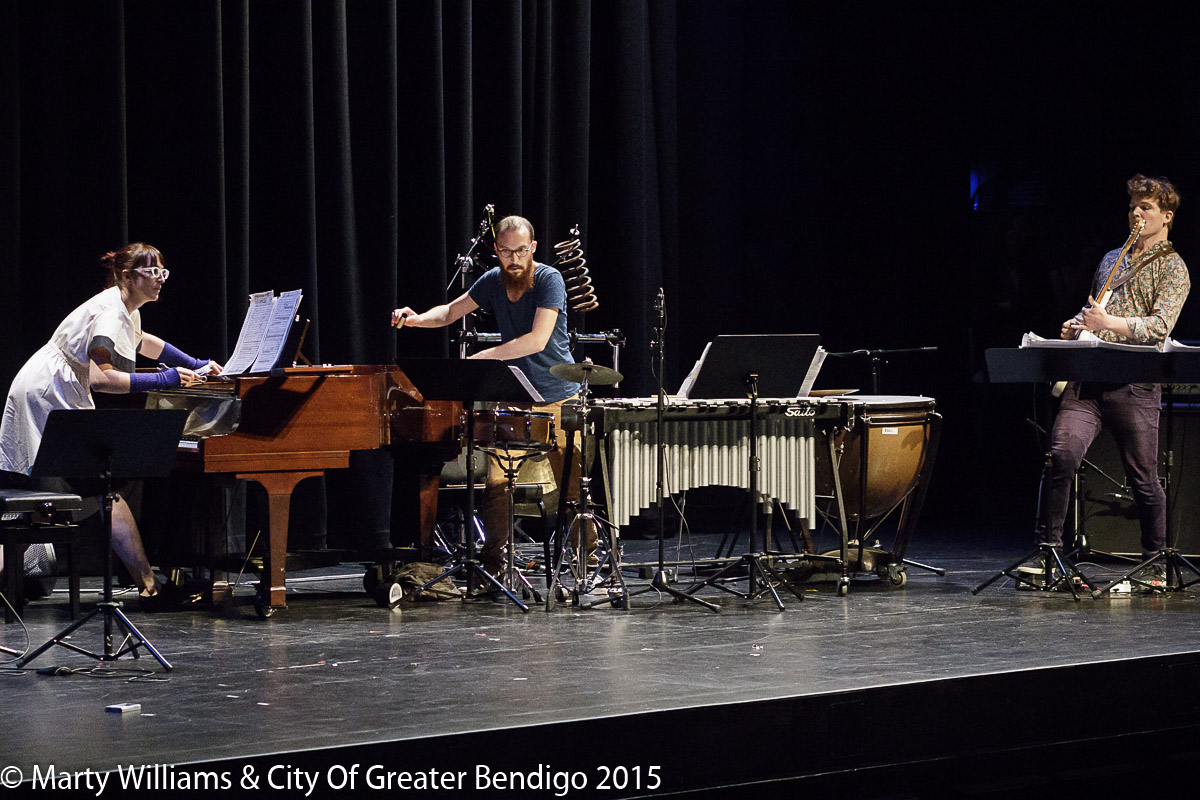
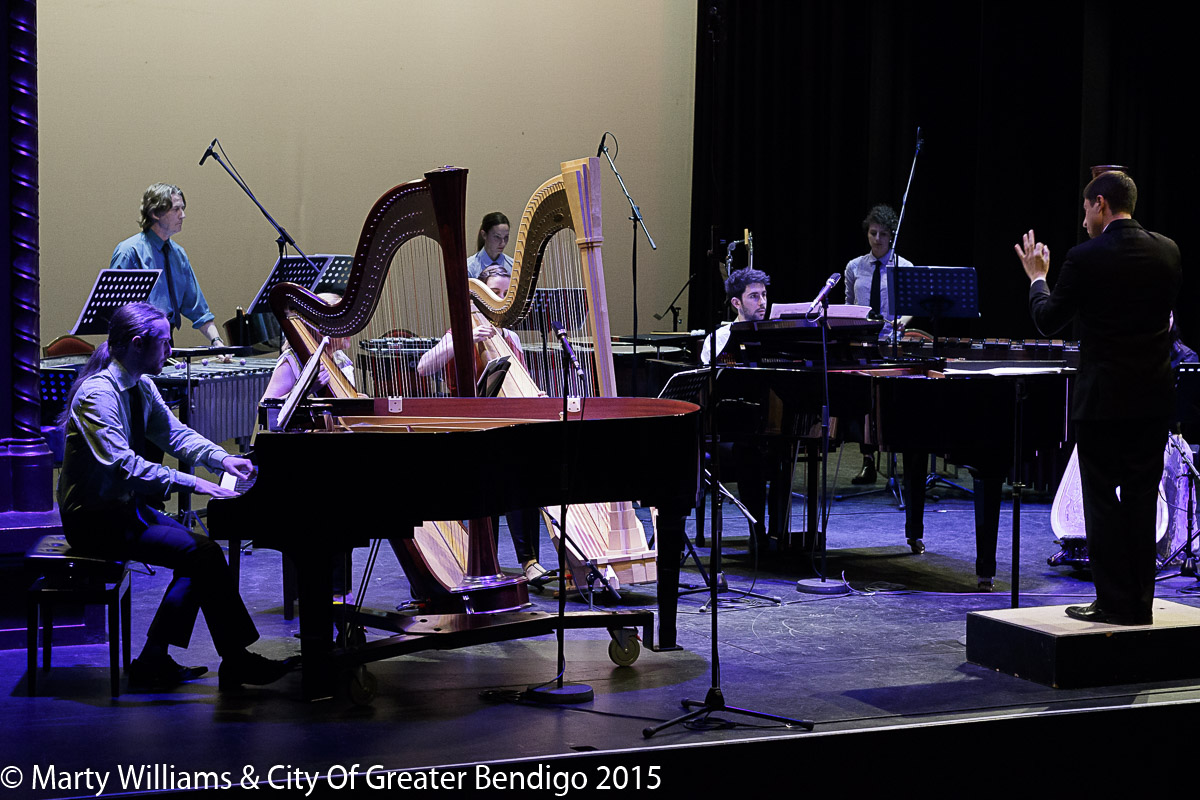
The Argonaut Ensemble perform Boulez's Sur incises. Photo by Marty Williams.
The Argonaut Ensemble perform Boulez’s Sur incises. Photo by Marty Williams.

Review by Jaslyn Robertson

The stage layout for Argonaut ensemble’s performance of Boulez’s Sur Incises sculpts an image of the sound world to come. Three pianos at the front of the stage are shadowed by three harps—extensions of their resonant strings. Behind, three batteries of tuned percussion give physical form to that ringing resonance that hovers above the music. The lush garden of sounds Argonaut ensemble evoke in their performance of the 1998 work reflects with purity Boulez’s orchestration and texture. The eclectic instrumentation may limit performances of the work, but the collection of timbres allows for a distinctive fluidity between instruments, with harps and vibraphones becoming extensions of the piano.

Conductor Eric Dudley and the ensemble were clearly aware of the importance of decay throughout the work, and exploited this thematically. This is epitomised in the final moment of the concert, when Dudley holds the audience in silence until well after the last note dies out. There’s an ethereal harmony heard in the resonance of three separate chords ending each pianist’s run. The ringing tones of vibraphones, crotales and steel drums hang in the air in moments between dense activity. Boulez’s orchestration disguises the attack of one instrument in the decay of others, blurring the distinction between instruments. Dense piano clusters reduce to reveal a gentle harp melody or crotales take over to continue an ascending passage as a pianist reaches the top end of his range.

Alternation between precisely timed rhythmic passages and aleatoric gestures are a defining feature of the piece. At times, the music lingers in one mindset for a while, as in the fast, strict toccata of the first movement. The musicians in this performance perfected both technical rhythms and interpreted grace notes—unmeasured notes which allow for flexibility. On the latter, the conductor signals only a starting point after which each performer decides the timing of the notes, creating a gentle falling away of sound. The smooth contour of the work was not lost in these parts, a credit to the ensemble’s ability to give expression without hesitation while maintaining coherency.

The performers were not only individually virtuosic, but worked well as an ensemble. Moulding the individuality of their playing, the three pianists often worked to create the same kind of timbre, even at times sounding as one instrument. There was also a sense of timbral continuity between different instruments, with the pianists gently caressing the keys to evoke the sound of harp glissandi or playing low rhythmic passages to imitate marimba.

The ensemble lost no expressivity in this accurate performance of a technically demanding piece. The natural cohesion between conductor and all ensemble members was felt by the audience. A well-rehearsed and knowledgeable ensemble held together a piece that relies on moments of chance indistinguishable from strictly notated passages. Argonaut’s interpretation of ‘Sur Incises’ was a highlight of the festival.

Sur Incises
Pierre Boulez
The Argonaut Ensemble
Bendigo International Festival of Exploratory Music
The Capital Theatre
5 September 2015
Jaslyn Robertson

Boulez

Argonaut

BIFEM 2015
BIFEM: Defunensemble, All Finnish

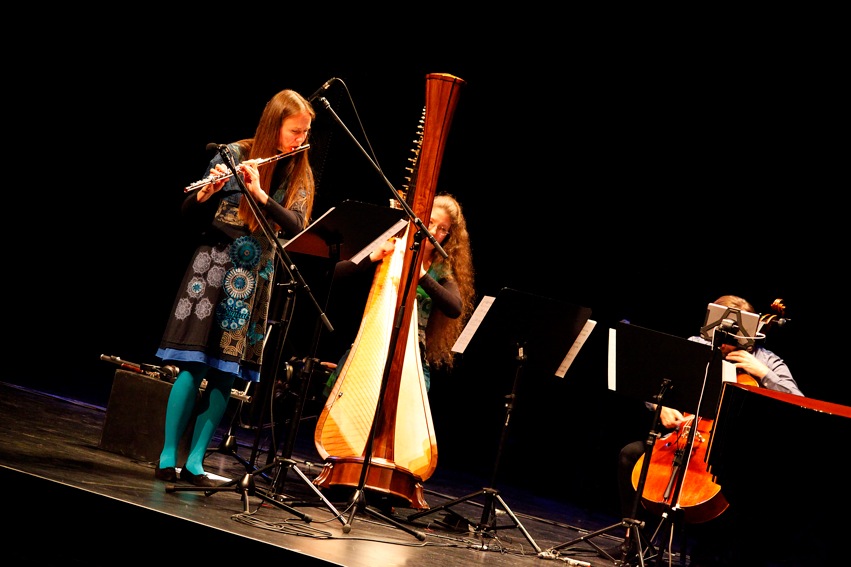
Defunensemble perform at the Ulumbarra Theatre. Photo by Jason Tavener

Review by Charles MacInnes

A thread running through the festival weekend was the artistic and philosophical challenges facing composers and listeners when images and sound cohabit a performance. A panel at a Composer Colloquium had discussed this earlier in the day and it was a recurring theme in those quick and energised exchanges you have right after a concert, whispered between pieces, walking to the next venue or waiting for your coffee or wine.

Tonight, I had no idea what would unfold, had never heard Finland’s Defunensemble before and knew none of the composers or works. In contrast to many other performances over the weekend, this All Finnish concert made no use of projected images. But, like the single letters, words and sentences of a novel that unfurl and re-form to become lives and your own experiences, the performance was one of the most rich and visually potent I’ve attended. This was international exploratory music, and tonight Defunensemble nailed it.

Juhani Nuorvala’s Ruoikkohuhuilu (2014) begins with Hanna Kinnunen (alto flute) appearing in aquamarine colours out of a dark and gentle crest of pre-recorded sound designed by Anders Pohjola and Timo Kurkikangas (electronics). The flute outlines the open building blocks of chords as if glimpsed through cloud, before descending as a sallow Nordic counterpart. The crescents become glassy and shafts of whole tones are harvested, before drifting away again into the light. It stings a little as you get close, but like the tide Kinnunen returns from whence she came. This was a breathtaking and gentle prologue that kept itself just far enough away from becoming ambience.

In Ville Raasakka’s Erinnerung (2010), the harp (Lily-Marlene Puusepp), clarinet/bass clarinet (Mikko Raasakka), cello (Markus Hohti) and piano (Emil Holmström) join the flute and electro-acousticians. The players wore headphones for audio synchronisation which allowed them to take part in an extravagant internalised reminiscence. An entire lifetime is recalled in a quick succession of darting textures and contradictions. Beginning with a cubist burst of repeated tones, relationships begin to form only to disintegrate. Harp sides with reinforced piano, but then piano switches to join flute, so harp teams up with cello, while the breath of the bass clarinet intermingles with high piano and cello grinds to a stop. More solid structures build now, but these teeter and need recalibrating. Characters become more mature and the conversation less pushy; three is no longer a crowd. But the tensions of earlier times are not forgotten altogether with the clarinet’s air and cello’s scratch silenced by close-voiced piano repetitions. Hang on, was that an entire life or just one weekend?

The relativity and ambiguity of time are further explored in Perttu Haapanen’s Doll Garden (2013) for the same instrumentalists as in the previous work. The acoustic musicians at first represent the thoughts and gaps between the spelling out of the track, which is triggered via the flautist’s foot pedal. The individual keystrokes of a typewriter start off well, but hesitations and corrections increase as the paper gets wound backwards and ackspacebackspacebar and spa ace bar, leeeetterskeyyyyyyyyystart arts___ _xxxxxx xxxrepeating. With paper tearing loose and the platen cogs giving way, we enter a slow dance as the bell at each carriage end carries us round the room. When we open our eyes again, life’s become a high-speed connection and it’s oftentimes turbulent and too fast for our thoughts to keep up. We try to recall and recapture a time when sounds lived on vinyl and the words of a book carried a particular smell. But despite using a QWERTY keyboard to talk to a computer, it’s not the same machine. The bass clarinet and flute hang in the air and I’m wondering what the pact is between artificial intelligence and vintage technology.

For Niilo Tarnanen’s Kään (2014) the group pares back to harp, bass clarinet and piano, though with a new microphone position to pick up subtle piano transmissions. The ambient track begins with static prior to both harp and the low register of the inside of the piano producing pings of sound along the copper wire wrappings of the low strings. I’m deep inside circuits and I feel currents flowing hither and thither; the bass clarinet emits a few sinewy charges and there is a strange order to the random spreadings and impulses. Being so close to the components makes it hard to navigate, but I feel we are approaching a nerve centre of sorts. The switches and plucks and battery stings to the tongue are synapses to other worlds. Towards the end we sense a twisting of some giant undersea cable and catch a fleeting glimpse of the meniscus above.

The full ensemble returns for the final work in the program—Feed (2013) by Sami Klemola, who joins the group on guitar. He checks his signal through a massive Marshall amplifier; this cheeky response lets the audience know straightaway that we are in for a feast. Of everything I heard over the weekend, this piece was one of the few that showed how freedom and spontaneity can lend a work a burst of creative expression. An organised structure and well controlled timings allowed the players a permissiveness that sent shivers through the audience. The guitarist as ringleader teases and incites the others to join him. The rapid and chaotic improvisation of the opening gives way to a shock unison that morphs into a cluster and snaps off again. Squelching downbeats from the band accompany an extraordinary trade-off between guitar amp buzz and flute air. After five shots, the anarchistic figures begin again but even thicker and darker than before. After this subsides we arrive at the highlight of the work. On cue, the players launch into rhythmic unison three-note figures over and over with pauses between each set. To my ear these are not fixed notes but “any pitches”. In the gaps, guitar fills are the pin pricks of sound produced behind the pickup. As the three-note figures continue—together but always shifting in frequency and pitch—they turn into background to the guitar which now evolves into a full blown exploration of phased hisses, buzzes and scratchings.

As the final “free” section of Feed restarts, I ‘see’ it through a different lens. Like traffic from afar it seems an impenetrable wall of noise, but up close it is hundreds and thousands of tiny and equally valid movements and transactions. Even when sirens wail, each goes about its own business, all but trying to hold onto a delicate and fleeting farewell. So drew the 2015 Bendigo International Festival of Exploratory Music to a close. Defunensemble’s All Finnish was a textbook example of what makes a spellbinding concert. This team gave us discernible structural signposts, pieces with cogent emotional intent, huge spectrums of sonic variation, lively and committed playing and a flawless sound design.

All Finnish
Defunensemble
6 September 2015
Ulumbarra Theatre
Bendigo International Festival of Exploratory Music
Charles MacInnes

BIFEM: Argonaut String Quartet, 4x4x4

Review by Angus McPherson

‘Did he know he was going to make this piece crazy?’ A child’s voice comes through my ear-piece over the sounds of the Argonaut Quartet performing Christophe Bertrand’s Quatuor No.1. The ear-piece and radio are part of Soundtracks, an art intervention by St Martins Youth Arts Centre providing live commentary to Bertrand’s music by young artists between the ages of eight and twelve. Bassi, Satchmo and Anh are my commentators and they guide me through the quartet, much like a DVD commentary (though less intrusive).

Before the quartet commences, the children explain that they know three things about Quator No.1: that it was written by Christophe Bertrand, that Bertrand died by suicide at the age of 29 and that there were originally nine movements, but two have been lost. The knowledge of Bertrand’s suicide, a heavy and complex topic for such young children, obviously colours their interpretation.

The images they use to describe the music are highly evocative: the pizzicato of the first movement is the ‘pitter patter of rain’ and as it intensifies it prompts a story of being caught in an out-of-the-blue hail storm. The ending of the movement is compared to a snowball rolling downhill that seems like ‘it’s going to explode or collapse, but when it gets to the bottom it just sits there’. The fourth movement, full of droning strings and pitch slides, sounds like ‘wolves howling’ at the edge of a cold, dark forest, and the slow glissandos and microtonal shifts in the sixth movement are ‘like a baby crying’. The music of the melancholy fifth movement sounds like it ‘keeps reaching and falling down’.

Interspersed with these responses to the music, the children tell me the questions they would like to ask the composer, such as: ‘What was his first memory of a connection to music?’ as they try to put together ‘the pieces of the puzzle that would help us understand him’. In answer to the question ‘what does it mean?’ they sadly conclude, ‘we can only guess’.

There are also lighter moments. The actions of the players in the dance-like second movement resemble ‘yanking a tooth out’ and Judith Hamann’s cello technique in the third inspires a story of whisking cream to have with strawberries. Members of the quartet are compared to wound up ‘mechanical toys nodding their heads and moving their arms’. The children’s observations of the music are remarkably astute, drawn from their own experiences. Independently moving parts are compared to students packing up their bags at the end of a day at school, some are faster and some slower, some have more things to pack up, some have less.

As the drama of the music builds to its climax in the final movement, static fuzzes through my earpiece and I only catch the words ‘storm brewing’ and ‘really wild’. The end of the quartet fades away slowly, ‘like dust blown off a surface, leaving nothing’.

The concert had begun with Kimmo Kuokkala’s Kirvis, a work of bouncing bows, scratchy rustlings, ending on a pure crystalline high note.

The world premiere of New Zealander Dylan Lardelli’s Mapping, an inlay follows the Bertrand, and gradually unfolds like a landscape coming into view, recorded in precise detailed lines. The meditative sound world is made up of gentle dissonance, dull hisses, papery harmonics and warbling strings.

4x4x4 finishes with Stefano Gervasoni’s Six lettres à l’obscurité (und zwei Nachrichten) or Six Letters to Obscurity (and Two Stories). The obscure letters, one for each movement, spell the name Claire (the deliberate irony is that this also means ‘clear’ in French). The story movements are inserted after the letters ‘l’ and ‘i’. The music swings from atmospheric noises to upbeat folky passages and the movement ‘r’ stands for ricecar, Gervasoni quoting Girolamo Frescobaldi’s Recercar chromatico post il Credo for organ in an arrangement where the edges are frayed with distorted timbres and shrieks.

The Bertrand quartet with art intervention from St Martins was certainly the most affecting work on the program. While the commentary distracted from full immersion in the Argonaut Quartet’s performance, it did provide a fascinating insight into the response of children to music. Wise and empathetic, the commentators coloured my own response to Bertrand’s quartet, and added layers of meaning and depth to the experience. That said, the sudden (if altered) tonality of Frescobaldi’s ricecar in the Gervasoni provoked an unexpectedly powerful frisson, coming at the end of a weekend full of exploratory music.

Argonaut String Quartet
4x4x4
The Bendigo International Festival of Exploratory Music
Bendigo Bank Theatre
6 September 2015
Angus McPherson

BIFEM: Inventi Ensemble, Urban Gypsies

Inventi Ensemble perform Melody Eötvös' House of the Beehives. Photo courtest of the artists.
Inventi Ensemble perform Melody Eötvös’ House of the Beehives. Photo courtest of the artists.

Review by Charles MacInnes

From the initial notes of Saturday’s Inventi Ensemble concert, I was struck by the excellent quality of sound produced—the tonal integrity of the acoustic instruments was consistently the central focus and the electronic material was expertly integrated. The Stratagem Studio at Bendigo’s Ulumbarra Theatre was the ideal space for sonic and visual close-ups of the flute’s inner workings, the struggles of the Roma people near Berlin, Gauguin in Tahiti and the lives of bees. Listeners were invited into an abundant world of imagery—part projected, part imagined.

In Passages (1979) by Jean-Claude Risset, Melissa Doecke’s solo flute interacts with a quaint episodic array of late 1970s electro-acoustics. By switching between the standard flute, its head joint alone, and the piccolo, Risset uses sound to creatively outline the workings of the harmonic series in music. His pioneering research into sound synthesis is apparent as we are reminded that perception of pitch is a response to changing frequencies. The samples were unpretentious, and each event occupied its own tonal area with certainty. The music travelled through changing air streams, touched on a hard-surfaced interlude, before bouncing off more disparate tonal language which was in turn stilled by vocal light at tunnel’s end.

Urban Gypsies (2005) by Johannes Kretz for oboe, electronics and film (by Laszlo Moholy-Nagy, 1932) documents and musically narrates the lives of a group of Roma people living on the fringe of the city. Ben Opie’s mournfully pleading oboe conjures faces and words that become more forceful as images of grass and dirt give way to concrete and traffic. Disputes play out as trams and cars vie for prominence while the cries and honks of the oboe are the heart-wrenching anguish of animals being haggled over. People’s futures and pasts are also traded as the well-heeled are offered palm readings to the sound of vinyl cracklings and the oboe’s key clicks. As dice hit a beer stained card table, a tussle ensues which a plaintive child observes, perched upon a fence. A barrel of booze is rolled towards a celebration where women let down their hair and children horse around in dress-ups. The band is at full tilt and the couplings are blurred by fiddles, trills and multiphonics. With Hitler’s rise to power just a year away, I can’t help wondering what fate awaited these poor people.

Forty years earlier, Paul Gauguin made his first journey to Tahiti where, along with some of his most famous paintings, he produced a woodcut and travelogue both with the title Noa Noa. Kaija Saariaho’s 1992 work of the same name has become a standard work for flute and electronics, borrowing material from Gauguin’s text. Stage whispers are skilfully combined with quarter-tone recitations, air sounds and multiphonics. Doecke has throughly absorbed the composer’s stance on extended techniques and they are brought to life as the natural extensions of fragrant breath and song. This piece is an excellent example of how sound alone can create a rich and beautiful world of imagery.

The final work in the program, Melody Eötvös’ House of The Beehives (2015) was commissioned by lawyer and human rights activist Julian Burnside. The current ecological plight of the bee population is explored here with flute, oboe, electronics and film. With its many blackouts and white flashes, saturated tree-scapes, and close-ups of flowers, the film was a little too reliant on effects, while the music swayed between evoking Celtic chants and upbeat hocketing. The combination left my imagination little room to roam—would simpler footage and greater exploration of the harmonic and textural vocabulary create a more poetic end result?

Inventi Ensemble’s Urban Gypsies illuminated many opportunities for multi-disciplinary artists wishing to combine images with sound. Which should take precedence, and how do they interlace to form a clear artistic statement? Perhaps works that are semi-improvised, or composed re-imaginings of obscure or abstract stories, have a greater chance for audience receptivity. They, like readers, are willing to fill in the gaps, imagine the backstories and even glance away to see where else they might be transported.

Inventi Ensemble
Urban Gypsies
5 September 2015
Stratagem Studio, Ulumbarra Theatre
Bendigo International Festival of Exploratory Music
Charles MacInnes

BIFEM: The Amplified Elephants, Select Naturalis

Founding Amplified Elephants member Kathryn Sutherland demonstrates the RESONANCE table for the audience after the concert.

Review by Simon Eales

The lights are dimmed already, giving this small but regal room in Bendigo’s Capital Theatre a warm, apricot hue. The dull glow offsets two veiled television-sized monitors placed on a ledge above the five black-clad performers. We sit around what looks like an overhead projector: a large horizontal screen with an optical lens perched on a stem above it.

These performers are the Amplified Elephants, a sound art group based in Footscray whose members live with intellectual disability. Formed in 2006 as an offshoot of the sonic art collective The Click Clack Project, they have created a diverse range of projects using experimental techniques to evoke soundscapes and make performance art from new technologies, prepared traditional instruments and found objects.

This debut of their latest work, Select Naturalis, showcases a remarkable new piece of technology developed by Jonathan Duckworth in the CiART program at RMIT. The room’s central piece of equipment is in fact a large digital touchscreen tablet: images appearing on its surface are captured by the camera lodged above, and displayed in real time on the room’s two monitors. In developing the performance, the Elephants programmed a range of acoustic and digital sounds into the tablet’s software. They trigger these sounds in performance through tactile engagement with the interface.

Guided by Artistic Director James Hullick’s gentle prompts, performers improvise short solo sets. The piece builds in the first movement with Jay Euesden’s concentrated, space-activating pokes and Teagan Connors’ broad, multi-fingered glides. In the second movement, following an extended drone, Kathryn Sutherland masterfully drives the piece to peak intensity. We hear squelching, screechy and swampy sounds; an array of tropical bird-calls; excited human hollering; and a medley of straw-sucking and blowing. With one or two measured looks, Robin McGrath invites the audience to engage on a more personal level with this act of the creation.

The ensemble place and adjust hand-sized coloured blocks on the screen, which triggers trippy tie-die swirls and graphics evoking a cell nucleus and its spinning electrons. Upon tapping, the electrons shoot along lines extending mandala-like from the base of each block to synapse with the lines generated by others.

The cellular representation here, in the tablet’s graphics, thematically coheres with the piece’s other key symbols: the title, referencing Charles Darwin’s notion of natural selection; the male voiceover which challenges those readings of Darwin which promote the notion of ‘survival of the fittest’ over other less reductive understandings of how humans have evolved; and the prerecorded backing track, which forms a foundation for the semi-improvised performances. A striking example of this backing track’s effect occurs in the piece’s opening moments. Before there’s any action, we’re enveloped by a loud and low, dubbed hum from the surround sound system. It holds a tightly looped rhythm, as if an old computer program scrolling through endless options. Or, more ominously, is stuck on one option. Either way, no selection is made.

This symbolic system suggests that while genealogical science might be undeniable, we should not let it limit the infinite ways we can practice art. Perhaps more importantly, it suggests that our continued evolution, including our ability to adapt to conditions like climate change, depends on acknowledging biological capacities we may already have developed, but ignored. It’s a perspective which links this performance text closely to the raison d’etre of the group performing it. If the Elephants, as bearers of intellectual disability, are the ‘elephants in the room,’ their amplification of that position represents their way forward, which is actually a way in. As the voiceover says, ‘meta-listening,’ a biological feature perhaps developed by our distant ancestors, involves just such a process of shining awareness on the functional, and the willingly unseen or unheard. Select Naturalis seeks to metaphorise that awareness and, it seems, achieve real social affect: community, inclusion, technological progress and ever-better names for things.

Select Naturalis
The Amplified Elephants
The Bendigo International Festival of Exploratory Music
Bendigo Bank Theatre
Simon Eales
5 September 2015

BIFEM: soundinitiative, Made in France

soundinitiative perform Faction by Raphaël Cendo. Photo by Marty Williams.

Review by Angus McPherson

The lurid orange hoses worn around the necks of soundinitiative’s performers in D’Après flamboyantly illustrate Clara Iannotta’s dictum that ‘music should be seen as well as heard.’ The opening is atmospheric, players running their fingers around the lips of wine glasses, the percussionist gripping a bow between his teeth. Pitches warp and contort and sudden flourishes create spikes in the smooth soundscape. The orange pipes produce whistling harmonics and the music evolves, refulgent shimmers giving way to dryer sounds: tapping and short articulate wind entries, and finally, the sounds become gongs and bell-like attacks from the winds. The Italian Iannotta is the only composer on the program who isn’t French, but D’Après was composed in Paris, in keeping with the theme Made in France.

Christophe Bertrand’s Aus sees small cells of music undergo gradual metamorphoses. A heartbeat from the piano builds and mutates, new notes emerging like growths. On first impression the music seems to have echoes of Minimalism, but it is soon clear that the figures never repeat exactly, they roil and spread, shifting like sand. The rolling figures become pointilistic: staccato in the winds and pizzicato in the strings, culminating in a vigorous crescendo of scrubbing harmonics from Julia Robert’s viola.

‘Berceuse’ from Gérard Grisey’s Quatre chants pour franchir le seuil (Four Songs for Crossing the Threshold) is tranquil and introspective, the instrumentalists providing a lush, undulating accompaniment to Fabienne Séveillac’s flexible mezzo-soprano. In Grisey’s Quatre chants…, this lullaby is the reflective finale following apocalyptic scenes with text taken from the Babylonian Epic of Gilgamesh. The composer said of ‘Berceuse’, ‘it is not intended to lull one to sleep; instead it is meant to awaken one to the dying of humanity, finally liberated from its nightmare’. Heard here in isolation, ‘Berceuse’ gives us a sense of peace, but not the catharsis that would have followed the first three of Grisey’s songs.

Grisey died of an aneurysm at 52; Four Songs for Crossing the Threshold was the last piece he completed. Phillipe Leroux’s homage to Grisey Un lieu verdoyant, for mezzo-soprano and soprano saxophone, was written the year after his death. Séveillac and Joshua Hyde shine in this heartfelt performance, their delicate timbres almost indistinguishable as their voices come together and move apart. The balance between singer and saxophone is exquisite, the sighing glissandos and shaking tremolos evoking the grief of the text, which is based on the Book of Lamentations from the Hebrew Scriptures. Hyde turns his back to the audience as Un lieu verdoyant descends into Séveillac’s whispering, ‘mémoire pour Gérard’.

Séveillac is centre-stage again for Gérard Pesson’s setting of poetry by Marie Redonnet Cinq chansons, scored for voice and a quintet of viola, cello, flute, clarinet and piano. Séveillac’s voice entreats over the ambiguous, unstable moods of the accompaniment in ‘La chanteuse des rues’ (The street singer). ‘La stripteaseuse du Mac Doc’ (The stripteaser of Mac Doc) combined upbeat striking of the wood of cello and piano with humorous slides and twists from the winds. The lyrics translate as ‘without a hat/without a coat/without panties’ and so on. ‘La merchande de sable’ (The sand merchant) is a dark miniature, the soft jagged music reflecting the madness of a woman collecting sand and rocks, mistaking them for gold.

Soundinitiative’s finale for Made in France is Raphaël Cendo’s Faction, a wildly joyful piece in the composer’s self-described style of ‘Saturationism’, opening with loud, energetic ‘shredding’ on all three instruments. Faction requires electric guitar, prepared piano, prepared vibraphone (and hopefully prepared vibraphonist, quips Hyde, entertaining the audience during the stage change). Soistier’s preparations seem to involve several kinds of tape stuck to various parts of the instrument. Kobe van Cauwenberghe’s guitar dominates, but vibraphone and Gwenaëlle Rouger’s piano emerge and recede from the almost constant wall of sound.

Cendo’s music is incredibly physical and Soistier embraces this, throwing his body around the percussion section, leaping from the vibraphone to bow a cymbal, and diving over the open piano. He scrapes the piano strings with what appears to be a pink ruler, metallic sweeps mingling with the distortion of the electric guitar.

Consisting entirely of Australian premieres, soundinitiative’s Made in France provided a fascinating taste of contemporary French music by an ensemble thriving on a wide array of sonic worlds and musical styles.

Made in France
soundinitiative
Saturday 5 September
Bendigo International Festival of Exploratory Music
Ulumbarra Theatre
Angus McPherson

BIFEM: Phoebe Green, Iti Ke Mi

Phoebe Green. Photo courtesy of the artist.

Review by Matthew Lorenzon

The intimate solo recitals at the Old Fire Station have become a BIFEM tradition. The prestigious afternoon and late-night slots are a recognition of a performer’s unique contribution to new music in Australia. Violist Phoebe Green has been commissioning new work from some of the most distinctive voices in Australian music since 2005. She marked a decade of commitment to new music with a dynamic program of new works and modern masterpieces for her instrument.

Violists also have a way of adding an extra dimension to their performances, whether it’s Alexina Hawkins performing an arrangement of Michael Jackson’s “Billie Jean” in her recent ANAM recital or, in this case, performing one of Iannis Xenakis’s athletic works while eight-and-a-half months pregnant. The extra dimension in question here has heard every moment of Green’s concert preparation, from the whispering bows of Luke Paulding’s Repose and Vertigo in Diluvial Light to the metallic churning of Pierluigi Billone’s Iti Ke Mi. Green is definitely the queen of multitasking.

The Melbourne-based composer Luke Paulding is known for his complexly sensuous palette. It was therefore surprising to hear the stripped-back second outing of his viola work Repose and Vertigo in Diluvial Light. The work’s electronic part has been removed, leaving only the viola’s breath-like muted bowing and vertiginous harmonics. Variations of bow pressure save the piece from being entirely schematic. The performer must still lean in to certain delicious tones, like a distant memory of human feeling after the flood. The piece is a hushed song at the end of the world, a faulty remembrance of things past.

Standing imperious, proud, and definitely pregnant, Green launched into the muscular double-stops of Xenakis’ Embellie. Embellie is a unique work within Xenakis’ output, being his only solo viola work and his last solo piece. Embellie also exhibits the folksong-like quality of parts of his later works. Green brought out the lyricism of Xenakis’ bespoke microtonal mode, a difficult feat given the work’s proliferation of double-stops and leaps.

Dialling Xenakis’ elemental energy down a notch, Green was joined on stage by percussionist Leah Scholes for the première of Juliana Hodkinson’s touching and humorous Harriet’s Song. The piece seems to be a musico-theatrical meditation on familial relationships. Scholes and Green play ethereal, almost inaudible tones on vibraphone and viola. Then suddenly, Scholes darts out a pair of scissors at one of the many objects dangling by fishing wire from a microphone stand. A bell clashes to the ground, or a feather lightly floats away. At one point Scholes sharpens a knife and cuts three objects off at once. One’s eye lingers expectantly on the small glass hanging precariously from the fishing wire. The process could continue until all of the objects have shattered on the ground, but Green saves us from this antagonistic fate. Green detaches a music box from the stand and starts humming along to its tune. The piece concludes with Scholes gently accompanying the lullaby on the vibraphone and the rest of the hanging objects.

Green swapped violas for Pierluigi Billone’s Iti Ke Mi. Played with sweeping circular bows that pass from the fingerboard, past the bridge, and onto the tailpiece, the piece therefore requires a tailpiece without fine tuners. Green conjured incredible, shifting tones out of the viola. The wood of the bow on the fingerboard sounds metallic, while the tailpiece emits a deep groan. These sounds are not clearly delineated, but swept up in a whirling timbral vortex. Making broad circles with her arm across the whole instrument and sliding her left hand up and down the fingerboard, the piece begins completely fluidly. There are no static pitches or timbres, only movement. As the piece progresses, the performer’s movements slowly become tighter. Very slowly. The piece is extremely long and I fail to see the waypoints that justify it being so. Eventually the sounds occasionally stop “in the throat” of the instrument and about ten minutes later the piece ends with a whimper.

I am a viola convert. With its larger dimensions and deeper range, the viola is an ideal instrument for extended techniques. Creaks, scratches, and harmonics resonate that little bit longer and are that little bit richer than the violin. After Green’s recital I questioned why anyone would ever again write an extended-techniques work for the violin.

Phoebe Green
Iti Ke Mi
Bendigo International Festival of Exploratory Music
The Old Fire Station
6 September 2015
Matthew Lorenzon

BIFEM: Erik Griswold, Wallpaper Music

Erik Griswold performs Wallpaper Music. Photo by Marty Williams.

Review by Delia Bartle

Combine the melodic charm of the piano with the raw elements of percussion, and you have the prepared piano. It’s a musical universe filled with metallic rattles, buzzing bell-like tones and dulled acoustics that inventive Brisbane-based composer and pianist Erik Griswold has been exploring for decades. In his 2006 long-form piano work Wallpaper Music, Griswold ‘radically retunes’ the traditional piano by inserting everyday objects such as screws, bolts and strips of rubber between the strings of the piano. This physically demanding performance of apparent perpetual motion, with hidden melodies and richly layered percussive timbres, turned Bendigo’s Old Fire Station into a hypnotic space.

In 1940, American composer John Cage was commissioned to write accompaniment for an African themed dance piece. The work’s small performance venue was impractical for a percussion ensemble, so Cage created the prepared piano as a substitute. By preparing the piano the notes lose their ‘pure’ identifiable pitch and instead take on a metallic, dull or wooden quality akin to that of percussion instruments.

Cage believed the foundations of music to be sound and silence, with the only thing common to both being duration. As a result he felt rhythm was more important than melody and harmony, making prepared piano—with its added percussive focus—the perfect medium for combining all three. Griswold explores this notion in Wallpaper Music, a continuous 60-minute piece with minimal melodic and dynamic variation that ultimately allows the audience to focus on the relationship between percussive effects and rhythmic structure.

The sheer physicality of the performance was impressive as Griswold played an unbroken flow of notes with rippling fluidity. His effortless dexterity in navigating the full range of the keyboard added a visual element to an already engaging performance. Bold forward momentum and a simultaneous sense of stillness seemed to turn in an infinite loop as Griswold, often swaying in slow circles, balanced relentless motoric figures with delicate emerging melodies. His refusal of dynamic accentuation in a work already without definable rhythmic metre created the perception of a circular, almost minimalist, development.

A glimpse inside the piano revealed a sight rarely seen: shiny screws and small squares of folded cardboard carefully wedged between strings, strips of rubber woven across an octave, and even gaffer tape stretched over some lower strings. Griswold had also locked down selected white keys in the bottom two octaves by squeezing slivers of cardboard between each key and the vertical piano front, so as to avoid sounding those pitches when he played clustered notes with his palm. In a way the work is illustrative of wallpaper, with its repetitive patterns and intense consistency. However this performance was enveloping, driven and much more vibrant than the unobtrusive two-dimensionality we commonly associate with ‘wallpaper music.’

Erik Griswold
Wallpaper Music (2006)
2015 Bendigo International Festival of Exploratory Music
The Old Fire Station, Bendigo
Saturday 5 September 2015
Delia Bartle

BIFEM: Aviva Endean, Dual Rituals

Aviva Endean performs Dual Rituals. Photo by Alexander Gellmann.

Review by Angus McPherson

A screaming clarinet multiphonic, pitches grating against each other, presages thunderous bass drums. The impact from the drums triggers blinking in the audience, bodies recoiling from the onslaught of sound that seems too vast and terrible to be contained in the tightly packed Old Fire Station. Late on Friday night, Aviva Endean opened the proceedings of Dual Rituals with Finnish composer Magnus Lindberg’s Ablauf (Expiration). This strident music began a recital that had all the solemnity and pageantry of a spiritual rite. The contrast between piercing howls and whispered prayers made Dual Rituals compelling and deeply unsettling.

Flanked by black-hooded bass drummers Peter Neville and Leah Scholes, Endean’s energy is implacable; she slides around the clarinet with virtuosic zeal and screams at the audience in short, vicious barks. She is just as nimble on bass clarinet as the drums recede to low rumbles. Ablauf fades out, the stage goes dark and Endean appears on video above the stage holding up a sign instructing the audience that they will ‘need earplugs to play’ the next piece.

Endean’s own composition, A Face Like Yours, invites the audience to copy the actions of her filmed self, and we obediently insert earplugs and begin touching and tapping at our faces. Drumming fingertips lightly against the earplugs elicits reverberations inside our heads, and in the otherwise silent audience, we run fingers over our scalps and behind our ears. We slap our cheeks and lips, a soft fleshy patter that rises and falls. When the stage fades once more to black the audience, bereft of its leader, seems unsure whether to break the spell by applauding.

The lights come up on Endean kneeling at the front of the stage, Tibetan sounding bowls in her hands for Pierluigi Billone’s Mani. Gonxha, a hypnotic performance of ceremonial prayer. Endean draws a variety of metallic sounds from the bowls – traditionally used in meditation – as she slides them together, mutes them or loosens her grip allowing them to ring out. It is a long piece to sustain such a narrow range of timbres, but Endean’s focus never slips. Her body is both resonator and dampener, as much a part of the percussion as the bowls, and the dull tapping of one bowl against the knuckles of her hand evokes an air of self-flagellation. This intensifies as she beats one bowl against the other pressed to her abdomen, as if trying to drive it into her belly. There is a sense of intrusion, as if this is a private act we have stumbled upon. Quiet gong-like vocalisations become chanting as Endean finally lifts her eyes to stare into the audience.

Endean sits at a desk, the pieces of a disassembled clarinet arranged before her like a vanitas still life. The premiere of Wojtek Blecharz’s Counter-Earth begins with the amplified sound of the clarinet’s barrel rolling across the wooden desk. Dramatically lit from above, Endean paints sounds with the clarinet’s parts, while cymbals chime from a recording, extending the ceremonial mood of Mani. Gonxha. The clarinet’s middle joints become machines for trapping and releasing breath, and one is played as a side-blown flute, reminiscent of a funerary Shakuhachi. The chiaroscuro lighting distorts Endean’s features as she stretches her eyelids open with her hands and claws at her face. Electronic sounds mingled with those produced by the clarinet, which is gradually assembled.

In the next movement, Endean delivers the text of the Wikipedia entry on the Syrian city of Aleppo in the voice of a friendly tour-guide. Her recitation of the historical value of one of the oldest continuously inhabited cities in the world is rendered heartbreaking by the destruction that has resulted from the Civil War. Endean periodically interrupts her bright delivery with hissing chants from a darker text. ‘A slow death, a slow death, a slow death’ a chilling reminder of the suffering Aleppo has seen. Crouching, Endean reaches into a glowing chest, which illuminates her as she pulls out pieces of rubble and drops them onto the stage.

Bathed in blood red light, Endean plays an Aztec death whistle into a microphone for Counter-Earth’s finale. The rasping of the skull shaped instrument is light at first, but gradually mutates into something like raucous, hysterical laughter.

Aviva Endean drew the audience in with her trance-like intensity. Sustaining the reverent solemnity of a priest or shaman throughout, she made us complicit as witnesses to and participants in her dark rituals.

Dual Rituals
Aviva Endean
Bendigo International Festival of Exploratory Music
Old Fire Station
4 September 2015
Angus McPherson

BIFEM: soundinitiative, The Exhausted (3)

Fabienne Séveillac performs The Exhausted with soundinitiative. Photo by Marty Williams.

Review by Simon Eales

When, in Samuel Beckett’s Endgame, the character Hamm says “Use your head, can’t you, use your head. You’re on earth, there’s no cure for that,” we edge a little closer to understanding what futility in the Irish playwright means. The sense of it is ‘there’s no getting out of the situation we’re in, so just use what you happen to have.’ This call to stark rationality gets renewed with each utterance. As impossible as it seems, there’s always a way to surpass the impasse.

This preoccupation—with exploring possibilities—forms the philosophical jumping off point for Austrian composer Berhard Lang’s new long-form, part concert, part music theatre piece, The Exhausted. Co-commissioned by BIFEM and Singapore’s Yon Siew Toh Conservatory of Music for young French ensemble, soundinitiative, it bears a compelling combination of traditional musical structure and experimental elements. Just as a line of coherence develops, we are jolted sideways into a new stratum.

In his 1992 essay L’épuisé, French philosopher Gilles Deleuze articulates Beckett’s exhaustion of possibilities within delimited sets of field. It’s from this essay that Lang takes this piece’s name, and its libretto. Deleuze explores the ways in which Beckett’s plays work and rework the iterations of physical and logical possibilities, providing some indication of why Beckett seems to require a unique style of viewing. His pieces are populated with characters and stories, but, as soon as they begin, their linearity discontinues. They become about what could have happened had what happened not happened.

Throughout soundinitiative’s performance, the twelve ensemble members break with conventional concert behaviour. They are physically gestural, cleaning their instruments for far longer, and more regularly, than could be practically useful, for example. Mezzo soprano, Fabienne Séveillac, carries most of the dramatic responsibility, stepping slowly at times, quickly at others, trance-like, across The Capital’s thrust. At one point she climbs aboard a table and, lying on it, sings. We are not necessarily watching musicians create a piece of music, but being drawn into a demonstration of the creation of musico-theatrical options.

This notion is concise in Beckett. His sparse settings, few characters, and severe repetition of words, allow him to strip individual phenomena of the power they draw as individual elements. His seemingly sovereign objects could easily not have existed. There seem to be many more possibilities presented here. They bifurcate licentiously, like when Séveillac repeats, “It is night, it is not night. It is night, it is not night,” as a funk bassline and jazzrock groove on the kit links a phase of arresting, strung sustain to an intriguing section of plucks, chimes, and short strums. The words of this latter section huddle around difficulty: “scruples,” “remorseful,” “not guilty.”

As Deleuze might find in Beckett, we come across many half-lines of monologue (delivered predominantly by Séveillac, but also by the ensemble as chorus), constantly stunted melodic progressions, various genres, and a vivid flirtation between cacophony and synthesis. Ensemble members flirt, too. Upon the concert beginning, the whole ensemble arrives, enigmatically engaging the audience with eye contact from their individual positions, before most leave the stage, only a few stragglers remaining. The stragglers then leave. Some players return, make to begin playing, then leave again. These syncopated entrances and exits continue for minutes.

As the piece develops, its collection of generic, modal, tonal, rhythmic, attitudinal, instrumental, physical, and psychological possibilities burgeons, pushing the modest limits of this festival goer’s receptivity. Pique moments, such as Joshua Hyde’s saxophone solo, satisfy what thirst there is for brilliant individualism. But there is genuine pleasure in the play of departures, the decomposition of structure, the humour, the joyful combination of disparate elements, and the phases of rhythmic repetition. We can also always plug into the piece’s verbal impasses to rejuvenate our interest in the instrumental ones: “I gave up before I was born”; “I am my father, I am my son.”

It’s worth noting that Lang’s composition is exceptionally well drilled by its players. In our post-performance correspondence, Séveillac emphasised the complexity of the rhythmic and tonal micro-variations within Lang’s structural looping. Such complexity is reminiscent of Beckett, and the ensemble’s execution of the loops is exceptional. Frequent glimmers of spirited expression in the playing, however, seem to signal a point of departure (in both Lang’s text and its performance) from how Beckett required his work to be performed. He would stringently determine things like stage direction, physical form, and attitude for those selected to realise them. Soundinitiative absorb the strokes of their conductor, who is lodged above and behind the audience, and, at the same time, manage to transform the movements of this intricately mechanised system into opportunities for joy. In doing so, they allow the influence of Deleuze’s generative philosophical style to attain a compelling resonance.

The Exhausted
By Bernhard Lang
soundinitiative
The Capital Theatre
Bendigo International Festival of Exploratory Music
4 September 2015
Simon Eales