DOMICILE

Review by Liza Lim

Forty people gathered expectantly in a quiet laneway tucked behind Melbourne’s vibrant Lygon Street. Like the stories of Polish writer Bruno Schulz in which reality hides extravagant strangeness, the door of a small terrace house opened into a ‘wunderkammer’, a veritable cabinet of curiosities in which each room contained twilight-zone performances of strange beauty, menacing wonder, as well as exquisite sensuality.

The event was DOMICILE, a programme of performances and installation pieces directed by Aviva Endean and staged with deft and imaginative flair in the house in which she grew up. The audience, provided with a plan of the house, wandered the rooms at will.
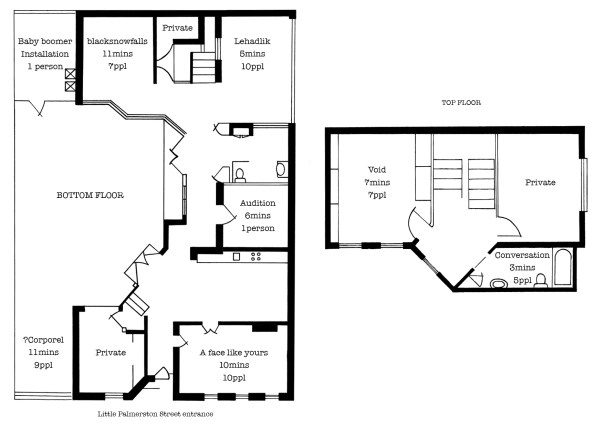
INSIDE PLAN PROGRAM.jpg
Program map courtesy of the artist.

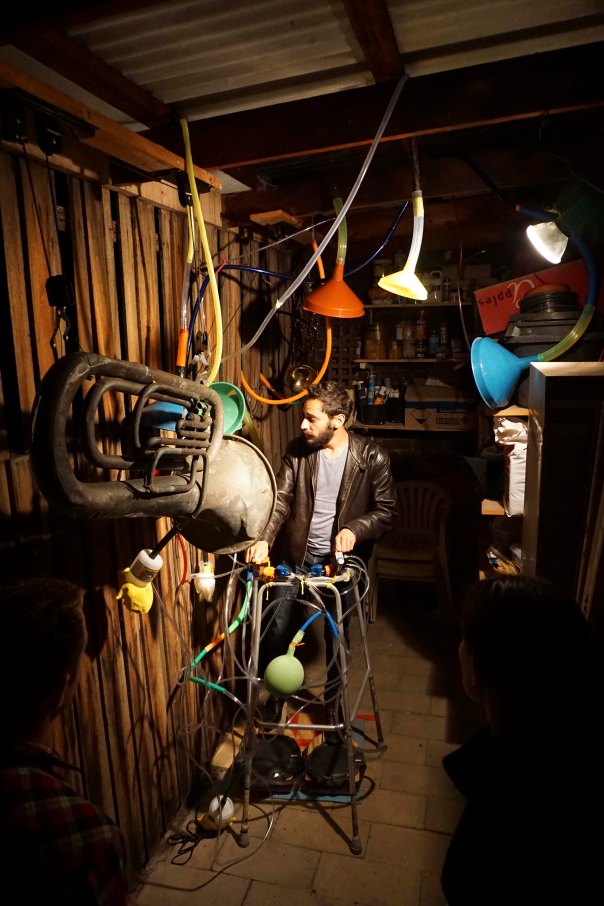
In the lounge room, a silent film, A face like yours (2015), made and performed by Aviva Endean and filmed by Christie Stott, flickered on the television. Earplugs provided allowed one to encounter a subtle internal world of sound as we mimicked the gestures and followed instructions on the screen to tap cheeks, hum, manipulate our lips etc. By way of contrast, in the back shed, one could interact more noisily with Dale Gorfinkel’s Baby Boomer (2015), a Heath Robinson-like contraption of foot pumps and balloons joined with plastic tubing to funnels, a battered tuba and a trombone, with garden irrigation switches allowing one to orchestrate changes to the wheezing combinations of sounds.
DSC04513 bb.JPG
Dale Gorfinkel’s Baby boomer. Photo by Pier Carthew.

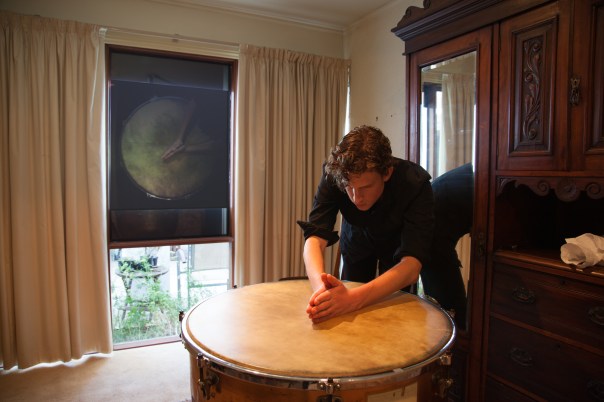
Out in the garage, Matthew Horsley could be found performing Vinko Globokar’s classic of body percussion ?Corporel (1984). On a loop during the 75 minutes of the event, this was a feat of concentration and commitment as he repeatedly slapped the different sounding surfaces of his bare chest, face and a satisfyingly resonant head. Another kind of skin percussion could be heard in the back bedroom inhabited by Matthias Schack-Arnott. In Wotjek Blecharz’s Blacksnowfalls (2014), hands and fingernails inscribe calligraphic movements onto a timpani giving rise to susurrations and sliding moans and creating a séance-like mood. A live video feed provided an additional level of visual detail, though for the audience of seven crammed into the room and sandwiched between a bed and mirrored wardrobe, proximity to the performer was intimacy enough.

Intimacy was the watchword for other works – two singers, Jenny Barnes and Niharika Senapati soaked in bubbles in the bathtub upstairs whilst exchanging enigmatic snatches of inhaled and exhaled sounds in Georges Aperghis’ Conversation (2004). In the next bedroom, a ‘grand amour’ was enacted in Endean’s Void (2015):

a pair of lovers approach in slow motion, the microphone held in the mouth of one (Aviva Endean) setting off feedback from the speaker held in the open mouth of the other (Alexander Gellman), reaching an inevitable denouement in a strangled kiss. Another ‘up-close’ experience could be had with Angelo Solari’s Audition (2014), staged as a one-on-one encounter with singer Carolyn Connor, with all the flavour of a Monty Pythonesque interview in a correctional facility. The queue was too long for me to get to it but my 13-year old son had a ball answering questions from the script and engaging in the staring contest. His verdict: ‘cool’.

Domicile-14.jpg
Jenny Barnes and Niharika Senapati perform Conversation by Georges Aperghis. Photo by Pier Carthew.

Endean’s talents for creating an immersive atmosphere were perhaps most completely showcased in her composition Lehadlik (2015) in which the audience was invited to sit at a formally set dining table. The day’s coincidence with the start of Hanukkah provided an extra level of resonance to the work’s evocation of Jewish ritual: two lit candles were wired with sensors used to trigger recordings of incantations from the Torah, the sonic landscape enriched with Endean’s melismatic clarinet playing. The meditative ritual ended with a snuffing out of the candles through the bell of the instrument.

‘House events’ have long held an important place in experimental practice in music and performance, from concerts in Berlin apartments or New York loft-spaces to, more locally, the work of Aphids in domestic settings in the 90s and Chamber Made’s opera productions commissioned for people’s residences. The use of such spaces to shift the frame on audience interaction is a well played-out ploy, yet, DOMICILE refreshed this format through a finely tuned curatorial sensibility. The choice of repertoire, quality of performances, size and nature of the venue combined to create a very special evening that exuded hospitality and a sense of enchanted time. Adding to the sensory feast, there was even cake to share at the end. Cooked during the evening, it had suffused the house with a lemon-sweet tang that followed us out into the balmy Melbourne night.

Review by Liza Lim

DOMICILE
Fleur Ruben’s house in Carlton
Melbourne, 4, 5, 6 December 2015

Directed by Aviva Endean and presented as part of the New Music Network’s emerging artists program with support from Creative Victoria

Performers: Aviva Endean, Matthew Horsley, Carolyn Connors, Matthias Schack-Arnott, Alexander Gellmann, Jenny Barnes, Niharika Senapati

Set design, Romanie Harper
Technical design, James Paul
Artwork, Betty Musgrove
DOMICILE: Alone Together

Review by Charles MacInnes

I set off to Carlton for the first performance of DOMICILE last Friday night, and even though I knew quite a few people amongst the group gathered outside, we remained mostly silent during the event. As we visited the different areas of the house there was a quick whisper on the stairs, a smile from across the room or a small nod of encouragement before something new began.

Straight through the downstairs section of the house, I landed in blacksnowfalls (2014 by Wotjek Blecharz) where Matthias Schack-Arnott had lithely joined himself to a single, slightly battered timpani. Like a teenager on the train I stared at the window and watched the sounds go by. The skin became taut and some sequences of letters formed, along with rhythms of copper under a body that moved and stretched to dampen the sounds.

Domicile-141.jpg
Matthias Schack-Arnott performs blacksnowfalls by Wotjek Blecharz. Photo by Pier Carthew.

Next door were the honks and squeezes of Dale Gorfinkel’s installation Baby boomer. You pedalled while holding on to an old Zimmer frame and the balloons and hoses and brass relics came to life. The apparatus seemed to have assembled itself from the junk in the shed and it kept going even after we stopped pumping air through. My brass player self began to realise how accidental a lot of life’s noise is. Sound and its complex waves and vibrations already exist, and we players perhaps take a little too much credit for its creation, and are correspondingly also deflated when it from time to time falters.

Domicile-88.jpg
Vanessa Tomlinson plays on Baby boomer by Dale Gorfinkel. Photo by Pier Carthew.

Ascending the stairs, I overhear the Conversation (2004 by Georges Aperghis) between two women (Jenny Barnes and Niharika Senapati) in the bath. The bubbles obscure their bodies and the voices are a mixture of inwards exhalations and assenting disagreement. When I hear people arguing, I can quickly tell that most of the time they don’t know what they are arguing about. They become so used to their practised roles that a quip or jibe represents years of misunderstanding. The underlying root of the problem is long since forgotten—we’ve lost the ability to analyse—instead acting out our expected frustrations on whoever’s at hand.

Downstairs again, I sat in the chair waiting to be next in a one-to-one Audition (2014 by Angelo Solari) with Carolyn Connors. We were seated opposite each other and the script/score was open. She: Hello

[pause]

I (reading): hello.

We bounced back and forth following the lines, mimicking each other in normal voices. Often asked to overlap the dialogue, it got a little faster before a Martin was mentioned a few times. She sprung from her chair and left, returning with the electric kettle now full of water. While waiting for it to boil we had to stare at one another. I was strategically pessimistic about my efforts at doing well, but kept my gaze fixed. Blinked a few times. Much later in the garden after the whole performance was finished, she said I was one of the most natural ones because I didn’t try to act.

Now heading to the front room, I copied Aviva Endean’s filmed actions in A face like yours (2015) on the TV screen. This was a warping of space and time perspective because I had done this once already at this year’s Bendigo International Festival of Exploratory Music. This time I was alone as I put the squishy coloured earplugs in. My fingers, as I copied the screen, started drumming on cheek bones, moving to ears, neck, face, nose, forehead then squeezes and pullings at the the lips and teeth. The sound is magnified and distorted as it comes in through the strange connections of bones, tendons and nerves like a web of old water pipes in an apartment building. We arrived at the Adam’s Apple with a high pitched humming before ending with hands covering nose and mouth.

Tiny wisps of air made it through the clarinet in Lehadlik, also performed and written by Aviva Endean (2015) in the open dining room at the heart of the house. Two candles flickered from the clarinet’s presence and a crackly recording of an old man’s torah incantation came from under a chair by the hearth. The tones were long and suspended but low in the air. My mind wandered out into the garden and I looked again at the window I’d been staring at from inside by the timpani with the live projected image of him still playing. The pieces in the house were repeating over and over as the audience shifted and changed and I think they’re doing it again now as I write.

Domicile-86.jpg
Aviva Endean performs Lehadlik. Photo by Pier Carthew.

To get to the garage you had to pass through three or four bedsheets hung from the gables. Matthew Horsley was shaved bald and had on a pair of flimsy white cotton pants. ?Corporel (1984 by Vinko Globokar) was disembodied as if from another time and dimension, perhaps some edited-out character of Brecht’s insisting that we feel and understand the false glamour and artificiality of entertainment today? His chest and face and scalp become chafed red from the harsh contact of his hands, and it finished with a dramatic exit through the automatic roller door that would’ve done Bertolt proud. The last piece I heard was a couple (Aviva Endean and Alexander Gellman) in the upstairs bedroom performing Void. Walking slowly toward each other in a routine they’ve enacted many times before, the microphones in their mouths caused a screech and wail of feedback. Was it getting stronger as they neared or changing frequency? Or were our poor ears just getting used to the piercing, painful sound? When they kissed it stopped. But they walked out again to quickly reassume positions for another round.

Domicile-45.jpg
Aviva Endean and Alexander Gellman perform Void. Photo by Pier Carthew.

As the audience, we narrowed down the distance between each of us as we moved through the different floors and rooms of the house. As I glanced into the makeshift mirror of glass over a black and white photo on the landing, I was reminded just a little more of who I am. Music does this beautifully; we are connected but each engrossed in our own calm thoughts. In DOMICILE we circumnavigated sound and it came together under one roof with the utmost magic and beauty.

DOMICILE
A house in Carlton
4/5/6 December 2015
Directed by Aviva Endean
Presented as part of the New Music Network’s emerging artists program

Review by Charles MacInnes
Melbourne-based composer and trombonist Charles MacInnes is currently undertaking a PhD on the role of improvisation in new music. http://www.charlesmacinnes.com

Six Degrees and Arcko Symphonic Ensemble: Eighty Plus!

Not only European composers come in generational clusters. The Australian composers Nigel Butterley and Helen Gifford were both born in 1935 and went on to become two of the country’s most recognisable compositional voices. The composers also share stylistic traits, emphasising the ritualistic and ecstatic side of the human voice in works drawing on antiquity. Both composers are well at home in atonal pitch space, even if they navigate it with differing degrees of systematicity. Players from two great champions of Australian music, Six Degrees and Arcko Symphonic Ensemble, came together to celebrate the composers’ eightieth years at the Church of All Nations.

Desperation for solo viola opens with microtonally detuned motoric rhythms. Phoebe Green, for whom the piece was written, pursued the anxious bowing with an intensity worthy of the work’s title. The piece explores not only moments of desperation but also the stupor that follows. The violist has to nimbly attach and remove a heavy practice mute in moments of creepy stasis, before launching back in to the ruminative acrobatics.

Highly-charged physicality also featured in the second solo piece by Gifford on the program.  Siva: the Auspicious One was composed for the virtuoso pianist Michael Kieran Harvey and demands positively divine energetic resources. Siva, the Hindu god of destruction and recreation, is conjured in this epic piece by thunderous bass chords, ascending scales, and hammered-out tremoli. Pianist Peter Dumsday put his entire body into the twists and turns of the work, reminding us all that he is—in his spare time—a racing-car driver. The piece raises the abstract dialectical question: Can you really destroy anything in music? Once a note is played it cannot be undone, only opposed by a new note. The violent chords of Siva: the Auspicious One seem to rail against this musical limitation, straining to bring real destruction into music but only making more music in the process.

Laudes and Forest I by Nigel Butterley plunged the audience into environments of delicious variety. Both pieces are inspired by spaces, the four movements of Laudes being inspired by four different churches and Forest I sketching a woodland scene. The dense writing never lapsed into monotony thanks to the sensitive interpretations of the performers and conductor Timothy Phillips.

Justine Anderson shined a light on the composers’ love of text and myth with two vocal works: Nigel Butterley’s Three Whitman Songs and Helen Gifford’s Music for the Adonia. The Whitman settings are gems of twentieth-century art song, nimbly bringing the tip-toeing text of “O you whom I often and silently come,” the spiralling incandescence of “Not heat flames up and consumes,” and the hallowed tones of “I heard you solemn-sweet pipes of the organ” to musical life.

Gifford’s Music for the Adonia is remarkable within the program for showing just how much Gifford’s music has changed over the past twenty years or so. Her interest in Ancient Greece provides her with a masterfully-imagined sound world that is at once raw and refined. The text for the piece is sound-based, painting with ecstatic power the Adonia, a festival where women mourned the death of Adonis.

Six Degrees and Arcko have once again provided audiences with informed and refined interpretations of some of Australia’s finest contemporary music. If only Gifford and Butterley could turn 80 more often.

Musicians from Six Degrees and Arcko Symphonic Ensemble
Eighty Plus!
Church of All Nations
11 December 2015
Nigel Butterley, Laudes; Helen Gifford, Desperation for solo viola; Nigel Butterley, Three Whitman Songs, Forest I; Helen Gifford, Siva: The Auspicious One, Music for the Adonia.

Rubiks: Things are become new

Competing schedules, fickle venues, and piles of percussion gear: There are myriad difficulties involved in organising a contemporary music concert. It can feel like a puzzle, a riddle, or even a Rubik’s cube. This was the sentiment expressed by flautist Tamara Koehler at the beginning of the first self-organised concert by Rubiks, a group of ANAM graduates who have found time in their busy international careers to come together and perform contemporary repertoire. The organisational effort was well worth it. Six players thrilled the crowd at the Church of All Nations in Carlton—fast becoming the venue of choice for contemporary music in Melbourne—with a polished program of canonic and recent works. The theme of change and transformation underpinned the program and was expertly handled by the ensemble.

Cellist Gemma Tomlinson conjured the movement and colour of butterflies in Kaija Saariaho’s Sept papillons. Saariaho explores every possible butterfly-like gesture on the cello throughout seven miniatures. Fast trills between harmonics shimmer like iridescent wings and Tomlinson’s bow-arm seems to take flight, arcing across the strings in fast arpeggios. There are high, trilling harmonics; low, susurrating tremoli; glittering, rapid alternations between open strings and stopped notes, all in constant motion and gradated change. The performer is called upon to constantly change their bow-tone, moving from heavy, slow, gritty over-bowing to fast, light, floating bows. Tomlinson managed these transitions with astonishing precision and ease.

Samuel Smith’s Things are become new was written for Adelaide’s Soundstream collective and showcases the composer’s sensitivity to the relationship of instrumental tone colour and gesture. A medley of mallets and stick-ends thump and rattle away on the vibraphone, a trio of winds woof and huff, while the strings play swelling messe di voce. The piece is a study in transformation, requiring great commitment to bring out its kaleidoscope of techniques and timbres. Rubiks were more than up to the task, providing a spirited and dynamic rendition of the piece.

Anna Clyne’s Steelworks approaches the theme of transformation programmatically. The piece combines live performance with field recordings and interviews from the Flame Cut Steelworks, the last steelworks factory in Brooklyn. Justin Beere’s pneumatic bursts on the bass clarinet, as well as Kaylie Melville’s kick-drum and the clacking keys of the flute remind us that modern instruments are machines of the industrial revolution. The voices of steel-workers ride on top of this mechanical racket, debating the merits of change. Their voices are slowed and clipped, gestures that are affectingly imitated by the instrumentalists as the entire musical machine winds down.

An explosion of energy (definitely “with panache” as instructed by the composer) concluded the concert in the form of Irish composer Donnacha Dennehy’s Glamour Sleeper II. From the multicoloured butterflies of Saariaho’s Sept papillons to the dark bouquet of Smith’s Things are become new, the concert showcased Rubiks’ searingly-precise ensemble skills and instrumental control. Rubiks are a formidable contribution to Australia’s growing community of contemporary music makers.

Things are become new
Rubik’s Collective
Church of All Nations, Carlton
28 November 2015
Samuel Smith, Things are become new; Anna Clyne, Steelworks; Kaija Saariaho, Sept papillons; Marcus Fjellström, Odboy and Erordog Episodes 2 and 3; Donacha Dennehy, Glamour Sleeper II.

Melbourne Festival: Fly Away Peter

Brenton Spiteri in Fly Away Peter. Photo courtesy of the artist.

The surreal style of David Malouf’s novel Fly Away Peter attracted Elliott Gyger when searching for a text for a companion piece to Stravinsky’s The Soldier’s Tale. The Soldier’s Tale is one of Western art music’s great false starts. An colourful ensemble of clarinet, bassoon, cornet, trombone, percussion, violin, and double bass is chain-ganged into the service of a second-rate text. Composed in the wake of the First World War, the folk-tale of a soldier selling his violin to the devil says too little about the events that had just shaken Europe. Writers and composers have since tried to give the work teeth. In 1993 Kurt Vonnegut reworked the text into a tale about the first soldier in the United States military to be executed for desertion. Gyger’s companion piece takes the same ensemble, but provides it with new music, a new text, and even a few new instruments. To Gyger, writing for Resonate Magazine, surrealism is an essential prerequisite for “the wonderful absurdities of the operatic medium.” But surrealism is also an essential strategy for dealing with the incomprehensible carnage of war. Fly Away Peter, produced by Sydney Chamber Opera for the second time as part of the 2015 Melbourne Festival, does not reduce the First World War to a dadaist romp. Instead, like a musical Malouf, Gyger carefully balances clear binaries and their fragmentation.

Clancy is torn apart half-way through the novel. The protagonist Jim Saddler rests to take tea after loading supplies for the trenches. Clancy approaches carrying a billy and mugs. Suddenly Jim is covered in blood and Clancy is nowhere to be seen. Clancy had been struck by a “minnie,” one of the German minenwerfer or trench mortars that bombarded the Western Front in the First World War. The traumatic event separates the optimism of Jim’s bird-watching days in Australia from his hardened military career in the trenches. On the surface, the novel is rife with such clear thematic binaries (as a generation of Australian high-school students will tell you): Birds and biplanes, natural and human timescales, life and death. But surreal fragmentation, disorientation, and dismemberment pervade the novel from one end to the other. The novel’s emblem is not the bird, but the minnie.

The novel’s fragmented binaries are reflected in Gyger’s music. The score is based on a grid of 21 five-note chords. The pitches of the chords are fixed in register, covering the entire range of the ensemble. Taking his cue from the libretto’s binary of earth and air, each chord is mirrored by another, inversionally-symmetrical chord, resulting in a “landscape-like” grid of pitches. The piece’s pitch profile generally moves from treble to bass as the characters move from halcyon Australia to the battlefield, an aural sensation obvious to all. But instead of simply choosing chords from the lower half of his pitch grid, Gyger reconfigures and layers the grid when Jim reaches the battlefield. The symmetrical binary established at the beginning of the piece is “turned inside out” by Gyger’s musical minnie. One can hear this device as evoking war’s effect on bodies, their dismemberment and distribution over vast areas. It can also be heard as war’s effect on the mind, or more precisely, as evoking the new understanding of human subjectivity to which the War gave rise.

The libretto by Pierce Wilcox is set out in three columns, one for each of the principal voices here stunningly performed by Mitchell Riley (baritone) Jessica Aszodi (mezzo-soprano), and Brenton Spiteri (tenor). In this way Wilcox reflects the fragmented subjectivity of the novel’s central trio. Each character is gifted their own distinct faculty of knowing the world around them. The landowner Ashley Crowther is a musician who reverts to tuneless singing when at a loss for words, Imogen Harcourt the nature photographer captures the world in images, while Jim has a unique gift for the names of birds. Like the three wise monkeys of Japanese mythology, they are the three innocent monkeys who have not yet heard, seen, or spoken evil. Only the omniscient narrative voice has access to all three faculties of hearing, seeing, and naming. The distributed subjectivity of the trio prefigures Jim’s psychoanalytic observation, made while drenched in Clancy’s blood—though in the detached voice of the narrator—: “The body’s wholeness, it seemed to him, was an image a man carried in his head.” Fly Away Peter shows how the trauma of war reveals the imperfect and multifaceted knowledge we have of ourselves and our environments.

The surrealism of Fly Away Peter is therefore found at the meeting point of intense sensation and detachment. The story is the perfect match for Gyger’s detailed and transparent compositional style. The opera opens with gorgeous birdsong transcribed for the violin of James Wannan. Moments later Jim is taken on a terrifying ride in a biplane painted with little more than a gentle drum roll. At times I found myself gliding along these surface-level depictions. But if one pays more attention to the music, Gyger’s rich harmonic landscape flies by in full colour.

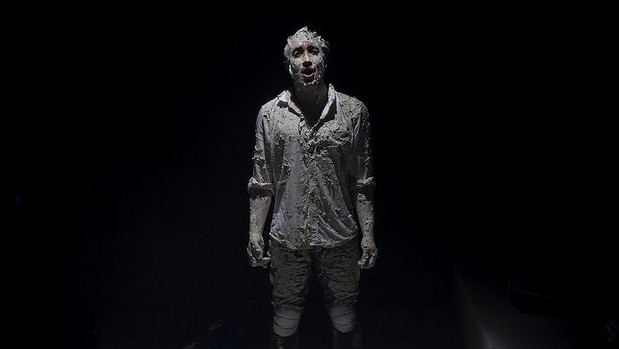
The beautiful staging by Elizabeth Gadsby is also both schematic and affecting. Dozens of blue buckets of clay are the opera’s only props. Their varied placement around the five-tiered white stage is an art installation in itself. They begin in asymmetrical patterns, but finish ranged in rows like tombstones. This minimalist staging evokes suffocating terror as the singers cover themselves in the clay.

The whole experience flits past so quickly that I feel the work will reward multiple viewings and stagings. Riley, Aszodi, and Spiteri seamlessly and effectively switch between characters and scenes in the retaking of a violin bow. Ultimately the strength of these performers hold together a challenging new work.

Fly Away Peter
Composed by Elliott Gyger
Libretto by Pierce Wilcox
Based on the novel by David Malouf
Sydney Chamber Opera
The Melbourne Festival
The State Theathre
21 October 2015


Melbourne Festival: The Experiment

The_Experiment
Mauricio Carrusco in The Experiment. Photo by Emmanuel Bernardoux.

A rural homestead flickers on a screen. Deep blue moonlight reflects off the corrugated iron roof and lamps glow on the veranda. The house looms out of an inky-black forest. It is almost three-dimensional, a composite of 24 different images. The projection is divided into imperfectly-aligned quadrants that cycle jerkily through three frames each. These are in turn projected on two scrims, one several meters in front of the other. You could stare at this image all night, lulled by the primitive synthesizer loop and cheery, fuzzy voices of AM radio diffused through 48 speakers suspended above you. All is childhood and reverie, falling asleep in the back seat on a long nocturnal drive. The Experiment‘s opening mise-en-scène is a beautiful moment in itself, showcasing the incredible attention to detail and aesthetic unity of its creative team.

The multiple visual and aural perspectives of the opening also flag the work’s central theme: The unreliability of memory. The musical theatre work (in the sense of the European genre that introduces theatrical elements into musical performance) is based on a monologue by the British playwright Mark Ravenhill, who was in turn inspired by the Australian philosopher Peter Singer. A solo performer (the guitarist Mauricio Carrasco) recites the text in a careful monotone, trying to remember the circumstances of a series of horrific experiments he and his partner performed on children. One moment he is an accessory, the next he is the perpetrator, once more he is a concerned neighbour sneaking around the house with a video camera. Scenes are described in detail and then summarily denied as never having taken place. Once more the sound design plays on a multiplicity of perspectives. Seven microphones hang in a semicircle around Carrasco, capturing his voice from different angles and projecting them, along with pre-recorded text, in a disjointed chorus.

The piece raises a range of ethical issues, though with varying degrees of clarity and urgency. There are traces of Peter Singer’s utilitarian argument that animals with similar levels of awareness and intelligence should be treated alike. If we are comfortable performing painful medical experiments on non-human animals, then we should feel comfortable performing the same experiments on severely intellectually-disabled humans. Describing an experiment viewed through a crack in the shed door, Carrasco-as-concerned-neighbour claims he wanted to say (with the staircase wit typical of situations where one’s moral fiber is tested—in Melbourne we could substitute “tram wit”) “We are no better than animals. Is this what we are doing with what God has given us?” The neighbour upholds the idea of human exclusivity, that any human life is more valuable than one of another species. But the experimenters do not appear to be using severely intellectually-disabled children. Nor does Singer advocate the use of humans in medical experiments as much as urges us to reconsider our treatment of animals.

The dilemma of The Experiment is closer to a “trolley problem”: You control the switch on a railway track and can choose to either leave a runaway carriage to plow through five people or divert it to a track with one person on it. Most people accept that switching the trolley to the less populated track is preferable to doing nothing, even though this makes them an active participant in the moral wrong of the death of one person. By contrast, most people will not choose to push a particularly heavy person on to the track to stop the train from killing five people. This latter form of the dilemma, the “fat man” version, is that presented in The Experiment. The protagonist’s partner is suffering from an incurable and presumably fatal illness. They choose to infect their children in the hope of finding a cure for the parent, the children, and many others. Again, this doesn’t present as a compelling ethical dilemma, as the chances of finding a cure are so uncertain. The one moment that makes you stop and think is when Carrasco says “I loved my children, but I loved my partner.” This—if the situation were actually as determinate as a trolley problem—introduces a new layer of emotional and ethical tension. This is especially interesting as the “partner’s” existence is uncertain. Despite the half-cocked ethical dilemmas, Carrasco provides an absolutely compelling, understated delivery of the tortured text.

As a piece of musical theatre, The Experiment has the virtue of giving text and music their due. This virtue also turns out to be the piece’s weakness. Musical theatre often plays on the ecstasy of the syllable, breaking texts down into their phonetic elements and repeating them as a dramatisation of language’s inherent instability or on the assumption that the sounds will eventually give up their hidden aesthetic interest. The Experiment takes an attitude towards language that I like very much, which is to take the instability of language for granted and then see how many meanings or interpretations can be derived from an only mildly garbled text.

In musical theatre, music is often reduced to the parodying of musical gestures and conventions. The Experiment takes the bold step of including three distinct pieces of music for solo guitar performed without any text at all. Each piece is played on a different guitar that references the text in some way. The first, melancholic piece for acoustic guitar reflects the pathos of the narrator’s opening text. The second piece, by guest composer Fernando Garnero, is performed with a variety of tools on an electric guitar placed inside a vitrine. The tools and vitrine reference the experiments conducted upon the children. The final piece is not performed by Carrasco, but is programmed for a stunning mechanical guitar built by Nara Demasson and Ben Kolaitis. The guitar is constructed from two guitars stuck together top-to-tail with a variety of solenoids and servo motors activating beautiful copper, brass, and wooden arms, plectrums, and wheels. This sculpture reflects the twin children treated as biological machines, or perhaps the couple bound together by their past. While the decision to include musical interludes was refreshing, they jarred uncomfortably with the surrounding theatrical episodes. I wonder whether this all comes back to that fabulous opening mise-en-scène. The opening established the expectation of a primarily theatrical piece into which a purely musical performance could only intrude. Despite this formal incongruity, the team have set a new benchmark for the detailed and sensitive integration of video and sound design in musical theatre.

The Experiment
Performed by Mauricio Carrasco
Text by Mark Ravenhill
Music by David Chisholm
Guest composer Fernando Garnero
Media Artist Matthew Gingold
Dramaturg Jude Anderson
The Melbourne Festival of the Arts
The Malthouse Theatre
23 October 2015

Alexina Hawkins: Spectrum

Alexina Hawkins’s viola is a vessel for reaching out and engaging with her network of musicians and creators. Eschewing the South Melbourne Town Hall for the cavernous ceiling and broad windows of the BRIGHTSPACE gallery in St Kilda, the expansive, final concert of Hawkins’ ANAM fellowship included an improvisation on water by percussionist Thea Rossen and an exciting new work for massed violas by Samuel Smith.

Continuum II by Nicoleta Chatzopoulou begins with axiomatic statements of different types of articulation: Legato bowing, tapping the body of the instrument, tremoli. As the piece develops we are treated to glorious chorale textures decorated with harmonics, glissandi, and double-stops that resonated beautifully in the room. This piece was a lesson in the timbral possibilities of the instrument, setting the stage for the massed violas to come.

But not before the audience was gently ambushed by the percussionist Thea Rossen. Rossen began her liquid improvisation behind one of the gallery’s partitions. The singing tone of a hydrophone called from afar before growing nearer as Rossen moved through the audience. Like a ritual procession, she eventually reached a bowl of water brilliantly lit from below. Here the spell was broken as Rossen conjured a series of slapping noises from the water. One sound caught the ear: the sharp attacks produced by flicking the water with the thumb and forefingers.

Emerging from studies with Larry Sitsky and Elliott Gyger, Samuel Smith is one of Australia’s most sought-after young composers. Over the past months he has been busy composing for Ensemble Offspring, Soundstream Collective, and the Melbourne Symphony Orchestra. His piece for seven violas premiered in Hawkins’ concert joins pieces for massed violas by Peter de Jager and Brett Dean performed throughout Hawkins’ fellowship. As I claimed earlier, massed violas are incredible vehicles for contemporary music. In elsewhere; everywhere Smith wastes no time in pushing the instrument to its limits. One viola breaks into a finely-detailed solo of rapid string crossings; light whispering bowing, crunchy double-stops, sotto-voce trills, and harmonics. The solo is a piece on its own, a polyphony of timbres on one instrument with swishing up-bows like a samurai sword. Two more violists seamlessly join in, producing a fluid texture of sirens crashing into grinding, heavy bows on the lower strings.  The piece is so linked to breath and motion that I feel it could be arranged for a vocal ensemble.

Once the ensemble grows to more than three voices, the piece becomes less convincing. Four violists face each other on either side of the trio. Their antiphonal imitation is obvious and repetitious, though moments where the entire ensemble contrast with solo voices are positively sublime. At one point Smith pits a Xenakian chorus of glissandi against one tough little solo voice. Evan Lawson’s broad conducting was perfect for the massive, pitching rollercoaster of sound. Smith quits while he is ahead. The ensemble puts their mutes on to finish and I was left thinking I could have heard more, which is always a good thing.

Hawkins ended with the solo piece Light is Calling by Bang on a Can co-founder Michael Gordon. Light is Calling is an exhausted appeal to beauty after the events of September 11. The solo violin (here viola) plays sustained, plaintive tones against an electroacoustic track of reversed guitar sounds. Hawkins articulated her line with more vibrato and dynamic phrasing than Véronique Serret during the recent Metropolis New Music Festival. Serret’s interpretation produced an atmosphere of angelic serenity, but Hawkins may have opted for a more dynamic interpretation because she was not playing against Bill Morrison’s accompanying film. Spectrum, like all of Hawkins’ ANAM fellowship concerts, showcases her collaborative nous, artistic vision, and instrumental virtuosity.

Alexina Hawkins
Spectrum
BRIGHTSPACE
12 September 2015

Nicoleta Chatzopoulou, Continuum II; Thea Rossen, Improvisation; Samuel Smith, elsewhere; everywhere; Michael Gordon, Light is Calling.

BIFEM: Argonaut Ensemble, Superimpose Cycle

The Argonaut Ensemble perform Alexander Schubert's Superimpose Cycle. Photo by Jason Tavener.
The Argonaut Ensemble perform Alexander Schubert’s Superimpose Cycle. Photo by Jason Tavener.

Review by Delia Bartle

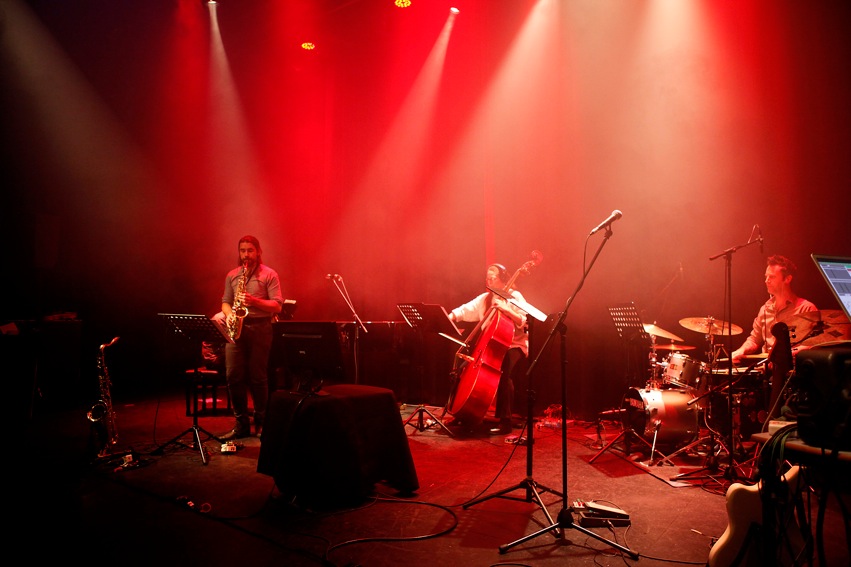
“Splits between real and faked instruments; a hyperactive zapping through styles and stereotypes” is how Hamburg composer Alexander Schubert describes his 2011 Superimpose Cycle for Jazz Quartet and Electronics. This whimsical idea was energetically realised in the work’s Australian premiere by the Argonaut Ensemble, comprising a hybrid instrumentation of piano, saxophone, violin, double bass, electric guitar, drums and electronics. Both the audience and musicians were seated on the dimly lit stage of Bendigo’s Capital Theatre, immersed in a hazy space that became home to disfigured saxophone solos, hammered piano notes and wailing guitar glissandi.

Schubert creates a dense and unpredictable cross-genre sensation by mixing traditional composition elements with the impulsive spontaneity of jazz and electronics. The musicians in Superimpose Cycle were guided by in-ear click tracks—quite a contrast to typical jazz gigs where performers are often reliant on eye contact and gesture to achieve cohesiveness. Even though the individualised click tracks created the appearance of a detached ensemble, the seven musicians maintained a palpable sense of joyous unity. Saxophonist Joshua Hyde and pianist Emil Holmström thundered vigorously through demanding passages of repeated notes, with minimal signalling and absolute synchronicity.

In the second movement, ‘Night of the Living Dead’, Anita Hustas explored the timbral possibilities of amplified double bass by alternating quick pizzicato stabs with weighty bowed tones, her smooth glissandos juxtaposed with electronics that bubbled with tension. Drummer Phil Collings joined in with a laidback jazz rhythm before launching into the complex patterns that propelled the work.

‘Infinite Jest’ exploded with a frenzy of crashing electronic waves that were initially a little confronting. As the floor rumbled with shuddering pulses, this density soon enveloped the audience in a cocoon of sonic experimentalism. Roaring and gnarly chords were driven to the forefront of this wall of sound by electric guitarist Kobe Van Cauwenberghe.

The evolving interplay between the live acoustic instruments and processed electronics was particularly intriguing. In the earlier movements, stuttering sound samples were interspersed with instrumental figures in a back-and-forth manner, like the musical equivalent of a tennis match. This divide became gradually less distinctive as the electronics instead distorted the real-time performance with reverb and effects.

Schubert wrote a series of computer processers to align with the timing sequence of the click track, so that new sound effects are implemented and withdrawn as the musicians reach certain points in the score. Heavily amplified violin featured in ‘Sugar, Maths and Whips’ with audible bow changes of a gritty, textural quality. Violinist Winnie Huang coped exceptionally with an unintentional technology glitch as the violin’s notes echoed in the sound system after a second of delay. Electronic musician Myles Mumford was on stage to control the running of the pre-programmed processors, and he explained afterwards that the unexpected delay was due to a processer adding latency where there should have been none. Although this was a computer error, it also became a functional musical feature that unknowingly embodied Schubert’s philosophy of there being little distinction between scripted sounds and indeterminate happenings.

To superimpose is to place one thing over another so that both items are still evident and identifiable. The Argonaut Ensemble achieved this by balancing myriad diverse sounds and textures as though they were coloured panes in a kaleidoscope. Beautiful textural patterns constantly rotated to create shifting overlaps of colour and sound in a thrilling performance of vibrant musicality.

Superimpose Cycle
The Argonaut Ensemble
Alexander Schubert
The Capital
6 September 2015
BIFEM 2015
Delia Bartle

BIFEM: Defunensemble, O Book of Returns

The audience arrives for Defunensemble's O Book of Returns. Photo by Marty Williams
The audience arrives for Defunensemble’s O Book of Returns. Photo by Marty Williams

Review by Simon Eales

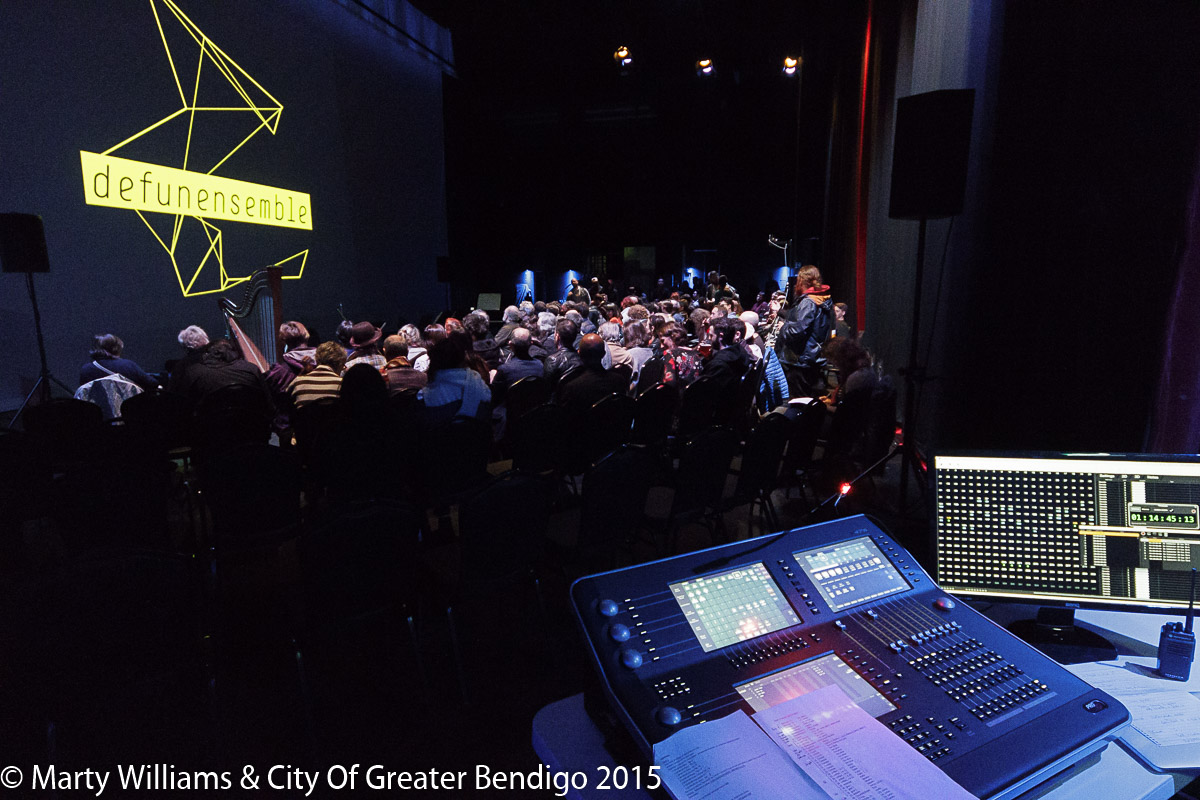
Helsinki-based Defunensemble presents a uniquely immersive experience in their debut Australian show. The audience for their Saturday night performance of Peter Ablinger’s Book of Returns (1985-2015) and Kimmi Kuokkala’s O (2011) join the performers onstage. Our backs to the house curtain, we sit beneath hanging cans, profiles and fly-bars; between legs, fly-rope and wings; lit by the low-voltage blue glow usually reserved for the stage-crew’s safe passage. It’s a remarkable atmosphere. With the Ulumbarra Theatre’s glistening newness, we’re lodged in the cockpit of some auricular sputnik.

Nowhere is this feeling clearer than in the distortional insistency of Kuokkala’s work. Before it begins, guitarist Sami Klemola—who shines in the group’s second program, All Finnish, the following afternoon—tells us that Kuokkala is known as the ‘shaman of Jyväskylä.’ Located in the lake district of central Finland, and identified as the country’s version of Athens for its cultural and educational distinction, Jyväskylä has its own mood which seems manifest in O. Klemola adds that Kuokkala’s work uses minimalism to create an atmosphere ‘of a certain kind.’ Such indeterminacy seems part of the seductive effect.

Lily-Marlene Puusepp works the top end of her harp in restrained but mesmerising rotations, accompanying Emil Holmström’s structural piano work. She rocks the instrument gently, hypnotically back and forth, letting grace notes drift into the realms of other instruments. Hanna Kinnunen switches between flute and bass flute, triggering a shift from tantalising revelation to calm. Her easy voyage through lower registers alongside clarinetist Mikko Raasakka’s stint on bass saxophone lends the piece its emotional resonance: affirmation and mystery carefully bundled together.

Markus Hohti’s performance on the cello, however, furnishes the piece with its dynamism. He takes frenetic escapades below the bridge, tearing hair off his bow. Arms in agitation, his over-bowing fills the piece with crunchy texture. It’s as if he’s plugged into a loop pedal, such are the driving waves of energy. One lasting image is of Hohti leaning into extended and aggressive spiccatto sections while Raasakka, sitting opposite, offers long and sonorous—almost doleful—counterpoint.

 Although there is no visual projection involved, O seems filmic. My mind conjures images of a scarily alien, but actually innocuous, leviathan floating and rolling through the air above. I imagine that we view it from strange angles and that the electronically generated, muffled public announcement-style sounds we hear are the inhabitants of this being speaking to us. This conjured vision is not the product of pure delusion; digital effects are a strong presence throughout. They distort the analogue instrumentation and add visceral chimes, gongs and the sound of a sword being swiftly drawn from a scabbard.

Peter Ablinger’s Book of Returns is presented first and primes us for this shamanic journey through its overtly metrical composition. It’s billed as a long-form work entirely constituted of 40-second cells of sound. The players arrange themselves in a line before us, and watch a small electronic timer behind us like hawks. In the first movement, they play individually until, when 40 seconds is up, they abruptly stop. Another player begins and does the same. When the musical baton is returned, the player picks up exactly where they left off. One of these modules involves Puusepp, not touching her harp, reciting very large numbers in hushed Polish. Another is Kinnunen reading a German philosophical tract. The effect is of a deconstructed soundscape in which multiple layers of sonic sense are created and seem to persist in unison, despite their sequential arrangement in time.

This is only the start of the fascinating formal games. Another module consists of silence. We all simply wait for the nominated duration to finish. We then get an extended section—it seems like longer than the other units—of the sounds of a city street scene. We learn afterwards that the group had placed microphones outside the theatre doors and were beaming the sounds of Bendigo into the theatre for us, live. Other elements drawing attention to the performance’s own theatricality expand the text into physical space and appeal to other senses: Hohti’s slaptick engagement with a retro tape deck, a pretend curtain call, Holmström’s strained vocal scale, and a geometrical animation projected on the scrim. Not for the first time at BIFEM, compositional experiments become fertile soil for an intensely arresting audience experience.

One senses that Book of Returns could continue developing and distorting for another twenty years and only benefit. In fact, the immediacy of its resistance to its own form almost demands that such an evolution take place. Putting these two works together seems destined, too. Ablinger’s work suggests that when form breaks, another form will always take its place. Kuokkala’s takes those breaks and provides a more sensual second option: a deeply connective shamanic journey, to which we all have access.

Defunensemble
O Book of Returns
BIFEM 2015
Ulumbarra Theatre
5 September 2015
Simon Eales

BIFEM: James Hullick, Rotation Post-Sapien

_MG_7021

Review by Jaslyn Robertson

In the centre of the stage, a bazaar of trinkets covers the piano. Our attention is first diverted, though, to a humbler setup on the floor where James Hullick begins Rotation Post-Sapien, his exploration of the sound world he’s brought with him to BIFEM. The sounds he begins with are child-like and ritualistic: the gentle tapping of a drum, rolling sticks over each other, a cymbal reverberating. Quiet groans escape his mouth. A large screen to the side of the stage gives us a simultaneous close-up of Hullick’s sound-making.

Soft moans accompany the artist’s move to the piano, inside which he places his camera so we have an intimate view of the arrangement of his materials. The inventory of objects in and on the instrument range from typical prepared piano settings, giving it a percussive sound, to hanging bells, bags of rocks and other objects outside the piano for Hullick to manipulate. While prepared piano is well established, Hullick creates a unique sound world, using it not so much as a melodic instrument but to create a natural soundscape. A golden elephant suspended above the piano strings swings gently in front of the camera. A tablet lies inside, placed so that electronic sounds can be triggered as Hullick plays.

The written score Hullick occasionally glances at suggests a pre-composed structure to the improvisation. As the work progresses, this becomes more evident as a cycling through emotions as well as an exploration and destruction of his carefully constructed environment. When he first sits at the piano, his movements are deliberately tentative, feeling out the sounds. The piano playing is initially percussive, but with a resonance that seems amplified. Now Hullick’s vocal tones transform into hissing and accentuated breathing, echoing through electronics while his use of piano and percussive objects becomes more frantic. The elephant’s circular movements are interrupted by increasing vibrations sending it swinging in all directions.

While many modern composers use pre-recorded music or soundscape to add to the texture of a solo or small ensemble performance, Hullick performs all his noises in the moment. Using only short samples and sound effects, he doesn’t impose on the highly responsive, emotional nature of his improvisation. He cleverly builds the texture with acoustic sounds as well, rolling a marble across the front of the piano into a drum, a sustained sound over which he can continue to play. The way Hullick plays the electronic sounds, and even the positioning of devices inside and next to the piano, prompt the audience to question as to the need for a strict distinction between electronic and acoustic instruments. Repeating rhythmic and melodic figures develop in the piano part while Hullick creates an electronic soundscape over the top. It doesn’t matter that he occasionally breaks his rhythm handling the two parts at once; it adds to the natural motion of the performance, something which wouldn’t be the same if he had a second performer playing the electronic component. Hullick makes a point of keeping the piece as human as possible by having complete control of all sounds–including electronic ones–at all times.

Sci-fi sound effects gradually make their alien intrusion into the environment, setting off a turbulent juxtaposition between the natural and the synthetic. Bleeps, squelches and futuristic laser noises push their way between prepared piano and bells. An indiscernible robotic voice makes the occasional foreign statement and a spacey synth melody is heard. Everything is now amplified, and the music makes its anxious descent into destruction. The mechanical mood of this section contrasts with the opening, as the introduction of a new category of sounds to music before it is understood enough to harness emotive possibilities. Technology appears to overpower the humanity of the prepared piano.

Hullick returns his attention to the piano with a changed attitude. His once careful, calculated movements seem to have been transformed by a fit of rage as he throws around objects inside the instrument. A spidery metallic device is violently tossed across the strings, dislodging screws and bells. The elephant almost swings off its chain in the entropy. Piano strings hit forcefully with mallets set off a cymbal, producing a crashing wave that dominates the space. Red lights flare across the stage as Hullick cries out, his voice piercing through the chaos of both piano and electronics.

Then, a cathartic restoration. Wailing turns into pained sighs. The stage turns blue. The computer-like female voice, once too distorted to identify, echoes ‘Time’. Hullick carefully returns to the initial soft exploration of the beginning, sussing out the altered positions of his objects as well as the changed emotional atmosphere of the room. ‘You’, chants the voice. The work ends with Hullick seated cross-legged on the floor again, turning over sticks and rocks in his hand.

Both prepared piano, electronic synths and samples are concepts that were once new but have now become commonplace, almost historical. Hullick places them in what feels like a post-apocalyptic landscape along with his raw vocals. Stripped of shock value, prepared piano and electronics–as well as sound art–gain the capacity to become more emotive, completing their rotation from something alien to overwhelmingly human. With ‘Rotation Post-Sapien’, Hullick combines and re-invents musical relics from different periods in a ritualistic exploration of human emotion.

James Hullick
Rotation Post-Sapien
BIFEM 2015
The Old Fire Station
6 September 2015
Jaslyn Robertson