Ensemble Offspring
Between the Keys
The Street Theatre
8 June
Guest review by Veronica Bailey
I have always had a love for chamber music with varied instrumentation. It allows composition to drive what sounds are included rather than being restricted by the instruments that are available to the ensemble. This was beautifully demonstrated in the concert Between the Keys, presented by Sydney based group Ensemble Offspring. Instruments were commissioned for the ensemble for a previous concert. These instruments included a violin like instrument called an Undachin Tarhu, built by Peter Biffin, with an additional set of seven strings under the fingerboard that resonate with different frequencies . These strings are tuned to the centaur tuning system developed by Kraig Grady which was likewise adopted by other instruments in the ensemble. This included a vibraphone, harmonium, the bell-like meru bars, the clarinis and a keyboard.
The concert opened with a work by Arana Li titled Mysteries. The work aptly demonstrated the new sounds of the centaur vibraphone, the undachin tarhu and the clarinis. This was one of my favourite works of the night, the instruments sounding as naturally as if this configuration of instruments was as common as a string quartet.
Next was Music in Similar Motion by Phillip Glass, a minimalist piece conceived to be played by any group of instruments. This piece suited the centaur vibraphone and detuned keyboard perfectly, the ringing of the vibraphone adding a hypnotic quality to the work.
Amanda Cole’s Hydra was written specifically for the clarinis made for the ensemble. The sound was reminiscent of medieval music and the melodic interaction between the two players was enjoyable to listen to.
Some Shades of Blue by the artistic director Damien Ricketson was performed with great style by Anna McMichael on the undachin tarhu. It evoked thoughts of Mongolian nomads wandering vast plateaus. The conclusion to the piece had centaur vibraphone broken chords accompanying undachin tarhu bow scrapes, which were haunting and other-worldly.
Kraig Grady’s pentatonic piece Akashic Torus was often reminiscent of gamelan music. The vibraphone playing of Claire Edwards stood out in this piece and the meru bars, built by Grady, added a wonderful, sonorous quality when struck.
Arvo Pärt is a composer that I love listening to and I greatly enjoyed the Ensemble Offspring version of Fratres. Perhaps not more than the original, but still very much.
The final piece of the evening was a composition by Terumi Narushima. Hidden Sidetracks took the listener on a journey of all the centaur tuning has to offer. Beginning as a very tonal piece, with few centaur tunings evident, the piece quickly changes to take on a more oriental feel, and more notes feel a little strange to western ears. Quick dance-like segments feature regularly, with the work then returning to a more tonal centre.
This was a most enjoyable concert exploring an intriguing and rarely visited sonic landscape. Different, but very accessible, the program proved a hit with barely an empty seat in the house.
Before the first exhibition was installed, the new Bus Projects space in Collingwood opened its doors to Jon Heilbron’s Phonetic Ensemble. Like many double bassists, Heilbron straddles the worlds of notated and non-notated music, as comfortable in an orchestra as he is improvising with a group of jazz-trained musicians. The Phonetic Ensemble—a sprawling collection of brass players, percussionists, guitarists, double bassists, woodwind players and computer-musicians—collectively questions this divide by experimenting with the conventions of performance and musical notation. In a several-hour musical exorcism of the pristine new gallery, The Phonetic Ensemble performed two sets juxtaposing the idea of “sound on silence” with “silence on sound.” This conceptual arrangement was augmented with a score by Manfred Werder consisting of several blank pages and the words:
place
time
( sounds )
The introduction of “place” to the performance through the distribution of players across the gallery’s three main rooms clustered the instrumentalist and added a dynamic inertia to the development of silence and sound throughout the piece. Suddenly this was not an experiment with a single musical surface projected towards the audience from a stage, but several such experiments interacting and affecting one another through individual echoes, flocking and contrasts between individuals and groups.
Initial arrangement of The Phonetic Ensemble in Bus Projects gallery
In the front room (c) guitarists Dave Brown and Brett Thompson set themselves up between Reuben Lewis on trumpet and Dale Gorfinkel, who played a modified trumpet with a clarinet mouthpiece and a long plastic tube running from a valve to a secondary trombone bell. On the other side of a partition the trumpet-players Peter Knight and Callum G’Froerer flanked Jon Smeathers with his laptop running Ableton Live (b). Down a short hallway the gallery’s narrow projection space (a) was inhabited by Matthias Schack-Arnott’s table of percussion instruments, Jon Heilbron on double bass and Aviva Endean on clarinets.
When the concert began I found myself in room a, where Endean played swelling, nasal phrases over the grinding sound of a port glass rubbed against a coarse tile. Heilbron added a ground of low, bowed tones before contrasting with high, short attacks and low trills. Schack-Arnott responded by rattling a chime made of empty bottles. Though group a formed a musical world unto itself, they were soon echoed by muted trumpet trills from room b, where a more timbral game was at play. G’Froerer’s trumpet hissed and spat like a leaky espresso machine and Smeathers triggered harsh explosions of square-wave tones. This sound-world was picked up in room c where wooden-sounding “chucks” and muted flurries from the guitars announced a flock of dry, harsh sounds between rooms b and c.
Standing up and playing low, grumbling sounds at ground-level with his flexible trombone bell, Gorfinkel moved to the gallery’s “sweet spot” where all three groups could be heard equally (d). Raising and lowering the trombone bell from the ground, he was able to mute and unmute a quiet gurgling sound that also projected from the primary trumpet bell. The timbre of the sound was further manipulated by raising the bell into the air and directing the sound toward the three main rooms.
Returning to room a, a man lay down and Endean and Gorfinkel were playing around his head and pressing the trombone bell on his back. This moment had a certain pedigree, with both Schack-Arnott and Endean having recently developed intimate one-audience-member programmes.
Suddenly there was a breath, the first moment of silence in the performance so far. The rest of the performance was more focused, with detailed interaction across the ensemble. The silence was broken by a clatter of high metal percussion and low double bass tones. The clatter and bass subsided, leaving high tones from the clarinet and trumpets in all three rooms. These give way in turn to a low double-trill on the clarinet and the quiet whirr of a coffee stirrer with a paper fin playing a double bass string.
I installed myself at d as shifting shades of brass and low, distorted guitar chords struck up from rooms b and c. The clarinetresponded with low, rising glissandi, which were in turn echoed in the electronics. The electronics built in a garbled fury as the trumpets entered staggered across the space. The trumpet echoes died away, leaving a decorated clarinet line and rattling bells.
Shifting their attention from the sound painted on silence to the importance of silence between sounds, the musicians were much less restrained with the sounds they did make in the second set. The performance was not so much an exploration of silence than an exploration of spatial disconnection. The uncanny atmosphere of the second set was enhanced by a rearrangement of the ensemble. Thompson took up the Endean’s corner, while Lewis took up corner e. Brown stoically held room c, playing a quiet ostinato that could not be heard in any other room. Lewis offered fluttering “sigh motifs” from his lonely corner, while G’Froerer responded with rising interjections. Silence returned, except for Schack-Arnott bowing crackling, popping sounds out of the protective foam of his table. A distorted rumble rose from the electronics. Lewis started throwing rattling, jittering tones between rooms a and c while Thompson plucked out a lazy tune next to Schack-Arnott shaking his percussion table. Wailing trumpets erupted while Schack-Arnott took to worrying a large chain.
It is remarkable how the spatialisation of the ensemble rearranged the priorities of the performance from an interrogation of silence and sound to musical connection and disconnection across the ensemble. This was evinced by the performers, who strived to maintain connection with the rest of the ensemble by inhabiting spaces d and e. It was more interesting as a listener, however, when they didn’t. The interest lay in hearing the connections across the spaces and moving to discover a sound, or even a whole sonic environment, that was inaudible a few steps away, in other words, the relative distribution of silence across the space.
Wednesday 12 June. Video, music, art exhibition Surface Noise opens at Bus Projects, Vic, at 6pm, featuring albums and audio works by Eugene Carchesio, Alex Cuffe, ∑gg√e|n, Lawrence English, HAPPY COOL, Benjamin Kolaitis, The Histrionics, and Darren Sylvester. Runs until 29 June.
Thursday 13 June. ISEA 2013 palpates the bleeding edge of performance interface research with Machrophonics II, featuring work by Wade Marynowsky, Julian Knowles and Donna Hewitt. Bon Marche Studio, 755 Harris St, Ultimo, NSW.
Friday 14 June.Ensemble Offspring bring their Listening Museum programme to the Paddington Uniting Church, NSW, at 6:30pm.
Saturday 15–Sunday 16 June. ISEA 2013 presents the Music Metacreation Weekend, exploring a range of themes around software music creation, various locations, Sydney, NSW.
Tuesday 18 June. The Australia Quartet premiere Elena Kats-Chernin’s newly-arranged Winter at the Melbourne Recital Centre at 6pm.
The Phonetic Ensemble take their provocative exploration of improvised and notated music to The Make it up Club at Bar Open, Brunswick St, Fitzroy, Vic, from 8pm. After reports of founder Jon Heilbron’s solo show at Bar 303 it ought to be a treat.
Winterreise by Ida Duelund, Chamber Made Opera Records
Winterreise (album launch)
Ida Duelund
Peter de Jager
A living room in Williamstown
Chamber Made Opera Records
Saturday 25 May
A supermoon hung in the seaside gloaming as I inexpertly navigated the streets of Williamstown. Getting a little lost is all part of the Chamber Made Opera experience. In the company’s successful Living Room Opera series, the audience is given the address of a household venue somewhere in Melbourne, hoping that the door they knock on hides the host, audience and performers they are looking for and not a family preparing dinner. Chamber Made Opera’s new record label is taking a similar approach, eschewing the trappings of bar or concert-hall launches for an intimate engagement with performers in a suburban living room. Though the autumnal ramble towards last Saturday’s coastal home was far from the lonely winter’s journey depicted in Franz Schubert’s Winterreise song cycle, the experience lent a heightened sense of strangeness and discovery proper to Schubert’s subject.
Gathered around cheese platters with cups of mulled wine, we were not to hear Ida Duelund’s unique interpretation of Schubert for voice and double bass before pianist Peter de Jager treated us to Bach’s Toccata in F# minor, Schubert’s Impromptu in Gb major and Australia-based composer Chris Dench’s E330. Jager’s sensitive articulation of polyphonic voices adds fresh depth and interest to works as well-known as Schubert’s Impromptu. Appropriate for an evening dedicated to the erring soul, all three works performed by Jager pitted a wandering, arpeggiated accompaniment against a searching prinicpal line. Dench’s E330 (from the opera We based on the novel by Yevgeny Zamyatin) strikingly contrasts a Scriabin-like Fantasy with a faux-serial study. In We, the piece is played by a character in a strictly regulated, utilitarian dystopia to demonstrate the difference between Scriabin’s hyper-emotional music and the coolly-formulated music of the One State. Both parts are marvelous constructions on their own, but gain value in their juxtaposition. The icy, crystal-clear vistas and balance between the principal and accompanying voices in the latter half of E330 comes as an epiphany, but only after the Scriabinesque turmoil.
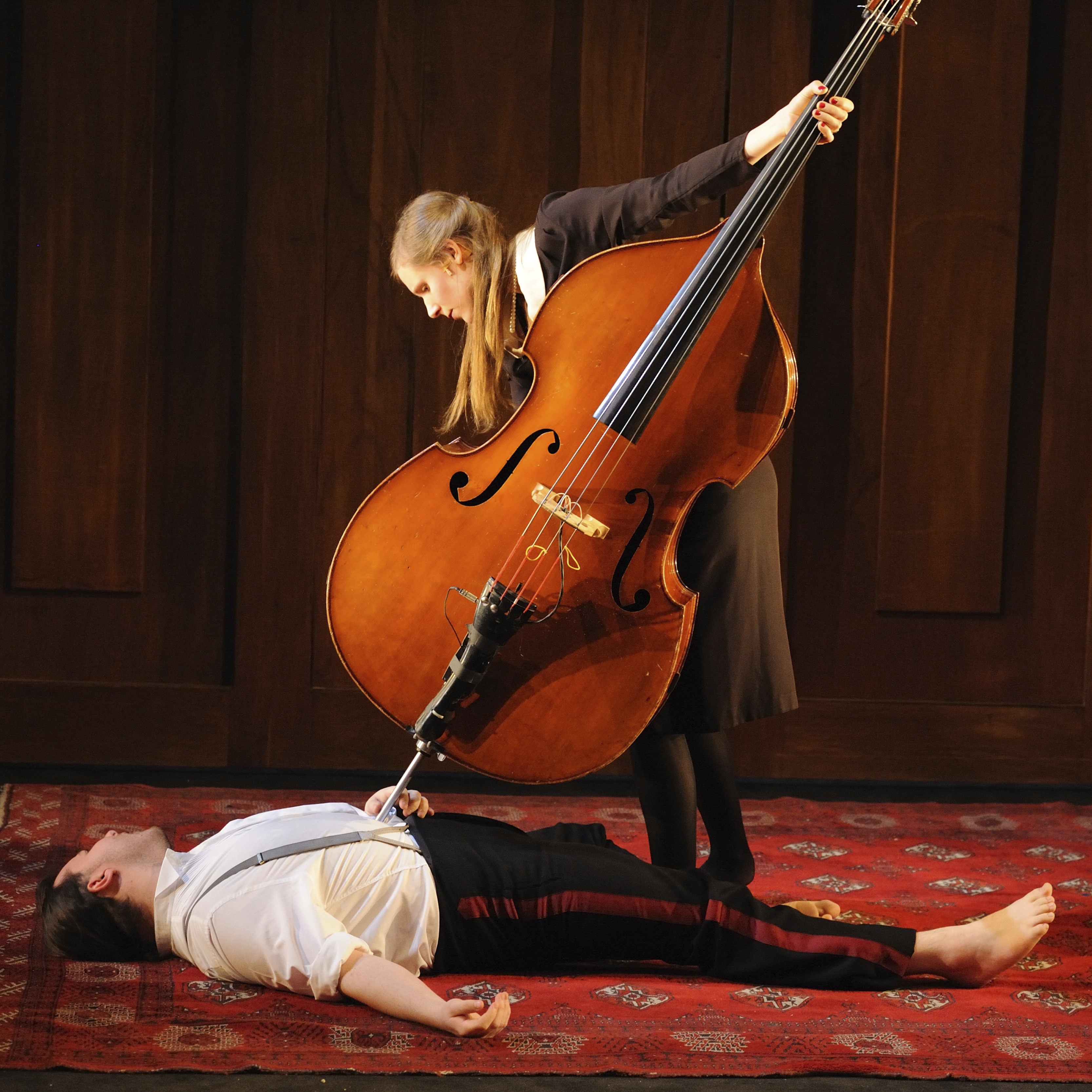
Ida Duelund in Another Lament, 2011. Photo by Paul Dunn
Duelund intoned the first falling notes of Gute Nacht a capella as the night turned black and ship lights passed by outside. Wedged in an opening between two rooms, she performed to one, then to the other audience, accompanying her seraphic voice with bowed and pizzicato double bass. Duelund’s interpretation of Schubert is an intimate rediscovery of counterpoint, at times dissonant, at others of the purest, open intervals. Missing from the launch was Jethro Woodward’s electronic manipulation of the double bass, which accompanied Duelund in the first outing of her Winterreise programme in 2011. Woodward’s subtle atmospheric support is reproduced to great effect on the album itself, available online through Chamber Made Records. What was lost in Woodward’s absence was more than compensated for by some of Duelund’s new compositions, mostly sung in Danish, which show her wandering contrapuntal style extended to new extremes, with an extended vocal range, daring leaps and completely exposed singing against semitones and quartertones in the bass. Like Schubert’s wanderer, Duelund’s voice always returns to some sort of home, though never that from which it sets out, creating a challenging, unnerving, but ultimately rounded experience.
If Ida Duelund does not become a stratospherically famous avant-garde pop star then it will be by no fault of her own. We can blame the market, or the public, or any number of extraneous circumstances, but the counterpoint of Duelund’s seraphic voice and searching double bass confronts, confuses and finally wins one over in a way that is utterly unique today.
RealTime has three copies of Ida Duelund’s Winterreise to give away courtesy of Chamber Made Opera Records. Details here.
Wednesday 5 June: “Wind Energy,” a concert featuring new compositions by Kristofer Spike for World Environment Day. The Independent, North Sydney, 7pm. Proceeds go to the Nature Conservation Council.
Thursday 6 June: The Hobart Wind Symphony perform works by Tasmanian composers including Karlin Greenstreet Love, Russell Gilmour, Don Kay and Simon Reade. The Tasmanian Conservatorium, 7pm.
The Melbourne Symphony Orchestra premieres Stanhope’s piccolo concerto alongside works by Stravinsky and Copland. Hamer Hall, 6pm. Also Friday, 6pm.
Friday 7 June: Cormac McCarthy’s novels are given a musical tribute by composer Kynan Robinson at the Melbourne Recital Centre Salon at 6pm.
Anthony Pateras, Natasha Anderson and Erkki Veltheim perform composed and improvised electro-acoustic music in Abstraction and Pathology at 8:30pm at the Seymour Theatre Centre, NSW, as part of Vivid’s New Wave: Sound series.
I am as curious as anyone to know What’s Hot in contemporary music. Find out from a panel of people who know at the Seymour Theatre Centre, NSW, at 6pm.
Get along to Nonsemble‘s album launch for “Practical Mechanics” at 7:30pm at The Box Art Space, QLD. Nonsemble deploy post-rock aesthetics within a contemporary classical frame.
The International Symposium on Electronic Art begins and runs until the 16th June! Many events, see here.
Saturday 8 June: A whole day of events at the Seymour Theatre Centre, NSW as part of Vivid’s New Wave: Sound series. Performers include Anthony Pateras, Natasha Anderson and Erkki Veltheim; Alicia Crossley presenting new works for bass recorder and electronics; saxophone, guitar and electronics duo Covalent; the Ampere Quartet premiering new works by Julian Day and Malin Bang; Sydney and Adelaide electronic duo Collarbones collaborating with Paris-based artist Michael Salerno; amplified string ensemble The Noise; electro-acoustic works by Daniel Blinkhorn and Julian Day’s An Infinity Room.
The Phonetic Ensemble, Melbourne’s newest New Music ensemble, perform at BUS Projects, Collingwood, VIC, 6pm.
Ensemble Offspring perform their programme of works for unique handmade instruments in Between the Keys at the Street Theatre, ACT, 7:30pm.
Tuesday 11 June: Marshall McGuire curates works by Gordon Kerry as part of ANAM’s Australian Voices series at 6pm at the South Melbourne Town Hall.
Wrong Answers
Callum G’Froerer (Curator)
He & Eve & The Big Apple
Monday 3 June
There was a charmed quality to the second concert of Callum G’Froerer’s ANAM fellowship, where solo and small ensemble works for trumpet, violin, voice, double bass and percussion flowed past as seamlessly as the Merri Creek just outside the warehouse venue’s door. The carefully-curated and -staged programme gave rise to a rarefied sound world of delicate and uncommon extended techniques. More familiar techniques were given new life in the resonant environment by an ensemble of dedicated performers.
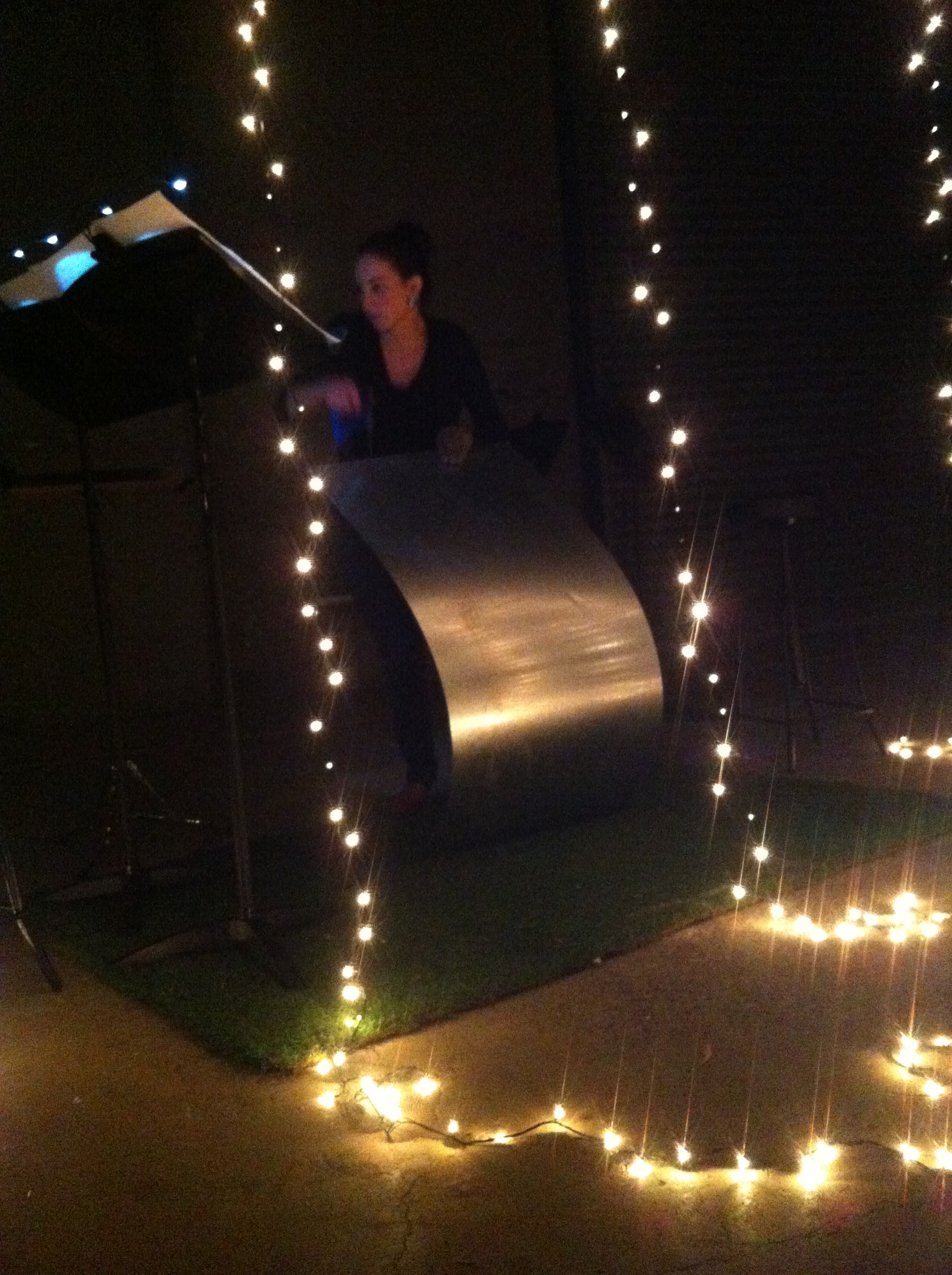
G’Froerer began the concert with the ominous rising tones of Morton Feldman’s Very Short Trumpet Piece, hidden behind the audience in the offices overlooking the warehouse floor. Instruments at the ready, the double bassists Jon Heilbron and Rohan Dasika stared each other down behind a curtain of fairy lights like a pair of dueling mythical creatures. This cinematic superposition gave way to Rebecca Saunders’ Blue and Gray, where the double bassists sprang to life with groaning crescendi. The gritty, grinding attacks echoed around the room as the beasts of wood battled.
Eres Holz’s MACH for solo trumpet set a new tempo for the space alternating rapid, mincing steps and short lyrical flights. A parrot also took flight outside, briefly adding its squawking counterpoint to Holz’s mysterious calculations, by then obscured behind a trumpet mute. G’Froerer’s deft manipulation of the first valve slide in the third section of the piece left all the trumpet-players breathless and the rest of the audience confused and impressed by the timbral spectrum opening up before them.
The most remarkable moment of the concert was also its quietest: Helmut Lachenmann’s Toccatina for solo violin, performed with casual precision by Amy Brookman. The piece is true to its name, deriving from the Italian toccare “to touch,” in the diminutive. Brookman lightly touched the screw of the bow to the violin strings, bringing out pinpoints of sound with this subtlest of articulations. This technique developed into a sort of double pizzicato with the screw passing back and forth past the string. Once the note was released, the screw rejoined the string with the wiry jangling of a guitar-slide. This dynamic climax of the piece was followed by toneless bowing on different parts of the instrument and rapid ricochets with the back of the tip of the bow near the bridge. Brookman’ performance was a frank statement of what can be achieved before one even reaches mezzo-piano.
Abel Paúl’s Wrong Answers to Robert B’s Wrong Question continued the investigation into novel instrumental techniques, this time focusing on a single sheet of metal. Fingers, a tuning fork, a hacksaw and finally the ubiquitous superball mallet were all brought to bear on the clanging, springing, singing piece of metal. The piece has no interest past its catalogue of eyebrow-raising techniques, which are each carefully displayed like exotic artefacts in a museum by the gloved performer (Kaylie Melville).
Covering stage changes, short pieces by Feldman and Carter descended upon the audience from the offices above the audience. Of note was Jenny Barnes’ rendition of Feldman’s Only for solo voice. Barnes’ tone is unlike any other emerging singer in Melbourne, combining an untrained-sounding simplicity with technical precision and a flair for improvisation and timbral exploration. This voice came to the fore in an improvised set at the end of the concert, where G’Froerer, Heilbron, Barnes and electronics artist Jon Smeathers deployed their precise and innovative musical craftsmanship in an utterly transporting musical soundscape.
Johannes Moser, cello
Benjamin Northey, conductor
ANAM Musicians and Orchestra
South Melbourne Town Hall
Friday 24 May
The program is daunting: One of the most famous cello sonatas, followed by one of the most difficult cello concertos, followed by one of the most important chamber works of the past century-and-a-bit. But the cellist is astonishing, the conductor fearless and the orchestra excellent, so what are you going to do?
From the first notes of Shostakovich’s Sonata for cello and piano in D minor it was evident this was to be no ordinary recital—though that’s exactly where half the audience would have heard the famous piece many times. Johannes Moser’s performance began slightly faster than usual, though the tempo didn’t compromise the cellist’s fluid, light articulation. Do not be fooled by the “intense, introverted cellist” promotional photo, Moser plays directly to the audience, making eye contact and even occasionally lunging at them, when the music seems to call for it. The playful first movement made way for the ferocious reeling of the second. Light, brittle spiccato figures stood out like sardonic laughter. The Largo third movement was a testament to good taste. Every line was shaped, every dissonance perfectly stressed as the movement meandered towards its grim conclusion. By contrast, Finale demonstrated the fact that if the melody is simple and repetitive enough you can get away with the most outrageous articulation and dynamics. The audience will fill in the notes they do not hear. As in comedy, it is good to reward the audience for meeting you half way.
The Lutoslawski Cello Concerto is a feat in semi-aleatoric twentieth-century orchestration, with remarkable effects including prickling, teeming clouds of string pizzicati, blaring brass heterophony, unorthodox percussion and woodwind attacks like splattering paint: So much colour from a piece that begins with plodding solo cello Ds marked indifferente. While these sounds are standard New Music fare, the Lutoslawski Cello Concerto never ceases to sound fresh. Part of this currency derives from the dynamic interplay of the soloist and the forest of sounds around them, a dynamic that conductor Benjamin Northey describes as the relationship of the individual and the “oppressive” masses. A problem with this interpretation is that the orchestra only enters tutti in the finale of the piece, an effect made all the more shocking by the fact that the orchestral colours are sparse and individuated up until that point. There is some very obstinate brass throughout, for sure, but there are also some conciliatory woodwind, playful percussion and serene string textures. With its bipolar, paranoid cello, chattering brass returning like a repressed trauma, cast of orchestral characters, “chase scene” and final destruction, the piece would make a good soundtrack for a Hitchcock movie. Both the orchestra and Moser played their parts perfectly, with bow hair flying and barely a musician not short of breath at the end. The audience’s pulses were just as high.
After an interval we were treated to the piece that started it all, Verklärte Nacht by Arnold Schoenberg. Here the ANAM students’ sensitivity and endurance were called upon to sustain Schoenberg’s exposed late-romantic lines. It was for me, as for the rest of the audience in the packed South Melbourne Town Hall, a transfigured night.
Saturday 1 June. The Astra Chamber Music Society present paintings and electronic works by Catherine Schieve and Warren Burt, with choral works by Ravel, Robert Carl, Will Ogdon and the rollercoaster of Dan Dediu’s Harmonic Labyrinth and Fugue. At the Meatmarket, North Melbourne, Vic, 5pm. Second show Sunday 2 June.
A programme of Western and non-Western musical and choreographic fusions in The Meander Project at South Melbourne Town Hall, Vic, 6pm. Clarinet, viola and double bass meet shamisen, balafon and classical Indian singing under the direction of ANAM fellow Linda Andonovska. Guzheng meets contemporary dance in a new piece by Mindy Meng Wang and Victoria Chiu.
Monday 3 June. Callum G’Froerer presents new and not-so-new music by Feldman, Saunders, Holz, Lachenmann, Paul and Carter. Improvisations by Callum G’Froerer, trumpet; Jon Heilbron, contrabass; Jenny Barnes, voice and Jon Smeathers, electronics. Hosted at the new warehouse space He & She & The Big Apple on the banks of Merri Creek, Northcote, Vic, 7pm.
Petrichor Trio (at the Abbotsford Convent), photo by Jessica King
Petrichor Trio
Conduit Arts
Rowan Hamwood (flute)
Alexina Hawkins (viola)
Jessica Fotinos (harp)
Wednesday 22 May
Petrichor’s recent concert at Conduit Arts found young and established composers alike asking themselves what on earth to do with a harp. Petrichor’s “take no prisoners” style of performance charged the small space of Conduit Arts with an atmosphere of absolute concentration.
Julius Millar’s Two Pieces for Flute, Viola and Harp contrasted a soundscape haunted with apparitions of clusters and string tremoli with a rhythmic piece based around a “ticking” harp ostinato. Sometimes the viola would join the harp in a hocket figure, or soar away on a legato line. Well-developed counterpoint between the flute and viola provided a moment of intense interest that then exploded into a spectacular cacophony on all three instruments.
Barry Conyngham’s Streams cast the harp in a similar role, as the pulsing accompaniment to contrapuntal play between the harp and viola. Conyngham transitions fluidly between such textures and layered trills with swelling dynamics and glorious open chords cut short by the idiomatic harpistic string-clang, which has to be heard to be believed (and if you go to harp concerts, will be believed more often than you wish).
Evan Lawson’s Skinnis for Flute, Viola and Harp (now on its second outing) was the only piece to utilise the harp’s majestic glissandi and full, ringing chords. These kitschy effects were welcome after the crystal-clear articulation and motoric effects of the “bean-counting harp.”
Sofia Gubaidulina’s The Garden of Joy and Sorrow canvassed all of these possibilities for combining flute, viola and harp, then developed many more through a series of vignettes punctuated by spoken German phrases. A particularly fascinating sound was an extremely fast phrase on viola, played with a very fast bow to produce a “squeaky” sound like a tape on fast-forward, above a machine-gun tattoo on the harp with paper woven between the strings.
The program also included a series of solo works including Gordon Kerry’s Antiphon for viola, Salvatore Sciarrino’s Canzona di Ringraziamento for fluteand Suart Greenbaum’s Church at Domburg for harp. In all three cases the skill and conviction of these ANAM-trained musicians was in evidence.
Wednesday 22 May. New New Music ensemble Petrichor are performing works by Gubaidulina, Kerry, Aronowicz and Lawson tonight at Conduit Arts, Fitzroy, Vic. 8:30 start.
Thursday 23 May. Drawing on experiences in Australia, Norway and Iceland, Luke Howard presents compositions for electronics, strings, piano and guitars from his album Sun, Cloud at theMelbourne Recital Centrefrom 7:30pm.
Double bassist John Heilbron curates a night at Conduit Arts, Fitzroy, Vic, from 8:30pm.
Friday 24 May. Cellist Johannes Moser performs, amongst other things, the Lutoslawski Cello Concerto at ANAM, Vic, from 7pm.
Saturday 25 May. Chamber Made Opera Records releases Ida Duelund’s album of Winterreise covers at a living room in Williamstown, Victoria, at 5pm. Concert includes works for piano by Chris Dench performed by Peter de Jager. Address revealed upon booking.
The Australia Ensemble perform works by Sculthorpe, Edwards, Schultz and Munro at 7pm in the Sir John Clancy Auditorium, University of New South Wales. Also, a performance of a new dance collaboration between composer John Peterson and choreographer Sue Healey.
Manteia curate Conduit Arts, Fitzroy, Vic, with John Heilbron from 8pm.
Laura Altman and Monika Brooks perform experimental textures for clarinet and accordion at The Old Darlington School at the University of Sydney, Darlington Campus, from 8pm as part of the New Music Network series.
Sunday 26 May. Sydney’s Volta Collective present works by Russell Phillips, Lachlan Hughes, Martin Sheuregger and Morgan Krauss at South Melbourne Town Hall from 2pm.




 Partial Durations