Read my discussion of David Toop’s keynote and performances at the International Computer Music Conference and the Totally Huge New Music Festival over at RealTime.
Arts Centre, Einstein on the Beach
Fleur Kilpatrick has written a great review of Einstein on the Beach at the Arts Centre in Melbourne. Read it over at her blog.
Utopias in music education
For this year’s RealTime education edition we took a different tack to our usual critical style and engaged in some utopian thinking about possible educational futures. Read the music education piece here.
Totally Huge New Music Festival: Di Scipio, Curran, Burt and Haco

photo Brad Serls
Read about the International Computer Music Conference keynote concert featuring works by Agostino di Scipio, Alvin Durran, Haco and Warren Burt over at RealTime.
Concert guide: 14–20 August
A curated list of upcoming concerts. See also the Australian Music Centre concert calendar and the New Music Network concert series.
Thursday 15 August. The Totally Huge New Music Festival continues with the Percussion and Live Electronics concert at Hackett Hall at the West Australian Museum from 8pm. Masonik and Té perform at the festival club, The Bakery, from 10pm.
The Australian Art Orchestra present the second concert of their ElectroACOUSTIC AcousticELECTRO residency at Bennetts Lane Jazz Club, Vic, from 8:30pm. As part of the first Bennetts Lane residency under artistic director Peter Knight, the concert will feature an eclectic quintet drawn from improvisers from around Australia.
Five composers (Michael Bakrncev, Tilman Robinson, Lisa Illean, Anni Hui-Hsin Hsieh and Travis John respond to five spaces at the Melbourne Arts Centre with five-minute compositions in 5x5x5. Bring your headphones and smartphone and see the front desk for a map. Runs during opening hours until 18 August.
Friday 16 August. The International Computer Music Conference finale features WA’s new music ensemble Decibel and David Toop from 8pm at Hackett Hall, the West Australian Museum.
Saturday 17 August. The THNMF continues in Fremantle with Alvin Curran’s Maritime Rites at B Shed, Victoria Quay, at 3pm, then A Sonic Celebration with David Toop, Haco, Clocked out and Catherine Schieve at PSAS from 8pm. Back in Perth, the West Australian Symphony Orchestra perform their second Latitudes concert at 8pm, featuring works by Skipworth, Anderson, Muhly, Grime and Adès.
Students from the Queensland Conservatorium perform new works by Robert Davidson, Andrew Ford and Nicole Murphy alongside Takemitsu, von Bingen and Gabrieli at St John’s Cathedral, Brisbane, 8pm.
The Griffyn Ensemble perform earth-inspired music by Griffyn director Michael Sollis, Martin Wesley Smith, Cold Chisel, Juan Orrego-Salas, Ursula Mamlok, Henrik Strindberg, Jenny Hettne and Frederik Högberg. CSIRO Discovery Centre, Canberra, 7pm.
The Monash Art Ensemble perform works by George Lewis and Mary Finsterer at Monash University, Clayton, VIC, 7:30pm.
Sunday 18 August. Check out Alvin Curran’s BEAMS with massed ensemble at B Shed, Victoria Quay, Fremantle, from 3pm, as part of the THNMF.
Dale Hubbard‘s new CD/DVD A Sea of Faces will be launched in a concert setting at The Old Museum, Brisbane, at 7pm.
Tuesday 20 August. New works by Johanna Selleck will be performed by an all-star cast at the Melbourne Recital Centre from 6pm.
Totally Huge New Music Festival: Michael Kieran Harvey, Inferno

photo by Brad Serls
Michael Kieran Harvey performs his own Psychosonata and Elliott Gyger’s INFERNO at the Totally Huge New Music Festival. Read about it over at RealTime.
Totally Huge New Music Festival: Speak Percussion and Robin Fox, Transducer
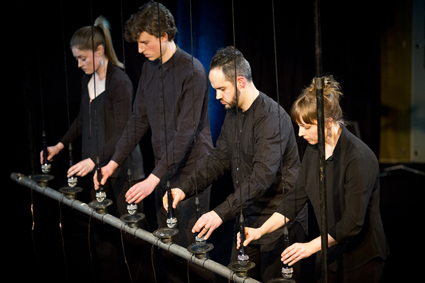
photo Brad Serls
Read about the new work developed by Speak Percussion’s Eugene Ughetti and Robin Fox for the Tura Totally Huge New Music Festival here.
Totally Huge New Music Festival: Haco, Ourobonic Plague and Barn Owl

Read about the Totally Huge New Music Festival opener in Perth on Friday night over at RealTime.
Concert guide: 7–13 August
A curated list of upcoming concerts. See also the Australian Music Centre concert calendar and the New Music Network concert series.
Thursday 8 August. Five composers (Michael Bakrncev, Tilman Robinson, Lisa Illean, Anni Hui-Hsin Hsieh and Travis John respond to five spaces at the Melbourne Arts Centre with five-minute compositions in 5x5x5. Bring your headphones and smartphone and see the front desk for a map. Runs during opening hours until 18 August.
The Tura Totally Huge New Music Festival (THNMF) launches at the Perth Museum, WA, at 6pm.
Friday 9 August. THNMF events include Haco and Barn Owl at The Bakery for the festival opening concert at 8pm.
Chronology Arts presents Vitality, a series of three collaborations between composers and choreographers at the Seymour Centre, NSW, at 7pm on 8, 9 and 10 August.
The Australian Art Orchestra present the second concert of their ElectroACOUSTIC AcousticELECTRO residency at Bennetts Lane Jazz Club, Vic, from 8:30pm. As part of the first Bennetts Lane residency under artistic director Peter Knight, the concert will feature an eclectic quintet drawn from improvisers from around Australia.
Italian pianist Antonietta Loffredo performs music for piano and toy piano about Antarctica composed by composers Paolo Longo, Gian Paolo Luppi, Stefano Procaccioli, Francesco Schweizer and Antonio Giacometti (Italy); Paul Smith, Diana Blom and Nathan Wilson (Australia); Chris Adams (New Zealand); Mercedes Zavala (Spain) and Sara Carvalho (Portugal) at Theme & Variations Showroom, Willoughby, NSW, from 6:30pm.
The Griffyn Ensemble perform earth-inspired music by Griffyn director Michael Sollis, Martin Wesley Smith, Cold Chisel, Juan Orrego-Salas, Ursula Mamlok, Henrik Strindberg, Jenny Hettne and Frederik Högberg. The Royal Botanic Gardens, Melbourne, VIC, 7:30pm. Repeat performance at the Discovery Science and Technology Centre, Bendigo, VIC, on Saturday 10 August at 4:30pm.
Saturday 10 August. THNMF events include Speak Percussion and Robin Fox performing the new work Transducer and Stockhausen’s Mikrophonie I at the WA Museum, 8pm.
Duo Deconet premiere new music from Latin American and Australian composers including Miguel Bernal Jimenez, Alejandro Corona, Carlos Salomon, Paul Dessene, Eddie Mora, Daniel Rojas, Margaret Brandman and Elena Kats-Chernin at Mosman Art Gallery and Community Centre, NSW, 6:30pm.
Sunday 11 August. THNMF events include Michael Kieran Harvey’s Psychosonata programme, the International Computer Music Conference keynote concert featuring Alvin Curran, Agostino Di Scipio, Warren Burt and Haco, and Club Huge featuring H+ and Chris Arnold.
Ali Fyffe and Matt Hinchliffe present The Modern Day Saxophone featuring works by Fuminori Tanada. JacobTV, Louis Andriessen, Giacinto Scelsi and Bruno Mantovani at The Gryphon Gallery at The University of Melbourne, 3pm. The concert will also be streamed live at http://www.themoderndaysaxophone.com.au
Topology perform Ten Hands, a continuous, one-hour work at Chapel off Chapel, Prahran, VIC, at 6:30pm.
Monday 12 August. THNMF events include Michael Kieran Harvey’s Piano and Live Electronics programme, the Perth Laptop Orchestra’s Guitar and Live Electronics performance and Club Huge featuring l.n0JaQ and Andrew Nonlinearcircuits.
Benjamin Martin performs Keith Humble’s Piano Sonata, amongst other works, at the Melbourne Recital Centre at 6pm.
Matthew Lutton and David Chisholm, The Bloody Chamber

The Bloody Chamber
By Angela Carter
Directed by Matthew Lutton
Music by David Chisholm
Performance text by Van Badham
The Malthouse Theatre
6 August, 2013
Entering the theatre one can just make out dark stains on the stage floor. Drop by drop a puddle of water forms between three monolithic black cubes. Occasionally a tone like struck metal rings out. The sounds rise and fade, accompanied by the dead percussion of wood.
Suddenly, with a rattle of chains, one of the cubes starts to rise. It stops just high enough to reveal the pedaling feet of three harpists, the source of the wooden sounds. The gong sounds (produced by putting Blu-Tac on the harp strings) increase in intensity as the harpists run their hands down their wire strings, producing harsh whispers like the falling blades of guillotines. Then, slowly, the smallest of the three boxes rises to show two feet dripping with blood. The box continues to rise, carrying the gently twitching feet high above the pool of blood below.
We are inside Bluebeard’s castle where, according to the seventeenth-century version of the tale by Charles Perrault, a sadistic aristocrat has murdered a series of wives for disobeying his one proscription: Do not enter the forbidden room. Showing a propensity for divergent characterisations of violence, the story has since been rewritten many times, notably in Bartok’s 1911 opera and Angela Carter’s 1979 short story on which the Malthouse production is based.
The original cautionary tale assumes a male monopoly on violence for the punishment of woman’s supposed innate and sinful curiosity. Violent punishment is also meted out between men, as the young wife’s brothers save Bluebeard’s youngest wife, the protagonist of the story. Bartok’s interpretation plays down the cautionary tale to focus on the symbolic violence of Bluebeard’s capricious affections, his love of the idea of his wives over their reality. Bluebeard cannot truly admit the new wife into his shuttered castle, initially refusing to let her open the doors and let the light in. When she finally convinces him to do so, she finds the wives alive. The young wife is then similarly enshrined in jewelry and locked away. The castle is no longer a moral prison, but a cold, damp, dark psychological world.
Without forgetting punitive or symbolic violence, Carter elaborates the sexual violence inherent in the tale. An array of mirrors shatters the protagonist into twelve identical copies that are “impaled” in a honeymoon chamber decked with lilies, a symbol of death. In Lutton’s production the bedroom is hidden under the third cube and consists of only a carved four-poster bed. Alison Whyte shifts effortlessly between Bluebeard’s menace and the new wife’s fear, playing both parts with the help of a finely-tuned pitch-shift effect by sound designer Jethro Woodward.
Carter returns to the violence of punishment by having the young wife’s mother ride to the rescue, her skirts tucked around her waist, a backdrop of ocean spray “witness to her furious justice” as she shoots Bluebeard in the head. In Lutton’s production this moment is punctuated by a veritable rain of bullets upon the stage.
While punitive violence ultimately saves the day, the story’s happy ending is predicated on symbolic non-violence. Bluebeard is initially attracted to the new wife for her conservatoire training as a pianist. It is an “accomplishment,” a symbol by which Bluebeard identifies her, placing a Bechstein in the mirrored room. Carter then shows how music can function as something other than a sign of accomplishment, as a bridge between people and a fundamental part of one’s identity. The new wife is able to calm herself by playing Debussy and Bach. The piano also leads her to the blind piano tuner Jean-Yves, with whom she will open a music school after they are both liberated by her gunslinging mother.
The three harpists of Lutton’s production (Jacinta Dennett, Yinuo Mu and Jess Fotinos), representing the three dead wives, extend Carter’s musical theme. Since its feminisation in the late eighteenth century, the harp has inhabited a space of both convention and transgression. While the harp upset a woman’s deportment in the most suggestive ways, it also became the accomplishment par excellence for young women leading up to the French Revolution. As the instrument became larger, heavier and the strings tighter, its physical demands became greater and so women had to fight against a quantity that continued to claim that the instrument was unsuitable for feeble female hands. At times Chisholm’s music fills out the sparse set design, such as where the harpists sing drones over tremoli to evoke the monotonous train ride to the castle. Then, arriving to a dawn sky “scattered with rose-pink,” the harpists unleash a pointillistic flurry of notes. At other times the harpists superimpose the new wife’s alternative psychological world on the dark castle, playing whimsical, dissonant tunes as she traipses around the castle playing with her new riches. Finally, after supporting Whyte, the harpists assert their own identity, literally packing up their bags and leaving the stage. As Carter has said, her rewriting isn’t about men and women, but about “tigers and lambs,” a dynamic as relevant today as it was thirty years ago.
 Partial Durations