Arcko Symphonic Ensemble: Chamber View 4

Arcko Symphonic Ensemble
Chamber View 4
Richmond Uniting Church
10 May, 2014

Every time a conservative party wins an election in Australia, or a social-democratic party sinks to new lows of cruelty in the treatment of asylum seekers, one would judge from social media that Australia were in danger of immanently losing its youth to New Zealand. Something of the sort did actually take effect in the late nineteenth century, when hundreds of disillusioned Australian workers set off to found William Lane’s socialist utopia, New Australia, in Paraguay. Showing that Australian progressives did not have a monopoly on racist national policy, the colonists beat them by some six years to the founding of a society based on racial exclusion. The collective floundered, split, and was eventually dissolved by the Paraguayan government. As does, quite intentionally, George Dreyfus’ setting of the settlers’ anthem “The Men of New Australia.” This opening of The Arcko Symphonic Project’s latest chamber music concert took us back a century to the brash marching rhythms, woodwind and brass of colonial music. The more resigned ending provides some wonderful antiphony between a lilting cello line and a mournful trumpet. It sounds like film music because it is, composed for Caroline Jones’ documentary And Their Ghosts may be Heard.

There are so many pieces about sounds of the Australian environment that they constitute a genre to themselves with their own history, forms, sonic palettes and, indeed, compositional clichés. As it happens, I lived in the Blue Mountains until I was seven years old, so feel particularly sympathetic to the genre, in particular to Wendy Hiscocks’ Rainforest Toccata for solo piano. Hiscock articulates soft thunder in the bass with chiming clusters in the treble reminiscent of bellbird song. Pianist Elizabeth Watson’s fluid, light touch lent the piece all the presence of the rainforest’s ozone-charged, pre-rain atmosphere.

After Hiscocks’ clusters, Elliot Gyger’s Threshold struck out across the piano into broader harmonic fields. The piece is a duet for two hands, with the rhythms and pitches of the two voices moving gradually together and apart. As probably the most romantic post-serial solo piano work, morse code messages representing Gyger’s name and that of his wife Catherine are written into the rhythmic material of each hand.

Nigel Butterley’s Laudes is a quietly busy work for mixed octet, reminiscent of the hushed, decorated interiors of four European churches and cathedrals visited by the composer. The piano, counting away in one corner, contrasts with the fluidity of gestures moving through the rest of the ensemble. The figures slowly coalesce into distinct instrumental sections like a religious procession at the Basilica of Sant’Apollinare. The Apse, Norwich Cathedral is represented by a consistent movement from loud, staccato gestures to legato, piano textures. This foundational movement is punctuated by isolated outbursts like the building’s pillars and arches. The ensemble only truly awoke in the third movement when painting the vibrant stained glass and trumpeting angels of King’s College Chapel, Cambridge.

The relative lack of instrumental colour in Laudes was highlighted by the novel instrumental groupings of Tim Dargaville’s Invisible Dances. The composer doesn’t hide the piece’s dance rhythms quite so much as he claims in the programme, which keeps things lively (with the help of a drum kit). First the cello and piano play in duet, before focus moves to the flute and harp. All the while a mysterious whistling sound keeps the audience guessing (I still don’t know who was making it). The duets swept my corner of the audience away, digging deep into the bass registers of the instruments before shooting back up. It was a delight to end the concert on such a mosaic of finely-balanced, jewel-like miniatures.
12 reasons not to cut Australia Council funding for music

Though opposition leader Bill Shorten has announced his intention to oppose the proposed cuts to health, education and the pension, the $87.1m in cuts to the Australia Council for the Arts and Screen Australia appear to be flying through unopposed. The effect of these cuts on contemporary music in Australia could be absolutely devastating. As Tony Grybowski, chief executive of the Australia Council has announced, the cuts are likely to affect individual artist and project grants rather than major ensembles. Unfortunately, the programming of contemporary music by Australia’s major ensembles remains extremely limited. Australia Council grants are a vital part of the diverse range of funding sources that keep musicians playing contemporary compositions around Australia every month (indeed, every week and almost every day) of the year. Seeing as the budget announcement roughly coincides with the anniversary of Partial Durations, I have found twelve reasons why the funding of contemporary Australian artists and projects should not be affected. All of the ensembles, composers, small arts organisations and festivals mentioned below have received Australia Council funding at some point over the past six years. They are, of course, a small selection amongst many, many more excellent musicians and organisations around Australia.

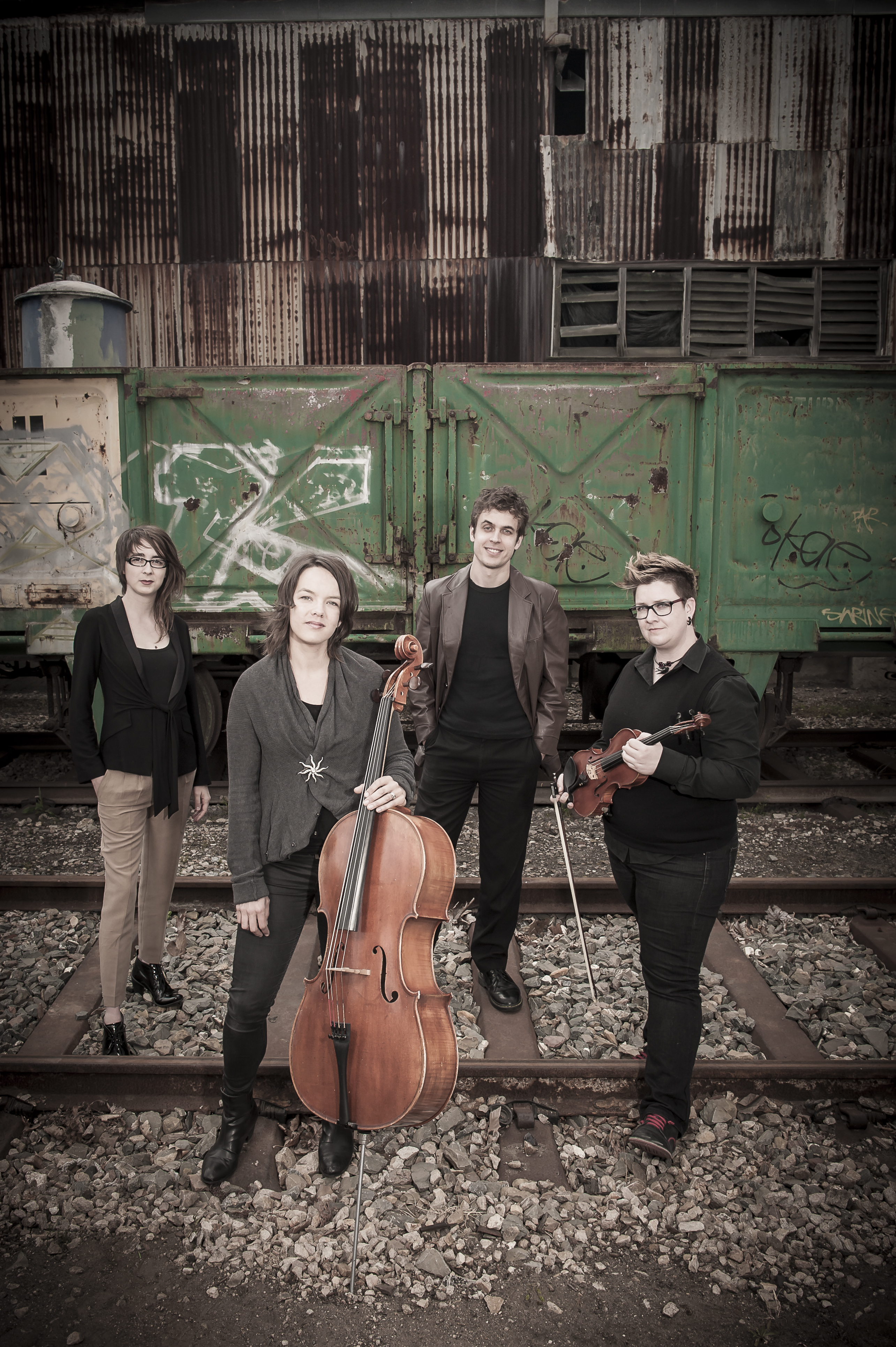
Zephyr Quartet. Photo by Sam Oster

1. April: The Zephyr Quartet

The Zephyr Quartet have been presenting some of the finest contemporary music in Adelaide for years now. In fact, I can count their concerts amongst my first experiences of contemporary music as a student. Part of their skill at communicating with audiences is a passion for diverse styles and settings, which sees them performing in bars as well as recital halls. In 2013 Zephyr released A Rain from the Shadows, a CD of works that have inspired and inspired by poetry.

2. May: Kupka’s Piano

The new Queensland-based ensemble Kupka’s Piano have proven themselves indefatigable champions of the post-war European avant-garde in its most challenging forms. More importantly, they think of these forms as living traditions crossing national boundaries. Every concert features works by contemporary European and Australian composers, often in collaboration with visiting ensembles. Kupka’s Piano’s concert series at the Judith Wright Centre in Brisbane kicked off with “Giants Behind Us,” a survey of contemporary German composition.

3. June: The Phonetic Ensemble

Melbourne’s Phonetic Ensemble is pushing the boundaries (just when you thought there were no more to be pushed!) of site-specific, semi-improvised music. This year sees them teaming up with some of Australia’s most respected contemporary musicians in a series of mentorships that will stretch these incredible musicians even further. In their first ever performances, The Phonetic Ensemble transformed Bus Projects into a dynamic musical performance.

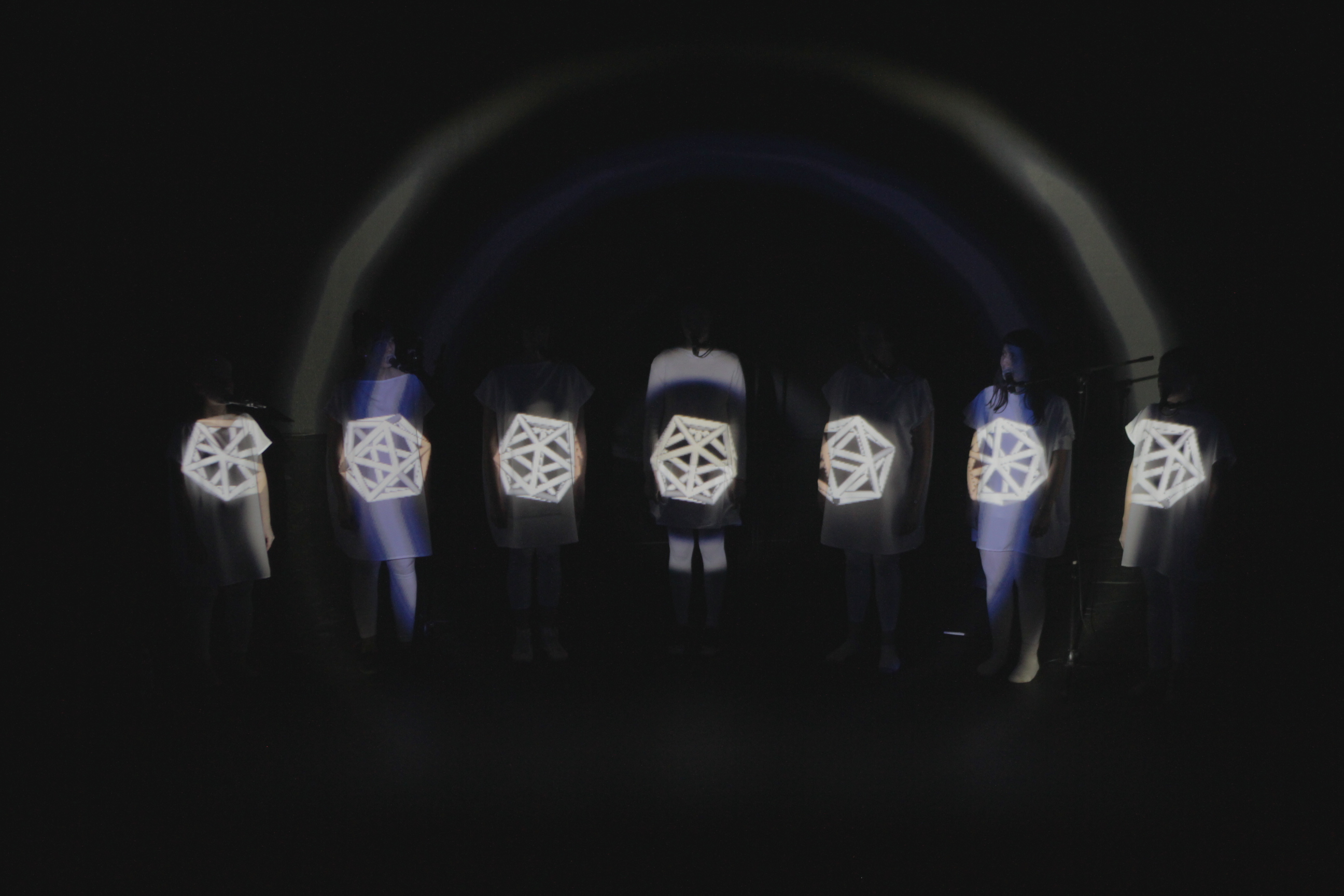
Invenio Singers in Luminesce. Image courtesy of Gian Slater.

4. July: Invenio

Composer and performer Gian Slater leads the Invenio Singers, an a cappella group bringing minimalist timbral improvisation and extended tonality to the masses. What’s more, they’re apt to tour and so you can be sure to hear them in a city near you. They’re great fun to see perform, especially when teaming up with an ace lighting or costume designer.

Decibel performing Alvin Curran, THNMF13 photo Brad Serls
Decibel performing Alvin Curran, THNMF13
photo Brad Serls

5. August: The Totally Huge New Music Festival/Decibel Ensemble

The East Coast has never seen anything like what happened in Perth last year with the combined International Computer Music Conference and Totally Huge New Music Festival. Every day and night over almost two weeks was saturated with orchestral, small ensemble and electroacoustic performances,

as well as some of the more lively discussion about contemporary music that one is lively to hear. The festival featured numerous performances by Perth’s own Decibel Ensemble, who commissioned new works by visiting composers David Toop and Alvin Curran.

6. September: The Bendigo International Festival of Exploratory Music

I must admit I was overseas when BIFEM was on last year, and more’s the pity. Composer David Chisholm has developed an utterly unique festival with an attention to programming not seen since the Domaine musical.

Speak Percussion, photo by Jeff Busby

7. October: Speak Percussion

Speak Percussion have become Australia’s foremost percussion ensemble over the decade or so of their existence. As well as reviving large-scale works by the likes of Grisey and Xenakis, they are avid commissioners of new works by Australia’s most unique composers. To top it all off, the ensemble has a flair for presentation that makes each performance a unique and thrilling experience. Collaborating with SIAL studios for some truly magnificent sound projection, their performance of Le Noir de l’étoile at Deakin Edge was a highlight of contemporary percussion last year.

8. November: Annie Hui-Hsin Hsieh

Annie Hui-Hsin Hsieh is one of Australia’s finest composers, a fact made all too evident by the fact that she is rarely here any more. There is a discipline to her writing that refuses to slip into confusion, tempered by a lively musical imagination. In Icy Disintegration, already five years old, she has also produced a poignant work about the impending disasters associated with climate change.

Bodhasāra, Chronology Arts & New Music Network. Photo Hospital Hill
Bodhasāra, Chronology Arts & New Music Network.
Photo Hospital Hill

9. December: Chronology Arts

Enough can’t be said for the small contemporary music organisations like Tura New Music in Perth and Chronology Arts and the New Music Network in Sydney. These organisations provide an external impetus to the goings-on of composers and musicians, bringing new ideas and audiences into contact with new music. In December, Keith Gallasch reported on a Chronology Arts event involving new compositions inspired by the 18th century Sanskrit text Bodhasâra.

10. January: Ensemble Offspring

Ensemble Offspring, who have recently achieved “Key Organisation” status at the Australia Council, are doing more than anyone to break down barriers between classical and popular music audiences. Their concerts are fresh, lively and relaxed, with the ensemble taking frequent time out to explain what’s going on in the music to the audience. They also maintain significant relationships with composers and performers overseas, keeping their schedule stocked with commissions and tours.

11. February: James Rushford

James Rushford’s name and photograph have popped several times while writing the above blurbs. Rushford has made a name for himself both as an improvising musician, frequently performing alongside Joe Talia and touring internationally, and as a composer working along spectralist and experimental lines. In keeping with his explorations within relatively limited timbral worlds, his recent solo work for Speak Percussion Artistic Director Eugene Ughetti is an enigmatic study in metal percussion engaging every limb of the performer in an immense battery of chimes and bells.

12. March: Luke Paulding

Emerging composer Luke Paulding’s complexist aesthetic is coupled with a poetic sensitivity to produce dynamic compositions of unequalled charm in the Australian scene. Some highlights for me have been Her Sparkling Flesh in Saecular Ecstasy, and a fragment of an opera on Icarus and Daedalus commissioned by Chamber Made Opera. His recent works have become more spacious and consciously polyphonic. He has a well-stocked SoundCloud here where you can hear much of his music, including his latest efforts at the Royaumont Foundation.


Partial Durations is a RealTime/Matthew Lorenzon joint project.

Australian Voices: Stuart Greenbaum

Australian Voices Series
Works by Stuart Greenbaum
Melbourne Recital Centre
Curated by Jessica Fotinos
Thursday 8 May

Stuart Greenbaum’s transparent textures and unabashedly diatonic harmonies leave space for the audience to consider the poetry and art with which his works are often coupled. The timbral and rhythmic subtlety of his work lends itself to the harp, which featured in all three of the works in this concert curated by ANAM harpist Jessica Fotinos.

Nine Candles for Dark Nights for solo harp, performed with great sensitivity by Fotinos, features a meditative, wandering ostinato inflected with harmonics. Fotinos integrated the melody’s cross-rhythms into the gentle flow of the piece with absolute ease like the “bending arcs of flame” of the nine memorial candles flickering in Greenbaum’s poem.

Ross Baglin’s poems set in Four Finalities for female voice, cor anglais and harp take their cues from the refined imagism of T. S. Eliot. The catalogues of luggage, clothes, furniture, snow and flowers—including snow filling flowers!—; the ruminations on “the time / It takes a finger to decide” and the peal of bucolic church bells are put to good use by Greenbaum. The first song of the cycle, with soprano Lotte Betts-Dean throwing herself into its swelling, keening melody, could be one of the more soulful Eurovision winners. The sparing interjections of the cor anglais (David Reichelt) fit the charm of these pensive poems wonderfully and constitute some of the most captivating moments in the cycle.

The eight miniatures of Greenbaum’s Mondrian Interiors are filled with skyward gestures of weightless optimism. Startling tutti chords strike out at the audience like the Mondrian’s Red Tree while a lighter texture paints the blue sky behind. The cubist Tree (c.1913) was evoked with a minimalist canon. Echoing the bold harmonic palette of Composition with Red, Yellow and Blue, the fifth movement has the bravado and syncopation of the introduction to a 1990s morning show. The fourth movement has the conciliatory tone of the end of a children’s movie from the same decade with its swooning, edgeless chords resembling the pastels of Composition in Oval with Colour Planes.

While communicating directly and succinctly (with the help of a spirited execution by the performers), Greenbaum’s painting of his points of inspiration can come across as overly simplistic. I wonder how Greenbaum’s engagement with his subjects extends both him and his listeners beyond their existing musical comfort zones and into the unknown.


Partial Durations is a Matthew Lorenzon/RealTime joint project.

Next Wave: Fluvial

Matthias Schack-Arnott in Fluvial. Photo by Jesse Hunniford.

Matthias Schack-Arnott
Fluvial
Next Wave Festival
North Melbourne Town Hall
1 May, 2014

Hundreds of sheets of metal, aluminium pipes, tiny metal piano tuning pins and glass bottles hang above or lie upon two long, raised platforms that run in parallel through the centre of the space. There is just enough room between them for the percussionist Matthias Schack-Arnott to move, the sole percussionist in the installation-performance Fluvial.

“Fluvial” may describe the changes wrought upon an environment by streams and rivers. Forever moving, sometimes gentle and sometimes violent may well describe Schack-Arnott’s performance. The show begins and ends with graceful, poetic gestures. At one end of the metallic array, Schack-Arnott sends four thin metal pipes, hanging parallel to the ground, into motion. When struck, they emit clear tones that pulse as they rotate. Schack-Arnott watches their orbits narrowly avoid each other, as though he were some modern-day Copernicus turning his calculations from the heavens to the pressing terrestrial matters of the age.

Things take a chaotic turn after this harmonious vision. Schack-Arnott brings the pipes in collision with the granite tiles beneath them, juxtaposing the pipes’ ethereal tones with the dead clunkings of stone. Moving through the centre aisle, Schack-Arnott strikes a deeper set of pipes that lie across a fulcrum on the granite tiles. As they rebound from the stone they emit a sharp sound like rain on a roof.

Each episode of the piece presents a truly intriguing new sound. While percussionists will be familiar with a tremolo on pipes with soft mallets, the effect of a dozen pieces of sheet metal, suspended from their centres, being thrust onto a piece of granite and then released will be a revelation in the extremes of muting and uncontrolled resonance. As will Matthias’ dramatic throttling and submerging of a bunch of glass bottles in a sink of water and the cacophonous (the only truly ear-splitting moment in the piece) collision of a flock of metal sheeting with a cloud of microtonally-tuned wind-chimes.

The installation is as thought-provoking as it is beautiful. The system’s forces hang in a state of equilibrium. Each piece of metal and granite is microtonally tuned in clusters around different pitch centres. This helps to separate the different sound sources for the listener and at times produces a ritualistic, chant-like quality to the performance. One is also aware that nothing is absolutely static or ordered in this musico-environmental model. As the audience enters, the air movement they produce occasionally causes a bottle to moves against another, or a finely-balanced chime finally tips over into a new position. Schack-Arnott is no prime mover in this environment, but one who powerfully interferes with its balance of forces. Theatrically stunning, aurally stimulating, Fluvial is an unmissable experience at this year’s Next Wave festival.

Fluvial runs 1–4 and 7–11 May.

Partial Durations is a RealTime/Matthew Lorenzon joint project.

Kupka’s Piano and Ensemble Offspring: The Machine and the Rank Weeds

Kupka’s Piano and Ensemble Offspring
The Machine and the Rank Weeds
Judith Wright Centre
21 March 2014
Review by Liam Viney

Kupka’s Piano recently performed alongside Sydney’s Ensemble Offspring in a collaboration that seemed mutually beneficial to the two groups, and was exciting for the capacity audience that attended at the Judith Wright Centre in Brisbane. Exploring the relationship between “the mechanic and organic”, the performance was illuminated by a quote from the composer of one of the major works that may as well have been describing the ensembles themselves:

“These wild flowers, these rank weeds pushing up in the interstices of the machine, grow in importance and then overflow until they give the sections into which they have worked their way like parasites an entirely unexpected coloration.” Gérard Grisey

The quote describes Grisey’s image for his Talea, the centerpiece of the program, but it equally serves as a metaphor for these two groups; Kupka’s Piano trails Ensemble Offspring by 17-year years in terms of lifespan, yet within the current cultural “machine,” both groups are flowers with wildness in their character, and (especially together) they have an “overflowing” abundance of important things of beauty to say. The “unexpected coloration” is detected in the exponential power generated by the collaboration. Negative ecological connotations surrounding “weeds” and “parasites” are here inverted into an admiration for feisty living things that persist and succeed in a potentially hostile environment, similar to, for example, new music groups.

Across eight compositions, including two world premieres (both completed this year) and two Australian premieres, the performance proved how profoundly engaged modern music is with present-day cultural, social, political, and, (increasingly throughout the 20th century), scientific concerns. Jane Stanley’s Helix Reflection seductively intertwined flute and clarinet lines in a sonic imagining of the double helix, performed with delicacy and perfectly blended instrumental balance by Lamorna Nightingale and Jason Noble. Damian Barbeler’s Deviations on White similarly derived inspiration from the natural world, in this case a dazzling chiaroscuro evoking the interplay of light and dark shades filtered through a fast-moving cloudscape. Claire Edwardes gave a brilliant first performance of this challenging work, launching herself, (mallets descending with accuracy from great height), into what constitutes an imposing new contribution to the solo vibraphone literature. Hannah Reardon-Smith’s virtuosic and mesmerizing rendition of Phillipe Hurel’s Loops also represented a connection with potentially organic principles – transformative processes enacted through repetition.

One of many highlights was 24-year old Michael Mathieson-Sandars’ starkly beautiful Character Motions (2014) – performed with precision, sensitivity and consummate chamber musicianship by Alex Raineri, Angus Wilson and Reardon-Smith. Again, the music linked to organic themes with the program notes describing the composer’s attempt to use a “more bodily approach” to composing in order to find a “more complex kind of subject.” Complexity was achieved, within a highly economical language, in the form of a work full of expressive connotation. Physicality also played a significant role in Noble’s bass clarinet solo Asteletsa, by Jukka Tiensuu, in which a set of instructions for physical movement is included. Rude-ish off-stage sonic gestures bookend the palindromically structured piece, which is full of invention and flirtatious wit, and Noble’s performance had listeners (and, here more than usual, watchers) focused on his every action.
The panache with which the Ensemble Offspring players handle semi-theatrical movement was confirmed in Matthew Shlomowitz’s Letter Piece 8. Robotic movements connected the piece to the program’s mechanic/organic theme, but revealed another seam within the program – the relationship between sound and gesture. Letter Piece 8 seems to separate out music and gesture, creating a space where repeated beat-long musical gestures become associated (for this listener) with specific and distinctive beat-long bodily gestures over the course of the piece as the players rotate and alternate between playing while seated, and making movements while standing. In a wonderful sort of climax (perhaps anti-climax in the sense of confounding standard notions of climaxes as necessarily boisterous), all three players performed movements at the same time, in silence, yet the listener could not help but hear the corresponding musical gestures continuing in a kind of internal ghost-echo. The silence was deafening as the room seemed to come alive with aural awareness. Edwardes, Nightingale and Noble fully inhabited their roles as slightly absurdist pseudo-circus performers in an utterly irresistible and entertaining work that rewards multiple listening/watchings in unusual ways. Thankfully, Ensemble Offspring has uploaded an earlier performance to YouTube.

Finally, the large works by Gérard Grisey and Louis Andriessen that ended the first half and entire concert respectively. Grisey’s Talea (subtitled The Machine and the Rank Weeds) and Andriessen’s Workers Union effectively signposted the organic/mechanic theme of the concert. The conductorless performers of Kupka’s Piano (previously mentioned players joined by Adam Cadell and Katherine Philp) navigated a complex score through phenomenal communication and a strong sense of collective responsibility for keeping time. Difficult microtonal intonation was heroically delivered against a slightly out of tune piano that made such accuracy all the more difficult. The piece itself is a work of major significance that broke new and gorgeous ground in its manipulation of pitch and time. Perhaps it was the vibrancy of the surrounding works and the performances they received that highlighted Talea’s position as an “established” work (it is, after all, close to thirty years old). While Brisbane may have only been host to a handful of performances of Grisey (a few by Kupka’s Piano), spectralism is more established overseas and is more frequently heard. That this particular party might be well underway underscores the importance of events like this for Brisbane’s musical health. Andriessen’s Worker’s Union is even more popular, and could one day be in danger of becoming that composer’s Bolero. Yet on this occasion, (a performance notable for its creative use of percussion), with both groups uniting to perform the last piece, a sense of joy was palpable. There was a feeling of recognition between the two groups – an appreciation of common purpose, the rich vitality and life-affirming persistence of “wild flowers and rank weeds.”

Liam Viney


Partial Durations is a RealTime/Matthew Lorenzon joint project.

Metropolis: Syzygy Ensemble, Logic

Logic
Syzygy Ensemble
Metropolis New Music Festival
Melbourne Recital Centre
11 April, 2014

Syzygy Ensemble’s concert at the Metropolis New Music Festival established them as Australia’s most unique contemporary music ensemble. These four hyped-up new music nerds have hit upon a winning strategy of disarming the audience by tittering amiably at them before striking fear into their hearts with faultless virtuosity.

Syzygy gave pride of place to an accomplished work by Elliott Hughes, the inaugural winner of the Melbourne Recital Centre Composition Commission. The title, Arcs and Sevens, describes the two movements of the work that play on energetic, colourful polyphony on the one hand and a stricter 7/8 metric plan on the other. The piece opens with syncopated lines that erupt from the ensemble. These eventually settle into a slower, more lyrical, minor-mode polyphony of melodies. Eventually even these lines settle into held notes like vibrating geological strata. The shorter, swinging second section sees lines imitated throughout the ensemble. The two parts of the work are in reality very well integrated, so that Hughes takes the audience on a colourful journey, rather than juxtaposing contrasting ideas.

The ensemble’s intensity only increased as they tackled Nicholas Vines’ Economy of Wax, which is based on a portion of Charles Darwin’s On the Origin of the Species dealing with the emergent structure of honeycomb from the autonomous action of bees guided by the evolutionary principle of the economy of wax. It was difficult to tell whether the work was conceived with an economy of notes in mind as the ensemble navigated the work’s metric modulations and various structures based on the number six. The instruments buzz with a sort of autonomy, each regurgitating enough musical ideas for a lifetime of composition. Above them all, Judith Dodsworth sang the text ecstatically loud and high, less a queen than another buzzing worker in the hive.

Logic forms the first of three concerts in which Syzygy Ensemble explore the medieval trivium of grammar, logic and rhetoric. In this first concert pragmatism, automatism, arithmetic and nature were variously traded as synonyms for logic. Toshio Hosokawa’s exquisite Stunden-Blumen reflects upon nature and time in a refined palette drawn from French mid-twentieth-century composers Jolivet and Messiaen (ending with a lovely glissando-trill-tremolo!). John Luther Adams’ The Light Within continued this “nature” theme with a minimalist drone that changed like the shades of the sky at dawn. All in all, I am not sure that the pieces chose did the “logic” theme justice. A stricter interpretation of the word, considering logical properties and their relationship to composition, would have made for a much less colourful show. However, it remains to be seen how Logic will contrast with the remaining two concerts in Syzygy’s series to describe the limits of each concept.

Kate Soper’s immensely entertaining Only the Words Themselves Mean What they Say perhaps came the closest to a reflection on logic as such, which is only capable of determining whether an argument is valid, not whether it is true. A valid argument is one in which, if its premises are true, then its conclusion will be true as well. Whether this argument is about bees or, in Soper’s case, human relationships, is immaterial. Laila Engle and Dodsworth’s performance was by far the best that I have seen of this popular piece. This may seem ridiculous, but it helped that Engle and Dodsworth are almost exactly the same height and that, as well as taking the piece a little faster than usual and being impeccably coordinated the whole way through, they choreographed their body language and facial expressions so that they seemed to meld into one variously sad, angry and staring body.

Metropolis: Melbourne Symphony Orchestra, Frescoes of Dionysius

Frescoes of Dionysius
Melbourne Symphony Orchestra
Melbourne Recital Centre
9 April, 2014

This year Helsinki-born Olli Mustonen conducts the Melbourne Symphony Orchestra at the Metropolis New Music Festival, bringing with him his extensive knowledge of and experience with Scandinavian music and composers. In particular, his mentor and friend Rodion Shchedrin has been singled out for special attention, with three Australian premieres of Shchedrin pieces programmed in the festival.

Wednesday night’s performance began with Shchedrin’s haunting Frescoes of Dionysius for nonet. A sculptural clarity pervades the smooth lines of the work, which proceeds through a steady pulsing between two notes that are variously transformed through savage Bartok pizzicati in the strings and foggy winds. Occasionally the celesta punctuates the plodding surface, or a violin strikes up a folksy double-stopped line. Dissonant chords rumble underneath. The timeless quality of the pulse is decorated by the instrumental intrusions like the natural and human world around the Ferapontov monastery where the frescoes are painted.

Mustonen’s sonata for violin and orchestra can be heard as an expansion of the Frescoes into a larger form. The rumbling chords appear in the winds as Kristian Winther’s violin line mulls over short sequences of notes in the most beautifully preoccupied way. Winther carried the audience through the piece with presence and conviction in what was not just an execution but a true performance. The pulse appears and builds to a climax in contrary motion in the treble and bass of the orchestra. If this description sounds simplistic, it is because Mustonen’s orchestration of sonata’s original piano part is simple. This simplicity lent an elegance to the first third. However, after the solo violin whips the orchestra into a frenzy with a folk dance tune, the piece dissipates into a sort of Hollywood score of indistinct menace and wonder, with tired filmic harmonies standing exposed and undecorated in the strings.

Cybec finalist Lisa Cheney’s The Pool and the Star is based on Judith Wright’s poem of the same name. The poem tells of a pool watching a star rise in the sky. The star is reflected in the pool all night until, when the star sets, the pool and the star appear to kiss. A short timbral introduction with bowed cymbals quickly gives way to an intensely thematic piece. Keening melodies dance in the woodwind and on the harp before some excellent, bold brass writing tells of the intensity of the pool’s desire.

Shchedrin’s “sotto voce” concerto for cello and orchestra was originally composed for Mstislav Rostropovich, whose reputation as a strong player made him perhaps a novel choice for a concerto exploring the quieter end of the dynamic spectrum. The audience has to wait a while to hear it, though, for the first movement is as intense as that of any late romantic cello concerto. The principal theme is repeated several times over the murky watercolour background of strings and brass, becoming quieter and quieter each time, until the final, truly sotto voce statement. It would definitely have been possible in the magnificently resonant Elisabeth Murdoch Hall for cellist Marko Ylönen to exaggerate these dynamic contrasts. Though the thematic material of the first movement seems a little formulaic for what I would expect from a Metropolis concert, the concerto gets better as it goes along. A magnificent solo bursts forth with a wash of resonance and instrument-sound. The instrument vibrates to its absolute limits as Ylönen scrubs across all four strings. The string section pick up this thick, marshy texture and the principal theme returns. I wonder sometimes which musical effects are only possible with a long build-up, with extensive preparation from the composer and attentive listening from the audience. Perhaps the finale of the “sotto voce” concerto is just such a moment. Alarming in its simplicity, bells and a folk-like chant on tenor recorder (played by Genevieve Lacey) appear out of the romantic dross. The work is wonderfully bipolar from here on. The orchestra rushes in like a bulldozer. When the recorder returns, the tune is imitated high up on the cello. The piece ends with the cello playing a tremolo on a false harmonic glissando to the top of the instrument, with the distant sound of stones knocking together in the distance.

Metropolis New Music Festival: Six Degrees, Garden of Earthly Desire

Garden of Earthly Desire
Six Degrees
Melbourne Recital Centre
Metropolis New Music Festival
9 April, 2014

Three works of immense clarity and character filled the program of Six Degrees—a new ensemble including some of Melbourne’s best-known contemporary musicians—at the Metropolis New Music Festival.  Somei Satoh’s The Heavenly Spheres are Illuminated by Lights began with the almost mystical experience of Justine Anderson’s voice filling the room from everywhere and nowhere. An improvised-sounding piano part plays around Anderson’s phrases, which hang in the air like mist. Peter Neville wrought sustained tones from the percussion battery with superballs, bows and soft mallet tremoli.

Helen Gifford’s Music for the Adonia was an opportunity (after Deborah Kayser’s performance of Iphigenia in Exile in 2010) to revisit the composer’s musical world inspired by ancient Greek mythology. An elemental anakrousis (thankyou Nick Tolhurst for this term) of clanging percussion, grunting cello and erupting winds gave way to a gentler texture of rattling percussion and plucked strings. Anderson’s vocal line is an imagined ancient language. She chants repeated consonants and vowels against the bone-dry ensemble, reimagining the Feast of Adonis celebrated exclusively by women.

I recently spoke with Liza Lim about The Garden of Earthly Desire, her first work for the ELISION Ensemble. Though the piece was originally intended as music for a puppet show by Handspan Theatre, it retains its sense of drama and character without attendant theatrics. Moreso than other complexist works of the eighties, one has the sense of sitting amongst a crowd of detailed characters. There is a sense of discovery in focussing on one instrument of the ensemble at a time. Sections also differentiate themselves with fluttering string textures and keening, seagull-like flocks of winds. Lim’s language of the time—with a preference for declamatory, speech-like instrumental lines—lends a certain rhythmic monotony to the proceedings. The wild energy of the piece was sustained, however, by semi-improvised sections allowing for much slap-bass and bass-slapping by Miranda Hill. Charlotte Jacke’s cello also returned several times in different duo and trio combinations, sporting a truly virtuosic range of colours across the entire pitch range of the instrument.

Samuel Wagan Watson: Smoke Encrypted Whispers

Samuel Wagan Watson, photo courtesy of the artist

Samuel Wagan Watson
Smoke Encrypted Whispers
Melbourne Recital Centre
24 March, 2014

For the first concert of the Melbourne Recital Centre’s Australian Voices series for the year, 23 composers wrote two-minute pieces in response to 23 poems by Samuel Wagan Watson, one of Australia’s most important living poets. The composers were all chosen because they had some connection to Watson’s home town of Brisbane during the Bjelke-Petersen years of Watson’s youth. Watson’s poems follow him beyond his childhood, out amongst the hoons, Satan-worshippers and humming electricity pylons of the outer suburbs; deep into the last outposts of rural Queensland; then overseas to Wellington and the Berlin wall.

The format, alternating readings by Watson with musical performances, reflected its original commission for the Music and Words series at the State Library of Queensland. Watson’s poems combine brooding interiority with colourful exteriority. Reflecting the often contradictory mood being evoked and picture being painted tested the versatility and sensitivity of the composers.

Where the mood and images of the poems were aligned, the piece could serve simply as an evocative counterpart. Many of Watson’s poems recall his childhood in “Tigerland,” the area of Brisbane around Mt. Gravatt in Brisbane where Watson grew up. Paul Dean’s piece based on the poem “Tigerland” used racing rhythms worthy of Stravinsky and lush, Gershwinesque harmonies to paint busy street scenes. Two poems about Watson’s childhood fear of the dark rendered strikingly different results. Richard Mills’ “Scared of the Dark,” where Watson remembers “Bjelke-Petersen policemen at [his] parents’ back door” and the shadows of truck headlights on his bedroom wall, was sung in an eerie Brittenesque soprano line by Judith Dodsworth. Stephen Stanfield’s piece based on “Author’s Notes #1” used more traditional horror movie soundtrack trills and angular wind and piano lines. “Author’s Notes #2” reflects upon the act and experience of writing. Sean O’Boyle’s transparent, major-mode miniature captures the liberating moment of blue-sky optimism that Watson writes about when confronted with a blank page.

More complicated poems yielded mixed results. The threatening undertone and final conflagration of Capalaba house was eschewed by composer William Barton in favour of a whimsical (but extremely beautiful) duet for oboe and piano and then a trio for oboe, bassoon and piano. Barton was, notably, one of the only composers to compose for less than the entire ensemble. Watson tinges “Ghosts of Boundary Street” with menace, despite the poem describing all people made equal by hangovers on New Year’s Day. Despite the contrast and detail of the poem, Lisa Cheney’s piece paints the poem entirely in asphalt-grey. Similarly, Watson’s ambivalent feelings on visiting Wellington are pasted over by Tom Adeney’s saccharine, filmic setting.

I recently commented on the difference between cultural engagement and cultural appropriation in contemporary music, arguing that we needed the former while being careful not to slip over into the latter. Smoke Encrypted Whispers is a model of such  responsible engagement, where an Indigenous perspective is being offered (rather than assumed) and composers are contributing to the project as equals.

Partial Durations is a Matthew Lorenzon/RealTime joint project.

The Montreal-New York Quartet Tour Australia

Tim Brady, photo courtesy of the artist
Tim Brady, courtesy of artist

The Montreal-New York Quartet will bring four of the finest improvisers and experimental musicians from Canada and the United States to Australia in April. I caught up with guitarist Tim Brady via Skype to talk about his super-group ensemble, commissioning works from antipodean composers and Julian Assange’s phrasing.

You’ve visited Australia periodically since 1990, but this time you’re bringing a bunch of people with you. Can you tell us about the ensemble?

Well, three is hardly a bunch, but yes, I am. From Montreal I’m bringing viola player Pemi Paull and bass-clarinettist Lori Freedman, whom I’ve worked with for about ten years. They are amazing players; they’re considered some of the best players on their instruments in Canada. Both have classical backgrounds and Lori is also an incredible improviser. Tom Buckner has been one of the mainstays of the New York experimental scene for about 25 years. He’s worked a lot with an American experimental composer called Robert Ashley and he’s also a great improviser. He has this great range: he can do lieder, he can do improvisation, experimental, extended vocal techniques. This whole project was initiated by Tom and his production company. We picked the musicians more on who we thought would be interesting to work with. The instrumentation is quite wonderful but quite exotic: Baritone voice, electric guitar, viola and bass clarinet.

So what have you found to play?

Pemi Paull, courtesy of artist

There’s a lot of interesting new music in Australia. We’ve commissioned new pieces by two Australian composers who we thought had a lot to say. They’re very different pieces. One is a text-based piece with a bit of improvisation, the other is more of a lieder, chamber music setting. Tom has been working with the New Zealand composer Annea Lockwood, who has been living in New York for a long time and who has done a lot of work in Australia (though I am well aware that Australia is not New Zealand and vice versa!).

I’ve got a couple of works in there, then we’ll be playing a piece by John Cage and Christian Wolf for two reasons: One is that Tom has a strong connection with the American experimental movement. He’s been doing that for 35–40 years. The other is that because our instrumentation is so peculiar there’s no off-the-rack music, so we’ve worked with open and graphic scores. Also, because we’re all quite comfortable with improvisation and active, spontaneous music-making.

How have the experimental and improvised music scenes changed over the past 15 or so years, since you were last performing here? What are you bringing that you couldn’t have back then?

Lori Lockwood, courtesy of artist
Lori Freedman, courtesy of artist

I don’t mean to sound blasé, but I’m not sure if music can sound remarkably different anymore. Nowadays, as you know, any sound is permitted. It is impossible to shock people with sound, apart from with the simplistic party trick of playing too fucking loud. That’s just painful and we don’t plan to do that. For me, two things are interesting: finding artists who have developed their own voice. It’s difficult to say where someone’s music stands in the flow of time these days, we’re too close to it, but at least people have something personal to say. The other thing is playing music, such as my own, which is very precisely notated, next to the Cage and the Wolf stuff, which is very imprecisely notated. The Australian music sits a little bit between them. The most interesting thing about this concert to me is that the people listening actually won’t care. If it’s a good performance, if it’s a great piece, whether it’s precisely or imprecisely notated won’t matter. We’re getting past the questions of “how is the music written down?” and more to “what is the music trying to say? What is it trying to portray on stage and give to the audience?”

And one of the pieces contains quotations from Julian Assange, is that right?

Tom Buckner, courtesy of the artist

That’s the Griswold. That was Tom Buckner’s team’s idea. They thought it would be interesting for two reasons: One is that Julian Assange is Australian, the other is that he is an interesting and controversial figure at the moment. They asked me if I wanted to do it and, while I do find Julian Assange a very interesting figure and much of what he has written is very interesting, when I was reading these texts of his I didn’t hear any music. I have a very simple rule for when I set a text to music: I have to read the text and almost instantaneously hear some sort of music to go along with it. It may not be the final piece, but it has to create a sense of musical dialogue right away. The Assange texts were great, but I heard no music in them. I was very pleased that Erik could find some texts to make a piece. The texts are quite deconstructed, though you can still sometimes understand the sense. He also uses them as the basis for improvisations. Assange is talking about very serious issues and it boils down to the phrase structure. He writes long sentences with lots of subordinate clauses, which is entirely appropriate to the kind of thing he is trying to communicate. But when you’re trying to set text to music, subordinate clauses are a nightmare because you can’t sing them. So Erik came up with a way of cutting it up that sidesteps the whole problem in a very elegant manner.

The Montreal-New York Quartet will be touring Australia in April, including:

April 5, Presented by Tura New Music, Western Australian Academy of Performing Arts, Perth, WA (concert will be broadcast by ABC Classic FM)
April 7–9, Elder Conservatorium of Music, Adelaide, SA
April 10, Monash University (Classes and workshops), Performing Arts Center, Clayton, VIC
April 14, The University of Melbourne, Melba Hall, Melbourne, VIC
April 16, Queensland Conservatorium, Clocked Out Series, Ian Hangar Recital Hall, Brisbane, QLD
April 17, University of Western Sydney, Playhouse Theatre, Sydney, NSW


Partial Durations is a Matthew Lorenzon/RealTime joint project.