Sydney Chamber Opera: Fly Away Peter

Fly Away Peter, Sydney Chamber Orchestra, Carriageworks, 2015. Photo by Zan Wimberley.
Mitchell Riley, Brenton Spiteri and Jessica Aszodi. Fly Away Peter, Sydney Chamber Orchestra, Carriageworks, 2015. Photo by Zan Wimberley.

Review by Alistair Noble

A Triumph for Contemporary Opera

Elliott Gyger’s masterful opera, given a polished and committed première performance by Sydney Chamber Opera this week, is surely one of the major musical events of the year. It takes on even greater significance in the context of the ever-more conservative, fearful programming of the major musical institutions in Australia such as Opera Australia. This is not the place to rehash the recent public debates about the value or nature of contemporary opera but it is necessary to acknowledge that Gyger’s work serves as a perfect rebuttal of the foolish arguments put forward by those who think opera should be no more modern than Puccini, or no more radical than a Broadway musical. One can only hope that the prime-movers of such regressive notions have the courage to attend Fly Away Peter. If they did, they might well learn something from the experience.

During the past few days, we have seen the opera gain an exceptional degree of critical attention and acclaim in the mainstream media, reflecting not only the inherent qualities of the work and of the performance, but also the sense that the full-house audiences were in the presence of something powerful, significant, and above all beautiful. Contemporary opera is alive and successful in Australia, but it’s not in the Opera House. Perhaps that is a good thing. Poetic, provocative, beautiful, and haunting, Fly Away Peter is work that surely must have a strong future. There have already been calls for this production to tour, and I have no doubt that other companies will be keen to stage it in future years.

Cashing in on the ANZAC centenary juggernaut, the publicity for Fly Away Peter gave the impression of this being a war-themed opera. I must admit to some initial scepticism about the work for this very reason and if one did take the marketing hooks as the basis for interpretation it would be deeply problematic. Viewed as a simple war opera, it would be hard to justify such a poetic treatment, which flies dangerously close to romanticising death and destruction. As Adorno famously wrote in 1951, »nach Auschwitz ein Gedicht zu schreiben, ist barbarisch«, and surely one could argue much the same for the appallingly stupid horrors of WW1—and yet we keep at it. Fortunately, Fly Away Peter is not really a war opera, and perhaps only tangentially concerned with the war at all—in this way arguably similar to Malouf’s original book. To my relief, I found that the opera soars above and beyond the limitation of war-commemoration and is much concerned with larger issues of genuine human concerns about the nature of our meaningfulness in the world. In this sense, it is a work of incisive contemporary relevance and not at all a historical drama.

The Libretto

David Malouf’s novella Fly Away Peter (1982) is justly renowned for the lyrical poeticism of its descriptive writing. Malouf sings his landscapes and characters lovingly to life with words that convey much more than is written, opening spaces for imagination and wonder. Dramatically, it presented some challenges to the librettist, in so far as there is not a great deal of direct dialogue and indeed not a great deal of plot—some of the key ‘action’ takes place off set, or off the page, and what remains serves more as material for contemplation than drama. Pierce Wilcox has done a very artful job of creating the libretto for the opera, and his text serves as the structuring vehicle for both Gyger’s music and the dreamlike world of Imara Savage’s staging.

Staging

The cavernous industrial space of the Carriageworks theatre works very well for the set designed by Elizabeth Gadsby—an assymetrical pyramid of giant steps washed over with white clay. This set, like many aspects of the work, is only simple at first glance. As the piece unfolds we find that the production is elegantly minimalist, with a well thought-out function and poetry that goes far beyond the merely minimal. The only props are simple blue buckets, laid out across the steps in different ways at different times, and containing the white clay that gradually ends up smeared over characters clothes and bodies. There is a nuanced ambiguity in this, as one wonders whether the humans are growing out of the mud, or dissolving into it.

Fly Away Peter, Sydney Chamber Orchestra, Carriageworks, 2015. Photo by Zan Wimberley.
Brenton Spiteri. Fly Away Peter, Sydney Chamber Orchestra, Carriageworks, 2015. Photo by Zan Wimberley.

I particularly enjoyed Verity Hampson’s lighting of this production, which uses angled side-lights to play with the singers’ shadows on the huge expanses of concrete wall at Carriageworks. This contributed strongly to the dreamlike, poetic nature of the work as one’s eye was drawn back and forth between the bodies of the singers on the set and their giant, puppet-like figures moving across the walls. As the opera progressed, this created a magical sense of a multi-layered drama in which certain aspects are played out on the ground and embodied, while others are metaphysically projected into other realms of being or consciousness.

The Ensemble

The singing cast of Mitchell Riley, Brenton Spiteri and Jessica Aszodi have a considerable burden to carry as the only characters on stage for the 80-minute uninterrupted play. The success of this present production is certainly due in large part not just to their individual abilities but their strength as a remarkably unified ensemble. Their actual characters are not fixed, as they fluidly shift from their main parts to speak for others at different times, and to sometimes voice more abstractedly reflective or poetic words—and even birdsongs.

It is clear that Gyger composed for these particular voices, making careful use of their individual abilities and strengths. Spiteri has a beautiful, effortless tenor voice that is wonderfully consistent in tone across its range and brings a refined lyricism to his main character of the wealthy landowner Ashley Crowther. Riley’s voice is in some ways more complex, with gear-shifts that complement the youthful athleticism and foal-like awkwardness of his character Jim Saddler, a working man and passionate bird-fancier. In the final, transfigurative scene of the opera, Gyger makes a sensational use of Riley’s powerful falsetto. Jessica Aszodi’s part as the middle-aged photographer Imogen Harcourt is also judiciously composed to use her distinctive and always well-controlled voice to great effect. She has a challenging role to play in some respects, as her character is sometimes part of the main action, sometimes drifting to one side as a kind of chorus, and at other times chatting with the two soldiers (Jim and Ashley) far away on the Western Front, as all three meet in world of the mind that is the centre of gravity of the opera. Her strong lower register proves useful, as her vocal line at times sits within the same space as the male voices; on a musical level as well as a dramatic one she can move in and out of the men’s world.

Fly Away Peter, Sydney Chamber Orchestra, Carriageworks, 2015. Photo by Zan Wimberley
Jessica Aszodi. Fly Away Peter, Sydney Chamber Orchestra, Carriageworks, 2015. Photo by Zan Wimberley

Supporting and embracing the theatrical core of the vocal parts, the instrumental ensemble directed by Jack Symonds is very strong and colourful. There is terrific playing from all seven members of the group (violin, double bass, clarinet, bassoon, trumpet, trombone, percussion), while violinist James Wannan and percussionist Alison Pratt both play key roles with flair and sensitivity.

The Music

Gyger’s music is always skilful, cleverly designed, poetic and elegant. All these characteristics serve to bring out the subtleties of Fly Away Peter’s libretto and, perhaps more importantly, provide the background energy and structure that carries the play forward with a compelling momentum. The overall musical cohesion of the piece is a tremendous feat—it successfully feels like one great sweep of music and theatre rather than a succession of set-pieces and scenes. This is achieved partly by the use of a carefully planned set of harmonic structures, in which chords and (by extrapolation) melodic lines relate to each other by vertical symmetry—an analogue for the air and earth relations that are fundamental to the text.

These particular harmonies, and the way in which they are used for much of the work, enable the creation of music that has a lovely, radiant transparency. This is the source, I feel, of the beautiful dreamlike character of the opera overall, that is sympathetically translated to set, staging and lighting by the production team. At the point of the play where the two young men are translated to the war-zone, the chord materials are re-organised to be more dense, with the harmonic shift being heralded by a skilfully phrased drum solo that grows out of the sound of an aircraft engine. Later sections of the opera seem to move between these two sound-worlds, of the radiantly spacious on one hand and the more claustrophobic, entrapped on the other.

Although the instrumental septet is a conscious replica of Stravinsky’s Soldier’s Tale ensemble (1918), there is little other reference to Stravinsky’s work—except perhaps obliquely in the magnificent jazz-age rhythms that drive the aircraft/war section of the opera. Gyger uses the small ensemble in such a colourful way that one cannot help thinking that the large orchestras of conventional symphonically-oriented opera are a little redundant. From the intimacy of brief solos to the massed sound of the full ensemble, a universe of sound is encompassed. The use of muted brass and bowed percussion add another layer of affective colours.

With the ornithological focus of the story, it was inevitable that the composer must consider the use of birdsong in the music. Gyger has made skilful use of transcribed birdsongs in some sections of the opera—more in the manner of Messiaen than of Sculthorpe, in so far as the songs are not simple effects but integrated with the musical materials in interesting and powerful ways, moving across registers and woven through the harmonies. In a very interesting recent article, Gyger has noted that this use of birdsong has introduced two new kinds of material to his work: glissandos, and microtones.[1] This is, I feel, very significant. At the age of 46, Gyger has given us his first opera—and at the same time the project has changed his music. To some extent this illustrates how important it can be for composers to have opportunities such as this, to collaborate with writers and dramatists, and in the process to inspire us also to reinvent our worlds.

The Message

Opera is an inherently strange artistic medium—it is by nature contrived, an extremity of artifice. How could this possibly be made relevant to us as Australians in the 21st century? In this, one senses the significance of the broader achievement of Fly Away Peter: Gygyer has demonstrated that it is possible to write theatrical vocal music that is singable without being simple, that is expressive without being cheesy or melodramatic, that invites us to suspend disbelief and enter the world of imagination that is opera itself. Rather than being stuffy and elitist, this is a universe where each of us hears to some extent our own voices, and where we observe ourselves acting out the drama of human existence.

How, the character of Jim asks, can we as fragile individuals stand against such a leviathan as war? He has a vision of a future in which people are herded into cattle-trucks… and he is not only speaking of the holocaust but warning us of our own loss of freedom, of the ways in which we too are herded. The things Jim understands, his natural abilities, seem worthless in this world.

Fly Away Peter is an opera about ordinary people being caught up in the great meat-grinder of history. It is about powerlessness. It reminds us that the things we love and understand (symbolised by birds and seedling plants) have no value in the economy of politics and war (wars, after all, are not started by armies but by politicians). Similarly, human life and the natural environment we inhabit seem to have all value leached away, dissolved into the barren mud. And yet, after the tide of inhuman ‘great event’ has turned, these simple, individual activities and delights revive. The war recedes into the form of a near-meaningless nightmare, while ghosts dreaming of birds on the estuary at home in Queensland become ever more meaningful and real.

To some extent, Fly Away Peter strikes me as a manifesto of very current relevance: to what sinister machineries of state/nation/ideology/economy are we (unwittingly) serving as the cannon-fodder? To what limited extent is there scope for resistance? What are the dreams and loves that we would cling to, that bring beauty and meaningfulness to our brief lives, and form our only true legacy?

– Alistair Noble

Fly Away Peter
Music by Elliott Gyger
Libretto by Pierce Wilcox from the novella by David Malouf
Sydney Chamber Opera
Carriageworks 2-9 May 2015

[1] http://www.australianmusiccentre.com.au/article/insight-fly-away-peter
Metropolis: Forest Collective, Moonfall

Still from Marcus Fjellström's Odboy and Erordog. Image courtesy of Forest Collective.
Still from Marcus Fjellström’s Odboy and Erordog. Image courtesy of Forest Collective.

Forest Collective’s “Moonfall” programme explored two important aspects of the Metropolis festival’s theme, “Music inspired by the moving image.” Firstly, Forest Collective recognised the importance of computer games to any discussion of music and the moving image today. Secondly, the concert was downright creepy.

Without culturally- and physiologically-ingrained harmonic cues, contemporary music can fall into an emotional binary of anodyne lyricism and anger. Humour and fear are like lyricism and anger’s more sophisticated cousins. Without wanting to be prescriptive (a piece need not aim for any of these emotional modes, nor any emotional mode at all),  humour and fear show that a composer has enough command over their work to shape a complex audience experience. In film, the same distinction could be drawn between a slasher film that relies on loud and sudden noises to disturb the audience and the unnerving qualities of, say, a Tarkovsky film (more about Tarkovsky in a forthcoming review of the Melbourne Symphony Orchestra’s first Metropolis programme!).

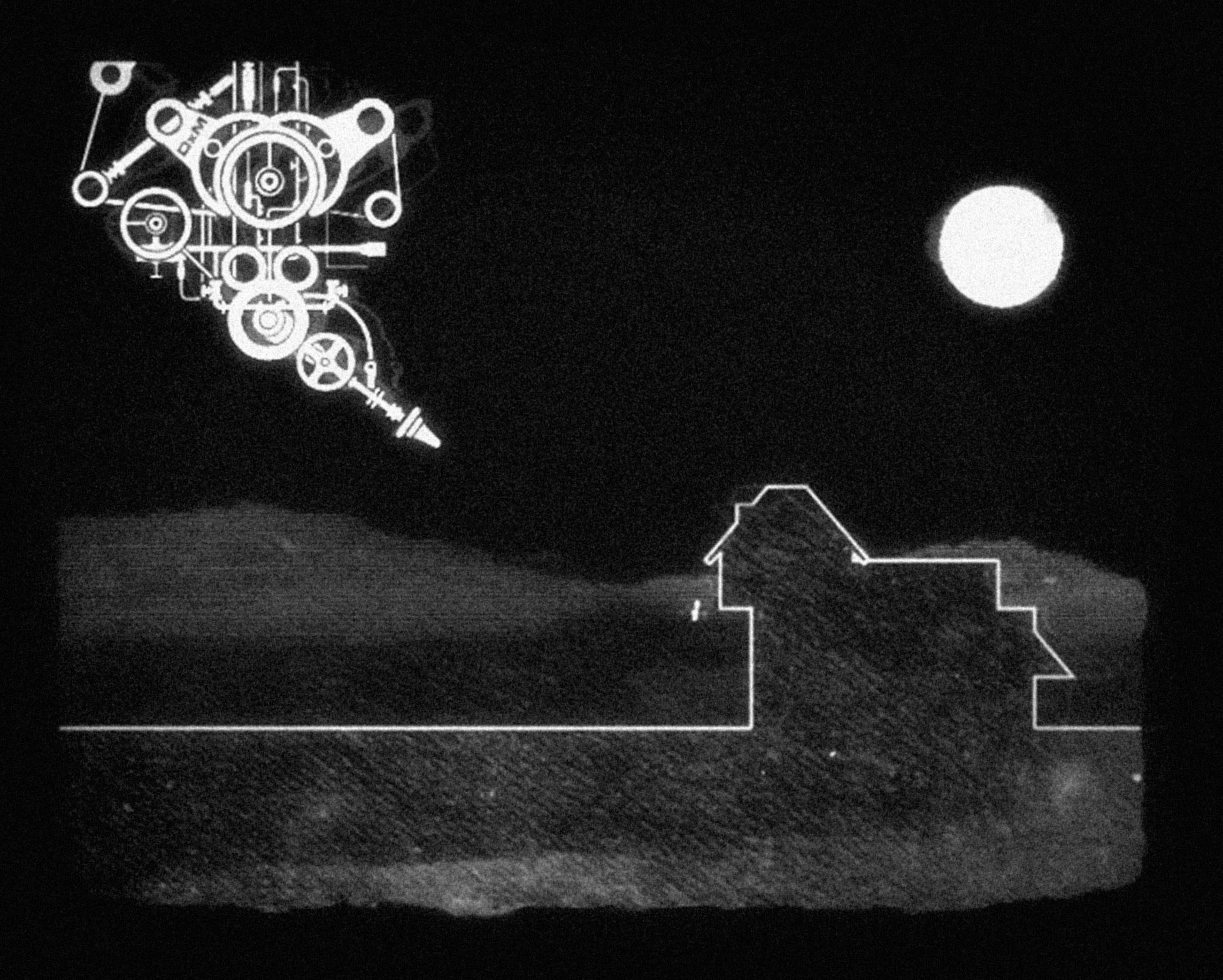
Forest Collective built their programme around Marcus Fjellström’s triptych Odboy and Erordog (available on Fjellström’s Youtube channel). Each episode reflects the sequential, task-driven atmosphere of certain nightmares. Odboy and his trusty Erordog embark on foreboding journeys to  perform arduous “chores.” As in nightmares, the imperative to perform the tasks is overwhelming while the meaning of the tasks is obscure. The journeys will be familiar to all retro gamers and light-sleepers, including “finding the big house” and “crossing the spider pit” while “looking out for the wild boar” (echoes of Conquests of Camelot?). The first episode includes an electronic score by Fjellström utilising rhythmic record pops and theatre organ that complement the grainy black-and-white video. The second two episodes include written scores for the ensemble, who provided a sparse layering of extended techniques and musical accents. Fjellström is currently working on what appears to be a sci-fi chamber opera entitled “Boris Christ.” Hopefully we can get it over to Australia (Forest Collective I’m looking at you).

Odboy and Erordog combines black-and-white film aesthetics with 1980s computer-game graphics. Computer games form an essential part of screen culture for anybody under the age of forty. While those who did not grow up with computer games may recognise the burgeoning computer game market, those who spent too long in front of screens as children will understand the emotional resonance of old, lo-fi computer game aesthetics. If I may indulge in some folk-psychology, perhaps this is because an active imagination is needed to turn a few blocky pixels into a whole fantasy-world. On the other hand, the stark colour contrasts and blocky designs of old games have design elements unto themselves that are, for want of a better word, beautiful.

Forest Collective threaded a series of dark and foreboding chamber works between the Fjellström films, beginning with Evan Lawson’s arrangement of Rupert Holmes’ song “Moonfall” from the 1985 musical The Mystery of Edwin Drood. The musical is based on an unfinished novel by Charles Dickens and was the first musical to feature multiple endings, which were chosen by an audience vote. Lawson states in the programme that he wanted to capture the “smoky streets of nineteenth-century London.” He certainly achieves this goal with a murky bed of clarinets (Vilan Mai and Aaron Klein) and shimmering string tremoli.

The concert featured the world première of Evan Lawson’s Orpheus and the Cave. The piece is a study for a large-scale orchestral work featuring two solo sopranos and solo harp. In the study, Lawson’s usual lush sound palette is stripped back and spread about the room. The spatial distribution of the ensemble is some of the most effective that I have heard. The piece begins with a drum roll behind the audience, before Orpheus (Rosemary Ball) sings to Euridice (Teresa Duddy) across the room. The solo violins (Katriona Tsyrlin and Isabel Hede) to the left and right of the audience create a striking stereo effect. At the end of the piece, Mai and Tanya Vincent on clarinet and flute leave the auditorium to play a perhaps too-recognisable excerpt of Monteverdi’s 1610 Vespers as “the birds calling out on the surface of Earth.”

Forest Collective’s dark programme triggered a series of questions surrounding horror and music. While sudden, high-pitched and dissonant sounds may appeal to our fundamental survival instincts, how do we process subtler unsettling sounds? If we are taught to recognise certain sounds as “creepy,” then how can we access the emotional impact of creepy music from throughout history? What is the first recorded piece of “scary” music?

Forest Collective
Moonfall
Metropolis New Music Festival
Melbourne Recital Centre
7 May 2015

Marcus Fjellström, Odboy and Erordog; Rupert Holmes (arr. Evan Lawson), Moonfall; Evan Lawson, Orpheus in the Cave.

Metropolis: Shaun Tan’s The Arrival

Ben Walsh and The Orkestra of the Underground perform The Arrival. Photo courtesy of the artist.

Ben Walsh and the Orkestra of the Underground’s score to The Arrival is a timely exercise in empathy. Shaun Tan published his picture book in 2006, five years into the “new normal” of Australian immigration policy. Since the Tampa crisis of 2001, both major Australian political parties have sought to outdo each other in the cruelty with which they treat asylum seekers arriving by boat. It is debatable whether this cruelty, including indefinite detention in deplorable conditions, is coherent with or the best way of achieving their most common justification: stopping deaths at sea. With the UN Special Rapporteur on Torture Juan Mendez recently finding that aspects of Australia’s immigration policy violated the Convention Against Torture and Other Cruel, Inhuman or Degrading Treatment or Punishment, now is the perfect time to reconsider the place of “the arrival” in the Australian imagination. Instead of demonising them as “illegals” or “queue jumpers,” The Arrival paints those seeking a better life in a new country as resilient and grateful members of the community.

The Arrival is remarkable for its unpolemical yet highly emotional depiction of immigration, the result of Tan’s extensive research into the migrant experience. Throughout the thousand-or-so images of the wordless picture book, one follows a father as he leaves his family in a town menaced by some unnamed evil. He arrives in a strange new land, finding accommodation and work thanks to small acts of kindness from others with their own stories of persecution and war. He is finally reunited with his family in the new land. In a touching final scene, his daughter gives directions to another new arrival. In Walsh’s production, stills from the picture book are projected behind the band in glorious detail, with minimal panning to give the scenes a greater sense of movement.

It is a shame that Tan does not write more, as he is one of the most beautifully-expressed individuals I have had the pleasure of hearing and reading. At the beginning of the concert, Walsh read a letter from Tan explaining that the last thing anyone who has written a book or a PhD wants is to see their work projected on a screen. However, seeing and hearing Walsh’s musical accompaniment to the book brought him back to its inspiration: The stories of migrants who leave everything behind to form a new life, granting hope and insight to us who take peace and security for granted. He concludes, “We are all the children of migrants.”

It is notable, however, that the sympathetic characters in The Arrival all seem to share their own personal stories of migration. Are people for whom the memory of fear and flight has faded a lost cause? Absent, too, is the xenophobia so many migrants experience upon arrival in a new country. Tan may have held some hope in 2006 that a Labor government would try a different tack on immigration. After ten more years of the new normal, I wonder whether Tan would draw the book differently today.

The reader is able to empathise with the protragonist of The Arrival because he leaves a world that would be relatively familiar to any reader. The protagonist’s fashion and surroundings are roughly Eastern European. The Orkestra of the Underground mirror the protagonist in white shirts and waistcoats. They reflect his implied nationality with an energetic Balkan brass band sound augmented with the percussion of Walsh, Gregory Sheehan, and the seamlessly-integrated tabla of Tarlochan Kandola. The Orkestra of the Underground is a band of extremely talented musicians and each player is given a truly awe-inspiring solo.

The protagonist arrives by boat in a new city that is utterly foreign. The clothing, animals and language that Tan creates for the city resemble those of no culture in existence. From that point on, the reader has no more purchase in the world than the protagonist as he learns to navigate the city and understand the local food and language. It was evident (after hearing a few days of weird and wonderful musical worlds at the Metropolis New Music Festival) that the music of The Arrival does not change with the protagonist’s surroundings. Instead of confronting the listener with a completely alien musical world when the protagonist arrives in the new city, Walsh and the Orkestra of the Underground continue to paint the dramatic arc of the work in the dance-rhythms of his homeland. To be fair, an hour of hardcore avant-garde music might not have the desired cathartic effect, but I was left wondering what Tan’s strange new world might have sounded like.

The ensemble provided compelling incidental music to accompany the story, sliding seamlessly between “exogenous” musical accompaniment and painting “endogenous” sounds from the images. A roll on the tabla becomes the running feet of soldiers, a tuba makes a very convincing foghorn and a heavy bow on the double bass sounds like creaking wooden planks. Perhaps most striking is the moment where the protagonist encounters a curling black tail like those menacing his hometown. The ensemble stops in its tracks as the traumatic trigger floors the protagonist. The Arrival has had a long run, enjoying sold-out shows around Australia. I only hope that more people have the chance to see this beautiful and important work.

The Arrival
Ben Walsh and the Orkestra of the Underground
Metropolis New Music Festival
The Melbourne Recital Centre
6 May 2015

Metropolis: Syzygy Ensemble, Undine the Spirit of Water

unnamed
Grace Lowry in Agatha Yim’s film Undine: The Spirit of Water.

Feminine water-spirits may be found in diverse mythologies, from Ancient Greek Sirens to the Slavic Rusalka and the Thai Phi Phraya. The “Undine” appears relatively recently,  in the writings of the renaissance Swiss-German alchemist Paracelsus. Paracelsus classes the Undine as a water elemental alongside the airy “Sylph,” the earthy “Pygmy” and the fiery “Salamander.” The Undine is remarkable for being a much more benign creature than its predecessors, the unfortunately-stereotyped women seducing and drowning sailors. Paracelsus was, after all,  a man of science. Syzygy Ensemble’s programme for the Metropolis New Music Festival asked the question “What is the spirit of water in music?” Four composers provided four different answers to this question, interspersed with beautiful and humorous videography by Agatha Yim.

In Yim’s short film, a charming Undine (Grace Lowry) prances about a Victorian rainforest encountering members of the ensemble. Cellist Blair Harris ineffectually chops wood in his concert blacks, flautist Laila Engle wrestles the Undine for a light bulb, and was that a fleeting shot of pianist Leigh Harrold I saw floating in the water? A narrative emerges throughout the concert, with a young man falling in love with the Undine before becoming married to another woman, without ever forgetting the Spirit of Water.

Helena Tulve’s Streams 2 is an experiment in musical current. A current has not only force, but depth. In Stream 2, a single instrument always holds the work together with a smooth, legato line. Tulve favoured the dark tone of the clarinet in evoking the viscous flow of water. The rest of the ensemble resembled flotsam or the play of light on the water’s surface with ricochet bowing, whispering flautando flurries and rubbed woodblocks. Tulve’s streams are not splashing torrents. Instead, we hear the steady stream from within, like the submerged Undine at the end of Yim’s first video.

Syzygy Ensemble rehearse Undine: The Spirit of Water at the Melbourne Recital Centre. Photo courtesy of the artist.

Tom Henry’s Time is Another River provides a much more thematic depiction of a watercourse. The work for violin, cello and piano features beautiful counterpoint with long melodic lines that rise, float and fall.

Marc Yeats’ The Half-Life of Facts provides a jarring and welcome contrast to Henry’s mellifluous river. Yeats’ piece is an absolutely unrelenting ten minutes or so of fragmented extended techniques including Bartok pizzicati, string glissandi and bass clarinet grunts. The lights changed from red to yellow and back to red again half-way through the piece, as if to highlight the monotony of the barrage of sound.

After Yeats’ complete fracturing of contour, the audience mustn’t have minded retreating into Niels Rønsholdt’s reassuring use of repetition and rhythmic motifs. Instead of water, Rønsholdt’s Burning is accompanied by a projection of a match catching alight in the dark, albeit reduced to a shadowy black and white image with the tones inverted. The piece features a rhythmic cross-rhythm that is tapped out quietly on the backs of instruments like a post-rock mantra before being howled out in desperate waves (along with some desperate teenage poetry) by the whole ensemble. During these climaxes, the piano part grows from glissandi across the keyboard to vigorous assaults with the palms.

Undine: The Spirit of Water is a magnificent response to the festival’s theme: “Music inspired by the moving image.” As the composers featured in the programme have shown, water and movement go hand in hand.

Syzygy Ensemble
Undine: The Spirit of Water
Metropolis New Music Festival
Melbourne Recital Centre
8 May 2015

Helena Tulve, Streams 2; Tom Henry, Time is Another River; Marc Yeats,  The half-life of facts; Niels Rønsholdt, Burning.

Metropolis: Melbourne Piano Trio, Delicacies of Molten Horror

The Melbourne Piano Trio brought an intimate programme of film-related chamber music to the Melbourne Recital Centre Salon as part of the Metropolis New Music Festival. Paul Dean’s Threnody for Clara Bow is inspired by the silent film actress Clara Bow, who achieved astronomical fame before sinking into complete obscurity after the introduction of the talkies. Dean’s piano trio seems to find Bow at the height of her fame, with explosive piano chords (Rhodri Clarke) and a muscular cello line in 5/8, a meter intended by Dean to evoke the skipping of early film reels. The ecstatic opening gives way to a singing violin line played by Holly Piccoli as the piece begins to take on a darker tone. A menacing, polytonal climax gives Chris Howlett’s expressive cello playing time to shine. The piece traces Bow’s decline from starlet to her lonely death from a heart attack at the age of sixty. As Dean wonders: “Imagine going from 40,000 fan letters a month to dying alone.” Dean gives Bow a moment of grace at the end of her life, with ethereal arpeggios across the violin and a heartbreaking cello line.

It was nice to hear some film music by Ryuichi Sakamoto arranged for piano and piano trio. Clarke brought out all the gushing sentimentality of Sakamoto’s soundtracks including The Last Emperor and Merry Christmas Mr Lawrence. I was sad to hear that Christopher de Groot’s new work Delicacies of Molten Horror accompanied by the film of the same name by Stan Brakhage was not able to be performed. The Armenian composer Arno Babjanian’s Piano Trio in F-Sharp Minor was performed with plenty of (musical) fireworks as substitute.

Melbourne Piano Trio
Delicacies of Molten Horror
Metropolis New Music Festival
Melbourne Recital Centre
5 May 2015

Arno Babjanian, Piano Trio in F-Sharp Minor; Ryuichi Sakamoto, Babel: Bibono Aozora, The last Emperor, Seven Samurai, Merry Christmas Mr Lawrence; Paul Dean, Threnody for Clara Bow.

Metropolis: Speak Percussion, Between Two Parts there is an Intermission of a Hundred Thousand Years

Alexander Garsden's Messages to Erice I & II. Photo by Sarah Walker.
Alexander Garsden’s Messages to Erice I & II. Photo by Sarah Walker.

The title of Speak Percussion’s opening concert sets a playful tone for this year’s Metropolis New Music Festival. The joke was driven home to me when I heard the announcement: “Ladies and gentlemen, Between Two Parts there is an Intermission of a Hundred Thousand Years by Speak Percussion will begin in Elisabeth Murdoch Hall … .” I imagine this title came up during rehearsals, as the ensemble worked out how to switch between the three pieces, each with a different seating arrangement or in a different space entirely. Ultimately there was no such intermission. The ushers herded a willing audience around the building, leaving just enough time to consider the three composers’ distinct responses to the festival’s theme: Music and the moving image.

Speak Percussion’s artistic director Eugene Ughetti chose the composers Peter de Jager, Alexander Garsden and Jeanette Little because they are each at a pivotal moment in their careers. Each composer can comfortably forgo the term “emerging” in their biographies, though they are still “young” composers. They inhabit a no-man’s land between the important but largely unpaid opportunities open to students and the networks of commissioners of established composers.  Speak Percussion’s commissions, supported by the Australia Council for the Arts, showed each composer settling into and refining their individual style.

Peter de Jager, Fractured Timelines

DSC_9769
Peter de Jager’s Fractured Timelines. Photo by Sarah Walker.

The audience took their seats on the stage of the Elisabeth Murdoch Hall for Peter de Jager’s Fractured Timelines. The gleaming keyboard percussion instruments of Peter Neville, Matthias Schack-Arnott and Eugene Ughetti formed three sides of a square around De Jager’s piano, with each performer facing inward towards each other. So intimately close were the audience to the performers that they could follow the coordinating glances of the performers and hear the pedals of the instruments moving. Though designed to project sound out into the auditorium, the stage made an excellent chamber music setting, equalising the natural volume of each instrument.

Fractured Timelines is a multi-modal, gestural romp to heaven and back. The piece is structured as a triptych with two roughly inverted movements separated by their “collision.” The first movement moves from ethereal and whimsical arpeggios and melodies down to a rumbling nether-world with highlights of damped cymbals. Instead of avoiding recognisable thematic, tonal and modal materials, De Jager crams Fractured Timelines full of them. Speak Percussion clearly enjoyed shaping the piece’s cellular themes and different instrumental configurations, including many duo and trio passages, shared lines and runs passed between instruments. The third movement moves in the opposite direction, from the dark to the light and back again, ending with a fabulous rolling ostinato in the bass registers of the vibraphone, marimba and piano. The second movement seems less the “collision” of the two exterior movements than its aftermath. Instead of the arching development of the exterior movements, De Jager presents juxtaposed fragments of thematic material, including funereal, plodding piano chords and a whimsical vibraphone solo (I haven’t heard Ughetti play like that for, well, ever). With his thematic riches and multi-modal language, De Jager is like a modern-day Messiaen without god. Like Messiaen, De Jager gives the themes in his scores short descriptions. In De Jager’s case, these descriptions (including “creepy mountain path” and “briar”) are drawn less from sacred imagery than his life-long experience playing video games. Commander Keen is still his favourite.

Alexander Garsden, Messages to Erice I & II

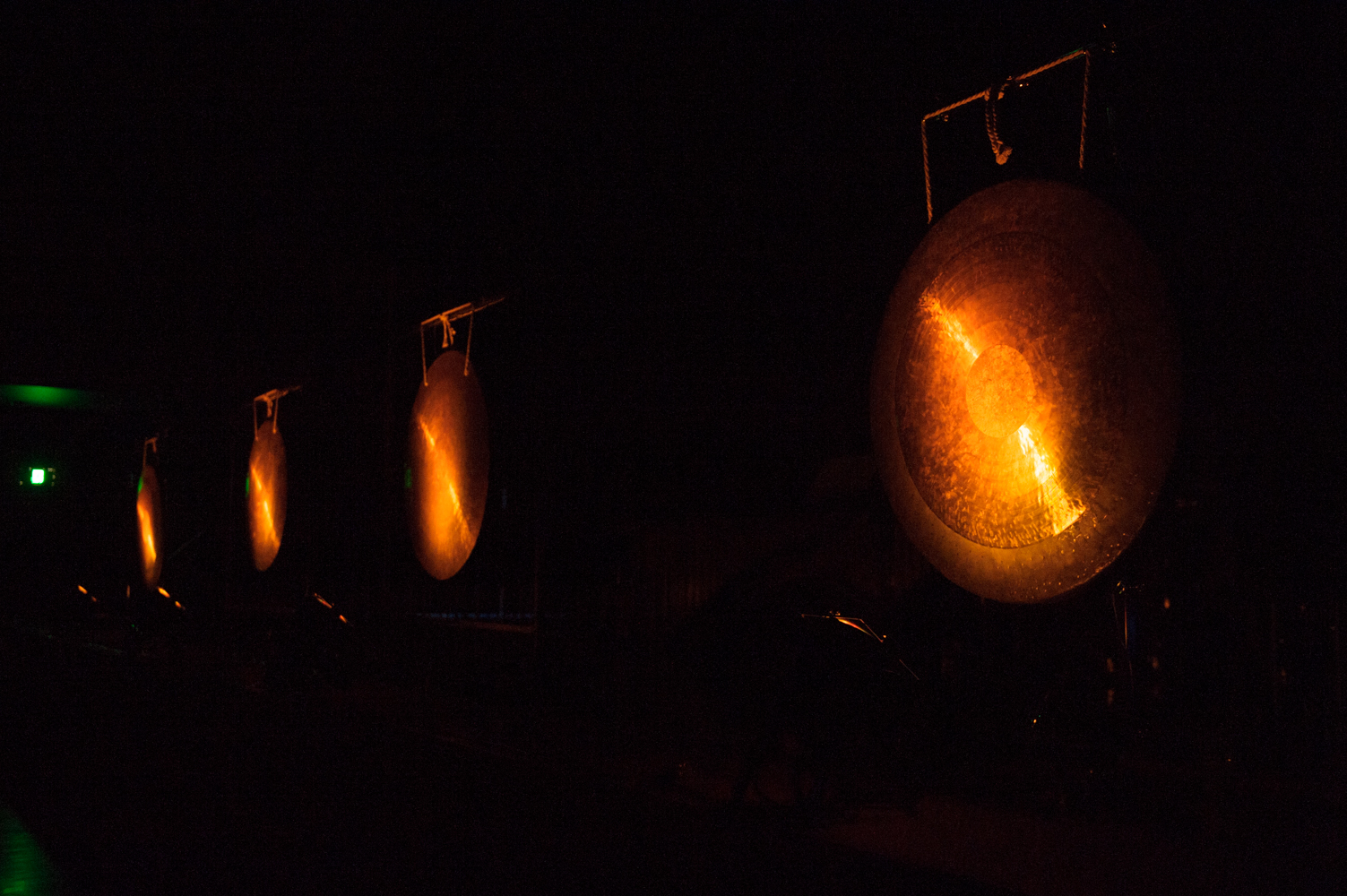
The audience retired to the stalls of the Elisabeth Murdoch Hall for Garsden’s beautiful new work Messages to Erice I & II. Four large tam-tams were arrayed along the front of the stage and lit from below by yellow-gold spot lights. Each tam-tam is fitted with a transducer (like a speaker without the cone). Garsden has made recordings of each individual tam-tam. In the live performance, he manipulates these recordings and plays them back through the instrument via the transducer. The four tam-tams stand there like bronze breastplates, or altars, their mysterious sounds emanating not just toward the audience, but filling the high ceiling of the hall with shimmering, insect-like buzzing and clear, brassy tones. The lights suddenly change to a silvery-blue as the second movement (or “process”) of the piece begins. Here the sound signals are further processed, creating an alien sound world of “washboard” vibrations and fierce roaring. Garsden motivated the festival’s theme in several ways. The algorithmic relationship between the sound-processing of the different tam-tams is related to the relationships of the characters in Víctor Erice’s 1973 film El Spíritu del Colmena. The piece furthermore makes use of recordings, which can be considered moving “sound images.” Most strikingly, the performance itself was a moving cinematic gesture.

Jeanette Little, No Optic

Jeanette Little's No Optic. Photo by Sarah Walker.
Jeanette Little’s No Optic. Photo by Sarah Walker.

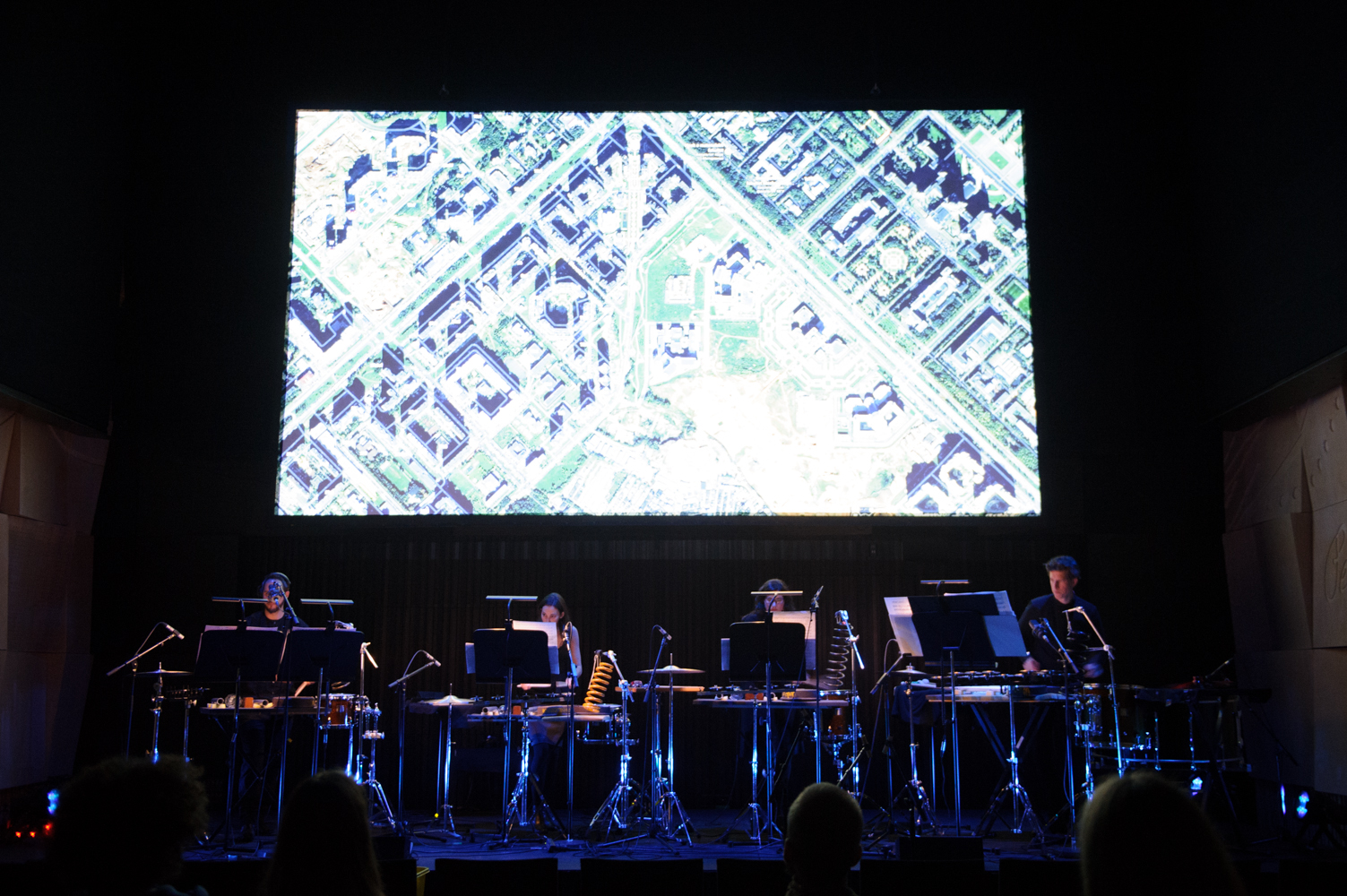
Once ushered into the Salon, we were treated to Jeanette Little’s No Optic for four percussionists and live electronics. The piece is accompanied by a video work by the Russian video artist Sasha Litvintseva. The video features a screenshot of somebody exploring high-resolution Google Maps images of various metropolises. In a reference to online and CCTV surveillance, copies of the screenshots are then dragged onto the screen, producing a multiplicity of staggered images. Scrolling cascades of images of roads and cars pass over the screen. The layering process is repeated with a video of somebody taking a photo with a smartphone. I appreciated that this was a video made almost entirely (if not actually entirely) without a camera. The moving image is now omnipresent, with almost every possible setting and activity recorded and uploaded into the cloud (or into some server farm in a desert). However, I was more amused than scared by the “electronic panopticon” (as it was described in the programme). This may be due to Little’s score, which aimed to conjure mixed feelings of “intimacy, discomfort, anxiety and opportunity.” The four percussionists, Ughetti, Kaylie Melville, Anna Camara and Matthias Schack-Arnott, stood behind four almost identical batteries of metal percussion. They produced beds of sound, like the high-pitched rattling of skewers on metal pipes. At other points the ensemble signalled important transitions. For instance, tiled videos of the interiors of trains give way to a single long-range shot of a city with a train passing through it in the distance. The performers stop suddenly, the resonance of car suspension springs ringing out into the calm. The pre-recorded materials, including loud dance music or a sacred classical-era aria, highlighted the omnipresence of recorded sound in our lives as well as recorded images.

Composers often regret the lack of opportunities available to them after their first student commissions. By commissioning three confident young composers, Speak Percussion has brought three fascinating and valuable new works into existence. This year’s Metropolis festival is full of such adventurous and intimate programmes by local and international new music stars. Be sure to grab a ticket or three.

Speak Percussion
Between Two Parts there is an Intermission of a Hundred Thousand Years
Melbourne Recital Centre
Metropolis New Music Festival
4 May 2015

Peter de Jager, Fractured Timelines; Alexander Garsden, Messages to Erice I & II; Jeanette Little, No Optic.

Ensemble Offspring and Ironwood: Broken Consorts

Ensemble Offspring and Ironwood perform Broken Consorts at the Baha'i Centre, Hobart. Photo courtesy of the ensemble.
Ensemble Offspring and Ironwood perform Broken Consorts at the Baha’i Centre, Hobart. Photo courtesy of the ensemble.

It is a truth commonly acknowledged that a fan of irrational rhythms, jarring dissonances and difference tones will also  enjoy the rasping timbres and wild gestures of baroque music. In Broken Consorts, Ensemble Offspring and Ironwood explore this subterranean passage between early and new music that passes under the full-to-bursting tone and metrical pomp of the romantic era. What explains the affinity between early and contemporary music? As the composer Damien Ricketson mused during the concert, the groups share “a mutual disregard for vibrato.” Performers of early music will retort that this description only applied in the early days of Historically Inspired Performance Practice and that today they know to use vibrato sparingly as an expressive effect. But neither adepts of early music nor contemporary music are known for their sense of humour.

In early music terminology, a “broken consort” is an ensemble constituted from more than one family of instruments. By playing contemporary and early music on early, modern and bespoke instruments,  Ensemble Offspring and Ironwood bring the notion of the broken consort into the twenty-first century. While some works in the programme were creative reimaginings of old and new works on old and new instruments, a new work by Felicity Wilcox was commissioned especially for the concert. While the reimagined early and modern works provided an engaging comparison of instrumental timbres, Wilcox’s piece went furthest towards a genuine exploration of new and early musics’ shared emphases on gesture and rhetoric.

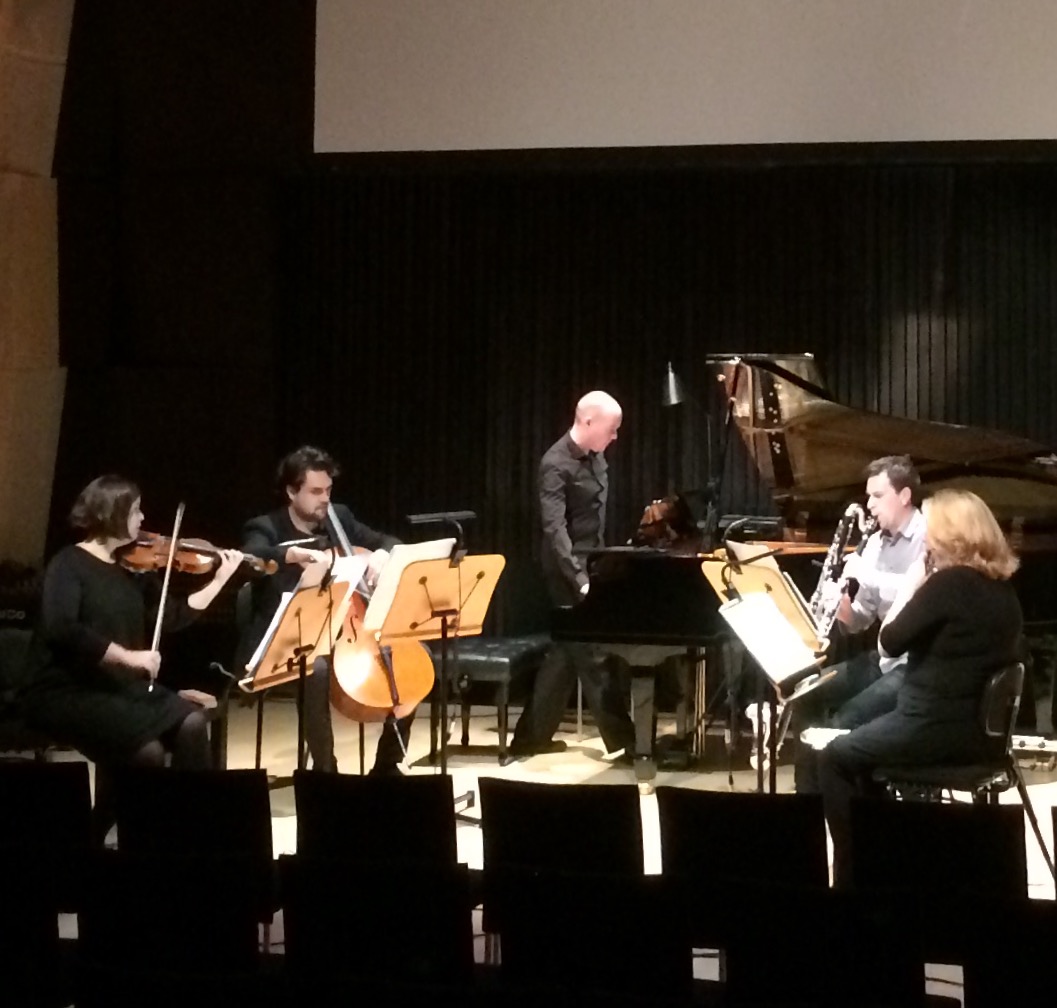
The concert began with Matthew Locke’s Consort of Fower Parts, which Ironwood played in a historically-inspired fashion. This was the first time I have had the pleasure of hearing Ironwood perform, and I was blown away by Daniel Yeadon’s cello tone and rhetorical expressivity. From a purely early-music performance to a completely new work, Wilcox’s Uncovered Ground was a palimpsest of musical styles. The composer likens the piece to a “a chipped painted wall that partially reveals a forgotten mural.” The piece features begins with a descending figure reminiscent of the lamenting bass of a passacaglia or Monteverdi’s Lamento della ninfa. This baroque gesture is quickly replaced by modern extended techniques, including pianist Zubin Kanga playing inside the piano with a bottle. Other baroque forms can be made out beneath the whispering, scraping string sounds, including a decorative string duet and dance rhythms.

The episodic form of Matthew Locke’s Suite from The Tempest provided opportunities for creative instrumentation. Kanga’s piano was prepared to comical effect, with Blu-Tac on piano strings producing “popping” cadences. Paper in between the piano strings and bulldog clips on Claire Edwardes’ vibraphone brought the instruments closer to the brighter, buzzier baroque sound world. I was pleasantly surprised when the two ensembles stood for a spot of very convincing madrigaling.

Damien Ricketson’s Trace Elements was inspired by a sixteenth-century manuscript, the Cracow Lute Tablature. The manuscript includes musical forms that are unidentifiable within our current knowledge of sixteenth-century music. Ricketson was attracted to the idea of forgotten musical styles, as well as the fact that tablature describes the actions required for a piece to be played rather than how it sounds. Trace Elements is written in an invented tablature that can be performed by a quartet consisting of two wind and two string insturments. The performance will thus be different every time that a different combination of instruments and tunings are used. Due to the tablature, as Ricketson writes, “the underlying gestural identity remains constant.” The ensemble chose a compelling combination of modern flute and clarinet with early viola and cello. This produced startling effects as the undeniably “modern” gestures, using the full range of the instruments, were modulated by the gut strings of the string instruments.

The concert closed with Mary Finsterer’s Silva, which was composed in 2013 for Ensemble Offspring featuring Claire Edwardes on percussion. The title means “forest” and the piece reflects the eerie quiet of forest environments, with scattered fragments of Tallis’ “Spem in alium” and Schubert’s “Death and the Maiden” lighting up the space like birdsong. There were some wonderful timbral surprises, including a sumptuous combination of gut-stringed cello and modern bass clarinet. The tone of Veronique Serret’s modern-strung violin stuck out in the muted forest like an enthusiastic lyrebird. After each instrument was given some time to make itself heard, the piece closed with a beautifully rough gong chime evocative of a rusted bell in a forgotten temple.

Ricketson’s Trace Elements

Ensemble Offspring and Ironwood Ensemble

Broken Consorts

Fortyfivedownstairs

23 February 2013

Matthew Locke, Consort of Fower Parts; Felicity Wilcox, Uncovered Ground; Matthew Locke, Suite from The Tempest; Damien Ricketson, Trace Elements; William Lawes, Consort in Six Parts; Mary Finsterer, Silva.

The Sound Collectors: New Music Beauty Queen

View More: http://johnephotography.pass.us/soundcollectors2015
The Sound Collectors perform Gone, Dog. Gone! by Mark Applebaum. John E Photography

New Music Beauty Queen is an innovative musical response to an innovative fashion label. In curating the programme, The Sound Collectors Louise Devenish and Leah Scholes were inspired by the 2014 collection of the clothing store, manufacturing company and fashion label New Model Beauty Queen. NMBQ is an ethical and sustainable clothing company stocking products made from recycled fabrics. Rather than contribute to each season’s excess of new fabrics, the labels stocked at NMBQ source fabrics from auction houses and redesign them with the aid of NMBQ’s Ethical Clothing Australia-accredited screen printing facility. With their batteries of percussion instruments spaced around the bright, white basement under a sky of incandescent bulbs, The Sound Collectors achieved a thought-provoking synthesis of materials collected from text, gesture, news and politics.

NMBQ’s 2014 collection was inspired by Matilda Butters’ Press Dress from 1866. Butters was a costume designer and, as wife to the politician James Stewart Butters, a serial fancy dresser. The silk Press Dress was printed with the front pages of fourteen different Victorian papers and the mastheads of eighteen regional papers. NMBQ’s 2014 collection, which was spread around the edges of the basement, features vintage typefaces and images printed over bold, block colours. The original Press Dress was even on display by the door, looking perfectly at home alongside NMBQ’s more recent creations.

Leah Scholes and Louise Devenish complemented the collections with a programme of new and existing percussion repertoire inspired by current affairs, politics, text and gesture. Beyond the thematic similarity between the NMBQ collection and the Sound Collectors’ programme, there is a two-dimensionality to the works by Burkhardt, de Mey, Davidson, Hope, Leak and Applebaum that match the designs by NMBQ. Each piece is a linear sequence of actions, words and percussion events pressed upon silence like the symbols printed on the t-shirts and dresses around the edges of the NMBQ basement.

Simulcast by Rick Burkhardt begins with the two percussionists as news readers or radio announcers, speaking into cow bells to give their voices a distant, muffled tone. The text appears to begin with a stream of consciousness of a sales person or a journalist on a trip, walking unfamiliar streets and taking photographs. Before long the tone turns sinister. There is confusion, the speaker is trying to ask questions and is frustrated with the questions of others. Are they at a press conference? An interrogation? The piece leaves the audience as confused at the end as they were at the start, but set up the text-based and focussed dynamic for the rest of the concert.

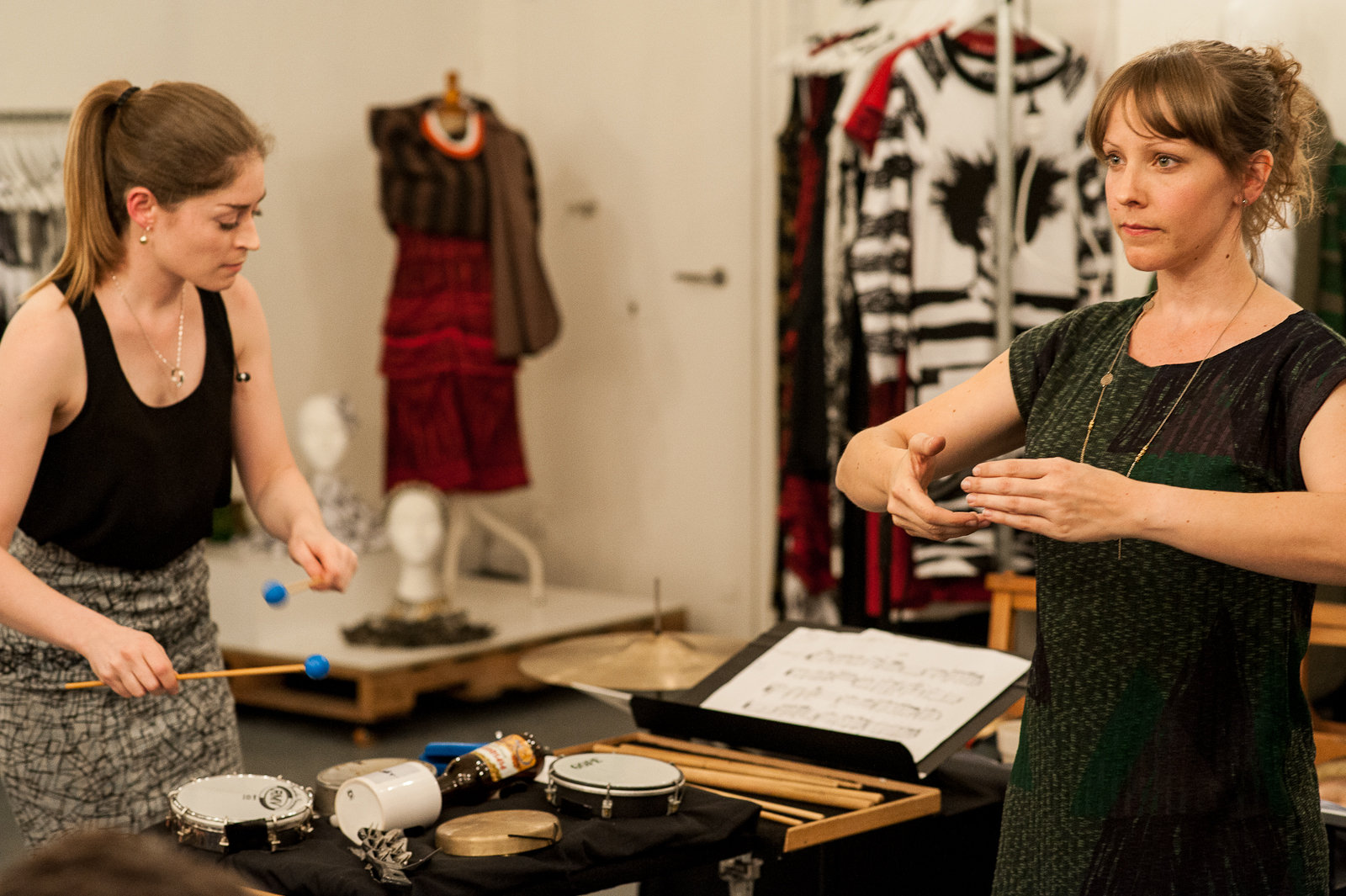
Thierry de Mey’s Silence Must Be is a simple and extremely effective exploration of audience expectations in the relationship of sound and gesture. Scholes conducts in silence at one end of the basement. The conducting becomes more stylised, like a sort of martial art (conductors would probably like to think that they are ninjas). The gestures change from open-handed strikes to smooth, swaying lines and figures of eight. Two figures of eight move in and out of phase like sine waves. Suddenly Scholes starts from the beginning, but this time each gesture is accompanied by a sound from Devenish’s battery at the opposite end of the room. Of course that is what the gestures sound like! Just as one is becoming overwhelmed at the cleverness of it all, the percussion stops. The rest of the gestures play out in silence. The lack of sound compels one to imagine what Scholes’ gestures would sound like. Would they be high or low? Rough or smooth? How would they move?

Rob Davidson’s highly politicised music recently went viral with his choral setting of Julia Gillard’s misogyny speech. Davidson has continued in the same vein with Human Beings as Well, a piece for two percussionists and a recording of a Sky News reporter interviewing an Islamic commentator. After the interviewer asks the commentator whether he condones beheadings by extremist groups such as ISIS, he responds that Islamic people are “human beings too” and “shouldn’t have to justify” themselves against the actions of extremists. “Get over yourself” the interviewer interjects. The percussion parts bolt along beneath the tragicomic interview. Davidson mocks the sensationalism of the Sky News interview with an upbeat groove, while amplifying the intensity of the speakers’ voices by echoing them on skin drums.

The Sound Collectors perform Sub Aerial by Cat Hope.
The Sound Collectors perform Sub Aerial by Cat Hope. John E Photography

In Hope’s Sub Aerial, the performers trace particular patterns with percussion brushes and mallets on pieces of fabric with different textures. Finally, they trace shapes in the air with portable radios tuned to static. The piece is extremely quiet and was unfortunately drowned out by the overhead fans of the basement. Nevertheless, I was put in mind of a conversation I recently had with the composer Cat Hope at a conference. I, defending pitch-class set theory in the analysis of certain notated post-tonal works, made the generalisation that after one discards the rules of harmony, modality and counterpoint as guiding principles of a work “all one is left with is numbers.” I meant by this that one is left with raw, uninterpreted data. The music analyst’s job is then to find some order in the data, either the composer’s or one’s own. Hope rightfully took me to task for this generalisation, as a set of pitch-classes will not necessarily lead one to understand compositional processes or modes of listening based on curves and gestures rather than discrete pitches and durations. We were of course talking at cross purposes. I was talking about the analysis of dodecaphonic, serial and alternative serial works while Hope was talking about post-serial works and graphic scores. I think Hope would also agree that works like Sub Aerial are no less precise and repeatable than a piece that can be reduced to pitch classes. The use of graphic scores is not always about introducing greater uncertainty and scope for interpretation into a work, but is a way of creating scores that demand the same fidelity from the performer as any notated score.

Next to more recent text-based works, Graeme Leak’s … And Now for the News from 1984 still sounds fresh. As Devenish pointed out, the piece was one of the first Australian solo percussion pieces composed by a percussionist-composer. Like Davidson’s piece, the work incorporates a tape part, this time a Vietnamese news bulletin recorded from 2EA radio. The piece combines direct imitation of the rhythms of the spoken language with metrical episodes derived from the transcription.

Thanks to Devenish and Scholes’ sensitivity and precision as performers, the concert was a revelation as to the merits of text and gesture-based works. As the rhythms of … And Now for the News and the gestural curves of Sub Aerial show, there are rhythms and phrases in actions and words that a musician won’t come up with when composing at an instrument or hunched over a piece of manuscript paper. But against the backdrop of these incredibly successful attempts at mining speech and gesture, Mark Applebaum’s Gone, Dog. Gone! appears less convincing. As Scholes explained to the audience, Applebaum is interested in the musical value of gestures abstracted from their contexts and meanings. Gone, Dog. Gone!, like its predecessor Go, Dog. Go!, is inspired by a children’s book. A part of Gone, Dog. Gone! mimes every bizarre action that a group of dogs are performing in a tree during one part of the book. In Applebaum’s piece, one percussionist performs a sequence of gestures while the other plays corresponding punctuations on a table of percussion instruments. Particular gestures do not seem to be accompanied by particular sounds and the sounds themselves are so short (the battery consisting of small glass and metal objects) that their relationship to the gestures beyond signalling their overarching rhythm is obscure. From what, then, is the overarching rhythm of the piece derived? The rhythm, however chosen, seems to drive the gestures rather than the other way around. The piece was nevertheless a joy to watch as the catalogue of gestures are not too literal, leaving one guessing what they could be referring to. Applebaum’s piece was just one part of New Music Beauty Queen as a thought-provoking and thoroughly enjoyable synthesis of repertoire and context.

The Sound Collectors
New Music Beauty Queen
New Model Beauty Queen basement boutique
1 April 2015

Programme: Rick Burkhardt, Simulcast; Thierry de Mey, Silence Must Be; Rob Davidson, Human Beings As Well; Cat Hope, Sub Aerial; Graeme Leak, … And Now for the News; Mark Applebaum, Gone, Dog. Gone!

Partial Durations is a Matthew Lorenzon/RealTime joint project.

Chamber Made Opera: Captives of the City

Adam Pierzchalski. Photo by Jeff Busby.

Sarah Kriegler and Ben Grant’s Captives of the City is a political fable set in the bowels of a dystopian regime. The show has a simple message about the power of citizen journalism and artistic freedom that is cleverly and cleanly communicated through digital puppetry and stunning musical performances. The piece has been through several stages of development and reflects the Arab Spring and Wikileaks, as well as more recent events such as the Charlie Hebdo attacks.

The audience is met in the foyer of the Melbourne Arts Centre by an officious usher played by Adam Pierzchalski. Pierzchalski clowns about masterfully, disposing of a dead pigeon and checking the cuffs of audience members for recording devices. The audience is taken in groups into the basement while a video screen mounted on the wall of the lift shows security camera footage.

The basement of the Arts Centre is a warren of cages. The entire space is miked up, a sonic microcosm of the authoritarian state above. Two musicians, Mark Cauvin and Matthias Schack-Arnott, are captives of the city. They are taken in and out of cages by the usher and made to perform graphic scores by David Young. I’m not sure whether this is supposed to be a punishment, a moment of restricted freedom or indentured labour for the musicians. The standout performance for me was Schack-Arnott’s solo improvisation on a close-miked cage with knitting needles. Schack-Arnott conjures silvery tones, phasing swathes of sound and deep bass notes out of the bars.

As the performers go about their musical servitude, a magnificent rat made out of fragments of text scuttles around the walls, designed by Dave Jones and projected by Jacob Williams. The rat has moods, increasing the font size and style of its skin as it responds to the musicians. The rat is befriended by the musicians, who cleverly pick the projection off of a wall with a score and “place” it onto Cauvin’s double bass. To cut a short story shorter, the musicians break free with the help of a swarm of digital rats, who write words on the walls of the basement that became famous after the revolution in Tahrir Square:

Oh regime that is scared of a pen and a brush
you’ve been unfair to the people you crushed
if you were honest
you would not fear paint
the best you can do is fight walls
and claim victory over colors and lines

It is tempting to read Captives of the City as a liberal fable counseling artistic freedom without surveillance. However, doesn’t the piece contrast two different problems, that of artistic freedom and that of freedom of information? These are the priorities of two different denizens of the city: the musicians, who have a degree of freedom and whose art is valued in some part by the regime, and the underground activist-rats. The aims of these groups are not necessarily aligned and the slowness with which the musicians befriend the rat in Captives of the City seems to recognise this. Ultimately the musicians achieve liberation through making some particularly loud and threatening music with the pylons of the basement, an ending that only seems to highlight the political futility of their art form. As the rats overrun the city, a montage of citizens on their computers forms the shape of a giant rat. The musicians become a symbol of courage while the rats become agents of political change. As the artists write in the programme of the cartoonists killed in the Charlie Hebdo attacks: “Regardless of opinion of the ‘correctness’ of their work, there is no doubt the artists working for Charlie Hebdo were unflinching in their right to use art to make a statement about the world around them.” The world of surveillance and security moves quickly and since the performance of Captives of the City some of the most far-reaching data retention laws in the world were passed in Australia with bipartisan support, despite there being little evidence that easier access to metadata will stop attacks like those on the offices of Charlie Hebdo or the Lindt cafe.

As Helen Razer recently wrote for Crikey, the data retention laws recently passed in Australia with bipartisan support will have a chilling effect on artistic practice. As Razer writes, Australia’s fascination with censorship extends well beyond the often-cited justification of stopping child pornography: “From Piss Christ to Pasolini to the novels of Zola, artworks are treated with more revulsion in Australia than any other western liberal democracy. Adult consumers of video games were not permitted to legally play items with an R18+ rating until 2012.” The metadata retention laws will raise the stakes of artistic courage.

Captives of the City
By Sarah Kriegler and Ben Grant
Directed by Sarah Kriegler
Chamber Made Opera
Lemony S Puppet Theatre
The Arts Centre
11 February 201

Partial Durations is a Matthew Lorenzon/RealTime joint project.

ANAM: The Inextinguishable

For ANAM’s opening concert of the year Stanley Dodds, newly-appointed principal conductor of the Berlin Symphony Orchestra, led the cohort in a programme of meteorological proportions. George Butterworth’s A Shropshire Lad is a bombastic early-twentieth-century romp. Written after the Second Boer War, the work’s folk-inflected romanticism has become familiar to concert-goers throughout these two years of commemorations of the First World War. The piece is a reminder that the language of grief changes and that composers are constantly inventing new ways of expressing the extremely complex emotions associated with trauma, loss and mourning.

A case in point being Wilfred Lehmann’s Symphonic Requiem for the Child Victims of War from 1994. The score has been revived by ANAM’s librarian Philip Lambert, who heroically typeset the piece over fourteen months. Where Butterworth’s war is one of misplaced heroism, Lehmann uses the post-World War Two trope of senseless mechanisation. Menacing strings descend upon scratched cymbals and motoric snare drums. An alienating cluster of woodwinds combine with an eerie bowed vibraphone. Lehmann paints this terrifying environment so that we empathise all the more with the Symphonic Requiem‘s instrumental “protagonists”: a violin, a mandolin and a glockenspiel. The solo violin appears first, its lament accompanied by a sombre, marching orchestra. The mandolin and glockenspiel enter, playing a sort of hide and seek punctuated by cheeky portamenti. As the background becomes more chaotic, the voices are separated. The mandolin and violin “run” away among blasts from the timpani. This is a piece for current wars as much as past ones. It is about refugee children and those who don’t get to be refugees because they die before they can escape. Shane Chen performs the solo violin part masterfully, executing an extremely virtuosic cadenza before rejoining the plodding orchestral march. Everybody plays the violin’s lament from the beginning, but the violin has the last word with a bit of a jig.

After the vibrant characterisations of Lehmann’s Symphonic Requiem, it was difficult to settle in to Carl Nielsen’s “The Inextinguishable.” A bloated opening orchestral statement thankfully gives way to a mysterious and compelling cello solo (all the more compelling because of the lightning from the storm brewing outside the hall). Another bouncing, bolshy orchestral episode gives way to a thin, tense moment in the strings. Once more, the weather helped, with the storm buffeting the building from all sides. This was the perfect environment in which to hear the Symphony’s central wind octet—with extra-musical wind.

The Inextinguishable
Students of Australian National Academy of Music
Shane Chen, violin
Conducted by Stanley Dodds

George Butterworth, A Shropshire Lad; Wilfred Lehmann, Symphonic Requiem for the Child Victims of War; Carl Nielsen, Symphony No. 4, “The Inextinguishable.”

Partial Durations is a Matthew Lorenzon/RealTime joint project.