
An account of some super-chilled acousmatic listening in the atrium of the Western Australian Museum here.
An account of some super-chilled acousmatic listening in the atrium of the Western Australian Museum here.
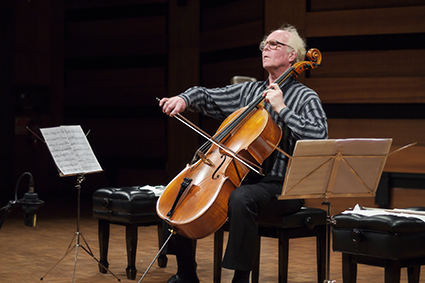
An absolute standout performance of the Totally Huge New Music Festival. Friedrich Gauwerky performs a German-Australian programme of Henze, Reiner, Stockhausen, Hübler, Werder, Heyn and Hindemith. Read about it over at RealTime.

In which I give myself a primer on modular synthesis and discuss some very fine noise performance over at RealTime as part of the Totally Huge New Music Festival.
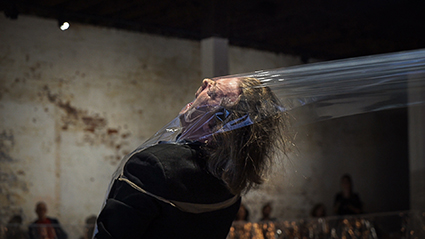
I’m in Perth covering the Totally Huge New Music Festival and mentoring a bunch of great young writers. Our reviews will be appearing on the RealTime website over the next week. Check out my review of Johannes Sistermanns’ opening installation/performance with Western Australia’s premier new music ensemble Decibel here.
Guest review by David R. M. Irving
The Metropolis New Music Festival, showcasing works associated with film and the moving image, reached its stunning conclusion on Saturday with a program of recent compositions and more ‘classic’ works. The Melbourne Symphony Orchestra was in fine form, conductor André de Ridder decisive in direction and eloquent in speech, and the Melbourne Recital Centre an ideal locus for a performance that was both extravagant in scope and intimate in experience. For me, the juxtaposition of ‘old-new’ music with ‘new-new’ music spoke volumes of a continuing desire for postmodern assemblages in concert programming – if such an observation isn’t already a mode of criticism long passé. Yet what was particularly striking was that ‘classic’ works such as Penderecki’s Polymorphia (1961) and Varèse’s Déserts (1954) sounded far more experimental and groundbreaking than the considerably more conservative and self-reflexive works by Jonny Greenwood and John Corigliano. This represented a timely reminder of the non-linear and multicentric flowering of compositional style over the past half-century, but perhaps it also says something about canonisation and the ritualised recycling of repertoire in most art music programming – at least in terms of listeners’ preconditioned ideas of orchestral music and style. (An anonymised program and testing of audience reactions on musical vintage could actually be quite illuminating, not to mention fun.)
The practice of performing suites of film music in orchestral concerts echoes the programming of seventeenth-century theatre music by Purcell and co., but the aural experience of this repertoire seems altogether more divorced from its context if given without the accompanying moving images. It was in this vein that we began the program with Greenwood’s There Will Be Blood suite: a veritable sonic landscape with vivid aural evocations of Californian oil fields. (I haven’t actually seen the film, by way of full disclosure, but learnt the context from the concise and informative program notes.) A special feature was the use of the ondes martenot, an electronic instrument championed by Messiaen, which emitted a luminous melody hovering above the strings. Greenwood was pretty sparing with it, and the ondes were conspicuous for their absence for the rest of the piece, but the audience was clearly thrilled with the experience. The suite was very much a tableau of diverse sounds, and a thoughtful and artful voyage of sonic discovery, making use of many different string textures and techniques. The MSO, reduced in forces for this programme, was a model of excellent ensemble and rhythmic precision, and played as if they were performing chamber music, with a blend of movement and sound rarely seen in an ensemble of this size.
Corigliano’s The Red Violin: Chaconne for Violin and Orchestra is a companion piece to the score of the eponymous film. By Chaconne the composer implies a repeated chord progression, but I felt the piece would better reflect the name of “rhapsody” or “romance”. Violinist Sophie Rowell was technically brilliant and immensively expressive in her rendition of the difficult solo part. It featured all the usual late-Romantic characteristics: multiple-stops, big arpeggios and virtuosic scalic passages, sweeping long melodies, and – as the composer points out – the incorporation of difficult études into the solo line. There were certainly some very moving moments. Yet some of the longer orchestral interludes and especially the big orchestral “hits” (large chords) right at the end represented something of a cliché, reinforcing a melodramatic aesthetic that one rarely hears outside the cinema. Still, this piece certainly reflected the subject of the film that inspired it. An impressive feat to perform, and the audience gave it a rousing vote of thanks.
Speaking of associations between film and music, who can forget the terror inspired by Jack Nicholson in parts of The Shining, underpinned by the unsettling whispering, murmuring, and whistling of 48 string players producing Penderecki’s organised cacophony that is Polymorphia, and bringing us to the very edge of our seats? This piece arguably deserves recognition in its own right as a masterpiece of new music in the 1960s. It must have caused a sensation at its original performance in 1961, and it certainly did here. All I could think about, though, was the way in which those extended string techniques – playing below the bridge, bowing the tailpiece, tapping the instrument with flesh and with wood, and so on – have been associated with so many different emotions; here the aesthetic is linked indelibly to terror, thanks to Stanley Kubrick, and yet we hear many of the same kinds of sounds representing the raucous dawn chorus in Sculthorpe’s Kakadu. (Okay, that’s a pretty random binary opposition, and one I won’t explore further, but maybe we can chew some more on the meanings that high frequencies have for human emotions.) The best part of witnessing a concert performance of Polymorphia by 48 string instruments is to recognise gradually the aural and visual order in the seeming chaos, and to watch the director bathe in waves of sound while pointing the cues in rapid-fire succession. The surprise C major chord at the very end jolted us suddenly into (or out of?) an altered reality.
Varèse’s Déserts was for me the calling card of the programme. This was clearly intended as the show-stopping finale, while other works were intended for aural contemplation without the projections of video stimulus. Performed with Bill Viola’s video of 1994, it’s difficult to say whether the music of Déserts was accompanying the moving image, or vice versa, as the synchrony of sound and vision was impressive indeed. The conductor presumably had a click track: the coordination was precise, right down to the live instrumental accompaniment of sudden lightning strikes on the screen. The musicians were split into several small groupings on stage, making for a stereophonic atmosphere that interacted well with the tape-recorded passages broadcast at specific points in the piece. The mesmeric quality of the film lulled us into a transcendent space of seeing, hearing, and being. Perhaps a nice example of a complete artwork, albeit without voice.
The MSO players provided a wonderful visual display in a technically assured and highly expressive performance, within the attractive wood-lined ambiance of the MRC’s Elisabeth Murdoch Hall. A fitting finale to the 2015 Metropolis New Music Festival.
– David R. M. Irving
There Will Be Blood
Melbourne Symphony Orchestra
Metropolis New Music Festival
Melbourne Recital Centre
16 May 2015
Jonny Greenwood, There Will Be Blood; John Corigliano, The Red Violin: Chaconne for Violin and Orchestra; Krzystzof Penderecki, Polymorphia; Edgard Varèse, Déserts.

Sydney-based new music group Ensemble Offspring continue the Metropolis festival with a colourful series of works for live ensemble and video. Their programme Light is Calling began with a great example of a minimalist work that uses less to achieve more. Light is Calling for solo violin, electronics, and video is an attempt to “make something beautiful” after the ugliness of the attacks on the World Trade Center on September 11, 2001. Composer Michael Gordon provides a slow-moving violin part, devastatingly interpreted by Ensemble Offspring’s Veronique Serret. Reverberant and reversed samples form a finely-textured bed of electronic sound. Film maker Bill Morrison, who also contributed to Julia Wolfe’s Fuel in the MSO’s second Metropolis program, brings the piece to new emotional heights. Morrison’s film consists of a reprint of footage from the black and white 1926 movie The Bells. Morrison melts film footage of figures, faces and horses to produce hauntingly distorted images. As the film turns to yellow, brown, and black, the images smear and stretch across the screen. The echoing electronic part, lamenting violin and immolating film all seem mourn a long-lost innocence.
Nico Muhly’s It Goes Without Saying combines live clarinet (Jason Noble) with prerecorded metallic sounds including a kitchen whisk, bells and harmonium. The delicate sound world also includes pre-recorded clarinets that duet playfully with the live performer. The piece is accompanied by a video of stop-motion hair clippings on a white background. The hair slowly coalesces into a face, setting in motion a series of vivid animations including soap suds and metallic shards. Noble transfixed the audience with the hypnotic clarinet part. This was especially strong during the opening abstraction of drifting hair follicles.
Ensemble Offspring’s Metropolis programme included the world première of audiovisual artist Chris Perren’s Dive Process. In Dive Process, Perren builds on his recent experiments with musical and video phasing. Dive Process uses a retro video of a girl diving into water. The video is reversed and replayed at her point of entry into the pool, creating a rhythmic explosion and contraction of bubbles. Three versions of this film are then played side by side at different rates in a mesmerising phasing pattern. Perren’s score for percussion, clarinet, and violin mirrors the visual phasing pattern. Perren builds the intensity of this pattern during segments where dozens of copies of the video are spaced around a sphere. Continuing the theme of rhythmic counterpoint, the ensemble then played Steve Reich’s Vermont Counterpoint, a sister-piece to Reich’s Six Pianos, which Zubin Kanga performed in an arrangement by Vincent Corver earlier in the festival.
Ensemble Offspring reserved the second half of the concert for Damien Ricketson’s magnificent Fractured Again Suite. For this large-scale chamber ensemble work, Ricketson draws inspiration from the physical properties and sound of glass. In particular, Ricketson singles out the glass harmonium, a relatively popular instrument in the eighteenth century that has since fallen into obscurity. The closest thing one can hear to its ethereal tone nowadays is a dextrous performance on a row of tuned wineglasses. Ricketson builds the Fractured Again Suite out of fragments of compositions for the glass harmonium by Mozart, Donizetti and others. These fragments are then reflected, distorted and splintered like glass to form the arresting and sparkling surface of the suite. The rapid opening resembles an off-kilter clockwork automaton racing towards self-destruction. The glass-inspired video accompanying the work includes a brilliant array of coloured lights projected upon tubes, panes, and rods of glass. Some of these lights are reflected in repetitive, rhythmic ways, while at others they resemble the more timbral reflections of the piece’s later movements.
Ensemble Offspring
Light is Calling
Metropolis New Music Festival
Melbourne Recital Centre
14 May 2015
Michael Gordon, Light is Calling; Nico Muhly, It Goes Without Saying; Chris Perren, Dive Process; Steve Reich, Vermont Counterpoint; Damien Ricketson, Fractured Again Suite.
By drawing their inspiration from urban life in the second half of the twentieth century, minimalist composers bear witness to the most carbon-intensive period in human history. The jumbo jet opening John Adams’ Nixon in China and his orchestral fanfare Short Ride in a Fast Machine, Steve Reich’s City Life and Glass’ epic modern chronicle Koyaanisqatsi all show us a world kept in motion by fossil fuels. The composers may not have intended to represent our carbon-dependent lifestyles. It is all the more interesting that the issues they thought they were addressing, including the mediatisation of politics, consumerism, the proliferation of nuclear weapons and the alienation of individuals from their communities, are all connected tangentially to this one core issue that now looms as the greatest threat to human life. The works bear witness to this moment in history more than judge it. Through its serene and spacious textures, the minimalist musical language often struggles to cast judgement. Instead it impartially reflects, if not sublimates, the images it is associated with.
Julia Wolfe, Fuel
Julia Wolfe’s Fuel brings this problem running all of our trains, cars and planes to the surface. The piece is accompanied by time lapse footage of the port of Hamburg by Bill Morrison. Wolfe describes the piece as beginning in a conversation with Morrison: “We talked about the mystery and economy of how things run—the controversy and necessity of fuel—the global implications, the human need.” Originally composed for Ensemble Resonanz as something of a virtuosic party piece, the MSO strings kept up the stiff pace set by guest conductor André de Ridder. No lugubrious meditation on modern life, Fuel has the orchestra scrubbing, running and glissing for the better part of twenty minutes. Meanwhile, the film shows cranes loading containers on and off of enormous cargo ships. There is something daunting about the film and music, as though the whole frenzied business were precarious, excessive, in a word: unsustainable.
Tan Dun, “Crouching Tiger” Concerto
Cellist Oliver Coates returned to the stage to perform Tan Dun’s cello concerto based on music from the soundtrack to the film Crouching Tiger, Hidden Dragon. From the opening glissando-strewn theme I was transported back to my spotty adolescence, seeing the film’s most excellent and unrealistic sword fights for the first time. As such, I loved the cheesy main theme that returns three or four times throughout the concerto. This time around I also appreciated the piece’s extensive catalogue of well-integrated extended techniques, including left-hand pizzicato rolls, glissando effects, plectrum use and en masse string-slapping from the orchestra.
Alexander Garsden, Faculties Intact (Cybec finalist)
Alexander Garsden’s Faculties Intact is the second Cybec commission to be heard at this year’s festival. As Garsden related in his interview with De Ridder, MSO’s first play-through of the piece in January helped him understand “how overblown and ill-informed [his] initial ideas were.” One of the great virtues of the Cybec program at the Metropolis festival is that composers have the opportunity to refine their compositions and then hear them performed again. The audience is also able to hear the diversity of compositional styles among young composers, including Garsden’s idiosyncratic combination of spectralist, stochastic and other post-serial methods. Garsden’s style is unique in Australia. Many Australian composers fixate upon the performer or the instrument. The idea of a piece may have its genesis in the gestures that a performer makes while playing. They may also want to expand the range of sounds one can conjure from an instrument. Garsden seems more interested in the sound you hear rather than how it is made. He may work from a spectrogram (a graph of the energy at different frequencies of a particular sound) to derive the pitches he will use. He then makes sure that certain relationships hold between the timbres of different instruments. For instance, in Faculties Intact the violins move their bows too quickly, so that the sound produced is high-pitched and squeaky. As the violins move into higher and higher registers, the percussionist begins bowing a piece of styrofoam, carrying this squealing sound even higher. At another moment, the violins scrub away lightly in a lower register, producing a rustling sound that is adopted and expanded by a tam-tam scraped with the shaft of a mallet. Smooth, “ordinary” tones make an appearance as an afterthought at the end of the piece, just in case you forgot they were there.
Philip Glass, The Light
Instead of gas-guzzling technologies, The Light draws inspiration from Albert A. Michelson and Edward W. Morley’s experiments in physics. Michelson and Morley determined that there was no substrate, such as a “luminiferous aether,” through which light waves travelled. Their experiments led to research into the velocity of light and eventually the Special Theory of Relativity. Glass takes this pivotal moment in the history of modern science as the basis for his orchestral work The Light, writing that “this is a portrait not only of the two men for whom the experiments are named but also that historical moment heralding the beginning of the modern scientific period.” Where the concert began with Wolfe’s picture of the twentieth century running itself into ecological crisis, the concert ends with the dawn of the century and all of its scientific hopes. Can a new scientific dawn resolve the crisis brought about by the past century of industrial activity? This is a question that has been left to the next generation of minimalist composers, such as the artists of the Bedroom Community label.
The Light
Melbourne Symphony Orchestra
Metropolis New Music Festival
Melbourne Recital Centre
13 May 2015
Julia Wolfe, Fuel; Tan Dun, Crouching Tiger Concerto; Alexander Garsden, Faculties Intact (con tutta forza); Philip Glass, The Light.
Metropolis audiences enjoyed a week of chamber music before the Melbourne Symphony Orchestra gave its first concert of the festival. It was a pleasure to hear contemporary music writ large after becoming accustomed to the tight-knit intensity of chamber music. Under the baton of guest conductor André de Ridder, the orchestra takes diverse and stimulating approaches towards the festival’s theme of “music inspired by the moving image.” De Ridder has also taken the opportunity to introduce Australian audiences to the young composers represented by the Bedroom Community label. De Ridder even brought the cellist Oliver Coates—a Bedroom Community veteran—along for the ride.
Tōru Takemitsu, Nostalghia “in memory of Andrei Tarkovsky”
Rather than fill the programme with music composed for film, De Ridder explored circuitous routes between music and the moving image. The concert began with Tōru Takemitsu’s Nostalghia for solo violin and orchestra, which was written in memory of the Soviet and Russian film-maker Andrei Tarkovsky. Tarkovsky’s film of the same name is about a writer who travels to Italy researching the life of a composer. Takemitsu’s piece is thus a composition about a film about a composer. I mentioned Tarkovsky in an earlier Metropolis review as a example of a film maker with a sophisticated understanding of unsettling cinematic effects. Tarkovsky develops tension through long, wide shots of indifferent and beautiful landscapes before introducing human characters in the foreground. A mysteriously teeming, elemental nature is always lurking behind human fickleness. I would call the atmosphere of films like The Sacrifice or Stalker a sort of claustrophibic agoraphobia. Takemitsu’s elegy for Tarkovsky is a perfect meeting of artistic styles, brilliantly brought to life by Sophie Rowell. In Takemitsu’s music, nature and the elements are also in the ascendant with swooping lines and ethereal bow effects. Rowell took the audience through Takemitsu’s other-worldly musical space with the utmost conviction.
Arnold Schoenberg, Accompaniment to a Cinematographic Scene
Schoenberg composed his Accompaniment to a Cinematographic Scene in 1929 on the invitation of Heinrichshofen Verlag, a publishing house specialising in silent film scores. Fritz Lang had recently released his chilling image of the future in the silent film Metropolis. The Great Depression and the rise of Nazism in the Weimar Republic provided their own, terrifyingly real images of the future. It is only fitting, then, that instead of composing music for a particular scene, Schoenberg used his twelve-tone technique to express “threat, danger and catastrophe” more generally. The piece is today an interesting historical record of frightening effects in music. In Accompaniment to a Cinematographic Scene the language of fear is still pinned to the outer reaches of the circle of fifths and in evocative gestures like scurrying, swarming strings. The timbral effects of Penderecki (whose work Polymorphia appears in Saturday’s programme) have since come to dominate the language of horror-film scores. The MSO made the most of Schoenberg’s evocative language, bringing out each vignette of the piece. Perhaps there is still more horror-music to be written with tone rows. I was scared.
Harry Sdraulig, Kaleidoscope (Cybec finalist)
Every MSO concert of the Metropolis festival includes a piece by one of the finalists of the Cybec Foundation’s 21st Century Australian Composers Program. The program gives young composers the valuable opportunity to workshop their compositions with players from the orchestra. Three pieces are then chosen for presentation at the Metropolis festival, providing the even more valuable opportunity of refining their compositions. Harry Sdraulig’s Kaleidoscope was chosen as the first Cybec piece of the festival. Sdraulig was able to develop the piece with guidance from the composers Julian Yu and Brenton Broadstock. In a short interview with De Ridder, Sdraulig explained that he wanted to make the most of the timbre of each instrument in the orchestra. Like the coloured crystals of a kaleidoscope, each instrumental colour shines through the rich orchestral texture. Sharp attacks from the keyboard percussion punctuate winding, Stravinskian woodwind lines and driving string-section rhythms.
Nico Muhly, Cello Concerto
Nico Muhly and Daníel Bjarnason form part of the Bedroom Community label, a close-knit group of composers based in Reykjavík including Australia’s own Ben Frost. Muhly’s use of diatonic harmony and repetition show the influence of his long-term mentor Philip Glass. He has worked closely with a number of pop artists, notably Björk, whose free and idiosyncratic use of voice and electronics can also be heard in some of Muhly’s compositions. Muhly’s orchestral works break free from the strict rhythmic counterpoint of Glass and paint a more complex, immersive sound world. Muhly divides stuttering, fragmented rhythmic material between distinct instrumental timbres. He is, however, intent on keeping his musical language easy on the ears. Without the continuity and counterpoint of earlier minimalist works, Muhly’s voices are snapped to a harmonic and metrical grid. This is especially the case in Muhly’s Cello Concerto, which opens with successive shocks of percussion underneath a searching cello line. This texture is consciously borrowed from the beginning of Henri Dutilleux’s Métaboles. Unlike Dutilleux’s more ambiguous and threatening opening chords, each of Muhly’s percussive chords is a brick supporting the flowing crescendi and decrescendi of the melody. Cellist Oliver Coates (for whom the Cello Concerto was written) gave a febrile performance of the piece, with lush string crossings, double stops and tremoli.
Daníel Bjarnason, Blow Bright
While minimalist influences still permeate Bjarnason’s work, his orchestral composition Blow Bright presents a more menacing side of the Bedroom Community sound. Bjarnason’s piece is inspired by the “brightness and energy” of the Pacific Ocean, though this is an energy that evidently runs into dark and foreboding depths. Slapping Bartok pizzicati jump out from the cellos and basses while the percussion drives the piece forward with insistent cross-rhythms. Bjarnason contrasts full, saturated orchestral textures with stripped-back rhythmic figures.
These contrasts made me consider the dramatic role of dynamics in relation to the festival’s sub-theme of suspense and horror. Loud and sudden sounds will always surprise us. At 2013’s Totally Huge New Music Festival I discussed David Toop’s very effective practice of betraying the audience with loud shocks after lulling them into a false sense of security. The juxtaposition of loud and soft orchestral textures, appearing in baroque terraced dynamics, probably hasn’t had the same emotional effect on audiences since the advent of electrical amplification. All the more reason to investigate the subtle art of freaking people out with tones.
In terms of audience numbers, Metropolis appears to be having its most successful year yet. The combination of film as a theme and works by minimalist composers may be responsible for this. It is to De Ridder’s credit that he has explored the festival’s theme through a variety of stimulating avenues.
Nostalghia
Melbourne Symphony Orchestra
Metropolis New Music Festival
Melbourne Recital Centre
9 May 2015
Tōru Takemitsu, Nostalghia; Arnold Schoenberg, Accompaniment to a Cinematographic Scene; Harry Sdraulig, Kaleidoscope; Nico Muhly, Cello Concerto; Daníel Bjarnason, Blow Bright.

Lisa Moore packed out the Melbourne Recital Centre Salon with her programme of well-known piano works by Philip Glass and For the Sexes: The Gates of Paradise by Martin Bresnick. From the beginning of Glass’ Etude No. 2 I remembered how characteristically Moore performs minimalist repertoire. She is not afraid of taking pieces a little faster than usual, adding some rubato or hammering out particular lines. After the energetic Etude, Moore invited the audience to sit back and sink into the Glass “sublime” without applauding between works. I took this as a cue to put down my notepad as well. Throughout Metamorphosis I and II I was transported back to undergraduate music, where I first heard Glass. The performance made me wish I could go forget everything and learn about music all over again. While embracing the Glass sublime as well as I could, I also had some niggling thoughts about minimalism’s place in global history that I will save for my discussion of the Melbourne Symphony Orchestra’s minimalism-inflected Metropolis programmes. I suppose you can take the audience out of postgraduate musicology, but you can’t take postgraduate musicology out of the audience.
After an intermission, the audience returned for Martin Bresnick’s musical interpretation of William Blake’s poem For the Sexes: The Gates of Paradise. The piece combines a piano part with recitations of the poem and animations of Blake’s illustrations by Puppetsweat Theater. The phallocentric panning of Puppetsweat’s animations is completely in tune with Blake’s own worship of sexual—in particular phallic—energy. The superimposition of images and words in the animations are beginning to show their age. Since the work’s creation in 2001 there have been a string of excellently-animated still drawings, from Arthur Rackham’s illustrations of The Ring Cycle in Heath Lees’ introduction to the work Wagner’s Ring, to Jessica Yu’s animations of Henry Darger’s illustrations in In the Realms of the Unreal. I occasionally found myself closing my eyes to better appreciate Bresnick’s rich score.
The piano part paints the elements and stages of life described in the poem, which is read and sung by Moore throughout. Sometimes the piano part imitates the rhythm of the voice, sometimes it develops snatches of folk-sounding melodies. At one particularly weird and arresting moment, Moore trails a card over the keys while reciting the book’s poem on death and the grave. Like Blake, Bresnick draws on the most fundamental materials of life and art to produce a complex new mythology.
Lisa Moore
A Bigger Picture
Metropolis New Music Festival
Melbourne Recital Centre
9 May 2015
Philip Glass, Etude No. 2, Mad Rush, Metamorphosis I, Metamorphosis II, Satyagraha Act III (Conclusion arr. Michael Riesman); Martin Bresnick, For the Sexes: The Gates of Paradise.
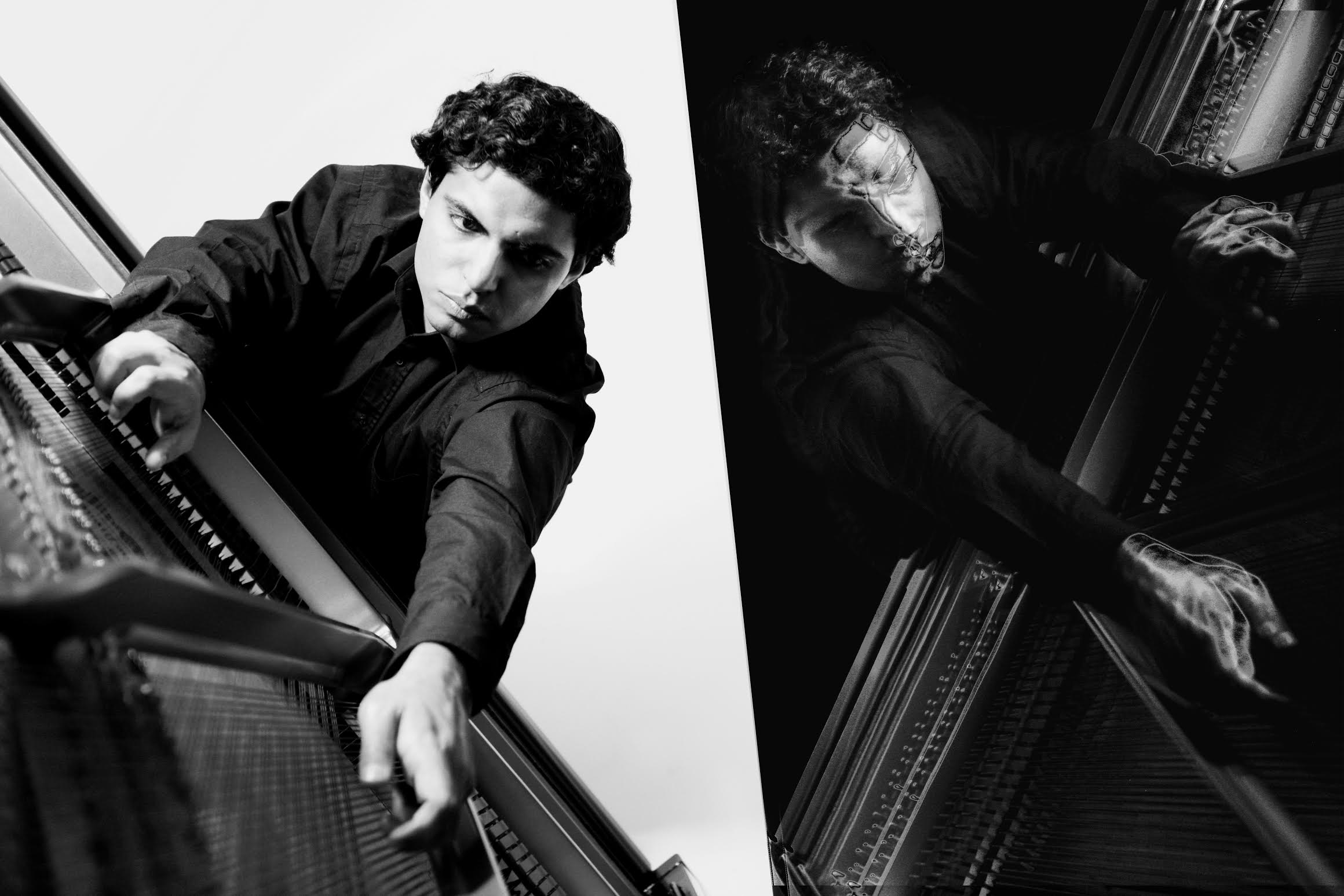
Zubin Kanga always drags half a dozen new works in his wake as he criss-crosses the globe in search of the bleeding edge of piano repertoire. Kanga’s last tour of Australia entitled “Piano: Inside/Out” explored the inside of the piano, either through playing the piano strings directly with the hands or by preparing the strings with objects like paper and Blu-Tac to change their tone. In his current “Dark Twin” tour, Kanga extends the piano outward through live electroacoustic manipulation and video projections.
Premièring new music necessarily runs the risk of performing a “bad” or “unsatisfactory” work. Saying that a work is “beautiful,” “successful,” or that it “works” would be meaningless if the reverse were not possible. Composers are often their best critics and will revise works after a first hearing. Andrew Ford’s recent book Earth Dances tells of how Stravinsky struggled to find a satisfactory ending to The Rite of Spring. On the other hand—to continue the Rite example—audiences and critics have often failed to appreciate how a work is beautiful or successful upon first hearing. Knowledge of the multiplicity of ways in which a piece can be “good” is perhaps the reason why critics can shy away from negative judgements. However, I feel particularly emboldened to make critical judgements this morning because George Brandis has just funneled $104.8m away from the peer-review-based Australia Council for the Arts and into his own ministry, where who knows what sort of evaluation process will take place. Consider this review a battle-cry for judgment over cronyism. In this review, the success of a work is judged according to how well it achieves what the composer or performer set out to do in writing and performing it. I will try to bring other qualities of the works to light as well, in spite of the creators’ stated intentions.
Stefan Prins, Piano Hero
In Stefan Prins’ Piano Hero, Kanga plays a MIDI keyboard that triggers video samples of a man playing with his hands on a stripped-back piano frame. The minimal gestures of the keyboardist contrast with the full-body movements of his avatar in the video, who strums and strikes the strings. The avatar also uses subtler gestures, including conjuring a smooth tone from the body of the piano with a cork on the end of a stick. He bounces and throws a handful of piano keys onto the strings, scattering them across the frame.
According to Kanga’s programme notes, the work seeks to “explore the modern trend of the virtual replacing the real while deconstructing the relationship between pianist, instrument and observer.” The work achieves the first of these goals, while leaving the second in the air. The starkly-lit, beautifully-textured surfaces of the piano frame make the video seem more real than the poorly-lit keyboardist. The avatar’s movements are also more visceral than those of the keyboardist.
The second goal, to deconstruct the relationship between the pianist, instrument and observer, is barely addressed. Yes, the keyboardist’s gestures and the audience’s attention are decoupled from one another and directed towards the avatar on the screen. To stress this point, the screen occasionally switches to a camera trained on the keyboardist silently playing away. However, to deconstruct is not just to take apart (unless one is ordering a deconstructed polenta stack at a Melbourne café). Literary deconstruction reveals underlying assumptions and arbitrary norms that are inexpressible within the frame of a particular discourse. Piano Hero reconfigures the performer-instrument-observer triangle, but it does not tell us anything about concert conventions that we don’t already know. [EDIT: Kanga has since pointed out that Prins originally used the more appropriate term “recontextualise.” “Deconstruct” was Kanga’s paraphrase.]
One of Piano Hero‘s greatest strengths is the compositional use Prins makes of his technical apparatus, whatever its rationale. The piece begins with the keyboardist triggering only the resonance left after the piano strings are struck. The performer’s hands hover above the strings, seemingly conjuring the resonance out of them. As more violent gestures are introduced, with the performer striking the strings, the speed of the gestures are modulated by the MIDI keyboard. This creates striking contrasts as the physical intensity of the performer attacking the strings contrasts with more balletic, slowed-down gestures.
Julian Day, Dark Twin
Julian Day’s Dark Twin is the result of a long-term collaboration between Kanga and Day. Day describes the piece as stemming from his experience learning the piano as a child. Instead of the solitary experience of piano practice, he imagined a situation where a pianist plays against a ghostly other. As Kanga paraphrases Day’s intentions:
At first [the electronic part] matches the pianist closely, but then begins to slide in pitch and distort in colour –techniques that are impossible on a piano. Over the course of the piece, the electronic part shifts from being an indistinguishable electronic ‘twin’ of the pianist to becoming a grotesque rival.
The piece begins with the minimalist gesture of two rapidly-alternating notes. At this point, the live part does indeed sound almost indistinguishable from the electronic part. As the piece progresses, the electronic part becomes deeper and seems to spread around the room. The timbre of the electronic part also becomes more distorted. The impression is less a “dark twin” of the piano part than an expansion of the piano part. The two parts are indistinguishable in the muddy and saturated air.
Benjamin Carey, _derivations
Benjamin Carey’s _derivations provides a much more convincing example of a pianist duelling with an electronic other. I have previously reviewed a recording of Carey’s _derivations system and it was a pleasure to see it in action for one of the first performances of the system with a piano. _derivations is a program intended to improvise with a live performer. The program listens to and analyses the performer’s musical gestures. These gestures are stored in a database, drawn upon and manipulated to contrast with or complement the live performer. The program may also respond through several voices or channels at once, even responding to itself. In some ways the program’s responses to Kanga were predictable and gave a sense of balance to the performance. When Kanga played high on the piano, _derivations introduced a bassy hum. When Kanga ran his hands over the piano strings, _derivations turned this sound into a glassy cloud of sonic fragments. I had the impression in this performance, as I did when listening to the recording above, that the system was playing material straight back to Kanga rather than strategically introducing large-scale formal contrasts. It would be nice to hear a longer performance where the system was able to exert more control over the course of an improvisation.
Cat Hope, The Fourth Estate
Cat Hope’s The Fourth Estate uses electromagnetic interference in the form of pocket radios and EBows to represent the disruptive and filtering political effects of the free press. As Kanga’s programme (once more a paraphrase of the composer) reads:
As the Fourth Estate is thought to be an element of society ‘outside’ official recognition, here the radios and e-bows (small electromagnets on the strings) act as static sonic barriers, interfering with the mercurial and lively piano part.
What a great idea! Unfortunately it was not one that I found represented in the performance. It seemed to me that Kanga’s runs and key-mashing in different registers were more to “get the strings moving” rather than to provide pianistic gestures that the EBows and radios would then corrupt. I cannot say whether this was the result of the specific directions on the graphic score or its interpretation. The EBows and radios then failed to interfere significantly with the sound of the piano. Occasionally one could hear the jangle of an EBow or a radio physically bouncing on the piano strings, but they did not appear to intermingle with or modulate the piano’s sound. Surely the media is not that ineffectual, bouncing along the titanic reverberations of politicians? Now, I am fully aware that I am about to fly to Perth to review the Totally Huge New Music Festival and will no doubt spend a lot of time in the same room with Hope, but this only goes to show how seriously I take reviewing.
Michel van der Aa, Transit
In Transit by Michel van der Aa, an elderly man fights loneliness through a series of repetitive acts. He struggles to open doors and open the window. He drags a chair back and forth and bottles steam from a kettle that he can barely lift. The noir-like film captures the claustrophobia of physical weakness and the importance of memory. The live piano and electroacoustic parts are integrated into the rhythm of the film. Kanga’s silent movements, such as raising his arms to play, or reaching to one side of the piano but not striking a key, are accompanied by electroacoustic sounds. This gives the impression that Kanga is a magical piano samurai, which is not too far from the truth.
Daniel Blinkhorn, FrostbYte: Chalk Outline
Blinkhorn’s FrostbYte: Chalk Outline is an audiovisual piece contrasting pristine Arctic waters with industrial infrastructure. The Chalk Outline of the title refers to the climate change, exacerbated by industrial activity, that is rapidly transforming the landscape. Blinkhorn created the piece with video and audio material he collected while travelling in areas of the Arctic. The musical accompaniment to the footage of the Arctic landscape is fittingly tinkly, high and “icy.” Blinkhorn begins to introduce sounds from dubstep, with wobbly bass and dramatic, booming punctuations as the footage moves to cranes, which are processed through abstract mirroring effects on the video. The stunning video footage was inexplicably processed through a filter that broke it up into beveled windows. It seemed to me that this was unnecessary as the beautiful landscape spoke for itself.
Steve Reich (arr. Vincent Corver), Piano Counterpoint
Steve Reich’s Six Pianos is difficult to mount due to the problem of gathering six pianos together in the same space and still having room for the audience. Pianist Vincent Corver has opened the door for more (partially) live performances of the work by arranging it for one live pianist and five pre-recorded parts in the retitled work Piano Counterpoint. Kanga performed the live part with bravado and flair. We will no doubt hear this piece many more times in the future.
See also Charles MacInnes’ thoughtful review.
Zubin Kanga
Dark Twin
Metropolis New Music Festival
Melbourne Recital Centre
8 May 2015
Stefan Prins, Piano Hero; Julian Day, Dark Twin; Benjamin Carey, _derivations; Michel van der Aa, Transit; Daniel Blinkhorn, FrostbYte: Chalk Outline; Cat Hope, The Fourth Estate; Steve Reich (arr. Vincent Corver), Piano Counterpoint.
 Partial Durations