Category Archives: Reviews

Partial Durations is a Matthew Lorenzon/RealTime joint project.

Metropolis: Melbourne Symphony Orchestra, The Light

By drawing their inspiration from urban life in the second half of the twentieth century, minimalist composers bear witness to the most carbon-intensive period in human history. The jumbo jet opening John Adams’ Nixon in China and his orchestral fanfare Short Ride in a Fast Machine, Steve Reich’s City Life and Glass’ epic modern chronicle Koyaanisqatsi all show us a world kept in motion by fossil fuels. The composers may not have intended to represent our carbon-dependent lifestyles. It is all the more interesting that the issues they thought they were addressing, including the mediatisation of politics, consumerism, the proliferation of nuclear weapons and the alienation of individuals from their communities, are all connected tangentially to this one core issue that now looms as the greatest threat to human life. The works bear witness to this moment in history more than judge it. Through its serene and spacious textures, the minimalist musical language often struggles to cast judgement. Instead it impartially reflects, if not sublimates, the images it is associated with.

Julia Wolfe, Fuel

Julia Wolfe’s Fuel brings this problem running all of our trains, cars and planes to the surface. The piece is accompanied by time lapse footage of the port of Hamburg by Bill Morrison. Wolfe describes the piece as beginning in a conversation with Morrison: “We talked about the mystery and economy of how things run—the controversy and necessity of fuel—the global implications, the human need.” Originally composed for Ensemble Resonanz as something of a virtuosic party piece, the MSO strings kept up the stiff pace set by guest conductor André de Ridder. No lugubrious meditation on modern life, Fuel has the orchestra scrubbing, running and glissing for the better part of twenty minutes. Meanwhile, the film shows cranes loading containers on and off of enormous cargo ships. There is something daunting about the film and music, as though the whole frenzied business were precarious, excessive, in a word: unsustainable.

Tan Dun, “Crouching Tiger” Concerto

Cellist Oliver Coates returned to the stage to perform Tan Dun’s cello concerto based on music from the soundtrack to the film Crouching Tiger, Hidden Dragon. From the opening glissando-strewn theme I was transported back to my spotty adolescence, seeing the film’s most excellent and unrealistic sword fights for the first time. As such, I loved the cheesy main theme that returns three or four times throughout the concerto. This time around I also appreciated the piece’s extensive catalogue of well-integrated extended techniques, including left-hand pizzicato rolls, glissando effects, plectrum use and en masse string-slapping from the orchestra.

Alexander Garsden, Faculties Intact (Cybec finalist)

Alexander Garsden’s Faculties Intact is the second Cybec commission to be heard at this year’s festival. As Garsden related in his interview with De Ridder, MSO’s first play-through of the piece in January helped him understand “how overblown and ill-informed [his] initial ideas were.” One of the great virtues of the Cybec program at the Metropolis festival is that composers have the opportunity to refine their compositions and then hear them performed again. The audience is also able to hear the diversity of compositional styles among young composers, including Garsden’s idiosyncratic combination of spectralist, stochastic and other post-serial methods. Garsden’s style is unique in Australia. Many Australian composers fixate upon the performer or the instrument. The idea of a piece may have its genesis in the gestures that a performer makes while playing. They may also want to expand the range of sounds one can conjure from an instrument. Garsden seems more interested in the sound you hear rather than how it is made. He may work from a spectrogram (a graph of the energy at different frequencies of a particular sound) to derive the pitches he will use. He then makes sure that certain relationships hold between the timbres of different instruments. For instance, in Faculties Intact the violins move their bows too quickly, so that the sound produced is high-pitched and squeaky. As the violins move into higher and higher registers, the percussionist begins bowing a piece of styrofoam, carrying this squealing sound even higher. At another moment, the violins scrub away lightly in a lower register, producing a rustling sound that is adopted and expanded by a tam-tam scraped with the shaft of a mallet. Smooth, “ordinary” tones make an appearance as an afterthought at the end of the piece, just in case you forgot they were there.

Philip Glass, The Light

Instead of gas-guzzling technologies, The Light draws inspiration from Albert A. Michelson and Edward W. Morley’s experiments in physics. Michelson and Morley determined that there was no substrate, such as a “luminiferous aether,” through which light waves travelled. Their experiments led to research into the velocity of light and eventually the Special Theory of Relativity. Glass takes this pivotal moment in the history of modern science as the basis for his orchestral work The Light, writing that “this is a portrait not only of the two men for whom the experiments are named but also that historical moment heralding the beginning of the modern scientific period.” Where the concert began with Wolfe’s picture of the twentieth century running itself into ecological crisis, the concert ends with the dawn of the century and all of its scientific hopes. Can a new scientific dawn resolve the crisis brought about by the past century of industrial activity? This is a question that has been left to the next generation of minimalist composers, such as the artists of the Bedroom Community label.

The Light
Melbourne Symphony Orchestra
Metropolis New Music Festival
Melbourne Recital Centre
13 May 2015

Julia Wolfe, Fuel; Tan Dun, Crouching Tiger Concerto; Alexander Garsden, Faculties Intact (con tutta forza); Philip Glass, The Light.

Metropolis: Lisa Moore, A Bigger Picture

Lisa Moore. Photo by Carla Zavala.

Lisa Moore packed out the Melbourne Recital Centre Salon with her programme of well-known piano works by Philip Glass and For the Sexes: The Gates of Paradise by Martin Bresnick. From the beginning of Glass’ Etude No. 2 I remembered how characteristically Moore performs minimalist repertoire. She is not afraid of taking pieces a little faster than usual, adding some rubato or hammering out particular lines. After the energetic Etude, Moore invited the audience to sit back and sink into the Glass “sublime” without applauding between works. I took this as a cue to put down my notepad as well. Throughout Metamorphosis I and II I was transported back to undergraduate music, where I first heard Glass. The performance made me wish I could go forget everything and learn about music all over again. While embracing the Glass sublime as well as I could, I also had some niggling thoughts about minimalism’s place in global history that I will save for my discussion of the Melbourne Symphony Orchestra’s minimalism-inflected Metropolis programmes. I suppose you can take the audience out of postgraduate musicology, but you can’t take postgraduate musicology out of the audience.

After an intermission, the audience returned for Martin Bresnick’s musical interpretation of William Blake’s poem For the Sexes: The Gates of Paradise. The piece combines a piano part with recitations of the poem and animations of Blake’s illustrations by Puppetsweat Theater. The phallocentric panning of Puppetsweat’s animations is completely in tune with Blake’s own worship of sexual—in particular phallic—energy. The superimposition of images and words in the animations are beginning to show their age. Since the work’s creation in 2001 there have been a string of excellently-animated still drawings, from Arthur Rackham’s illustrations of The Ring Cycle in Heath Lees’ introduction to the work Wagner’s Ring, to Jessica Yu’s animations of Henry Darger’s illustrations in In the Realms of the Unreal. I occasionally found myself closing my eyes to better appreciate Bresnick’s rich score.

The piano part paints the elements and stages of life described in the poem, which is read and sung by Moore throughout. Sometimes the piano part imitates the rhythm of the voice, sometimes it develops snatches of folk-sounding melodies. At one particularly weird and arresting moment, Moore trails a card over the keys while reciting the book’s poem on death and the grave. Like Blake, Bresnick draws on the most fundamental materials of life and art to produce a complex new mythology.

Lisa Moore
A Bigger Picture
Metropolis New Music Festival
Melbourne Recital Centre
9 May 2015

Philip Glass, Etude No. 2, Mad Rush, Metamorphosis I, Metamorphosis II, Satyagraha Act III (Conclusion arr. Michael Riesman); Martin Bresnick, For the Sexes: The Gates of Paradise.

Metropolis: Zubin Kanga, Dark Twin

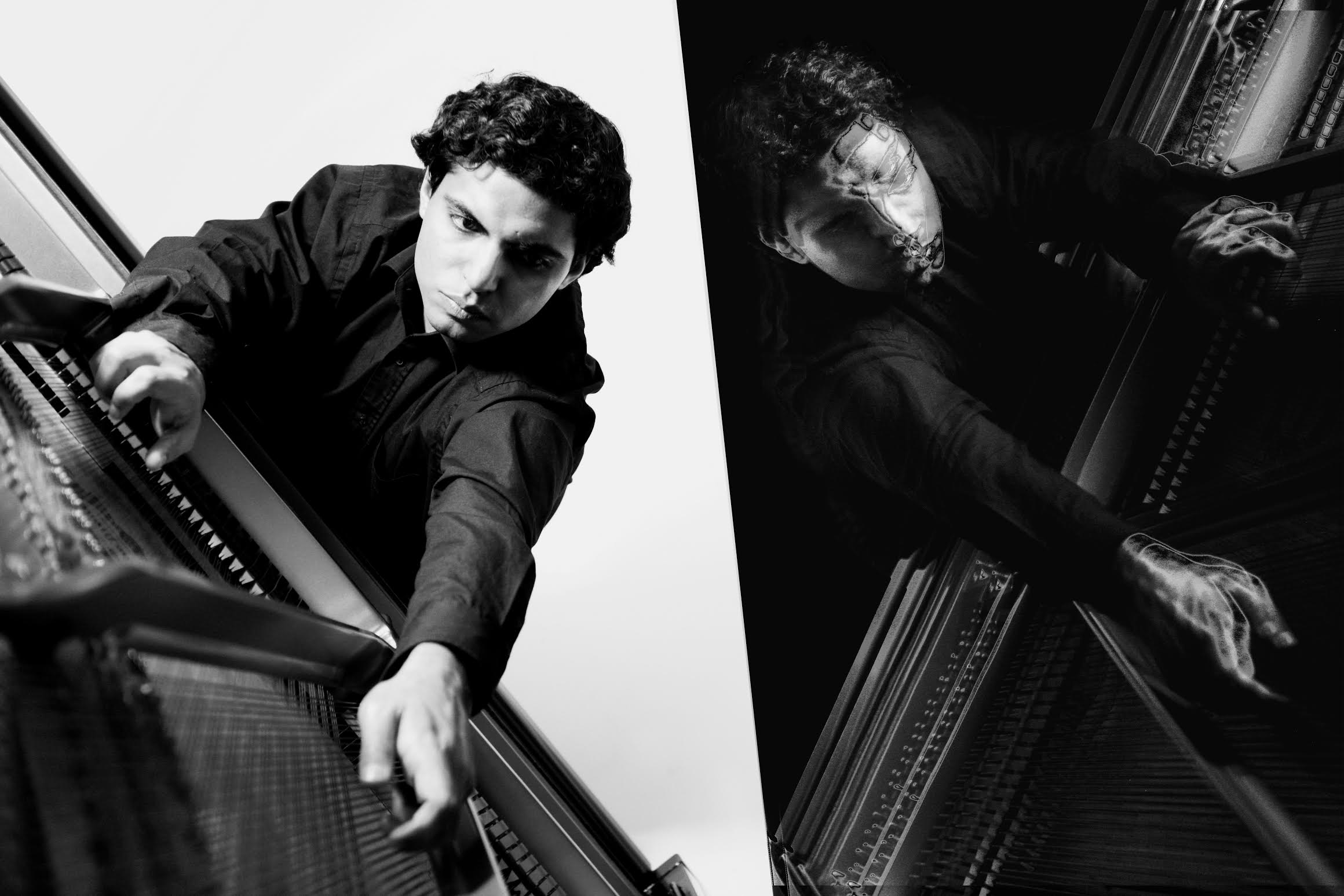
Zubin Kanga. Image courtesy of the artist.

Zubin Kanga always drags half a dozen new works in his wake as he criss-crosses the globe in search of the bleeding edge of piano repertoire. Kanga’s last tour of Australia entitled “Piano: Inside/Out” explored the inside of the piano, either through playing the piano strings directly with the hands or by preparing the strings with objects like paper and Blu-Tac to change their tone. In his current “Dark Twin” tour, Kanga extends the piano outward through live electroacoustic manipulation and video projections.

Premièring new music necessarily runs the risk of performing a “bad” or “unsatisfactory” work. Saying that a work is “beautiful,” “successful,” or that it “works” would be meaningless if the reverse were not possible. Composers are often their best critics and will revise works after a first hearing. Andrew Ford’s recent book Earth Dances tells of how Stravinsky struggled to find a satisfactory ending to The Rite of Spring. On the other hand—to continue the Rite example—audiences and critics have often failed to appreciate how a work is beautiful or successful upon first hearing. Knowledge of the multiplicity of ways in which a piece can be “good” is perhaps the reason why critics can shy away from negative judgements. However, I feel particularly emboldened to make critical judgements this morning because George Brandis has just funneled $104.8m away from the peer-review-based Australia Council for the Arts and into his own ministry, where who knows what sort of evaluation process will take place. Consider this review a battle-cry for judgment over cronyism. In this review, the success of a work is judged according to how well it achieves what the composer or performer set out to do in writing and performing it. I will try to bring other qualities of the works to light as well, in spite of the creators’ stated intentions.

Stefan Prins, Piano Hero

In Stefan Prins’ Piano Hero, Kanga plays a MIDI keyboard that triggers video samples of a man playing with his hands on a stripped-back piano frame. The minimal gestures of the keyboardist contrast with the full-body movements of his avatar in the video, who strums and strikes the strings. The avatar also uses subtler gestures, including conjuring a smooth tone from the body of the piano with a cork on the end of a stick. He bounces and throws a handful of piano keys onto the strings, scattering them across the frame.

According to Kanga’s programme notes, the work seeks to “explore the modern trend of the virtual replacing the real while deconstructing the relationship between pianist, instrument and observer.” The work achieves the first of these goals, while leaving the second in the air. The starkly-lit, beautifully-textured surfaces of the piano frame make the video seem more real than the poorly-lit keyboardist. The avatar’s movements are also more visceral than those of the keyboardist.

The second goal, to deconstruct the relationship between the pianist, instrument and observer, is barely addressed. Yes, the keyboardist’s gestures and the audience’s attention are decoupled from one another and directed towards the avatar on the screen. To stress this point, the screen occasionally switches to a camera trained on the keyboardist silently playing away. However, to deconstruct is not just to take apart (unless one is ordering a deconstructed polenta stack at a Melbourne café). Literary deconstruction reveals underlying assumptions and arbitrary norms that are inexpressible within the frame of a particular discourse. Piano Hero reconfigures the performer-instrument-observer triangle, but it does not tell us anything about concert conventions that we don’t already know. [EDIT: Kanga has since pointed out that Prins originally used the more appropriate term “recontextualise.” “Deconstruct” was Kanga’s paraphrase.]

One of Piano Hero‘s greatest strengths is the compositional use Prins makes of his technical apparatus, whatever its rationale. The piece begins with the keyboardist triggering only the resonance left after the piano strings are struck. The performer’s hands hover above the strings, seemingly conjuring the resonance out of them. As more violent gestures are introduced, with the performer striking the strings, the speed of the gestures are modulated by the MIDI keyboard. This creates striking contrasts as the physical intensity of the performer attacking the strings contrasts with more balletic, slowed-down gestures.

Julian Day, Dark Twin

Julian Day’s Dark Twin is the result of a long-term collaboration between Kanga and Day. Day describes the piece as stemming from his experience learning the piano as a child. Instead of the solitary experience of piano practice, he imagined a situation where a pianist plays against a ghostly other. As Kanga paraphrases Day’s intentions:

At first [the electronic part] matches the pianist closely, but then begins to slide in pitch and distort in colour –techniques that are impossible on a piano. Over the course of the piece, the electronic part shifts from being an indistinguishable electronic ‘twin’ of the pianist to becoming a grotesque rival.

The piece begins with the minimalist gesture of two rapidly-alternating notes. At this point, the live part does indeed sound almost indistinguishable from the electronic part. As the piece progresses, the electronic part becomes deeper and seems to spread around the room. The timbre of the electronic part also becomes more distorted. The impression is less a “dark twin” of the piano part than an expansion of the piano part. The two parts are indistinguishable in the muddy and saturated air.

Benjamin Carey, _derivations

Benjamin Carey’s _derivations provides a much more convincing example of a pianist duelling with an electronic other. I have previously reviewed a recording of Carey’s _derivations system and it was a pleasure to see it in action for one of the first performances of the system with a piano. _derivations is a program intended to improvise with a live performer. The program listens to and analyses the performer’s musical gestures. These gestures are stored in a database, drawn upon and manipulated to contrast with or complement the live performer. The program may also respond through several voices or channels at once, even responding to itself. In some ways the program’s responses to Kanga were predictable and gave a sense of balance to the performance. When Kanga played high on the piano, _derivations introduced a bassy hum. When Kanga ran his hands over the piano strings, _derivations turned this sound into a glassy cloud of sonic fragments. I had the impression in this performance, as I did when listening to the recording above, that the system was playing material straight back to Kanga rather than strategically introducing large-scale formal contrasts. It would be nice to hear a longer performance where the system was able to exert more control over the course of an improvisation.

Cat Hope, The Fourth Estate

Cat Hope’s The Fourth Estate uses electromagnetic interference in the form of pocket radios and EBows to represent the disruptive and filtering political effects of the free press. As Kanga’s programme (once more a paraphrase of the composer) reads:

As the Fourth Estate is thought to be an element of society ‘outside’ official recognition, here the radios and e-bows (small electromagnets on the strings) act as static sonic barriers, interfering with the mercurial and lively piano part.

What a great idea! Unfortunately it was not one that I found represented in the performance. It seemed to me that Kanga’s runs and key-mashing in different registers were more to “get the strings moving” rather than to provide pianistic gestures that the EBows and radios would then corrupt. I cannot say whether this was the result of the specific directions on the graphic score or its interpretation. The EBows and radios then failed to interfere significantly with the sound of the piano. Occasionally one could hear the jangle of an EBow or a radio physically bouncing on the piano strings, but they did not appear to intermingle with or modulate the piano’s sound. Surely the media is not that ineffectual, bouncing along the titanic reverberations of politicians? Now, I am fully aware that I am about to fly to Perth to review the Totally Huge New Music Festival and will no doubt spend a lot of time in the same room with Hope, but this only goes to show how seriously I take reviewing.

Michel van der Aa, Transit

In Transit by Michel van der Aa, an elderly man fights loneliness through a series of repetitive acts. He struggles to open doors and open the window. He drags a chair back and forth and bottles steam from a kettle that he can barely lift. The noir-like film captures the claustrophobia of physical weakness and the importance of memory. The live piano and electroacoustic parts are integrated into the rhythm of the film. Kanga’s silent movements, such as raising his arms to play, or reaching to one side of the piano but not striking a key, are accompanied by electroacoustic sounds. This gives the impression that Kanga is a magical piano samurai, which is not too far from the truth.

Daniel Blinkhorn, FrostbYte: Chalk Outline

Blinkhorn’s FrostbYte: Chalk Outline is an audiovisual piece contrasting pristine Arctic waters with industrial infrastructure. The Chalk Outline of the title refers to the climate change, exacerbated by industrial activity, that is rapidly transforming the landscape. Blinkhorn created the piece with video and audio material he collected while travelling in areas of the Arctic. The musical accompaniment to the footage of the Arctic landscape is fittingly tinkly, high and “icy.” Blinkhorn begins to introduce sounds from dubstep, with wobbly bass and dramatic, booming punctuations as the footage moves to cranes, which are processed through abstract mirroring effects on the video. The stunning video footage was inexplicably processed through a filter that broke it up into beveled windows. It seemed to me that this was unnecessary as the beautiful landscape spoke for itself.

Steve Reich (arr. Vincent Corver), Piano Counterpoint

Steve Reich’s Six Pianos is difficult to mount due to the problem of gathering six pianos together in the same space and still having room for the audience. Pianist Vincent Corver has opened the door for more (partially) live performances of the work by arranging it for one live pianist and five pre-recorded parts in the retitled work Piano Counterpoint. Kanga performed the live part with bravado and flair. We will no doubt hear this piece many more times in the future.

See also Charles MacInnes’ thoughtful review.

Zubin Kanga
Dark Twin
Metropolis New Music Festival
Melbourne Recital Centre
8 May 2015

Stefan Prins, Piano Hero; Julian Day, Dark Twin; Benjamin Carey, _derivations; Michel van der Aa, Transit; Daniel Blinkhorn, FrostbYte: Chalk Outline; Cat Hope, The Fourth Estate; Steve Reich (arr. Vincent Corver), Piano Counterpoint.

Metropolis: Forest Collective, Moonfall

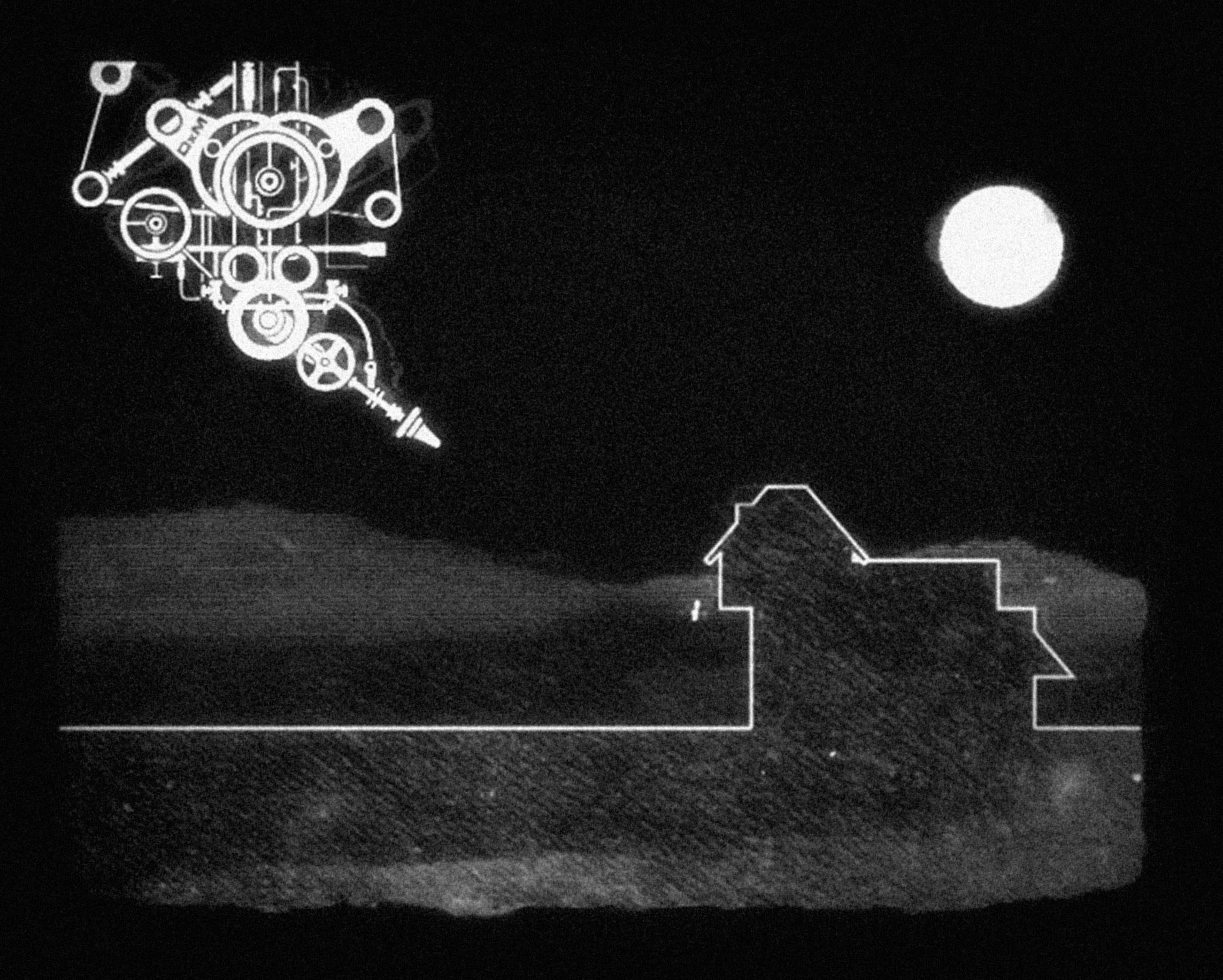
Still from Marcus Fjellström's Odboy and Erordog. Image courtesy of Forest Collective.
Still from Marcus Fjellström’s Odboy and Erordog. Image courtesy of Forest Collective.

Forest Collective’s “Moonfall” programme explored two important aspects of the Metropolis festival’s theme, “Music inspired by the moving image.” Firstly, Forest Collective recognised the importance of computer games to any discussion of music and the moving image today. Secondly, the concert was downright creepy.

Without culturally- and physiologically-ingrained harmonic cues, contemporary music can fall into an emotional binary of anodyne lyricism and anger. Humour and fear are like lyricism and anger’s more sophisticated cousins. Without wanting to be prescriptive (a piece need not aim for any of these emotional modes, nor any emotional mode at all),  humour and fear show that a composer has enough command over their work to shape a complex audience experience. In film, the same distinction could be drawn between a slasher film that relies on loud and sudden noises to disturb the audience and the unnerving qualities of, say, a Tarkovsky film (more about Tarkovsky in a forthcoming review of the Melbourne Symphony Orchestra’s first Metropolis programme!).

Forest Collective built their programme around Marcus Fjellström’s triptych Odboy and Erordog (available on Fjellström’s Youtube channel). Each episode reflects the sequential, task-driven atmosphere of certain nightmares. Odboy and his trusty Erordog embark on foreboding journeys to  perform arduous “chores.” As in nightmares, the imperative to perform the tasks is overwhelming while the meaning of the tasks is obscure. The journeys will be familiar to all retro gamers and light-sleepers, including “finding the big house” and “crossing the spider pit” while “looking out for the wild boar” (echoes of Conquests of Camelot?). The first episode includes an electronic score by Fjellström utilising rhythmic record pops and theatre organ that complement the grainy black-and-white video. The second two episodes include written scores for the ensemble, who provided a sparse layering of extended techniques and musical accents. Fjellström is currently working on what appears to be a sci-fi chamber opera entitled “Boris Christ.” Hopefully we can get it over to Australia (Forest Collective I’m looking at you).

Odboy and Erordog combines black-and-white film aesthetics with 1980s computer-game graphics. Computer games form an essential part of screen culture for anybody under the age of forty. While those who did not grow up with computer games may recognise the burgeoning computer game market, those who spent too long in front of screens as children will understand the emotional resonance of old, lo-fi computer game aesthetics. If I may indulge in some folk-psychology, perhaps this is because an active imagination is needed to turn a few blocky pixels into a whole fantasy-world. On the other hand, the stark colour contrasts and blocky designs of old games have design elements unto themselves that are, for want of a better word, beautiful.

Forest Collective threaded a series of dark and foreboding chamber works between the Fjellström films, beginning with Evan Lawson’s arrangement of Rupert Holmes’ song “Moonfall” from the 1985 musical The Mystery of Edwin Drood. The musical is based on an unfinished novel by Charles Dickens and was the first musical to feature multiple endings, which were chosen by an audience vote. Lawson states in the programme that he wanted to capture the “smoky streets of nineteenth-century London.” He certainly achieves this goal with a murky bed of clarinets (Vilan Mai and Aaron Klein) and shimmering string tremoli.

The concert featured the world première of Evan Lawson’s Orpheus and the Cave. The piece is a study for a large-scale orchestral work featuring two solo sopranos and solo harp. In the study, Lawson’s usual lush sound palette is stripped back and spread about the room. The spatial distribution of the ensemble is some of the most effective that I have heard. The piece begins with a drum roll behind the audience, before Orpheus (Rosemary Ball) sings to Euridice (Teresa Duddy) across the room. The solo violins (Katriona Tsyrlin and Isabel Hede) to the left and right of the audience create a striking stereo effect. At the end of the piece, Mai and Tanya Vincent on clarinet and flute leave the auditorium to play a perhaps too-recognisable excerpt of Monteverdi’s 1610 Vespers as “the birds calling out on the surface of Earth.”

Forest Collective’s dark programme triggered a series of questions surrounding horror and music. While sudden, high-pitched and dissonant sounds may appeal to our fundamental survival instincts, how do we process subtler unsettling sounds? If we are taught to recognise certain sounds as “creepy,” then how can we access the emotional impact of creepy music from throughout history? What is the first recorded piece of “scary” music?

Forest Collective
Moonfall
Metropolis New Music Festival
Melbourne Recital Centre
7 May 2015

Marcus Fjellström, Odboy and Erordog; Rupert Holmes (arr. Evan Lawson), Moonfall; Evan Lawson, Orpheus in the Cave.

Metropolis: Syzygy Ensemble, Undine the Spirit of Water

unnamed
Grace Lowry in Agatha Yim’s film Undine: The Spirit of Water.

Feminine water-spirits may be found in diverse mythologies, from Ancient Greek Sirens to the Slavic Rusalka and the Thai Phi Phraya. The “Undine” appears relatively recently,  in the writings of the renaissance Swiss-German alchemist Paracelsus. Paracelsus classes the Undine as a water elemental alongside the airy “Sylph,” the earthy “Pygmy” and the fiery “Salamander.” The Undine is remarkable for being a much more benign creature than its predecessors, the unfortunately-stereotyped women seducing and drowning sailors. Paracelsus was, after all,  a man of science. Syzygy Ensemble’s programme for the Metropolis New Music Festival asked the question “What is the spirit of water in music?” Four composers provided four different answers to this question, interspersed with beautiful and humorous videography by Agatha Yim.

In Yim’s short film, a charming Undine (Grace Lowry) prances about a Victorian rainforest encountering members of the ensemble. Cellist Blair Harris ineffectually chops wood in his concert blacks, flautist Laila Engle wrestles the Undine for a light bulb, and was that a fleeting shot of pianist Leigh Harrold I saw floating in the water? A narrative emerges throughout the concert, with a young man falling in love with the Undine before becoming married to another woman, without ever forgetting the Spirit of Water.

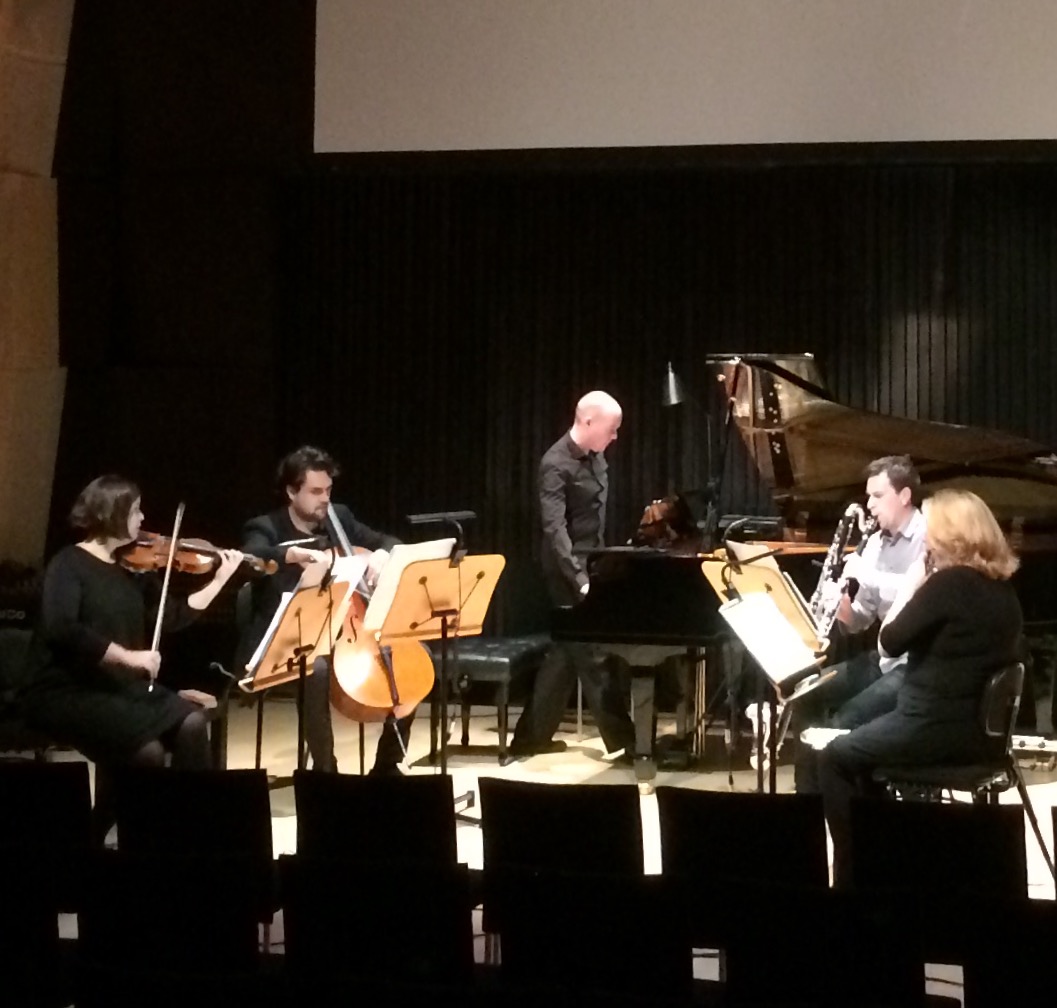
Helena Tulve’s Streams 2 is an experiment in musical current. A current has not only force, but depth. In Stream 2, a single instrument always holds the work together with a smooth, legato line. Tulve favoured the dark tone of the clarinet in evoking the viscous flow of water. The rest of the ensemble resembled flotsam or the play of light on the water’s surface with ricochet bowing, whispering flautando flurries and rubbed woodblocks. Tulve’s streams are not splashing torrents. Instead, we hear the steady stream from within, like the submerged Undine at the end of Yim’s first video.

Syzygy Ensemble rehearse Undine: The Spirit of Water at the Melbourne Recital Centre. Photo courtesy of the artist.

Tom Henry’s Time is Another River provides a much more thematic depiction of a watercourse. The work for violin, cello and piano features beautiful counterpoint with long melodic lines that rise, float and fall.

Marc Yeats’ The Half-Life of Facts provides a jarring and welcome contrast to Henry’s mellifluous river. Yeats’ piece is an absolutely unrelenting ten minutes or so of fragmented extended techniques including Bartok pizzicati, string glissandi and bass clarinet grunts. The lights changed from red to yellow and back to red again half-way through the piece, as if to highlight the monotony of the barrage of sound.

After Yeats’ complete fracturing of contour, the audience mustn’t have minded retreating into Niels Rønsholdt’s reassuring use of repetition and rhythmic motifs. Instead of water, Rønsholdt’s Burning is accompanied by a projection of a match catching alight in the dark, albeit reduced to a shadowy black and white image with the tones inverted. The piece features a rhythmic cross-rhythm that is tapped out quietly on the backs of instruments like a post-rock mantra before being howled out in desperate waves (along with some desperate teenage poetry) by the whole ensemble. During these climaxes, the piano part grows from glissandi across the keyboard to vigorous assaults with the palms.

Undine: The Spirit of Water is a magnificent response to the festival’s theme: “Music inspired by the moving image.” As the composers featured in the programme have shown, water and movement go hand in hand.

Syzygy Ensemble
Undine: The Spirit of Water
Metropolis New Music Festival
Melbourne Recital Centre
8 May 2015

Helena Tulve, Streams 2; Tom Henry, Time is Another River; Marc Yeats,  The half-life of facts; Niels Rønsholdt, Burning.

Metropolis: Melbourne Piano Trio, Delicacies of Molten Horror

The Melbourne Piano Trio brought an intimate programme of film-related chamber music to the Melbourne Recital Centre Salon as part of the Metropolis New Music Festival. Paul Dean’s Threnody for Clara Bow is inspired by the silent film actress Clara Bow, who achieved astronomical fame before sinking into complete obscurity after the introduction of the talkies. Dean’s piano trio seems to find Bow at the height of her fame, with explosive piano chords (Rhodri Clarke) and a muscular cello line in 5/8, a meter intended by Dean to evoke the skipping of early film reels. The ecstatic opening gives way to a singing violin line played by Holly Piccoli as the piece begins to take on a darker tone. A menacing, polytonal climax gives Chris Howlett’s expressive cello playing time to shine. The piece traces Bow’s decline from starlet to her lonely death from a heart attack at the age of sixty. As Dean wonders: “Imagine going from 40,000 fan letters a month to dying alone.” Dean gives Bow a moment of grace at the end of her life, with ethereal arpeggios across the violin and a heartbreaking cello line.

It was nice to hear some film music by Ryuichi Sakamoto arranged for piano and piano trio. Clarke brought out all the gushing sentimentality of Sakamoto’s soundtracks including The Last Emperor and Merry Christmas Mr Lawrence. I was sad to hear that Christopher de Groot’s new work Delicacies of Molten Horror accompanied by the film of the same name by Stan Brakhage was not able to be performed. The Armenian composer Arno Babjanian’s Piano Trio in F-Sharp Minor was performed with plenty of (musical) fireworks as substitute.

Melbourne Piano Trio
Delicacies of Molten Horror
Metropolis New Music Festival
Melbourne Recital Centre
5 May 2015

Arno Babjanian, Piano Trio in F-Sharp Minor; Ryuichi Sakamoto, Babel: Bibono Aozora, The last Emperor, Seven Samurai, Merry Christmas Mr Lawrence; Paul Dean, Threnody for Clara Bow.

Metropolis: Speak Percussion, Between Two Parts there is an Intermission of a Hundred Thousand Years

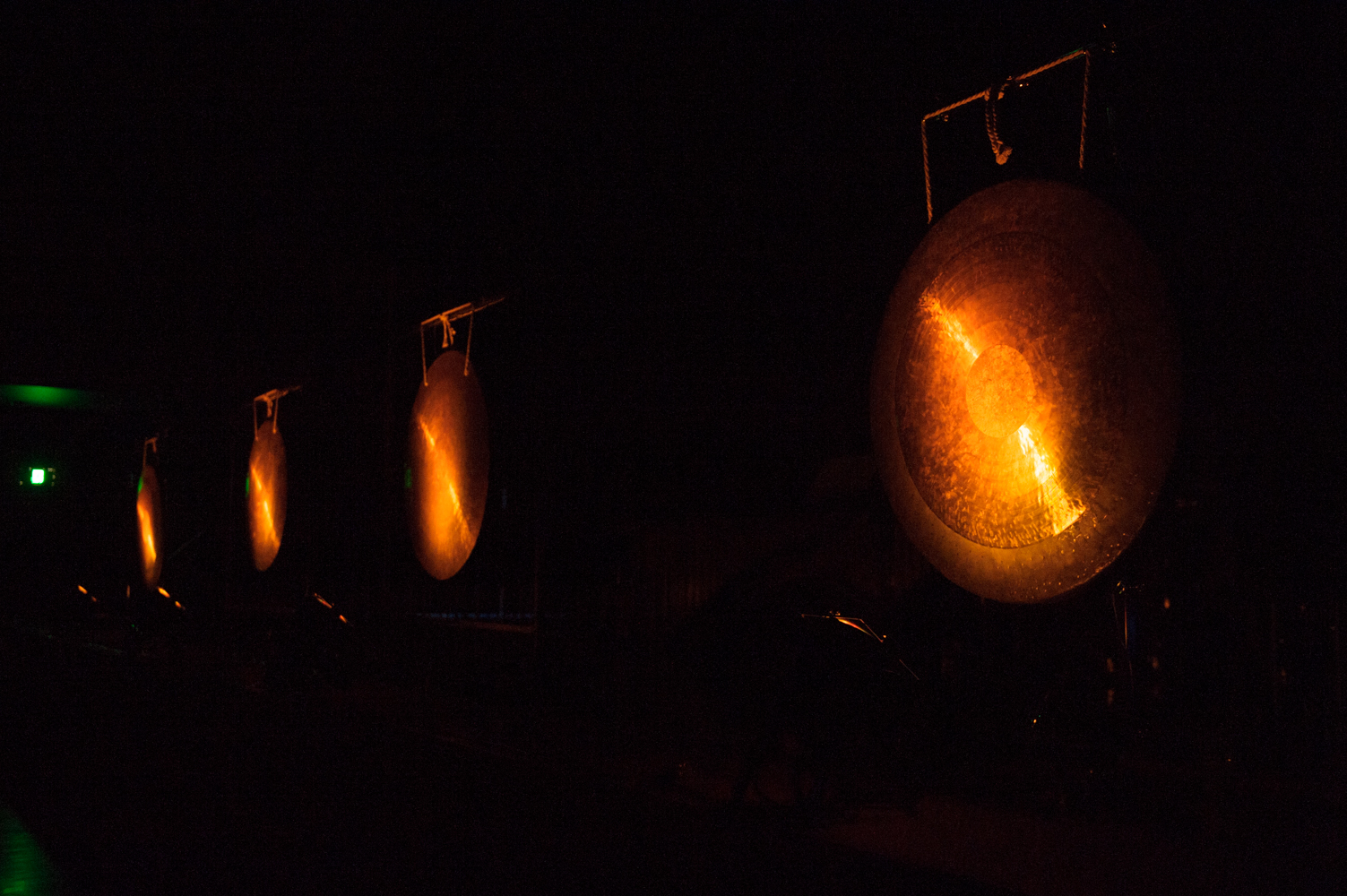
Alexander Garsden's Messages to Erice I & II. Photo by Sarah Walker.
Alexander Garsden’s Messages to Erice I & II. Photo by Sarah Walker.

The title of Speak Percussion’s opening concert sets a playful tone for this year’s Metropolis New Music Festival. The joke was driven home to me when I heard the announcement: “Ladies and gentlemen, Between Two Parts there is an Intermission of a Hundred Thousand Years by Speak Percussion will begin in Elisabeth Murdoch Hall … .” I imagine this title came up during rehearsals, as the ensemble worked out how to switch between the three pieces, each with a different seating arrangement or in a different space entirely. Ultimately there was no such intermission. The ushers herded a willing audience around the building, leaving just enough time to consider the three composers’ distinct responses to the festival’s theme: Music and the moving image.

Speak Percussion’s artistic director Eugene Ughetti chose the composers Peter de Jager, Alexander Garsden and Jeanette Little because they are each at a pivotal moment in their careers. Each composer can comfortably forgo the term “emerging” in their biographies, though they are still “young” composers. They inhabit a no-man’s land between the important but largely unpaid opportunities open to students and the networks of commissioners of established composers.  Speak Percussion’s commissions, supported by the Australia Council for the Arts, showed each composer settling into and refining their individual style.

Peter de Jager, Fractured Timelines

DSC_9769
Peter de Jager’s Fractured Timelines. Photo by Sarah Walker.

The audience took their seats on the stage of the Elisabeth Murdoch Hall for Peter de Jager’s Fractured Timelines. The gleaming keyboard percussion instruments of Peter Neville, Matthias Schack-Arnott and Eugene Ughetti formed three sides of a square around De Jager’s piano, with each performer facing inward towards each other. So intimately close were the audience to the performers that they could follow the coordinating glances of the performers and hear the pedals of the instruments moving. Though designed to project sound out into the auditorium, the stage made an excellent chamber music setting, equalising the natural volume of each instrument.

Fractured Timelines is a multi-modal, gestural romp to heaven and back. The piece is structured as a triptych with two roughly inverted movements separated by their “collision.” The first movement moves from ethereal and whimsical arpeggios and melodies down to a rumbling nether-world with highlights of damped cymbals. Instead of avoiding recognisable thematic, tonal and modal materials, De Jager crams Fractured Timelines full of them. Speak Percussion clearly enjoyed shaping the piece’s cellular themes and different instrumental configurations, including many duo and trio passages, shared lines and runs passed between instruments. The third movement moves in the opposite direction, from the dark to the light and back again, ending with a fabulous rolling ostinato in the bass registers of the vibraphone, marimba and piano. The second movement seems less the “collision” of the two exterior movements than its aftermath. Instead of the arching development of the exterior movements, De Jager presents juxtaposed fragments of thematic material, including funereal, plodding piano chords and a whimsical vibraphone solo (I haven’t heard Ughetti play like that for, well, ever). With his thematic riches and multi-modal language, De Jager is like a modern-day Messiaen without god. Like Messiaen, De Jager gives the themes in his scores short descriptions. In De Jager’s case, these descriptions (including “creepy mountain path” and “briar”) are drawn less from sacred imagery than his life-long experience playing video games. Commander Keen is still his favourite.

Alexander Garsden, Messages to Erice I & II

The audience retired to the stalls of the Elisabeth Murdoch Hall for Garsden’s beautiful new work Messages to Erice I & II. Four large tam-tams were arrayed along the front of the stage and lit from below by yellow-gold spot lights. Each tam-tam is fitted with a transducer (like a speaker without the cone). Garsden has made recordings of each individual tam-tam. In the live performance, he manipulates these recordings and plays them back through the instrument via the transducer. The four tam-tams stand there like bronze breastplates, or altars, their mysterious sounds emanating not just toward the audience, but filling the high ceiling of the hall with shimmering, insect-like buzzing and clear, brassy tones. The lights suddenly change to a silvery-blue as the second movement (or “process”) of the piece begins. Here the sound signals are further processed, creating an alien sound world of “washboard” vibrations and fierce roaring. Garsden motivated the festival’s theme in several ways. The algorithmic relationship between the sound-processing of the different tam-tams is related to the relationships of the characters in Víctor Erice’s 1973 film El Spíritu del Colmena. The piece furthermore makes use of recordings, which can be considered moving “sound images.” Most strikingly, the performance itself was a moving cinematic gesture.

Jeanette Little, No Optic

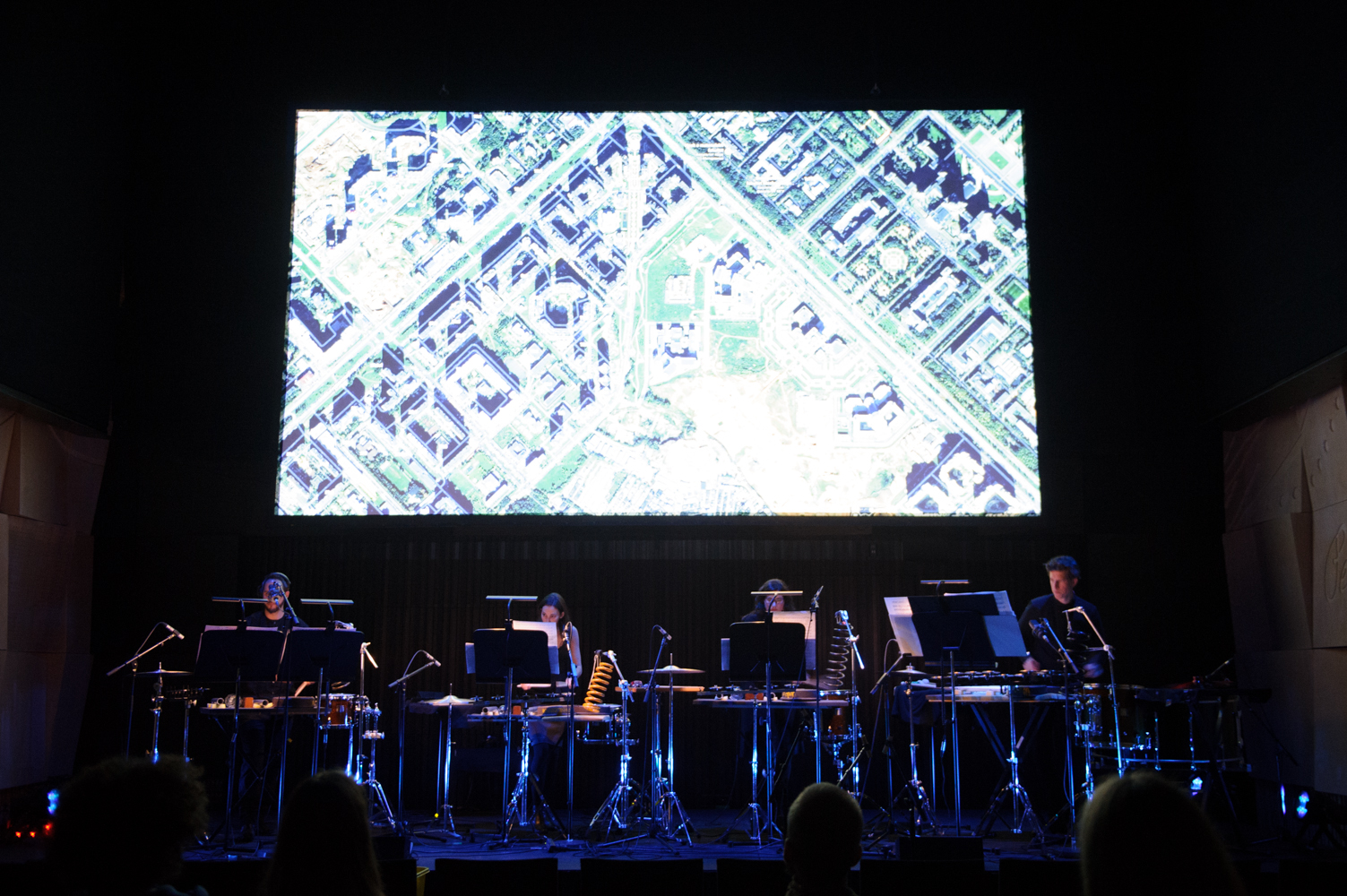
Jeanette Little's No Optic. Photo by Sarah Walker.
Jeanette Little’s No Optic. Photo by Sarah Walker.

Once ushered into the Salon, we were treated to Jeanette Little’s No Optic for four percussionists and live electronics. The piece is accompanied by a video work by the Russian video artist Sasha Litvintseva. The video features a screenshot of somebody exploring high-resolution Google Maps images of various metropolises. In a reference to online and CCTV surveillance, copies of the screenshots are then dragged onto the screen, producing a multiplicity of staggered images. Scrolling cascades of images of roads and cars pass over the screen. The layering process is repeated with a video of somebody taking a photo with a smartphone. I appreciated that this was a video made almost entirely (if not actually entirely) without a camera. The moving image is now omnipresent, with almost every possible setting and activity recorded and uploaded into the cloud (or into some server farm in a desert). However, I was more amused than scared by the “electronic panopticon” (as it was described in the programme). This may be due to Little’s score, which aimed to conjure mixed feelings of “intimacy, discomfort, anxiety and opportunity.” The four percussionists, Ughetti, Kaylie Melville, Anna Camara and Matthias Schack-Arnott, stood behind four almost identical batteries of metal percussion. They produced beds of sound, like the high-pitched rattling of skewers on metal pipes. At other points the ensemble signalled important transitions. For instance, tiled videos of the interiors of trains give way to a single long-range shot of a city with a train passing through it in the distance. The performers stop suddenly, the resonance of car suspension springs ringing out into the calm. The pre-recorded materials, including loud dance music or a sacred classical-era aria, highlighted the omnipresence of recorded sound in our lives as well as recorded images.

Composers often regret the lack of opportunities available to them after their first student commissions. By commissioning three confident young composers, Speak Percussion has brought three fascinating and valuable new works into existence. This year’s Metropolis festival is full of such adventurous and intimate programmes by local and international new music stars. Be sure to grab a ticket or three.

Speak Percussion
Between Two Parts there is an Intermission of a Hundred Thousand Years
Melbourne Recital Centre
Metropolis New Music Festival
4 May 2015

Peter de Jager, Fractured Timelines; Alexander Garsden, Messages to Erice I & II; Jeanette Little, No Optic.

Ensemble Offspring and Ironwood: Broken Consorts

Ensemble Offspring and Ironwood perform Broken Consorts at the Baha'i Centre, Hobart. Photo courtesy of the ensemble.
Ensemble Offspring and Ironwood perform Broken Consorts at the Baha’i Centre, Hobart. Photo courtesy of the ensemble.

It is a truth commonly acknowledged that a fan of irrational rhythms, jarring dissonances and difference tones will also  enjoy the rasping timbres and wild gestures of baroque music. In Broken Consorts, Ensemble Offspring and Ironwood explore this subterranean passage between early and new music that passes under the full-to-bursting tone and metrical pomp of the romantic era. What explains the affinity between early and contemporary music? As the composer Damien Ricketson mused during the concert, the groups share “a mutual disregard for vibrato.” Performers of early music will retort that this description only applied in the early days of Historically Inspired Performance Practice and that today they know to use vibrato sparingly as an expressive effect. But neither adepts of early music nor contemporary music are known for their sense of humour.

In early music terminology, a “broken consort” is an ensemble constituted from more than one family of instruments. By playing contemporary and early music on early, modern and bespoke instruments,  Ensemble Offspring and Ironwood bring the notion of the broken consort into the twenty-first century. While some works in the programme were creative reimaginings of old and new works on old and new instruments, a new work by Felicity Wilcox was commissioned especially for the concert. While the reimagined early and modern works provided an engaging comparison of instrumental timbres, Wilcox’s piece went furthest towards a genuine exploration of new and early musics’ shared emphases on gesture and rhetoric.

The concert began with Matthew Locke’s Consort of Fower Parts, which Ironwood played in a historically-inspired fashion. This was the first time I have had the pleasure of hearing Ironwood perform, and I was blown away by Daniel Yeadon’s cello tone and rhetorical expressivity. From a purely early-music performance to a completely new work, Wilcox’s Uncovered Ground was a palimpsest of musical styles. The composer likens the piece to a “a chipped painted wall that partially reveals a forgotten mural.” The piece features begins with a descending figure reminiscent of the lamenting bass of a passacaglia or Monteverdi’s Lamento della ninfa. This baroque gesture is quickly replaced by modern extended techniques, including pianist Zubin Kanga playing inside the piano with a bottle. Other baroque forms can be made out beneath the whispering, scraping string sounds, including a decorative string duet and dance rhythms.

The episodic form of Matthew Locke’s Suite from The Tempest provided opportunities for creative instrumentation. Kanga’s piano was prepared to comical effect, with Blu-Tac on piano strings producing “popping” cadences. Paper in between the piano strings and bulldog clips on Claire Edwardes’ vibraphone brought the instruments closer to the brighter, buzzier baroque sound world. I was pleasantly surprised when the two ensembles stood for a spot of very convincing madrigaling.

Damien Ricketson’s Trace Elements was inspired by a sixteenth-century manuscript, the Cracow Lute Tablature. The manuscript includes musical forms that are unidentifiable within our current knowledge of sixteenth-century music. Ricketson was attracted to the idea of forgotten musical styles, as well as the fact that tablature describes the actions required for a piece to be played rather than how it sounds. Trace Elements is written in an invented tablature that can be performed by a quartet consisting of two wind and two string insturments. The performance will thus be different every time that a different combination of instruments and tunings are used. Due to the tablature, as Ricketson writes, “the underlying gestural identity remains constant.” The ensemble chose a compelling combination of modern flute and clarinet with early viola and cello. This produced startling effects as the undeniably “modern” gestures, using the full range of the instruments, were modulated by the gut strings of the string instruments.

The concert closed with Mary Finsterer’s Silva, which was composed in 2013 for Ensemble Offspring featuring Claire Edwardes on percussion. The title means “forest” and the piece reflects the eerie quiet of forest environments, with scattered fragments of Tallis’ “Spem in alium” and Schubert’s “Death and the Maiden” lighting up the space like birdsong. There were some wonderful timbral surprises, including a sumptuous combination of gut-stringed cello and modern bass clarinet. The tone of Veronique Serret’s modern-strung violin stuck out in the muted forest like an enthusiastic lyrebird. After each instrument was given some time to make itself heard, the piece closed with a beautifully rough gong chime evocative of a rusted bell in a forgotten temple.

Ricketson’s Trace Elements

Ensemble Offspring and Ironwood Ensemble

Broken Consorts

Fortyfivedownstairs

23 February 2013

Matthew Locke, Consort of Fower Parts; Felicity Wilcox, Uncovered Ground; Matthew Locke, Suite from The Tempest; Damien Ricketson, Trace Elements; William Lawes, Consort in Six Parts; Mary Finsterer, Silva.

The Sound Collectors: New Music Beauty Queen

View More: http://johnephotography.pass.us/soundcollectors2015
The Sound Collectors perform Gone, Dog. Gone! by Mark Applebaum. John E Photography

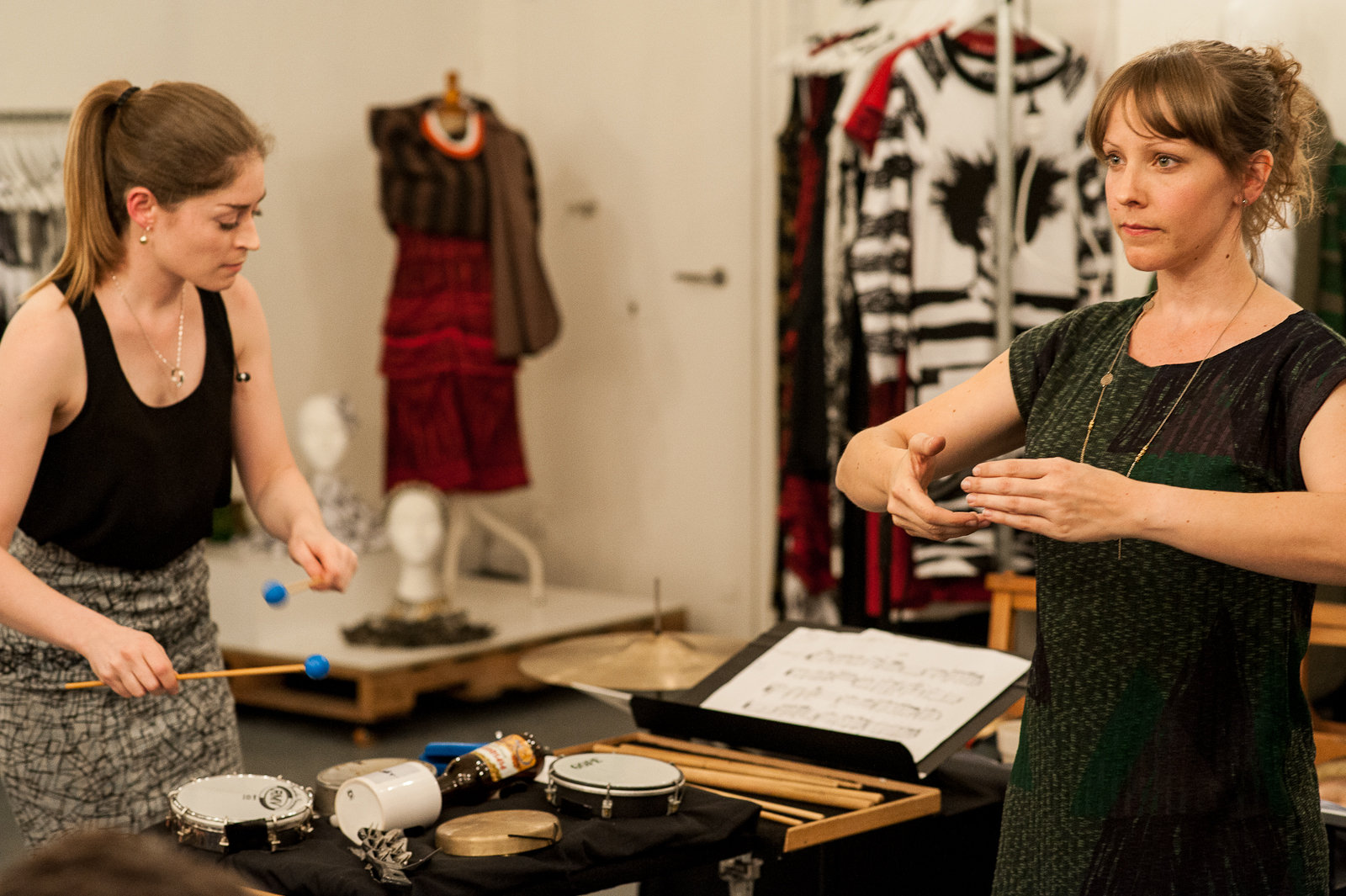
New Music Beauty Queen is an innovative musical response to an innovative fashion label. In curating the programme, The Sound Collectors Louise Devenish and Leah Scholes were inspired by the 2014 collection of the clothing store, manufacturing company and fashion label New Model Beauty Queen. NMBQ is an ethical and sustainable clothing company stocking products made from recycled fabrics. Rather than contribute to each season’s excess of new fabrics, the labels stocked at NMBQ source fabrics from auction houses and redesign them with the aid of NMBQ’s Ethical Clothing Australia-accredited screen printing facility. With their batteries of percussion instruments spaced around the bright, white basement under a sky of incandescent bulbs, The Sound Collectors achieved a thought-provoking synthesis of materials collected from text, gesture, news and politics.

NMBQ’s 2014 collection was inspired by Matilda Butters’ Press Dress from 1866. Butters was a costume designer and, as wife to the politician James Stewart Butters, a serial fancy dresser. The silk Press Dress was printed with the front pages of fourteen different Victorian papers and the mastheads of eighteen regional papers. NMBQ’s 2014 collection, which was spread around the edges of the basement, features vintage typefaces and images printed over bold, block colours. The original Press Dress was even on display by the door, looking perfectly at home alongside NMBQ’s more recent creations.

Leah Scholes and Louise Devenish complemented the collections with a programme of new and existing percussion repertoire inspired by current affairs, politics, text and gesture. Beyond the thematic similarity between the NMBQ collection and the Sound Collectors’ programme, there is a two-dimensionality to the works by Burkhardt, de Mey, Davidson, Hope, Leak and Applebaum that match the designs by NMBQ. Each piece is a linear sequence of actions, words and percussion events pressed upon silence like the symbols printed on the t-shirts and dresses around the edges of the NMBQ basement.

Simulcast by Rick Burkhardt begins with the two percussionists as news readers or radio announcers, speaking into cow bells to give their voices a distant, muffled tone. The text appears to begin with a stream of consciousness of a sales person or a journalist on a trip, walking unfamiliar streets and taking photographs. Before long the tone turns sinister. There is confusion, the speaker is trying to ask questions and is frustrated with the questions of others. Are they at a press conference? An interrogation? The piece leaves the audience as confused at the end as they were at the start, but set up the text-based and focussed dynamic for the rest of the concert.

Thierry de Mey’s Silence Must Be is a simple and extremely effective exploration of audience expectations in the relationship of sound and gesture. Scholes conducts in silence at one end of the basement. The conducting becomes more stylised, like a sort of martial art (conductors would probably like to think that they are ninjas). The gestures change from open-handed strikes to smooth, swaying lines and figures of eight. Two figures of eight move in and out of phase like sine waves. Suddenly Scholes starts from the beginning, but this time each gesture is accompanied by a sound from Devenish’s battery at the opposite end of the room. Of course that is what the gestures sound like! Just as one is becoming overwhelmed at the cleverness of it all, the percussion stops. The rest of the gestures play out in silence. The lack of sound compels one to imagine what Scholes’ gestures would sound like. Would they be high or low? Rough or smooth? How would they move?

Rob Davidson’s highly politicised music recently went viral with his choral setting of Julia Gillard’s misogyny speech. Davidson has continued in the same vein with Human Beings as Well, a piece for two percussionists and a recording of a Sky News reporter interviewing an Islamic commentator. After the interviewer asks the commentator whether he condones beheadings by extremist groups such as ISIS, he responds that Islamic people are “human beings too” and “shouldn’t have to justify” themselves against the actions of extremists. “Get over yourself” the interviewer interjects. The percussion parts bolt along beneath the tragicomic interview. Davidson mocks the sensationalism of the Sky News interview with an upbeat groove, while amplifying the intensity of the speakers’ voices by echoing them on skin drums.

The Sound Collectors perform Sub Aerial by Cat Hope.
The Sound Collectors perform Sub Aerial by Cat Hope. John E Photography

In Hope’s Sub Aerial, the performers trace particular patterns with percussion brushes and mallets on pieces of fabric with different textures. Finally, they trace shapes in the air with portable radios tuned to static. The piece is extremely quiet and was unfortunately drowned out by the overhead fans of the basement. Nevertheless, I was put in mind of a conversation I recently had with the composer Cat Hope at a conference. I, defending pitch-class set theory in the analysis of certain notated post-tonal works, made the generalisation that after one discards the rules of harmony, modality and counterpoint as guiding principles of a work “all one is left with is numbers.” I meant by this that one is left with raw, uninterpreted data. The music analyst’s job is then to find some order in the data, either the composer’s or one’s own. Hope rightfully took me to task for this generalisation, as a set of pitch-classes will not necessarily lead one to understand compositional processes or modes of listening based on curves and gestures rather than discrete pitches and durations. We were of course talking at cross purposes. I was talking about the analysis of dodecaphonic, serial and alternative serial works while Hope was talking about post-serial works and graphic scores. I think Hope would also agree that works like Sub Aerial are no less precise and repeatable than a piece that can be reduced to pitch classes. The use of graphic scores is not always about introducing greater uncertainty and scope for interpretation into a work, but is a way of creating scores that demand the same fidelity from the performer as any notated score.

Next to more recent text-based works, Graeme Leak’s … And Now for the News from 1984 still sounds fresh. As Devenish pointed out, the piece was one of the first Australian solo percussion pieces composed by a percussionist-composer. Like Davidson’s piece, the work incorporates a tape part, this time a Vietnamese news bulletin recorded from 2EA radio. The piece combines direct imitation of the rhythms of the spoken language with metrical episodes derived from the transcription.

Thanks to Devenish and Scholes’ sensitivity and precision as performers, the concert was a revelation as to the merits of text and gesture-based works. As the rhythms of … And Now for the News and the gestural curves of Sub Aerial show, there are rhythms and phrases in actions and words that a musician won’t come up with when composing at an instrument or hunched over a piece of manuscript paper. But against the backdrop of these incredibly successful attempts at mining speech and gesture, Mark Applebaum’s Gone, Dog. Gone! appears less convincing. As Scholes explained to the audience, Applebaum is interested in the musical value of gestures abstracted from their contexts and meanings. Gone, Dog. Gone!, like its predecessor Go, Dog. Go!, is inspired by a children’s book. A part of Gone, Dog. Gone! mimes every bizarre action that a group of dogs are performing in a tree during one part of the book. In Applebaum’s piece, one percussionist performs a sequence of gestures while the other plays corresponding punctuations on a table of percussion instruments. Particular gestures do not seem to be accompanied by particular sounds and the sounds themselves are so short (the battery consisting of small glass and metal objects) that their relationship to the gestures beyond signalling their overarching rhythm is obscure. From what, then, is the overarching rhythm of the piece derived? The rhythm, however chosen, seems to drive the gestures rather than the other way around. The piece was nevertheless a joy to watch as the catalogue of gestures are not too literal, leaving one guessing what they could be referring to. Applebaum’s piece was just one part of New Music Beauty Queen as a thought-provoking and thoroughly enjoyable synthesis of repertoire and context.

The Sound Collectors
New Music Beauty Queen
New Model Beauty Queen basement boutique
1 April 2015

Programme: Rick Burkhardt, Simulcast; Thierry de Mey, Silence Must Be; Rob Davidson, Human Beings As Well; Cat Hope, Sub Aerial; Graeme Leak, … And Now for the News; Mark Applebaum, Gone, Dog. Gone!

Partial Durations is a Matthew Lorenzon/RealTime joint project.

Chamber Made Opera: Captives of the City

Adam Pierzchalski. Photo by Jeff Busby.

Sarah Kriegler and Ben Grant’s Captives of the City is a political fable set in the bowels of a dystopian regime. The show has a simple message about the power of citizen journalism and artistic freedom that is cleverly and cleanly communicated through digital puppetry and stunning musical performances. The piece has been through several stages of development and reflects the Arab Spring and Wikileaks, as well as more recent events such as the Charlie Hebdo attacks.

The audience is met in the foyer of the Melbourne Arts Centre by an officious usher played by Adam Pierzchalski. Pierzchalski clowns about masterfully, disposing of a dead pigeon and checking the cuffs of audience members for recording devices. The audience is taken in groups into the basement while a video screen mounted on the wall of the lift shows security camera footage.

The basement of the Arts Centre is a warren of cages. The entire space is miked up, a sonic microcosm of the authoritarian state above. Two musicians, Mark Cauvin and Matthias Schack-Arnott, are captives of the city. They are taken in and out of cages by the usher and made to perform graphic scores by David Young. I’m not sure whether this is supposed to be a punishment, a moment of restricted freedom or indentured labour for the musicians. The standout performance for me was Schack-Arnott’s solo improvisation on a close-miked cage with knitting needles. Schack-Arnott conjures silvery tones, phasing swathes of sound and deep bass notes out of the bars.

As the performers go about their musical servitude, a magnificent rat made out of fragments of text scuttles around the walls, designed by Dave Jones and projected by Jacob Williams. The rat has moods, increasing the font size and style of its skin as it responds to the musicians. The rat is befriended by the musicians, who cleverly pick the projection off of a wall with a score and “place” it onto Cauvin’s double bass. To cut a short story shorter, the musicians break free with the help of a swarm of digital rats, who write words on the walls of the basement that became famous after the revolution in Tahrir Square:

Oh regime that is scared of a pen and a brush
you’ve been unfair to the people you crushed
if you were honest
you would not fear paint
the best you can do is fight walls
and claim victory over colors and lines

It is tempting to read Captives of the City as a liberal fable counseling artistic freedom without surveillance. However, doesn’t the piece contrast two different problems, that of artistic freedom and that of freedom of information? These are the priorities of two different denizens of the city: the musicians, who have a degree of freedom and whose art is valued in some part by the regime, and the underground activist-rats. The aims of these groups are not necessarily aligned and the slowness with which the musicians befriend the rat in Captives of the City seems to recognise this. Ultimately the musicians achieve liberation through making some particularly loud and threatening music with the pylons of the basement, an ending that only seems to highlight the political futility of their art form. As the rats overrun the city, a montage of citizens on their computers forms the shape of a giant rat. The musicians become a symbol of courage while the rats become agents of political change. As the artists write in the programme of the cartoonists killed in the Charlie Hebdo attacks: “Regardless of opinion of the ‘correctness’ of their work, there is no doubt the artists working for Charlie Hebdo were unflinching in their right to use art to make a statement about the world around them.” The world of surveillance and security moves quickly and since the performance of Captives of the City some of the most far-reaching data retention laws in the world were passed in Australia with bipartisan support, despite there being little evidence that easier access to metadata will stop attacks like those on the offices of Charlie Hebdo or the Lindt cafe.

As Helen Razer recently wrote for Crikey, the data retention laws recently passed in Australia with bipartisan support will have a chilling effect on artistic practice. As Razer writes, Australia’s fascination with censorship extends well beyond the often-cited justification of stopping child pornography: “From Piss Christ to Pasolini to the novels of Zola, artworks are treated with more revulsion in Australia than any other western liberal democracy. Adult consumers of video games were not permitted to legally play items with an R18+ rating until 2012.” The metadata retention laws will raise the stakes of artistic courage.

Captives of the City
By Sarah Kriegler and Ben Grant
Directed by Sarah Kriegler
Chamber Made Opera
Lemony S Puppet Theatre
The Arts Centre
11 February 201

Partial Durations is a Matthew Lorenzon/RealTime joint project.