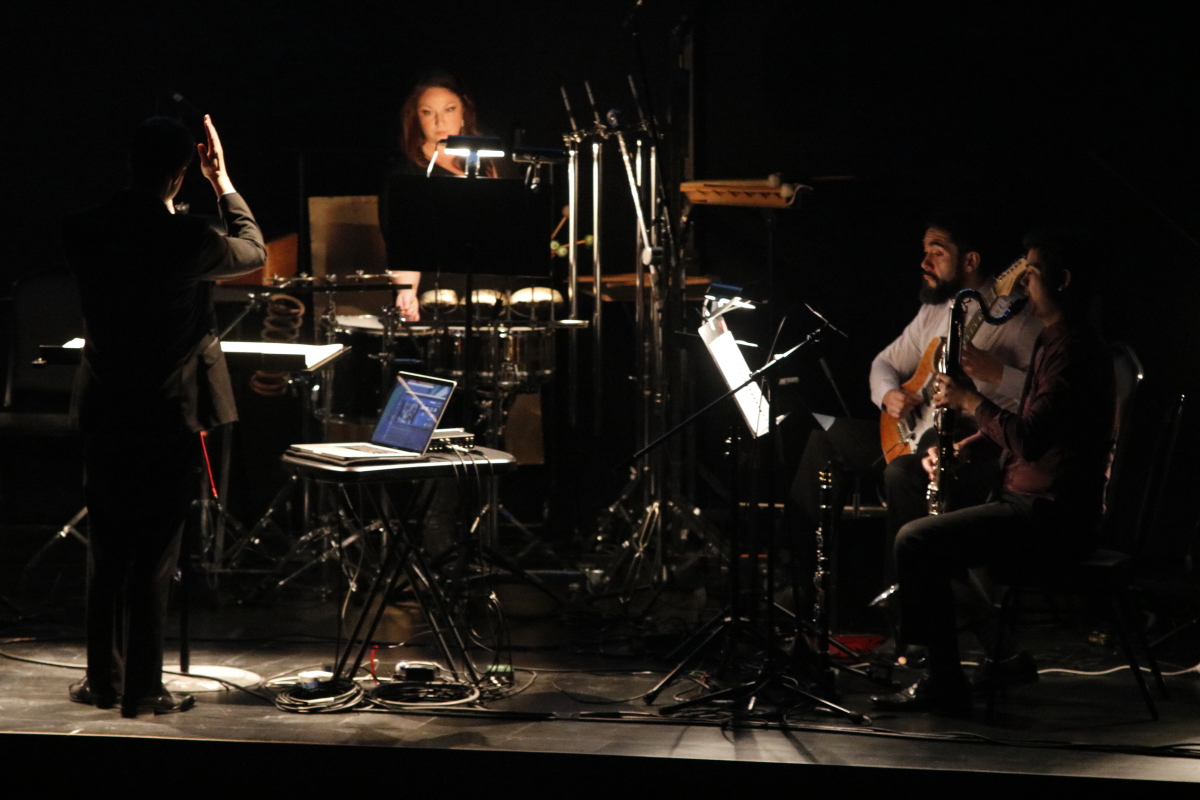
Argonaut Ensemble perform Olga Neuwirth’s Maudite soit la guerre. Photo by Marty Williams.
Review by Charles MacInnes
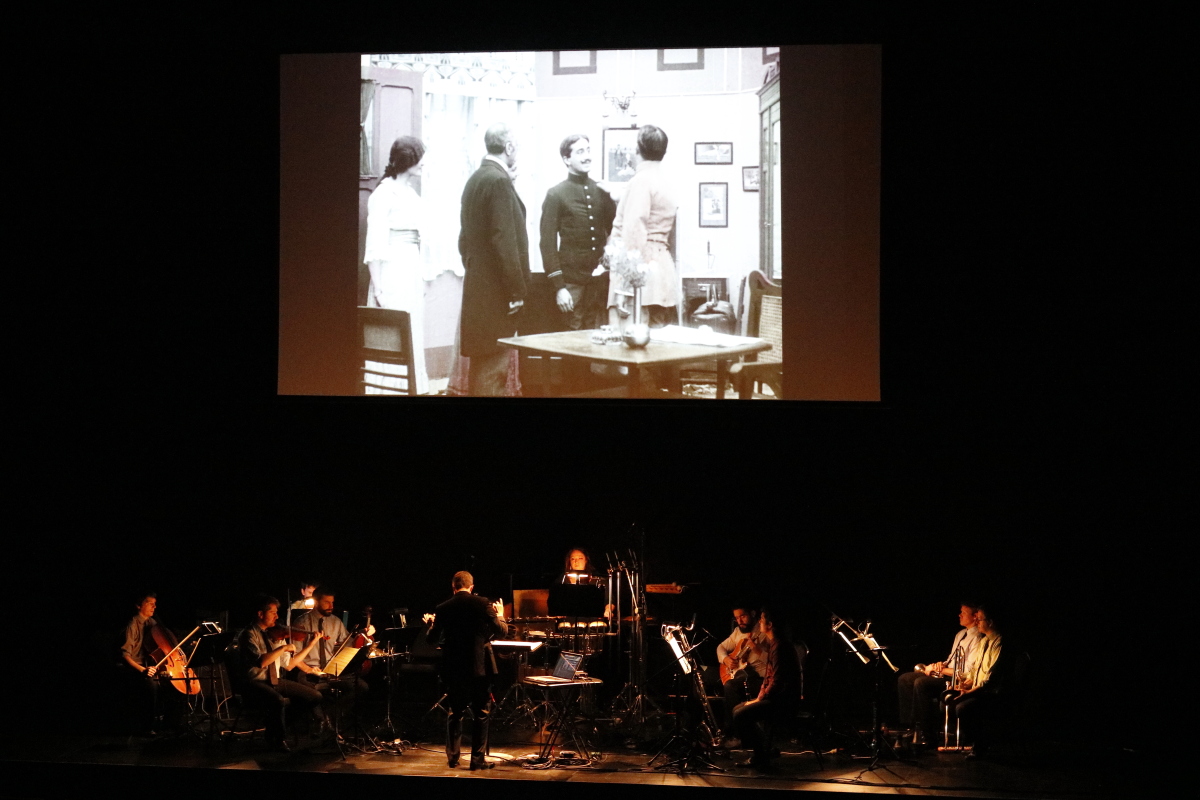
Olga Neuwirth provokes fresh artistic perspectives by combining the new with the old. We see the patchy restoration of the Belgian silent film “Maudite soit la Guerre” (“Accursed be War”, dir. Alfred Machin, 1914), but accept it due to a live music that pits episodic tunefulness against a soundscape of slipping tonal certainty. The trick to understanding this is to place the sound at the focal point of our attention so it becomes the narrative, and the pictures become the incidental.
Music can perform this shift very well because its abstraction leaves you imagining a world beyond the visual. The chamber orchestra replaces the organ accompaniment of old: “You always need to remember the past! That is the only way that we could learn something,” says Neuwirth in an interview with her publisher Ricordi in 2014. As I walk from the Ulumbarra Theatre’s converted gaol toward the Rifle Hotel, I’m already thinking of the Syrians arriving in Europe. Of our collective responsibility. And guilt. Neuwirth is a step ahead because her sound world provides us with a more satisfying ultimate redemption than that of the colourised celluloid.
In the film story itself, Adolph furthers his training as an aviator by visiting a country that looks and feels like Belgium or France. Honky-tonk piano clanks while the harmon-muted brass crack wise and jostle with colleagues as they meet at the airfield. New-fangled flying machines are being inspected, and as the string harmonics are slowly replaced by concentric sustained cowbells, we are taken to the tavern three months hence as Germany declares war.
The declaration means that Adolph and his new friend Sigismond are now enemies. Even though Adolph has fallen in love with Sigismond’s sister Lidia, he must now return to the Vaterland to take up arms. The melodrama thickens; a grave clarinet turns upon itself alongside forward marching brass and above the strata of an elbowing organ and stringed hums. A mistuning of signals is now more pronounced—the sample track and whimsical electric guitar are prompting us to reconsider earlier impressions.
Blood red explosions are sighted through binoculars as the world is turned upside down. Adolph hallucinates that his sweetheart appears as the suddenly more menacing and now armed flying contraptions lurch and veer above. The percussionist stings the enemy with rapid gunfire and a harrowing sequence follows where hot air balloons are attacked, catching fire and eventually caving in on themselves. These are the corpses; war is indeed cursed. Neuwirth tells us with a further splaying of the tonal focus that another pivotal scene is nigh. A telegraph communiqué is sent via elevated strings and leads to the windmill where Adolph is hiding being set ablaze and collapsing. Lover and girlfriend’s brother emerge from the opposing sides and are both slain on the battlefield.
Cut to a year later and the lieutenant who brought the grim tidings to the family is making a play for the now single Lidia. Love is in the air until she spots her lover’s medallion pinned to his uniform. She convulses and contemplates drowning herself but instead retreats to the convent. We hear a veiled Bach chorale (could it be “A Mighty Fortress Is Our God”?) and later a Stravinsky-like “Jesu, Joy…”. By now the sample track and the orchestra are worlds apart and the last vocal echoes shimmer a little longer beyond the church and greenery.
Eric Dudley’s conducting magnificently disguised the presence of his in-ear click track and the Argonaut Ensemble was precise and fluid. I was not convinced that the sound design and amplification recognised the subtle internal dynamics of the acoustic ensemble. The strings and bright percussion occasionally dominated in the mix, leaving some of the delicate muted brass and guitar layers behind. The sophistication of the writing and interpretation created an extraordinarily poignant opening to the 2015 Bendigo International Festival of Exploratory Music.
Maudite soit la guerre: A Film Music War Requiem (2014) by Olga Neuwirth
Argonaut Ensemble conducted by Eric Dudley
Friday 4 September
Ulumbarra Theatre
Bendigo International Festival of Exploratory Music
Charles MacInnes
Argonaut Ensemble perform Olga Neuwirth’s live score to Maudite soit la guerre. Photo by Marty Williams.
Review by Delia Bartle
Scenes of war flicker across a screen in a darkened hall. Repetitive percussion drills like gunfire and strains of a honky tonk piano emerge from under shimmering strings. This is the sound of Maudite soit la guerre (War is Hell), one of the first anti-war films. The 1914 motion picture juxtaposes tradition with the unexpected arrival of a mechanical age of war. Similarly, Austrian composer Olga Neuwirth’s live score bridges the divide between conventional instrumentation and innovative performance techniques.
The film interprets the turmoil of war through the narrative of a doomed love story and two rival aviators. Neuwirth was commissioned by Ensemble 2e2m in 2014 to compose a soundtrack and the Argonaut Ensemble interpreted the score with a spellbinding balance of delicacy and vigour.
Eric Dudley conducted with subtle gestures to foster an ensemble dynamic that bristled with energy. Neuwirth’s score is unique as far as film music goes in that the image and sound sometimes do not correlate. At one point a windmill crashes to the ground, but there’s no literal effect to signify this. It was intriguing to witness the way in which our reactions were shaped by what we heard more so than what we saw, in particular when comical salon music drew laughter from the audience while characters on screen were departing for war.
Violinist Zachary Johnston, violist Christian Read and cellist Paul Zabrowarny excelled, playing cowbells as well as their usual instruments. Roughly bowed string motifs and airy harmonics created an electric atmosphere. Trumpeter Tristram Williams and trombonist Benjamin Marks delivered crisp notes before shifting into rich echoes of military fanfare. Marks even picked up a melodica to add comic effect to the already diverse world of sound, and electric guitarist Mauricio Carrasco emulated eerie air raid sirens with rising and sinking glissandos.
Neuwirth draws on a range of textures and instrumentations to create a dramatic mix of electronics, classical instrumentation and film. Maudite soit la guerre predominantly features soundscapes over melodic continuity, often with dense passages of limited dynamic range. Neuwirth’s musical theatre works frequently explore the relationship between collaboration and resistance, and that was identifiable in this performance through the overlapping textures and conflicting musical and visual themes.
The film’s director, Alfred Machin, produced this work with the intent to counteract the typically glamorised war propaganda that saturated society leading into the First World War. Neuwirth says of the film, ‘You always need to remember the past! That is the only way that we could learn something’. The Argonaut Ensemble embraced Neuwirth’s philosophy with this performance that honoured the ANZAC Centenary, reminding us of the harrowing emotions generated by war through the frame of an explorative soundscape.
Argonaut Ensemble
Maudite soit la guerre (War is Hell) – A Film Music War Requiem (2014)
2015 Bendigo International Festival of Exploratory Music
Ulumbarra Theatre, Bendigo
Friday 4 September, 2015
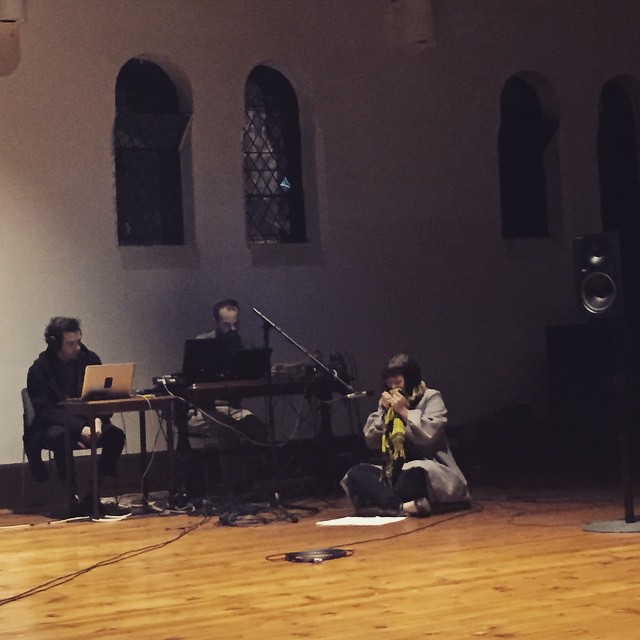
Alexander Garsden, Rohan Drape, and Jessica Aszodi perform Garsden’s Four suns and a whole sky on fire. Photo by Lloyd Honeybrook.
The Inland concert series explores a musical interior. Like the blend of properties at the center of a colour graph, Inland explores the gradations between notated, improvised, and electroacoustic performances. Concert 15.3 at the Church of all Nations in Carlton explored a single, focussed point of this hinterland, that of static textures developed through layering live and captured sounds.
Samuel Dunscombe’s Unfinished Piece for 27 Clarinets is performed by only three clarinettists, in this case Dunscombe, Aviva Endean, and Michiko Ogawa. The electronic part quickly swells to an atmosphere of drones and squawks. The effect is like listening to a great crowd of people, with half-heard conversations and choruses arising and subsiding from the dense body of sound.
Rohan Drape is largely to blame for the perfectly balanced sound diffusion throughout the concert. In each piece, the electroacoustic part perfectly matched the live performers to the extent that, from my vantage point at the back of the church, they were difficult to distinguish. This was as true for instruments as it was for voices. The collaborative work Four suns and a whole sky on fire amplified and multiplied phonemes and words uttered by the soprano Jessica Aszodi before Drape and Garsden introduced a droning accompaniment.
Jeanette Little’s Barbaric Yawp for Uilleann Pipes was a highlight of the night and not just because it featured an instrument so little-heard in the contemporary music world. Once again, the focus was on the instrument’s polyphonic texture and Matthew Horsley carefully managed the piece’s microtonal pitch bends and shifting drones. The melody, when it arrives, is a bleating, squealing thing that resonated delightfully in the church with a little help from the sound design.
Judith Hamann’s untitled solo cello performance featured a series of expertly-diffused extended cello sounds, my favourite of which was bowed cello spike. The vibrations of the spike were so slow that they formed a rhythm of sussurating sounds accompanied by maritime creaks.
The stage faintly glowed beneath the cross of the Church of All Nations. The semicircle of speakers and microphones formed a sacred space, like prayer or a pulpit, within which the sounds of the performers were amplified. But no god was intended to hear these performances, nor does Inland espouse any particular cosmology. With the concert closely following the Supersense Festival of the Ecstatic and directly preceding the Ballarat Slow Music Festival, I wondered after the intentions of the audience members scattered around on the floor. Why do audiences so desperately want to doze? The society-wide will to relaxation is not just a symptom of our busy, technology-stuffed lifestyles, but of our increasing infantilisation as consumers who can’t be trusted to go to bed on time without the right app.
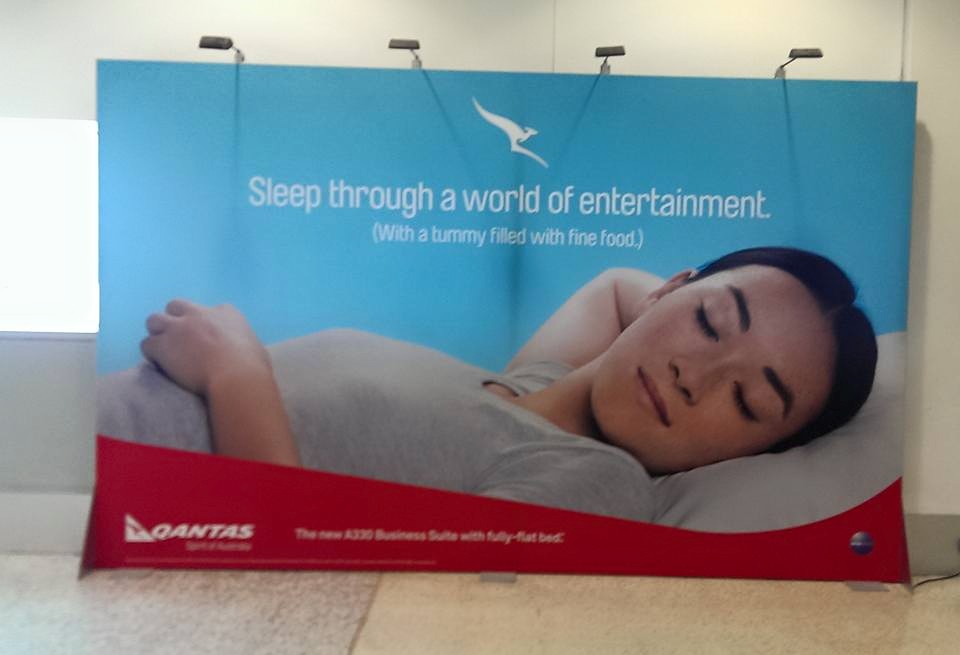
I recently photographed this ridiculous Qantas ad in an airport.
Photo by Matthew Lorenzon
Needless to say, a world of entertainment is not much use while you are asleep, much less if you are trying to get to sleep on a full stomach. But Qantas wants you to consume even when you are full and asleep. There is nothing new in this. If the pinnacle of luxury is gorging oneself and falling asleep in front of a television, then a good portion of the population lives the dream on a regular basis. This ideal of luxury also informs contemporary music. Where falling asleep in a concert was once seen as a bad thing, the ambient sound artist Robert Rich has been presenting “sleep concerts” for several decades. In contemporary art music, it seems that every few months an audience is invited to lie on cushions or curl up in pods.
Trance, transcendence, non-knowledge, or inner experience have their place and exploring these states of mind may be extremely beneficial to one’s health and well-being, but can’t this happen outside of the concert hall? Old-fashioned though these Enlightenment ideals may be, society extricated itself from the comfort of religious dogma for compelling reasons. Even though the last couple of hundred years of technological advancement may well lead to the doom of Western Civilisation as we know it, we can’t crawl back inside the womb now. I am interested to see what composers will do next, once they get bored of the ersatz-sacred bubble.
I have written several times about David Toop‘s performance at the 2013 Totally Huge New Music Festival, where he brutally interrupted his soporific, crackling sound design with deafening strikes of a snare drum. While this is one of the most appropriate responses to a society falling asleep at the wheel, I must admit that I too lay down for Jessica Aszodi’s closing performance of Morton Feldman’s Three Voices, hoping to see the light.
Unfortunately I missed Aszodi’s performance of Three Voices at the 2013 Bendigo International Festival of Exploratory Music, so I was excited to hear Aszodi’s performance this year. Once again, the projection of Aszodi’s two prerecorded parts was perfectly matched to her live voice, so that one was sometimes at a loss to tell which part she was singing. A short check of the tempo and Aszodi was away, gliding effortlessly through the hour-long performance as though on a cloud. Or perhaps that was the audience, which was utterly transfixed for the duration of a performance that requires such obvious skill and precision. Aszodi’s easy command of such an exposed work made it an otherworldly experience.
Though I finally succumbed to lying on the floor and enjoying the mesmerising refraction of light through half-closed lids, I’m taking a twenty-minute nap before concerts from now on.
Inland 15.3: Your House is the Last Before the Infinite
Church of All Nations, Carlton
24 August 2015
Matthias Schack-Arnott’s performance of Diplopia captured by a GoPro. Courtesy of the artist.
The Supersense Festival of the Ecstatic hits all the right notes. Intelligent and accessible, the festival takes its place among a growing number of superbly curated and executed contemporary music festivals in Australia. The audience crowds down a stairway into the bowels of the Arts Centre. Coloured lights and ambient sound design herald their entrance into a netherworld of heightened experience. Once inside, the audience has free run of three or so simultaneous acts curated by Sophia Brous and drawn from the world over. The acts are durational, sincere, cross-cultural, and avant-garde, but peppered with high-profile acts presenting more conventional fare. The audiences crowding into the performances on Friday night prove once again that, if presented in an open and enticing light, audiences absolutely love contemporary music. Friday night’s program was underpinned by a three-hour performance of the Javanese Kuda Lumping (Flat Horse) ritual directed by Chunky Move’s founding Artistic Director Gideon Obarzanek with lighting design by Ben Cisterne. The performers, accompanied by an Indonesian music ensemble, danced themselves into trance states before being lifted out of the room by black-clad shamans. The audience could equally attend a performance by Tao Dance Theatre as they twisted and contorted their way through some of the most controlled contact improv I have ever seen. I was particularly interested to see Matthias Schack-Arnott’s new performance Diplopia, which follows his lauded solo percussion projects Fluvial and Chrysalis.
Diplopia (double vision) plays on the simple yet effective idea of attaching a microphone to each wrist of the performer and amplifying them through stereo speakers so that the performer’s hand movements are translated into rhythmic panning effects. Schack-Arnott surrounded himself with cymbals and tam-tams of different sizes, which furnished him with a beautiful array of metallic resonances.
Schack-Arnott began by gently playing a series of mid-range upturned cymbals, moving his arms in circles. The audience was lulled by the gently pulsating hum highlighted by metallic shimmering. Tighter and looser arm circles produced striking phasing effects, while several very slow circles produced a viscous aural effect like smearing clay. By contrast, a wide, fast arc over a single small cymbal would produce a short, clipped yelp. The moment I began wondering what the harmonic, microtonal properties of the cymbal array might be, Schack-Arnott started playing multiple cymbals producing beating, dissonant tones.
Schack-Arnott explored large tamtams, which gave a rather dead bassy hum, and much smaller cymbals whose rhythmic, amplified resonance was almost vocal in timbre. Swelling sine tones based on harmonics of the cymbals were dispelled by immaculately-timed attacks. The higher the pitch of the cymbal, the more complex and interesting the tones, with the higher cymbals accompanied by beating harmonics.
The flowing, rhythmic performance was a perfect opening for Supersense, but I’d like to hear these ideas explored further. What would jagged and irregular movements sound like? What about using only one microphone so that initial attacks were not amplified but their resonances were? How many different tones could one cast one’s hand over before they became indistinguishable? Schack-Arnott has opened up a world of new possibilities.
Matthias Schack-Arnott
Diplopia
Supersense Festival of the Ecstatic
State Theatre Rehearsal Room, Arts Centre Melbourne
Friday 7 August, 2015
Hana Lee Crisp and Bert LaBonté in I am a Miracle. Photo by Pia Johnson.
Marvin Lee Wilson was executed on 7 August 2012 for the murder of a police drug informant. Tested to have an IQ of 61, he should have been ineligible for the death penalty under a United States Supreme Court ruling. Wilson’s IQ test was dismissed as evidence because it was administered by a PhD candidate rather than a clinical psychologist. On this technicality, his execution proceeded. Writer Declan Greene describes I am a Miracle as “a play for” rather thanabout Wilson, but does he nevertheless range too far from his subject? The play’s two acts provide historical and contemporary snapshots of racial inequality. These vignettes are framed by Bert LaBonté’s impassioned monologues as a sympathetic observer of Wilson’s plight.
Bombast paints a thin veneer over an unsatisfactory ending. As giant incandescent bulbs blind the audience, LaBonté offers a rousing call to arms. He pledges to carry Wilson’s memory to wage cosmic revolution. He wants to undo not just generations, but billions of years of inequality.
Two acts seem too few for a play that addresses universal injustices. The sense of incompleteness is almost musical. Three spotlit narratives of murder and subjugation might have given a better sense of the universality of racial subjugation. As they stand, the two acts seem more like separate plays. Melita Jurisic delivers a grimly humorous story of slavery in a nineteenth-century Dutch colony. In what was a brilliantly sustained escalation of tension, LaBonté plays a mentally ill man falling through the cracks in modern-day Melbourne.
A live musician on stage is a perpetual question for the audience, but director Matthew Lutton made a virtue out of soprano Hana Lee Crisp’s presence. She was never left hanging by the wings, but appears at intervals starkly framed by an arch or in front of a curtain. Lutton describes her as “an archangel of justice,” and her pure renditions of David Chisholm’s settings of biblical text elevates the audience above the play’s worldly themes of inequality, mud, and death. The three actors all lend beautiful and distinctive voices to the stage, which is otherwise suffused with subtle choral textures by sound designer Marco Cher-Gibbard.
Chisholm’s renaissance-style vocal score also raises a question that is held in delicious suspense until we learn of Wilson’s religious faith in Bert LaBonté’s final monologue. Becoming profoundly religious while in prison, Wilson’s final words included:
Take me home, Jesus.
Take me home, Lord.
I ain’t left yet.
Must be a miracle.
I am a miracle.
With every piece of the play’s promotional material foregrounding Wilson, the audience may be surprised by the marginal role of Wilson’s story. As an audience we are always watching LaBonté watch Wilson. We never hear Wilson’s words or learn anything about his life, but are left with the consolation of religion and ambient rage.
I am a Miracle
Written by Declan Greene
Directed by Matthew Lutton
Composition by David Chisholm
Malthouse Theatre
3 August 2015
Justine Anderson performs Berio’s Sequenza III. Photo by Rachel Edward.
Curated by soprano Justine Anderson, Signs and Symbols explored three little-heard masterpieces inspired by dreams and the unconscious.
New music fans over the age of fifty may be surprised to hear Boulez’s half-hour long serialist saga Le marteau sans maître described as “little-heard.” The chamber work was played to death throughout the seventies as Boulez’s compositional aesthetic cemented itself in composition departments the world over. The stunning work almost disappeared from Australian concert programs over the following decades, though its temporary absence may have had some benefits. When audiences hear the work today, they are no longer hearing a work on a pedestal, but a historical document free of the partisan baggage that accompanied its first performances. Without extended-technique pyrotechnics or electroacoustic sorcery, Le marteau sans maître sounds rather dated. And yet, like an Ars Nova puzzle, one immediately appreciates the work’s fine-grained understatement. Conductor Elliott Gyger lost none of the piece’s precise rhythmic counterpoint. Even René Char’s surrealist poetry is treated less with Pierrot Lunaire melodrama than as the machinations of an impossibly complex piece of clockwork. Anderson’s accuracy and control proved equal to the challenge.
Some sounds just grab you. As the muted ensemble ticked along, I was drawn again and again to a slithering sound emanating from the back of the hall. It was a maraca. Matthias Schack-Arnott would hold it upside down and make circular movements with his arm, causing the grains inside to shoot around the bulb like cyclists around a velodrome. The resulting ear-massage was part autumn leaves, part rain, part chocolate mousse. When he stopped moving the maraca, the grains would take time to roll to a stop. One seemed to hear each grain rolling over the others until finding its perfect resting place in the percussive microcosm. It turns out that this was not just any maraca, but rather a maraca that the Australian percussionist Barry Quinn used when performing similar repertoire with The Fires of London in the 1970s. Perhaps this was the first ever historically-informed performance of this piece.
The audience returned to a drastically rearranged South Melbourne Town Hall for Morton Feldman’s spatialised performance For Franz Kline. The stark, feathered monochrome brush strokes of Kline’s paintings were evoked by the synchronised attacks and indeterminate endings of pitches in the ensemble. Feldman fans may contradict me here, but it was nice to have a Feldmanesque soundwallow after the highly-strung Marteau.
Justine Anderson concluded the concert with Luciano Berio’s solo vocal tour de force, Sequenza III. The work requires power, agility, and loads of character. Anderson provided all three in abundance, sweeping through the hall in Barking Spider Visual Theatre’s reconstruction of Mrs Matilda Butters’ fancy-dress constume of 1866, which was printed with the mastheads of dozens of Victorian newspapers. It is good to see the dress in movement after its first new music appearance with The Sound Collectors earlier in the year. It was even better to hear this vocal masterpiece performed with such flair by one of Australia’s finest new music sopranos.
Signs and Symbols
Curated by Justine Anderson
The South Melbourne Town Hall
29 May 2015
Pierre Boulez, Le marteau sans maître; Morton Feldman, For Franz Kline; Luciano Berio, Sequenza III.
The origin-stories of works can shed light upon their final shape. Gordon Kerry’s new opera Snow White began in May 2014, when Kerry attended a production of Carmen by Opera Scholars Australia at the Old Melbourne Gaol. Graeme Wall, director of Australian Music Events, approached Kerry about writing a stage work for the Opera Scholars. With the support of an old friend also present at the concert, Kerry agreed to write a modern opera on a libretto by the Australian poet John Kinsella. But writing for the Opera Scholars posed challenges. The work was to be the first contemporary opera that many of the young singers would ever perform, it had to accommodate a high number of soloists, and it had to be satisfying to Kerry as an experienced composer of contemporary music. The fairy tales collected by the Grimm brothers were just the thing. Five short stories included numerous solo parts, while their gruesome content provided opportunities for chromatic, expressionistic vocal lines.
Faced with this set of challenges, Kerry, Kinsella, the Opera Scholars, and the Hopkins Sinfonia presented a triumphant new piece of repertoire for young singers. The palpable foreboding of the tales is evident from the opening act, “The Seven Ravens.” The leaping, bird-like harp part (provided electronically by Jodie Lockyer) contrasts with the sinister, syncopated chorus of brothers who have been transformed into crows for carelessly dropping a pitcher of water into a river (not much room for error in Grimm). Josephine Grech sympathetically sang the part of the sister who bravely saves the brothers from their avian fate.
After the first act’s creepy cawing, Stephen Coutts’ powerful solo as the rich farmer in “The Grave Mound” broadened the expressive range of the opera. It is unfortunate that Coutts disappears into the eponymous grave mound so soon, but the audience was rewarded with a timely parable about same-sex parenting. A poor man inherits the rich farmer’s wealth on the condition that he watches over the rich man’s grave when he dies. A soldier, hanging around the graveyard late one night, stumbles across the poor man and agrees to spend the night with him. The devil tries to lure them away from the graveside with gold, but the soldier tricks the devil to remain until daybreak, at which point he melts away leaving a large sack of gold. The soldier and the (now rich) poor man retire to the latter’s house to look after his children together. They finish with a beautiful duet about how happy they will be together.
Elizabeth Barrow as the Queen in Snow White and Other Grimm Tales. Photo by David Ng.
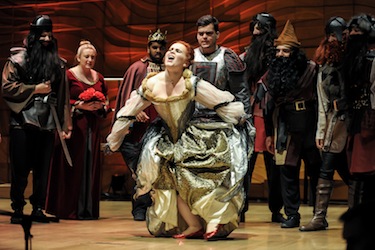
The star of “Snow White” would have to be Elizabeth Barrow as the evil queen who, as well as performing strongly throughout, screams and dies excellently in red-hot iron shoes. The act is a lesson in rapid storytelling and Kerry evidently enjoyed challenge of illustrating such a hectic plot line with clever effects and allusions. A crunchy chord in the woodwind accompanies Snow White’s mother’s fatal pin-prick. The forest is painted with echoes of Debussy’s Pelléas et Mélisande. The words “over the mountain” are accompanied by a particularly juicy cello line (Belinda Liew). Things turn very Lord of the Rings once Snow White gets across said mountains and meets the seven marvelously beardy dwarves. So effective was the costuming that I’m completely unable to single out particular singers beneath the hair. Their funeral chorus was very affecting, however.
“The Peasant in Heaven” is one long gag. A rich man and a poor man arrive at the gates of heaven and the poor man is ignored while the rich man is welcomed with fanfare. The peasant asks whether he is a second-class citizen in heaven as on earth. St. Peter reassures the peasant that this is not at all the case; he is just happy because it is so uncommon for a rich man to reach heaven. The story is actually an acute critique of privilege blindness. The rich man enters heaven oblivious to his preferential treatment, being accustomed to that extra centimeter of smile when he arrives at airport gates. Meanwhile, the poor man is asked to accept inferior treatment just this once, on account of the exceptional arrival of the rich man. Of course the poor man would have experienced the same dismissive treatment many times on earth, at the doors to schools, jobs, and concerts, even if the perpetrators never meant it intentionally. Stephen Marsh brilliantly sings the part of St. Peter as a besuited schmoozer, a sort of business development officer claiming to be on the side of the poor man, but who is dressed to better welcome rich men. He’ll angle for a donation later, after a personalised tour of heaven’s deteriorating organ pipes.
Kerry did not save his best work to last. Like many folk tales, “The Old Woman in the Wood” has a repetitive plot line. Kerry chose to cut and paste material for each repetition, rather than increase dramatic tension or musical interest by differentiating the score. Janneke Ferwerda acted and sang with conviction as another heroic young woman. Tim Daly’s clear voice doubled well as a tree and a dove.
Full of compelling vocal lines, Kerry has produced a dramatic collection of short stage works. Snow White is ideal for any young operatic ensemble seeking to gain experience performing contemporary music. The Opera Scholars rose to the challenge with grit and charisma, proving themselves a versatile troupe of operatic performers.
Opera Scholars Australia
Snow White and Other Grimm Tales
Libretto by John Kinsella
Music by Gordon Kerry
Melbourne Recital Centre
28 May 2015
Kupka’s Piano are a Brisbane-based new-music ensemble, made up of a core group of intelligent and startlingly adept young musicians supplemented periodically by equally interesting guests. They are committed to the performance of important works by living composers from around the world, alongside a focus on Australian composers. Many of their performances are Australian premieres, which says a great deal about the significance of the group in the cultural life of the nation. Over the past several years in Brisbane, they have built up a well-deserved, devoted following.
In this, the second concert of Kupka’s Piano’s 2015 series at the Judith Wright Centre of Contemporary Arts, the ensemble continues its ‘extra mural’ theme with a notion of sounds from “the other side.” What exactly these walls represent is perhaps something open to individual interpretation (a state of mind? Geographical or cultural distance?), but the conceit does reflect rather well the sense of permeability that characterises much recent and contemporary music, where sounds, styles, ideas, colours, and voices often bleed across old boundaries. Individual musical works (and bodies of work) now seem to talk to each other so freely, even promiscuously, yet we retain some sense of the old lines of demarcation without which such transgressions might seem less thrilling, while at the same time inscribing our own lines upon the conceptual maps of our increasingly strange and estranging world.
New music doesn’t really shock anymore. At worst, it might irritate or, more commonly, simply fail to engage with its listener, like a missed train connection. We no longer talk much about whether a piece is good or bad (let alone great), but rather couch our critiques in terms of whether a work ‘works’, or not, according to mutable criteria of functionality that perhaps have some relation to the ‘mural(s)’ of this series’ theme.
Past Brisbane-resident Liza Lim’s Inguz (fertility) for clarinet and cello was composed in 1996, and the title is a reference to a Nordic rune. This is a lovely work of fluid poetry and organic proliferations; gently melodic, yet thoroughly of its time in terms of technique and colour. Lim handles the two instruments masterfully—the unique colours of each are imaginatively exploited yet contained within a frame of the composer’s imagination, a space that both can inhabit and that informs their interactions. Cellist Katherine Philp and clarinettist Macarthur Clough gave a forensically beautiful performance that made the most of all the subtle gorgeousness of the intricate score.
Jérôme Combier’s Feuilles des paupières (2005) for piano, percussion, flute and clarinet is also a very beautiful work. This piece is one part of a large cycle, Vies Silencieuses, a series of chamber works inspired by painters and in particular the quietly powerful still-life paintings of Giorgio Morandi. Combier approaches the instruments with great aural sensitivity, and a vital sense of orchestration. On the one hand, he writes for piano/percussion as if they form a single, huge instrument. The sounds he conjures from the players are both seductive and exciting, and show a detailed understanding of what the instruments can do and how to bend them to his musical purpose. Against this, Combier has written flute and clarinet parts that are, once again, so well integrated in conception as to seem almost a single instrument, or like a pair of intimately connected human voices. Combier’s music demands both sensitivity and precision to succeed in performance, which certainly works to the strengths of Kupka’s Piano as an ensemble (augmented here by guest flautist, Tamara Kohler). The performance was tightly controlled and colourful—although I felt that in this case the piece might benefit from a more forgiving, resonant acoustic environment. Some of the fragile sounds need a little more reverberation in the room to fully bloom. Is Kupka’s Piano working towards an Australian premiere performance of the full Vies Silencieuses cycle? Let’s hope so.
Philippe Hurel’s Tombeau in memoriam Gerard Grisey (1999) for piano and percussion has, on the surface at least, a lot going for it. It has the name of our sainted Grisey in the title, for a start… yet in many respects it disappoints. Pianist Alex Raineri and percussionist Angus Wilson gave a superlatively virtuosic and dramatic performance of the four movement work, which is so brimming with challenges as to be virtually created to fail. The instrumental combination of piano and vibraphone, upon which much of the work relies, is a highly problematic one. It has all the inherent difficulties of a two piano ensemble (essentially two percussion instruments having to play exactly in time with each other) with the added problem of the oil-and-water timbral (in)compatibility of piano and vibraphone as a duo. Of course, uncommon or peculiar instrumental combinations can be very interesting in the right hands, but in this work Hurel fails to hear a way through the obstacles, and it never quite comes into focus as a genuine duo. In sonority and structure, this is essentially a piano piece, over-burdened with hollowly clichéd gestures at several levels, onto which the percussion parts have been grafted as a kind of lean-to extension. The effect, when it succeeds now and then, is very like a prepared piano.
There are some nice moments—the first movement has an arresting, kinetic excitement, and the slow second movement unfurls an interestingly tense, reflective mood—yet the piece undermines itself too often with unconvincing, unfocused sonorities and empty gestures. One such, if I may labour the point, is an episode of tedious transpositions, in which upper and lower parts move outward from each other, stepping rather aimlessly along a scale. This is a recurrent motif of Messiaen’s technique that in his own work has a relentless, implacable energy but in imitation almost always sounds dull—and, like musical spakfilla, one suspects that its function is to conceal some inherent structural flaw. Raineri and Wilson battled heroically against the inbuilt weaknesses of Hurel’s work (and made it sound in some ways a more interesting piece than it actually is) but in the end one is left with a sense that Grisey deserves a better memorial than this.
Brussels-based Australian composer Liam Flenady’s new work Si el clima fuera un banco (2015), for piano and fixed media (pre-recorded midi-piano and speaking voices), takes its inspiration from Hugo Chavez’ famous 2009 speech in Copenhagen, where he observed that ‘If the climate were a bank, they would have saved it already’. This is very interesting piece, which works with Flenady’s interests in politics and counterpoint to play with seeming oppositions such as refinement versus crudeness, complexity versus directness. The score is certainly fearsomely complex, and makes great demands of the pianist. Here, Raineri projected a very different quality of sound to that heard in the earlier works in the concert: less percussive, richer and warmer. As a result of this very beautiful sonority and Raineri’s confidence with the virtuosic score, Flenady’s music was revealed as luxuriantly poetic, even lyrical.
The combination of live and recorded/artificial piano is an interesting one, and the interactions between the two were intriguing. One cannot help wondering if this would be even more effective if the work was scored for two pianos…? Or perhaps that would be a different piece. I found the recorded voices to be most effective in a musical sense when the words could not quite be heard clearly… then, it felt as though the sounds (not merely words) of voices from another room were intruding, and commingling with the piano music. In a way, this raised another interesting question: does the work really need those voices, or could it succeed as a purely instrumental piano (or two-piano) work? For myself, I felt that the counterpoint of voices, together with the in- and out-of-room pianos evoked exactly that sense of permeability that seems ideally characteristic of music in our times, like an eggshell letting the oxygen in. What stayed with me long after was not the words or even the explicit political messages, but the expressivity of Raineri’s piano playing as the work seemed to breath in and out the fragrance and texture of disembodied voices.
Flenady writes in the program that his work ‘will have little impact on politics’, and in a sense that is true… but perhaps music affects us in a different way, in a different substance, on a different level. I’m not sure that we can measure such impact in the same way we measure political (or, for that matter, market) impacts. The power elites of our world would have us believe that music is just entertainment, thus powerless, but I think we should exercise caution in assuming that this is the case. Flenady’s music raised these final questions in my mind: What if music as an art form actually does have an impact? Would that change the way we do things?
The concert ended with the Australian premiere of Beat Furrer’s Gaspra, a marvellous work for seven instruments composed in 1988. It astonishes me that this piece has not been previously played in Australia—but then very little of this important Swiss-born composer’s work has been heard in this country, to our loss (mind you, the same could be said of Grisey). While there were other very good pieces on this concert program, Gaspra was from the first moment in a realm of its own, like a comet (or rather, a stray asteroid) burning through the sky. Like all Furrer’s music, Gaspra is created from a fusion of electric nervous energy with moments of intense calm; the two in some way feeding each other. There is a powerful yet subtle intelligence at work here, and a wonderful instinct for sonority and colour that is thoroughly integrated with structure—even passages of more-or-less indeterminate pitch, glissandos or extended techniques, move within an iron-strong harmonic frame.
Gaspra is built as an intricate montage-form in terms of its overall architecture, with several motifs recurring and interacting with each other as the work progresses. One of these, some lovely low-pitched rhythms for the piano, seems to be a distilled reference to La Princesse de Bali from André Jolivet’s Mana (a neglected masterpiece of the earlier twentieth century). At other moments we hear little flashes of material that betray Furrer’s interest in the music of Feldman, but such references or allusions are never simply pastiche in Furrer’s music: they are always very integrated with his own distinctive language, and deeply meaningful. Under the direction of conductor Benjamin Marks, Kupka’s Piano gave a splendid performance of great flair and magical subtlety. The ensemble was joined for this piece by the inimitable Graeme Jennings (viola) and Tamara Kohler (flute) as guests.
This was an important concert for both Brisbane and Australia. The immense dedication of the ensemble members is clearly evident, as this is a kind of music that requires a huge effort of preparation to perform well and Kupka’s Piano play very well indeed. Their programming is creative, thoughtful, and thought-provoking. The cutting edge of Australian music creation is at present very clearly in the hands of smaller groups or individuals operating independently of large institutions and venues and often on very limited budgets. Kupka’s Piano are one of the best and most exciting of these groups, and one senses as they perform that history is being made.
– Alistair Noble
Kupka’s Piano
Extra mural II: Outer Sounds
Friday June 19th
Judith Wright Centre of Contemporary Arts
Liza Lim, Inguz
Beat Furrer, Gaspra, AP
Phillipe Hurel, Tombeau in Memoriam de Gerard Grisey, AP
Jérôme Combier, Feuilles des paupières, AP
Liam Flenady, Si el clima fuera un banco, WP
The Metropolis New Music Festival, showcasing works associated with film and the moving image, reached its stunning conclusion on Saturday with a program of recent compositions and more ‘classic’ works. The Melbourne Symphony Orchestra was in fine form, conductor André de Ridder decisive in direction and eloquent in speech, and the Melbourne Recital Centre an ideal locus for a performance that was both extravagant in scope and intimate in experience. For me, the juxtaposition of ‘old-new’ music with ‘new-new’ music spoke volumes of a continuing desire for postmodern assemblages in concert programming – if such an observation isn’t already a mode of criticism long passé. Yet what was particularly striking was that ‘classic’ works such as Penderecki’s Polymorphia (1961) and Varèse’s Déserts (1954) sounded far more experimental and groundbreaking than the considerably more conservative and self-reflexive works by Jonny Greenwood and John Corigliano. This represented a timely reminder of the non-linear and multicentric flowering of compositional style over the past half-century, but perhaps it also says something about canonisation and the ritualised recycling of repertoire in most art music programming – at least in terms of listeners’ preconditioned ideas of orchestral music and style. (An anonymised program and testing of audience reactions on musical vintage could actually be quite illuminating, not to mention fun.)
The practice of performing suites of film music in orchestral concerts echoes the programming of seventeenth-century theatre music by Purcell and co., but the aural experience of this repertoire seems altogether more divorced from its context if given without the accompanying moving images. It was in this vein that we began the program with Greenwood’s There Will Be Blood suite: a veritable sonic landscape with vivid aural evocations of Californian oil fields. (I haven’t actually seen the film, by way of full disclosure, but learnt the context from the concise and informative program notes.) A special feature was the use of the ondes martenot, an electronic instrument championed by Messiaen, which emitted a luminous melody hovering above the strings. Greenwood was pretty sparing with it, and the ondes were conspicuous for their absence for the rest of the piece, but the audience was clearly thrilled with the experience. The suite was very much a tableau of diverse sounds, and a thoughtful and artful voyage of sonic discovery, making use of many different string textures and techniques. The MSO, reduced in forces for this programme, was a model of excellent ensemble and rhythmic precision, and played as if they were performing chamber music, with a blend of movement and sound rarely seen in an ensemble of this size.
Corigliano’s The Red Violin: Chaconne for Violin and Orchestra is a companion piece to the score of the eponymous film. By Chaconne the composer implies a repeated chord progression, but I felt the piece would better reflect the name of “rhapsody” or “romance”. Violinist Sophie Rowell was technically brilliant and immensively expressive in her rendition of the difficult solo part. It featured all the usual late-Romantic characteristics: multiple-stops, big arpeggios and virtuosic scalic passages, sweeping long melodies, and – as the composer points out – the incorporation of difficult études into the solo line. There were certainly some very moving moments. Yet some of the longer orchestral interludes and especially the big orchestral “hits” (large chords) right at the end represented something of a cliché, reinforcing a melodramatic aesthetic that one rarely hears outside the cinema. Still, this piece certainly reflected the subject of the film that inspired it. An impressive feat to perform, and the audience gave it a rousing vote of thanks.
Speaking of associations between film and music, who can forget the terror inspired by Jack Nicholson in parts of The Shining, underpinned by the unsettling whispering, murmuring, and whistling of 48 string players producing Penderecki’s organised cacophony that is Polymorphia, and bringing us to the very edge of our seats? This piece arguably deserves recognition in its own right as a masterpiece of new music in the 1960s. It must have caused a sensation at its original performance in 1961, and it certainly did here. All I could think about, though, was the way in which those extended string techniques – playing below the bridge, bowing the tailpiece, tapping the instrument with flesh and with wood, and so on – have been associated with so many different emotions; here the aesthetic is linked indelibly to terror, thanks to Stanley Kubrick, and yet we hear many of the same kinds of sounds representing the raucous dawn chorus in Sculthorpe’s Kakadu. (Okay, that’s a pretty random binary opposition, and one I won’t explore further, but maybe we can chew some more on the meanings that high frequencies have for human emotions.) The best part of witnessing a concert performance of Polymorphia by 48 string instruments is to recognise gradually the aural and visual order in the seeming chaos, and to watch the director bathe in waves of sound while pointing the cues in rapid-fire succession. The surprise C major chord at the very end jolted us suddenly into (or out of?) an altered reality.
Varèse’s Déserts was for me the calling card of the programme. This was clearly intended as the show-stopping finale, while other works were intended for aural contemplation without the projections of video stimulus. Performed with Bill Viola’s video of 1994, it’s difficult to say whether the music of Déserts was accompanying the moving image, or vice versa, as the synchrony of sound and vision was impressive indeed. The conductor presumably had a click track: the coordination was precise, right down to the live instrumental accompaniment of sudden lightning strikes on the screen. The musicians were split into several small groupings on stage, making for a stereophonic atmosphere that interacted well with the tape-recorded passages broadcast at specific points in the piece. The mesmeric quality of the film lulled us into a transcendent space of seeing, hearing, and being. Perhaps a nice example of a complete artwork, albeit without voice.
The MSO players provided a wonderful visual display in a technically assured and highly expressive performance, within the attractive wood-lined ambiance of the MRC’s Elisabeth Murdoch Hall. A fitting finale to the 2015 Metropolis New Music Festival.
– David R. M. Irving
There Will Be Blood
Melbourne Symphony Orchestra
Metropolis New Music Festival
Melbourne Recital Centre
16 May 2015
Jonny Greenwood, There Will Be Blood; John Corigliano, The Red Violin: Chaconne for Violin and Orchestra; Krzystzof Penderecki, Polymorphia; Edgard Varèse, Déserts.
Ensemble Offspring, photo courtesy of the artists.
Sydney-based new music group Ensemble Offspring continue the Metropolis festival with a colourful series of works for live ensemble and video. Their programme Light is Calling began with a great example of a minimalist work that uses less to achieve more. Light is Calling for solo violin, electronics, and video is an attempt to “make something beautiful” after the ugliness of the attacks on the World Trade Center on September 11, 2001. Composer Michael Gordon provides a slow-moving violin part, devastatingly interpreted by Ensemble Offspring’s Veronique Serret. Reverberant and reversed samples form a finely-textured bed of electronic sound. Film maker Bill Morrison, who also contributed to Julia Wolfe’s Fuel in the MSO’s second Metropolis program, brings the piece to new emotional heights. Morrison’s film consists of a reprint of footage from the black and white 1926 movie The Bells. Morrison melts film footage of figures, faces and horses to produce hauntingly distorted images. As the film turns to yellow, brown, and black, the images smear and stretch across the screen. The echoing electronic part, lamenting violin and immolating film all seem mourn a long-lost innocence.
Nico Muhly’s It Goes Without Saying combines live clarinet (Jason Noble) with prerecorded metallic sounds including a kitchen whisk, bells and harmonium. The delicate sound world also includes pre-recorded clarinets that duet playfully with the live performer. The piece is accompanied by a video of stop-motion hair clippings on a white background. The hair slowly coalesces into a face, setting in motion a series of vivid animations including soap suds and metallic shards. Noble transfixed the audience with the hypnotic clarinet part. This was especially strong during the opening abstraction of drifting hair follicles.
Ensemble Offspring’s Metropolis programme included the world première of audiovisual artist Chris Perren’s Dive Process. In Dive Process, Perren builds on his recent experiments with musical and video phasing. Dive Process uses a retro video of a girl diving into water. The video is reversed and replayed at her point of entry into the pool, creating a rhythmic explosion and contraction of bubbles. Three versions of this film are then played side by side at different rates in a mesmerising phasing pattern. Perren’s score for percussion, clarinet, and violin mirrors the visual phasing pattern. Perren builds the intensity of this pattern during segments where dozens of copies of the video are spaced around a sphere. Continuing the theme of rhythmic counterpoint, the ensemble then played Steve Reich’s Vermont Counterpoint, a sister-piece to Reich’s Six Pianos, which Zubin Kanga performed in an arrangement by Vincent Corver earlier in the festival.
Ensemble Offspring reserved the second half of the concert for Damien Ricketson’s magnificent Fractured Again Suite. For this large-scale chamber ensemble work, Ricketson draws inspiration from the physical properties and sound of glass. In particular, Ricketson singles out the glass harmonium, a relatively popular instrument in the eighteenth century that has since fallen into obscurity. The closest thing one can hear to its ethereal tone nowadays is a dextrous performance on a row of tuned wineglasses. Ricketson builds the Fractured Again Suite out of fragments of compositions for the glass harmonium by Mozart, Donizetti and others. These fragments are then reflected, distorted and splintered like glass to form the arresting and sparkling surface of the suite. The rapid opening resembles an off-kilter clockwork automaton racing towards self-destruction. The glass-inspired video accompanying the work includes a brilliant array of coloured lights projected upon tubes, panes, and rods of glass. Some of these lights are reflected in repetitive, rhythmic ways, while at others they resemble the more timbral reflections of the piece’s later movements.
Ensemble Offspring
Light is Calling
Metropolis New Music Festival
Melbourne Recital Centre
14 May 2015
Michael Gordon, Light is Calling; Nico Muhly, It Goes Without Saying; Chris Perren, Dive Process; Steve Reich, Vermont Counterpoint; Damien Ricketson, Fractured Again Suite.




 Partial Durations