Category Archives: Reviews

Partial Durations is a Matthew Lorenzon/RealTime joint project.

Metropolis New Music Festival 2016: Elision

From the circles of Dante’s Inferno to Ethiopian churches carved into rock faces, Elision’s program was inspired by sacred cities both real and imagined. With their almost inhuman virtuosity, the performers took the stage like mythical guardians of each citadel.

The only musical sound Dante hears in hell is a horn belonging to the giant Nimrod. The giants are trapped in the Circle of Treachery for attempting to overthrow the gods. With their intelligence and compassion “in inverse proportion to their size,” the program note for Elision’s Metropolis concert associated them with “thuggish brutality and malevolent military power.” In Giganti John Rodgers attempts to compose the sound of this loud and brutal instrument played by lungs larger than any human’s. Given new music’s addiction to supersized wind instruments, it’s surprising someone hasn’t tried it before. Benjamin Marks’ trombone lays a powerful bed of sound while Tristram Williams adds high overtones on trumpet. Aviva Endean’s contrabass clarinet provides grist and timbre, rumbling and roaring in waves. But even giants run out of breath and eventually this imagined meta-instrument falls silent.

In Richard Barrett’s Adocentyn, Genevieve Lacey and Paula Rae painted another type of sacred city: Tommaso Campanella’s utopian City of the Sun inspired by an eleventh-century textbook of magic. The city has a central castle with four gates guarded by an eagle, a bull, a lion, and a dog. On the summit of the castle is an enormous tower that changes colour, kind of like the Melbourne Arts Centre during White Night. But unlike the feverish crush of White Night, Lacey’s bass recorder and Rae’s bass flute are busy and gentle, playing a sotto voce duet with all the twists and turns of medieval streets.

Aaron Cassidy’s The wreck of former boundaries for electric lap steel guitar takes a sledgehammer to the musical architecture of Elision’s history. Treating recordings of past performances as “found material”, they are processed beyond recognition by Daryl Buckley’s effects pedals, forming an immersive sonic environment like tonnes of glass being ground into fine powder. Buckley’s guitar carves lines through this sonic dessication like a finger through dust.

Elision celebrate 30 years of new music this year, making their first commissions not so new any more. Marshall McGuire acknowledged this history with a performance of Vezelay, a solo harp work by Alessandro Solbiati from the 1990s, when the ensemble maintained close relationships with a group of Italian composers. The piece is inspired by an abbey in Vezelay that is constructed to represent “a way from darkness to light.” The piece is satisfyingly ambiguous about what counts as darkness and light. Contrasting use of the harp’s low and high registers is kept to a minimum. Rather, obscurity and clarity seem to be the key distinguishing characteristics. The piece begins with McGuire striking and messily brushing the strings. Dirty glissandi and harmonics jumble together. Tremoli across strings—some of which are muted—creates a sound like rattling beetle shells. Clearer sounds stand out from these obscured tones, like clear harmonics struck simultaneously with a lower fundamental, or whispering high trills.

When the program note to Matthew Sergeant’s ymrehanne krestos said that a superimposed texture of decoupled articulations, valve patterns, and dynamics would be “scrubbed” to reveal its constituent parts I didn’t expect there to be any actual scrubbing. But Peter Neville dutifully raises a scrubbing brush at the beginning of the piece and attacks a pair of bongo drums. Harsher scrubbing seems to coincide with moments of clarity in the brass texture as Williams and Marks focus on elements of articulation or dynamics. The composer associates this distinction between dense surface texture and excavated simplicity with the Ethiopian monastery ymrehanne krestos, which is carved into a rock face.

The trend in complexist music to draw inspiration from ancient history and mythology has found itself at home in this year’s Metropolis New Music Festival’s theme of the city. Of real and imagined cities the festival has so far focused on the imaginary or those of the distant past. I look forward to the festival’s march towards the urban present over the next two weeks.

Elision
Sacred Cities
10 May 2016
Salon
Melbourne Recital Centre

John Rodgers, Giganti; Richard Barrett, Adocentyn; Aaron Cassidy, The wreck of former boundaries; Richard Barrett, Aurora; Alessandro Solbiati, Vezelay; Matthew Sergeant, ymrehanne krestos

Metropolis New Music Festival 2016: Hymns to Pareidolia

The 2016 Metropolis New Music Festival got off to a meditative start with duration-based and minimalist performances by Atticus Bastow, Nick Tsiavos (et al.), and the Australian Art Orchestra, nut before long we were racing through the dystopian 8-bit streets of imaginary cities.

Throughout the festival, free after-work performances in the foyer are set to attract passers-by and patrons of the bar next door. On the festival’s opening night the sound artist Atticus Bastow—resembling a sound-monk in his black robes and shaved head—welcomed the audience with a buzzing, humming soundscape. The carefully-arranged speaker system diffused the sleepy, insect-like drones into unique sonic nooks provided by the architecture.

Wandering into the candle-lit Salon I spotted a row of beanbags and immediately claimed one. I had heard of Nick Tsiavos’ fifteen-hour Immersion performance at Dark Mofo last year and was determined to make the most of the hour before the next performance began. Though Immersion is a long program, it has the feel of a series of perfectly crafted miniatures. Each piece explores a particular idea or texture with warmth and humour. Tsiavos called them “gently unfolding musical events” and as I began to doze in my beanbag I was most certainly inclined to agree. Percussionists Peter Neville and Matthias Schack-Arnott played two sets of ride cymbals. Neville threw splashes of sound into the air as he struck his overlapped set, letting them jangle against each other. Schack-Arnott brushed a lazy rhythm on his, barely a groove. At another point Neville and Schack-Arnott face off around a bass drum with wood blocks on top. They traded rhythmic motifs faster and faster until Neville’s mallet broke, but he persevered with the stick and severed mallet head. Given the intimate context, it seemed only appropriate, if not fortuitous, that something like that should happen. Anthony Schulz plays a pitch-bending accordion solo. Adam Simmons bleats a sad, breaking soprano saxophone tune accompanied by Tsiavos, who cuts each phrase off short, letting the pathos linger. A series of poems sung by Deborah Kayser punctuate these instrumental adventures. Kayser’s velvet croon melds into the sound of an accordion or a saxophone, creating microtonal beats against the other instruments. I could have stayed another 14 hours.

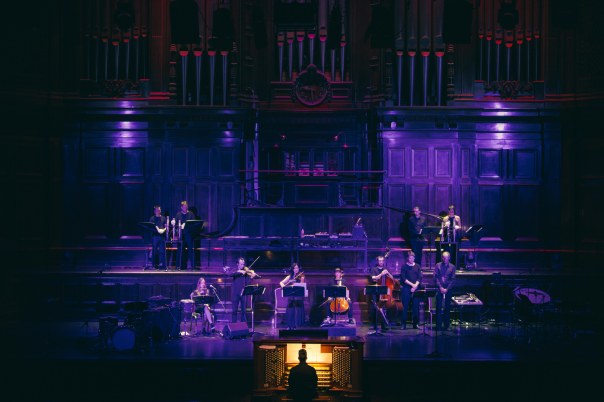
The Australian Art Orchestra spread lavishly across the stage of the Elisabeth Murdoch Hall. The stage bristles with brass, strings, percussion batteries, keyboards, and electronics, each of which toots, rattles, and growls mechanically through the program’s gigantic and complex piano rolls of minimalist music. The Australian Art Orchestra are the country’s masters in flat, pointillistic textures, as the pulsating atmospheres of Peter Knight’s Diomira and the looped vignettes of Austin Buckett’s Virtuoso Pause made clear.

The concert’s featured composer and turntablist Nicole Lizée wields this style to great effect in Hymns to Pareidolia. Pareidolia is the condition of seeing patterns where none exist. Each instrument seems to follow its own loping pace over a walking bass played on the piano. Like a Pollock painting, rhythms of colour and texture jumble together in nonchalant harmony. Then, as though Pollock’s canvas is being stretched and bent, the entire ensemble dramatically slows and increases its tempo like a tectonic tempo rubato. The technique must require remarkable ensemble coordination. Either that, or a great conductor such as Tristram Williams, who led the ensemble through two of Lizée’s pieces with video.

At this point the relaxed, meditative festival was given a shot of red cordial and a smartphone with unlimited Youtube data. Karappo Okesutura is a mashup of edited and spliced karaoke videos (which derives from the full title, which means “empty orchestra”). In her program notes Lizée imagines a scenario where “a karaoke singer takes to the stage to perform an 80’s chart-topper only to find that the karaoke machine is behaving erratically. It begins jumping to different sections of the track, rewinding and stopping without warning. The karaoke tape itself is damaged and warped, yet the singer is still able to keep their composure; they keep up with the machine and finish the song like a professional.” Except it is so much more than that. Each song is masterfully arranged for the ensemble, which accompanies and augments the skipping, warping tape. Lizée loops and lingers on moments of audiovisual oddity, such as the way colour sweeping across a line of karaoke text curves around a “b”, or the strange meatiness of kisses in old black and white movies.

8-bit Urbex was commissioned especially for the concert as an “excavation of the hidden, lost, abandoned, forgotten and destroyed ruins of cities.” In this case the cities are to be excavated from 1980s and ’90s video games and their bleeping soundtracks are combined with other musics of the city, including jazz and ’70s-’80s era turntabling. For me it was a trip down memory lane (and the “trip” is explicitly figured in the work, with someone placing tabs on their tongue with scenes from the computer games printed on them). There is something truly psychedelic about those early computer games, where programmers had to find rough and ready design solutions and create images with the bare minimum of pixels. At one point Lizée repeats two frames in a computer game where the only movement is a sprite opening and closing their pixellated mouth. Elsewhere Lizée adds depth to the orchestral sound, accompanying the skipping soundtrack of a noir-style platform shooter with rich orchestral timbres. My favourite scene, though, was Lizée’s setting of the original Sim City, playing on the satisfying crunch of laying roads in strange, commuter-hellish designs.

From 0 to 100 in three hours, we have entered the cities of Metropolis 2016.

Metropolis New Music Festival
Atticus Bastow, Nick Tsiavos, Australian Art Orchestra
Melbourne Recital Centre
9 May 2016

Syzygy Ensemble and Anni Ha: The 7 Great Inventions of the Modern Industrial Age

We live in remarkable times, though we rarely stop to reflect on this fact. Sally Greenaway’s steampunk infomusical The Seven Great Inventions of the Modern Industrial Age asks us to step back and consider the major technological achievements of the past 150 years. As Michael Orloff tells us in the show’s information-packed brochure, over the last 40,000 years:

  • Only 120 generations have known and used the wheel.
  • Roughly 40 generations have used windmills and watermills.
  • 20 generations have known and used timepieces.
  • 10 generations have known printing.
  • 5 generations have travelled in [steam-powered] ships and trains.
  • 4 generations have used electric lights.
  • 3 generations have travelled in automobiles, used telephones and vacuum cleaners.
  • Only today’s generation [and a half?] has travelled to outer space, used atomic energy, PCs and notebooks and artificial satellites to transmit audio, video, and other information around the globe.

Greenaway takes us through the advent of telecommunication, the Age of Convenience, computing, industrial warfare, modern medicine, and cinema with the help of an adventuring reporter (Anni Ha) and her luddite, morse-coding zeppelin pilot. Ha shares the stage with Syzygy Ensemble sporting 1920s aviation kit and several fantastical stage pieces by Candlelight Productions. As each issue segues neatly into the next, the audience is left with a succinct message concerning the benefits and drawbacks of the technology we take for granted. Have telecommunications really made us feel more connected to one another? The audience ponders this as the ensemble bounces jazzy themes back and forth. We consider how appliances don’t seem to leave us with more free time as fragments of vintage radio ads build into a suffocating crescendo.

As someone of an almost futurist persuasion, I loved seeing the mechanical miracles of the past century and a half paraded before my eyes. But I wondered whether the negatives were understated. Greenaway’s accelerating runs and drifting harmonies capture the thrill we all should feel flying around thousands of feet above the ground in machines with over a million moving parts, but the obvious ecological impacts of international flight were not addressed. It also seemed a bit weak to end a three-movement meditation on the horrors of war with a call to consider the technological advances that war has accelerated. But that was always going to be a difficult episode to segue in and out of and overall the issue of war is handled with sensitivity and tact.

The show’s pedagogical intent is obvious and its value extends to the appreciation of avant-garde musical composition. Greenaway whips out an arsenal of groaning and clashing extended techniques to represent industrial warfare, showing just how affecting these sounds can be when contrasted with tonal materials and inserted into a narrative. Her incorporation of prerecorded material is also effective, particularly when we listen to a scientist describing bursting into tears after implanting the first successful bionic ear. Thanks to the Merlyn Myer Composing Women’s Commission, Greenaway was able to bring together a stellar team of musicians, actors, and producers to create an enthralling and polished work.

The Seven Great Inventions of the Modern Industrial Age
Syzygy Ensemble
Anni Ha
The inaugural Merlyn Myer Composing Women’s Commission
The Melbourne Recital Centre
27 April 2016

Plexus: L’Invitation au château

13120694_10154203620734974_1073284356_o.jpg
Plexus (Philip Arkinstall, Monica Curro, and Stefan Cassomenos) with Helen Morse and Paul English at Cranlana. Photo courtesy of the artists.

Surrounded by autumnal trees, lush lawns, and the Italianate outcroppings of Harold Desbrowe-Annear’s sunken garden, it is easy to forget that Cranlana is only twenty minutes from the city centre. The house is a cultural treasure-trove, with portraits of the Myer family surrounded by Chinese vases and dwarfed by a painting of Captain Cook, Sir Joseph Banks, and the Fourth Earl of Sandwich (yes, that’s the Earl of Sandwich). Described by Lady Marigold Southey as the “family function centre,” none of the Myer family currently live at Cranlana. The building still has the distinct feeling of a home, perhaps due to the steady stream of guests who gather there for lectures, concerts, fundraisers, and masterclasses. On this particular occasion Cranlana opened its doors for Launch Housing, an organisation dedicated to ending homelessness. On the initiative of Josephine Ridges, Melbourne’s serial commissioners of new music Plexus and the actors Helen Morse and Paul English volunteered a humorous and poignant concert combining music and the spoken word.

Launch Housing’s Deputy CEO Dr Heather Holst explained the frequent case of pregnant women accessing housing services because their current living situation is no longer suitable for raising a family. Launch Housing envisages a purpose-built apartment building that not only provides shelter to these women and their families, but also provides them with access to Melbourne’s cultural riches. While Plexus’ program had distinct ANZAC Day overtones, there was plenty to make one consider the themes of home, safety, and belonging.

Stravinsky originally wrote Histoire du soldat (The Soldier’s Tale) “to be read, played, and danced” by three actors and a septet of musicians. The performance may also include dancers contending with Stravinsky’s lively rhythms and constantly changing time signatures. Plexus and English had their work cut out for them and they rose to the challenge superbly. Plexus tore through the piece’s waltzes, tangos, and Stravinsky’s faltering attempt at jazz. English captivated the audience with a truly wicked devil.

The Soldier’s Tale tells the parable of a soldier returning home who trades his fiddle with the devil for wealth. Awakening from his dream of riches, he has been turned into a wraith-like figure who his friends and family can no longer see. In the original Russian tale the soldier is a deserter, but in The Soldier’s Tale his past is ambiguous. We are simply told that he is broken by war. Instead of divine justice, his trade with the devil is almost accidental, the result of seeing a genial enough face after so much hardship. The Soldier’s Tale draws the audience’s attention to the soldier’s experience rather than its cause. We might approach the issue of homelessness with as few preconceptions and as much empathy. A lack of shelter is a basic emergency to be dealt with before the effects of long-term homelessness take hold, including estrangement from one’s family, networks, and invisibility to society at large.

The theme of anonymity continued with the world première of And I Always Thought by the American composer Martin Bresnick. Bresnick is one of the most thoughtful of contemporary composers, treading a line between craft, art, and experiment. The piece takes as its poetic inspiration two poems by Bertold Brecht: “And I Always Thought”  and “Legend of the Unknown Soldier Beneath the Triumphal Arch”. The pathos of the former infects the subject of the latter. I take away from “And I Always Thought” dismay at a grinding condition of existence.

[…] When I say how things are
Everyone’s heart must be torn to shreds.
That you’ll go down if you don’t stand up.
Surely you see that.

The poem’s first phrase is an artistic manifesto in itself: “And I always thought that the simplest words / Must be enough”. But the poem’s last line “Surely you see that” calls the first into question, leaving Brecht’s “simple words” hanging in the air. This question  provides us with a way of interpreting Bresnick’s approach to the second poem. Legend of the Unknown Soldier Beneath the Triumphal Arch describes the relentless pursual of the unknown soldier “from Moscow to the city of Marseilles.” The soldier is captured, killed, and defaced. A monument to war is then built over his body “so that / The Unknown Soldier / In no circumstances stand up on Judgement Day / and unrecognisable / […] pointing his finger, expose us who can be recognised / To justice.” Chilling stuff. In Bresnick’s composition I like to think that the trio plays the role of the soldiers building the arch. Curro lays brick upon brick of slow, rising double-stops. Arkinstall plays a limping, persistent clarinet line. One begins to feel the weight of the growing arch in the dense piano chords. The piece is relentless, but so is war. Bresnick seems to give us a new manifesto for representing a grinding struggle: Simple words, repeated. But is this still enough?

Plexus have a knack of putting together balanced and varied programs and this concert was no exception with plenty of lighter pieces to offset Bresnick’s gravitas. You can almost taste popcorn in the soaring, filmic lines of Robert Davidson’s Lost in Light. A movement from Mary Finsterer’s “Julian Suite” dedicated to the human rights advocate and philanthropist Julian Burnside gave the audience space to reflect while the trees sighed in the wind outside the Cranlana ballroom. The audience was left in high spirits thanks to a hilarious performance of Jean Anouilh’s comedy L’Invitation au château, cleverly adapted and read by Helen Morse. Plexus played the incidental music with all of the good humour due to Poulenc, at times joining in the play itself. And so the audience stepped out of the château a little lighter of heart and pocket, having raised funds for other much-needed homes.

L’Invitation au château
Plexus with Helen Morse and Paul English
Launch Housing benefit concert
Cranlana
1 May 2016

Igor Stravinsky, L’Histoire du soldat; Robert Davidson, Lost in Light; Mary Finsterer, Julian Suite no. 1, movement 1: “Nobility”; Martin Bresnick, And I Always Thought; Francis Poulenc, L’Invitation au Château.

Melbourne Metropolitan Sinfonietta: Midnight Songs

Second-hand musical nationalism emerged as a theme of the Melbourne Metropolitan Sinfonietta’s Midnight Songs program at Melba Hall, with composers arranging and imitating musical styles from Bulgaria, China, Russia, as well as the Communist International.

The 153 pieces making up Béla Bartók’s Mikrokosmos will be familiar to pianists who have jumped through the collection’s graded hoops as students. For this concert the composer and conductor Elliott Gyger gave six of the folk music-influenced tunes an orchestral makeover. Gyger focussed on movements with beats of unequal length, known as “Bulgarian rhythm.” By arranging the pieces for orchestra, it is as though Gyger has “coloured in” the monochrome piano pieces, or enhanced the piano’s limited colour palette. The Melbourne Metropolitan Sinfonetta, conducted by Gyger, painted the piece in beautiful brush-strokes while bringing the pieces’ rhythmic energy to the stage.

Moving east, James Wade’s Midnight Songs take as their inspiration a collection of Chinese yuèfǔ poems written  by an anonymous poet during the Southern Dynasties in the fifth or sixth centuries. The “simple symphonic poem on the changing of the seasons” shows masterful control of tone colour, with overlapping planes of senza vibrato strings melding into clear flute and woodwind tones, all underpinned by the rasping texture of double-stopped cello. The piece appeared to me an orientalist romp, to the extent that the opening, shimmering chords seemed a striking imitation of the Chinese sheng (mouth organ). The Wade explained to me afterwards that it wasn’t his intention at all to imitate the sound of the instrument, which just goes to show how much these interpretations can be in the ear of the beholder.

Julian Yu imitated the style of Shostakovich in Shostakovich’s 16th Symphony (Unfinished). The piece is brimming with clever imitations of Shostakovich’s symphonies, jokes that the ensemble clearly enjoyed performing.

Perhaps the odd one out on this program was Liam Flenady’s Kampflieder. It doesn’t imitate any particular national style, but instead takes as its basic material revolutionary songs from a book given to Conlon Nancarrow when he joined the Spanish Civil War in 1936–7. Nancarrow fought with the International Brigades, an amalgam of liberal-democratic, socialist, and communist anti-fascist soldiers recruited by communist parties around the world. The Kampflieder were also brought together by the Comintern or Third International, even if some of the songs are more obviously communist than others. As was typical of this stage of communism, the book is an attempt to piece together a catholic, international communist culture from diverse nations. Communism, the Kampflieder seem to say, isn’t just something from Russia; it belongs to all.

A selection of these revolutionary songs are given a similarly “generic” treatment in Flenady’s composition. They are not treated with this or that national style, but instead treated with post-serial metrical, harmonic, and structural techniques that were also considered—once upon a time—to hold a certain pan-cultural legitimacy. I’m sympathetic to this idea that the inventions of modernist artists and musicians should be  accessible to all (whether people choose to learn about them is another matter), but like communist axioms their adoption in different contexts can have wildly diverging effects.

Modernist works should also be subject to local evaluation and appreciation. So, did Flenady’s process-based composition work in Melba Hall performed by the Melbourne Metropolitan Sinfonietta and surrounded by various national caricatures? Yes, for several reasons. The piece was an excellent contrast to the lyrical nationalism of the surrounding works. Like a detailed triptych by Hieronymous Bosch, the orchestra is divided into three sections playing in different time signatures, creating a complex rhythmic counterpoint. Against its more conservative foils, the piece also displays adventurous instrumental writing, with seething masses of high violins, wallowing woodwinds, and gritty bass strings. This grandiosity is punctuated by muted percussion, lending the texture a pathetic intimacy. You can’t make out the individual songs, but certain harmonic colours pass like clouds between the orchestral sections. I began wondering where the fight was in all of this textural refinement when a shred of melody turns into a cluster of notes run wild. Before I knew it the orchestra had exploded into a wonderful, blaring mess with a solo piccolo riding atop it with gentle upward glissandi. Not wanting to be too cliché in his socialist anthem, Flenady makes the piece amble to the end.

Modeled on the London Sinfonietta, the Melbourne Metropolitan Sinfonietta are filling an important niche in local musical life. In Midnight Songs they have brought together established and emerging composers for an accessible and challenging program.

The Melbourne Metropolitan Sinfonietta
Conducted by Elliott Gyger
Melba Hall
18 March 2016
Béla Bartòk, arr. Elliott Gyger, 6 Dances in Bulgarian Rhythm; James Wade, Midnight Songs; Liam Flenady, Kampflieder; Julian Yu, Shostakovich’s 16th Symphony (Unfinished).

A musical reply to violence against women

12910250_10154051869826672_170531850_n.jpg
Gemma Tomlinson performs alongside the voice of Kaija Saariaho in Lisa Cheney’s When we Speak.

This year’s International Women’s Day saw institutions and individuals around Australia actively intervene in the contemporary music scene in the interests of gender equality. Today (just as a couple of years ago when gender equality was addressed on this blog) around a quarter of the composers studying, represented in concerts, and represented by the Australian Music Centre are women. As Delia Bartle wrote for Limelight Magazine, The Sydney Conservatorium’s new National Women Composers’ Development Program seeks to boost this number by providing emerging composers with two years of intensive mentorship followed by a prestigious commission. Lisa Cheney and Peggy Polias from Making Waves curated a special playlist featuring women composers including Clare Johnston, Maria Grenfell, Annie Hui-Hsin Hsieh, among many others.

In Melbourne, the composer Samantha Wolf produced a concert fundraiser for the Safe Steps Family Violence Response Centre. Entitled This Will Be Our Reply, the concert featured five thoughtful responses to the theme of International Women’s Day and violence against women in particular. Each of the five composers eschewed clichés to present an original musical response to these themes.

“Shrill, pretty, abrasive.” In Hystericus—and other (mostly) women’s words, Alice Humphries uses the language of contemporary music—its squawking, gritty vocabulary—to make the audience think about words often associated with women. In doing so, Humphries has created one of the most conflicting situations for the listener since Shostakovich’s Fifth Symphony. A listener sympathetic to grating and buzzing extended techniques may draw comparisons between criticisms of contemporary music and misogynist language. “Too loud and complex!” “But you are choosing to focus on only particular, difficult pieces of music,” the audience member might counter. Or they might offer my favourite response (misremembered but courtesy of Adorno) “maybe you understand contemporary music too well, because it is speaking about real problems.”

A misogynist audience member (keeping in mind that misogyny and a taste for contemporary music are not at all mutually exclusive) might instead bring up the Lacanian dynamic of the Master and the hysteric often associated with the relationship of the critic and the artist. No matter what explanation or interpretation the psychoanalyst gives to the hysteric’s words, they will always counter “that’s not it.” “Exactly!” The misogynist new music skeptic might respond, “It is in the nature of both contemporary music and women to be unreasonable, repetitive, and exhausting!” In her program note Humphries doesn’t offer an interpretation of her own but lets all of these subject-positions linger in the air. Whatever your interpretation the compositional experiment was extremely satisfying to the ears, with two thirds of Rubiks Collective (Tamara Kohler and Gemma Tomlinson) teaming up with the rich tone of Kyla Matsuura-Miller’s violin and Aaron Klein’s bass clarinet to run a gauntlet of musical textures and moods.

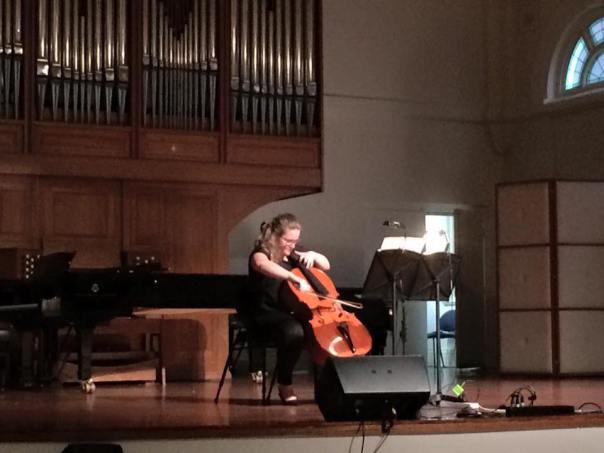
After playing on stereotypes of women’s voices, Lisa Cheney brought us the voice of a woman, indeed, one of the greatest living woman composers. Cheney’s When We Speak combines live and prerecorded cello with a manipulated recording of an interview with Kaija Saariaho. While Saariaho’s voice is usually manipulated for its sonic value, moments of Saariaho’s reflections on gender politics in the music industry are clear. Cheney’s resonant electronics part is an atmosphere of unfathomable spaciousness. Clouds of voice fragments swirl around the space along with clouds of her solo cello composition Sept Papillons. In the middle of this environment the cellist Gemma Tomlinson struggles to be heard, playing strings of extended techniques with her characteristic commitment and control. At times the live cello becomes one with the prerecorded track or has a fleeting solo moment. This piece could be heard as a solo woman struggling to be heard in the male-dominated music scene, except all of the samples are of women and the piece is composed by a woman. It could also be heard as a woman engaging or even struggling with the history of women composers and the weight of Saariaho’s legacy. The piece ends with one solution, in Saariaho’s voice: “Create something personal because that’s the only thing that counts.”

Kyla Matsuura-Miller returned to the stage to perform Jessica Wells’ Sati and Satya, a two-movement piece for piano and violin inspired by Buddhist notions of “mindfulness” and “truth” respectively. The piece relates in a very concrete way to the concert’s theme, the first movement being composed for HSC students and requiring a certain tonal restraint. The “truth” movement expands on these restrained ideas in a more personally meaningful way for the composer. The composer likens this process to the way she finds herself moderating her behaviour to suit social norms and the difference between one’s “inner” and “outer” selves.

May Lyon’s On the Inside begins with a similar duality before expanding on this theme in multiple directions. The piano trio for flute, clarinet, cello, and piano is a journey of developing harmonic and rhythmic nuance. From simple thematic beginnings the piece gathers colour, variety, and character. Beneath this fine instrumental writing is a sophisticated critique of notions of beauty and gender roles. The piece’s title, On the Inside, suggests a binary between inner and outward  beauty, but the composer is quick to point out that many conventionally “beautiful” moments in the piece have been retained because “perceived beauty is not something to be ashamed of or feared.” Instead of simply busting the binary of inner and outer beauty, the piece explores “a woman’s life, from growth to complexity (as opposed to innocence to uselessness).” Lyon also contrasts the view of a developing, rich inner life to other supposedly emancipated, developmental views of a woman’s changing social value as maiden, mother, and crone.

Samantha Wolf’s The More I Think About It, the Bigger It Gets closed the evening with an affecting theatrical gesture. Footsteps resound through the speakers while Kohler, Tomlinson, and Matsuura-Miller attack their instruments with darting gestures. Audio samples from news reports and talk-back radio describe acts of violence against women, placing the blame on women’s shoulders. The program note described the footsteps and musical gestures as representing a woman walking home at night and the fears and received rhetoric that swirl around her mind. The tension was palpable, showing yet another way in which the techniques of contemporary music can be used as critical tools for interrogating issues of gender and violence.

This Will Be Our Reply
A Fundraiser for the Safe Steps Family Violence Response Centre
Melba Hall7 March

Alice Humphries, Hystericus—and other (mostly) women’s words; Jessica Wells, Sati and Satya; Lisa Cheney, When We Speak; May Lyon, On The Inside; Samantha Wolf, The More I Think About It, the Bigger It Gets.

Do You See What I Hear?: If I am a Musical Thinker

CarmenChan_If_I_am_a_Musical_Thinker_LaMamaMusica2016_imagebyAdamCasey.jpg
If I am a Musical Thinker. Photo by Adam Casey

The latest installment in Carmen Chan’s experimental music/visual art/performance art project Do You See What I Hear? took place on someone else’s stage. La Mama squeezes its music series around the scenery and props of current productions, leaving Brigid Burke’s projector, Warren Burt’s tangle of electronic gear, Adam Simmons’ arsenal of wind instruments, and Chan’s cello intimately perched in front of an enormous screen.

The American composer Benjamin Boretz originally wrote If I am a Musical Thinker in 1981 for his graduate students at the University of Texas. The aesthetic, social, and spiritual credo is one of the most influential documents of 1980s experimental art and was here spoken by Clinton Green alongside improvised music and video.

I have to confess that I haven’t had the pleasure of reading Boretz’s text. It wasn’t part of my own graduate program and I haven’t had the opportunity to chase it up since the concert. As such, what follows relates only to what I remember from the concert and is probably a misrepresentation of Boretz’s actual words.

The text begins with a phenomenological epoché, a momentary suspension of all preconceptions about musical experience. “If I am a Musical Thinker,” the audience heard, “I want to know what it is I am thinking about.” The musicians strike up a beautiful and spacious atmosphere: whisper-soft clarinet, rubbed clay pot and the odd electronic sound. Boretz heads straight for a teleological or ends-oriented definition. Music is a medium of expression. Like Leonardo DiCaprio in The Revenant, Boretz begins If I am a Musical Thinker at the farthest reaches of his journey and then has to find his way home by an unfamiliar route (but hopefully in less horse carcasses). If music expresses, what does it express? Identity. How? In one of my favourite lines Boretz asserts that expression is not just “raw evacuation” of identity. Instead, we form our selves in relation to and through pre-formed musical conventions. Boretz posits a dialectical world of musical discourses negating one another. Against this headlong pitch into abstraction a recording of Boretz’s text is layered and amplified in a trippy web of voices.

Eager to return the individual into the mix, Boretz turns to the experience of listening to these discourses. When we listen we recompose the music we hear, reacting to it insofar as its forms are already within us. For this performance Burt has sonified the ink blot illustrations throughout Boretz’s text and turned them into a bank of different sound effects. Like ink blots, we try to match music to our ever-evolving and complex bank of musical experiences. In this way “music,” Boretz argues, “expresses us.” I understand this in the same way that something enrages us. The external object resonates with a pre-existing bias. We do not use the term “enjoy” in the same way (one enjoys something, not the other way around), though I think it would be nice to say that a piece of music “enjoys us.”

The essential musical unit is then not the musical work, but the musical occasion where this magnificent process of reflection-recomposition takes place. The reason for the musicians’ live semi-improvised performance then becomes clear. While Boretz is arguing that all musical experience follows the model of the musical occasion, an improvised performance provides the opportunity for a form to be dredged out of one consciousness and—hopefully—communicated to another. The black and white drawings and text of Burke’s projections give a hallucinatory, half-significating feel to the swirling mass of musical forms taking place before us.

Boretz opens the discussion out, making some judgements about music education. He claims that in the brow-beaten world of conservatorium education the urge to express oneself is transferred on to the need for external approval. Discipline replaces engagement. And so Boretz finds his way home a little wiser and a little bloodier, claiming that his original decision—that music is expression—is important because expression is the key to our musical salvation.

But this is precisely the problem with Boretz’s method. His return journey is only used to justify—rather than question—his original decision. This method will be familiar to anyone who has walked to a 7-Eleven for milk and returned with a jar of Nutella. When Boretz set out on his thinkspedition he already knew deep down that he wanted Nutella, so that’s what he got. Evidently he had pre-formed opinions on the hot-housing methods of some music institutions and fabricated the scenario of an unbiased phenomenological investigation to bolster them. I would like to see this text turned around. A future Do You See What I Hear? performance could start at the end, looking for the reasons behind musician burn-out. They could ask why musicians emotionally disengage from their musical experiences when placed in a highly critical environment, coming to the conclusion that they have divorced their need for musical expression from their musical practice (it all seems fairly redundant and self-explanatory this way around doesn’t it?). Then, instead of the walk of shame, they should walk straight out into the wilderness asking the tough questions: Are composing, playing, and listening really comparable experiences for the individual? How about for different people? To what extent can two people claim to have the same musical experience? Does Boretz discount experiences that we might like to call “musical,” but which do not correspond to affective states at all? These are huge questions raised by just the first sentence of Boretz’s text. I think I’ll leave them until I get back from the shops.

If I am a Musical Thinker
Do You See What I Hear?
La Mama Courthouse Theatre
15 February 2016

Australian Art Orchestra and Ensemble Offspring: Exit Ceremonies

AAO-ExitCeremoniesConcert_IMG_2681_MiaForrest.jpg
Ensemble Offspring and the Australian Art Orchestra perform Alvin Lucier’s Swings. Photo by Mia Forrest

The grand organ is a true feat of engineering. Most concertgoers won’t realise that behind the organs gracing our town halls and churches are chambers containing forests of pipes of different shapes and sizes. Some bass flues are so large you have to climb inside to clean them, while each pipe needs to be meticulously maintained and tuned. The organists who harness this incredible machinery have to contend with baffling lag times and instrumental idiosyncrasies, but the outcome is an astonishing timbral palette. Given the awesome presence of these instruments, their history, and the considerable expense involved in maintaining them, it is surprising that so little contemporary music has been written for them. One thinks of Messiaen, Ligeti, and Xenakis, but there most people’s knowledge of contemporary organ repertoire stops. The Australian Art Orchestra and Ensemble Offspring’s recent commissioning program for new organ works is therefore of international importance. The AAO and Ensemble Offspring’s performance at the Melbourne Town Hall was the first complete showing of the program, including the world premiere of a work by the “phenomenological music” pioneer Alvin Lucier.

Austin Buckett’s Aisles begins with a stunning, brassy explosion involving the whole ensemble of strings, percussion, trumpet, turntables, voice, and organ. The sound echoes off the back of the hall (or was that the live sound processing?), giving it a wave-like, viscous force. The instruments’ differing levels of decay give the wave a shimmering, multicoloured tail. The piece progresses by looping such gestures and then juxtaposing blocks of loops. The interstellar explosions are replaced by Sonya Holowell’s solo voice singing intimately into a microphone. A cavernous, spacious racket returns for a while before we finally hear the common, pitched sound of the organ. It is a high wail above the ecstatic chatter of ride cymbals played by Claire Edwardes and Joe Talia on either side of the stage. So the dynamic atmospheres of Aisles continue, a ritualistic procession as varied as it is enchanting.

Simon James Phillips’ Flaw begins with Martin Ng performing some of the quietest turntabling that you have ever heard. Breathy hums (from the organ perhaps?) are slowed down to subsonic frequencies then back into a somnambulent mid-range. Edwardes plays a shell chime and the sound is captured and transformed to sound like rain. Among this artificial pastoral scene a prerecorded bird can be heard. This meditation on technology and the natural world continues for half an hour, with swelling, arpeggiating strings and crackling speakers slowly rising and falling in the hazy texture.

Flaw and Lucier’s Swings make for an interesting juxtaposition. Simple ideas and static textures can be either numbingly boring or deeply fascinating. There is a thin line between one and the other, a line that no doubt shifts from individual to individual. Swings is based on one idea: shifting the pitch and timbre of an organ pipe by covering the open end with one’s hand. For the performance at the Melbourne Town Hall, six pipes were extracted from the bowels of the grand organ and mounted on stage, connected to the mothership through snaking black umbilical cords. The overall effect begged comparison with an H.R. Giger illustration. Four performers stood around the pipes, their hands clad in white gloves like surgeons or museum curators (scaaaary museum curators!). The strings and organ provided a steady drone as one by one the performers slowly bent the pitch of each pipe. Subtle beating filled the air. I was mesmerised as each new pipe modulated the sound of the others and the instrumental ensemble. So used to listening for pitch and rhythm, new dimensions of sound unfolded for the listener as the overall timbre became more complex with the introduction of each new pipe. At the central climax of the piece the air becomes alive with what seem aural hallucinations. Mobile, distorting, ringing ghosts of tones fill the hall. Then the sound is disassembled tone by tone. It was fascinating as an audience member to witness the construction of this sound that turned out to be so much more than the sum of its parts.

Exit Ceremonies
The Australian Art Orchestra
Ensemble Offspring
Melbourne Town Hall
6 February 2016
Austin Buckett, Aisles; Simon James Phillips, Flaw; Alvin Lucier, Swings

Another Other: A self-fulfilling prophecy about the death of art

Image 1_Chamber Made Opera –Another Other_Caption – Erkki Veltheim, Sabina Maselli, Natasha Anderson and Anthony Pateras_Credit – Jeff Busby.jpg
Erkki Veltheim, Sabina Maselli, Natasha Anderson and Anthony Pateras in Another Other. Photo by Jeff Busby

Waiting in line at the North Melbourne Meat Market, I spot the corpse. A humanoid shape lies wrapped in black plastic bags. The sound of clocks (or are they shovels?) emanate from it. A program essay by Ben Byrne tells us it is the body of art. He quotes Ingmar Bergman (The Snakeskin, 1965) who claims that art is basically unimportant, deprived of its traditional social value. Like a snakeskin full of ants, art is convulsed with the efforts of millions of individual artists. Each artist, including Bergman himself, is elbowing the others “in selfish fellowship,” in pursuit of their own insatiable curiosity. To celebrate the fiftieth anniversary of Bergman’s film Persona, Natasha Anderson, Sabina Maselli, Anthony Pateras, and Erkki Veltheim have crawled inside the film’s 79-minute skin.

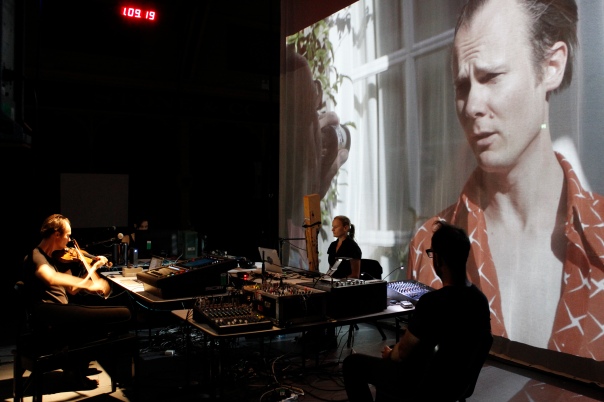
The four artists sit facing each other beneath red digital clocks counting down the opera’s duration. Pateras works his Revox B77: a machine with a loop of tape and multiple heads that can be manipulated live to produce a stunning array of sounds. Veltheim nurses his violin, which he processes through a laptop running  MaxMSP. Natasha Anderson festoons her Paetzold contrabass recorder with an array of sensors and microphones. Sabina Maselli commands an arsenal of projectors and spotlights, including reels of custom-shot 16mm film.

Once inside the film’s skin, the collaborators throw out its organs of character and plot. The artists instead motivate its mise-en-scène. Maselli’s deeply-textured footage of hands, faces, and landscapes mirror Bergman’s own sumptuous images. The close-miked sounds of violin, recorder, and water echo the conspicuous detail of 1960s foley. Spoken text references monologues in the film, notably Alma’s story of a foursome on a beach. And so the ideas cycle: hands—faces—landscapes—text, interspersed with solo episodes for each performer, until the time runs out.

Image 2_Chamber Made Opera –Another Other_Caption – Anthony Pateras and Erkki Veltheim_Credit – Jeff Busby.jpg
Comparing hands. Don’t they know it’s bad luck? Photo by Jeff Busby

After the third extended shot of intertwined hands, I wondered whether the artists were labouring under a category mistake. Texture and materiality were the bread and butter of contemporary arts throughout the 1980s and 1990s, but the structures of plot and character are surely now considered as much part of the artistic “surface” than image and sound. Thanks to the fashion of basing new music on old films, there are counterexamples. For instance, Alex Garsden’s Messages to Erice I & II, which uses the familial relationships of the characters in Víctor Erice’s 1973 film El Spíritu del Colmena to structure the algorithmic relationships of four amplified tam-tams.

By throwing out plot and character, the creators of Another Other struggle to address the original film’s themes of identity, motherhood, art, and being. The film’s iconic shot of Elisabet and Alma’s juxtaposed faces is critical of traditional gender roles precisely because the characters struggle with those roles. The repeated superimposition of the artists’ faces in Another Other is less critical than narcissistic.

While stating that art’s traditional social function is dead, Bergman’s essay affirms the personal significance of art, a belief that is reflected in Elisabet’s first scene in Persona. Elisabet is an actress who stops speaking because she harbours a burning will to live authentically and shake off the role of motherhood. She laughs at a radio soap but seems affected by a piece of music. In Another Other no such distinction is made between inauthentic and personally authentic art. Veltheim plays the Chaconne from J.S. Bach’s violin Partita no. 2 while the artists’ faces are shown through a day-time soap vaseline lens. I will accept that universally authentic art is impossible, but I struggled to find even an affirmation of personally authentic art in Another Other. Unsure of the artists’ belief in their own work, I failed to commit as an audience member.

After fifty minutes I even started believing that art was dead. Thanks to the clocks high above the stage I could regret every minute left. The saddest thing was that I respect the work of each artist in their own right. But four good artists in a box does not an opera make. At the end of Another Other the artists imagine a different ending to the film. The doctor says that Elisabet’s silence was just another role that she sloughed off in the end, not a real existential crisis. She was perhaps also depressed and infantile. The doctor concludes “But perhaps you have to be infantile to be an artist in an age such as this.” I laughed. It made me particularly glad I trusted them with an hour and a half of my life.

Another Other
Chamber Made Opera
Meat Market
18 February 2016
Natasha Anderson, Sabina Maselli, Anthony Pateras, Erkki Veltheim.

Rubiks and Forest Collective: Sunrise

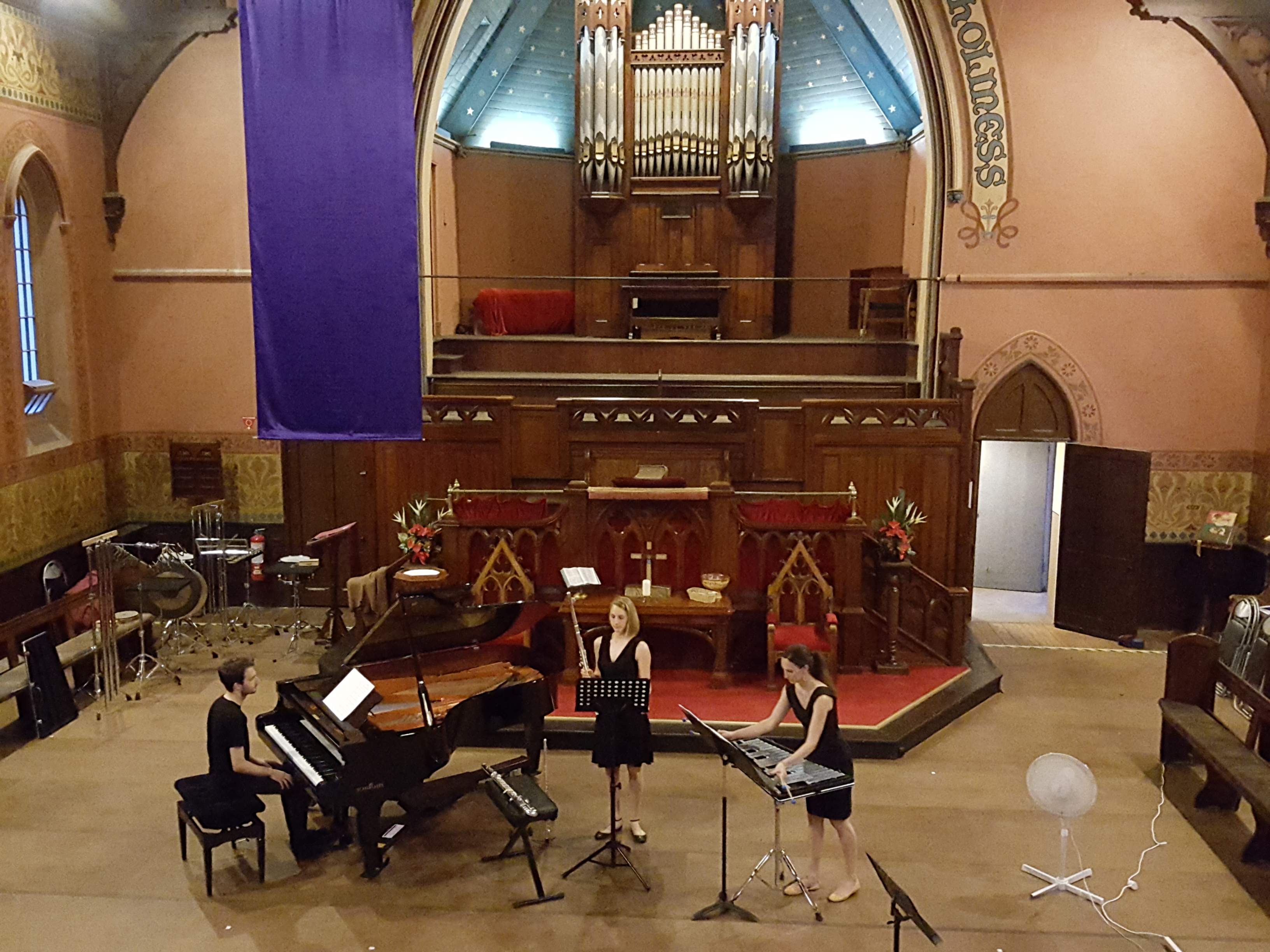
Rubiks set up for Morton Feldman's Why Patterns? on a steaming-hot December evening.
Rubiks set up for Morton Feldman’s Why Patterns? on a steaming-hot December evening.

Forest Collective teamed up with their ensemble in residence Rubiks to provide a folk-inflected final concert of 2015.

Michael Bakrnčev’s The Virtuous Woman with the Watermelon is a lighthearted piece for narrator and small ensemble based on a Macedonian folk tale. Commissioned expressly for this concert, the piece was an appropriate companion to Berio’s Folk Songs. The narrator (Stefanie Dingnis) tells the story of the ideal married couple receiving visitors, but all is not as it seems. The fussy husband constantly sends his wife back to the market to buy a better watermelon for their guests and the wife simply returns to the kitchen and polishes the watermelon until the husband declares that she has indeed found the very best watermelon in town. I’m not sure what the moral of the story is. Don’t be a demanding partner? Do make pragmatic shortcuts? “The husband and wife are a team” explained Bakrnčev after the concert, the story hinging on our guessing at the husband’s knowledge of the wife’s actions and the slow transformation of the meaning of the word “virtuous” in the story’s title. Bakrnčev accompanies the story with a mock-military march. A flute trembles stertorously over a snare drum. At one point the narrator vocalises beautifully over a cheery piano tune. Next to the Folk Songs Bakrnčev’s musical accompaniment sounded very light indeed.

There is always time for another performance of Berio’s Folk Songs. In arranging eleven folk songs from the United States and Europe (including two original compositions), Berio sought “a unity between folk music and our music.” I assume that by “our music” he means contemporary art music rather than the classical tradition more broadly. Berio surrounds the folk tunes with an atmosphere of extended techniques evoking natural environments. Thorny instrumental interjections paint a sound-world far removed from the singing tones of a modern orchestra. Does the listener really hear the spirit of ancient music brought alive to modern ears, or a fantasy of a lost world? Whether real or imagined, in 1964 Berio constructed a bridge between pre-modern tones and the overblown, underbowed techniques  of contemporary music. This bridge has since grown to a widely acknowledged superhighway between early and contemporary music. The Folk Songs may have been a striking statement in 1964, but this conduit has now passed over into ideology and is ripe for interrogation.

Today’s culturally-aware listeners are sensitive to issues of cultural appropriation. Performers need to carefully balance their preconceptions of ancient and modern music. Too “folksy” a performance and the performance will slide into parody, too straight a performance and the songs will lose much of their appeal. Stefanie Dingnis chose a relatively restrained performance style, letting the beauty of the tunes speak for themselves. Dingnis came alive in the Sicilian song “A la femminisca” with its clashing, explosive opening that cannot be mistaken for anything but an invitation to let loose. The ensemble, conducted by Evan Lawson, provided plenty of colour in their masterfully balanced accompaniment. The sensitive articulation of harpist Samantha Ramirez and thrilling execution of the piece’s signature viola solo by Anthony Chataway deserve special mention.

Listening to and watching old recordings, I wonder whether anyone could or would want to perform the Folk Songs with the same accents and dance moves today as the Songs‘ dedicatee Cathy Berberian.

The concert also included a stunning performance by Nicholas Yates of Berio’s Sequenza VIIb for soprano saxophone. The piece’s drone was provided by string players spaced around the Richmond Uniting Church. So subtle was their movement and quiet was their playing that I became conscious of the ethereal sound over a minute or so. What a beautiful effect. Yates’ agile execution of the popping, pointillist piece was something to behold! The concert concluded with Morton Feldman’s Why Patterns? performed by Rubiks Collective. Jacob Abela (piano), Tamara Kohler (flute), and Kaylie Melville (percussion) move through their sparse parts at their own rate, coming together at certain  vertiginous moments. These meeting-points become moments of great focus as the performers become aware that they are a page or so away from each other. The performers have to make so many decisions in executing their part that I was put in mind of Alistair Noble’s recent lecture on Feldman at the Melbourne Music Analysis Summer School. Noble argued that, given the tight-knit community within which Feldman’s works were composed and performed, he assumed a certain stylistic palette when composing indeterminate elements in his works. For the most part we cannot hope to—and may not want to—recover the assumed stylistic traits of the early performances of Feldman’s works, but there is certainly interesting work to be done in that direction.

Sunrise
Rubiks and Forest Collective
Richmond Uniting Church
19 December 2015

Michael Bakrnčev, The Virtuous Woman with the Watermelon; Luciano Berio, Sequenza VIIb, Folk Songs; Morton Feldman, Why Patterns?