Category Archives: Reviews

Partial Durations is a Matthew Lorenzon/RealTime joint project.

2016BIFEM: Argonaut Ensemble, Seeing Double (2)

(C)Jason Tavener Photography HARP G UITAR DOUBLE CONCERTO_MG_1126
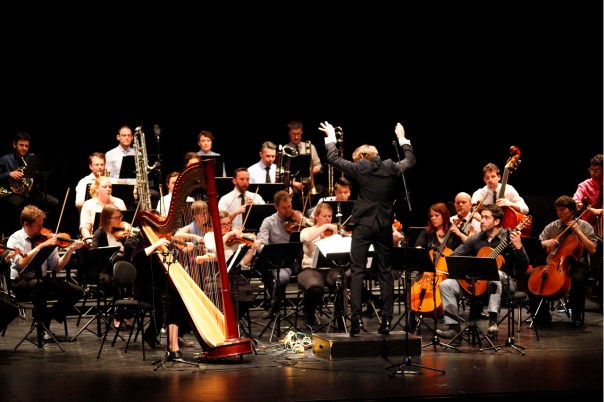
Argonaut Ensemble, Maxime Pascal conductor, Harp Guitar Double Concerto by David Chisholm, Jason Tavener photography

Review by Alex Taylor

Bendigo’s Ulumbarra Theatre, a converted jail, may soon be home to BIFEM’s resident Argonaut ensemble on a more permanent basis. At Friday night’s opening concert Seeing Double, Bendigo festival founder and featured composer David Chisholm waxed lyrical on the “criminal” lack of this kind of permanent new music infrastructure. “All criminals need to be brought to justice, and this is the jail where that can happen.” BIFEM’s opening double bill of double concerti showed us both the possibilities and temptations of that infrastructure, embodied here by large, skilful instrumental forces and consummate soloists and conductors; a veritable toybox for two precocious postmodernists.

Jack Symonds’s Decadent Purity is a work that attempts to blend quite disparate elements. At the outset a cloud of high harmonics hovers over a stop-start grumble of double bass and contrabass clarinet, opening up a chasm of registral space and spectral colour. The two solo instruments, too, carve opposing roles; the viola d’amore draws out its long line against percussive exclamation marks: elaborated argument against decisive punctuation. The first of seven movements also sets out another more uncomfortable dichotomy: two harmonic worlds in combat. A sturdy neo-Baroque tonality, reminiscent of Arvo Pärt’s Fratres, is pitted against the subtle slippage and inflection of microtones and textural nuance. It’s a promising collision.

Both soloists hold the drama of the work in their phrasing and movements. James Wannan sways on tiptoe, his viola d’amore an ornate, many-stringed creature of clear resonance and line, making the most of the acoustic at the front of the Ulumbarra Theatre stage. Wannan’s approach embodies the decadent purity of the title, imbuing Baroque details with a rich, almost Romantic sensibility. Percussionist Kaylie Melville moves with a pixie swagger, each entry dashed off with a cutting, almost sardonic precision. But her role for the most part remains one of commentary and fleeting gesture, unable to enter the harmonic and melodic realms that form the bulkhead of the work.

As captivating as the soloists were to watch and listen to, the dramaturgy and flow of the work itself at times seemed forced, imposed from above rather than extrapolated from the rich materials already at play. You couldn’t help but be seduced by sighing herds of ascending or descending microtones, but these remained as fixed objects rather than catalysts for generating gesture. The restraint and sensitivity of more spacious sections (for example the penultimate movement with its slow-moving scales) was several times undercut by overtly dramatic tropes. High-energy toccatas recurred throughout the work, most forcefully in the final movement where the marimba propelled us, no, forced us, towards cadential release.

The attractiveness of Symonds’s work is undeniable, but the promise of that initial collision of soloists, ensemble and the stylistic strains of both Baroque and modernist Avant-Garde is ultimately left unfulfilled.

David Chisholm’s Harp Guitar Double Concerto seemed a more natural and less masochistic pairing than viola d’amore and percussion: here were two forces of equal dynamism and resonance. A striking, hard-edged opening hints at the diverse gestural possibilities of those two soloists. Rapid pinball glissandi in the brittle high reaches of the harp answer a deep upward sweep in the guitar.

Like a flickbook, the opening cuts rapidly from gesture to gesture, often blurring in the orchestral maelstrom of an expanded Argonaut Ensemble. You get the sense that this is a kind of pastiche, but not of direct quotation, or even of particularly strong stylistic allusion. Occasionally more distinctive slivers poke through: swaggering muted brass recall Miles Davis, and later a frantic viola solo has echoes of Elliott Carter, a haywire cog spinning in the wrong machine. These are relatively rare moments, and you sense there might be a wealth of such detail hidden amidst some ambitiously thick, even clumpy textures. These aren’t helped by an acoustic that threw the soloists into relief at the front of the stage, while damping the intricacies beyond the proscenium arch.

For much of the work, the action continues in postmodern pile-up fashion, impulsive, rather than linear, time hammered out ecstatically. For a time, this was immersive, like those pools of plastic balls you used to get at some adventurous fast food chain playgrounds, a liquid made of solid objects. But as the piece progressed there was a more and more present feeling that these gestures, constrained as they were in a four-square metric scheme, rarely got beyond fragments. You have to say too that the obvious talents of conductor Maxime Pascal were utilised sparingly with so much martial time-keeping. However within the relatively square metric scheme, Pascal was able to draw out a range of bold shapes and colours from the ensemble.

It wasn’t until the fluid, effortless harp cadenza, a dazzling display of delicacy both from Chisholm and from harp soloist Jessica Fotinos, that we glimpsed an interior alternative to the glitzy, pluralistic mass offered by the front half of the work. Even though, like the rest of the piece, it might have benefitted from more space and breath, the finely crafted but rather lengthy cadenza allowed us to pivot towards lyricism and fragility. Out of the cadenza came a positively decadent cor anglais duo from Jasper Ly and Benjamin Opie, foreshadowing their oboe heroics at the exquisite, abrupt ending. In turn the cor anglais led us tag-team into a nostalgic, washed-out kind of texture, strings fluttering between solid pitches and combinations of ethereal partials.

The guitar soloist, Mauricio Carrasco, also had a chance to show off his solo chops, delivering both sheer brutality and lyrical nuance in a much shorter but no less impactful cadenza. In fact, it contained to my mind the evening’s most sensitive, fantastical moment. Out of the resonance of guitar harmonics came a delicate veil of sound, initially difficult to place but revealed as a falsetto vocal hum from Fotinos across the stage. The harmonics and falsetto continued, a true interior world, almost haunting in a fragile continuity against the flamboyance of what had come before. After a brief and brutal swansong in the guitar, we returned to that interior, but more confidently, as if a fresh discovery has been made. Over a breathy mass of sustained string harmonics, the oboes asserted this new, insistent lyricism: at the very end, a way forward.

Seeing Double
The Argonaut Ensemble
Bendigo International Festival of Exploratory Music
Ulumbarra Theatre
2 September 2016
Jack Symonds, Decadent Purity; David Chisholm, Harp Guitar Double Concerto

Jack Symonds, Decadent Purity (James Wannan Viola d’amore; Kaylie Melville, percussion; Jack Symonds, Conductor)

David Chisholm, Harp Guitar Double Concerto (Jessica Fotinos Harp; Mauricio Carrasco Guitar; Maxime Pascal Conductor)


2016BIFEM: Argonaut Ensemble, Seeing Double (1)

cjason-tavener-photography-decadent-purity_mg_1054
James Wannan performs Decadent Purity, Jason Tavener Photography

By Zoe Barker

The world premiere of two new Australian double concerti was a bold way to open the BIFEM festival. The inherent juxtapositions allowed by the medium, including the relationship between the two soloists, and their interaction with the chamber orchestra, were explored in different ways by composers Jack Symonds and David Chisholm. With both composers writing for unique instrumental combinations, Symonds’ Decadent Purity pairing viola d’amore with percussion, and Chisholm’s work for harp and guitar, there were many opportunities for an absorbing musical dialogue.

 Symonds’ manipulation of range and timbre was one of his work’s most striking aspects. The chamber orchestra was scored for instruments which reflected the extremes of their families—bass flute paired with piccolo, clarinet with contrabass clarinet, and a string section comprising two violins, two celli and a double bass. Opening the work, the viola d’amore soloist James Wannan was joined by the two orchestral violins playing pure dissonant tones at the top of their registers. The addition of bowed vibraphone created an ethereal sound world, and the entrance of the double bass at the depths of its range created a sense of open space ready to be filled by the soloists. This feeling of envelopment continued throughout, with the viola d’amore often given the space to fill in the registral gaps. Not only was this interesting scoring, but a clever move from Symonds. By eliminating instruments of a similar range, the mellow tone of the viola d’amore had no problem cutting through the small orchestra.

The strengths of the performance owed much to the inspired interpretation of the two soloists. Wannan approached sections of the work with the energy of a violinist playing a Romantic concerto, with virtuosic chordal passages and series of string crossings executed with flair. Crucially, he also knew when to pull back and play with a sense of fragility, blending with the small chamber orchestra. Kaylie Melville mesmerised with her dancing movements among the large percussion set-up, and demonstrated an extraordinary ability to impart a sense of musicality to even the smallest gestures. With so much material for Wannan to delve into, the percussion line unfortunately seemed underdeveloped in comparison. Sporadic snatches of marimba and vibraphone played a supporting role to Wannan’s line, as did the work of Melville’s untuned percussion, but the instruments were never an equal partner in the concerto.

Symonds explored many musical ideas within the work, ranging from the delicate opening to the parodic sections underscored by steady percussion beats, and those of a more modernist idiom with alternate agitated stabs from the soloists and orchestra. While each section had merit and interest, the work attempted to draw together too many disparate elements—perhaps inevitable given the task of featuring a baroque instrument alongside the very twentieth century concept of a percussion solo. Those sections which slowly unfurled, exploring the timbral qualities of the unusual instrumentation could have been developed further. The section towards the end using slow scales climbing through the ensemble was one of the most effective in this way, and it was moments such as these where the work’s title, Decadent Purity, was most strongly reflected. These glimpses of purity could be identified at points throughout, coming through especially in the upper strings, providing moments to savour.

For David Chisholm’s new double concerto, the Argonaut ensemble swelled to a 29 piece chamber orchestra, suggesting that this piece might be more decadent than the first. Opening the work with flamboyant gestures from the two soloists, Chisholm launched into a spirited postmodern pastiche, with different musical ideas emerging at once from all sections of the orchestra. The scoring for the solo instruments often enhanced their timbral similarities, heightening the playfulness of the work by adding an element of aural ambiguity. A concern in the opening, and other fairly densely scored sections in the work, was the ability of the guitar to be heard over Chisholm’s sometimes heavy-handed orchestration. While the harp benefitted from its greater natural resonance, the guitar was often lost.

Harpist Jessica Fotinos fully drew out the different facets of the work, excelling in sections of contemporary harp writing featuring extended techniques as well as making the most of more traditional passages with her lyrical playing. The harp cadenza was a point of serenity in an otherwise busy work, with her expressive performance commanding attention. Guitarist Mauricio Carrasco also managed to capture the many different idioms and styles demanded of him, ranging from agitated strummed passages to quasi flamenco chords, traditional classical guitar technique and a humorous passage of slide guitar.

While the cadenzas proved to be great vehicles for demonstrating the talents of the two soloists, their sheer length impaired the flow of the work, the content doing little to distill or clarify the many layers of material presented in the orchestral sections. These often proved overwhelming, with little distinction between the snippets of stylistic allusion layered in the dense score.

While a fuller string section would have benefitted this work, the existing players demonstrated their sound abilities through divisi passages requiring all violinists to act as soloists. A strong woodwind section was headed by oboists Benjamin Opie and Jasper Ly, who impressed in their unusual double cor anglais solo following the harp cadenza, and their unexpected heroic oboe line to finish the work. Interjections from trombonist Charles MacIness added both humour and darkness to the piece, and were supported by a very strong bass woodwind section. The Argonaut Ensemble in its new large format confirmed its position as an exciting voice in Australian contemporary music making.

By Zoe Barker
As part of the 2016 BIFEM Music Writers’ Workshop

Seeing Double
The Argonaut Ensemble
Bendigo International Festival of Exploratory Music
Ulumbarra Theatre
2 September 2016

Jack Symonds, Decadent Purity (James Wannan Viola d’amore; Kaylie Melville, percussion; Jack Symonds, Conductor)

David Chisholm, Harp Guitar Double Concerto (Jessica Fotinos Harp; Mauricio Carrasco Guitar; Maxime Pascal Conductor)
Phoebe Green and Leah Scholes: The Arrival

While viola and percussion were traditionally supporting parts of the orchestra, the twentieth century saw composers rediscover their unique musical possibilities. If the viola came a little later to the contemporary music party, it has certainly received recent attention in Melbourne with Xina Hawkins’ series of commissions for multiple violas and Phoebe Green’s own solo recital at the Bendigo International Festival of Exploratory Music last year. With Leah Scholes preparing a solo recital for BIFEM this September, the time is ripe for a viola and percussion duo commissioning works by some of Australia’s most inventive composers.

Taking place less than two weeks after the Orlando shooting, Green and Scholes’ duo concert was an opportunity for shaken souls to come in from the cold and share a moment of creative unity. Scholes and Green dedicated their performance of David Chisholm’s The Arrival (one of Chisholm’s “requiem” pieces) to “the LGBT community and the lives lost in Orlando.” It is a piece that aims at remembrance “with love, not tears.” This is a particularly painful form of remembrance. The piece plunges you into darkness. Dipping, wounded double-stops fray and fall into the lower register of the viola. Chisholm then gives the audience space for their own thoughts with a thin texture of whistling and occasional glockenspiel. When a more lively texture returns it does not reflect our own feelings of loss in a sentimental, cathartic climax. Instead it offers a snapshot of a personality. The viola line is speech-like, coloured by Scholes’ percussive rim shots. It is uncomfortable to hear a personality conjured so matter-of-factly. But we have to move beyond our personal experience of grief or else we cannot hear the departed voice clearly. Hearing a departed voice without tears is perhaps how we do that voice justice.

Cat Hope’s The Sinister Glamour of Modernity (after Ross Gibson) arranged for viola and vibraphone is an insect-like exploration of clusters picked out of the vibraphone with thimbled fingers. It is an exceptionally creepy, spidery sound underpinning the viola’s drunken, careening lines.

Liza Lim’s viola solo Amulet motivates the instrument’s full range of bow pressure, angle, and speed. Green’s deft control of Lim’s demanding bowing instructions was matched ambidextrously by her left hand, which works both independently and interdependently with the right.

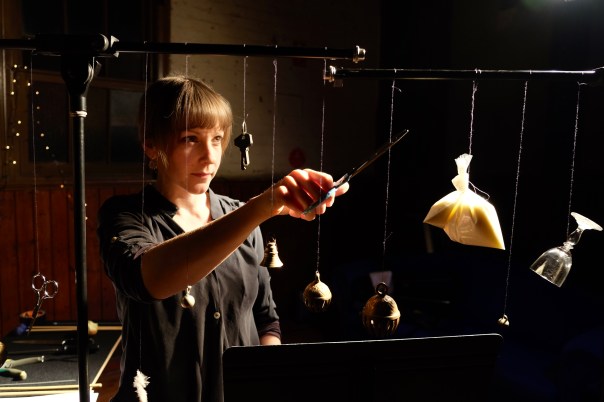
Scholes and Green performed Juliana Hodkinson’s enigmatic performance piece Harriet’s Song last year at BIFEM. The duo lull the audience into a false sense of security with a long, hushed duet. The audience is no doubt wondering what is going to happen to the array of bells, feathers, chimes, and sand bags suspended from microphone stands with fishing twine. Suddenly Scholes’ arm darts out and cuts an object off with a pair of scissors. The attacks become gradually more violent as she picks up pliers and finally, sharpens a knife and lets several bells crash to the ground at once. Without offering any spoilers, I have seen the piece twice and am still hoping to hear certain objects fall, but I suspect the score is specific about which objects are cut (or perhaps Scholes just doesn’t want to clean up afterwards).

DSCF0141
Leah Scholes with the set-up for Juliana Hodkinson’s Harriet’s Song. Photo by Matthew Lorenzon.

The concert also featured the world premiere of Alistair Noble’s  hauteurs/temps. With sparse bass drum and declamatory viola, the piece has a ritualistic air. There is nothing monolithic or imposing about this ritual thanks to a certain harmonic softening around the edges. This harmonic thread draws the listener closer to the work, especially when the texture is filled out with resonant crotales. Another sonic highlight was the introduction of a second viola played by Scholes with mallets. While composers and performers will often treat string instruments percussively in improvisations and solo compositions, this is the first time that I have heard this technique effectively integrated in a duo.

I have been reading about Cretan palaces and Noble’s ritualistic sound world transported me into a fantasy of the ancient past. Speaking with Noble over some of Green and Scholes’ home-baked cakes after the concert I was surprised to find that he was also thinking about Cretan palaces while composing it. Or maybe we have both seen Women in Love.

Phoebe Green, Leah Scholes
The Arrival
Chalice, Northcote
24 June 2016

Metropolis New Music Festival 2016: MSO, Heavenly Cities; Aura Go and Tomoe Kawabata, Visions de l’Amen

With classic works by Olivier Messiaen and forward-looking pieces by living Australian composers, the final night of the Metropolis New Music Festival straddled over 75 years of new music. Building on the festival theme of “the city” with two world premières, Metropolis finally addressed issues of migration and the unique environmental and social predicaments of Australian cities.

Barry Conyngham’s Diasporas placed much-needed emphasis on the migrant populations that make cities thrive. And he did so—thank goodness—without trying to imitate a cultural melting pot of musics. Instead the piece was like watching a world map of population movements. A deep, murky bed of sound depicts the various dangers and “push factors” that encourage populations to pack up their things and move to unknown shores. Textures made up of massed scurrying runs or accented notes pass from desk to desk and from section to section. From the birds-eye view of this composed heterophony we zoom down to the human level as instrumental solos full of bitter-sweet hope rise out of the texture. Moving from statistical abstraction to human detail, Diasporas inverts the dominant narrative of migration in this country, the narrative that says “yes there are human lives at stake, but we mustn’t let that influence our policy.”

Michael Bakrnčev updates the “city scape” piece for twenty-first century Melbourne with Sky Jammer. Sky Jammer has at its base the social and environmental problems arising from urbanisation that have been so absent from the festival so far. In his program note Bakrnčev cites a prediction that by 2056 the population of Melbourne will climb towards ten million. But can the surrounding environment support such a population (especially if Melbourne’s water supply is reduced by up to 35% as a result of climate change)? Bakrnčev also feels that social groups and families will be strained by the growing population. With median house prices at or near one million dollars in Melbourne and Sydney, young people cannot afford to buy property near their families or where they grew up. To Bakrnčev, the sky scrapers being erected around Melbourne are not the beacons of progress and economic vigor as we have heard older composers depict them. He writes:

The term ‘skyscraper’ once implied ‘progress’. To my mind—and thinking not only of my own generation, but of our children’s and their children’s—’progress’ has become a dubious word. So emerges this work’s title, Sky Jammer.

I don’t entirely agree with Bakrnčev. With their stunning density and vacancy,  Melbourne skyscrapers are deservedly symbols of Australia’s inflated housing market and disregard for community health. However, building up is one alternative to Melbourne’s addiction to building out across the countryside. But the more densely a city is developed, the more planning is necessary to ensure the city is healthy. And in Melbourne, home of bike lanes on raised tram stops, I hold out little hope for a renaissance in enlightened civic planning.

Sky Jammer is a local and contemporary piece in more than its program. Its sound so clearly draws on the compositional influences around Bakrnčev. In its dense, rapidly-changing textures one can hear the influence of Australian complexist composers. The instrumental timbres have the grit of a piece by Anthony Pateras. With its attention to instrumental colour and formal cohesion one can hear the influence of Bakrnčev’s teacher Elliott Gyger. Though this description might make him sound like the love-child of dour modernists, Bakrnčev brings his own crowd-pleasing style to the piece, in particular during a virtuosic violin solo for Sophie Rowell, who needs to be congratulated for several incredible solo passages throughout the festival.

 Two works by Olivier Messiaen took the festival theme skyward. Couleurs de la Cité Céleste evokes the jewel-encrusted walls of the Heavenly City descending to Earth after the apocalypse. Scored for a large ensemble of brass, woodwind, percussion, and piano, the sheer volume and violence of the music is more apocalyptic than sublime. For a composer so sensitive to tone colour, the piece has a notable absence of resonance. Only bells ring out across the auditorium. The brass—evoking the seven trumpets of the apocalypse—announce the end-times in gigantic clusters while the keyboard and keyboard percussion piece together a mosaic of dry attacks. It is a flat, medieval representation of the Heavenly City rather than a scene of shimmering fanfare. The MSO’s Guest Conductor Robert Spano did not hold back from Messiaen’s vision. In his interpretation each tutti chord is so loud you can hardly bear to listen to it—like looking into the sun. This is perhaps Messiaen’s idea: to paint the cataclysmic aura around a city that shines so brightly you cannot look directly at it.

The most dedicated audience members stayed on for a precious event: Aura Go and Tomoe Kawabata’s late-night performance of Messiaen’s Visions de l’Amen for two pianos. Where one can sometimes question individual players’ commitment to new music in an orchestral concert, Go and Kawabata’s performance was positively ecstatic. Locked on to each other’s gaze across the bodies of the two grand pianos, sweat dripping onto the keyboards, each movement was a masterful, sensitive interpretation of Messiaen’s understanding of the polyvalent “Amen”. Returning to this work composed shortly after the Second World War, at the dawn of the experiments in form, rhythm, pitch, and timbre we call “contemporary music,” was the perfect nightcap for a thrilling festival.

Metropolis New Music Festival
The Melbourne Symphony Orchestra, Aura Go and Tomoe Kawabata
Melbourne Recital Centre
21 May 2016

Metropolis New Music Festival 2016: Michael Kieran Harvey

An “aporia” is a problem, a state of puzzlement, or a rhetorical gesture based in a lack of information. A few of the reviews in this series on the Metropolis New Music Festival have ended in aporia. I have argued that urban centers present both problems and solutions to environmental and social problems. As such, I am unsure of how to interpret twentieth-century music representing cities. Does the triumphalist evocation of skyscrapers in Copland and Higdon sound optimistic or cynical to me? Maybe it is too early to tell. Maybe it is too late. I was also unsure of how musicians should approach the explosion of sexual norms that urban centers make possible. Is a focus on sexual extremes necessary, or will a potted history of sex in music suffice? Admittedly, I was using aporia to shut down hurriedly-written articles, but to post-structuralist philosophers like Jacques Derrida, a situation in flux was a creative space. Michael Kieran Harvey’s Piano Sonata no. 3 “Aporia” also uses this space of uncertainty as a creative tool.

The aporia of Harvey’s piano sonata is the uncertainty between intuitive and systematised writing. Philosophical subtexts of musical compositions can sometimes be disappointingly reductive, such as when a piece tries to depict a concept that lives and breathes in a complex world of abstract language. Consider if Harvey just wrote a piece that meandered about uncertainly for a while to depict the philosophical impasse of an aporia. Instead, Harvey uses “aporia” to describe his compositional process. As any composer or music analyst of systematised music will tell you, this is the musical aporia. A system may give you a series of possible structures, but how do you actually fit them together to make a piece of music? When do you change the results of your system to suit your tastes?

Another reason title “Aporia” is so appropriate is that it captures the audience’s (or at least my) thought process while hearing the piece. Inspired by the incredible sound of the trams that rumble past the home of the piece’s commissioners Graeme and Margaret Lee, “Aporia” is based on the harmonic series and its inversion. One catches snatches of the harmonic series at the beginning of the work, but one largely has to take the composer at his word. Harvey’s brute physicality as a pianist adds to this aporia. The sonata’s thunderous clusters and showers of filigree may well be predetermined, but at times they slip into the realm of sheer physical gesture. At one point Harvey pauses, stares at the keyboard, and begins attacking it with sweeping glissandi. Where is the system? Does it matter? These are perennial, undergraduate questions, but sometimes the most basic questions are the most important and in this case, they actually bring the piece to life.

The rest of the program was occupied by extended prog-rock keyboard solos that a better critic will have to describe. Harvey’s recitation of a poem by Saxby Pridmore about the massacre of Jews by Arrow Cross militiamen provided a moment of supreme gravity amid the synthesized bacchanal.

City of Snakes
Michael Kieran Harvey
Metropolis New Music Festival
20 May 2016

Michael Kieran Harvey, Piano Sonata no. 3 “Aporia”, City of Snakes, From the Walls of Dis, Deaths Head Mandala, N Chromium, 48 Fugues for Frank (Zappa), The Green Brain; No. 6 ‘Beetles’, Budapest Sunrise, Kazohinia

Metropolis New Music Festival 2016: The Letter String Quartet, MSO: City Scapes

For their second Metropolis concert, the MSO teamed up with The Song Company to take us from sweeping urban vistas right down into the streets of renaissance Paris and London. Emerging from this program was a double-sided view of the city as the source and solution to specifically urban problems. But first Australia’s new music dream team The Letter String Quartet treated the audience milling around the MRC foyer to excerpts from Wally Gunn’s moody work Blood. Perched in a window opening out onto the city night, the foyer concert introduced a welcome buzz to the cultural bunker that is Southbank. If TLSQ’s stylistic range—from artpop ballads to arch contemporary string writing—is anything to go by, then we can expect interesting things from the quartet’s concert on 26 November including new works created in collaboration with Bree Van Reyk, Ned Collette, Yana Alana, Zoë Barry Jed Palmer, and Mick Harvey.

With the MSO ranged expectantly on stage, The Song Company burst into Clément Janequin’s sixteenth-century setting of Parisian street cries. Singing from the gallery high above the audience, the cries of Paris rang out with an eerie clarity, like ghosts haunting the MRC. This haunting effect was even stronger in Orlando Gibbons’ The Cryes of London as the ensemble hummed a viol consort accompaniment. Weaving street cries into polyphonic music was a popular renaissance trope suggesting an awareness of the correlation between the multiple independent lines of polyphonic music and renaissance rationality and individualism. The cries are also a snapshot of the unique problems of urban life, including how to feed such a large concentration of people and how to control the rats and mice that accompany people wherever they go. Luciano Berio updated the trope with atonal polyphony in his The Cries of London in 1974. The Song Company’s lucid and nuanced performance of this modern masterpiece was by far the highlight of the evening.

The composer Michael Kurth also takes the streets as his inspiration in Everything Lasts Forever, which includes three pieces inspired by Atlanta street art. The cartoon feet of the street artist Toes are represented by swaggering slap bass. The pathos of a bird singing on a boarded-up door is conjured in a sadly lyrical movement. A loping movement in an additive meter presents an ironic commentary on the message “We Have All the Time in the World.”

The program contrasted the human interest of Janequin, Gibbons, Kurth, and Berio with pieces depicting cityscapes by Aaron Copland and Jennifer Higdon. These cityscape pieces present another side of the modern city: the city as a symbol of free market capitalism. The twentieth century is perhaps the first time in history where you have a piece like Jennifer Higdon’s City Scape where, in the composer’s words, “steel structures present an image of boldness, strength and growth, teeming with commerce and the people who work and live there.” Higdon wrote these words in 2002 and may think differently now. The global financial crisis of 2008 revealed that these steel skyscrapers were in fact images of selfishness and fragile growth, teeming with hedge funds undermining the world economy. The piece’s third movement is another hymn to a road, a “representation of all those roadways and main arteries that flow through cities.”  As I pointed out in my review of the first MSO Metropolis concert, this climate change music is already sounding dated, more a relic of the twentieth century than a music of our time. It’s a pity, because Higdon’s piece really is a virtuosic kaleidoscope of orchestral gestures depicting, as she writes, “the diversity in city streets.” But to contemporary listeners faced with climate change and fragile global economies, the teeming, unregulated economy of the city sounds more like a problem rather than a status quo to be celebrated.

Cityscapes
The Melbourne Symphony Orchestra, The Song Company
Conducted by Robert Spano and Antony Pitts
Metropolis New Music Festival
The Melbourne Recital Centre
18 May 2016

Clément Janequin, Voulez ouyr les cris de Paris; Aaron Copland, Music for a Great City; Orlando Gibbons, The Cryes of London; Michael Kurth, Everything Lasts Forever; Luciano Berio, Cries of London; Jennifer Higdon, City Scape

Metropolis New Music Festival 2016: Forest Collective, Sensuality in the City

In 2009 the clarinettist Richard Haynes played a piece by Richard Barrett naked but for a feathered head dress, Chris Dench on a surgical table wrapped in glad wrap and wearing a cock ring, David Young while pissing into an amplified 44-gallon drum, and David Lang while climbing a ladder in a hard hat and not much else. The concert, Listen My Secret Fetish, was an Aphids production directed by David Young and Margaret Cameron and it set the bar for explorations of new music and sexuality. Not everyone has to wee into a bucket, but sex and music is a thematic pair with as much room for exploration as, well, sex and music.

Forest Collective’s Sensuality in the City program at the Metropolis New Music Festival began promisingly. The audience was met at the door by a cardboard torso complete with a glory hole for happy-snaps (nobody took full advantage of this). Once in the salon, the audience sat through a tense minute of droning cello and gently pulsating piano clusters while the marvelously hairy bass-baritone Christian Gillett glowered darkly above us. After a while he stated emphatically “I wanna fuck Chris Hemsworth.” The original version of F**k forever by Philip Venables gives George Miles as the object of affection, but I think we can allow this local variation in contemporary performance practice.

From this point on artistic director Evan Lawson conducted a historical survey of urban sexuality divided into brackets addressing desire, sex, and conflict. The “desire” bracket included three sumptuous arrangements of pieces by Robert Schumann, Claude Debussy, and Franz Schubert. Soprano Rosemary Ball brought out the budding desire in “Im wunderschönen Monat Mai,” at least so far as singing about birds allows. The ensemble crowded around Rebecca Scully’s double bass, voyeuristically illuminating her visceral performance of Syrinx with torches.

The “sex” bracket approached sex most obliquely indeed. George Aperghis’ Recitation No. 9 received an unprecedentedly powerful performance by Ball. The soprano recites the sentence “Parfois je résiste à mon envie parfois je lui cède pourquoi donc ce désir,” which might be translated as something like “Sometimes I resist my inclination sometimes I give in to it why then this desire?” The phrase is revealed word by word from the end to the beginning, taking on different meanings with each iteration. In terms of suggestion—and Ball’s rendition was wonderfully suggestive—this piece is clearly still in the realm of desire. So too is Lawson’s Himeros, a piece dedicated to the pain in desire. Contorted Wagnerian strings send heart-strings thrumming before a sparse and delicate middle section lulls the audience to sleep. The audience is painfully awoken with a bang from the percussion as the brass begin to cry. If the association of Himeros with sex is obscure, then Marc Yeats’ Lines and Distances is absolutely cryptic. The measured, pointillist tapestry unfolds before the listener like a medieval love story, with clarinettist Vilan Mai carefully managing each turn of the tale. But once again we are in a world of courtship and managed proximities.

For the third bracket dedicated to “confusion, conflict and confusion” the audience heard a truly heartbreaking rendition of Schubert’s “Gefrorne Tränen” performed by Gillett, then music from an opera by Venables where members of a family and their maid “beat a mysterious bandaged figure lurking in the corner while discussing what they’ll eat for dinner.” The program felt like a film that cuts straight from a prolonged scene of flirtatious winking to a scene of domestic violence, skipping over physical sensuality entirely. The program’s lacklustre programming was not aided by some very unsexy intonation. Now I don’t know how you’d actually go about making a good “sexy program.” It seems a bit like someone asking you to “be funny,” you can’t just do it on the spot. I struggle to be half-way presentable most days. But someone out there has got to be able to get this right.

Sensuality in the City
Forest Collective
Metropolis New Music Festival
Melbourne Recital Centre
18 May 2016

Philip Venables, F**k Forever; Robert Schumann, Im wunderschönen Monat Mai; Claude Debussy (arr. Rebecca Scully), Syrinx; Franz Schubert (arr. Alexander Morris), Ganymede; Georges Aperghis, Recitation No. 9; Evan Lawson, Himeros; Marc Yeats, Lines and Distances; Franz Schubert (arr. Evan Lawson), Gefrorne Tränen; Philip Venables, Fight Music.

Metropolis New Music Festival 2016: MSO, City Lives

Occasionally you read a pithy description of a piece in a program and immediately have an idea of how the piece might sound. As the piece begins, however, it takes you places you couldn’t have imagined. Your two-dimensional expectation becomes a teeming microcosm, a city unto itself. Like a poem, the architecture of the piece defies paraphrase. This was the impression I had listening to Unsuk Chin’s Graffiti performed by the Melbourne Symphony Orchestra under the baton of Robert Spano. Graffiti opens with strings scrubbing near the bridge, a play (despite the composer’s claim that the piece is neither illustrative nor programmatic) on the origin of graffiti in messages “scratched” into the walls of ancient cities. This lone scratching expands into a scurrying chorus, depicting the “Palimpsest” of the movement’s title. I would say that the piece is not only illustrative (if any music is), that it is just as enjoyable without any program. The second movement, “Notturno Urbano,” manages to be both spacious and grotesque thanks to a plethora of extended woodwind techniques that deftly escape cliché, while the epic “Urban Passacaglia” is an immersive journey firmly held together by Spano.

If you are going to do something, do it well. This might the be ethos of the young Perth-based composer Alex Turley. When I first met Turley at the 2015 Tura Totally Huge New Music Festival, he told me he wrote unapologetically pretty music. This year he brings his refined sense of texture and atmosphere to the Metropolis New Music Festival as one of the three finalists of the Cybec 21st Century Australian Composers Program. His piece, City of Ghosts, depicts a city shrouded in mist, devoid of people. Modal melodies arise from a subtly-thunderous bed of pianissimo tuba and double bass. The melodies move wraith-like across the ensemble, describing towering buildings and arches. With its profound palette, City of Ghosts is testament to Turley’s musical imagination and honed talents as an orchestrator.

Michael Daugherty’s Sunset Strip depicts a drive down Sunset Strip from downtown Los Angeles to the Pacific Ocean. It is also a journey in time, evoking the sounds of “swank restaurants, private eye offices, tattoo parlours, Mexican restaurants, motor inns, discos, bilboards, parking lots, gas stations, burlesque halls, piano bars and jazz lounges.” As with so much music from Daugherty’s generation, I wonder how the next generation will hear it. As conflict breaks out over resources and oceans rise, will they hear in Sunset Strip a metropolis teeming with cultural activity, or an engine of environmental destruction? The piece is, after all, literally a homage to a road.

Composed only four years earlier, Steve Reich’s City Life seems more critical of the technological basis of our urban lives. The piece foregrounds recordings of cars and pile drivers, but surrounds them with an uncomfortable harmonic atmosphere. The piece even includes an extended recording of an alarm, signalling that all is not right with the city. But just as the consumerist urban lifestyle fêted in Sunset Strip increases our carbon footprint, population density reduces the fossil fuels used in transportation of goods and electricity. A theme emerging from Saturday night’s two concerts is the city as both problem and solution. As Le Corbusier told us earlier in the evening in Davidson’s City Portraits, we have to learn to live close together to enjoy “sun, space, and green.”

City Life
Melbourne Symphony Orchestra
Melbourne Recital Centre
Metropolis New Music Festival
14 May 2016

Unsuk Chin, Graffiti; Alex Turley, City of Ghosts; Michael Daugherty, Sunset Strip for Orchestra; Steve Reich, City Life

Metropolis New Music Festival 2016: Press, Play

So far Metropolis has explored the theme of “the city” through urban music, ancient and sacred cities, and architecture. All nice, creative approaches to the theme. With Press, Play’s program Crashing Through Fences, Metropolis got political. And it is high time, too, since whether we like it or not (mostly not) we are in the middle of an election campaign through which we decide what our society—and cities—will look like. Will they be divided into gated communities and slums or will we stop widening the gap between the rich and everyone else? Will we invest in services that will reduce homelessness? Will the roads be choked by car fumes or will public transport decongest arterial motorways? Will parts of the city be under water in half a century? The poet Sean Whelan joined pianist Sonya Lifschitz and flautist Lina Andonovska to show that politics can be as appropriate a subtext to a contemporary music concert as ancient architraves and turntabling.

Whelan’s laconic, Melbourne-inspired poems heightened the concert’s political relevance by stealth. I assume they were written for this occasion as they were read for the first time in this concert. Icon describes the city covering the natural vegetation, a perfect preface to Steve Reich’s pastoral Vermont Counterpoint. Andonovska  highlighted the piece’s twittering and popping textures while deftly swapping between flutes of different sizes.

Whelan’s Shadow described the memories intermingling behind our backs before the fluid rhythms of Erik Griswold’s In Patterns of Shade took us on their dappled journey.

With Other People’s Houses Whelan approaches the lived reality of cities more directly and intimately. He speaks of a home that “knows too much,” this time accompanied by the mysterious swirling flute of Timo Andres’ Crashing Through Fences.

Lifschitz retook the stage alone for three “City Portraits” by Robert Davidson. Each portrait is based on the speech patterns of a figure who has shaped our urban environment. “Free Architecture” uses Frank Lloyd Wright’s interview with Mike Wallace. Wright’s vision of “an architecture that would be a grace to its landscape not a disgrace” is reflected in Walter Burley Griffin’s original and much-departed-from designs for Canberra. “Not Now, Not Ever” is a piano arrangement of Davidson’s famous choral arrangement of Julia Gillard’s even more famous “misogyny speech,” a speech that for one glorious moment crushed the persistent, casual misogyny that is so often tolerated in silence beneath a mighty, righteous fist.

In the third “City Portrait” a voice says “I am a young man of 71 years old, I built my first house when I was 17 1/2.” It is particularly affecting that we do not have an image of the speaker this time. Who is this man? He describes himself as a poet “working with my eyes and hands,” venturing into nature, speaking from “the heart of man.” Footage of children playing in a park flickers past as he describes his dream of “sun, space and green” for all. But to have sun, space, and green, the voice tells us, 2000 people must live together joined by a single vertical road. It is the voice of Le Corbusier, the modernist architect who we have to thank for every reinforced concrete tenement built after the Second World War. But when described in his voice and accompanied by Davidson’s expansive piano, played with Lifschitz’s commitment and sensitivity, one begins to understand his utopian vision. Against this bitter-sweet piano part we see his buildings torn down like so many democratic post-war innovations.

The image of thousands of people coexisting in neat blocks is given musical form in Beat Furrer’s Presto con Fuoco. The motoric flute and piano parts interlock precisely, filling each other’s silences. Bent at the knees, ready to spring at the dense score,  Andonovska’s charged, athletic performance keeps the entire audience on the edge of their seats.

Politics being out of the bag, Whelan’s When Everything Falls likens shopping to looting and criticises our diminishing sense of value in a world where anything can be bought. He imagines climbing Eureka tower and breaking a window, only to turn away from the “best view of Melbourne” to the face of his lover. After this, the amplified Sigur Rós-like chords of Chris Cerrone’s Hoyt-Schermerhorn are a devastating love song.

Whelan’s final poem Don’t Break My Sky poetically lists elements of our society that unpoetically slap us in the face every day: Draconian immigration policies, $6000 toasters, “the orange-tinted supervillain of the US Presidential primaries,” and so on. Confronted with all this Whelan says we “turn inward, turn outward,” and crash on through. It is so easy to switch off from politics when it is presented to us as a stream of unrelenting point-scoring imbecility. But a powerful program by these incredible artists is just enough to make you care again.

Crashing Through Fences
Press, Play
The Melbourne Recital Centre
Metropolis New Music Festival
14 May 2016

Sean Whelan, Icon; Steve Reich, Vermont Counterpoint; Sean Whelan, Shadow; Erik Griswold, In Patterns of Shade; Sean Whelan; Other People’s Houses; Timo Andres, Crashing Through Fences; Robert Davidson, City Portraits; Beat Furrer, Presto con Fuoco; Sean Whelan, When Everything Falls; Chris Cerrone, Hoyt-Schermerhorn; Sean Whelan, Don’t Break My Sky

Metropolis New Music Festical 2016: Syzygy Ensemble

A city shapes the people who inhabit it, as was demonstrated in an episode of the Radiolab podcast. The average speed at which people walk the streets is closely correlated to the city’s population size. Syzygy Ensemble took the transformative quality of living in close quarters as the inspiration for their “Cramped Space”  program at the Metropolis New Music Festical. Just as cramped physical spaces transform us as human beings, Syzygy Ensemble showed how artistic restrictions profoundly shape the music we create.

In Jacob Ter Veldhuis’ Tatatata cellist Blair Harris walks the virtuosic tightrope of a prerecorded voice: That of the surrealist poet Guillaume Apollinaire. The voice interjects the odd grainy “ta” as the cello plays rhythmic double-stops. The voice becomes more rhythmic as the two engage in a rapid and humorous duet. The two parts appear equal, but the cellist’s agency is limited by the prerecorded voice.

From a prerecorded duet partner to a live one, Giacinto Scelsi’s duet Ko Lho for flute and clarinet is a balletic study in dynamic and timbral precision. Swelling crescendi and decrescendi overlap in a haunting, shimmering surface. Where Harris was restricted in time by his prerecorded duet partner, the two instruments in Ko Lho are restricted in pitch-space. The swelling dynamics and tone colours of the piece are so many ways to differentiate the instruments within a tight harmonic range. Neither Ter Veldhuis nor Scelsi seem to mind their self-imposed restrictions. Both pieces end in gestures of resignation. The cello slides down into long, exhausted notes, while the flute and clarinet end luxuriating in their close harmonies.

The pianist Leigh Harrold and violinist Jenny Khafagi are tied together by John Adams’ motoric rhythms in Road Movies. Khafagi and Harrold’s rendition of this familiar piece was a tour de force of energetic precision. From the first movement, which races along like a race car driver with a death wish, to the contemplative scordatura of the second and the hectic hoedown of the final movement, the audience was completely transfixed by the Khafagi and Harrold’s unstoppable momentum.

Anna Clyne evokes the restricted space of childhood imagination in 1987. This space is not that of the supposedly unbounded imaginations of children, but our bounded memories of childhood. 1987 seems to have been a sad year for Clyne, judging by the ominous chorale for cello, violin, bass clarinet, and bass flute overlaid with the cranking and tinkling of a music box. Recordings of a fairground melt into a truly apocalyptic movement with gritty cello and bass clarinet.

Charlotte Bray’s Upflight of Butterflies continues the theme of cramped imaginary spaces by pursuing the paradox of loneliness in company. Each movement paints a bitter-sweet pair of words from the poetry of Pablo Neruda’s poetry including “Abandoned Sun,” “Trail of Light,” “White with Space” and “Dazzlement of Butterflies.” The sun is painted with flat, sustained harmonies like a cold and distant star singing to itself. The trail of light implies something leaving or being pursued, just as Laila Engle’s flute haplessly follows Harris’ meandering cello line. One would think that at least a “dazzlement of butterflies” would be unequivocally positive, but even the motoric beating of wings across the ensemble was tinged with acerbic harmonies.

Beyond Syzygy Ensemble’s characteristically thoughtful approach to the festival theme, the concert provided the opportunity to hear each individual performer’s formidable talents in a solo or duo setting, proving once again why Syzygy Ensemble are Melbourne’s most energetic and dynamic contemporary music ensemble.

Syzygy Ensemble
Cramped Space
Melbourne Recital Centre
Metropolis New Music Festival
12 May 2016

Jacob Ter Veldhuis, Tatatata; Giacinto Scelsi, Ko Lho; John Adams, Road Movies; Anna Clyne, 1987; Charlotte Bray, Upflight of Butterflies