Category Archives: Reviews

Partial Durations is a Matthew Lorenzon/RealTime joint project.

Johannes Moser, Lutoslawski Cello Concerto

johannesmoser2
Johannes Moser, image courtesy of ANAM.

Johannes Moser, cello
Benjamin Northey, conductor
ANAM Musicians and Orchestra
South Melbourne Town Hall
Friday 24 May

The program is daunting: One of the most famous cello sonatas, followed by one of the most difficult cello concertos, followed by one of the most important chamber works of the past century-and-a-bit. But the cellist is astonishing, the conductor fearless and the orchestra excellent, so what are you going to do?

From the first notes of Shostakovich’s Sonata for cello and piano in D minor it was evident this was to be no ordinary recital—though that’s exactly where half the audience would have heard the famous piece many times. Johannes Moser’s performance began slightly faster than usual, though the tempo didn’t compromise the cellist’s fluid, light articulation. Do not be fooled by the “intense, introverted cellist” promotional photo, Moser plays directly to the audience, making eye contact and even occasionally lunging at them, when the music seems to call for it. The playful first movement made way for the ferocious reeling of the second. Light, brittle spiccato figures stood out like sardonic laughter. The Largo third movement was a testament to good taste. Every line was shaped, every dissonance perfectly stressed as the movement meandered towards its grim conclusion. By contrast, Finale demonstrated the fact that if the melody is simple and repetitive enough you can get away with the most outrageous articulation and dynamics. The audience will fill in the notes they do not hear. As in comedy, it is good to reward the audience for meeting you half way.

The Lutoslawski Cello Concerto is a feat in semi-aleatoric twentieth-century orchestration, with remarkable effects including prickling, teeming clouds of string pizzicati, blaring brass heterophony, unorthodox percussion and woodwind attacks like splattering paint: So much colour from a piece that begins with plodding solo cello Ds marked indifferente. While these sounds are standard New Music fare, the Lutoslawski Cello Concerto never ceases to sound fresh. Part of this currency derives from the dynamic interplay of the soloist and the forest of sounds around them, a dynamic that conductor Benjamin Northey describes as the relationship of the individual and the “oppressive” masses. A problem with this interpretation is that the orchestra only enters tutti in the finale of the piece, an effect made all the more shocking by the fact that the orchestral colours are sparse and individuated up until that point. There is some very obstinate brass throughout, for sure, but there are also some conciliatory woodwind, playful percussion and serene string textures. With its bipolar, paranoid cello, chattering brass returning like a repressed trauma, cast of orchestral characters, “chase scene” and final destruction, the piece would make a good soundtrack for a Hitchcock movie. Both the orchestra and Moser played their parts perfectly, with bow hair flying and barely a musician not short of breath at the end. The audience’s pulses were just as high.

After an interval we were treated to the piece that started it all, Verklärte Nacht by Arnold Schoenberg. Here the ANAM students’ sensitivity and endurance were called upon to sustain Schoenberg’s exposed late-romantic lines. It was for me, as for the rest of the audience in the packed South Melbourne Town Hall, a transfigured night.

Petrichor, Garden of Joy and Sorrow

Petrichor Trio (at the Abbotsford Convent), photo by Jessica King

Petrichor Trio
Conduit Arts
Rowan Hamwood (flute)
Alexina Hawkins (viola)
Jessica Fotinos (harp)
Wednesday 22 May

Petrichor’s recent concert at Conduit Arts found young and established composers alike asking themselves what on earth to do with a harp. Petrichor’s “take no prisoners” style of performance charged the small space of Conduit Arts with an atmosphere of absolute concentration.

Julius Millar’s Two Pieces for Flute, Viola and Harp contrasted a soundscape haunted with apparitions of clusters and string tremoli with a rhythmic piece based around a “ticking” harp ostinato. Sometimes the viola would join the harp in a hocket figure, or soar away on a legato line. Well-developed counterpoint between the flute and viola provided a moment of intense interest that then exploded into a spectacular cacophony on all three instruments.

Barry Conyngham’s Streams cast the harp in a similar role, as the pulsing accompaniment to contrapuntal play between the harp and viola. Conyngham transitions fluidly between such textures and layered trills with swelling dynamics and glorious open chords cut short by the idiomatic harpistic string-clang, which has to be heard to be believed (and if you go to harp concerts, will be believed more often than you wish).

Evan Lawson’s Skinnis for Flute, Viola and Harp (now on its second outing) was the only piece to utilise the harp’s majestic glissandi and full, ringing chords. These kitschy effects were welcome after the crystal-clear articulation and motoric effects of the “bean-counting harp.”

Sofia Gubaidulina’s The Garden of Joy and Sorrow canvassed all of these possibilities for combining flute, viola and harp, then developed many more through a series of vignettes punctuated by spoken German phrases. A particularly fascinating sound was an extremely fast phrase on viola, played with a very fast bow to produce a “squeaky” sound like a tape on fast-forward, above a machine-gun tattoo on the harp with paper woven between the strings.

The program also included a series of solo works including Gordon Kerry’s Antiphon for viola, Salvatore Sciarrino’s Canzona di Ringraziamento for flute and Suart Greenbaum’s Church at Domburg for harp. In all three cases the skill and conviction of these ANAM-trained musicians was in evidence.

Victorian Opera, Nixon in China

Nixon in China, Photo by Martin Philbey
Nixon in China publicity, Photo by Martin Philbey

Nixon in China
Victorian Opera
Her Majesty’s Theatre
16–23 May

Natural minor scales rise ominously beneath a blood-red curtain. Slowly, a chorus in Zhongshan suits emerges from between the fiery drapes and intones Mao Tse-tung’s “Three Rules of Discipline and Eight Points for Attention,” the fundamental guidelines of the Chinese Red Army from 1928. Dropping subito piano and slowly approaching the audience, the chorus chants: “The people are the heroes now, Behemoth pulls the peasant’s plow.”

The awesome serenity of this opening evokes the mythology that China projected both to itself and to the West during the purges of the Cultural Revolution. It was into the long aftermath of this slaughter that Richard Nixon descended in 1972 and introduced a new layer of mediatised, political heroism through the broadcasting of the presidential visit (as Nixon (Barry Ryan) sings, “News has a kind of mystery”). Victorian Opera’s production is faithful to a third layer of mythology—after China’s propaganda and Western mediatisation—that John Adams and Peter Sellars inaugurated in 1987 to reflect the larger-than life image of the figures shown on the receiving end of the television. Victorian Opera’s production achieves a high level of historical accuracy in design and performance, from Mao and Nixon’s covered arm-chairs by set designer Richard Roberts, to Mrs Nixon’s ’70s outfits by costume designer Esther Marie Hayes, to the general recreation at Her Majesty’s Theatre of the opera’s previous incarnations by director Roger Hodgman. Even coming from a generation that didn’t grow up in the shadow of Nixon and Mao, the opera appeared relevant in its presentation of the conflict of humanism and political principle and the mediatisation of politics.

The drama of the first act relies on the audience’s acceptance, through their own experience of the era, of the importance of Nixon’s visit. Today Nixon’s dramatic entry on Air Force One is trivialised somewhat by the knowledge that for many years China and America had been trading table tennis players in an initiative now referred to as “ping-pong diplomacy.” I could certainly have exchanged Nixon and Mao’s duet about government bonds for an operatic game of table tennis. Baritone Bradley Daley expertly embodies the ailing Mao, though his villainous entry to thundering timpani necessarily had to contrast with the footage of Nixon and Mao’s actual meeting, where the Chairman laughs and chatters excitedly and the President smiles and fidgets nervously.

But the opera breaks down its own myths soon enough. The monumental first act, focusing on Nixon and Mao, is juxtaposed with an irreverent, “feminine” second act dealing with the wives of the protagonists, Mrs Nixon and Chiang Ch’ing. Here the true heroine of the opera, Mrs Nixon, presents the fundamental opposition of the opera, which is not Democracy and Communism, but a sort of bleeding-heart humanism and the political principle of equality, an opposition that sees no easy resolution. Mrs Nixon is initially sympathetic to the communist principle of equality, while also upholding man’s liberties. Touring a factory she “forsees a time when luxury dissolves into the air like a perfume” while people are free to speculate on the economy. The casting of Kissinger as the slave driver in Chiang Ch’ing’s revolutionary ballet The Red Detachment of Women quickly puts an end to this dream. Mrs Nixon asks “doesn’t that look like you know who?” as Kissinger (Andrew Collis) rises from his seat and enters the ballet. This leaves an empty seat next to Chiang Ch’ing and the Nixons, a reminder that the roles of oppressed and oppressor are so many places within larger economic and political structures waiting to be filled. The humanist Mrs Nixon does not realise this when she mistakes the play for reality and runs over to the beaten peasant girl. The Nixons exit as the peasant girl is armed and takes aim at the tyrant.

This unresolvable middle ground is also represented by Chinese Premier and peace-broking middleman Zhou Enlai, the only character to escape ridicule. Mao is portrayed as a mildly-expressed lecher, patting his female aide on the knee and referring to Madame Mao as “that tasty little starlet.” Nixon passes Kissinger small change for playing with the “backroom boys.” Tiffany Speight as Pat Nixon and Eva Jinhee Kong as Chiang Ch’ing give such stunning performances that you almost forgive Goodman their shallow characterization as soft-hearted ditz and fanatical harpy.

Not only is the conflict between humanism and political principle a perennial issue, Nixon in China remains relevant because it witnesses the birth of the sort of mediatised politics smothering political debate in Australia today. As Nixon’s speech at the state dinner was transmitted via satellite around the world, so every movement of a leader today is scrutinised and blown out of proportion, leading to the exaggeration of the trivial and the banalisation of the grandiose. As one audience member remarked on leaving the theatre: “Can you imagine someone doing that with Gillard or Abbott?” Actually, after watching the 1971 World Table Tennis Championship, I think I can.

Kupka’s Piano, Giants Behind Us: German Music and its Discontents

Kupka’s Piano
Giants Behind Us: German Music and its Discontents
10 May
Review by Jocelyn Wolfe

On Friday night Kupka’s Piano’s series of expeditions seeking innovative works from different countries led them back to the ‘spirit realm’, the place of geniuses, the land in which the great colonisation of western classical music originated—Germany. The title “Giants Behind Us” of course echoes Brahms’ trembling in the shoes of Beethoven. All the composers in Kupka’s “Giants” program are touched in one way or another by this history in presenting new works (including Australian and world premieres) in a new century, which, in Lilienstern’s words, has them all living in an internationalised, individualised world, learning from each other, trusting in their own musical ideas and perception. There was no trembling in the air in this concert. These were strong, confident statements of musical futures for all concerned, composers and performers alike. But there was nonetheless a sense of the long arm of tradition no matter what disaffection may reside in the creators. Flenady, in the program notes, describes this as a diverse expression unified in integrity and intent. For Rosenberger, it’s the “connective tissue” of events, actions, and people; and for von Lilienstern, it’s the connective tissue of Constructivism.

Before the concert, I was reminded in a conversation of the play currently showing in Brisbane—Red. It’s all about Rothko. Yes, Kupka is the painterly inspiration for the ensemble, but it’s to Rothko that I look for what the connective tissue was all about in this concert. His rectangular fields of colour—predominantly one colour—and the play of light open up to inquiring eyes. Just look—so much detail in fragments, layers, and textures within; and yet, after all, you can say that the painting is red. Across the pieces heard in this concert, there is this kind of canvas. Even gestures in the playing bespoke brush strokes of a painter, Rothko not Pollock—decisive, disciplined, and vigorous.

The opening piece by Wolfram Shurig (2005), a trio for piano (Alex Raineri), sax (Samantha Mason) and percussion (Angus Wilson), is a vibrant layering of relations between instruments, embedded in a rhythmic flux held firm in the hands of Wilson’s skillful mallets. It moves to a slow moving, pared down piano solo conveyed by Raineri with gossamer precision, until the return of the sax in a new guise—a melodic fragment ever so poetic. And the music simply breathes a few last breaths and is gone.

Brisbane-based Peter Clark, forging a future in composition and conducting with scholarships in conducting at Lucerne Academy under his belt, offers a piece for flute (Hannah Reardon-Smith), clarinet (Macarthur Clough), violin (Alethea Coombe), cello (Danielle Bentley) and vibraphone (Wilson), in what the composer calls version I of In Lines, in Time (2013). We are invited by Clark, who also conducts the piece, to consider whether the 5 instrumental lines, each rendered in a different meter, intersect or are heard each in their own right in a layering of sound. I find a weaving line, usually led by one of the five with its different timbres, melodic fragments, and rhythmic positioning, making a whole—sometimes broken, sometimes sparse, and at times rich and dense, but utterly coherent. The different underlying meters seem not to intrude in the sense of wholeness and there are definitive moments of absolute metric unity in the score, nicely articulated.

Before we hear version II, Isabel Mundry’s piece (1999) simply called Composition for Flute and Percussion, comes as a kind of intimate interlude. This is clever—nice programming. Its timbres of flute, (its percussive qualities are astutely teased out by Reardon-Smith) and various percussion, under the bandaged mallets of the inventive Wilson (yes, he found bandages to provide the best timbral qualities for the percussion palette of this piece) takes us into the surface textures of our canvas. This is a beautifully articulated interplay between the two, a lacy infrastructure with suspended moments and motivic patterns, attended by the ‘ching’ of a triangle.

And now the return of In Lines, in Time, this time version II, again conducted by Clark. This is more expansive, bringing back the piano, and has the quixotic vertical definition of harmony without harmonic definition. There’s a great balance in the ensemble, so many finely tuned ears and eyes focused on Clark’s brush strokes.

Soprano, (Tabatha McFayden, in splendid red), clarinet (Clough) and triangle (Clark) take to the stage in vehement conversation with Gerald Resch’s Splitter (2002). The composer’s note, hoping that the listener will not perceive the strict skeleton underlying the structure of the piece, which is based on a text by Austrian avant-garde poet Waltraud Seidlhofer, but will simply feel that “the musical things that happen have a certain logical alliance” is barely needed. The ear is completely tuned to the conversation—the clarinet resounds emphatically in short bursts and the soprano’s vocalisation shimmers, shouts, and whispers in retaliation. Clark’s scintillating triangle almost steals the show.

Katharina Rosenberger describes her solo for saxophone Phragmocone (2006/10) as having contours of melodic lines and overarching rhythmic incidents closely following the “logarithmic spirals” of a nautilus shell”. The effect is introspective of those spaces and lines, feeling the raw surface of unprocessed acoustic sound, thanks to Mason’s sensitive interpretation. But this is not the only time that I need to close my eyes for the full effect, as new music notations tend to require a great presence of paper and stands on stage.

On to the end–von Lilienstern’s The Severed Garden (2009) brings the core group of Kupka’s Piano together along with the fine bow of Danielle Bentley. This piece prompts me to wonder what Schoenberg, rather than Beethoven, would make of all of this now. I recall Alex Ross’s comments in The Rest is Noise: “Schoenberg’s atonal music is not all sound and fury. Periodically, it discloses worlds that are like hidden valleys between mountains, a hush descends, the sun glimmers in fog, shapes hover …” . While this piece is not a legacy of Schoenberg, it at the same times evokes things hidden and heard, there and not there, things that expand and shrink. It’s all there in the red canvas. So Lilienstern’s initial fury gets mellowed, the bass clarinet is genuinely grounding and the music takes on, as the composer describes, a more singing, symbolic quality. There is an unmistakable funereal finish, prescient with the sound of the bass drum.

Canvas complete. Context painted. Six composers writing at the beginning of the twenty-first century sharing to some extent a pedigreed genealogy that is fundamentally German—a genealogy not lost even on Australian Peter Clark. How does their canvas differ yet resonate with something implicitly German? Rosenberger has her finger on it saying:

I realised that for many years I was trying to run away from a Germanic contemporary approach to composition, which I perceived as overly rigid and kopflastig (‘top-heavy, overly intellectual’). I wanted to involve the body more, the senses, the physicality of sound … but I also recognise that I never shook off an obsession over details and how these relate to the entirety of a piece, and passing out the inner logic of a composition. (From Interview with Katharina Rosenberger)

Kupka’s Piano, still in their youthful twenties, bring a discerning maturity to their program and performance.

Manteia, Marionette

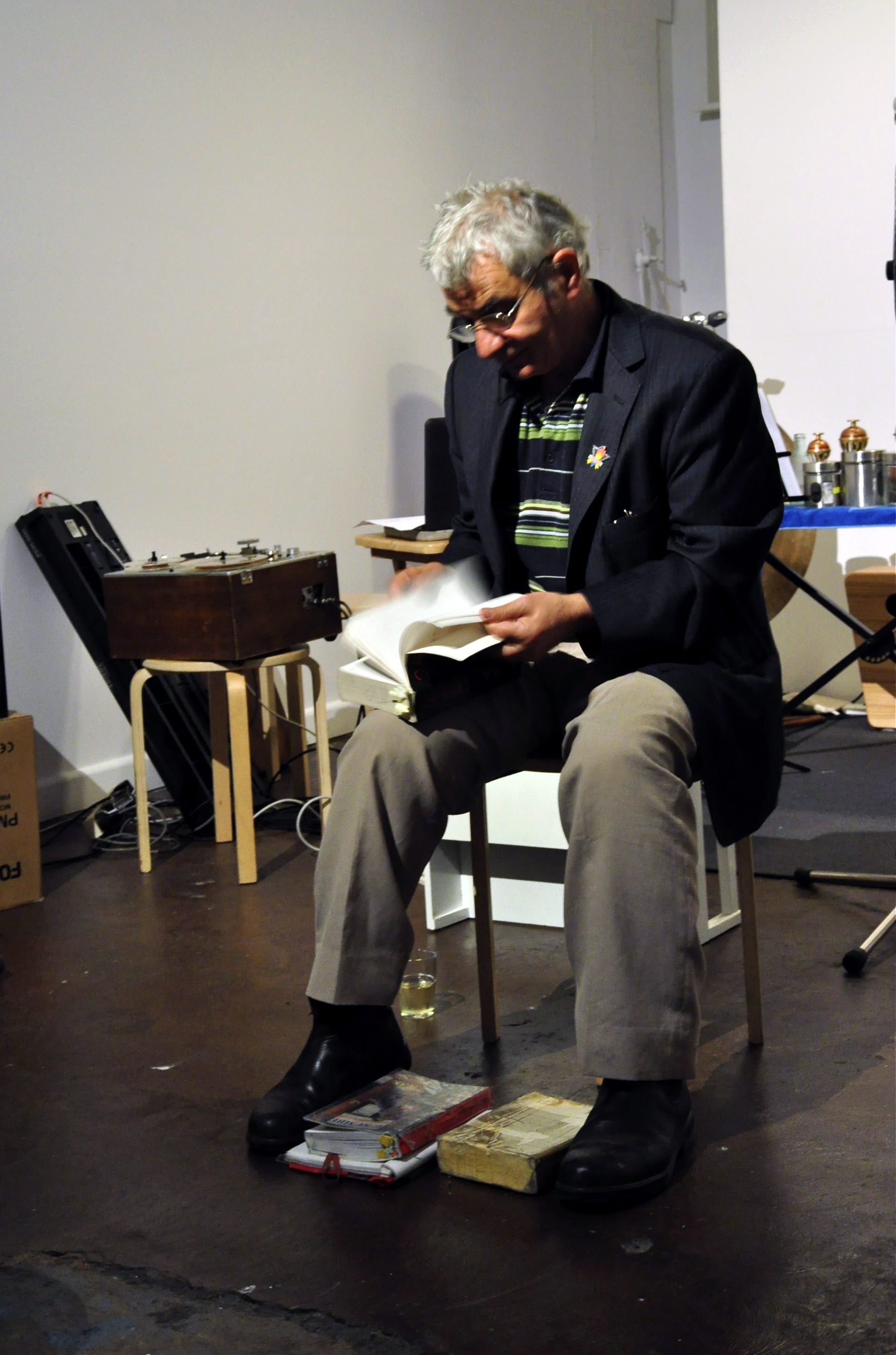
П.O. reads at Conduit Arts.
П.O. reads at Conduit Arts. Photo by Mandy Kitchener.

“marionette”
Manteia
П.O.
ROBA
Conduit Arts
9 May

The communication and corruption of biography and autobiography was an accidental theme of Simon Charles’ curated music night at Conduit Arts. When Charles contacted П.O. to read at Melbourne’s newest hybrid arts venue, he didn’t need to give directions. П.O. grew up just across the road, in the few blocks of Fitzroy that eventually made way for the Atherton Gardens housing estate. The audience at Conduit on Thursday night were lucky to hear some of П.O.’s seldom-performed “Fitzroy poems” from 24 Hours, a 740-page poetic record of the neighbourhood in the nineties. In a steady half-shout, П.O. described a walk around the pre-gentrification working class suburb with its cafés, grocery stores and “derros,” relating snatches of dialogue between shopkeepers and passers-by. My favourite moment: On board a tram an old man repeatedly wishes the conductor luck with his 6% pay claim, despite the conductor’s repeated assertion that he isn’t in the Union.

П.O.’s frank delivery and autobiographical psychogeography of Fitzroy couldn’t have contrasted more with Charles’ musical setting of Jessica Wilkinson’s “marionette.” Spanning 100 pages of layered, fragmented and eroded writing and pictures, “marionette” is an obscured biography of the already-obscured life of Hollywood starlet Marion Davies. Through the twisting, fading and cutting of text and images, the book amplifies the themes of decay and silencing inherent in historical materials, as well as the very deliberate manipulation of Davies’ image by the media tycoon William Randolph Hearst. Charles’ setting for sampler, tape and saxophone (Charles) percussion (Matthew Horsely) and two voices (Jessica Wilkinson and Jenny Barnes) adds a new layer to the palimpsest of Davies’ story, drawing inspiration from both the content of Wilkinson’s book and its typographic manipulation.

Jessica Wilkinson and Jenny Barnes perform marionette. Photo by Mandy Kitchener.

A high, wavering tone rose suspended in the narrow white shopfront. With barely enough room for them all, Manteia conjured a much larger space with a soundscape of scraped gongs and sparse vocal clicks. Suddenly the room became closer with the introduction of live and pre-recorded phrases of text overlapping, synchronising and then drawing apart again. Imitating the degraded reels of Davies’ films at the UCLA film archive, Charles hand-manipulated a tape recording of Wilkinson’s poem by slowing, speeding up and stopping the statements that introduced the underlying message of the concert: “We are the puzzle-solvers.”

As yet another form of silencing, Davies suffered from a stutter her whole life. Wilkinson’s textualisation of this stutter in her fragmented and halting text is tranformed into the short, scattered vocal sounds of Charles’ composition. Most of the time this percussive polyphony rises above a shifting bed of more sustained tones produced by the scraped glass and bells of Horsley’s battery, and Charles’ sampler. Like the three-dimensional effect of Wilkinson’s overlapping and untangling text, this distant, transparent texture is then brilliantly juxtaposed with a closer, denser texture where Horsely’s percussive interjections, the text of Charles’ tape and the speakers all brilliantly collide at the same dynamic.

With the instruments dying away or stopping still, the last word of each episode is given to Wilkinson, who delivers punctual cadences like “now you’ve certainly spilled the apple cart” or “you know, the silly stuff.” The text closes the musical movement of each poem while opening up a field of interpretive ambiguity, highlighting the creative friction between textual and musical “openness”. A musical work can be formally closed (it has reached a point of resolution or symmetry, or its development appears exhausted), while its text may remain open, inviting expansion and development. The openness introduced by each of Wilkinson’s closing lines threads the nine poems of “marionette” together into a meandering, stammering, whispering song cycle.

After the juxtaposition of П.O.’s autobiography and the biography of “marionette” I am again inclined to question the role of the artist-provocateur, as I have in relation to Matthew Herbert‘s End of Silence. The problem is that if there is no new historical material, judgement or conclusion in “marionette,” then it just repeats the silencing that it addresses. The tension of “marionette” lies in the audience’s paparazzi-like hunt for glimpses of Davies amongst the flow of corrupted text. As in the gossip columns of the day, only the promise of the “authentic,” unsilenced Davies lures one through the dross, even if it is now a purposely open, fragmented image. Does Wilkinson and Charles’ added noise in the message tell us anything new about Davies or the nature of history? If a certain degree of silencing is inherent in history, then what value can we attribute to the further, creative silencing of historical texts? There is in fact a critique in “marionette.” It is introduced through theoretical terms like “postmodernity” and “sexual politics” scattered through the text. However, left undeveloped as they are (the case would be different if we had the opportunity to read Wilkinson’s exegesis as well, or even had a pre-concert talk), the critical power of these terms is silenced through their aestheticisation.

Zephyr Quartet, A Rain from the Shadows

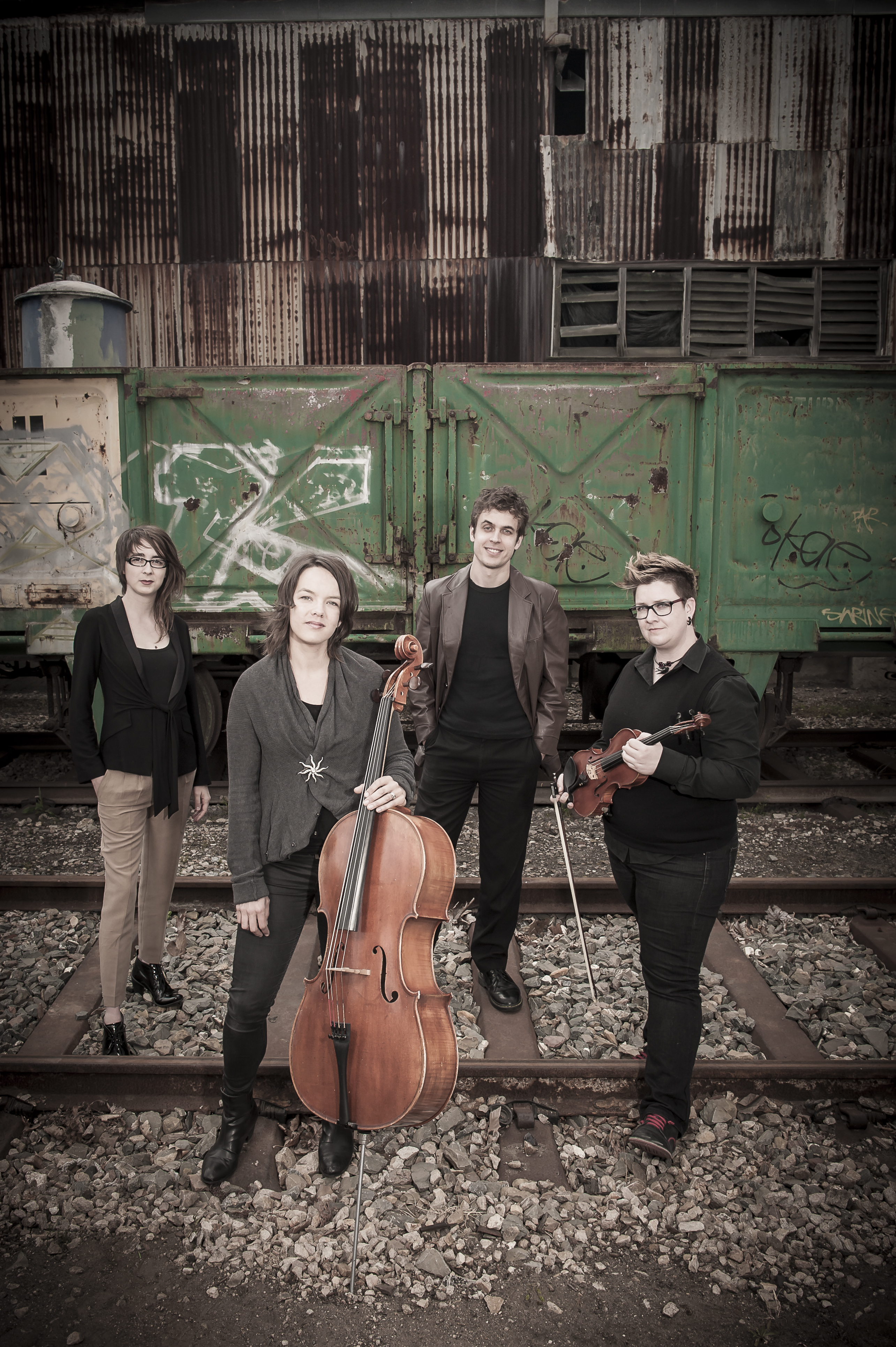
Zephyr Quartet. Photo by Sam Oster

Zephyr Quartet
A Rain from the Shadows (album launch)
Melbourne Recital Centre
26 April

More at home with a viola in his hand, Jason Thomas shakily grips the booklet of Zephyr Quartet’s new album A Rain from the Shadows. Glancing around the Melbourne Recital Centre Salon, he recites Mike Ladd’s “Dirt” in his best Radio National baritone. The quartet now seems to evoke the growing termite mounds of the Plenty Highway with rhythmic double-stops, looping violin motifs and ever more dramatic melodic interjections. Dirt is just one of the poetic responses to existing Zephyr Quartet compositions commissioned for A Rain from the Shadows. The album also includes works composed in response to poems by Iraqi-Australian poet Yahia Al Samawy, Australian Rob Walker and Mexican-American poet Gary Soto.

Belinda Gehlert’s compositions express a wide-eyed wonder at the natural world, drawing inspiration from snorkeling in freshwater sinkholes near Mt. Gambier in South Australia and expanses of dunes near the ocean. In Dunes, based on a poem by Rob Walker, the wind eternally blows millions of tiny boulders of sand over each other, eroding mountains and bones along the way. The loping, Sisyphean ostinato of the viola is contrasted with a lyrical slow section, as though we have taken a step back from Sisyphus’ microscopic work to view the shifting landscape.

Hilary Kleinig composes transformation in From Darkness to Day, drawing upon a similar line from Al Samawy’s poem Four Loaves from the Heart’s Oven. Sending a message of hope, the piece is a variation on a breath, from its first meditative inhalations to its final jubilant shouts.

Contrasting with Gehlert and Kleinig’s episodic impressionism, Emily Tulloch’s two compositions Skyroads and Air drew (unconsciously or not) on the contrasting worlds of nineties computer game music and twentieth-century timbral experimentation. Skyroads is so named because, after composing the piece, Tulloch realised it resembled the soundtrack to the eponymous 1993 shareware game. Having spent some time with the game over the weekend—purely in the interests of good journalism—I can critically and objectively verify this similarity. Tulloch’s sustained and polymetric violin lines recall a time in sound card manufacturing when timbral variation came at a premium and polyphony was an exciting new possibility. In contrast, Air develops a floating texture of string harmonics and the convoluted overtones of flautando bowing. The piece concludes with some masterful whistling over the quartet’s sustained notes.

With its vivid imagery and dramatic string writing, A Rain from the Shadows could be dramaturged and presented more theatrically. Some interest was lost in the absence of the texts from the performance (with the exception of Thomas’ recitation). The presence of the texts could encourage the quartet to further accentuate the gestural, expressive aspect of their original compositions.

Read Chris Reid’s review of A Rain from the Shadows over at RealTime.

James Rushford and Joe Talia, Manhunter

Manhunter by James Rushford and Joe Talia, cover art by Michael Salerno

James Rushford and Joe Talia
Manhunter album launch (Kye Records)
Northcote Uniting Church
25 April

Breath and wind united the four acts of James Rushford and Joe Talia’s album launch beneath the pipe organ of the Northcote Uniting Church. Robert McDougall and JK Fuller contrasted mouth organs and harmonica clusters with rumbling electronic ground-basses, percussive metallic articulations and a broad chroma of static interference and distortion effects in their ambient, minimalist electronic sets.

Armed with only her own voice, an accordion, brushes, a mouth organ and a sheet of aluminium foil, Carolyn Connors proves she needs no electronics to transition from a clear vocal tone to inhuman white noise, gibbering and squeaking. Variously bounced on her knee and played with brushes, the accordion becomes yet another wind instrument motivated by Connors’ nervous agitation. The perpetuum mobile is broken only as Connors wraps a sheet of aluminium foil around her head to project her powerful (and apparently indestructible) voice buzzily through the metallic veil.

Cloaked in a red half-light, Joe Talia and James Rushford open their set with several minutes of soothing, cycling chords on a Twin-Peaks-era synth. Sublime video footage by Michael Salerno of tornadoes graces the front of their desk. Those hoping that the tension between the awesome power of nature and the keening tonal salve will continue are sorely disappointed, plunged into an hour of mumbles and crackles over a pulsing, bassy hum.

Part of the fun of a Talia/Rushford show is trying to guess what they are doing. We know not to question someone’s apparent inactivity in front of a mixing desk, but what exactly is Rushford doing as he somnambulantly manipulates a stick on a tabletop, blows into what looks like a duct-taped syrinx, or sticks some sort of barbecue tongs in his mouth?

The show ends with a slowed-down recording of Auld Lang Syne on piano and strings. Rushford sips something out of a church-hall mug and Talia stares vacantly at his mixer. Saddest New Year’s Eve Ever.

Metropolis: Thomas Adès, Shadows

Thomas_Ades_Page03
Thomas Adès, image courtesy of the Melbourne Recital Centre

Thomas Adès
Melbourne Symphony Orchestra
Shadows
Metropolis New Music Festival
20 April

Bringing jazz-inspired works by Mark-Anthony Turnage and Thomas Adès together with the sensitivity and virtuosity of cellist Steven Isserlis, the final concert in the Metropolis New Music Festival celebrated contemporary compositional finesse.

Adès opened the concert conducting Niccolò Castiglioni’s Inverno In-ver. The wintry dance suite combines post-tonal transformations with the icy orchestral colours of celesta, woodwind, chimes and glockenspiel to create tableaux of racing snow and frosty stillness. Whereas some performers will complain that the results of some contemporary works do not warrant their difficulty, Castiglioni and Adès’ music may be compared in the dazzling surface-effects produced in their complexity.

A case in point being Adès’ jazz-era burlesques for orchestra from the opera Powder Her Face. Dripping with gritty sensuality, the excerpts harkened back not so much to the foxtrots and tangos of the 1930s, but to the sophisticated, self-aware, Weimar-era opera of Ernst Krenek and Kurt Weill.

Mark-Anthony Turnage draws on later jazz styles in his tour de force for cello, Kai. Confronting the audience with a deafening wood-clap, Kai proceeds to seduce them with a homage to the romantic cello concerto. A muted trumpet introduces the piece’s theme like a distant bugle call announcing the arrival of the jazz-cavalry. Each time the refrain returns on cello it is more desperate. It is a struggle for the cello to be heard above the ensemble, leading the cellist ever closer to the bridge with an ever-heavier bow and a correspondingly hyper-emotional sound. Then the shredding begins. Isserlis covers the cello, hair and all, like a 1980s speed-metal guitar guru.

Isserlis channeled a different kind of virtuosity for four of György Kurtág’s Signs, Games and Messages, repeating each descending mode or two-note phrase as though it were a completely new thought. At times scarcely audible, the meditative whisper of the cello was almost drowned out by the hall’s creaking light fixtures.

Cybec finalist Lachlan Skipworth conjures a “solar drama” (to use a phrase of the Australian Mallarmé scholar Gardner Davies) out of the orchestra in Afterglow. Like the dying rays of the sun, a fanfare on tuba announces shimmering string colours, which build and dissipate in a dense crescendo. The chaos leaves behind a more transparent texture with a lyrical oboe line. Harp and piano can faintly be heard moving across the orchestral surface. It is as though the tuba has dipped behind the horizon of the strings and risen again as a silver moon, lighting the path of two wanderers.

What the Shadows programme gained in stylistic dexterity it lost in innovation. It is remarkable that the most contemporary-sounding work on the programme was by Castiglioni, a dead composer. By contrast, the rest of the works (Kurtág’s Signs, Games and Messages excepted) presented reworkings of bygone styles for the orchestra and large ensembles. Many works in the smaller Metropolis concerts gave a stronger sense of being not just “current” but “contemporary.”

Metropolis: Mira Calix, Looking for Cowslips

MIra Calix
Mira Calix, image courtesy of the Melbourne Recital Centre

Mira Calix
Looking for Cowslips
Metropolis New Music Festival
20 April

Occupying the 6pm slot before Thomas Adès’ Shadows, there was a welcome informality to Mira Calix’s juxtaposition of her own chamber works with those of four other contemporary British composers. No projections, choirs or crickets: Instead, Calix gathered an intimate council of composers, performers and listeners to consider their relationship to nature with the help of poetry from the nineteenth century and today.

“This is me,” begins the electroacoustic track of “looking for cowslips,” Calix’s work for soprano, clarinet, viola, cello, piano and electronics based on Alice Oswald’s poem. The phrase proliferates in the space before being captured like a thought by soprano Lotte Betts-Dean. In such a simple gesture the multiple identities of nature are realised in a single human being.  The moment of self-awakening does not last long as the air is quickly disturbed by a tremolo on cello (Zoe Knighton) and Betts-Dean frantically calls “no, no, no, no.” Throughout the piece the harmonics, trills and pizzicati of the cello provide an internal, affective countermelody to the soprano’s narrative. Bird and insect calls form an external environment to which the soprano responds, while echoes and transformations of the soprano line reflect the permeability of the natural and human worlds.

Calix and Larry Goves reverse their usual compositional roles in their collaboration “eyepoe.” Calix takes control of the instrumental parts, while Goves is entrusted with the electronics. The piece contrasts melodic string and clarinet parts with short, prerecorded, haiku-like passages for what sounds like harp and steel-string guitar. As the piece progresses the instrumental parts become darker and the electroacoustic track more suffused with a wind-like roar, dissolving the musical into the ambience of natural sound.

The collaborative descent of “eyepoe” prepared the audience for Tansy Davies’ stark vocal setting of lines from the nineteeth-century nature poet John Clare’s autobiography. The soprano evokes cornfields and forests “troubled” by the “destroying beauty” of weeds through Davies’ hypnotic, falling chromatic lines.

The ensemble achieved a perfect balance between electroacoustic and instrumental sound in the intimate acoustic of the Salon. The result was a highly affective performance that drew the audience into the composers’ worlds of cowslips, cornbottles and sunflowers. In withdrawing her book Memorial from the T. S. Eliot prize in 2011 because of the prize’s questionable sponsors, Oswald described poetry as “the great unsettler.” Calix and company’s music provides unsettling settings of unsettling poetry, placing humanity’s relationship to nature on the salon table.

Metropolis: Speak Percussion, City Jungle

City Jungle € The Reginald € Seymour-31
Matthias Schack-Arnott and Eugene Ughetti, image courtesy of the Melbourne Recital Centre

Speak Percussion
City Jungle
Metropolis New Music Festival
19 April

Between its origin in mid-1990s rave culture and its contemporary chain-ganging into the long, wobbly march of dubstep, drum and bass was a hotbed of virtuosity and experimentation at the heart of electronic dance music. In Australia, pioneers like Terminal Sound System have continued to develop the unique style of breakneck drum beats and earth-moving bass with an ear towards contemporary art music and the forever-plastic world of electroacoustic composition. At the same time, classical musicians like Speak Percussion founder Eugene Ughetti have drawn from drum and bass and jungle to inspire their own virtuosic playing. City Jungle is more than a collaboration between Terminal Sound System and Speak Percussion, it explores and summarises possible lines of influence between two musical worlds.

An array of cymbals, drums and vibraphones gleam under purple and red lights at the far end of the Melbourne Recital Centre’s Salon. The audience is ranged through the room on chairs, lounges and at standing tables. The intimate-sounding room is arranged not so much for dancing as for an intense, though laid-back listening experience. Terminal Sound System himself is not present, but Matthias Schack-Arnott and Ughetti provide ample visual interest with their focused, breathtakingly-coordinated attack on the battery of instruments.

At times Ughetti and Schack-Arnott provide backbeats on toms and cymbals to expansive electronic atmospherics and smooth-jazz melodies, while at other times they provide spitting, hissing, syncopated breakbeats on snares and Chinese cymbals over melodic bass lines. Moving to the vibraphone, the musicians contribute melodic hooks and ostinati of bewildering complexity to the mix. In these ways Speak Percussion complement Terminal Sound System’s electronics, filling in a part of the whole musical picture.

Of greater interest, perhaps, is Ughetti and Schack-Arnott’s ability to reproduce electronic-sounding effects in a live setting. One effect is stereo panning and phasing. Facing each other at the front of the stage, the percussionists play tremoli on two triangles, gradually muting and unmuting them to create waves of timbre that pass back and forth across the room. A similar technique is used with rolls on snare drums, except this time the players send waves of both volume and speed back and forth. As the speed of the rolls decreases their volume increases, giving the sound spatial depth, as though it were moving towards you and getting larger. Other atmospheric effects included Schack-Arnott’s playing untuned radio static and conjuring unearthly sounds from a China ride cymbal.

Sometimes complementing Terminal Sound System’s sounds and sometimes expanding on them, Speak Percussion show the permeability between contemporary percussive and drum and bass sound worlds. Already in its third outing, City Jungle is becoming a remarkably popular and effective piece of contemporary Australian repertoire.