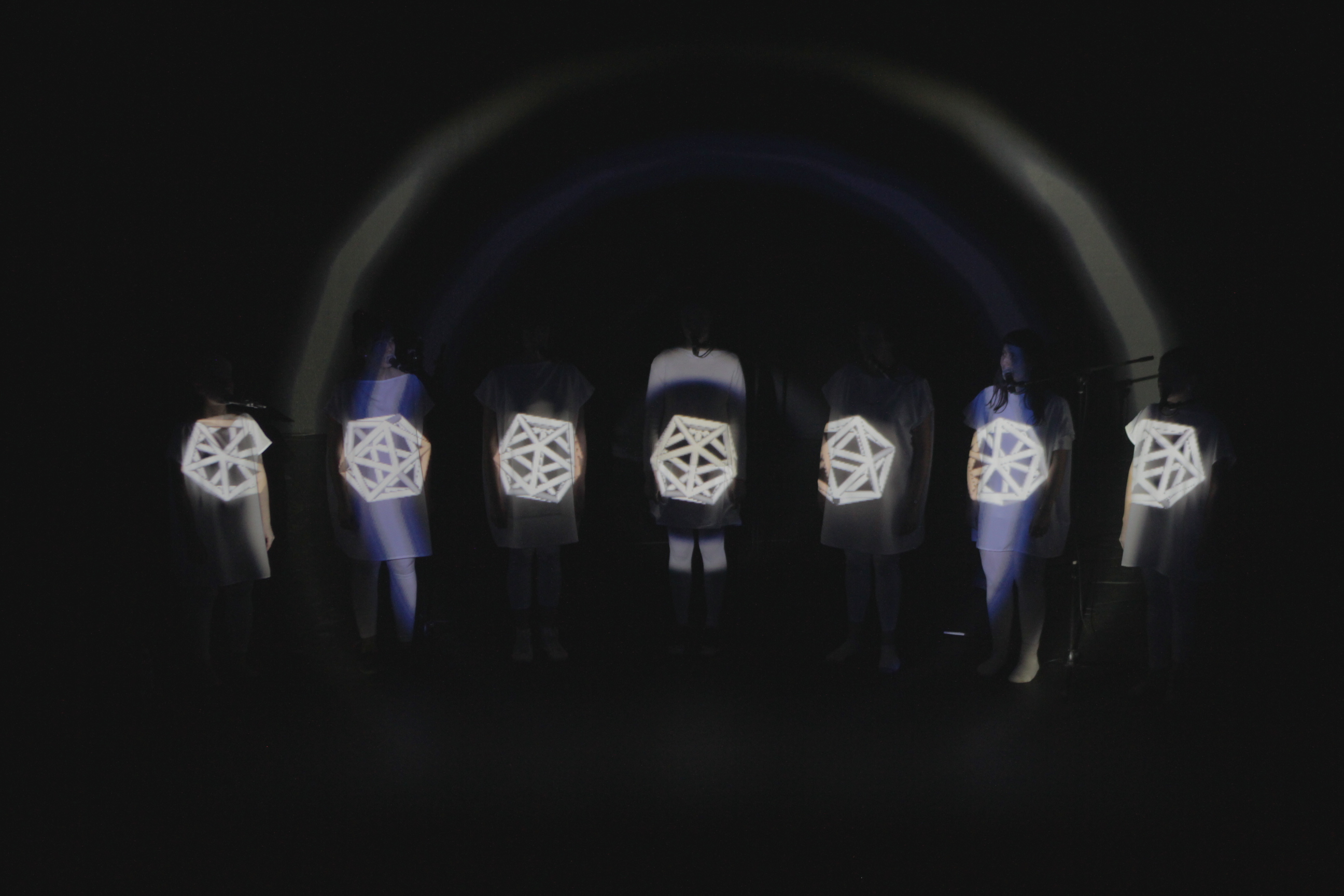
Invenio Singers in Luminesce. Image courtesy of Gian Slater.
Invenio
Luminesce
Guild Theatre, Melbourne
Thursday 11 July
Gian Slater’s compositions are kaleidoscopic musical worlds of dazzling rhythmic geometricity and ecstatic jazz-inflected polyphony. In contrast to this brilliant musical space her lyrics deal with day-to-day struggles like mustering the courage to deal with paperwork. The result is an enchanted hyper-reality where the mundane becomes the cosmic, or perhaps an internal space of solace in the face of a dull external reality. It is a world embraced by her ensemble, the Invenio Singers, who never fail to deliver an impeccably choreographed and polished performance of a good hour or so of music (in this case two) from memory.
Luminesce focuses on the abstract, musical side of Slater’s work, occasionally delving into more spikily chromatic territory than is usual for Invenio. The work is a collaboration with musician, video artist and creative coder Robert Jarvis. Using his software Voxstripe, Jarvis transforms the seven parts of Slater’s composition into visuals that are then projected onto the white-draped singers. Jarvis’ visualisations are simple and effective, like Slater’s music, using shapes and primary colours to highlight the shifting rhythms and phonemes of each singer. It’s such a magical combination of sound and light that it would seem a shame to ruin the surprise of future presentations of this work, which is currently in a “pilot” stage. In short, pastels bathe the ensemble in a glowing rainbow as they fill the room with diffuse harmonies, geodesic spheres are poetically transformed into jagged burrs as though a spiritual transformation is being enacted with each note and apertures like the insides of eyelids reveal and eclipse each singer as though under the gaze of a seven-eyed musical consciousness.
As well as being intensely satisfying for the pattern-searching brain we all share, Jarvis’ visuals highlight the polyphonic nuances of Slater’s composition, which reconciles the worlds of abstract musical composition and the extended possibilities of the vocal organs. It is remarkable that interactive technology is so familiar and affordable these days that elegant pieces such as Invenio can be produced without reliance on any technological “wow” factor, but rather trusting to the poetic integration of interactive projections into the composition. I’ll keep you posted about future showings of this hypnotic work.
In Shared Lines an itinerant spectacle of theatre, sculpture and music unfolds beneath the stained glass of the Rosina Auditorium. Hidden deep within the Abbotsford Convent, the hall’s art deco proscenium arch frames the proceedings like a portal into another time, a time of dance halls and dusty boarding school assemblies. The connotations are not lost on the musicians dressed with Vaudeville flair, much less the schoolgirls, maid and eccentric master of the house of Fixation, a physical theatre piece woven through and bleeding into the musical fabric of the night.
Upon entering the hall one is confronted with a pergola of cupboardry by artist Isabelle Rudolph, a musical ensemble tucked away next to a wall and an impossibly small square of seating in the centre of the room. The seating is more a provocation than an amenity, facing away from the musicians and providing an ideal view for only about five minutes of the entire performance.
It would have been a shame to have heard Rosemary Ball’s enchanting rendition of Liszt’s Oh quand je dors with only one ear, so I hovered near Rudolph’s comforting structure of wood and paint. A maid entered the stage and began miming hanging up laundry surrounded by glowing firefly puppets. The ensemble quietly repeated fragments of Oh quand je dors, this time interspersed with whispers and rattles from the string and wind instruments. Directed by Stephanie Osztreicher—freshly returned from a spell at the École International de Théâtre Jacques Lecoq—, Fixation is a tumble of action, humour and drama centred around an extract from Don Marquis’ Conversation with a Moth (powerfully delivered by Scott Jackson, especially so because we were a metre away from him at the time). The performance also served to lead the audience around the space and direct them towards Pandora, an installation by Robbie James and Ben Delves where the audience modifies the visual representation of improvisations on shakuhachi, flute and guitar by passing around an ominous wooden box. Don’t look inside!
A series of solo performances scattered the audience throughout the hall. I particularly enjoyed hearing the melodic sweeps of Chris Rechner’s Stem for clarinet (sensitively performed by Vilan Mai) from the back of the hall and Britten’s Metamorphosen for oboe (programmatically an ideal piece for the space and playfully realised by Katia Lenzi) at close range. The concert was also an opportunity to hear Jessica Fotinos’ virtuosic performance of George Enescu’s Allegro de Concert for the slightly terrifying chromatic harp, all the more so because she had to make do with the garden variety pedal harp. Katriona Tsyrlin brought out the introverted intensity of Evan Lawson’s Keys and Locks, a remarkable solo piece that contrasts well with the composer’s ensemble extravagances.
As a curator Lawson is to be commended for coaxing the audience into participation by making it ever harder for them to experience the performance without moving, a dynamic culminating in multiple performances in multiple rooms. Concert curators desiring audience members to move about the space (a desire usually expressed in a hasty mumble at the start of the concert) would do well to take note.
This review begins a series on the solo voice that weave together themes from contemporary performances with recent debate on the music, language and physicality of the voice.
Ellen Winhall at the Richmond Uniting Church. Photo by Michael Hooper.
Ellen Winhall
My Sister’s Song
Richmond Uniting Church
Thursday 11 July
Ellen Winhall’s recital for solo voice was an object lesson in the seamless integration of finely-honed classical musicianship with extended vocal techniques. The concert was also an opportunity to hear a remarkable body of repertoire for solo voice stemming from the English choral tradition including Australian premières of works by James Weeks, David Lumsdaine and Nicola LeFanu.
Aptly sung beneath the starry vault of the Richmond United Church, the concert was centred upon the nocturnal ruminations of David Lumsdaine’s 1974 composition My Sister’s Song. Based on love poems from a Classical Tamil Anthology translated by A. K. Ramanujan as The Interior Landscape, My Sister’s Song features a refrain evoking the calm passage of late-night hours:
The still drone of the time past midnight,
all words put out.
Men are sunk into the sweetness of sleep …
As a blogger has recently argued, the Tamil word originally used for “night” in this second–third century AD poem is related not just to the late night, but to a specific three-hour period, a midnight “watch.” The passage connotes not only the lucid quality of this period, but its quantity, a quantity that is developed throughout the poem in relation to the narrator’s singular loneliness. The author might be thinking of the period of reflective wakefulness some scholars believe divided the night in two before the invention of urban and electric lighting. As Roger Ekirch argues in At Day’s Close, Night in Times Past, long, dark nights encouraged people to go to bed early for a “first sleep” and rise for an hour or so to study, pray, or even visit neighbours before their “second sleep.” I can imagine David Lumsdaine composing the long, ruminative work during such a midnight “watch,” spinning out the slow, disjunct phrases like constellations on the page. So can I imagine Winhall, only the third soprano to perform the work since its composition for Jane Manning in 1974, humming the work’s melismatic decorations to herself during a period of nocturnal wakefulness. Every twist and turn of the atonal piece—part chant, part unaccompanied recitative, part expressive solo aria—was thoroughly internalised by Winhall, whose considered and precise execution was simply astonishing.
In her remarkable performance notes published as the two-volume New Vocal Repertory, Jane Manning writes that Nicola LeFanu’s But Stars Remaining is to be “sung as from a high rock, the voice flung across a spacious valley.” Winhall evokes the kestrel and the dove of Cecil Day-Lewis’ poem with all the exhilaration of the freely-soaring animals described, before retreating to the intimacy of whispers and half-spoken text.
Winhall’s dynamism and character as a performer blazed through the technical demands of Berio’s Sequenza III, where rapid sequences of phonemes are juxtaposed with hums, vowel-shifting tones, sighs and laughter. A similar carefree virtuosity marked Georges Aperghis’ Récitation 13, which concluded the concert with a playful series of mimicked percussion sounds. The only feature impeding the audience’s enjoyment of Winhall’s performance was perhaps the ABC Classic FM microphone stand limiting the audience’s view and Winhall’s physical mobility.
With their roots in the English choral tradition, the compositions of Weeks, Lumsdaine and LeFanu present an inversion of the usual emotional dynamics of contemporary repertoire. Winhall’s programme oscilllates between troubled, inward reflection and outward jubilation. It is such a pleasure to hear music where “loud” does not immediately connote “wrathful” and “quiet” “sensual.”
Winhall’s concert was recorded for ABC Classic FM. When we hear about a broadcast date we’ll keep you posted.
Gentleness-Suddenness
Campbelltown Arts Centre
29 June 2013
Review by James Nightingale
Campbelltown Arts Centre brought together four of Australia’s finest exponents of new classical music to perform a program of works by Sydney based composer Bruce Crossman. Crossman’s music brings facets of Asian musical idioms into what is fundamentally a contemporary classical musical language, creating a thoroughgoing cultural dialogue that takes the performers to their virtuosic limits.
Double Resonances, composed in 2008, is a duet for piano, played by Michael Kieran Harvey, and a world of percussion brought to life by Claire Edwardes. The contrasting resonances of the instruments themselves, and of the musics of east and west, form the defining feature of this evocative work. On the one hand, the density and harmonic homogeneity of the piano speaks from the Western concert hall, while on the other, Asian gongs, crotales, tam-tam, bowed vibraphone and cymbals carry the listener into the unique idiomatic sounds of metal—a batterie formed from the sounds of the Chinese, Korean, Japanese and Indonesian instruments that are now common in Western contexts.
Crossman favours a structural arc on which to pin his musical ideas. In Double Resonances, this arc travelled from a bleak stasis broken only by muted plucked piano through a dialogue between ‘jazz piano’ and ‘gamelan’ and back again. This journey was regularly punctuated by shared ensemble pulses/gestures that carried the weight and momentum of the work. Seeing the performers work with single-mindedness to carry through the complex instructions of the score was fascinating and rewarding for an audience that had made the journey on a rainy night to the CAC.
Violinist James Cuddeford joined Edwardes and Harvey for Not Broken Bruised Reed (composed in 2010), a work that also moved through an arc shaped structure. Here, the structure felt like Crossman had established a sound world based upon the natural fundamentals of the tones that was disrupted by the drama and journey of the work. The return of the original timbres of the work underlined the ritual space that the work inhabits, a sensation highlighted by the players speaking and whistling as they played.
After the interval Harvey, Cuddeford and Edwardes were joined by mezzo-soprano Lotte Latukefu for the premiere performance of Gentleness-Suddenness. This song cycle expands the artistic palette of the instruments with text, pictures and live electronics. As the title implies, the piece is about contrasts, although gentleness and suddenness are by no means antonyms of each other. Consisting of two parts—‘Water and Fire’ and ‘Spirit’—which again utilized the arc structure which framed the musical drama. The musical content in this piece, however, was directed more particularly at the task of giving colour and nuance to the texts. The text, which was assembled by Crossman from fragments of the Bible and Chinese Opera (specifically from the Peony Pavilion), was in effect a love poem, brought to life by Latukefu’s voice which travelled effortlessly through a joyful range of colours and textures.
The visual element of the performance, featuring photographs by David Cubby and film by Iqbal Barkat, attempted to provide a context to the musical discourse, however, I for one found it difficult to take my attention away from the performers. Perhaps the musical details and language of the work were more obvious to my ears than to others? The experiment should be persisted with, as I’m sure that this kind of creative collaboration will lead to further artistic insights for all involved.
Hearing several of Crossman’s pieces in succession provided a clear window into his aesthetic—space, clarity, action and reaction—and language, one that incorporates aspects of Asian music expressed through the idiomatic sounds of Western instruments. Harvey, Edwardes, Cuddeford and Latukefu took painstaking care to bring out the ensemble and individual details that cram Crossman’s scores. The works were recorded during the week prior to the concert and there will be many among the audience, like myself, who will be keen to have a second listen to the performances of these mysterious and subtle pieces. This was an engrossing and satisfying concert of music that displayed the highest artistic ambition and craft on the part of composer and performers.
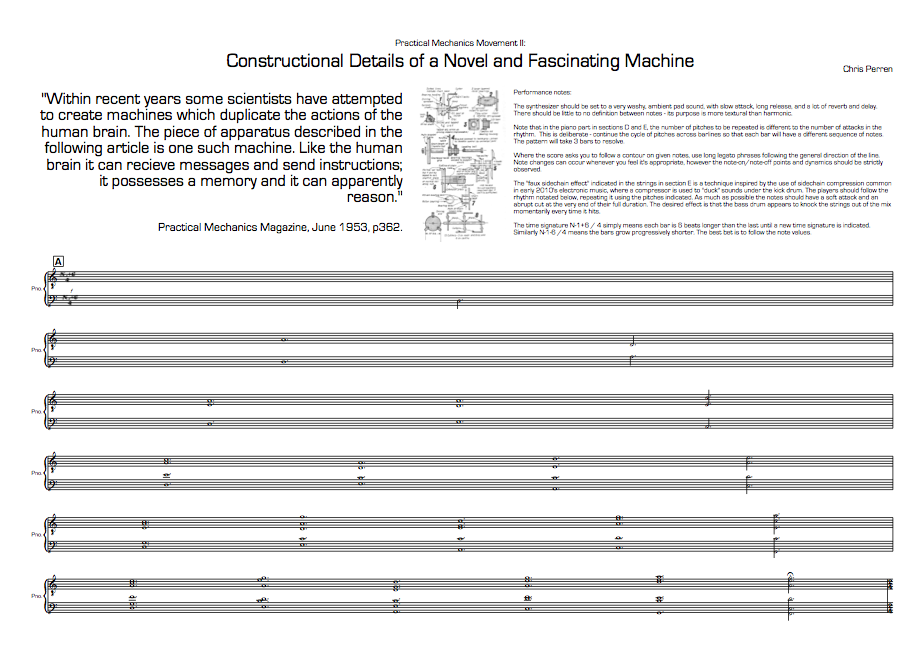
Practical Mechanics was a British hobbyist magazine that ran from 1933 to 1963, providing instructions on how to build anything from a bathtub to an airplane alongside articles on the emerging technologies of the space age. Composer Chris Perren has marvellously painted the magazine’s techno-utopianism in a five-movement composition for his Nonsemble, drawing on the machinic rhythms and open harmonies of post-rock and minimalism.
Thanks to a beautifully-typeset score, the album can be performed by anyone with ready access to junk percussion, a sampler, a piano and a string quartet. Perren ingeniously overcomes the notational clutter of long, syncopated “simile” passages by giving each instrument’s cell, number of repetitions and cues in relation to the other instruments. The score is also a great pleasure to read alongside the album, with the notation realising the love of mysterious technical geometry proper to the period.
Practical Mechanics by Chris Perren
The first movement The Great Awakening opens with a piano thumping underneath a vintage vocal sample. The piano sounds like the mechanical heartbeat of the watch listed in the sample alongside the elevator, airplane and other modern inventions. Swelling strings punctuate the anxious piano before launching into multi-geared polyrhythms that reach their climax in a magnificent breakdown of harmonic and metrical modulations. This thrilling opening to an album suffused with cold-war nostalgia benefits from comparison with Kinetic Work, the opening of the Montreal viola and percussion grindcore duo Hanged Up’s album Kicker in Tow. While Perren’s polyrhythms provide a greater sense of tumbling, racing freefall than Hanged Up’s energetic changes, Hanged Up use rusty, grimy production values to cast a more cynical pallor over the era’s myth of progress. Like the chrome space-phalli adorning the covers of Practical Mechanics, Nonsemble’s album is impossibly shiny and almost saccharine in its major-mode tonality. It is itself a testament to the spread of affordable technology.
With all my love of technology (more! Better! Faster!) I cannot help thinking that the period in question—with its proliferation of nuclear armaments—and the myth of technological progress in general deserves a healthy dose of morose musical criticism, if only for the gothic-horror kicks. But this would be selfishly steering Perren and Nonsemble towards an entirely different set of musical reference-points, Godspeed You! Black Emperor and Lutoslawski rather than Mogwai and Glass.
Gordon Kerry
Australian Voices (curated by Marshall McGuire)
Melbourne Recital Centre
11 June
The Australian Voices series, presented by the Melbourne Recital Centre and ANAM, celebrates established Australian composers with a night of performances by some of the country’s finest young musicians. For the performers and audience members, the series is an important education in recent and ongoing musical history. For the composers, the night is an opportunity to hear some of their works performed for perhaps only the second or third times. The intimate Salon is the ideal venue for such an event, with Kerry briefly introducing his works and thanking the concert organisers for “dusting him off.”
Kerry’s works between 2002 and 2008–from which the programme was drawn—play with shifting textures and formal convolutions (in the sense of a piece’s overall shape). Figures tumble over each other and episodes are reduced to glimpses through open doors as they are juxtaposed, superimposed and brought into lyrical contact with each other. The series curator Marshall McGuire commented on this aspect of Kerry’s compositions when he likened them to poems. Indeed, many of Kerry’s works are based on poems and it was particularly helpful of McGuire to read some of them out. If Kerry’s chamber pieces are poems, then, despite the lengths of their namesakes, they are sagas. And the Nothing That Is, Blue Latitudes and Nocturne all rely on their sprawling forms to achieve their full effect. As Wallace Stevens writes in The Snow Man, the inspiration for And the Nothing That Is: “One must […] have been cold a long time to behold the junipers shagged with ice […] and not to think of any misery in the sound of the wind.”
Kerry’s representations of snow and ice in And the Nothing That Is reveal a sensitivity to the still and crystalline forms of nature. Pointillistic piano decoration and pure string harmonics are scattered over the cold ground of a single cello note. The angularity of And the Nothing That Is contrasts with the fluid gestures of Blue Latitudes, where a flute springs over a ticking harp line. Not all is light and clear, however. Kerry’s music also has a dark side, as in the wandering, Wagnerian strings that precede the flute and harp duo.
A solo trombone piece and a marimba duo broke up the concert with interludes of energetic humour. As McGuire noted, Aria for trombone, performed by Iain Faragher, contrasts the lyrical and theatrical aspects of the instrument. The boppy marimba duo Out of the Woods sees two improvisatory lines converge upon a repeated hook.
The concert’s concluding work, Nocturne, was played beautifully by the ANAM students. Anthony Chataway attacked the dominant viola line with passion and precision. Lloyd van’t Hoff’s clarinet haunted the Salon from outside the space before entering to play a surging duo with the viola. Creeping figures met each other in the dark to engage in some midnight counterpoint, apparitions flickered across the ensemble and a repeated, descending piano figure tolled the hours.
As a lesson in history, the concert was a monument to the enormous body of post-impressionist music, for want of a better term, produced in Australia over the past thirty years in reaction to the brief dominance of the Boulezian aesthetic in our music institutions. Students of my generation, who were not traumatised by serialism, naturally ask themselves whether post-impressionism is still an interesting compositional path. When Boulez sits innocently next to Boyd on the shelf it seems no more valid to appeal to a piece’s listenability as a marker of its quality than it was to appeal to its complexity once upon a time, especially if that listenability devolves into tired word-painting and another faun-like flute line. After a few “rain” pieces that Boulez on the shelf looks mighty tempting. That said, Kerry’s chamber works form a worthy monument, with a three-dimensional discursivity betraying no lack of construction.
Ensemble Offspring
Between the Keys
The Street Theatre
8 June
Guest review by Veronica Bailey
I have always had a love for chamber music with varied instrumentation. It allows composition to drive what sounds are included rather than being restricted by the instruments that are available to the ensemble. This was beautifully demonstrated in the concert Between the Keys, presented by Sydney based group Ensemble Offspring. Instruments were commissioned for the ensemble for a previous concert. These instruments included a violin like instrument called an Undachin Tarhu, built by Peter Biffin, with an additional set of seven strings under the fingerboard that resonate with different frequencies . These strings are tuned to the centaur tuning system developed by Kraig Grady which was likewise adopted by other instruments in the ensemble. This included a vibraphone, harmonium, the bell-like meru bars, the clarinis and a keyboard.
The concert opened with a work by Arana Li titled Mysteries. The work aptly demonstrated the new sounds of the centaur vibraphone, the undachin tarhu and the clarinis. This was one of my favourite works of the night, the instruments sounding as naturally as if this configuration of instruments was as common as a string quartet.
Next was Music in Similar Motion by Phillip Glass, a minimalist piece conceived to be played by any group of instruments. This piece suited the centaur vibraphone and detuned keyboard perfectly, the ringing of the vibraphone adding a hypnotic quality to the work.
Amanda Cole’s Hydra was written specifically for the clarinis made for the ensemble. The sound was reminiscent of medieval music and the melodic interaction between the two players was enjoyable to listen to.
Some Shades of Blue by the artistic director Damien Ricketson was performed with great style by Anna McMichael on the undachin tarhu. It evoked thoughts of Mongolian nomads wandering vast plateaus. The conclusion to the piece had centaur vibraphone broken chords accompanying undachin tarhu bow scrapes, which were haunting and other-worldly.
Kraig Grady’s pentatonic piece Akashic Torus was often reminiscent of gamelan music. The vibraphone playing of Claire Edwards stood out in this piece and the meru bars, built by Grady, added a wonderful, sonorous quality when struck.
Arvo Pärt is a composer that I love listening to and I greatly enjoyed the Ensemble Offspring version of Fratres. Perhaps not more than the original, but still very much.
The final piece of the evening was a composition by Terumi Narushima. Hidden Sidetracks took the listener on a journey of all the centaur tuning has to offer. Beginning as a very tonal piece, with few centaur tunings evident, the piece quickly changes to take on a more oriental feel, and more notes feel a little strange to western ears. Quick dance-like segments feature regularly, with the work then returning to a more tonal centre.
This was a most enjoyable concert exploring an intriguing and rarely visited sonic landscape. Different, but very accessible, the program proved a hit with barely an empty seat in the house.
Before the first exhibition was installed, the new Bus Projects space in Collingwood opened its doors to Jon Heilbron’s Phonetic Ensemble. Like many double bassists, Heilbron straddles the worlds of notated and non-notated music, as comfortable in an orchestra as he is improvising with a group of jazz-trained musicians. The Phonetic Ensemble—a sprawling collection of brass players, percussionists, guitarists, double bassists, woodwind players and computer-musicians—collectively questions this divide by experimenting with the conventions of performance and musical notation. In a several-hour musical exorcism of the pristine new gallery, The Phonetic Ensemble performed two sets juxtaposing the idea of “sound on silence” with “silence on sound.” This conceptual arrangement was augmented with a score by Manfred Werder consisting of several blank pages and the words:
place
time
( sounds )
The introduction of “place” to the performance through the distribution of players across the gallery’s three main rooms clustered the instrumentalist and added a dynamic inertia to the development of silence and sound throughout the piece. Suddenly this was not an experiment with a single musical surface projected towards the audience from a stage, but several such experiments interacting and affecting one another through individual echoes, flocking and contrasts between individuals and groups.
Initial arrangement of The Phonetic Ensemble in Bus Projects gallery
In the front room (c) guitarists Dave Brown and Brett Thompson set themselves up between Reuben Lewis on trumpet and Dale Gorfinkel, who played a modified trumpet with a clarinet mouthpiece and a long plastic tube running from a valve to a secondary trombone bell. On the other side of a partition the trumpet-players Peter Knight and Callum G’Froerer flanked Jon Smeathers with his laptop running Ableton Live (b). Down a short hallway the gallery’s narrow projection space (a) was inhabited by Matthias Schack-Arnott’s table of percussion instruments, Jon Heilbron on double bass and Aviva Endean on clarinets.
When the concert began I found myself in room a, where Endean played swelling, nasal phrases over the grinding sound of a port glass rubbed against a coarse tile. Heilbron added a ground of low, bowed tones before contrasting with high, short attacks and low trills. Schack-Arnott responded by rattling a chime made of empty bottles. Though group a formed a musical world unto itself, they were soon echoed by muted trumpet trills from room b, where a more timbral game was at play. G’Froerer’s trumpet hissed and spat like a leaky espresso machine and Smeathers triggered harsh explosions of square-wave tones. This sound-world was picked up in room c where wooden-sounding “chucks” and muted flurries from the guitars announced a flock of dry, harsh sounds between rooms b and c.
Standing up and playing low, grumbling sounds at ground-level with his flexible trombone bell, Gorfinkel moved to the gallery’s “sweet spot” where all three groups could be heard equally (d). Raising and lowering the trombone bell from the ground, he was able to mute and unmute a quiet gurgling sound that also projected from the primary trumpet bell. The timbre of the sound was further manipulated by raising the bell into the air and directing the sound toward the three main rooms.
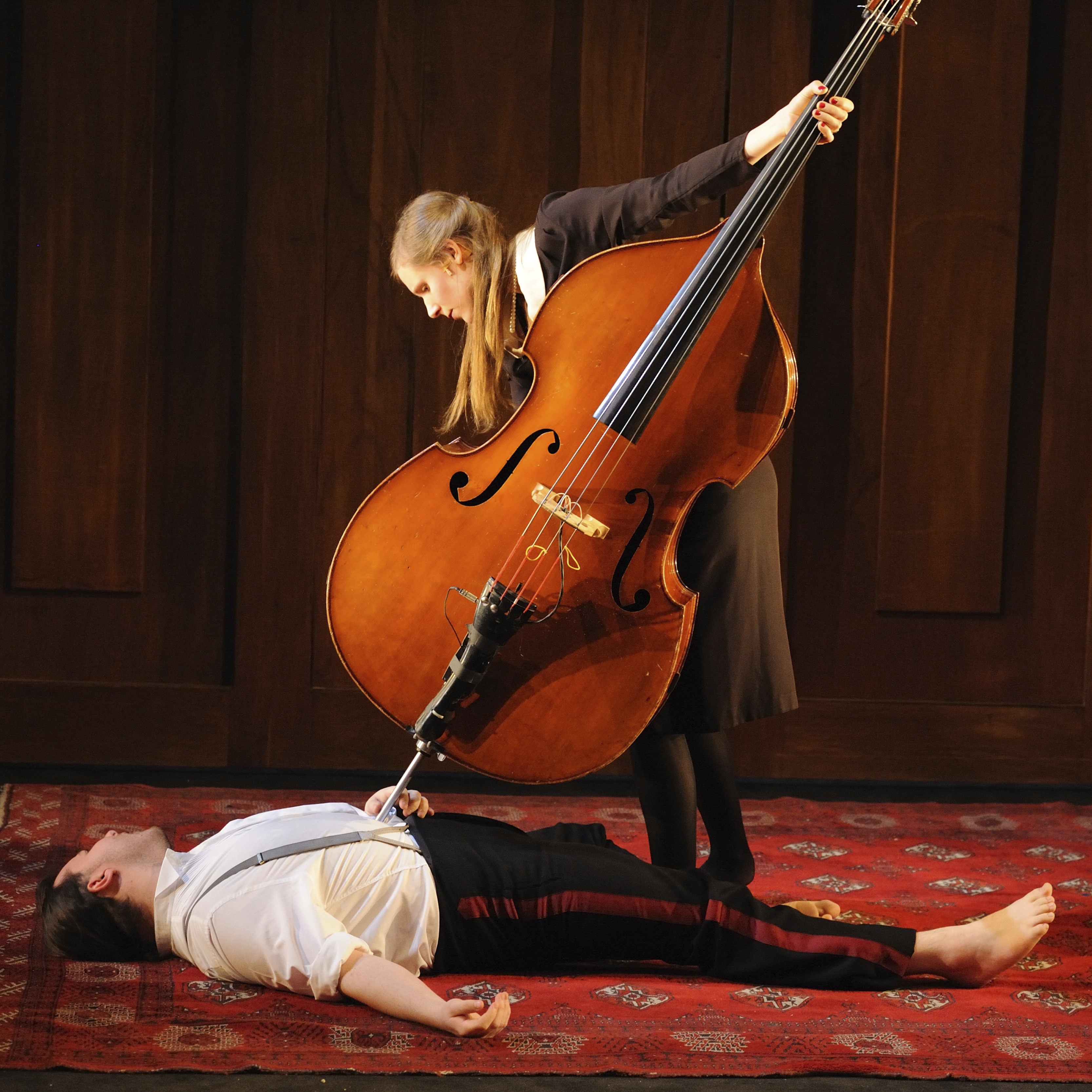
Returning to room a, a man lay down and Endean and Gorfinkel were playing around his head and pressing the trombone bell on his back. This moment had a certain pedigree, with both Schack-Arnott and Endean having recently developed intimate one-audience-member programmes.
Suddenly there was a breath, the first moment of silence in the performance so far. The rest of the performance was more focused, with detailed interaction across the ensemble. The silence was broken by a clatter of high metal percussion and low double bass tones. The clatter and bass subsided, leaving high tones from the clarinet and trumpets in all three rooms. These give way in turn to a low double-trill on the clarinet and the quiet whirr of a coffee stirrer with a paper fin playing a double bass string.
I installed myself at d as shifting shades of brass and low, distorted guitar chords struck up from rooms b and c. The clarinetresponded with low, rising glissandi, which were in turn echoed in the electronics. The electronics built in a garbled fury as the trumpets entered staggered across the space. The trumpet echoes died away, leaving a decorated clarinet line and rattling bells.
Shifting their attention from the sound painted on silence to the importance of silence between sounds, the musicians were much less restrained with the sounds they did make in the second set. The performance was not so much an exploration of silence than an exploration of spatial disconnection. The uncanny atmosphere of the second set was enhanced by a rearrangement of the ensemble. Thompson took up the Endean’s corner, while Lewis took up corner e. Brown stoically held room c, playing a quiet ostinato that could not be heard in any other room. Lewis offered fluttering “sigh motifs” from his lonely corner, while G’Froerer responded with rising interjections. Silence returned, except for Schack-Arnott bowing crackling, popping sounds out of the protective foam of his table. A distorted rumble rose from the electronics. Lewis started throwing rattling, jittering tones between rooms a and c while Thompson plucked out a lazy tune next to Schack-Arnott shaking his percussion table. Wailing trumpets erupted while Schack-Arnott took to worrying a large chain.
It is remarkable how the spatialisation of the ensemble rearranged the priorities of the performance from an interrogation of silence and sound to musical connection and disconnection across the ensemble. This was evinced by the performers, who strived to maintain connection with the rest of the ensemble by inhabiting spaces d and e. It was more interesting as a listener, however, when they didn’t. The interest lay in hearing the connections across the spaces and moving to discover a sound, or even a whole sonic environment, that was inaudible a few steps away, in other words, the relative distribution of silence across the space.
Winterreise by Ida Duelund, Chamber Made Opera Records
Winterreise (album launch)
Ida Duelund
Peter de Jager
A living room in Williamstown
Chamber Made Opera Records
Saturday 25 May
A supermoon hung in the seaside gloaming as I inexpertly navigated the streets of Williamstown. Getting a little lost is all part of the Chamber Made Opera experience. In the company’s successful Living Room Opera series, the audience is given the address of a household venue somewhere in Melbourne, hoping that the door they knock on hides the host, audience and performers they are looking for and not a family preparing dinner. Chamber Made Opera’s new record label is taking a similar approach, eschewing the trappings of bar or concert-hall launches for an intimate engagement with performers in a suburban living room. Though the autumnal ramble towards last Saturday’s coastal home was far from the lonely winter’s journey depicted in Franz Schubert’s Winterreise song cycle, the experience lent a heightened sense of strangeness and discovery proper to Schubert’s subject.
Gathered around cheese platters with cups of mulled wine, we were not to hear Ida Duelund’s unique interpretation of Schubert for voice and double bass before pianist Peter de Jager treated us to Bach’s Toccata in F# minor, Schubert’s Impromptu in Gb major and Australia-based composer Chris Dench’s E330. Jager’s sensitive articulation of polyphonic voices adds fresh depth and interest to works as well-known as Schubert’s Impromptu. Appropriate for an evening dedicated to the erring soul, all three works performed by Jager pitted a wandering, arpeggiated accompaniment against a searching prinicpal line. Dench’s E330 (from the opera We based on the novel by Yevgeny Zamyatin) strikingly contrasts a Scriabin-like Fantasy with a faux-serial study. In We, the piece is played by a character in a strictly regulated, utilitarian dystopia to demonstrate the difference between Scriabin’s hyper-emotional music and the coolly-formulated music of the One State. Both parts are marvelous constructions on their own, but gain value in their juxtaposition. The icy, crystal-clear vistas and balance between the principal and accompanying voices in the latter half of E330 comes as an epiphany, but only after the Scriabinesque turmoil.
Ida Duelund in Another Lament, 2011. Photo by Paul Dunn
Duelund intoned the first falling notes of Gute Nacht a capella as the night turned black and ship lights passed by outside. Wedged in an opening between two rooms, she performed to one, then to the other audience, accompanying her seraphic voice with bowed and pizzicato double bass. Duelund’s interpretation of Schubert is an intimate rediscovery of counterpoint, at times dissonant, at others of the purest, open intervals. Missing from the launch was Jethro Woodward’s electronic manipulation of the double bass, which accompanied Duelund in the first outing of her Winterreise programme in 2011. Woodward’s subtle atmospheric support is reproduced to great effect on the album itself, available online through Chamber Made Records. What was lost in Woodward’s absence was more than compensated for by some of Duelund’s new compositions, mostly sung in Danish, which show her wandering contrapuntal style extended to new extremes, with an extended vocal range, daring leaps and completely exposed singing against semitones and quartertones in the bass. Like Schubert’s wanderer, Duelund’s voice always returns to some sort of home, though never that from which it sets out, creating a challenging, unnerving, but ultimately rounded experience.
If Ida Duelund does not become a stratospherically famous avant-garde pop star then it will be by no fault of her own. We can blame the market, or the public, or any number of extraneous circumstances, but the counterpoint of Duelund’s seraphic voice and searching double bass confronts, confuses and finally wins one over in a way that is utterly unique today.
RealTime has three copies of Ida Duelund’s Winterreise to give away courtesy of Chamber Made Opera Records. Details here.
Wrong Answers
Callum G’Froerer (Curator)
He & Eve & The Big Apple
Monday 3 June
There was a charmed quality to the second concert of Callum G’Froerer’s ANAM fellowship, where solo and small ensemble works for trumpet, violin, voice, double bass and percussion flowed past as seamlessly as the Merri Creek just outside the warehouse venue’s door. The carefully-curated and -staged programme gave rise to a rarefied sound world of delicate and uncommon extended techniques. More familiar techniques were given new life in the resonant environment by an ensemble of dedicated performers.
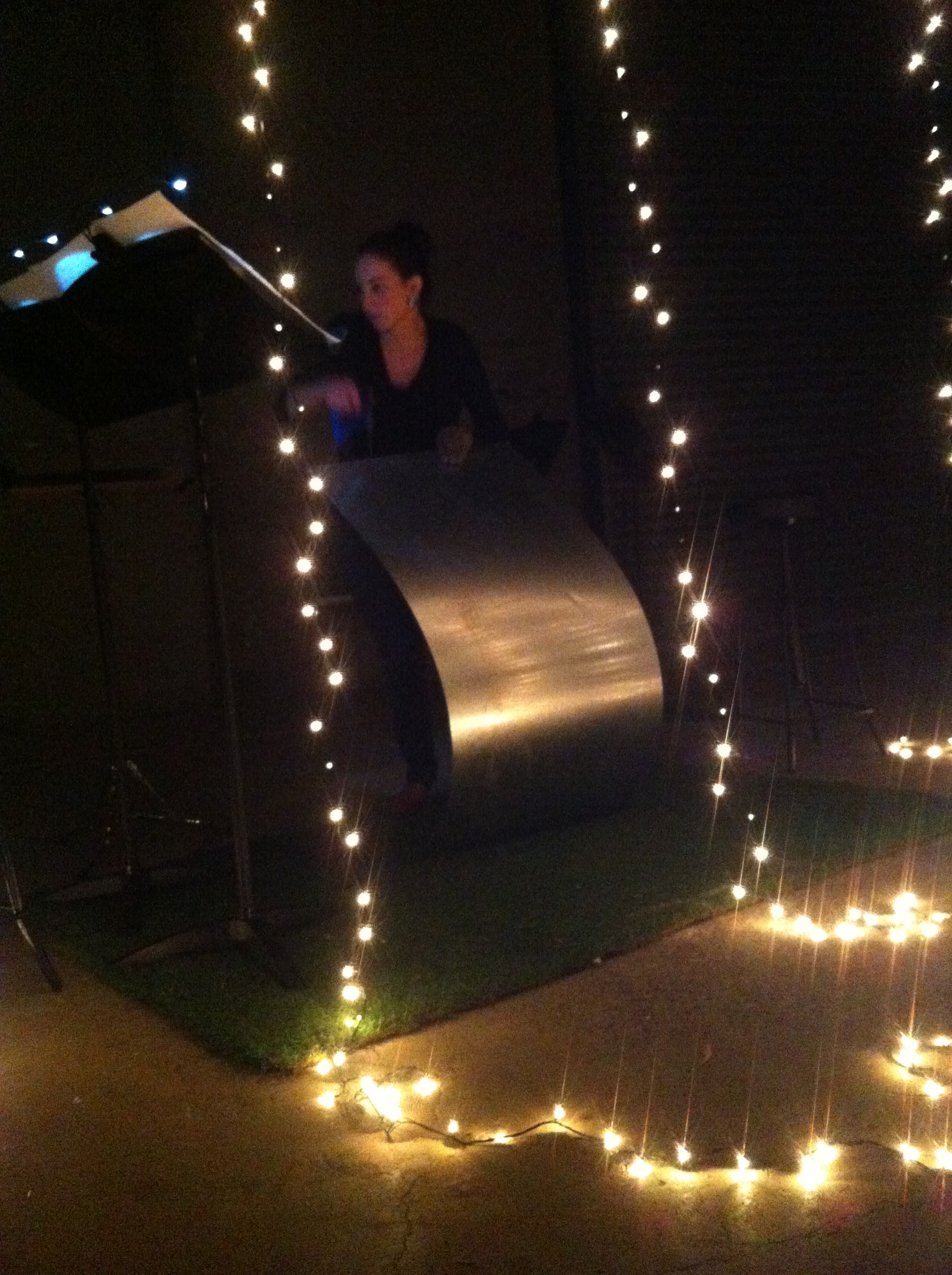
G’Froerer began the concert with the ominous rising tones of Morton Feldman’s Very Short Trumpet Piece, hidden behind the audience in the offices overlooking the warehouse floor. Instruments at the ready, the double bassists Jon Heilbron and Rohan Dasika stared each other down behind a curtain of fairy lights like a pair of dueling mythical creatures. This cinematic superposition gave way to Rebecca Saunders’ Blue and Gray, where the double bassists sprang to life with groaning crescendi. The gritty, grinding attacks echoed around the room as the beasts of wood battled.
Eres Holz’s MACH for solo trumpet set a new tempo for the space alternating rapid, mincing steps and short lyrical flights. A parrot also took flight outside, briefly adding its squawking counterpoint to Holz’s mysterious calculations, by then obscured behind a trumpet mute. G’Froerer’s deft manipulation of the first valve slide in the third section of the piece left all the trumpet-players breathless and the rest of the audience confused and impressed by the timbral spectrum opening up before them.
The most remarkable moment of the concert was also its quietest: Helmut Lachenmann’s Toccatina for solo violin, performed with casual precision by Amy Brookman. The piece is true to its name, deriving from the Italian toccare “to touch,” in the diminutive. Brookman lightly touched the screw of the bow to the violin strings, bringing out pinpoints of sound with this subtlest of articulations. This technique developed into a sort of double pizzicato with the screw passing back and forth past the string. Once the note was released, the screw rejoined the string with the wiry jangling of a guitar-slide. This dynamic climax of the piece was followed by toneless bowing on different parts of the instrument and rapid ricochets with the back of the tip of the bow near the bridge. Brookman’ performance was a frank statement of what can be achieved before one even reaches mezzo-piano.
Abel Paúl’s Wrong Answers to Robert B’s Wrong Question continued the investigation into novel instrumental techniques, this time focusing on a single sheet of metal. Fingers, a tuning fork, a hacksaw and finally the ubiquitous superball mallet were all brought to bear on the clanging, springing, singing piece of metal. The piece has no interest past its catalogue of eyebrow-raising techniques, which are each carefully displayed like exotic artefacts in a museum by the gloved performer (Kaylie Melville).
Covering stage changes, short pieces by Feldman and Carter descended upon the audience from the offices above the audience. Of note was Jenny Barnes’ rendition of Feldman’s Only for solo voice. Barnes’ tone is unlike any other emerging singer in Melbourne, combining an untrained-sounding simplicity with technical precision and a flair for improvisation and timbral exploration. This voice came to the fore in an improvised set at the end of the concert, where G’Froerer, Heilbron, Barnes and electronics artist Jon Smeathers deployed their precise and innovative musical craftsmanship in an utterly transporting musical soundscape.




 Partial Durations