
photo by Brad Serls
Michael Kieran Harvey performs his own Psychosonata and Elliott Gyger’s INFERNO at the Totally Huge New Music Festival. Read about it over at RealTime.
Michael Kieran Harvey performs his own Psychosonata and Elliott Gyger’s INFERNO at the Totally Huge New Music Festival. Read about it over at RealTime.
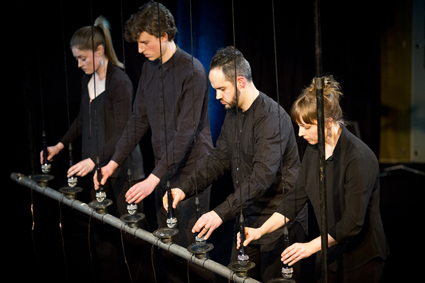
Read about the new work developed by Speak Percussion’s Eugene Ughetti and Robin Fox for the Tura Totally Huge New Music Festival here.

Read about the Totally Huge New Music Festival opener in Perth on Friday night over at RealTime.

The Bloody Chamber
By Angela Carter
Directed by Matthew Lutton
Music by David Chisholm
Performance text by Van Badham
The Malthouse Theatre
6 August, 2013
Entering the theatre one can just make out dark stains on the stage floor. Drop by drop a puddle of water forms between three monolithic black cubes. Occasionally a tone like struck metal rings out. The sounds rise and fade, accompanied by the dead percussion of wood.
Suddenly, with a rattle of chains, one of the cubes starts to rise. It stops just high enough to reveal the pedaling feet of three harpists, the source of the wooden sounds. The gong sounds (produced by putting Blu-Tac on the harp strings) increase in intensity as the harpists run their hands down their wire strings, producing harsh whispers like the falling blades of guillotines. Then, slowly, the smallest of the three boxes rises to show two feet dripping with blood. The box continues to rise, carrying the gently twitching feet high above the pool of blood below.
We are inside Bluebeard’s castle where, according to the seventeenth-century version of the tale by Charles Perrault, a sadistic aristocrat has murdered a series of wives for disobeying his one proscription: Do not enter the forbidden room. Showing a propensity for divergent characterisations of violence, the story has since been rewritten many times, notably in Bartok’s 1911 opera and Angela Carter’s 1979 short story on which the Malthouse production is based.
The original cautionary tale assumes a male monopoly on violence for the punishment of woman’s supposed innate and sinful curiosity. Violent punishment is also meted out between men, as the young wife’s brothers save Bluebeard’s youngest wife, the protagonist of the story. Bartok’s interpretation plays down the cautionary tale to focus on the symbolic violence of Bluebeard’s capricious affections, his love of the idea of his wives over their reality. Bluebeard cannot truly admit the new wife into his shuttered castle, initially refusing to let her open the doors and let the light in. When she finally convinces him to do so, she finds the wives alive. The young wife is then similarly enshrined in jewelry and locked away. The castle is no longer a moral prison, but a cold, damp, dark psychological world.
Without forgetting punitive or symbolic violence, Carter elaborates the sexual violence inherent in the tale. An array of mirrors shatters the protagonist into twelve identical copies that are “impaled” in a honeymoon chamber decked with lilies, a symbol of death. In Lutton’s production the bedroom is hidden under the third cube and consists of only a carved four-poster bed. Alison Whyte shifts effortlessly between Bluebeard’s menace and the new wife’s fear, playing both parts with the help of a finely-tuned pitch-shift effect by sound designer Jethro Woodward.
Carter returns to the violence of punishment by having the young wife’s mother ride to the rescue, her skirts tucked around her waist, a backdrop of ocean spray “witness to her furious justice” as she shoots Bluebeard in the head. In Lutton’s production this moment is punctuated by a veritable rain of bullets upon the stage.
While punitive violence ultimately saves the day, the story’s happy ending is predicated on symbolic non-violence. Bluebeard is initially attracted to the new wife for her conservatoire training as a pianist. It is an “accomplishment,” a symbol by which Bluebeard identifies her, placing a Bechstein in the mirrored room. Carter then shows how music can function as something other than a sign of accomplishment, as a bridge between people and a fundamental part of one’s identity. The new wife is able to calm herself by playing Debussy and Bach. The piano also leads her to the blind piano tuner Jean-Yves, with whom she will open a music school after they are both liberated by her gunslinging mother.
The three harpists of Lutton’s production (Jacinta Dennett, Yinuo Mu and Jess Fotinos), representing the three dead wives, extend Carter’s musical theme. Since its feminisation in the late eighteenth century, the harp has inhabited a space of both convention and transgression. While the harp upset a woman’s deportment in the most suggestive ways, it also became the accomplishment par excellence for young women leading up to the French Revolution. As the instrument became larger, heavier and the strings tighter, its physical demands became greater and so women had to fight against a quantity that continued to claim that the instrument was unsuitable for feeble female hands. At times Chisholm’s music fills out the sparse set design, such as where the harpists sing drones over tremoli to evoke the monotonous train ride to the castle. Then, arriving to a dawn sky “scattered with rose-pink,” the harpists unleash a pointillistic flurry of notes. At other times the harpists superimpose the new wife’s alternative psychological world on the dark castle, playing whimsical, dissonant tunes as she traipses around the castle playing with her new riches. Finally, after supporting Whyte, the harpists assert their own identity, literally packing up their bags and leaving the stage. As Carter has said, her rewriting isn’t about men and women, but about “tigers and lambs,” a dynamic as relevant today as it was thirty years ago.
The Melbourne Symphony Orchestra conducted by Simone Young
The Last Days of Socrates
Music by Brett Dean
Libretto by Graeme Ellis
26 July
With the Melbourne Symphony Orchestra Chorus ranged at the back of Monash University’s Robert Blackwood Hall and a hefty complement of brass and a battery of unconventional percussion augmenting the Melbourne Symphony Orchestra, it was evident that we were in for a work of epic proportions. Or shall we say tragic, as the immense forces were mounted against a lone Peter Coleman-Wright downstage as Socrates. Part courtroom drama and part soap opera, Dean’s secular oratorio depicting the trial and execution of Socrates provokes heartfelt association with the protagonist.
Dean reflects Socrates’ famously unattractive appearance and fatal questioning of every and all convention through an acerbic half-spoken style of singing. As the Athenian jury, the chorus sings in chant-like unison, summoning the protagonist with a thunderous “Socrates!” There are effective attempts to deviate from this static, though classically correct arrangement, with string sections, soloists and parts of the choir moving offstage and around the auditorium. Dean’s flair for orchestral colour also adds depth to the drama, with the orchestra superimposing uncertain, quivering strings lines with decisive, rhythmic tuned percussion and serene brass chorales. The addition of terracotta pots and pieces of metal—representing the coins that the jurors would throw into pots to cast their vote—helped lend the piece a unique sonic character.
Socrates finally breaks from his sprechstimme to perform his “swan song,” a touching and forlorn meditation on man’s irrational fear of death. The aria is another example of Dean’s capacity to drop solo lines of moving elegance into his larger structures. But this sentimentalisation of Socrates’ reason would never have stood up to peripatetic interrogation. In Plato’s Republic, written as a Socratic dialogue, modes encouraging sorrow and softness are banished from the city. While I am glad we sing with more than two of the ancient Greek modes today, the question lingers as to what music would befit the words of Socrates.
Old Kings in Exile
Soundstream Collective
Melbourne Recital Centre
23 July, 2013
The Pierrot ensemble, comprised of cello, violin, clarinet, flute and piano with various additions, has been a mainstay of chamber music since its use in Arnold Schoenberg’s Pierrot Lunaire of 1912. As the Old Kings in Exile programme at the Melbourne Recital Centre demonstrated, Australian composers continue to explore the versatility of this ensemble to great effect. The Soundstream Collective dove fearlessly into the diverse range of instrumental colours demanded from the works by James Ledger, Brett Dean, Anthony Pateras and Richard Meale.
In Ledger’s Sextet, jazz harmonies and rhythms are transformed into abstract, almost mechanical gestures that are passed between the instruments in a kaleidoscope of musical configurations. The work forms part of a tendency to take pleasure in eclectic compositional dexterity and finesse.
Pateras’ Broken, Then Fixed, Then Broken is a completely different sort of composition. A pre-established group of sounds for piano, clarinet and cello are played in rhythms strung together by chance. The interest of the work lies in the sounds chosen: hard knocking sounds on the prepared piano, Bartok pizzicati on the cello and muted “toots” of the clarinet. As the piece progresses, this high-end sound spectrum shifts to include some richer tones plucked on the cello and gong-like sounds from the piano.
Works by Dean and Meale link contemporary Australian composition and its recent past. Incredible Floridas, premièred by Peter Maxwell Davies’ Fires of London in 1971, is an astonishing response to the poetry of Arthur Rimbaud, drawing less on his actual poetry than on his poetic world where beauty and horror lie side by side. In the first of six movements, long violin and clarinet notes conjure the colours of vowels described by Rimbaud: “A, noir, E, blanc, I, rouge … .” Chords spread across the range of the piano punctuate and modify the vowels like consonants. Gongs create swelling, receding, fluid forms between the two. Elsewhere Judith Hamann plays a haunting cello solo with maracas, before being surrounded by military rhythms from the percussion and angular phrases from the winds and piano. Given the unforgettable adventure of hearing the piece, It is surprising that this work is only performed in Australia about once a decade.
Dean’s Old Kings in Exile draws inspiration from the memoir of Austrian author Arno Geiger that details the challenges faced by his aging father. Dean dedicates the piece to his own parents in the leafy suburbs of Brisbane, from where he has also drawn inspiration from the calls of the Pied Butcherbird. There is an early-morning pathos to the two slow movements framing the central scherzo of the work. Groaning bass drums and a layer of flortando trills accompany a melancholic clarinet melody that rises neither quietly nor gracefully.
Both Dean and Meale display a gift for bringing out the solo instrumental parts within the Pierrot ensemble. Meale claimed to have given up his modernist idiom because it struggled to express qualities like affection, love and tenderness. Indeed, in both Dean and Meale’s works we find sympathetic solo instruments struggling against a threatening ensemble. In Old Kings in Exile we also find moments of salvific unity achieved through juxtaposition, such as in the central scherzo where a frenetic passage shared by the flute and cello builds to a climax before cutting short, revealing misty piano chords melting into shimmering string trills.
Vocal Folds
Gertrude Contemporary Art Space
22 June–20 July 2013
Performance: Jenny Barnes, Alice Hui-Sheng Chang and Carolyn Connors, 27 June
Rarely do the worlds of contemporary art and music come together in so detailed a discussion within their own media as in Vocal Folds at Gertrude Contemporary Art Space. Each artwork inhabits a corner of the contemporary conceptual map of the voice, at times conflicting with the show’s curatorial rationale and the series of musical performances associated with the exhibition.

In Dawn Chorus by Marcus Coates, a forest of screens depicts individuals caught in the midst of their morning rituals. One is lying in bed, another in a bathtub, yet another paused in a stationary car. Their faces twitch and their mouths open and close rapidly as they emit high-pitched chirps and whistles. The sped-up videos of people imitating slowed-down birdcalls recreates the dawn chorus of birds, reinterpreting our most mundane moments as a social ritual that ties us to the animal life outside our windows. This simple technique also provides a comment on the relationship of music and the voice. The voice is musical not in its everyday mode, but when it strives to be something else, when it is removed from its everyday linguistic register and the fleshly sounds it is usually condemned to make. This is the essence of song, in particular the bel canto tradition of operatic singing, which has been lovingly described as “beautiful screaming.”

In Manon de Boer’s one, two, many, three video works alternate on two screens, creating a spatial and rhythmic phase in the darkened front gallery. The work’s conceit is the relationship between the voice and the listener and the embodiedness of breath. It may also be read as a duplication of some shaky arguments about music’s coded and uncoded relationships with the human body. In one video, Michael Schmid performs an intensely-focused circular breathing solo on the flute. In another, an ensemble sing Giacinto Scelsi’s Tre Canto Popolari to a mobile audience. In the third, the artist recounts the experience of listening to the voice of Roland Barthes to a ceiling cornice. The artist’s words are an improvisation or a variation on Barthes’ “The Grain of the Voice” from 1977, itself a rhapsody on Julia Kristeva’s theory of the semiotic and the symbolic best expounded in relation to music in Revolution in Poetic Language. So the argument goes, language consists of libidinal urges originating in a pre-symbolic, unreified sphere (the “chora”), which are then given form through the limitations of the physical body and the symbolic forms of language. Kristeva’s distinction between the pre-symbolic “semiotic” and the “symbolic” is sometimes put into critical practice by finding traces of this pre-symbolic energy in the prosody of text or with appeal to seemingly-nonsignifying music. These traces, however, are always-already symbolic, caught up in the media and the symbolic networks we perceive them through. Nowhere is this more evident than in music. To Kristeva, music represents the semiotic to the symbolic of language, while to Barthes music itself is divided into the “pheno-song” of language and musical writing and the “geno-song” of a particular performer’s tone and interpretation of dynamics, tempo and articulation. Playing every classical music enthusiast’s favourite game, Barthes compares the technically perfect German baritone Dietrich Fischer-Dieskau with Charles Panzéra, whose idiosyncratic voice and performance style moves him more profoundly. If only singers hadn’t been discussing precisely these characteristics in a highly technical manner for thousands of years, Barthes might have been on to something. One need look no further than the first Vocal Folds concert by Jenny Barnes, Alice Hui-Sheng Chang and Carolyn Connors to find a group of performers who, apparently inverting the supposed division between the semiotic and the symbolic in music, have developed a unique culture of principally timbral vocal performance.

There is a simplicity and an intimacy to improvised vocal performance that made Gertrude Contemporary Arts Space feel more like a living room than a performance venue. The audience made themselves comfortable as Barnes found a central space in the room. At first a barely-audible twittering filled the gallery. Eyes shut, Barnes slowly raised a hand that convulsed along with a texture of rapid squeaks, fleeting bilabial stops (“m”, “n”) and unvoiced plosives (“p,” “b”). With utmost control, the pointillistic texture slowly opened out into a fuller-voiced ensemble of groans and glottal stops articulated with the back of the mouth and throat. The rapid change between these two families of sounds produces a polyphonic effect, as though there were two or three voices in the room. Then, in an incredible display of vocal stamina Barnes began to channel animal calls. A sound like a small dog’s bark ripped through the controlled vocal tapestry and a series of rapidly articulated high tones built to a chorus of birdsong. Only at the end of the performance did this rapid rhythmic improvisation become a full-bodied roar.
By contrast, Hui-Sheng Chang slowly modified the overtones of long, sustained pitches. Over half a minute or more, Hui-Sheng Cheng moved between humming, open, nasal and rasping timbres. Hui-Sheng Chang moved around the room, kneeling amongst the audience to experiment with the sound of her breathing and wandering off to shout in a distant room.
As a performer, mentor and teacher, Carolyn Connors continues to initiate students into the craft of vocal improvisation. Connors’ Gertrude St set reprised some of the material from her recent performance at James Rushford and Joe Talia’s Manhunter launch, but with a greater emphasis on the augmentation of the voice with found objects. The performance was a study in multitasking, as Connors struggled to keep an accordion bouncing on her knee, strike it with brushes, produce a tone through a book pursed between her lips and wrap her head in aluminium foil.
The literature around Vocal Folds is a good example of what Alain Badiou calls “democratic materialism,” the belief that there are only bodies and languages. Because curator Jacqueline Doughty wants to move away from the voice’s coded, symbolic functions (namely language and music) she appeals to the voice’s physicality in the “lungs, vocal chords, tongue and lips.” But what if music were not subsumed into linguistic function of the voice? Might music fit just as awkwardly with the voice’s embodiedness? Considering the relationship that singers and other musical practitioners maintain with the voice implies a third manner of articulation consisting of technique and musical-conceptual axes like pitch, duration and timbre.
Read Keith Gallasch’s review of Michael Kieran Harvey performing an all-Australian programme of works by Raymond Hanson, Elliott Gyger and himself over at RealTime.

Do participants have a unique perspective on their fields? How might a frank assessment by a peer contrast with an “objective” work of music criticism? For this review as part of our “experiments in music journalism” series we invited experienced improviser and composer Simon Charles to give his considered opinion on the new concert series curated by James McLean and Callum G’Froerer, Directly or Indirectly.
Directly or Indirectly no. 1
Callum G’Froerer, Dave Brown, Joe Talia and James McLean
Conduit Arts
20 July
By Simon Charles
When approached to write this review I expressed an immediate reluctance, due to feeling uncomfortable about assuming the role of ‘reviewer’ and this being somehow different that of fellow artist. There is undoubtedly a benefit in articulating ideas about the motivation behind a work, and evaluating its effectiveness, as this discourse provides a groundwork through which broader stylistic narratives can start to emerge. Hopefully, the greater scrutiny these motivations are placed under can lead to more meaningful and lucid work. However, I can’t help feeling a certain disdain that the role of a reviewer can have such influence shaping broader musical values. I’ve shied away from it, because I would prefer to contribute to the conversation about musical value and emergent stylistic trends through my own musical practice.
However, I’ve obviously agreed to write this review, and in doing so I feel that it’s necessary for me to write this short disclaimer; that I know all the performers involved in this performance personally, and that I am giving my critical perspective through the lens of fellow musician, rather than ‘reviewer’ as such. It may seem a little harsh and direct, and it might seem to be lacking in the evocative, although ultimately inconsequential, detail typical of many reviews.
Directly or Indirectly is an initiative by James McLean and Callum G’Froerer that will hopefully become a regular forum for the presentation of experimental and improvised music. Their first event was held at Conduit Arts and featured solo improvisations by G’Froerer, McLean, Joe Talia and David Brown.
G’Froerer’s set on solo trumpet was characterised by a range of ‘extended’ techniques, revealing the performer’s vast experience in performing contemporary notated compositions. To his credit, G’Froerer managed to move beyond these common techniques, demonstrating an inventiveness and sense of exploration. The piece was successful as a series of episodes, intent on exploring the various sonic possibilities of the trumpet. However, there was room in this investigation to undergo even greater rigor, so that the work could convey a more unified statement. There is an obvious rigor in G’Froerer’s technical mastery of the instrument—he is capable of producing and incredibly beautiful sonorities. However, I craved a musical objective toward which this exploration could be orientated.

James McLean’s set for solo drum kit demonstrated absolute technical mastery. He plays with remarkable control over the timbre and resonance of his kit. He is also skilled as an improvisor in letting ideas emerge, controlling the rate at which they morph, and is decisive as to when they should end. Perhaps this is a personal quip, revealing my own frustrations in playing a musical instrument, however I felt that both G’Froerer’s and McLean’s improvisations revealed a preoccupation with the instrument, that comes at the expense of an artistic agenda to which both performer and audience can equally relate.
McLean’s solo set did demonstrate a keen awareness of structure and development, however there was a stage in the performance at which he seemed to return to material that was similar to ideas that had already been explored. As he returned to this material, it was possible to engage with the work on the level of its technical proficiency, however I craved a more adventurous sentiment to unite the work as a musical whole.
Joe Talia’s set was marked by an incredible attention to subtle glitches and clicks that were framed in such a way so as to draw the ear toward these essential parts of the work. There were moments when the work momentarily lost focus, however Talia was always able to steer the work back into interesting territory, displaying a remarkable talent for a kind of deep ‘retrospective’ listening—being able to successfully contextualise preceding ideas. His vocabulary or pallet of sounds was varied enough to provide contingencies that enabled work to move in different directions, whilst complimenting an overall ‘sound-world’ that unified the work.
Dave Brown’s set for solo guitar conveyed the performer’s unique and idiosyncratic ‘voice’ that reflects not only a personal understanding of musical style, but a perspective on some of the typifying stylistic traits of Australia’s underground, experimental scene. This voice never lost focus, which seemed to be the overall point toward which the performance was directed. Many of the ideas presented in Brown’s performance were interesting because they drew attention toward imperfections in sound (such as feedback, buzzing from the amplifiers, etc.) thus revealing the performer’s sensitivity to their immediacy and tactility. Rather than ideas being filtered through a preoccupation with a traditional conception of technique, Brown’s performance seemed more concerned with structure—that the work may ‘resonate‘ musically through a narrative of distinct and multi-layered passages.
The overall event demonstrated the unique and immense challenge of performing a lengthy solo improvised work. On reflection, it is entirely different to a context involving other players, as it lacks a sense of dialogue or conversation and there is no opportunity for the individual to ‘step out’ and re-enter the piece. It is a challenging format for both performers and audience. However it was clear that this was in no way underestimated, and that Directly or Indirectly, as an organisation, are committed to meaningful and challenging musical ventures.

Aviva Endean
Intimate Sound Immersion
Dane Certificate’s Magic Theatre
Thursday 25 July
What better time to visit a magic theatre down a dark, cobbled alleyway than a wet and windy winter night? The magic I sought on Thursday night was not, however, of the trick-shop kind. Nor did I seek spells or demonic powers, though all of the above found themselves, in a way, evoked in Aviva Endean’s Intimate Sound Immersion, a one-on-one encounter with one of Australia’s finest performers of contemporary clarinet repertoire.
Performers of contemporary music spend endless hours honing sounds that do not necessarily travel well to row WW of a concert hall. While instrumentalists must still be able to project a full tone to the back of an auditorium, they must also command an ever-growing repertoire of “extended techniques” ranging from barely perceptible whispers to deafening screeches, often augmenting their instruments with found objects and manipulating their sound in complex and astonishing ways. I did not know just how remarkable some of these sounds were until blindfolded and led behind the red curtain Dane Certificate’s Magic Theatre.
The performance begins with an almost imperceptible pulse by one’s ear. The sound is so low and so quiet that one is not entirely sure whether there is a draft or the building is shaking from a passing tram. The sensation grows louder and moves around one’s head, opening out the audience member’s spatial perception. Much of the performance plays on the juxtaposition of the still and the moving, the close and the distant, to remarkable effect.
The pulsing changes to a breathy sound that strikes both ears. By opening and closing two channels of a mysterious wind instrument (I suppose, not being able to see any of the tools of the magician’s trade) the listener is gripped in a rapid, rhythmic, spatial oscillation.
After this spatially-focused rhythmic intensity, the sound field is gloriously opened out by a chorus of chimes at different distances from the listener, including two small music boxes at close range by each ear. This was an absolutely stunning moment and more could have been made of this difference between centralised and dispersed sounds, the opening of the intimate conversation out into an imaginary landscape.
After several more short timbral studies, one encounters a wandering solo of double trills and overtones on the bass clarinet. After passing through the previous sound worlds like so many mythical trials, one feels that one is “meeting” the clarinet like a creature at the end of a quest. What it says I will leave up to you to decide. The unique opportunity of hearing such a solo up close is worth the entrance fee alone, a privilege that performers, who are condemned to a life of unflatteringly-close contact with their sound, might not immediately think of offering their audiences. Just as the audience member is led into the clarinet’s chamber, they are led out. The entire process leaves one with a definite sense of having heard “something” in the warbling trills of the clarinet that one can take away into the cold Melbourne streets.
With low overheads and more spatial flexibility than perhaps any other performance medium, one-on-one performance could be the most dynamic performance genre today. Endean’s performance contributes to a small tradition of performances in Melbourne (including percussionist Matthias Schack-Arnott’s Chrysalis and Paris-based found-sound artist Pascal Battus’ Sound Massage) that exploit a 360 degree sound field usually reserved for complex speaker arrays and orchestral staging.
Intimate Sound Immersion runs until Sunday night, so get down to Dane Certificate’s Magic Theatre, if it is still there.
 Partial Durations