Category Archives: Reviews

Partial Durations is a Matthew Lorenzon/RealTime joint project.

BIFEM: Vortex Ensemble, Bug

Bug
Music Theatre by Arturo Corrales
Bendigo International Festival of Exploratory Music
The Capital Theatre
9:00pm, Saturday 6 September

There is a whole musical world between performance art and opera that is rarely explored in Australia. In Europe it is referred to as “music theatre” (where other terms refer to what we call “music theatre” in the Anglosphere). Under their former Creative Director David Young, Chamber Made Opera came closest to developing this genre in Australia, relying as it did on workshop-based development, graphic scores and improvisation. While Chamber Made Opera spotted a niche in Australia, they also left open their post as a company dedicated to contemporary opera in the stricter sense and it will be interesting to see which path the company takes under their current Creative Director, Tim Stitz. BIFEM has gone some way to providing another taste of music theatre by programming three pieces by the Salvadoran composer Arturo Corrales. By turns unsettling, playful and virtuosic (and bearing a striking resemblance to the work of the godfather of music theatre, Georges Aperghis), Corrales brought out the best in the multi-talented Ensemble Vortex. At the Capital Theatre the three pieces were combined into one flowing performance that took place upon a bed of flour spread upon the stage (and scattered out the stage door by the end).

In Bug the solo guitarist is trapped within a circle of music stands, sitting on a pile of very mediocre speakers that distort and project his guitar and voice. In the festival’s colloquium on music and electronics, Corrales explained how he likes the challenge of making something interesting using very lo-fi, simple technology. Indeed, the piece constantly references the repetitive pulsing of a metronome, either imitated in the guitar part or heard as a disembodied voice. The audience, seated in the round, have a 360 degree view of the guitarist, who slowly rotates between the music stands. The guitarist mutters about how words are lost to memory, but actions persist. The guitarist picks out forlorn little gestures, explodes into distorted chords and uses a tuning fork as a slide. Guitarist Mauricio Carrasco is both an excellent musician and an actor. He has a seemingly natural capacity to apply his whole body to a musical problem, and I’m not only referring to Friday’s naked laptop performance. He is just the performer for Bug. Carrasco lends each note a certain pathos, giving meaning to the slightest twang of a guitar string with a well-timed facial expression or movement of the shoulders.

As soon as Bug ends, double bassist Jocelyne Rudasigwa and violinist Rada Hadjikostova-Schleuter spring to life with Corrales’ Music Box. Under a red light, they play a game of “knock, knock, who’s there?” Except nobody is there. “Just a voice?” Rudasigwa asks. There is no response. This eerie scenario is played out several times in between violent string chords.

The third part of the performance, Re, dissolves some of this tension with a hilarious romp about the stage. Ensemble Vortex are joined by Melbourne-based percussionist Kaylie Melville, who rolls unwieldy percussion instruments through the flour. She is chased by other performers and plays her instruments with mallets and balls of scrunched up red cellophane. The piece is not without its sinister undertones. It is as though some horrible fate has finally befallen the neurotic guitarist and the deluded bassist, with cellophane-blood splashing about on the white, flour-strewn floor.

You can stream part of the concert from ABC Classic FM’s New Music up Late.

Partial Durations is a Matthew Lorenzon/RealTime joint project.

BIFEM: Argonaut Ensemble, Matinée

Argonaut Ensemble
Bendigo International Festival of Exploratory Music
The Bendigo Bank Theatre
4:00pm, 15 September

In their second concert, BIFEM’s house band turn their attention to two local heroes, Elliott Gyger and James Rushford. They are joined by Clara Maïda, one of the festival’s international guests, in a musical exploration of form and the formless, of ambivalence and flux.

In Crystallise, Gyger seeks to compose a polyphony of four percussion voices. Percussionists are usually treated as so many arms activating so many instruments. Gyger characterises each of the four percussion batteries with a particular family of instruments, namely cymbals, wood percussion, metal percussion and tuned percussion. Unable to resist his combinatory urges, each battery also has something in common with another battery, such as the appearance of keyboard percussion in several sets of instruments. Gyger chose the formal structure of a primordial soup coalescing into distinct forms. This is a favourite programmatic conceit of Gyger’s generation, raised as it was on science fiction and pop-cosmology. It would be interesting to study the different mechanisms by which figures emerge from these compositional soups. Do figures articulate, sublimate or emerge out of the morass? I think that this form, by now a terrible cliché, belies a deeper ideology of the compositional process (not that there is anything inherently wrong with having an ideology of composition—we are all shouldered with a few regardless). This is the ideology that there are more or less structured elements of a composition, an ideology that stretches back at least as far as Nietzsche accusing Wagner of “agitating the swamp.” I prefer to think that a composition, be it aleatoric, serial or tonal, is always-already structured, if not by the composer then by the listener or at a “neutral” level. One might say that the structure of a piece (or a once-off performance) is “overdetermined” by so many forms of timbral, pitch and rhythmic listening that a primordial soup is technically impossible to compose.

That said, how does Gyger’s soup work programmatically? The piece sounds the same density throughout, giving the impression that Gyger’s is a petri-dish culture where nothing enters and nothing escapes. Elements move about until the four percussive voices take form. This presents a challenge for the performers, who are tasked with differentiating a homogenous texture.

Rushford’s Espalier is what I like to call one of his Twin Peaks pieces. This epithet comes from the quality of the synthesizer forming the background of the piece as well as its unsettling atmosphere. In a humorous exchange with ABC Classic FM’s Julian Day, Rushford associated the piece, perhaps more appropriately, with Brian Eno. The piece is inspired by espaliering fruit trees, a process replicated in the exchange of musical material between the clarinet, glass bottles, bass flute, violin and cello, as well as in the physical movement of the performers around the space.

Rushford’s second piece in the programme could hardly have contrasted more with the first. Viper Gloss is a concentrated, brilliant explosion of tone colour. It takes as its inspiration the space around a viper: its sheen, the movement of air and the movement of its prey. Impossibly agile and fluid cello and flute lines intertwine above cascades of shimmering piano and glockenspiel notes. With a hiss of aluminium foil in cello strings, the viper strikes and a moment of stunned, muted tones ensues. The peace does not last long, though, as terrifying screaming noises erupt from the piccolo.

Clara Maïda’s triptych Psyche cité/transversales returns to the theme of flux and crystallisation with a philosophical and psychoanalytic lens. As Maïda’s notes for the piece tell us, the first movement takes Spinoza’s “fluctuatio animi” as a starting point. Spinoza used the term to denote the ambivalent feelings that arise when one is confronted with an object that has both positive and negative connotations. Musicians will be familiar with this experience from the moment they lay eyes on their instrument each morning; the rest of us have our parents. Maïda’s “fluctuatio (in)animi” is thus the moment preceding this affective oscillation. Both states are presented simultaneously, overlapping and intertwining in an arborescent structure that is yet to be actualised. Maïda faces the same problem as Gyger: that of the presentation of the prestructured. Maïda’s complex of forces once again places the audience in the presence of an already-actualised, “programmatic” flux. The episodic alternation of electronic and instrumental parts also presents the audience with a very clear sense of ambivalent contrast that threatens to override the contrasting processes erring through the textures. For a truly sustained flux of simultaneous forces the audience had to wait a few more hours for the interminable polyphony of Stockhausen’s Sirius.

The second movement, “Ipso facto” [“by the fact itself”] does quite the opposite. Whereas “fluctuatio (in)animi” pitts various forces against one another, “Ipso facto” seeks to produce an electronic atmosphere completely devoid of automatism. The electronics of Psyche cité/transversales are a breath of fresh air in a country where the dominant electroacoustic aesthetic vacillates between the concentrated, material exploration of one particular instrument and noise. Rarely do we hear the Ircam house style of glittering, awesome atmospheres generated out of field recordings (though, as prodigious travelers, many Australians get rather sick of them overseas!).

The third movement, “Via rupta,” is named after the Roman practice of building straight highways by breaking through obstacles. The obstacles here are psychological, physiological and urban. Field recordings from subways are combined with instrumental parts where the performers play through their strings with plectrums. Moments of fluidity are released as the strings break into loose glissandi. The clarinet sounds like a jackhammer (though I usually associate that sound with dinosaurs, a spot of semantic fluctuatio).

You can listen back to the concert at ABC Classic FM.

Partial Durations is a Matthew Lorenzon/RealTime joint project.

BIFEM: Peter Dumsday and Samuel Dunscombe, Pluton

Pluton
Peter Dumsday and Samuel Dunscombe
Bendigo International Festival of Exploratory Music
Old Fire Station
2:30pm, 6 September

Pluton, Philippe Manoury’s epic composition for piano and electronics, was the first ever work to use the Max program designed by Miller Puckette. Just over twenty-five years later, Max/MSP is now a ubiquitous set of tools that composers and performers use to produce and alter sound and video in live performance. Its graphical user interface allows people with minimal programming experience to produce sophisticated performance and compositional systems without writing a single line of code. Those who are so inclined can produce their own objects to use in this immense musical sandbox. Pluton inaugurated an epoch of interactive instrument-and-electronics composition, including a repertoire of live sound transformations and spatialisations that are the mainstays of both contemporary computer music and classical composition.

But with audience members standing by the door of Bendigo’s Old Fire Station to hear the work, there was no sense that they were expecting to hear something old-fashioned or cliché. They were not disappointed. In an age where the electronic part of an instrument-and-electronics piece can sometimes dominate, it is refreshing to look back to this first Max/MSP piece and realise the importance given to Manoury’s traditionally-notated musical language. The piece is a true meeting of worlds, with the electronics variously complementing, modifying and enhancing the harmonically-rich, serial piano part. The piano is equipped in turn to send MIDI signals to the computer, ensuring precise synchronisation of effects and also controlling certain parameters of the electronic part. This enhancement of a seemingly-complete instrumental part comes out particularly in the final of the piece’s five movements, where the electronic part seamlessly modifies the resonance of the instrument. The sensitivity of Peter Dumsday’s playing seemed to bring the entire history of this comparatively ancient instrument to bear upon the new contender.

In earlier movements the piece shows its age with what can today be heard as crude granular synthesis.Technology has moved on somewhat in the past twenty-five years and the Max patch had to be rewritten for Pure Data in a feat of research and engineering worthy of the most laboured reconstruction of a renaissance score or period instrument. Max’s designer (and the original engineer for Pluton) Miller Puckette performed the core translation of the patch, while Samuel Dunscombe implemented the interface and communication design (along with some additional signal processing). As Dunscombe told the audience after the concert, he had consulted heavily with Puckette throughout the process. The pair even organised dates for Puckette to hack into Dunscombe’s computer to help troubleshoot the patch.

Pluton will no doubt endure as a classic, especially now that the hard work of updating it for contemporary software and hardware has been accomplished. I just hope that performers keep the piece’s final stunt. The piece ends with a two-minute sample of the piano. The lights fade to black and are then brought up again with the pianist having fled the scene, but the music still playing. Cute.

Edit: Since publishing this review I’ve had some interesting discussions about the piece that warrant mentioning here. The effect referred to above as “crude granular synthesis” is in fact nothing of the sort, as it predates granular synthesis as such. In fact, Dunscombe informs me that all of the processing is accomplished with hardware, not by the computer. In Pluton, short samples are repeated in different rhythms and diffused around the room in a manner that could be considered proto-granular, but which have an entirely different intended effect. They are supposed to be heard rhythmically, rather than timbrally. It is interesting that with today’s ears we cannot help but hear them as an attempt at granular synthesis. It is also interesting that this use of samples has by and large disappeared from contemporary music in favour of more processor-intensive timbral experiments.

Partial Durations is a RealTime/Matthew Lorenzon joint project.

BIFEM: Opening Concert, Argonaut Strings

Opening Concert
Argonaut Strings
The Capital Theatre
Bendigo International Festival of Exploratory Music
8:00pm, 5 September

Given that so little new music for strings is performed in Australia, a major concert dedicated to the genre was well overdue. BIFEM’s private stash of instrumentalists, the Argonaut Ensemble, was gradually augmented as the concert progressed from a violin solo to a work for thirteen players. This poetic gesture was coupled with a progressive exploration of the range of sounds and techniques available on the instruments, ranging from simple timbral studies to expansive works combining the wide range of colours of the string orchestra with thematic writing.

The concert opened with the oldest piece in the festival, Jean Barraqué’s Sonate pour violon seul from 1949. With trance-like serenity, Graeme Jennings brought the sonata to the stage of the Bendio Capital Theatre like an apparition from the past. Written in the composer’s early serialist style, the piece seems to speak a long-lost language of attacks and articulations. Though composed while Barraqué was a student of Olivier Messiaen, it was thought to have been lost until its rediscovery in 2009 making it a paradoxically contemporary work. The festival was dotted with such curiosities that helped one take stock of the breadth of the last century of music that we still like to call “contemporary” or “new.”

Back to the twenty-first century and Francisco Huguet’s Damora was the first of many “one-idea” pieces that would become a point of contention in Saturday’s discussion panel “Duration and Durability.” Like Barraqué’s sonata, Damora‘s inclusion has a certain pedagogical intent. The piece distils the two extremes of bow pressure that dominate contemporary string writing: shimmering, whispering light bowing and creaking, crunching heavy bowing. To begin with, the double bass and violin duo trill while scrubbing back and forth across the strings, producing a complex warbling effect. This sound transitions into a more strident chordal texture including many chiming harmonics. The overall effect is dirty and fragile, full of the fruity bow sound that the nineteenth century worked so hard to conceal and that composers revel in today.

The almost inaudible scraping of bow on string or grinding pressure would become familiar introductory sequences throughout the festival and Marielle Groven’s trio Je ne vois qu’infini par toutes les fenêtres [I see only infinity through all of the windows] was no exception. Groven explored the techniques up and down the strings, from the fingerboard to the bridge. Three little flutters in unison in the middle of the piece provided a focal point around which the complex of sound coalesced.

Expanding the ensemble’s forces to a septet, the Parisian conductor Maxime Pascal (recently lauded by a chocolate company in Salzburg) entered to conduct David Chisholm’s Jonestown Threnody. Jonestown Threnody is one of the composer’s many “requiem” pieces, though rarely does a requiem depict in quite so chilling a manner the death of its subject. The initial chaos of moans and squeals from the strings is shockingly similar—possibly even more shocking in its aesthetic amplification of the sounds—to the existing recordings of the mass suicide (many would say mass murder) of 918 people in 1978. Chisholm’s morbid fascination with the sound leads to variations with wide vibrato, disintegrating descending lines and some thematic imitation.

Liza Lim’s Gothic follows nicely from Chisholm’s because both composers use melodic material as one of many techniques in their incredibly dense musical environments. Lim is without doubt the contemporary master of declamatory, melodic invention. Pascal brought out the dynamic shapes Lim uses to bring her lines to life, giving the ensemble more than enough to work with in terms of physical gesture.

Then came the standout work of the concert, perhaps even of the festival: Claude Vivier’s Zipangu. As Pascal explained to the audience, the piece is characteristic of Vivier’s work with its ceremonial or ritualistic form, its exploration of colour and its development from a single melody (a technique adopted from Stockhausen, one of Vivier’s teachers). Zipangu was one of the names for Japan at the time of Marco Polo and the string orchestra is divided into two sides, who take turns invoking (Pascal mused) the spirit of Marco Polo with their incantations coloured by varieties of bow pressure and position. The addition of violinist Rada Hadjikostova-Schleuter seemed to have an electrifying effect on the orchestra, especially when she would launch into her muscular rendition of the piece’s recurring violin solo.

You can listen back to the whole concert online thanks to ABC Classic FM.

Partial Durations is a Matthew Lorenzon/RealTime joint project.


BIFEM: Ensemble Vortex, Kinecticut

Vortex Ensemble
Kinecticut
Bendigo International Festival of Contemporary Music
Bendigo Art Gallery
7:00pm, 5 September

Daniel Zea’s Kinecticut is “a sonorous choreography played by three or four naked dancer-musicians in front of their laptops” or, from the audience’s perspective, behind their laptops, which illuminate their bodies in glorious short-wavelength blue light. It is the sort of lighting most commonly experienced in private, but is here used in an exploration of the relationship between bodies and technology, a fitting complement to the Bendigo Art Gallery’s exhibition of Ancient Greek art, The Body Beautiful.

Each performer follows a score of movements that appears on their screen. The choreography is then captured by X-Box Kinect cameras. The position of different limbs determines different characteristics of the sound including envelopes and filters. Volume is controlled by the amount of the field of computer-vision occupied by the body. the sounds being controlled are banal enough, Zea’s sound palette moving through prickling grains, seething waves and electronic bleeps. An artificial voice occasionally offers snatches of text referring to social relations and digital technologies.

The performance was beautiful: Ensemble Vortex appeared as moving statues in the middle of the Bendigo Art Gallery, appropriately placed in front of four of Bill Henson’s less controversial photographs.  However,  the conceptual conceit of the work soon wears thin. As the composer writes, “[t]he musical instrument thus becomes the distance between the body and the machine: the space of relation between the man and the computer. The dialogue is composed of the choice of the movements of the man and, on the part of the machine, some temporal and verbal impositions. The man and the machine are actor and spectator, active and passive at the same time. The supremacy of the one over the other is not established or determined.” But it is determined, as was laid bare (no pun intended) when one performer’s laptop malfunctioned at the beginning of the performance. In what I think was an admirable decision, he would not touch the computer himself, but waited for another performer to intervene. What that event showed was that, ultimately, our relationship with machines is completely one-way. We program them, switch them off and switch them on. Only in very special sci-fi scenarios can a machine turn off a human. Perhaps more pointedly, Kinecticut shows that our relationship to technology is contractual. We decide to be drawn, sometimes naked, to them like moths. Perhaps the more important question is whether this contractuality pertains to our relationship to other parts of our society: to politics, class and gender. They can break down, yes. But which of these things can we switch off?

BIFEM: Julian Day, Lovers

Julian Day
Lovers (installation)
Bendigo International Festival of Exploratory Music
La Trobe University Visual Arts Centre
6:00pm, 6 September

Julian Day's Lovers. Photo by Matthew Lorenzon
Julian Day’s Lovers. Photo by Matthew Lorenzon

In Lovers, Julian Day pins two pairs of matching synthesisers to the floor and ceiling of the La Trobe University Visual Arts Centre with metal rods. The wit of this simple installation becomes evident as you move around the room, listening to the droning, beating, dissonant sevenths and ninths emitted by the four Casio keyboards. An earlier version of the installation was called Twinversion, which highlights its very material practice of musical inversion. Day’s playful approach to the concept is entirely warranted by inverson’s own varied and non-standardised practice. Since the beginning of music notation (and probably beforehand) composers found that they could invert a melody by loosely flipping its contour on a horizontal axis, that is, when restating a melody, they could “go down” where they “went up” and “go up” where they “went down” in the melody’s first appearance. In music from the baroque period onward, “inversion” can also mean taking one or more of the notes from the bottom of a chord and putting it on top of the chord while keeping the other notes of the chord in the same place.

In the twentieth century a range of more precise inversions were developed, aided by mathematised music theory. If one represents the pitches of the chromatic scale as the numbers 0–11 and represents a chord as a set of these numbers, say the C-major chord [0, 4, 7], then one can very precisely invert a chord, or a melody, or an entire piece if one wanted to, by choosing a point of symmetry and adding and subtracting the interval between that point of symmetry and each note, but in the opposite direction. In the same way as the notes of the chromatic scale loop after every twelve semitones, the numbers here are imagined, like a clock face, to loop between 11 and 0. In the case of the C-major chord, one can choose 0 as the point around which to invert the C-major chord and produce the chord [0, 8, 5], or an F-minor chord (in this example, the order of the notes and their absolute pitch, or placement in particular registers, is not important). Mathematicians will talk about a function, such as the inversion described above, “mapping” each element of a set onto another. A function can be expressed as an arrow when illustrating these maps, as in the diagram below.

A function f from X to Y. Wikipedia. Public Domain.

And this is what I thought of when I saw Day’s keyboards pinned by metal rods to the ceiling. But just what sort of function are Day’s metal poles? Each keyboard plays the same notes as its inverted twin. There is thus no inversion at work in the senses described above. The first pole simultaneously plays the lowest and and the highest notes of the chord. The second plays the second lowest and the second highest. The function is thus one from the same to the same, but each path between the notes is different. The function is one of absolute intimacy where the other is the same, where each part of one chord knows every note of the other.

The installation runs until October 5, 2014.

Brett Thompson and the Australian Art Orchestra: Atlas, Herbal, Ritual

The Australian Art Orchestra with Brett Thompson
Atlas, Herbal, Ritual
The Melbourne Recital Centre
14 July, 2014

Atlas, Herbal, Ritual is a tripartite, durational work that coerces and betrays the audience into different modes of listening. the first part consists of subtly-constructed sounds held together by intense silences. The Australian Art Orchestra provided Thompson with an accomplished ensemble, including several composers in their own rights, who sat and stood motionless around Thompson’s laptop and monitors. Once the audience focused in on the stillness of the ensemble, one became aware of the way silence framed the occasional shuffles from the players. A barely perceptible patch of static momentarily fills the void before disappearing. Gradually, scraping and blowing on trumpets and percussion instruments provide a new layer of sonic activity. Thompson plays on the audibility of gestures. Peter Knight’s use of a CD as a trumpet mute produced a breathy, rattling effect, while James Rushford’s bowing of the side of his viola was more of a visual treat. I like to think of this opening sequence as a sort of overture or frame for what is to come, a sensitisation of the audience to the level of activity at which the first half (though, for all the audience knows, the entire concert) operates. Eventually, the disparate sounds are combined to form new colours, then taken apart one-by-one to reveal their constituent parts. The most effective of these moments seemed to be when the hard, rattling sound of a bowed cymbal gave way to reveal a high trumpet tone, which was then removed to reveal a pure electronic tone.

A performative (or ritualistic) interlude provided some pathos and comic relief. Each member of the ensemble approached a microphone in the center of the stage, told an autobiographical story, usually an uncomfortable one, and proceeded to squeeze and drink the juice of a lemon. I quite liked the one about someone telling their friends at school they found a character on The Nanny hot. But which one was it?

In a wonderful betrayal of the close-listening trust built with the audience, the second half of the concert was loud and messy. One audience member, much distressed by this turn of events, ran out of the Salon. A slide used on the electric guitar lent a gritty, post-rock feel to the proceedings as the ensemble blared and crashed away. Thompson is one of the few composers in Australia drawing on German minimalism to develop daringly sparse and durational works. That said, more development is possible. Whether loud or soft, the regularity with which each idea passed over into the next produced a sense of predictability and monotony. I, for one, would liked to have heard the remarkable colour-building and deconstruction of the first half explored more fully and over different durations.

Stefan Cassomenos plays Carl Vine

Medley Hall. Photo by Matthew Lorenzon

On Sunday night I had the pleasure of once again hearing Stefan Cassomenos perform to a packed Medley Hall salon. The concert served as a test-run for a series of concerts Cassomenos will be giving in Germany following his Second Grand Prize in the International Telekom Beethoven Piano Competition last year. He was pleased to announce that he has been expressly invited to perform Carl Vine’s Toccatissimo, the idea being that while audiences were interested in a little contemporary Australian music, they wouldn’t want more than five minutes of it! The piece is frightfully clever, moving from sweeping gestures across the piano worthy of Prokofiev, to ticklish pointillistic passages, all while being invaded by awkward, tumbling, loping themes.


Partial Durations is a Matthew Lorenzon/RealTime joint project.
Plexus: Medley Recital Series

Plexus
Medley Hall Recital Series
1 June, 2014

Programme:
Jennifer Higdon, DASH
Charles Hoag, SweetMelancholy(lostyourdolly)SlowDragRag
Ian Whitney, Tanzendanses
Iain Grandage, The Keep
Charles Ives, Largo
Paul Dean, Fragmented Journeys

Plexus’ first concert at Medley Hall gives me the opportunity to introduce both a new ensemble and a new venue to Partial Durations. Though new to this site, both have fascinating histories that informed a multifaceted night of contemporary music. Plexus follow the instrumentation of the Verdehr Trio founded in 1972: violin, clarinet and piano. They also follow the Verdehr tradition of commissioning new work for the (now not so) neglected ensemble. The Verdehr Trio commissioned works by some of the most important composers of the late twentieth century, including the well-known Australians composers Peter Sculthorpe and Barry Conyngham.

Now a standard piece of repertoire, Jennifer Higdon’s DASH offered plenty of opportunities for the ensemble to show off. Rushing syncopations between the violin (Monica Curro) and clarinet (Philip Arkinstall) and siren-like rhythmic ostinati in the piano (Stefan Cassomenos) create a charged atmosphere that culminates in hockets between the instruments like the flashing lights of police cars. From the beginning it was evident that Plexus do not hold back, even in a room as small and live as Medley Hall.

After charging the room with this incredible sound, Plexus moved on to an older Verdehr commission: Charles Hoag’s SweetMelancholy(lostyourdolly)SlowDragRag. The piece is absolutely charming, demonstrating a refined compositional culture that plays on tropes and clichés with absolute self-aware mastery. The heads, moments of great jubilation, separate darker, brooding movements.

Iain Grandage provided the ensemble with an excerpt from his opera The Keep, which is partly an attempt to rediscover the folk tales of Grandage’s Anglo-Celtic heritage. Grandage is certainly not the first Australian composer to attempt this reconnection through music (I’m thinking of Fritz Hart and Percy Grainger). Would it be completely amiss to say that we witness this phenomenon at times of great uncertainty about Australia’s future? This is certainly not to say that Grandage shares any of Hart or Grainger’s views, but at times when the contingency of belonging in Australia is laid bare by political or environmental crisis, people start searching inwards as well as outwards for a sense of stability.

Cassomenos, speaking with much character and equal portions of false modesty explained playing Charles Ives’ Largo for violin, clarinet and piano as “like early music.” The funny thing is that Ives’ music can so often sound like the newest thing on the programme. The room really came into its own with this piece. Arkinstall’s perfectly-voiced clarinet line embraced the audience and Curro was able to make the most of the piece’s final, transcendent violin note.

In keeping with the philosophy of the ensemble, the concert included a recent commission by an Australian composer: Paul Dean’s Fragmented Journeys. Originally intended as a joke (is there a more worn-out journalistic cliché than talking about musical “journeys”?), the piece did in fact end up reflecting four journeys that the composer and his friends had variously taken. The first movement, “Fraught,” was particularly welcome as the first example of a “flat” texture in the whole concert. That is to say, the instruments were given equal importance, whereas elsewhere there was generally a principal voice and accompaniment. Here one found a punctum from the piano here, a warble from the clarinet there, or some frenetic scrubbing from the violin. The movement gains momentum, but is spiky from beginning to end, like rolling down a hill of thistles. I think this fits the description Dean provides of the movement depicting “a journey which I just didn’t want to take!” “An Unwanted Disturbance” is really quite iike DASH until the clarinet (piloted expertly by Arkinstall, though you’d want to, playing a piece of Dean’s in front of the man) enters and climbs ever higher and louder. “A Turn for the Worse” depicts a visit to a nursing home, and judging from the creepy piano noodling and see-sawing violin Dean felt a little uneasy from the start. When the booming piano chords and screeching clarinet enter, one knows that the situation only deteriorated. Given these experiences I can only suggest that Dean restrict himself to musical journeys from here on.

Medley Hall could well be the most unique music venue in Melbourne. Since its construction in 1893 on one of the most affluent streets in Melbourne (it was built for the widow of an arms dealer), it has variously been an Arbitration Office, an Italian club (hosting weekly boxing matches), home of a vigneron who graced one of the stained-glass windows with a bullet hole, the set of a Nicolas Cage film and, now, a residential college. Craftsmen and materials for the ornate Victorian Baroque parlor used for concerts, as well as the rest of the mansion, were imported from Italy. Just saying, if you are looking for a space for your next chamber music concert, Medley would be a great place to start. As to Plexus, I can only look forward to their next forty years of activity.


Partial Durations is a Matthew Lorenzon/RealTime joint project.

Benjamin Carey et al.: _derivations

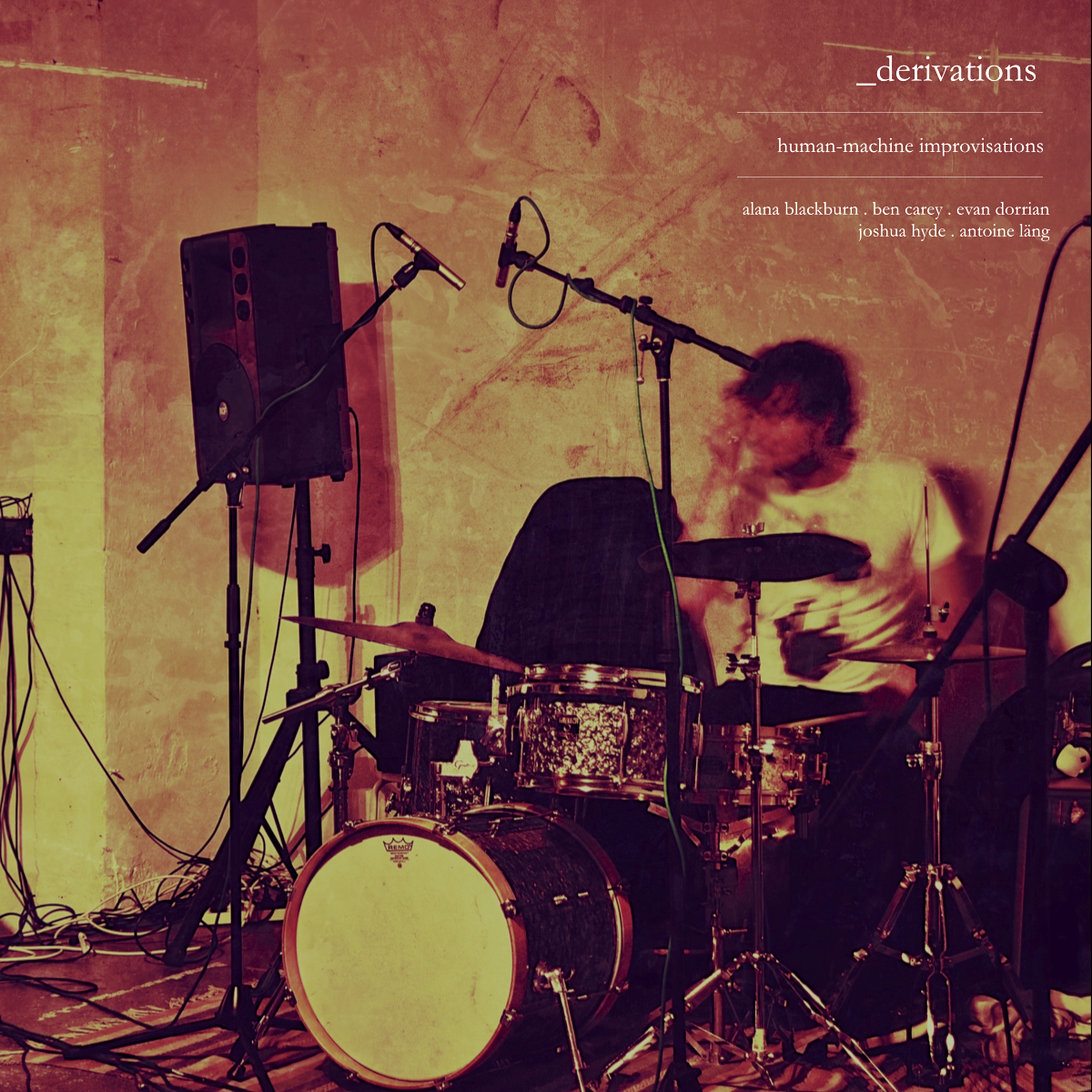
_derivations cover. Image courtesy of the artist.

Benjamin Carey, Alana Blackburn, Evan Dorrian, Joshua Hyde and Antoine Läng
_derivations
Integrated Records

Encounters between computers and improvising musicians can be overwhelmingly one-way. The instrumentalist begins playing. Their sound is recorded, transformed and spewed back into the space. A secondary level of input, in the form of buttons or foot pedals, allow the performer to trigger pre-programmed transformations. To minimise the disturbance of controlling the system, a second performer may operate the signal processor. How can an improvisational logic be programmed into the computer itself? How can a signal processing system not just play back to, but play with an instrumentalist? These are some questions that Benjamin Carey asked when he started working on the _derivations system in 2010.

The _derivations system analyses a musical performance in real time and creates a database of musical gestures based on that performance and, if the performer wishes, on previous performances as well. As in “traditional” electroacoustic improvisation, the program’s response is to transform and play elements of the recorded performance. Carey’s innovation is in the semi-autonomous actions the program makes in response  the live performance. _derivations tracks both the volume and spectral content of a live phrase. The statistical reduction of this phrase is then stored for comparison with later phrases and also for comparison with the phrases that _derivations itself plays. _derivations can respond through several channels or modules at once and all of these channels are listening to each other, generating results that are truly difficult to predict and so, from the performer’s point of view, semi-autonomous. Like a live performer, the modules are also conscious of when other modules are playing and so play in a broadly contrapuntal manner. _derivations can therefore “play with itself” without the performer playing at all.

What influence does the performer have in programming the system before the performance? The performer chooses a range for the lengths of phrases _derivations plays and also for their frequency of overlapping. This overlapping or density can also vary throughout a performance according to a preset trajectory.

The results, six of which have been recorded for Carey’s new album on Integrated Records, are remarkable in expanding the often linear and binary (multiply the same sort of sound as the performer or contrast starkly) of improvising laptop artists. The sessions feature drum-kit, recorder, saxophone and voice alone or in ensembles, performed by Alana Blackburn, Evan Dorrian, Joshua Hyde, Antoine Läng and Carey. They are miniature snapshots of rich sonic worlds, like intricate landscape dioramas. “Tactility” uses a library of sounds of a recorder, contrasting trills, low portamenti, flutter tonguing, melodic flurries and humming fields of sound. Without being able to see the performer and with the relatively restrained range of the digital sound transformations,  it is sometimes difficult to tell the system’s contributions from those of the performer. There is an insect-like autonomy-within-limits to the improvisations, which are constantly piquing the ears with new and only-just-unexpected sounds.

None of the recordings are longer than ten minutes and they give the impression that the program has a fairly static formal imagination. It is clear that the program treats the statistical data of each sample like a “point” or “molecule” in its system, much like the first serial composers. It would be great to hear the program extended to achieve a “molar” level of autonomous, large-scale organisation that might count the equivalent of one track of _derivations as a unit in itself.

You, too can have a play with _derivations here.

Partial Durations is a Matthew Lorenzon/RealTime project.