Ensemble Offspring, photo courtesy of the artists.
Sydney-based new music group Ensemble Offspring continue the Metropolis festival with a colourful series of works for live ensemble and video. Their programme Light is Calling began with a great example of a minimalist work that uses less to achieve more. Light is Calling for solo violin, electronics, and video is an attempt to “make something beautiful” after the ugliness of the attacks on the World Trade Center on September 11, 2001. Composer Michael Gordon provides a slow-moving violin part, devastatingly interpreted by Ensemble Offspring’s Veronique Serret. Reverberant and reversed samples form a finely-textured bed of electronic sound. Film maker Bill Morrison, who also contributed to Julia Wolfe’s Fuel in the MSO’s second Metropolis program, brings the piece to new emotional heights. Morrison’s film consists of a reprint of footage from the black and white 1926 movie The Bells. Morrison melts film footage of figures, faces and horses to produce hauntingly distorted images. As the film turns to yellow, brown, and black, the images smear and stretch across the screen. The echoing electronic part, lamenting violin and immolating film all seem mourn a long-lost innocence.
Nico Muhly’s It Goes Without Saying combines live clarinet (Jason Noble) with prerecorded metallic sounds including a kitchen whisk, bells and harmonium. The delicate sound world also includes pre-recorded clarinets that duet playfully with the live performer. The piece is accompanied by a video of stop-motion hair clippings on a white background. The hair slowly coalesces into a face, setting in motion a series of vivid animations including soap suds and metallic shards. Noble transfixed the audience with the hypnotic clarinet part. This was especially strong during the opening abstraction of drifting hair follicles.
Ensemble Offspring’s Metropolis programme included the world première of audiovisual artist Chris Perren’s Dive Process. In Dive Process, Perren builds on his recent experiments with musical and video phasing. Dive Process uses a retro video of a girl diving into water. The video is reversed and replayed at her point of entry into the pool, creating a rhythmic explosion and contraction of bubbles. Three versions of this film are then played side by side at different rates in a mesmerising phasing pattern. Perren’s score for percussion, clarinet, and violin mirrors the visual phasing pattern. Perren builds the intensity of this pattern during segments where dozens of copies of the video are spaced around a sphere. Continuing the theme of rhythmic counterpoint, the ensemble then played Steve Reich’s Vermont Counterpoint, a sister-piece to Reich’s Six Pianos, which Zubin Kanga performed in an arrangement by Vincent Corver earlier in the festival.
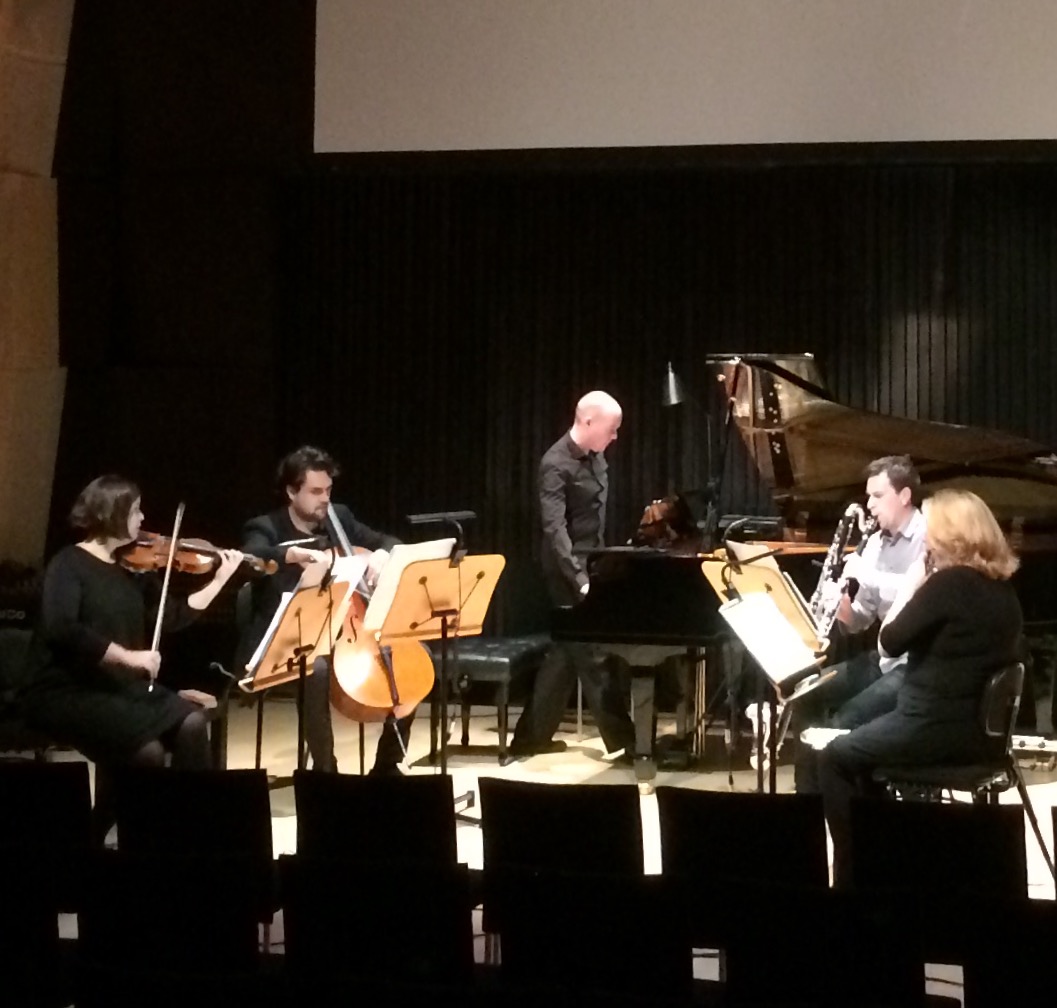
Ensemble Offspring reserved the second half of the concert for Damien Ricketson’s magnificent Fractured Again Suite. For this large-scale chamber ensemble work, Ricketson draws inspiration from the physical properties and sound of glass. In particular, Ricketson singles out the glass harmonium, a relatively popular instrument in the eighteenth century that has since fallen into obscurity. The closest thing one can hear to its ethereal tone nowadays is a dextrous performance on a row of tuned wineglasses. Ricketson builds the Fractured Again Suite out of fragments of compositions for the glass harmonium by Mozart, Donizetti and others. These fragments are then reflected, distorted and splintered like glass to form the arresting and sparkling surface of the suite. The rapid opening resembles an off-kilter clockwork automaton racing towards self-destruction. The glass-inspired video accompanying the work includes a brilliant array of coloured lights projected upon tubes, panes, and rods of glass. Some of these lights are reflected in repetitive, rhythmic ways, while at others they resemble the more timbral reflections of the piece’s later movements.
Ensemble Offspring
Light is Calling
Metropolis New Music Festival
Melbourne Recital Centre
14 May 2015
Michael Gordon, Light is Calling; Nico Muhly, It Goes Without Saying; Chris Perren, Dive Process; Steve Reich, Vermont Counterpoint; Damien Ricketson, Fractured Again Suite.
By drawing their inspiration from urban life in the second half of the twentieth century, minimalist composers bear witness to the most carbon-intensive period in human history. The jumbo jet opening John Adams’ Nixon in China and his orchestral fanfare Short Ride in a Fast Machine, Steve Reich’s City Life and Glass’ epic modern chronicle Koyaanisqatsi all show us a world kept in motion by fossil fuels. The composers may not have intended to represent our carbon-dependent lifestyles. It is all the more interesting that the issues they thought they were addressing, including the mediatisation of politics, consumerism, the proliferation of nuclear weapons and the alienation of individuals from their communities, are all connected tangentially to this one core issue that now looms as the greatest threat to human life. The works bear witness to this moment in history more than judge it. Through its serene and spacious textures, the minimalist musical language often struggles to cast judgement. Instead it impartially reflects, if not sublimates, the images it is associated with.
Julia Wolfe, Fuel
Julia Wolfe’s Fuel brings this problem running all of our trains, cars and planes to the surface. The piece is accompanied by time lapse footage of the port of Hamburg by Bill Morrison. Wolfe describes the piece as beginning in a conversation with Morrison: “We talked about the mystery and economy of how things run—the controversy and necessity of fuel—the global implications, the human need.” Originally composed for Ensemble Resonanz as something of a virtuosic party piece, the MSO strings kept up the stiff pace set by guest conductor André de Ridder. No lugubrious meditation on modern life, Fuel has the orchestra scrubbing, running and glissing for the better part of twenty minutes. Meanwhile, the film shows cranes loading containers on and off of enormous cargo ships. There is something daunting about the film and music, as though the whole frenzied business were precarious, excessive, in a word: unsustainable.
Tan Dun, “Crouching Tiger” Concerto
Cellist Oliver Coates returned to the stage to perform Tan Dun’s cello concerto based on music from the soundtrack to the film Crouching Tiger, Hidden Dragon. From the opening glissando-strewn theme I was transported back to my spotty adolescence, seeing the film’s most excellent and unrealistic sword fights for the first time. As such, I loved the cheesy main theme that returns three or four times throughout the concerto. This time around I also appreciated the piece’s extensive catalogue of well-integrated extended techniques, including left-hand pizzicato rolls, glissando effects, plectrum use and en masse string-slapping from the orchestra.
Alexander Garsden, Faculties Intact (Cybec finalist)
Alexander Garsden’s Faculties Intact is the second Cybec commission to be heard at this year’s festival. As Garsden related in his interview with De Ridder, MSO’s first play-through of the piece in January helped him understand “how overblown and ill-informed [his] initial ideas were.” One of the great virtues of the Cybec program at the Metropolis festival is that composers have the opportunity to refine their compositions and then hear them performed again. The audience is also able to hear the diversity of compositional styles among young composers, including Garsden’s idiosyncratic combination of spectralist, stochastic and other post-serial methods. Garsden’s style is unique in Australia. Many Australian composers fixate upon the performer or the instrument. The idea of a piece may have its genesis in the gestures that a performer makes while playing. They may also want to expand the range of sounds one can conjure from an instrument. Garsden seems more interested in the sound you hear rather than how it is made. He may work from a spectrogram (a graph of the energy at different frequencies of a particular sound) to derive the pitches he will use. He then makes sure that certain relationships hold between the timbres of different instruments. For instance, in Faculties Intact the violins move their bows too quickly, so that the sound produced is high-pitched and squeaky. As the violins move into higher and higher registers, the percussionist begins bowing a piece of styrofoam, carrying this squealing sound even higher. At another moment, the violins scrub away lightly in a lower register, producing a rustling sound that is adopted and expanded by a tam-tam scraped with the shaft of a mallet. Smooth, “ordinary” tones make an appearance as an afterthought at the end of the piece, just in case you forgot they were there.
Philip Glass, The Light
Instead of gas-guzzling technologies, The Light draws inspiration from Albert A. Michelson and Edward W. Morley’s experiments in physics. Michelson and Morley determined that there was no substrate, such as a “luminiferous aether,” through which light waves travelled. Their experiments led to research into the velocity of light and eventually the Special Theory of Relativity. Glass takes this pivotal moment in the history of modern science as the basis for his orchestral work The Light, writing that “this is a portrait not only of the two men for whom the experiments are named but also that historical moment heralding the beginning of the modern scientific period.” Where the concert began with Wolfe’s picture of the twentieth century running itself into ecological crisis, the concert ends with the dawn of the century and all of its scientific hopes. Can a new scientific dawn resolve the crisis brought about by the past century of industrial activity? This is a question that has been left to the next generation of minimalist composers, such as the artists of the Bedroom Community label.
The Light
Melbourne Symphony Orchestra
Metropolis New Music Festival
Melbourne Recital Centre
13 May 2015
Julia Wolfe, Fuel; Tan Dun, Crouching Tiger Concerto; Alexander Garsden, Faculties Intact (con tutta forza); Philip Glass, The Light.
Metropolis audiences enjoyed a week of chamber music before the Melbourne Symphony Orchestra gave its first concert of the festival. It was a pleasure to hear contemporary music writ large after becoming accustomed to the tight-knit intensity of chamber music. Under the baton of guest conductor André de Ridder, the orchestra takes diverse and stimulating approaches towards the festival’s theme of “music inspired by the moving image.” De Ridder has also taken the opportunity to introduce Australian audiences to the young composers represented by the Bedroom Community label. De Ridder even brought the cellist Oliver Coates—a Bedroom Community veteran—along for the ride.
Tōru Takemitsu, Nostalghia “in memory of Andrei Tarkovsky”
Rather than fill the programme with music composed for film, De Ridder explored circuitous routes between music and the moving image. The concert began with Tōru Takemitsu’s Nostalghia for solo violin and orchestra, which was written in memory of the Soviet and Russian film-maker Andrei Tarkovsky. Tarkovsky’s film of the same name is about a writer who travels to Italy researching the life of a composer. Takemitsu’s piece is thus a composition about a film about a composer. I mentioned Tarkovsky in an earlier Metropolis review as a example of a film maker with a sophisticated understanding of unsettling cinematic effects. Tarkovsky develops tension through long, wide shots of indifferent and beautiful landscapes before introducing human characters in the foreground. A mysteriously teeming, elemental nature is always lurking behind human fickleness. I would call the atmosphere of films like The Sacrifice or Stalker a sort of claustrophibic agoraphobia. Takemitsu’s elegy for Tarkovsky is a perfect meeting of artistic styles, brilliantly brought to life by Sophie Rowell. In Takemitsu’s music, nature and the elements are also in the ascendant with swooping lines and ethereal bow effects. Rowell took the audience through Takemitsu’s other-worldly musical space with the utmost conviction.
Arnold Schoenberg, Accompaniment to a Cinematographic Scene
Schoenberg composed his Accompaniment to a Cinematographic Scene in 1929 on the invitation of Heinrichshofen Verlag, a publishing house specialising in silent film scores. Fritz Lang had recently released his chilling image of the future in the silent film Metropolis. The Great Depression and the rise of Nazism in the Weimar Republic provided their own, terrifyingly real images of the future. It is only fitting, then, that instead of composing music for a particular scene, Schoenberg used his twelve-tone technique to express “threat, danger and catastrophe” more generally. The piece is today an interesting historical record of frightening effects in music. In Accompaniment to a Cinematographic Scene the language of fear is still pinned to the outer reaches of the circle of fifths and in evocative gestures like scurrying, swarming strings. The timbral effects of Penderecki (whose work Polymorphia appears in Saturday’s programme) have since come to dominate the language of horror-film scores. The MSO made the most of Schoenberg’s evocative language, bringing out each vignette of the piece. Perhaps there is still more horror-music to be written with tone rows. I was scared.
Harry Sdraulig, Kaleidoscope (Cybec finalist)
Every MSO concert of the Metropolis festival includes a piece by one of the finalists of the Cybec Foundation’s 21st Century Australian Composers Program. The program gives young composers the valuable opportunity to workshop their compositions with players from the orchestra. Three pieces are then chosen for presentation at the Metropolis festival, providing the even more valuable opportunity of refining their compositions. Harry Sdraulig’s Kaleidoscope was chosen as the first Cybec piece of the festival. Sdraulig was able to develop the piece with guidance from the composers Julian Yu and Brenton Broadstock. In a short interview with De Ridder, Sdraulig explained that he wanted to make the most of the timbre of each instrument in the orchestra. Like the coloured crystals of a kaleidoscope, each instrumental colour shines through the rich orchestral texture. Sharp attacks from the keyboard percussion punctuate winding, Stravinskian woodwind lines and driving string-section rhythms.
Nico Muhly, Cello Concerto
Nico Muhly and Daníel Bjarnason form part of the Bedroom Community label, a close-knit group of composers based in Reykjavík including Australia’s own Ben Frost. Muhly’s use of diatonic harmony and repetition show the influence of his long-term mentor Philip Glass. He has worked closely with a number of pop artists, notably Björk, whose free and idiosyncratic use of voice and electronics can also be heard in some of Muhly’s compositions. Muhly’s orchestral works break free from the strict rhythmic counterpoint of Glass and paint a more complex, immersive sound world. Muhly divides stuttering, fragmented rhythmic material between distinct instrumental timbres. He is, however, intent on keeping his musical language easy on the ears. Without the continuity and counterpoint of earlier minimalist works, Muhly’s voices are snapped to a harmonic and metrical grid. This is especially the case in Muhly’s Cello Concerto, which opens with successive shocks of percussion underneath a searching cello line. This texture is consciously borrowed from the beginning of Henri Dutilleux’s Métaboles. Unlike Dutilleux’s more ambiguous and threatening opening chords, each of Muhly’s percussive chords is a brick supporting the flowing crescendi and decrescendi of the melody. Cellist Oliver Coates (for whom the Cello Concerto was written) gave a febrile performance of the piece, with lush string crossings, double stops and tremoli.
Daníel Bjarnason, Blow Bright
While minimalist influences still permeate Bjarnason’s work, his orchestral composition Blow Bright presents a more menacing side of the Bedroom Community sound. Bjarnason’s piece is inspired by the “brightness and energy” of the Pacific Ocean, though this is an energy that evidently runs into dark and foreboding depths. Slapping Bartok pizzicati jump out from the cellos and basses while the percussion drives the piece forward with insistent cross-rhythms. Bjarnason contrasts full, saturated orchestral textures with stripped-back rhythmic figures.
These contrasts made me consider the dramatic role of dynamics in relation to the festival’s sub-theme of suspense and horror. Loud and sudden sounds will always surprise us. At 2013’s Totally Huge New Music Festival I discussed David Toop’s very effective practice of betraying the audience with loud shocks after lulling them into a false sense of security. The juxtaposition of loud and soft orchestral textures, appearing in baroque terraced dynamics, probably hasn’t had the same emotional effect on audiences since the advent of electrical amplification. All the more reason to investigate the subtle art of freaking people out with tones.
In terms of audience numbers, Metropolis appears to be having its most successful year yet. The combination of film as a theme and works by minimalist composers may be responsible for this. It is to De Ridder’s credit that he has explored the festival’s theme through a variety of stimulating avenues.
Nostalghia
Melbourne Symphony Orchestra
Metropolis New Music Festival
Melbourne Recital Centre
9 May 2015
Tōru Takemitsu, Nostalghia; Arnold Schoenberg, Accompaniment to a Cinematographic Scene; Harry Sdraulig, Kaleidoscope; Nico Muhly, Cello Concerto; Daníel Bjarnason, Blow Bright.
Lisa Moore packed out the Melbourne Recital Centre Salon with her programme of well-known piano works by Philip Glass and For the Sexes: The Gates of Paradise by Martin Bresnick. From the beginning of Glass’ Etude No. 2 I remembered how characteristically Moore performs minimalist repertoire. She is not afraid of taking pieces a little faster than usual, adding some rubato or hammering out particular lines. After the energetic Etude, Moore invited the audience to sit back and sink into the Glass “sublime” without applauding between works. I took this as a cue to put down my notepad as well. Throughout Metamorphosis I and II I was transported back to undergraduate music, where I first heard Glass. The performance made me wish I could go forget everything and learn about music all over again. While embracing the Glass sublime as well as I could, I also had some niggling thoughts about minimalism’s place in global history that I will save for my discussion of the Melbourne Symphony Orchestra’s minimalism-inflected Metropolis programmes. I suppose you can take the audience out of postgraduate musicology, but you can’t take postgraduate musicology out of the audience.
After an intermission, the audience returned for Martin Bresnick’s musical interpretation of William Blake’s poem For the Sexes: The Gates of Paradise. The piece combines a piano part with recitations of the poem and animations of Blake’s illustrations by Puppetsweat Theater. The phallocentric panning of Puppetsweat’s animations is completely in tune with Blake’s own worship of sexual—in particular phallic—energy. The superimposition of images and words in the animations are beginning to show their age. Since the work’s creation in 2001 there have been a string of excellently-animated still drawings, from Arthur Rackham’s illustrations of The Ring Cycle in Heath Lees’ introduction to the work Wagner’s Ring, to Jessica Yu’s animations of Henry Darger’s illustrations in In the Realms of the Unreal. I occasionally found myself closing my eyes to better appreciate Bresnick’s rich score.
The piano part paints the elements and stages of life described in the poem, which is read and sung by Moore throughout. Sometimes the piano part imitates the rhythm of the voice, sometimes it develops snatches of folk-sounding melodies. At one particularly weird and arresting moment, Moore trails a card over the keys while reciting the book’s poem on death and the grave. Like Blake, Bresnick draws on the most fundamental materials of life and art to produce a complex new mythology.
Lisa Moore
A Bigger Picture
Metropolis New Music Festival
Melbourne Recital Centre
9 May 2015
Philip Glass, Etude No. 2, Mad Rush, Metamorphosis I, Metamorphosis II, Satyagraha Act III (Conclusion arr. Michael Riesman); Martin Bresnick, For the Sexes: The Gates of Paradise.
Zubin Kanga always drags half a dozen new works in his wake as he criss-crosses the globe in search of the bleeding edge of piano repertoire. Kanga’s last tour of Australia entitled “Piano: Inside/Out” explored the inside of the piano, either through playing the piano strings directly with the hands or by preparing the strings with objects like paper and Blu-Tac to change their tone. In his current “Dark Twin” tour, Kanga extends the piano outward through live electroacoustic manipulation and video projections.
Premièring new music necessarily runs the risk of performing a “bad” or “unsatisfactory” work. Saying that a work is “beautiful,” “successful,” or that it “works” would be meaningless if the reverse were not possible. Composers are often their best critics and will revise works after a first hearing. Andrew Ford’s recent book Earth Dances tells of how Stravinsky struggled to find a satisfactory ending to TheRite of Spring. On the other hand—to continue the Rite example—audiences and critics have often failed to appreciate how a work is beautiful or successful upon first hearing. Knowledge of the multiplicity of ways in which a piece can be “good” is perhaps the reason why critics can shy away from negative judgements. However, I feel particularly emboldened to make critical judgements this morning because George Brandis has just funneled $104.8m away from the peer-review-based Australia Council for the Arts and into his own ministry, where who knows what sort of evaluation process will take place. Consider this review a battle-cry for judgment over cronyism. In this review, the success of a work is judged according to how well it achieves what the composer or performer set out to do in writing and performing it. I will try to bring other qualities of the works to light as well, in spite of the creators’ stated intentions.
Stefan Prins, Piano Hero
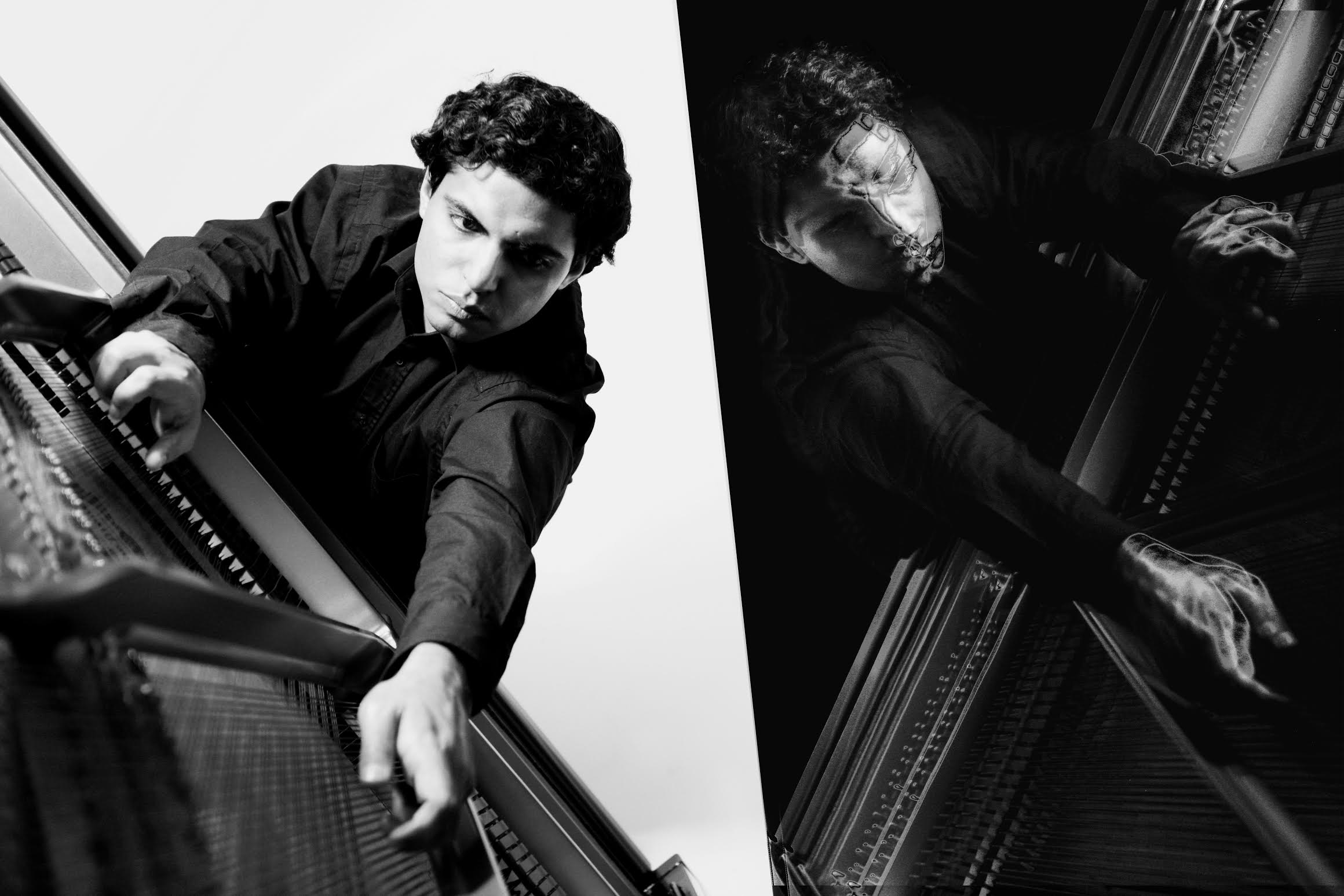
In Stefan Prins’ Piano Hero, Kanga plays a MIDI keyboard that triggers video samples of a man playing with his hands on a stripped-back piano frame. The minimal gestures of the keyboardist contrast with the full-body movements of his avatar in the video, who strums and strikes the strings. The avatar also uses subtler gestures, including conjuring a smooth tone from the body of the piano with a cork on the end of a stick. He bounces and throws a handful of piano keys onto the strings, scattering them across the frame.
According to Kanga’s programme notes, the work seeks to “explore the modern trend of the virtual replacing the real while deconstructing the relationship between pianist, instrument and observer.” The work achieves the first of these goals, while leaving the second in the air. The starkly-lit, beautifully-textured surfaces of the piano frame make the video seem more real than the poorly-lit keyboardist. The avatar’s movements are also more visceral than those of the keyboardist.
The second goal, to deconstruct the relationship between the pianist, instrument and observer, is barely addressed. Yes, the keyboardist’s gestures and the audience’s attention are decoupled from one another and directed towards the avatar on the screen. To stress this point, the screen occasionally switches to a camera trained on the keyboardist silently playing away. However, to deconstruct is not just to take apart (unless one is ordering a deconstructed polenta stack at a Melbourne café). Literary deconstruction reveals underlying assumptions and arbitrary norms that are inexpressible within the frame of a particular discourse. Piano Hero reconfigures the performer-instrument-observer triangle, but it does not tell us anything about concert conventions that we don’t already know. [EDIT: Kanga has since pointed out that Prins originally used the more appropriate term “recontextualise.” “Deconstruct” was Kanga’s paraphrase.]
One of Piano Hero‘s greatest strengths is the compositional use Prins makes of his technical apparatus, whatever its rationale. The piece begins with the keyboardist triggering only the resonance left after the piano strings are struck. The performer’s hands hover above the strings, seemingly conjuring the resonance out of them. As more violent gestures are introduced, with the performer striking the strings, the speed of the gestures are modulated by the MIDI keyboard. This creates striking contrasts as the physical intensity of the performer attacking the strings contrasts with more balletic, slowed-down gestures.
Julian Day, Dark Twin
Julian Day’s Dark Twin is the result of a long-term collaboration between Kanga and Day. Day describes the piece as stemming from his experience learning the piano as a child. Instead of the solitary experience of piano practice, he imagined a situation where a pianist plays against a ghostly other. As Kanga paraphrases Day’s intentions:
At first [the electronic part] matches the pianist closely, but then begins to slide in pitch and distort in colour –techniques that are impossible on a piano. Over the course of the piece, the electronic part shifts from being an indistinguishable electronic ‘twin’ of the pianist to becoming a grotesque rival.
The piece begins with the minimalist gesture of two rapidly-alternating notes. At this point, the live part does indeed sound almost indistinguishable from the electronic part. As the piece progresses, the electronic part becomes deeper and seems to spread around the room. The timbre of the electronic part also becomes more distorted. The impression is less a “dark twin” of the piano part than an expansion of the piano part. The two parts are indistinguishable in the muddy and saturated air.
Benjamin Carey, _derivations
Benjamin Carey’s _derivations provides a much more convincing example of a pianist duelling with an electronic other. I have previously reviewed a recording of Carey’s _derivations system and it was a pleasure to see it in action for one of the first performances of the system with a piano. _derivations is a program intended to improvise with a live performer. The program listens to and analyses the performer’s musical gestures. These gestures are stored in a database, drawn upon and manipulated to contrast with or complement the live performer. The program may also respond through several voices or channels at once, even responding to itself. In some ways the program’s responses to Kanga were predictable and gave a sense of balance to the performance. When Kanga played high on the piano, _derivations introduced a bassy hum. When Kanga ran his hands over the piano strings, _derivations turned this sound into a glassy cloud of sonic fragments. I had the impression in this performance, as I did when listening to the recording above, that the system was playing material straight back to Kanga rather than strategically introducing large-scale formal contrasts. It would be nice to hear a longer performance where the system was able to exert more control over the course of an improvisation.
Cat Hope, The Fourth Estate
Cat Hope’s The Fourth Estate uses electromagnetic interference in the form of pocket radios and EBows to represent the disruptive and filtering political effects of the free press. As Kanga’s programme (once more a paraphrase of the composer) reads:
As the Fourth Estate is thought to be an element of society ‘outside’ official recognition, here the radios and e-bows (small electromagnets on the strings) act as static sonic barriers, interfering with the mercurial and lively piano part.
What a great idea! Unfortunately it was not one that I found represented in the performance. It seemed to me that Kanga’s runs and key-mashing in different registers were more to “get the strings moving” rather than to provide pianistic gestures that the EBows and radios would then corrupt. I cannot say whether this was the result of the specific directions on the graphic score or its interpretation. The EBows and radios then failed to interfere significantly with the sound of the piano. Occasionally one could hear the jangle of an EBow or a radio physically bouncing on the piano strings, but they did not appear to intermingle with or modulate the piano’s sound. Surely the media is not that ineffectual, bouncing along the titanic reverberations of politicians? Now, I am fully aware that I am about to fly to Perth to review the Totally Huge New Music Festival and will no doubt spend a lot of time in the same room with Hope, but this only goes to show how seriously I take reviewing.
Michel van der Aa, Transit
In Transit by Michel van der Aa, an elderly man fights loneliness through a series of repetitive acts. He struggles to open doors and open the window. He drags a chair back and forth and bottles steam from a kettle that he can barely lift. The noir-like film captures the claustrophobia of physical weakness and the importance of memory. The live piano and electroacoustic parts are integrated into the rhythm of the film. Kanga’s silent movements, such as raising his arms to play, or reaching to one side of the piano but not striking a key, are accompanied by electroacoustic sounds. This gives the impression that Kanga is a magical piano samurai, which is not too far from the truth.
Daniel Blinkhorn, FrostbYte: Chalk Outline
Blinkhorn’s FrostbYte: Chalk Outline is an audiovisual piece contrasting pristine Arctic waters with industrial infrastructure. The Chalk Outline of the title refers to the climate change, exacerbated by industrial activity, that is rapidly transforming the landscape. Blinkhorn created the piece with video and audio material he collected while travelling in areas of the Arctic. The musical accompaniment to the footage of the Arctic landscape is fittingly tinkly, high and “icy.” Blinkhorn begins to introduce sounds from dubstep, with wobbly bass and dramatic, booming punctuations as the footage moves to cranes, which are processed through abstract mirroring effects on the video. The stunning video footage was inexplicably processed through a filter that broke it up into beveled windows. It seemed to me that this was unnecessary as the beautiful landscape spoke for itself.
Steve Reich (arr. Vincent Corver), Piano Counterpoint
Steve Reich’s Six Pianos is difficult to mount due to the problem of gathering six pianos together in the same space and still having room for the audience. Pianist Vincent Corver has opened the door for more (partially) live performances of the work by arranging it for one live pianist and five pre-recorded parts in the retitled work Piano Counterpoint. Kanga performed the live part with bravado and flair. We will no doubt hear this piece many more times in the future.
Zubin Kanga
Dark Twin
Metropolis New Music Festival
Melbourne Recital Centre
8 May 2015
Stefan Prins, Piano Hero; Julian Day,Dark Twin; Benjamin Carey, _derivations; Michel van der Aa, Transit; Daniel Blinkhorn, FrostbYte: Chalk Outline; Cat Hope, The Fourth Estate; Steve Reich (arr. Vincent Corver), Piano Counterpoint.
Mitchell Riley, Brenton Spiteri and Jessica Aszodi. Fly Away Peter, Sydney Chamber Orchestra, Carriageworks, 2015. Photo by Zan Wimberley.
Review by Alistair Noble
A Triumph for Contemporary Opera
Elliott Gyger’s masterful opera, given a polished and committed première performance by Sydney Chamber Opera this week, is surely one of the major musical events of the year. It takes on even greater significance in the context of the ever-more conservative, fearful programming of the major musical institutions in Australia such as Opera Australia. This is not the place to rehash the recent public debates about the value or nature of contemporary opera but it is necessary to acknowledge that Gyger’s work serves as a perfect rebuttal of the foolish arguments put forward by those who think opera should be no more modern than Puccini, or no more radical than a Broadway musical. One can only hope that the prime-movers of such regressive notions have the courage to attend Fly Away Peter. If they did, they might well learn something from the experience.
During the past few days, we have seen the opera gain an exceptional degree of critical attention and acclaim in the mainstream media, reflecting not only the inherent qualities of the work and of the performance, but also the sense that the full-house audiences were in the presence of something powerful, significant, and above all beautiful. Contemporary opera is alive and successful in Australia, but it’s not in the Opera House. Perhaps that is a good thing. Poetic, provocative, beautiful, and haunting, Fly Away Peter is work that surely must have a strong future. There have already been calls for this production to tour, and I have no doubt that other companies will be keen to stage it in future years.
Cashing in on the ANZAC centenary juggernaut, the publicity for Fly Away Peter gave the impression of this being a war-themed opera. I must admit to some initial scepticism about the work for this very reason and if one did take the marketing hooks as the basis for interpretation it would be deeply problematic. Viewed as a simple war opera, it would be hard to justify such a poetic treatment, which flies dangerously close to romanticising death and destruction. As Adorno famously wrote in 1951, »nach Auschwitz ein Gedicht zu schreiben, ist barbarisch«, and surely one could argue much the same for the appallingly stupid horrors of WW1—and yet we keep at it. Fortunately, Fly Away Peter is not really a war opera, and perhaps only tangentially concerned with the war at all—in this way arguably similar to Malouf’s original book. To my relief, I found that the opera soars above and beyond the limitation of war-commemoration and is much concerned with larger issues of genuine human concerns about the nature of our meaningfulness in the world. In this sense, it is a work of incisive contemporary relevance and not at all a historical drama.
The Libretto
David Malouf’s novella Fly Away Peter (1982) is justly renowned for the lyrical poeticism of its descriptive writing. Malouf sings his landscapes and characters lovingly to life with words that convey much more than is written, opening spaces for imagination and wonder. Dramatically, it presented some challenges to the librettist, in so far as there is not a great deal of direct dialogue and indeed not a great deal of plot—some of the key ‘action’ takes place off set, or off the page, and what remains serves more as material for contemplation than drama. Pierce Wilcox has done a very artful job of creating the libretto for the opera, and his text serves as the structuring vehicle for both Gyger’s music and the dreamlike world of Imara Savage’s staging.
Staging
The cavernous industrial space of the Carriageworks theatre works very well for the set designed by Elizabeth Gadsby—an assymetrical pyramid of giant steps washed over with white clay. This set, like many aspects of the work, is only simple at first glance. As the piece unfolds we find that the production is elegantly minimalist, with a well thought-out function and poetry that goes far beyond the merely minimal. The only props are simple blue buckets, laid out across the steps in different ways at different times, and containing the white clay that gradually ends up smeared over characters clothes and bodies. There is a nuanced ambiguity in this, as one wonders whether the humans are growing out of the mud, or dissolving into it.
Brenton Spiteri. Fly Away Peter, Sydney Chamber Orchestra, Carriageworks, 2015. Photo by Zan Wimberley.
I particularly enjoyed Verity Hampson’s lighting of this production, which uses angled side-lights to play with the singers’ shadows on the huge expanses of concrete wall at Carriageworks. This contributed strongly to the dreamlike, poetic nature of the work as one’s eye was drawn back and forth between the bodies of the singers on the set and their giant, puppet-like figures moving across the walls. As the opera progressed, this created a magical sense of a multi-layered drama in which certain aspects are played out on the ground and embodied, while others are metaphysically projected into other realms of being or consciousness.
The Ensemble
The singing cast of Mitchell Riley, Brenton Spiteri and Jessica Aszodi have a considerable burden to carry as the only characters on stage for the 80-minute uninterrupted play. The success of this present production is certainly due in large part not just to their individual abilities but their strength as a remarkably unified ensemble. Their actual characters are not fixed, as they fluidly shift from their main parts to speak for others at different times, and to sometimes voice more abstractedly reflective or poetic words—and even birdsongs.
It is clear that Gyger composed for these particular voices, making careful use of their individual abilities and strengths. Spiteri has a beautiful, effortless tenor voice that is wonderfully consistent in tone across its range and brings a refined lyricism to his main character of the wealthy landowner Ashley Crowther. Riley’s voice is in some ways more complex, with gear-shifts that complement the youthful athleticism and foal-like awkwardness of his character Jim Saddler, a working man and passionate bird-fancier. In the final, transfigurative scene of the opera, Gyger makes a sensational use of Riley’s powerful falsetto. Jessica Aszodi’s part as the middle-aged photographer Imogen Harcourt is also judiciously composed to use her distinctive and always well-controlled voice to great effect. She has a challenging role to play in some respects, as her character is sometimes part of the main action, sometimes drifting to one side as a kind of chorus, and at other times chatting with the two soldiers (Jim and Ashley) far away on the Western Front, as all three meet in world of the mind that is the centre of gravity of the opera. Her strong lower register proves useful, as her vocal line at times sits within the same space as the male voices; on a musical level as well as a dramatic one she can move in and out of the men’s world.
Jessica Aszodi. Fly Away Peter, Sydney Chamber Orchestra, Carriageworks, 2015. Photo by Zan Wimberley
Supporting and embracing the theatrical core of the vocal parts, the instrumental ensemble directed by Jack Symonds is very strong and colourful. There is terrific playing from all seven members of the group (violin, double bass, clarinet, bassoon, trumpet, trombone, percussion), while violinist James Wannan and percussionist Alison Pratt both play key roles with flair and sensitivity.
The Music
Gyger’s music is always skilful, cleverly designed, poetic and elegant. All these characteristics serve to bring out the subtleties of Fly Away Peter’s libretto and, perhaps more importantly, provide the background energy and structure that carries the play forward with a compelling momentum. The overall musical cohesion of the piece is a tremendous feat—it successfully feels like one great sweep of music and theatre rather than a succession of set-pieces and scenes. This is achieved partly by the use of a carefully planned set of harmonic structures, in which chords and (by extrapolation) melodic lines relate to each other by vertical symmetry—an analogue for the air and earth relations that are fundamental to the text.
These particular harmonies, and the way in which they are used for much of the work, enable the creation of music that has a lovely, radiant transparency. This is the source, I feel, of the beautiful dreamlike character of the opera overall, that is sympathetically translated to set, staging and lighting by the production team. At the point of the play where the two young men are translated to the war-zone, the chord materials are re-organised to be more dense, with the harmonic shift being heralded by a skilfully phrased drum solo that grows out of the sound of an aircraft engine. Later sections of the opera seem to move between these two sound-worlds, of the radiantly spacious on one hand and the more claustrophobic, entrapped on the other.
Although the instrumental septet is a conscious replica of Stravinsky’s Soldier’s Tale ensemble (1918), there is little other reference to Stravinsky’s work—except perhaps obliquely in the magnificent jazz-age rhythms that drive the aircraft/war section of the opera. Gyger uses the small ensemble in such a colourful way that one cannot help thinking that the large orchestras of conventional symphonically-oriented opera are a little redundant. From the intimacy of brief solos to the massed sound of the full ensemble, a universe of sound is encompassed. The use of muted brass and bowed percussion add another layer of affective colours.
With the ornithological focus of the story, it was inevitable that the composer must consider the use of birdsong in the music. Gyger has made skilful use of transcribed birdsongs in some sections of the opera—more in the manner of Messiaen than of Sculthorpe, in so far as the songs are not simple effects but integrated with the musical materials in interesting and powerful ways, moving across registers and woven through the harmonies. In a very interesting recent article, Gyger has noted that this use of birdsong has introduced two new kinds of material to his work: glissandos, and microtones.[1] This is, I feel, very significant. At the age of 46, Gyger has given us his first opera—and at the same time the project has changed his music. To some extent this illustrates how important it can be for composers to have opportunities such as this, to collaborate with writers and dramatists, and in the process to inspire us also to reinvent our worlds.
The Message
Opera is an inherently strange artistic medium—it is by nature contrived, an extremity of artifice. How could this possibly be made relevant to us as Australians in the 21st century? In this, one senses the significance of the broader achievement of Fly Away Peter: Gygyer has demonstrated that it is possible to write theatrical vocal music that is singable without being simple, that is expressive without being cheesy or melodramatic, that invites us to suspend disbelief and enter the world of imagination that is opera itself. Rather than being stuffy and elitist, this is a universe where each of us hears to some extent our own voices, and where we observe ourselves acting out the drama of human existence.
How, the character of Jim asks, can we as fragile individuals stand against such a leviathan as war? He has a vision of a future in which people are herded into cattle-trucks… and he is not only speaking of the holocaust but warning us of our own loss of freedom, of the ways in which we too are herded. The things Jim understands, his natural abilities, seem worthless in this world.
Fly Away Peter is an opera about ordinary people being caught up in the great meat-grinder of history. It is about powerlessness. It reminds us that the things we love and understand (symbolised by birds and seedling plants) have no value in the economy of politics and war (wars, after all, are not started by armies but by politicians). Similarly, human life and the natural environment we inhabit seem to have all value leached away, dissolved into the barren mud. And yet, after the tide of inhuman ‘great event’ has turned, these simple, individual activities and delights revive. The war recedes into the form of a near-meaningless nightmare, while ghosts dreaming of birds on the estuary at home in Queensland become ever more meaningful and real.
To some extent, Fly Away Peter strikes me as a manifesto of very current relevance: to what sinister machineries of state/nation/ideology/economy are we (unwittingly) serving as the cannon-fodder? To what limited extent is there scope for resistance? What are the dreams and loves that we would cling to, that bring beauty and meaningfulness to our brief lives, and form our only true legacy?
– Alistair Noble
Fly Away Peter
Music by Elliott Gyger
Libretto by Pierce Wilcox from the novella by David Malouf
Sydney Chamber Opera
Carriageworks 2-9 May 2015
Still from Marcus Fjellström’s Odboy and Erordog. Image courtesy of Forest Collective.
Forest Collective’s “Moonfall” programme explored two important aspects of the Metropolis festival’s theme, “Music inspired by the moving image.” Firstly, Forest Collective recognised the importance of computer games to any discussion of music and the moving image today. Secondly, the concert was downright creepy.
Without culturally- and physiologically-ingrained harmonic cues, contemporary music can fall into an emotional binary of anodyne lyricism and anger. Humour and fear are like lyricism and anger’s more sophisticated cousins. Without wanting to be prescriptive (a piece need not aim for any of these emotional modes, nor any emotional mode at all), humour and fear show that a composer has enough command over their work to shape a complex audience experience. In film, the same distinction could be drawn between a slasher film that relies on loud and sudden noises to disturb the audience and the unnerving qualities of, say, a Tarkovsky film (more about Tarkovsky in a forthcoming review of the Melbourne Symphony Orchestra’s first Metropolis programme!).
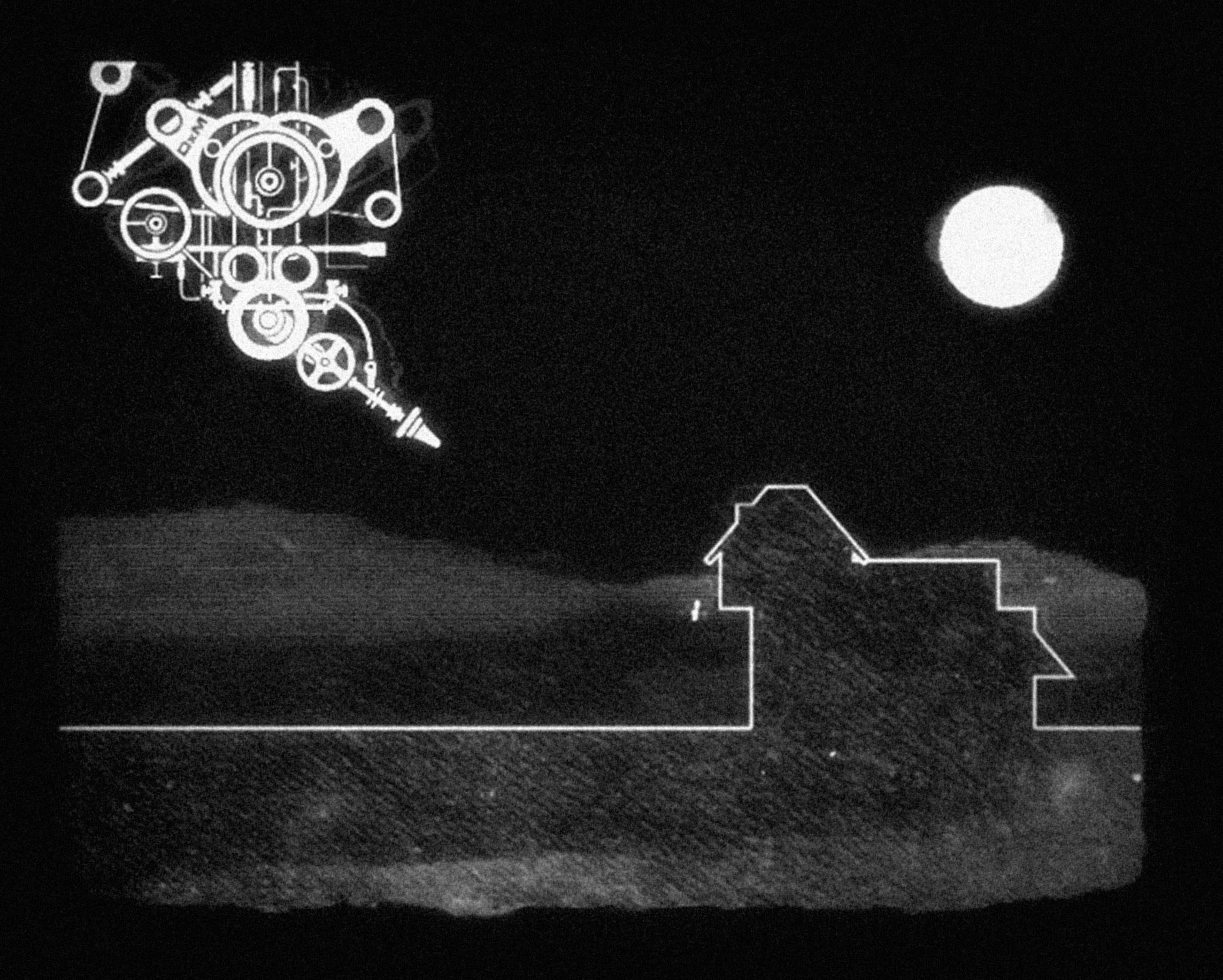
Forest Collective built their programme around Marcus Fjellström’s triptych Odboy and Erordog (available on Fjellström’s Youtube channel). Each episode reflects the sequential, task-driven atmosphere of certain nightmares. Odboy and his trusty Erordog embark on foreboding journeys to perform arduous “chores.” As in nightmares, the imperative to perform the tasks is overwhelming while the meaning of the tasks is obscure. The journeys will be familiar to all retro gamers and light-sleepers, including “finding the big house” and “crossing the spider pit” while “looking out for the wild boar” (echoes of Conquests of Camelot?). The first episode includes an electronic score by Fjellström utilising rhythmic record pops and theatre organ that complement the grainy black-and-white video. The second two episodes include written scores for the ensemble, who provided a sparse layering of extended techniques and musical accents. Fjellström is currently working on what appears to be a sci-fi chamber opera entitled “Boris Christ.” Hopefully we can get it over to Australia (Forest Collective I’m looking at you).
Odboy and Erordog combines black-and-white film aesthetics with 1980s computer-game graphics. Computer games form an essential part of screen culture for anybody under the age of forty. While those who did not grow up with computer games may recognise the burgeoning computer game market, those who spent too long in front of screens as children will understand the emotional resonance of old, lo-fi computer game aesthetics. If I may indulge in some folk-psychology, perhaps this is because an active imagination is needed to turn a few blocky pixels into a whole fantasy-world. On the other hand, the stark colour contrasts and blocky designs of old games have design elements unto themselves that are, for want of a better word, beautiful.
Forest Collective threaded a series of dark and foreboding chamber works between the Fjellström films, beginning with Evan Lawson’s arrangement of Rupert Holmes’ song “Moonfall” from the 1985 musical The Mystery of Edwin Drood. The musical is based on an unfinished novel by Charles Dickens and was the first musical to feature multiple endings, which were chosen by an audience vote. Lawson states in the programme that he wanted to capture the “smoky streets of nineteenth-century London.” He certainly achieves this goal with a murky bed of clarinets (Vilan Mai and Aaron Klein) and shimmering string tremoli.
The concert featured the world première of Evan Lawson’s Orpheus and the Cave. The piece is a study for a large-scale orchestral work featuring two solo sopranos and solo harp. In the study, Lawson’s usual lush sound palette is stripped back and spread about the room. The spatial distribution of the ensemble is some of the most effective that I have heard. The piece begins with a drum roll behind the audience, before Orpheus (Rosemary Ball) sings to Euridice (Teresa Duddy) across the room. The solo violins (Katriona Tsyrlin and Isabel Hede) to the left and right of the audience create a striking stereo effect. At the end of the piece, Mai and Tanya Vincent on clarinet and flute leave the auditorium to play a perhaps too-recognisable excerpt of Monteverdi’s 1610 Vespers as “the birds calling out on the surface of Earth.”
Forest Collective’s dark programme triggered a series of questions surrounding horror and music. While sudden, high-pitched and dissonant sounds may appeal to our fundamental survival instincts, how do we process subtler unsettling sounds? If we are taught to recognise certain sounds as “creepy,” then how can we access the emotional impact of creepy music from throughout history? What is the first recorded piece of “scary” music?
Forest Collective
Moonfall
Metropolis New Music Festival
Melbourne Recital Centre
7 May 2015
Marcus Fjellström, Odboy and Erordog; Rupert Holmes (arr. Evan Lawson), Moonfall; Evan Lawson, Orpheus in the Cave.
Ben Walsh and The Orkestra of the Underground perform The Arrival. Photo courtesy of the artist.
Ben Walsh and the Orkestra of the Underground’s score to The Arrival is a timely exercise in empathy. Shaun Tan published his picture book in 2006, five years into the “new normal” of Australian immigration policy. Since the Tampa crisis of 2001, both major Australian political parties have sought to outdo each other in the cruelty with which they treat asylum seekers arriving by boat. It is debatable whether this cruelty, including indefinite detention in deplorable conditions, is coherent with or the best way of achieving their most common justification: stopping deaths at sea. With the UN Special Rapporteur on Torture Juan Mendez recently finding that aspects of Australia’s immigration policy violated the Convention Against Torture and Other Cruel, Inhuman or Degrading Treatment or Punishment, now is the perfect time to reconsider the place of “the arrival” in the Australian imagination. Instead of demonising them as “illegals” or “queue jumpers,” The Arrival paints those seeking a better life in a new country as resilient and grateful members of the community.
The Arrival is remarkable for its unpolemical yet highly emotional depiction of immigration, the result of Tan’s extensive research into the migrant experience. Throughout the thousand-or-so images of the wordless picture book, one follows a father as he leaves his family in a town menaced by some unnamed evil. He arrives in a strange new land, finding accommodation and work thanks to small acts of kindness from others with their own stories of persecution and war. He is finally reunited with his family in the new land. In a touching final scene, his daughter gives directions to another new arrival. In Walsh’s production, stills from the picture book are projected behind the band in glorious detail, with minimal panning to give the scenes a greater sense of movement.
It is a shame that Tan does not write more, as he is one of the most beautifully-expressed individuals I have had the pleasure of hearing and reading. At the beginning of the concert, Walsh read a letter from Tan explaining that the last thing anyone who has written a book or a PhD wants is to see their work projected on a screen. However, seeing and hearing Walsh’s musical accompaniment to the book brought him back to its inspiration: The stories of migrants who leave everything behind to form a new life, granting hope and insight to us who take peace and security for granted. He concludes, “We are all the children of migrants.”
It is notable, however, that the sympathetic characters in The Arrival all seem to share their own personal stories of migration. Are people for whom the memory of fear and flight has faded a lost cause? Absent, too, is the xenophobia so many migrants experience upon arrival in a new country. Tan may have held some hope in 2006 that a Labor government would try a different tack on immigration. After ten more years of the new normal, I wonder whether Tan would draw the book differently today.
The reader is able to empathise with the protragonist of The Arrival because he leaves a world that would be relatively familiar to any reader. The protagonist’s fashion and surroundings are roughly Eastern European. The Orkestra of the Underground mirror the protagonist in white shirts and waistcoats. They reflect his implied nationality with an energetic Balkan brass band sound augmented with the percussion of Walsh, Gregory Sheehan, and the seamlessly-integrated tabla of Tarlochan Kandola. The Orkestra of the Underground is a band of extremely talented musicians and each player is given a truly awe-inspiring solo.
The protagonist arrives by boat in a new city that is utterly foreign. The clothing, animals and language that Tan creates for the city resemble those of no culture in existence. From that point on, the reader has no more purchase in the world than the protagonist as he learns to navigate the city and understand the local food and language. It was evident (after hearing a few days of weird and wonderful musical worlds at the Metropolis New Music Festival) that the music of The Arrival does not change with the protagonist’s surroundings. Instead of confronting the listener with a completely alien musical world when the protagonist arrives in the new city, Walsh and the Orkestra of the Underground continue to paint the dramatic arc of the work in the dance-rhythms of his homeland. To be fair, an hour of hardcore avant-garde music might not have the desired cathartic effect, but I was left wondering what Tan’s strange new world might have sounded like.
The ensemble provided compelling incidental music to accompany the story, sliding seamlessly between “exogenous” musical accompaniment and painting “endogenous” sounds from the images. A roll on the tabla becomes the running feet of soldiers, a tuba makes a very convincing foghorn and a heavy bow on the double bass sounds like creaking wooden planks. Perhaps most striking is the moment where the protagonist encounters a curling black tail like those menacing his hometown. The ensemble stops in its tracks as the traumatic trigger floors the protagonist. The Arrival has had a long run, enjoying sold-out shows around Australia. I only hope that more people have the chance to see this beautiful and important work.
The Arrival
Ben Walsh and the Orkestra of the Underground
Metropolis New Music Festival
The Melbourne Recital Centre
6 May 2015
Grace Lowry in Agatha Yim’s film Undine: The Spirit of Water.
Feminine water-spirits may be found in diverse mythologies, from Ancient Greek Sirens to the Slavic Rusalka and the Thai Phi Phraya. The “Undine” appears relatively recently, in the writings of the renaissance Swiss-German alchemist Paracelsus. Paracelsus classes the Undine as a water elemental alongside the airy “Sylph,” the earthy “Pygmy” and the fiery “Salamander.” The Undine is remarkable for being a much more benign creature than its predecessors, the unfortunately-stereotyped women seducing and drowning sailors. Paracelsus was, after all, a man of science. Syzygy Ensemble’s programme for the Metropolis New Music Festival asked the question “What is the spirit of water in music?” Four composers provided four different answers to this question, interspersed with beautiful and humorous videography by Agatha Yim.
In Yim’s short film, a charming Undine (Grace Lowry) prances about a Victorian rainforest encountering members of the ensemble. Cellist Blair Harris ineffectually chops wood in his concert blacks, flautist Laila Engle wrestles the Undine for a light bulb, and was that a fleeting shot of pianist Leigh Harrold I saw floating in the water? A narrative emerges throughout the concert, with a young man falling in love with the Undine before becoming married to another woman, without ever forgetting the Spirit of Water.
Helena Tulve’s Streams 2 is an experiment in musical current. A current has not only force, but depth. In Stream 2, a single instrument always holds the work together with a smooth, legato line. Tulve favoured the dark tone of the clarinet in evoking the viscous flow of water. The rest of the ensemble resembled flotsam or the play of light on the water’s surface with ricochet bowing, whispering flautando flurries and rubbed woodblocks. Tulve’s streams are not splashing torrents. Instead, we hear the steady stream from within, like the submerged Undine at the end of Yim’s first video.
Syzygy Ensemble rehearse Undine: The Spirit of Water at the Melbourne Recital Centre. Photo courtesy of the artist.
Tom Henry’s Time is Another River provides a much more thematic depiction of a watercourse. The work for violin, cello and piano features beautiful counterpoint with long melodic lines that rise, float and fall.
Marc Yeats’ The Half-Life of Facts provides a jarring and welcome contrast to Henry’s mellifluous river. Yeats’ piece is an absolutely unrelenting ten minutes or so of fragmented extended techniques including Bartok pizzicati, string glissandi and bass clarinet grunts. The lights changed from red to yellow and back to red again half-way through the piece, as if to highlight the monotony of the barrage of sound.
After Yeats’ complete fracturing of contour, the audience mustn’t have minded retreating into Niels Rønsholdt’s reassuring use of repetition and rhythmic motifs. Instead of water, Rønsholdt’s Burning is accompanied by a projection of a match catching alight in the dark, albeit reduced to a shadowy black and white image with the tones inverted. The piece features a rhythmic cross-rhythm that is tapped out quietly on the backs of instruments like a post-rock mantra before being howled out in desperate waves (along with some desperate teenage poetry) by the whole ensemble. During these climaxes, the piano part grows from glissandi across the keyboard to vigorous assaults with the palms.
Undine: The Spirit of Water is a magnificent response to the festival’s theme: “Music inspired by the moving image.” As the composers featured in the programme have shown, water and movement go hand in hand.
Syzygy Ensemble
Undine: The Spirit of Water
Metropolis New Music Festival
Melbourne Recital Centre
8 May 2015
Helena Tulve, Streams 2; Tom Henry, Time is Another River; Marc Yeats, The half-life of facts; Niels Rønsholdt, Burning.
The Melbourne Piano Trio brought an intimate programme of film-related chamber music to the Melbourne Recital Centre Salon as part of the Metropolis New Music Festival. Paul Dean’s Threnody for Clara Bow is inspired by the silent film actress Clara Bow, who achieved astronomical fame before sinking into complete obscurity after the introduction of the talkies. Dean’s piano trio seems to find Bow at the height of her fame, with explosive piano chords (Rhodri Clarke) and a muscular cello line in 5/8, a meter intended by Dean to evoke the skipping of early film reels. The ecstatic opening gives way to a singing violin line played by Holly Piccoli as the piece begins to take on a darker tone. A menacing, polytonal climax gives Chris Howlett’s expressive cello playing time to shine. The piece traces Bow’s decline from starlet to her lonely death from a heart attack at the age of sixty. As Dean wonders: “Imagine going from 40,000 fan letters a month to dying alone.” Dean gives Bow a moment of grace at the end of her life, with ethereal arpeggios across the violin and a heartbreaking cello line.
It was nice to hear some film music by Ryuichi Sakamoto arranged for piano and piano trio. Clarke brought out all the gushing sentimentality of Sakamoto’s soundtracks including The Last Emperor and Merry Christmas Mr Lawrence. I was sad to hear that Christopher de Groot’s new work Delicacies of Molten Horror accompanied by the film of the same name by Stan Brakhage was not able to be performed. The Armenian composer Arno Babjanian’s Piano Trio in F-Sharp Minor was performed with plenty of (musical) fireworks as substitute.
Melbourne Piano Trio
Delicacies of Molten Horror
Metropolis New Music Festival
Melbourne Recital Centre
5 May 2015
Arno Babjanian, Piano Trio in F-Sharp Minor; Ryuichi Sakamoto, Babel: Bibono Aozora, The last Emperor, Seven Samurai, Merry Christmas Mr Lawrence; Paul Dean, Threnody for Clara Bow.






 Partial Durations