We are proud to announce the five successful applicants for the BIFEM Music Reviewers’ Workshop. We are really happy to have received so many applications of such a high quality from around Australia. These five successful applicants will be writing up a storm during the incredible BIFEM festival.
Charles MacInnes
Charles MacInnes is a trombonist, composer, educator and researcher. He has performed with the North German Radio (NDR) Big Band, Australian Opera and Ballet Orchestra, Hamburg State Opera, Australian Art Orchestra, Australian Chamber Orchestra, Melbourne Symphony Orchestra, as well as working as a studio and theatre musician. He has composed works for Melbourne Chamber Choir, violinist Sarah Curro, pianist Michael Kieran Harvey, Australian Brass Quintet, Syzygy Ensemble, Plexus Ensemble and collaborates with artists as a sound designer. Charles has lectured at the Victorian College of the Arts, Australian National University, The University of Melbourne and specialises in creating music workshops for young people. He is currently undertaking a PhD at Monash University on the role of improvisation in new music.
Delia Bartle
Delia Bartle is a Hobart-based musician and writer with a keen interest in new and electronic music. In 2014 she was Dux of Hobart College and recipient of an ADF Long Tan Leadership and Teamwork Award. She attended the 2015 Australian Youth Orchestra’s National Music Camp under the tutelage of Julian Day and Alastair McKean in the Words About Music program. She was awarded the 2015 AYO Music Presentation Fellowship to work with ABC Radio National, the Australian Music Centre, Limelight Magazine and the Sydney Symphony Orchestra. She regularly contributes reviews and interviews to Limelight Magazine, Acid Stag, Pilerats and Casual Band Blogger. Her interviewees include Nick Tsiavos, Margaret Leng Tan, Helen Gillet and Natalie Williams.
Simon Eales
Simon is a Melbourne-based writer, poet, and post-graduate student. He has published critical work with Cordite Poetry Review, Rabbit Journal, The Music Magazine, and Don’t Do It Magazine. He recently completed a MA on radical poetics at the University of Melbourne.
Jaslyn Robertson
Jaslyn Robertson is a composer and currently studying a Bachelor of Music – Composition at Monash University. She has composed for international performers including ensemble Vortex from Switzerland. She has studied and written about the implications of improvisation in a new music context, development of form in music of the 20th and 21st centuries, and use of unconventional ‘noise’ in music.
Angus McPherson
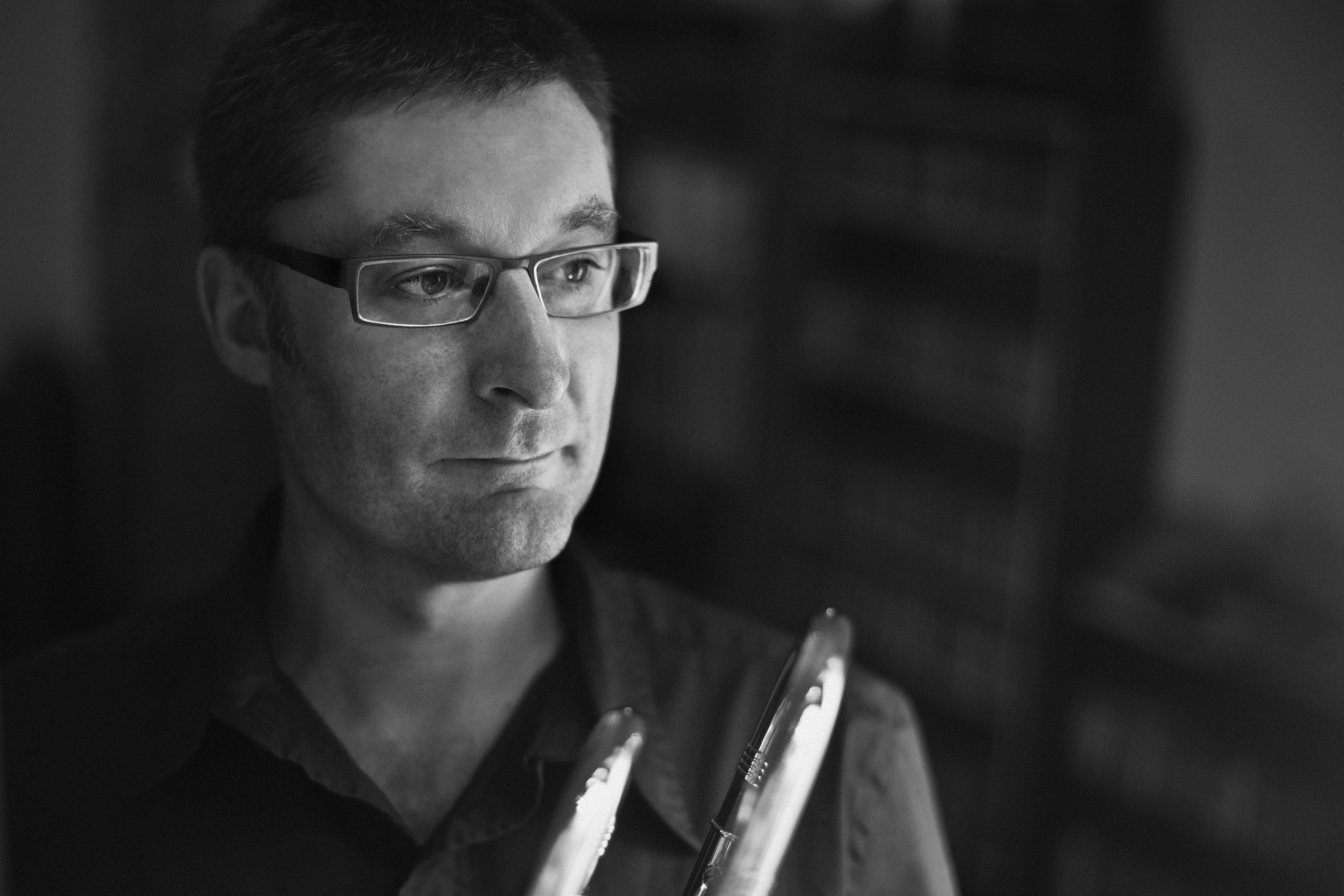
Angus McPherson is a Sydney-based flutist and writer. His articles have appeared in flute magazines and blogs in Australia and overseas including ClassikON and CutCommon. Angus attended the Australian Youth Orchestra’s Words About Music program in 2015. He is currently writing program notes for the Willoughby Symphony Orchestra and working with mentors in the field as winner of the AYO/WSO Fellowship.
Angus is currently completing a PhD in Music at the University of Tasmania. His research focuses on the work of contemporary Hungarian composer Gergely Ittzés. He has performed and taught in Australia, Canada and the UK.
The ensemble after performing Peter de Jager’s Metaphors. Photo by Hank Clifton.
The effervescent violist Xina Hawkins has returned from her stellar international career to present three concerts of music for solo and massed violas at the South Melbourne Town Hall. Peter de Jager, Brett Dean, and Samuel Smith have been engaged to compose for viola ensembles, and if De Jager’s offering is anything to go by, we are in for some valuable new repertoire for an often ignored instrument. But before we heard De Jager’s Metaphors, Hawkins had a few surprises in store.
First up, an imaginative piece for viola and piano by Paul Kerekes. The innocuous-sounding Four Pieces contains four far-from-innocuous movements. The first is inspired by the cartoons of Michael Leunig and features whimsical descending chromatic scales and the sort of minimalist rhythmic pitter-patter associated with innocence and blue skies in film scores. The final cadence leaves us with the pathos that so defines Leunig’s social commentaries. Kerekes gives us more pitter-patter in a movement inspired by hyper-organised supermarkets before moving attacca into “Aviophobia,” a movement depicting the fear of flying. Hawkins dug deep for this one, crafting soaring glissandi over piano tremoli. The final movement is inspired by “Michael Jackson and Ligeti,” a combination that works quite well. Kerekes combines Ligeti’s rolled clusters with syncopated, vamping bass lines. Citing “unfinished business,” Hawkins and Jacob Abela launched into a rendition of “Billie Jean.” The audience clicked out the song’s cross-rhythm and their enjoyment of Hawkins’ performance was evinced by their degree of rhythmic inaccuracy in the chorus.
Hawkins was then joined by double bassist Kinga Janiszewski, percussionist Hamish Upton, and oud player Yuval Ashkar for an extended Taqsim, or improvisation based on Arabic modes. The improvisation included the traditional song “Lamma bada yatathanna,” as well as an original song Marakesh Nights by Ashkar, which were framed by beatific improvisations.
Metaphors
Peter de Jager is the piano virtuoso of his generation. As a composer, too, he exhibits an almost incontinent imagination and creative felicity. I have found that his cellular, fragmented forms do not always amount to more than the sum of their parts. He is a pianist’s composer and the piano part can dominate within his ensemble pieces. The answer, we discovered on Tuesday night, is to take him away from the piano. Metaphors for nine violas presents so many unprecedented textures and effects, as well as familiar sounds presented in a new light. The piece is a beautiful synthesis of inspiration and craft.
The piece’s nine parts may suggest a disjointed series of studies.
Part I:
Ladder
Spheres
Stars
Planes
Particles
Smoke
Song
Part II:
Forest
Fugue, Chorale and Toccata
However, De Jager introduces a sense of continuity by increasing the number of violas in each movement from the microtonal solo “Ladder” to the nonet “Fugue, Chorale and Toccata.” Each movement is a work of astonishing refinement and control. “Stars” is a case in point. Reading the generic description “extremely high harmonics as twinkling points of light” I expected the piece to come and go without too much interest, but no. The three violists appear like a constellation on the far side of the stage from the previous duo. Their harmonics are very close and rhythmically overlapping, as though one were listening to distant interstellar patterns of morse code. The richness of the viola’s harmonics give a personal warmth to these starry sentinels and their peculiar harmony.
The following movement, “Planes,” is another aural delight. The viola quartet play loud, diverging glissandi reminiscent of Xenakis’ Metastaseis. These planes are “connected” by solo scalar runs. At first the planes are low and dense, but soon they rise higher in pitch-space. Then there are more simultaneous planes with multiple scalar stairways leading from them. The effect is extremely visual, and it’s a pleasure to follow De Jager’s Monument Valley-esque world of planes and bridges in the mind’s eye.
The final movement of Part I is a solo melody inspired by traditional Arabic music. The melody shows an intense melodic sensitivity on De Jager’s part, but the background texture is just as striking. I am not sure exactly how it is produced, but the six violas produce a rich, whispering, murmuring background that I had never heard before.
Part II features movements with a more diverse use of texture. “Forest” begins with eight violas playing trills with all fingers on open strings while changing their tone by moving their bows between the fingerboard and the bridge. Once again, De Jager takes a conventional enough technique and uses it to produce a sublime, sussurating effect like wind in the trees. After a while “gnarled branches” jut out of the foliage. The effect was all the more surprising after the long period of static rustling.
The final movement was an experiment in nine voices and three traditional textures. The fugual section lost clarity after five or so entries, not so the super-juicy nine-voice chorale of stacked seconds, which the ensemble balanced finely. The final, hocketing toccata was a great example of ensemble dynamics, with the final chord echoing out beautifully into the South Melbourne Town Hall. I can’t wait to hear what violist and composer Brett Dean (recipient of last night’s Art Music Award for orchestral work of the year) and rising star Samuel Smith have in store.
Xina Hawkins
ANAM Fellowship Recital #1
South Melbourne
Town Hall
Tuesday 11 August
Matthias Schack-Arnott’s performance of Diplopia captured by a GoPro. Courtesy of the artist.
The Supersense Festival of the Ecstatic hits all the right notes. Intelligent and accessible, the festival takes its place among a growing number of superbly curated and executed contemporary music festivals in Australia. The audience crowds down a stairway into the bowels of the Arts Centre. Coloured lights and ambient sound design herald their entrance into a netherworld of heightened experience. Once inside, the audience has free run of three or so simultaneous acts curated by Sophia Brous and drawn from the world over. The acts are durational, sincere, cross-cultural, and avant-garde, but peppered with high-profile acts presenting more conventional fare. The audiences crowding into the performances on Friday night prove once again that, if presented in an open and enticing light, audiences absolutely love contemporary music. Friday night’s program was underpinned by a three-hour performance of the Javanese Kuda Lumping (Flat Horse) ritual directed by Chunky Move’s founding Artistic Director Gideon Obarzanek with lighting design by Ben Cisterne. The performers, accompanied by an Indonesian music ensemble, danced themselves into trance states before being lifted out of the room by black-clad shamans. The audience could equally attend a performance by Tao Dance Theatre as they twisted and contorted their way through some of the most controlled contact improv I have ever seen. I was particularly interested to see Matthias Schack-Arnott’s new performance Diplopia, which follows his lauded solo percussion projects Fluvial and Chrysalis.
Diplopia (double vision) plays on the simple yet effective idea of attaching a microphone to each wrist of the performer and amplifying them through stereo speakers so that the performer’s hand movements are translated into rhythmic panning effects. Schack-Arnott surrounded himself with cymbals and tam-tams of different sizes, which furnished him with a beautiful array of metallic resonances.
Schack-Arnott began by gently playing a series of mid-range upturned cymbals, moving his arms in circles. The audience was lulled by the gently pulsating hum highlighted by metallic shimmering. Tighter and looser arm circles produced striking phasing effects, while several very slow circles produced a viscous aural effect like smearing clay. By contrast, a wide, fast arc over a single small cymbal would produce a short, clipped yelp. The moment I began wondering what the harmonic, microtonal properties of the cymbal array might be, Schack-Arnott started playing multiple cymbals producing beating, dissonant tones.
Schack-Arnott explored large tamtams, which gave a rather dead bassy hum, and much smaller cymbals whose rhythmic, amplified resonance was almost vocal in timbre. Swelling sine tones based on harmonics of the cymbals were dispelled by immaculately-timed attacks. The higher the pitch of the cymbal, the more complex and interesting the tones, with the higher cymbals accompanied by beating harmonics.
The flowing, rhythmic performance was a perfect opening for Supersense, but I’d like to hear these ideas explored further. What would jagged and irregular movements sound like? What about using only one microphone so that initial attacks were not amplified but their resonances were? How many different tones could one cast one’s hand over before they became indistinguishable? Schack-Arnott has opened up a world of new possibilities.
Matthias Schack-Arnott
Diplopia
Supersense Festival of the Ecstatic
State Theatre Rehearsal Room, Arts Centre Melbourne
Friday 7 August, 2015
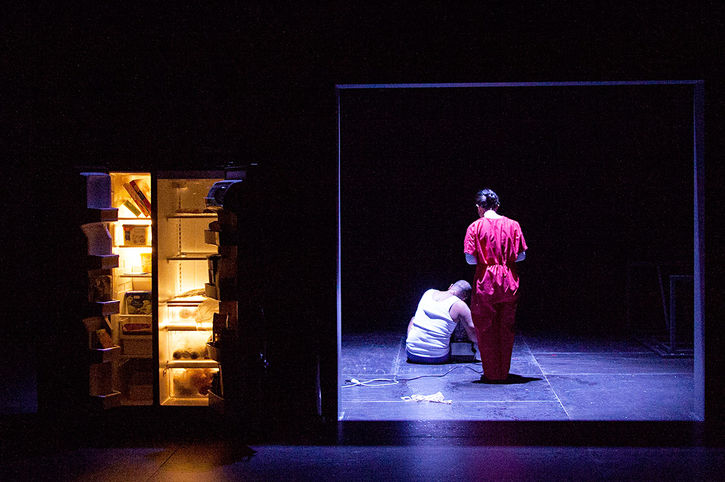
Hana Lee Crisp and Bert LaBonté in I am a Miracle. Photo by Pia Johnson.
Marvin Lee Wilson was executed on 7 August 2012 for the murder of a police drug informant. Tested to have an IQ of 61, he should have been ineligible for the death penalty under a United States Supreme Court ruling. Wilson’s IQ test was dismissed as evidence because it was administered by a PhD candidate rather than a clinical psychologist. On this technicality, his execution proceeded. Writer Declan Greene describes I am a Miracle as “a play for” rather thanabout Wilson, but does he nevertheless range too far from his subject? The play’s two acts provide historical and contemporary snapshots of racial inequality. These vignettes are framed by Bert LaBonté’s impassioned monologues as a sympathetic observer of Wilson’s plight.
Bombast paints a thin veneer over an unsatisfactory ending. As giant incandescent bulbs blind the audience, LaBonté offers a rousing call to arms. He pledges to carry Wilson’s memory to wage cosmic revolution. He wants to undo not just generations, but billions of years of inequality.
Two acts seem too few for a play that addresses universal injustices. The sense of incompleteness is almost musical. Three spotlit narratives of murder and subjugation might have given a better sense of the universality of racial subjugation. As they stand, the two acts seem more like separate plays. Melita Jurisic delivers a grimly humorous story of slavery in a nineteenth-century Dutch colony. In what was a brilliantly sustained escalation of tension, LaBonté plays a mentally ill man falling through the cracks in modern-day Melbourne.
A live musician on stage is a perpetual question for the audience, but director Matthew Lutton made a virtue out of soprano Hana Lee Crisp’s presence. She was never left hanging by the wings, but appears at intervals starkly framed by an arch or in front of a curtain. Lutton describes her as “an archangel of justice,” and her pure renditions of David Chisholm’s settings of biblical text elevates the audience above the play’s worldly themes of inequality, mud, and death. The three actors all lend beautiful and distinctive voices to the stage, which is otherwise suffused with subtle choral textures by sound designer Marco Cher-Gibbard.
Chisholm’s renaissance-style vocal score also raises a question that is held in delicious suspense until we learn of Wilson’s religious faith in Bert LaBonté’s final monologue. Becoming profoundly religious while in prison, Wilson’s final words included:
Take me home, Jesus.
Take me home, Lord.
I ain’t left yet.
Must be a miracle.
I am a miracle.
With every piece of the play’s promotional material foregrounding Wilson, the audience may be surprised by the marginal role of Wilson’s story. As an audience we are always watching LaBonté watch Wilson. We never hear Wilson’s words or learn anything about his life, but are left with the consolation of religion and ambient rage.
I am a Miracle
Written by Declan Greene
Directed by Matthew Lutton
Composition by David Chisholm
Malthouse Theatre
3 August 2015
Justine Anderson performs Berio’s Sequenza III. Photo by Rachel Edward.
Curated by soprano Justine Anderson, Signs and Symbols explored three little-heard masterpieces inspired by dreams and the unconscious.
New music fans over the age of fifty may be surprised to hear Boulez’s half-hour long serialist saga Le marteau sans maître described as “little-heard.” The chamber work was played to death throughout the seventies as Boulez’s compositional aesthetic cemented itself in composition departments the world over. The stunning work almost disappeared from Australian concert programs over the following decades, though its temporary absence may have had some benefits. When audiences hear the work today, they are no longer hearing a work on a pedestal, but a historical document free of the partisan baggage that accompanied its first performances. Without extended-technique pyrotechnics or electroacoustic sorcery, Le marteau sans maître sounds rather dated. And yet, like an Ars Nova puzzle, one immediately appreciates the work’s fine-grained understatement. Conductor Elliott Gyger lost none of the piece’s precise rhythmic counterpoint. Even René Char’s surrealist poetry is treated less with Pierrot Lunaire melodrama than as the machinations of an impossibly complex piece of clockwork. Anderson’s accuracy and control proved equal to the challenge.
Some sounds just grab you. As the muted ensemble ticked along, I was drawn again and again to a slithering sound emanating from the back of the hall. It was a maraca. Matthias Schack-Arnott would hold it upside down and make circular movements with his arm, causing the grains inside to shoot around the bulb like cyclists around a velodrome. The resulting ear-massage was part autumn leaves, part rain, part chocolate mousse. When he stopped moving the maraca, the grains would take time to roll to a stop. One seemed to hear each grain rolling over the others until finding its perfect resting place in the percussive microcosm. It turns out that this was not just any maraca, but rather a maraca that the Australian percussionist Barry Quinn used when performing similar repertoire with The Fires of London in the 1970s. Perhaps this was the first ever historically-informed performance of this piece.
The audience returned to a drastically rearranged South Melbourne Town Hall for Morton Feldman’s spatialised performance For Franz Kline. The stark, feathered monochrome brush strokes of Kline’s paintings were evoked by the synchronised attacks and indeterminate endings of pitches in the ensemble. Feldman fans may contradict me here, but it was nice to have a Feldmanesque soundwallow after the highly-strung Marteau.
Justine Anderson concluded the concert with Luciano Berio’s solo vocal tour de force, Sequenza III. The work requires power, agility, and loads of character. Anderson provided all three in abundance, sweeping through the hall in Barking Spider Visual Theatre’s reconstruction of Mrs Matilda Butters’ fancy-dress constume of 1866, which was printed with the mastheads of dozens of Victorian newspapers. It is good to see the dress in movement after its first new music appearance with The Sound Collectors earlier in the year. It was even better to hear this vocal masterpiece performed with such flair by one of Australia’s finest new music sopranos.
Signs and Symbols
Curated by Justine Anderson
The South Melbourne Town Hall
29 May 2015
Pierre Boulez, Le marteau sans maître; Morton Feldman, For Franz Kline; Luciano Berio, Sequenza III.
The origin-stories of works can shed light upon their final shape. Gordon Kerry’s new opera Snow White began in May 2014, when Kerry attended a production of Carmen by Opera Scholars Australia at the Old Melbourne Gaol. Graeme Wall, director of Australian Music Events, approached Kerry about writing a stage work for the Opera Scholars. With the support of an old friend also present at the concert, Kerry agreed to write a modern opera on a libretto by the Australian poet John Kinsella. But writing for the Opera Scholars posed challenges. The work was to be the first contemporary opera that many of the young singers would ever perform, it had to accommodate a high number of soloists, and it had to be satisfying to Kerry as an experienced composer of contemporary music. The fairy tales collected by the Grimm brothers were just the thing. Five short stories included numerous solo parts, while their gruesome content provided opportunities for chromatic, expressionistic vocal lines.
Faced with this set of challenges, Kerry, Kinsella, the Opera Scholars, and the Hopkins Sinfonia presented a triumphant new piece of repertoire for young singers. The palpable foreboding of the tales is evident from the opening act, “The Seven Ravens.” The leaping, bird-like harp part (provided electronically by Jodie Lockyer) contrasts with the sinister, syncopated chorus of brothers who have been transformed into crows for carelessly dropping a pitcher of water into a river (not much room for error in Grimm). Josephine Grech sympathetically sang the part of the sister who bravely saves the brothers from their avian fate.
After the first act’s creepy cawing, Stephen Coutts’ powerful solo as the rich farmer in “The Grave Mound” broadened the expressive range of the opera. It is unfortunate that Coutts disappears into the eponymous grave mound so soon, but the audience was rewarded with a timely parable about same-sex parenting. A poor man inherits the rich farmer’s wealth on the condition that he watches over the rich man’s grave when he dies. A soldier, hanging around the graveyard late one night, stumbles across the poor man and agrees to spend the night with him. The devil tries to lure them away from the graveside with gold, but the soldier tricks the devil to remain until daybreak, at which point he melts away leaving a large sack of gold. The soldier and the (now rich) poor man retire to the latter’s house to look after his children together. They finish with a beautiful duet about how happy they will be together.
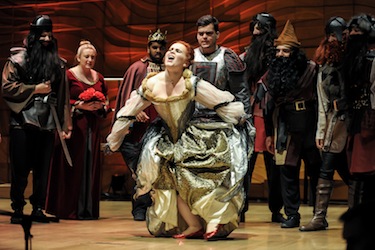
Elizabeth Barrow as the Queen in Snow White and Other Grimm Tales. Photo by David Ng.
The star of “Snow White” would have to be Elizabeth Barrow as the evil queen who, as well as performing strongly throughout, screams and dies excellently in red-hot iron shoes. The act is a lesson in rapid storytelling and Kerry evidently enjoyed challenge of illustrating such a hectic plot line with clever effects and allusions. A crunchy chord in the woodwind accompanies Snow White’s mother’s fatal pin-prick. The forest is painted with echoes of Debussy’s Pelléas et Mélisande. The words “over the mountain” are accompanied by a particularly juicy cello line (Belinda Liew). Things turn very Lord of the Rings once Snow White gets across said mountains and meets the seven marvelously beardy dwarves. So effective was the costuming that I’m completely unable to single out particular singers beneath the hair. Their funeral chorus was very affecting, however.
“The Peasant in Heaven” is one long gag. A rich man and a poor man arrive at the gates of heaven and the poor man is ignored while the rich man is welcomed with fanfare. The peasant asks whether he is a second-class citizen in heaven as on earth. St. Peter reassures the peasant that this is not at all the case; he is just happy because it is so uncommon for a rich man to reach heaven. The story is actually an acute critique of privilege blindness. The rich man enters heaven oblivious to his preferential treatment, being accustomed to that extra centimeter of smile when he arrives at airport gates. Meanwhile, the poor man is asked to accept inferior treatment just this once, on account of the exceptional arrival of the rich man. Of course the poor man would have experienced the same dismissive treatment many times on earth, at the doors to schools, jobs, and concerts, even if the perpetrators never meant it intentionally. Stephen Marsh brilliantly sings the part of St. Peter as a besuited schmoozer, a sort of business development officer claiming to be on the side of the poor man, but who is dressed to better welcome rich men. He’ll angle for a donation later, after a personalised tour of heaven’s deteriorating organ pipes.
Kerry did not save his best work to last. Like many folk tales, “The Old Woman in the Wood” has a repetitive plot line. Kerry chose to cut and paste material for each repetition, rather than increase dramatic tension or musical interest by differentiating the score. Janneke Ferwerda acted and sang with conviction as another heroic young woman. Tim Daly’s clear voice doubled well as a tree and a dove.
Full of compelling vocal lines, Kerry has produced a dramatic collection of short stage works. Snow White is ideal for any young operatic ensemble seeking to gain experience performing contemporary music. The Opera Scholars rose to the challenge with grit and charisma, proving themselves a versatile troupe of operatic performers.
Opera Scholars Australia
Snow White and Other Grimm Tales
Libretto by John Kinsella
Music by Gordon Kerry
Melbourne Recital Centre
28 May 2015
In 2013, I reviewed Juliana Hodkinson’s new Living Room Opera Turbulence. Staged in a small apartment in Melbourne, the opera explored the claustrophobic magic of air travel and familial relationships. The compact work has since taken flight in the form of two artistic responses. Peter Humble and Linda Edorsson have produced a beautiful video based on the opera, which has been published in the digital magazine LIGE. Meanwhile, the poet David Maney has written a perceptive poetic response, which he has kindly allowed me to post below. Check out the video, read the response, and enjoy.
The second in a series of monthly feature articles for Partial Durations.
Musicians have a way of getting to the bottom of things, such as when the 2015 budget papers announced that $104.7m would be taken from the Australia Council for the Arts (OzCo) to be redistributed from a National Programme for Excellence in the Arts (NPEA) within George Brandis’ ministry. While Brandis and News Corp columnists were busy driving a wedge between the Australian Major Performing Arts Group (AMPAG) companies and “grant-dependent tax sucklings” (the small to medium sector), Ensemble Offspring’s Claire Edwardes was meeting with Brandis’ arts adviser Michael Napthali. The meeting confirmed the community’s worst fears: The Minister would have the final say in funding decisions, individuals would not be funded, and the Programme would be open to AMPAG companies with ringfenced support from OzCo.
It all turned out to be true. Yesterday the Ministry for the Arts released Draft Guidelines for the NPEA. Sure enough, the final decision rests with the Minister and the Program will be skewed towards established organisations. Brandis’ NPEA pulls the ladder up on the next generation of composers and performers. Last month I wrote about the career-long process of securing philanthropic support as a composer or small ensemble. With its focus on applicants’ reputation, expertise, and established audience and private partnerships, the NPEA does not provide the entry-level experiences composers need to prove their worth to a donor. The programs jeopardised by the funding changes, including OzCo’s individual project grants, creation of new work grants, and development programs like Artstart, all provide these capacity-building opportunities. Surprisingly, with only $20m of funding announced for a “maximum” of four years, some $24.7m of arts funding remains unaccounted for. Someone prudently left the “-me” from “programme” on the sidewalk as well.
It is all well and good debating the utility of Brandis’ changes, but arts cuts are rarely utilitarian decisions. Or perhaps more correctly, arts funding is always ideological in the first place. There are important economic arguments to be made for the arts (they employ more people than the mining sector, artists make significant, taxable returns on public investment, and so on), but choosing to spend money on art instead of fighter jets requires a certain amount of willpower. Brandis and Napthali keep reminding us that the only thing keeping the vanishingly-small arts budget afloat is their belief in art’s value as an end in itself.
But are the arts really served well by Brandis’ brand of cultural conservatism? His public views on art may have changed over time, but Brandis’ brand is out of date. His wedge politics now risk losing support for the arts rather than fostering them. Even if Brandis is able to prosecute his case at home, how will the international arts community react to Brandis’ brand of heritage arts?
Populist Brandis
In the senate estimates hearing of 27 May, Brandis rehearsed his argument that the “great audiences of Australia” prefer performances by AMPAG companies to the offerings of the small to medium sector. It did not take long for the arts community to debunk this brand of elitist populism. Marcus Westbury dug around in some annual reports and found that MPA audiences were subsided at around $40 a seat. This is a level of government support that small to mediums could only dream of, as supported by the statistics posted to Westbury’s #fundedlikeamajor hashtag. I retraced some of Westbury’s steps and found that though AMPAG companies generated only 16% of ticket sales in 2012, they received almost 60% of Australia Council funding.[1]
It is also patently false to argue that that the Australia Council is a closed club handing out money to friends. While around 60% of Australia Council funding is ringfenced for the majors (and so mostly for the heritage arts), the rest of the funding goes to a staggering range of arts projects and developments. Of the individual musicians funded so far in 2015, I found an almost equal split between contemporary classical musicians on the one hand and jazz, popular, and world music on the other. Considering that most contemporary classical musicians lead double lives in pit orchestras and classical music ensembles, this portion of funding is also a significant investment in the heritage arts. In fact, whichever way you look at them, the Australia Council’s figures point towards a heavy bias towards the heritage arts. When Brandis says that we should fund the art that the “great Australian audiences” attend, he evidently does not mean “Australia’s large audiences,” but “Australia’s excellent audiences.” Not “great” audiences, but “great” audiences.
Excellent Brandis
Brandis has long advocated art as an end in itself rather than a means to utilitarian, social, or critical ends. In his 2013 address as opposition spokesperson for the arts, Brandis used the notion of artistic excellence to drive a wedge between the Labor party and the arts community. Excellence was to be “the central value of cultural policy under a Coalition Government.” He did not define this excellence, but was keen to distance it from the label of elitism: “In truth, the identification of the celebration of excellence with the defence of elitism is both self-limiting and ignorant.” Here Brandis was pre-empting legions of straw-theorists ready to rail against his conservative artistic values. However, as Martin McKenzie Murray recently pointed out, the culture wars of the 1980s are less relevant today than Brandis thinks.
Academies and indeed publics are not strictly divided into conservative art-lovers and Marxist cultural theorists. Today, Brandis and the French Maoist philosopher Alain Badiou could have a productive conversation about Wagner, the musicologist and pianist Charles Rosen, or the metaphysics of artistic truths. The infamous George Brandis Live Art Experience perfectly illustrates the changing face of the humanities. Superimposing Brandis’ face onto influential works of art is funny because everyone involved recognises the original art works. They may even like them. In short, the right does not have a monopoly on the heritage arts. Brandis may find, as he spreads his ministerial wings in an ambitious international touring program, that he has painted too narrow a picture of excellence.
Touring Brandis
International audiences are more adventurous than our AMPAG companies, as discussed by Alexander O’Sullivan in an earlier blog post. While I believe that classic works should be performed at the highest level in Australia, surely the last thing a European audience wants to hear from an ensemble travelling across the world is the same repertoire on offer next door. Our colleagues overseas can be unsettlingly au fait with Australian art. Nobody has ever asked me “What’s the Shakespeare like down there?”, but they have asked “Have you read Voss?” When Brandis read bush poetry in the senate, he could have been swotting up to meet the Serbian musicologist who gave me a half-hour lecture on the history and regional variations of Waltzing Matilda. International audiences may expect more from us than we are ready to give them.
Writing in Gramophone Magazine, Geoffrey Norris had good reason to question the value of the ten international orchestras, including the Melbourne Symphony Orchestra, who made their debut at the BBC Proms last year (of course, not supported by the NPEA, but I can imagine it is a taste of more to come). We can be confident that when we hear the MSO perform Strauss, Elgar, Britten, and Berlioz in Australia, we are hearing a performance at the highest level. But does this mean that we should play the same works at the Proms? As a critic, I know a backhanded compliment when I read one, and Erica Jeal’s “prize” to the MSO for coming “the furthest” is one of them. What really distinguished the MSO at the Proms? A faster tempo? A bassier bass? If we are going to tour an Australian orchestra, we should at least feature an Australian work. It is telling that while most Australian audiences wouldn’t even know who Percy Grainger was, Jeal found the Grainger encore “cliché.”
Questions remain around Brandis’ plans for international touring and the close relationship he is developing between the NPEA and DFAT. As former Director of the Music Board Dick Letts wrote for The Music Trust: “The Australia Council has a track record in this area. But despite the priority it gives to international projection, appears to be peripheral to these negotiations with DFAT. Why?”
What to do?
This depends on who you are. In all cases we must refuse Brandis and News Corp’s wedge and get on with advocating for the arts sector as a whole. The composer Liam Flenady realised this very early on in the saga, arguing that
Our first line of argument should be both defensive, and militant. We should say straight up that while the government is committed to spending 9 billion dollars on new warships, 10 billion dollars on fossil fuel subsidies each year, and eight billion dollars on torturing refugees, then arts funding should in no way be under the axe. We should not allow ourselves to fall into the trap of arguing for a bigger slice of the pie for arts at the expense of other (legitimate) parts of the pie (e.g. healthcare, education, welfare, foreign aid, etc). We should demand a bigger pie for everything that is good for ordinary Australians. That means reducing expenditure on destructive endeavours and increasing taxation on the wealthiest in Australia.
AMPAG companies should refuse Brandis’ blinkered view of excellence and find ways of working with individual artists and the small to medium sector to ensure that an unbridgeable gap does not open up between emerging and experienced performers. Nobody is born an excellent violinist or composer. Composers need diverse experiences working with ensembles to hone their craft. The vast majority of these opportunities will dry up under the new funding arrangements. We risk losing a generation of excellent composers and performers if they do not have access to funding for new commissions and chamber music performances.
The board of the Australia Council should stick to their guns. They shouldn’t resign, because I can’t imagine anything worse than Andrew Bolt in charge of the Australia Council. But when AMPAG companies start getting millions of dollars in funding from the Ministry for the Arts, I wouldn’t blame them if they started chipping away at their end.
Finally, Brandis really should give back the money. He’s fundamentally misunderstood how the arts sector works and has relied on poorly-formulated wedge tactics to scuttle any chance of gaining the support of the wider arts-going public. He doesn’t look like a brave culture warrior, just an avuncular conservative pawning the country’s artistic future for another production of Turandot.
[1] The Australia Council recorded 3.6m attendees to performances, workshops, or events by Major Performing Arts companies in 2012. The number of concert attendees was closer to 3.2m. MPA companies actually sold 2.6m tickets (though this includes international touring). That year, Live Performance Australia recorded almost 16.3m tickets sold Australia-wide. In other words, MPA companies commanded almost 15.95% of ticket sales to live performances in 2012. This number is generous, as the LPA only receives data on MPA companies from the Australia Council. The rest of their data is made up from major ticketing companies. They recognize that small to medium companies and individual artists are under-represented because they often ticket shows themselves or use a service not included in their survey. According to the Australia Council’s summaries, MPA companies received 59.14% of Australia Council funding in 2011–12 and 56.35% in 2012–13.
Kupka’s Piano are a Brisbane-based new-music ensemble, made up of a core group of intelligent and startlingly adept young musicians supplemented periodically by equally interesting guests. They are committed to the performance of important works by living composers from around the world, alongside a focus on Australian composers. Many of their performances are Australian premieres, which says a great deal about the significance of the group in the cultural life of the nation. Over the past several years in Brisbane, they have built up a well-deserved, devoted following.
In this, the second concert of Kupka’s Piano’s 2015 series at the Judith Wright Centre of Contemporary Arts, the ensemble continues its ‘extra mural’ theme with a notion of sounds from “the other side.” What exactly these walls represent is perhaps something open to individual interpretation (a state of mind? Geographical or cultural distance?), but the conceit does reflect rather well the sense of permeability that characterises much recent and contemporary music, where sounds, styles, ideas, colours, and voices often bleed across old boundaries. Individual musical works (and bodies of work) now seem to talk to each other so freely, even promiscuously, yet we retain some sense of the old lines of demarcation without which such transgressions might seem less thrilling, while at the same time inscribing our own lines upon the conceptual maps of our increasingly strange and estranging world.
New music doesn’t really shock anymore. At worst, it might irritate or, more commonly, simply fail to engage with its listener, like a missed train connection. We no longer talk much about whether a piece is good or bad (let alone great), but rather couch our critiques in terms of whether a work ‘works’, or not, according to mutable criteria of functionality that perhaps have some relation to the ‘mural(s)’ of this series’ theme.
Past Brisbane-resident Liza Lim’s Inguz (fertility) for clarinet and cello was composed in 1996, and the title is a reference to a Nordic rune. This is a lovely work of fluid poetry and organic proliferations; gently melodic, yet thoroughly of its time in terms of technique and colour. Lim handles the two instruments masterfully—the unique colours of each are imaginatively exploited yet contained within a frame of the composer’s imagination, a space that both can inhabit and that informs their interactions. Cellist Katherine Philp and clarinettist Macarthur Clough gave a forensically beautiful performance that made the most of all the subtle gorgeousness of the intricate score.
Jérôme Combier’s Feuilles des paupières (2005) for piano, percussion, flute and clarinet is also a very beautiful work. This piece is one part of a large cycle, Vies Silencieuses, a series of chamber works inspired by painters and in particular the quietly powerful still-life paintings of Giorgio Morandi. Combier approaches the instruments with great aural sensitivity, and a vital sense of orchestration. On the one hand, he writes for piano/percussion as if they form a single, huge instrument. The sounds he conjures from the players are both seductive and exciting, and show a detailed understanding of what the instruments can do and how to bend them to his musical purpose. Against this, Combier has written flute and clarinet parts that are, once again, so well integrated in conception as to seem almost a single instrument, or like a pair of intimately connected human voices. Combier’s music demands both sensitivity and precision to succeed in performance, which certainly works to the strengths of Kupka’s Piano as an ensemble (augmented here by guest flautist, Tamara Kohler). The performance was tightly controlled and colourful—although I felt that in this case the piece might benefit from a more forgiving, resonant acoustic environment. Some of the fragile sounds need a little more reverberation in the room to fully bloom. Is Kupka’s Piano working towards an Australian premiere performance of the full Vies Silencieuses cycle? Let’s hope so.
Philippe Hurel’s Tombeau in memoriam Gerard Grisey (1999) for piano and percussion has, on the surface at least, a lot going for it. It has the name of our sainted Grisey in the title, for a start… yet in many respects it disappoints. Pianist Alex Raineri and percussionist Angus Wilson gave a superlatively virtuosic and dramatic performance of the four movement work, which is so brimming with challenges as to be virtually created to fail. The instrumental combination of piano and vibraphone, upon which much of the work relies, is a highly problematic one. It has all the inherent difficulties of a two piano ensemble (essentially two percussion instruments having to play exactly in time with each other) with the added problem of the oil-and-water timbral (in)compatibility of piano and vibraphone as a duo. Of course, uncommon or peculiar instrumental combinations can be very interesting in the right hands, but in this work Hurel fails to hear a way through the obstacles, and it never quite comes into focus as a genuine duo. In sonority and structure, this is essentially a piano piece, over-burdened with hollowly clichéd gestures at several levels, onto which the percussion parts have been grafted as a kind of lean-to extension. The effect, when it succeeds now and then, is very like a prepared piano.
There are some nice moments—the first movement has an arresting, kinetic excitement, and the slow second movement unfurls an interestingly tense, reflective mood—yet the piece undermines itself too often with unconvincing, unfocused sonorities and empty gestures. One such, if I may labour the point, is an episode of tedious transpositions, in which upper and lower parts move outward from each other, stepping rather aimlessly along a scale. This is a recurrent motif of Messiaen’s technique that in his own work has a relentless, implacable energy but in imitation almost always sounds dull—and, like musical spakfilla, one suspects that its function is to conceal some inherent structural flaw. Raineri and Wilson battled heroically against the inbuilt weaknesses of Hurel’s work (and made it sound in some ways a more interesting piece than it actually is) but in the end one is left with a sense that Grisey deserves a better memorial than this.
Brussels-based Australian composer Liam Flenady’s new work Si el clima fuera un banco (2015), for piano and fixed media (pre-recorded midi-piano and speaking voices), takes its inspiration from Hugo Chavez’ famous 2009 speech in Copenhagen, where he observed that ‘If the climate were a bank, they would have saved it already’. This is very interesting piece, which works with Flenady’s interests in politics and counterpoint to play with seeming oppositions such as refinement versus crudeness, complexity versus directness. The score is certainly fearsomely complex, and makes great demands of the pianist. Here, Raineri projected a very different quality of sound to that heard in the earlier works in the concert: less percussive, richer and warmer. As a result of this very beautiful sonority and Raineri’s confidence with the virtuosic score, Flenady’s music was revealed as luxuriantly poetic, even lyrical.
The combination of live and recorded/artificial piano is an interesting one, and the interactions between the two were intriguing. One cannot help wondering if this would be even more effective if the work was scored for two pianos…? Or perhaps that would be a different piece. I found the recorded voices to be most effective in a musical sense when the words could not quite be heard clearly… then, it felt as though the sounds (not merely words) of voices from another room were intruding, and commingling with the piano music. In a way, this raised another interesting question: does the work really need those voices, or could it succeed as a purely instrumental piano (or two-piano) work? For myself, I felt that the counterpoint of voices, together with the in- and out-of-room pianos evoked exactly that sense of permeability that seems ideally characteristic of music in our times, like an eggshell letting the oxygen in. What stayed with me long after was not the words or even the explicit political messages, but the expressivity of Raineri’s piano playing as the work seemed to breath in and out the fragrance and texture of disembodied voices.
Flenady writes in the program that his work ‘will have little impact on politics’, and in a sense that is true… but perhaps music affects us in a different way, in a different substance, on a different level. I’m not sure that we can measure such impact in the same way we measure political (or, for that matter, market) impacts. The power elites of our world would have us believe that music is just entertainment, thus powerless, but I think we should exercise caution in assuming that this is the case. Flenady’s music raised these final questions in my mind: What if music as an art form actually does have an impact? Would that change the way we do things?
The concert ended with the Australian premiere of Beat Furrer’s Gaspra, a marvellous work for seven instruments composed in 1988. It astonishes me that this piece has not been previously played in Australia—but then very little of this important Swiss-born composer’s work has been heard in this country, to our loss (mind you, the same could be said of Grisey). While there were other very good pieces on this concert program, Gaspra was from the first moment in a realm of its own, like a comet (or rather, a stray asteroid) burning through the sky. Like all Furrer’s music, Gaspra is created from a fusion of electric nervous energy with moments of intense calm; the two in some way feeding each other. There is a powerful yet subtle intelligence at work here, and a wonderful instinct for sonority and colour that is thoroughly integrated with structure—even passages of more-or-less indeterminate pitch, glissandos or extended techniques, move within an iron-strong harmonic frame.
Gaspra is built as an intricate montage-form in terms of its overall architecture, with several motifs recurring and interacting with each other as the work progresses. One of these, some lovely low-pitched rhythms for the piano, seems to be a distilled reference to La Princesse de Bali from André Jolivet’s Mana (a neglected masterpiece of the earlier twentieth century). At other moments we hear little flashes of material that betray Furrer’s interest in the music of Feldman, but such references or allusions are never simply pastiche in Furrer’s music: they are always very integrated with his own distinctive language, and deeply meaningful. Under the direction of conductor Benjamin Marks, Kupka’s Piano gave a splendid performance of great flair and magical subtlety. The ensemble was joined for this piece by the inimitable Graeme Jennings (viola) and Tamara Kohler (flute) as guests.
This was an important concert for both Brisbane and Australia. The immense dedication of the ensemble members is clearly evident, as this is a kind of music that requires a huge effort of preparation to perform well and Kupka’s Piano play very well indeed. Their programming is creative, thoughtful, and thought-provoking. The cutting edge of Australian music creation is at present very clearly in the hands of smaller groups or individuals operating independently of large institutions and venues and often on very limited budgets. Kupka’s Piano are one of the best and most exciting of these groups, and one senses as they perform that history is being made.
– Alistair Noble
Kupka’s Piano
Extra mural II: Outer Sounds
Friday June 19th
Judith Wright Centre of Contemporary Arts
Liza Lim, Inguz
Beat Furrer, Gaspra, AP
Phillipe Hurel, Tombeau in Memoriam de Gerard Grisey, AP
Jérôme Combier, Feuilles des paupières, AP
Liam Flenady, Si el clima fuera un banco, WP
Fly Away Peter, Sydney Chamber Orchestra, Carriageworks, 2015. Photo by Zan Wimberley.
Keith Gallasch has reviewed Elliott Gyger’s new opera based on David Malouf’s novel Fly Away Peter for RealTime. Gallasch provides an insightful comparison of the opera with the original novel, arguing that the work deserves to be remounted despite its faults. Let’s hope someone picks it up soon…
Read Alistair Noble’s review for Partial Durations here.





![TURBULENCE [5]_Page_1](https://partialdurations.com/wp-content/uploads/2015/07/turbulence-5_page_1.jpg)
![TURBULENCE [5]_Page_2](https://partialdurations.com/wp-content/uploads/2015/07/turbulence-5_page_2.jpg)
![TURBULENCE [5]_Page_3](https://partialdurations.com/wp-content/uploads/2015/07/turbulence-5_page_3.jpg)
![TURBULENCE [5]_Page_4](https://partialdurations.com/wp-content/uploads/2015/07/turbulence-5_page_4.jpg)
![TURBULENCE [5]_Page_5](https://partialdurations.com/wp-content/uploads/2015/07/turbulence-5_page_5.jpg)
![TURBULENCE [5]_Page_6](https://partialdurations.com/wp-content/uploads/2015/07/turbulence-5_page_6.jpg)
![TURBULENCE [5]_Page_7](https://partialdurations.com/wp-content/uploads/2015/07/turbulence-5_page_7.jpg)

 Partial Durations