All posts by matthewlorenzon

Unknown's avatar

About matthewlorenzon

I'm a Melbourne-based musicologist and music-writer interested in contemporary music, music theory and philosophy.

BIFEM: soundinitiative, Made in France

soundinitiative perform Faction by Raphaël Cendo. Photo by Marty Williams.

Review by Angus McPherson

The lurid orange hoses worn around the necks of soundinitiative’s performers in D’Après flamboyantly illustrate Clara Iannotta’s dictum that ‘music should be seen as well as heard.’ The opening is atmospheric, players running their fingers around the lips of wine glasses, the percussionist gripping a bow between his teeth. Pitches warp and contort and sudden flourishes create spikes in the smooth soundscape. The orange pipes produce whistling harmonics and the music evolves, refulgent shimmers giving way to dryer sounds: tapping and short articulate wind entries, and finally, the sounds become gongs and bell-like attacks from the winds. The Italian Iannotta is the only composer on the program who isn’t French, but D’Après was composed in Paris, in keeping with the theme Made in France.

Christophe Bertrand’s Aus sees small cells of music undergo gradual metamorphoses. A heartbeat from the piano builds and mutates, new notes emerging like growths. On first impression the music seems to have echoes of Minimalism, but it is soon clear that the figures never repeat exactly, they roil and spread, shifting like sand. The rolling figures become pointilistic: staccato in the winds and pizzicato in the strings, culminating in a vigorous crescendo of scrubbing harmonics from Julia Robert’s viola.

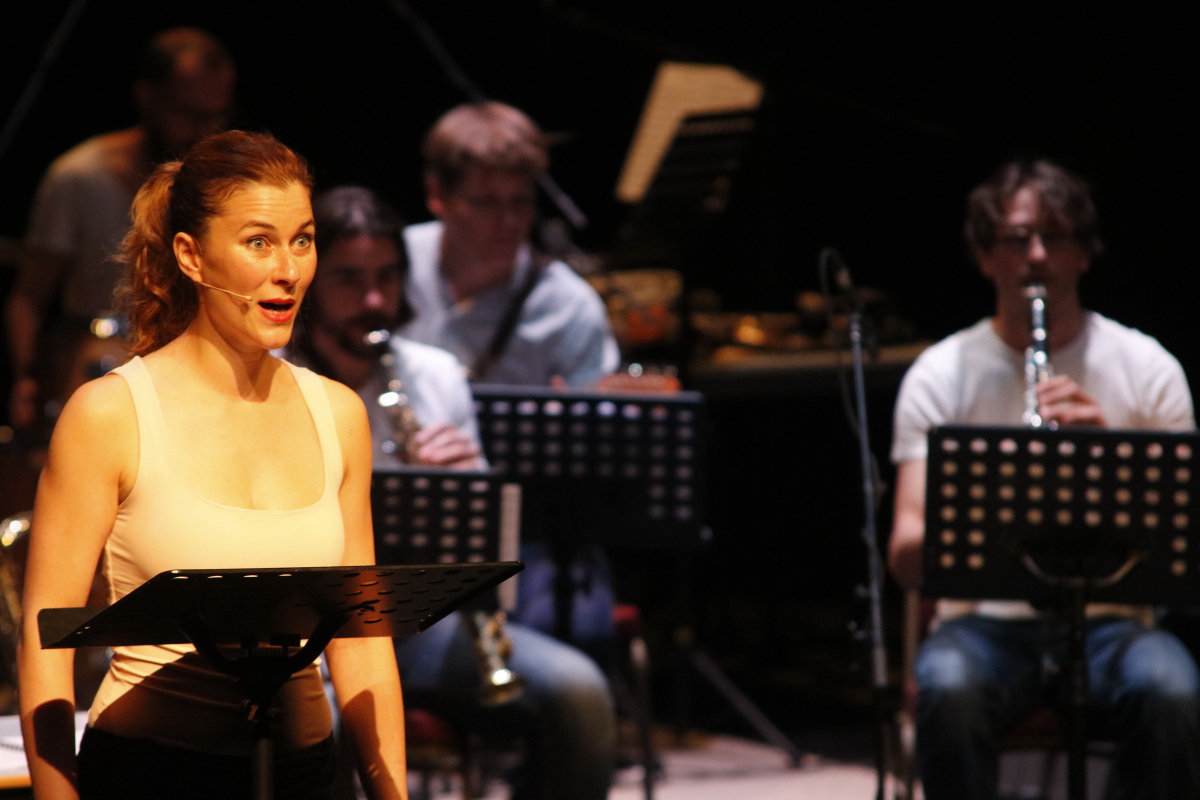
‘Berceuse’ from Gérard Grisey’s Quatre chants pour franchir le seuil (Four Songs for Crossing the Threshold) is tranquil and introspective, the instrumentalists providing a lush, undulating accompaniment to Fabienne Séveillac’s flexible mezzo-soprano. In Grisey’s Quatre chants…, this lullaby is the reflective finale following apocalyptic scenes with text taken from the Babylonian Epic of Gilgamesh. The composer said of ‘Berceuse’, ‘it is not intended to lull one to sleep; instead it is meant to awaken one to the dying of humanity, finally liberated from its nightmare’. Heard here in isolation, ‘Berceuse’ gives us a sense of peace, but not the catharsis that would have followed the first three of Grisey’s songs.

Grisey died of an aneurysm at 52; Four Songs for Crossing the Threshold was the last piece he completed. Phillipe Leroux’s homage to Grisey Un lieu verdoyant, for mezzo-soprano and soprano saxophone, was written the year after his death. Séveillac and Joshua Hyde shine in this heartfelt performance, their delicate timbres almost indistinguishable as their voices come together and move apart. The balance between singer and saxophone is exquisite, the sighing glissandos and shaking tremolos evoking the grief of the text, which is based on the Book of Lamentations from the Hebrew Scriptures. Hyde turns his back to the audience as Un lieu verdoyant descends into Séveillac’s whispering, ‘mémoire pour Gérard’.

Séveillac is centre-stage again for Gérard Pesson’s setting of poetry by Marie Redonnet Cinq chansons, scored for voice and a quintet of viola, cello, flute, clarinet and piano. Séveillac’s voice entreats over the ambiguous, unstable moods of the accompaniment in ‘La chanteuse des rues’ (The street singer). ‘La stripteaseuse du Mac Doc’ (The stripteaser of Mac Doc) combined upbeat striking of the wood of cello and piano with humorous slides and twists from the winds. The lyrics translate as ‘without a hat/without a coat/without panties’ and so on. ‘La merchande de sable’ (The sand merchant) is a dark miniature, the soft jagged music reflecting the madness of a woman collecting sand and rocks, mistaking them for gold.

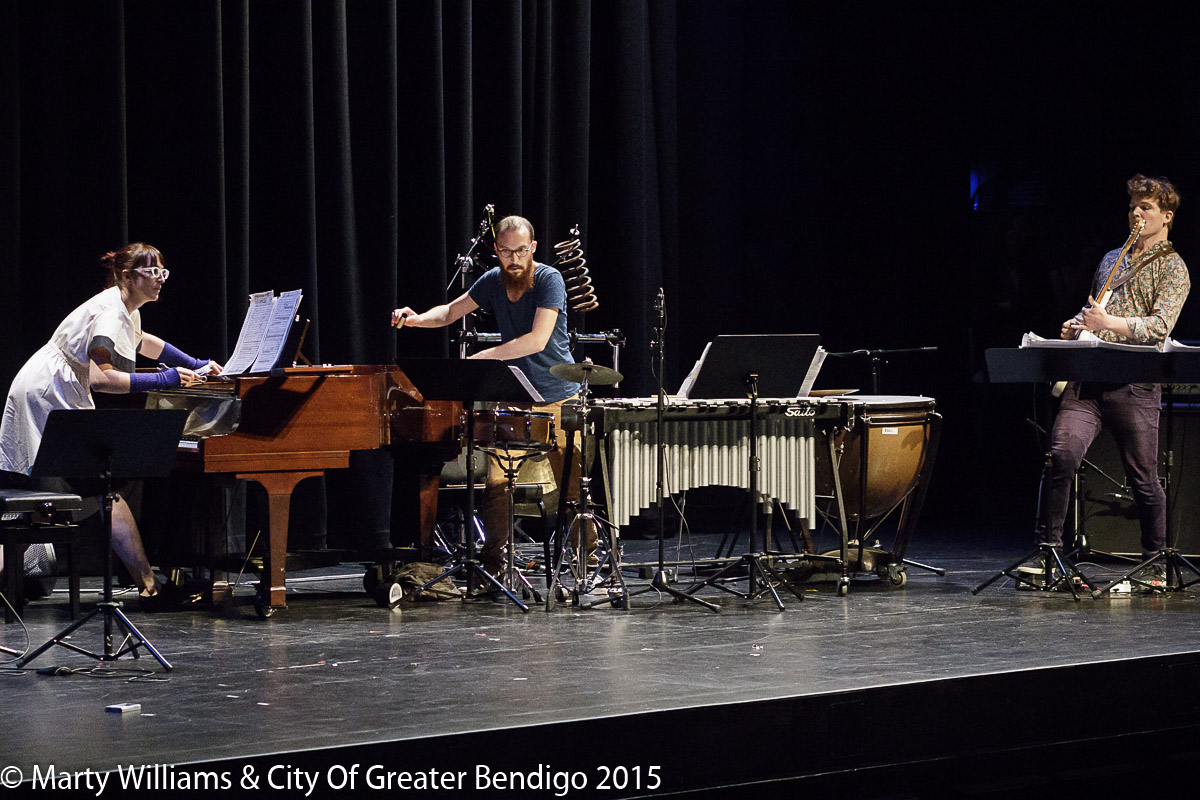
Soundinitiative’s finale for Made in France is Raphaël Cendo’s Faction, a wildly joyful piece in the composer’s self-described style of ‘Saturationism’, opening with loud, energetic ‘shredding’ on all three instruments. Faction requires electric guitar, prepared piano, prepared vibraphone (and hopefully prepared vibraphonist, quips Hyde, entertaining the audience during the stage change). Soistier’s preparations seem to involve several kinds of tape stuck to various parts of the instrument. Kobe van Cauwenberghe’s guitar dominates, but vibraphone and Gwenaëlle Rouger’s piano emerge and recede from the almost constant wall of sound.

Cendo’s music is incredibly physical and Soistier embraces this, throwing his body around the percussion section, leaping from the vibraphone to bow a cymbal, and diving over the open piano. He scrapes the piano strings with what appears to be a pink ruler, metallic sweeps mingling with the distortion of the electric guitar.

Consisting entirely of Australian premieres, soundinitiative’s Made in France provided a fascinating taste of contemporary French music by an ensemble thriving on a wide array of sonic worlds and musical styles.

Made in France
soundinitiative
Saturday 5 September
Bendigo International Festival of Exploratory Music
Ulumbarra Theatre
Angus McPherson

BIFEM: Phoebe Green, Iti Ke Mi

Phoebe Green. Photo courtesy of the artist.

Review by Matthew Lorenzon

The intimate solo recitals at the Old Fire Station have become a BIFEM tradition. The prestigious afternoon and late-night slots are a recognition of a performer’s unique contribution to new music in Australia. Violist Phoebe Green has been commissioning new work from some of the most distinctive voices in Australian music since 2005. She marked a decade of commitment to new music with a dynamic program of new works and modern masterpieces for her instrument.

Violists also have a way of adding an extra dimension to their performances, whether it’s Alexina Hawkins performing an arrangement of Michael Jackson’s “Billie Jean” in her recent ANAM recital or, in this case, performing one of Iannis Xenakis’s athletic works while eight-and-a-half months pregnant. The extra dimension in question here has heard every moment of Green’s concert preparation, from the whispering bows of Luke Paulding’s Repose and Vertigo in Diluvial Light to the metallic churning of Pierluigi Billone’s Iti Ke Mi. Green is definitely the queen of multitasking.

The Melbourne-based composer Luke Paulding is known for his complexly sensuous palette. It was therefore surprising to hear the stripped-back second outing of his viola work Repose and Vertigo in Diluvial Light. The work’s electronic part has been removed, leaving only the viola’s breath-like muted bowing and vertiginous harmonics. Variations of bow pressure save the piece from being entirely schematic. The performer must still lean in to certain delicious tones, like a distant memory of human feeling after the flood. The piece is a hushed song at the end of the world, a faulty remembrance of things past.

Standing imperious, proud, and definitely pregnant, Green launched into the muscular double-stops of Xenakis’ Embellie. Embellie is a unique work within Xenakis’ output, being his only solo viola work and his last solo piece. Embellie also exhibits the folksong-like quality of parts of his later works. Green brought out the lyricism of Xenakis’ bespoke microtonal mode, a difficult feat given the work’s proliferation of double-stops and leaps.

Dialling Xenakis’ elemental energy down a notch, Green was joined on stage by percussionist Leah Scholes for the première of Juliana Hodkinson’s touching and humorous Harriet’s Song. The piece seems to be a musico-theatrical meditation on familial relationships. Scholes and Green play ethereal, almost inaudible tones on vibraphone and viola. Then suddenly, Scholes darts out a pair of scissors at one of the many objects dangling by fishing wire from a microphone stand. A bell clashes to the ground, or a feather lightly floats away. At one point Scholes sharpens a knife and cuts three objects off at once. One’s eye lingers expectantly on the small glass hanging precariously from the fishing wire. The process could continue until all of the objects have shattered on the ground, but Green saves us from this antagonistic fate. Green detaches a music box from the stand and starts humming along to its tune. The piece concludes with Scholes gently accompanying the lullaby on the vibraphone and the rest of the hanging objects.

Green swapped violas for Pierluigi Billone’s Iti Ke Mi. Played with sweeping circular bows that pass from the fingerboard, past the bridge, and onto the tailpiece, the piece therefore requires a tailpiece without fine tuners. Green conjured incredible, shifting tones out of the viola. The wood of the bow on the fingerboard sounds metallic, while the tailpiece emits a deep groan. These sounds are not clearly delineated, but swept up in a whirling timbral vortex. Making broad circles with her arm across the whole instrument and sliding her left hand up and down the fingerboard, the piece begins completely fluidly. There are no static pitches or timbres, only movement. As the piece progresses, the performer’s movements slowly become tighter. Very slowly. The piece is extremely long and I fail to see the waypoints that justify it being so. Eventually the sounds occasionally stop “in the throat” of the instrument and about ten minutes later the piece ends with a whimper.

I am a viola convert. With its larger dimensions and deeper range, the viola is an ideal instrument for extended techniques. Creaks, scratches, and harmonics resonate that little bit longer and are that little bit richer than the violin. After Green’s recital I questioned why anyone would ever again write an extended-techniques work for the violin.

Phoebe Green
Iti Ke Mi
Bendigo International Festival of Exploratory Music
The Old Fire Station
6 September 2015
Matthew Lorenzon

BIFEM: Erik Griswold, Wallpaper Music

Erik Griswold performs Wallpaper Music. Photo by Marty Williams.

Review by Delia Bartle

Combine the melodic charm of the piano with the raw elements of percussion, and you have the prepared piano. It’s a musical universe filled with metallic rattles, buzzing bell-like tones and dulled acoustics that inventive Brisbane-based composer and pianist Erik Griswold has been exploring for decades. In his 2006 long-form piano work Wallpaper Music, Griswold ‘radically retunes’ the traditional piano by inserting everyday objects such as screws, bolts and strips of rubber between the strings of the piano. This physically demanding performance of apparent perpetual motion, with hidden melodies and richly layered percussive timbres, turned Bendigo’s Old Fire Station into a hypnotic space.

In 1940, American composer John Cage was commissioned to write accompaniment for an African themed dance piece. The work’s small performance venue was impractical for a percussion ensemble, so Cage created the prepared piano as a substitute. By preparing the piano the notes lose their ‘pure’ identifiable pitch and instead take on a metallic, dull or wooden quality akin to that of percussion instruments.

Cage believed the foundations of music to be sound and silence, with the only thing common to both being duration. As a result he felt rhythm was more important than melody and harmony, making prepared piano—with its added percussive focus—the perfect medium for combining all three. Griswold explores this notion in Wallpaper Music, a continuous 60-minute piece with minimal melodic and dynamic variation that ultimately allows the audience to focus on the relationship between percussive effects and rhythmic structure.

The sheer physicality of the performance was impressive as Griswold played an unbroken flow of notes with rippling fluidity. His effortless dexterity in navigating the full range of the keyboard added a visual element to an already engaging performance. Bold forward momentum and a simultaneous sense of stillness seemed to turn in an infinite loop as Griswold, often swaying in slow circles, balanced relentless motoric figures with delicate emerging melodies. His refusal of dynamic accentuation in a work already without definable rhythmic metre created the perception of a circular, almost minimalist, development.

A glimpse inside the piano revealed a sight rarely seen: shiny screws and small squares of folded cardboard carefully wedged between strings, strips of rubber woven across an octave, and even gaffer tape stretched over some lower strings. Griswold had also locked down selected white keys in the bottom two octaves by squeezing slivers of cardboard between each key and the vertical piano front, so as to avoid sounding those pitches when he played clustered notes with his palm. In a way the work is illustrative of wallpaper, with its repetitive patterns and intense consistency. However this performance was enveloping, driven and much more vibrant than the unobtrusive two-dimensionality we commonly associate with ‘wallpaper music.’

Erik Griswold
Wallpaper Music (2006)
2015 Bendigo International Festival of Exploratory Music
The Old Fire Station, Bendigo
Saturday 5 September 2015
Delia Bartle

BIFEM: Aviva Endean, Dual Rituals

Aviva Endean performs Dual Rituals. Photo by Alexander Gellmann.

Review by Angus McPherson

A screaming clarinet multiphonic, pitches grating against each other, presages thunderous bass drums. The impact from the drums triggers blinking in the audience, bodies recoiling from the onslaught of sound that seems too vast and terrible to be contained in the tightly packed Old Fire Station. Late on Friday night, Aviva Endean opened the proceedings of Dual Rituals with Finnish composer Magnus Lindberg’s Ablauf (Expiration). This strident music began a recital that had all the solemnity and pageantry of a spiritual rite. The contrast between piercing howls and whispered prayers made Dual Rituals compelling and deeply unsettling.

Flanked by black-hooded bass drummers Peter Neville and Leah Scholes, Endean’s energy is implacable; she slides around the clarinet with virtuosic zeal and screams at the audience in short, vicious barks. She is just as nimble on bass clarinet as the drums recede to low rumbles. Ablauf fades out, the stage goes dark and Endean appears on video above the stage holding up a sign instructing the audience that they will ‘need earplugs to play’ the next piece.

Endean’s own composition, A Face Like Yours, invites the audience to copy the actions of her filmed self, and we obediently insert earplugs and begin touching and tapping at our faces. Drumming fingertips lightly against the earplugs elicits reverberations inside our heads, and in the otherwise silent audience, we run fingers over our scalps and behind our ears. We slap our cheeks and lips, a soft fleshy patter that rises and falls. When the stage fades once more to black the audience, bereft of its leader, seems unsure whether to break the spell by applauding.

The lights come up on Endean kneeling at the front of the stage, Tibetan sounding bowls in her hands for Pierluigi Billone’s Mani. Gonxha, a hypnotic performance of ceremonial prayer. Endean draws a variety of metallic sounds from the bowls – traditionally used in meditation – as she slides them together, mutes them or loosens her grip allowing them to ring out. It is a long piece to sustain such a narrow range of timbres, but Endean’s focus never slips. Her body is both resonator and dampener, as much a part of the percussion as the bowls, and the dull tapping of one bowl against the knuckles of her hand evokes an air of self-flagellation. This intensifies as she beats one bowl against the other pressed to her abdomen, as if trying to drive it into her belly. There is a sense of intrusion, as if this is a private act we have stumbled upon. Quiet gong-like vocalisations become chanting as Endean finally lifts her eyes to stare into the audience.

Endean sits at a desk, the pieces of a disassembled clarinet arranged before her like a vanitas still life. The premiere of Wojtek Blecharz’s Counter-Earth begins with the amplified sound of the clarinet’s barrel rolling across the wooden desk. Dramatically lit from above, Endean paints sounds with the clarinet’s parts, while cymbals chime from a recording, extending the ceremonial mood of Mani. Gonxha. The clarinet’s middle joints become machines for trapping and releasing breath, and one is played as a side-blown flute, reminiscent of a funerary Shakuhachi. The chiaroscuro lighting distorts Endean’s features as she stretches her eyelids open with her hands and claws at her face. Electronic sounds mingled with those produced by the clarinet, which is gradually assembled.

In the next movement, Endean delivers the text of the Wikipedia entry on the Syrian city of Aleppo in the voice of a friendly tour-guide. Her recitation of the historical value of one of the oldest continuously inhabited cities in the world is rendered heartbreaking by the destruction that has resulted from the Civil War. Endean periodically interrupts her bright delivery with hissing chants from a darker text. ‘A slow death, a slow death, a slow death’ a chilling reminder of the suffering Aleppo has seen. Crouching, Endean reaches into a glowing chest, which illuminates her as she pulls out pieces of rubble and drops them onto the stage.

Bathed in blood red light, Endean plays an Aztec death whistle into a microphone for Counter-Earth’s finale. The rasping of the skull shaped instrument is light at first, but gradually mutates into something like raucous, hysterical laughter.

Aviva Endean drew the audience in with her trance-like intensity. Sustaining the reverent solemnity of a priest or shaman throughout, she made us complicit as witnesses to and participants in her dark rituals.

Dual Rituals
Aviva Endean
Bendigo International Festival of Exploratory Music
Old Fire Station
4 September 2015
Angus McPherson

BIFEM: soundinitiative, The Exhausted (3)

Fabienne Séveillac performs The Exhausted with soundinitiative. Photo by Marty Williams.

Review by Simon Eales

When, in Samuel Beckett’s Endgame, the character Hamm says “Use your head, can’t you, use your head. You’re on earth, there’s no cure for that,” we edge a little closer to understanding what futility in the Irish playwright means. The sense of it is ‘there’s no getting out of the situation we’re in, so just use what you happen to have.’ This call to stark rationality gets renewed with each utterance. As impossible as it seems, there’s always a way to surpass the impasse.

This preoccupation—with exploring possibilities—forms the philosophical jumping off point for Austrian composer Berhard Lang’s new long-form, part concert, part music theatre piece, The Exhausted. Co-commissioned by BIFEM and Singapore’s Yon Siew Toh Conservatory of Music for young French ensemble, soundinitiative, it bears a compelling combination of traditional musical structure and experimental elements. Just as a line of coherence develops, we are jolted sideways into a new stratum.

In his 1992 essay L’épuisé, French philosopher Gilles Deleuze articulates Beckett’s exhaustion of possibilities within delimited sets of field. It’s from this essay that Lang takes this piece’s name, and its libretto. Deleuze explores the ways in which Beckett’s plays work and rework the iterations of physical and logical possibilities, providing some indication of why Beckett seems to require a unique style of viewing. His pieces are populated with characters and stories, but, as soon as they begin, their linearity discontinues. They become about what could have happened had what happened not happened.

Throughout soundinitiative’s performance, the twelve ensemble members break with conventional concert behaviour. They are physically gestural, cleaning their instruments for far longer, and more regularly, than could be practically useful, for example. Mezzo soprano, Fabienne Séveillac, carries most of the dramatic responsibility, stepping slowly at times, quickly at others, trance-like, across The Capital’s thrust. At one point she climbs aboard a table and, lying on it, sings. We are not necessarily watching musicians create a piece of music, but being drawn into a demonstration of the creation of musico-theatrical options.

This notion is concise in Beckett. His sparse settings, few characters, and severe repetition of words, allow him to strip individual phenomena of the power they draw as individual elements. His seemingly sovereign objects could easily not have existed. There seem to be many more possibilities presented here. They bifurcate licentiously, like when Séveillac repeats, “It is night, it is not night. It is night, it is not night,” as a funk bassline and jazzrock groove on the kit links a phase of arresting, strung sustain to an intriguing section of plucks, chimes, and short strums. The words of this latter section huddle around difficulty: “scruples,” “remorseful,” “not guilty.”

As Deleuze might find in Beckett, we come across many half-lines of monologue (delivered predominantly by Séveillac, but also by the ensemble as chorus), constantly stunted melodic progressions, various genres, and a vivid flirtation between cacophony and synthesis. Ensemble members flirt, too. Upon the concert beginning, the whole ensemble arrives, enigmatically engaging the audience with eye contact from their individual positions, before most leave the stage, only a few stragglers remaining. The stragglers then leave. Some players return, make to begin playing, then leave again. These syncopated entrances and exits continue for minutes.

As the piece develops, its collection of generic, modal, tonal, rhythmic, attitudinal, instrumental, physical, and psychological possibilities burgeons, pushing the modest limits of this festival goer’s receptivity. Pique moments, such as Joshua Hyde’s saxophone solo, satisfy what thirst there is for brilliant individualism. But there is genuine pleasure in the play of departures, the decomposition of structure, the humour, the joyful combination of disparate elements, and the phases of rhythmic repetition. We can also always plug into the piece’s verbal impasses to rejuvenate our interest in the instrumental ones: “I gave up before I was born”; “I am my father, I am my son.”

It’s worth noting that Lang’s composition is exceptionally well drilled by its players. In our post-performance correspondence, Séveillac emphasised the complexity of the rhythmic and tonal micro-variations within Lang’s structural looping. Such complexity is reminiscent of Beckett, and the ensemble’s execution of the loops is exceptional. Frequent glimmers of spirited expression in the playing, however, seem to signal a point of departure (in both Lang’s text and its performance) from how Beckett required his work to be performed. He would stringently determine things like stage direction, physical form, and attitude for those selected to realise them. Soundinitiative absorb the strokes of their conductor, who is lodged above and behind the audience, and, at the same time, manage to transform the movements of this intricately mechanised system into opportunities for joy. In doing so, they allow the influence of Deleuze’s generative philosophical style to attain a compelling resonance.

The Exhausted
By Bernhard Lang
soundinitiative
The Capital Theatre
Bendigo International Festival of Exploratory Music
4 September 2015
Simon Eales

BIFEM: soundinitiative, The Exhausted (2)

Fabienne Séveillac performs The Exhausted with soundinitiative. Photo by Marty Williams.

Review by Matthew Lorenzon

“Exhausted is so much more than tired” begins Gilles Deleuze’s essay on Samuel Beckett (“The Exhausted,” trans. Anthony Uhlmann, 1995). Tiredness assumes there is more to be done; the exhausted has consumed, expended, or used up all possibilities. Everybody has experienced the former, whereas the latter is the stuff of mathematical definitions. Beckett combines the two. One can exhaust the possible combinations of objects in a series, just as Beckett permutes series of socks, stones, and physical movements in his plays and novels. “Beckett’s great contribution to logic,” Deleuze writes, “is to display that exhaustion (exhaustivity) does not occur without a certain physiological exhaustion.”

Bernhard Lang’s The Exhausted is a music theatre piece co-commissioned by the young Parisian ensemble soundinitiative for their debut at the Bendigo International Festival of Exploratory Music. Seated expectantly in the Capital Theatre, the audience was initially treated to only a momentary glimpse of the charismatic ensemble. The players wandered on stage, set up their instruments, and promptly exited. The next five minutes saw a constant flow of musicians entering and exiting the stage like waves lapping on the shore. The choreography by Benjamin Vandewalle made the most of the musicians’ natural and untutored movements. These were not actors and dancers striding purposefully on stage, but cellists and flautists repeating the gestural repertoire of the concert hall. The ensemble would stand, sit, slouch, or freeze with the simplicity proper to Beckett’s stage directions. The mezzo-soprano Fabienne Séveillac was no exception, though no other performer was called upon to sing vintage Deleuze upside-down beneath a table.

There is often a tenuous link between compositions and the philosophical texts upon which they are based. It is therefore wonderful to hear a composer developing his work so thoroughly from a single text. Objects on stage including a desk and a grey tape player are drawn directly from Deleuze’s essay. Beethoven’s Ghost Trio and Schubert’s Nacht und Träume feature in Beckett and Deleuze, though the pieces are cleverly introduced not underneath their description in the essay, but under Deleuze’s discussion of Beckett’s play Quad: “Four possible solos all given. Six possible duos all given (two twice). Four possible trios all given twice.”

Despite drawing heavily on Deleuze’s text, Lang has resisted the temptation to interpret Deleuze’s essay literally. He seeks the same nomadic movement of thought from Deleuze’s essay that Deleuze sought in reading Beckett. With all Deleuze’s talk of combinatory mathematics, it would be tempting to write a serial piece or engage in some other form of musical permutation, especially with such direct invitations as Deleuze’s phrase “Watt is the great serial novel.” While there may have been serial moments in the piece, the work seems to build upon the composer’s earlier Deleuze-inspired pieces by looping musical fragments, especially the jazz-inflected grooves of Lang’s student years. The piece, at least on one naïve hearing, plays to the tiredness inherent in repetition while referring obliquely to exhaustion’s formal properties.

Why repetition? A combinatorial sequence repeats the same elements in different ways, but Lang’s repetition is more static. A reader of Deleuze’s Difference and Repetition will recognise that repetition is only possible because of the infinitesimal difference between each iteration. This difference may provide a path past exhaustion. The audience and the performers may realise that there really are tangential possibilities hiding within each musical fragment beyond its combination with others. But repetition is also fatiguing and there is always the possibility that tiredness will win out before exhausted repetition opens a window onto the new.

The Exhausted
Bernhard Lang
soundinitiative
The Bendigo International Festival of Exploratory Music
The Capital Theatre
4 September 2015
Matthew Lorenzon

BIFEM: soundinitiative, The Exhausted (1)

Fabienne Séveillac performs The Exhausted with soundinitiative. Photo by Marty Williams.

Review by Jaslyn Robertson

The première of Austrian composer Bernhard Lang’s new work ‘The Exhausted’ (‘L’Épuisé’) began without music, members of Paris-based ensemble Soundinitiative moving mechanically on stage, then off, then back on again, repeating the process for minutes. The entrance set the scene for the repetitive, robotic nature of the music set to text from an English translation of Gilles Deleuze’s essay on Samuel Beckett.

Mezzo-soprano Fabienne Séveillac leads us through the text staring eerily above the audience, repeating phrases accompanied or followed by a complementary musical idea, opening with ‘exhausted is a whole lot more than tired’. Walking backwards and forwards, standing and sitting at her desk, Séveillac’s movements reinforce the mechanical repetition of her vocal part. At times, the instrumentalists use this sort of repetitive movement as well, cleaning clarinets and checking the alignment of bows. Described as ‘part-concert, part-music theatre’, movement is a significant part of the work. In a particularly haunting moment Séveillac lies herself across the desk until her head falls over the edge and sings, torso and head upside-down, without breaking her forward gaze.

The highlights of the performance occurred when the instrumentalists of Soundinitiative had a chance to show off their abilities. The stirring passion of Joshua Hyde’s saxophone solo over the cacophony of the other musicians mesmirised the audience. Forceful blowing and tongue slaps pierced through the sound in the background and demanded attention. His natural movements added as much to the concert as the repetitive choreographed actions. Hyde’s slow walk towards the audience, eyes closed, engrossed in producing rips of sound, is an equally unforgettable image.

The music of ‘L’Épuisé’ never loses interest, listeners bombarded with fast and marked change with each new phrase. Sections of text, with their allocated musical ideas, are never repeated for more than a minute, most lasting only 20 seconds or less. The majority of Séveillac’s delivery of text lies on the spectrum of speaking, ranging from breathy whispers to loud, robotic instruction. In the rare moments of high register singing, the clarity of her voice rings through the audience accompanied by sparse textures, from the likes of piano, electronic keyboard and glockenspiel. Like searching through radio stations, the rapid change between styles, varied in texture and rhythm, caused the music to never become static. Some ideas were more effective than others. Jazz sections suggested a shared feeling between composer and performers for the idiom that was clear to the audience, unlike the brief diversion into a hip-hop beat which sounded out of place on the instruments available and beneath Séveillac’s voice.

Although entertaining, Lang’s attempt to translate Deleuze’s philosophical ideas into music was sometimes sacrificed in order to create a hyperactive atmosphere that never allowed the audience to look away. The competence of standout musicians saved the work by giving expression to the chaos. The eccentricity of ensemble members gave it life, Venturini at one point climbing atop his piano in a fit of ‘insanity’. Soundinitiative showed technical prowess and bravery in taking on a work that required precision and adaptability in every instrument, with the added challenge of choreography. I can’t imagine many other ensembles that could capture the wild energy of this piece without missing a beat.

The Exhausted
Bernhard Lang
soundinitiative
Bendigo International Festival of Exploratory Music
6 September 2015
Jaslyn Robertson

BIFEM: Argonaut Ensemble, Maudite soit la guerre (2)

Argonaut Ensemble perform Olga Neuwirth's Maudite soit la guerre. Photo by Marty Williams.
Argonaut Ensemble perform Olga Neuwirth’s Maudite soit la guerre. Photo by Marty Williams.

Review by Charles MacInnes

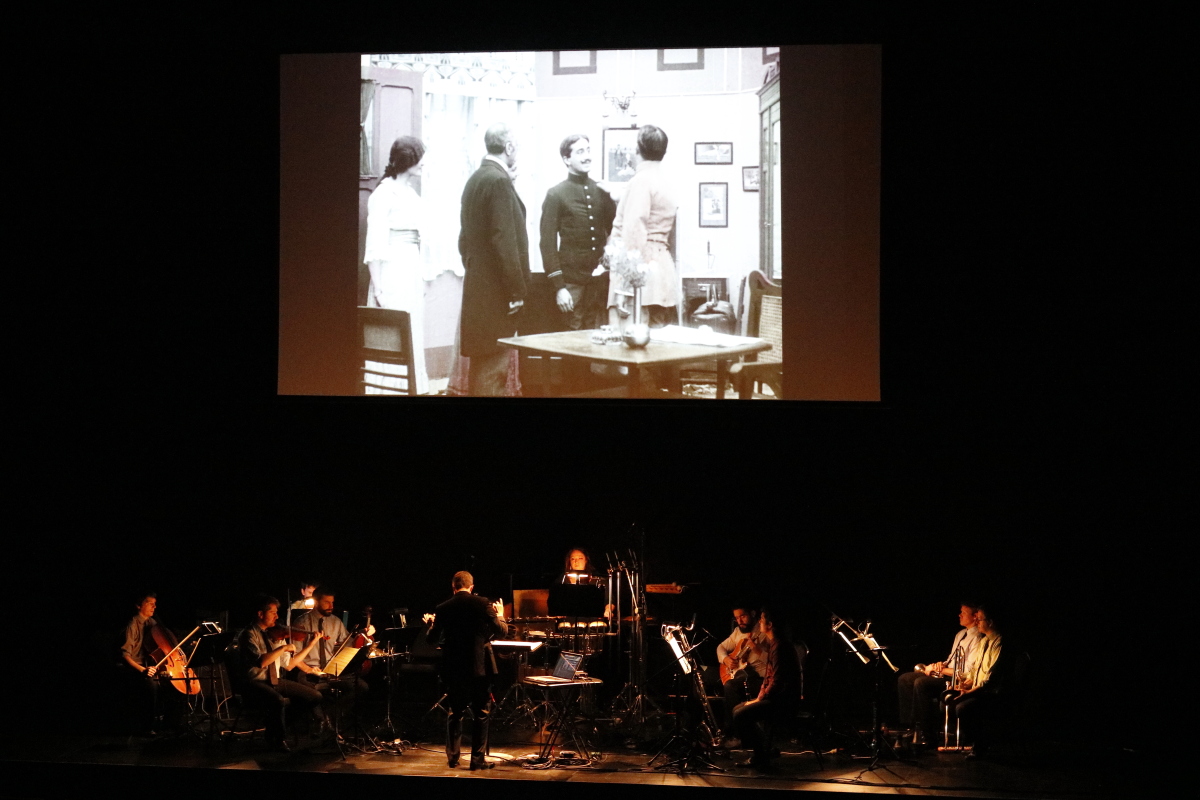
Olga Neuwirth provokes fresh artistic perspectives by combining the new with the old. We see the patchy restoration of the Belgian silent film “Maudite soit la Guerre” (“Accursed be War”, dir. Alfred Machin, 1914), but accept it due to a live music that pits episodic tunefulness against a soundscape of slipping tonal certainty. The trick to understanding this is to place the sound at the focal point of our attention so it becomes the narrative, and the pictures become the incidental.

Music can perform this shift very well because its abstraction leaves you imagining a world beyond the visual. The chamber orchestra replaces the organ accompaniment of old: “You always need to remember the past! That is the only way that we could learn something,” says Neuwirth in an interview with her publisher Ricordi in 2014. As I walk from the Ulumbarra Theatre’s converted gaol toward the Rifle Hotel, I’m already thinking of the Syrians arriving in Europe. Of our collective responsibility. And guilt. Neuwirth is a step ahead because her sound world provides us with a more satisfying ultimate redemption than that of the colourised celluloid.

In the film story itself, Adolph furthers his training as an aviator by visiting a country that looks and feels like Belgium or France. Honky-tonk piano clanks while the harmon-muted brass crack wise and jostle with colleagues as they meet at the airfield. New-fangled flying machines are being inspected, and as the string harmonics are slowly replaced by concentric sustained cowbells, we are taken to the tavern three months hence as Germany declares war.

The declaration means that Adolph and his new friend Sigismond are now enemies. Even though Adolph has fallen in love with Sigismond’s sister Lidia, he must now return to the Vaterland to take up arms. The melodrama thickens; a grave clarinet turns upon itself alongside forward marching brass and above the strata of an elbowing organ and stringed hums. A mistuning of signals is now more pronounced—the sample track and whimsical electric guitar are prompting us to reconsider earlier impressions.

Blood red explosions are sighted through binoculars as the world is turned upside down. Adolph hallucinates that his sweetheart appears as the suddenly more menacing and now armed flying contraptions lurch and veer above. The percussionist stings the enemy with rapid gunfire and a harrowing sequence follows where hot air balloons are attacked, catching fire and eventually caving in on themselves. These are the corpses; war is indeed cursed. Neuwirth tells us with a further splaying of the tonal focus that another pivotal scene is nigh. A telegraph communiqué is sent via elevated strings and leads to the windmill where Adolph is hiding being set ablaze and collapsing. Lover and girlfriend’s brother emerge from the opposing sides and are both slain on the battlefield.

Cut to a year later and the lieutenant who brought the grim tidings to the family is making a play for the now single Lidia. Love is in the air until she spots her lover’s medallion pinned to his uniform. She convulses and contemplates drowning herself but instead retreats to the convent. We hear a veiled Bach chorale (could it be “A Mighty Fortress Is Our God”?) and later a Stravinsky-like “Jesu, Joy…”. By now the sample track and the orchestra are worlds apart and the last vocal echoes shimmer a little longer beyond the church and greenery.

Eric Dudley’s conducting magnificently disguised the presence of his in-ear click track and the Argonaut Ensemble was precise and fluid. I was not convinced that the sound design and amplification recognised the subtle internal dynamics of the acoustic ensemble. The strings and bright percussion occasionally dominated in the mix, leaving some of the delicate muted brass and guitar layers behind. The sophistication of the writing and interpretation created an extraordinarily poignant opening to the 2015 Bendigo International Festival of Exploratory Music.

Maudite soit la guerre: A Film Music War Requiem (2014) by Olga Neuwirth
Argonaut Ensemble conducted by Eric Dudley
Friday 4 September
Ulumbarra Theatre
Bendigo International Festival of Exploratory Music
Charles MacInnes

BIFEM: Argonaut Ensemble, Maudite soit la guerre

Argonaut Ensemble perform Olga Neuwirth's live score to Maudite soit la guerre. Photo by Marty Williams.
Argonaut Ensemble perform Olga Neuwirth’s live score to Maudite soit la guerre. Photo by Marty Williams.

Review by Delia Bartle

Scenes of war flicker across a screen in a darkened hall. Repetitive percussion drills like gunfire and strains of a honky tonk piano emerge from under shimmering strings. This is the sound of Maudite soit la guerre (War is Hell), one of the first anti-war films. The 1914 motion picture juxtaposes tradition with the unexpected arrival of a mechanical age of war. Similarly, Austrian composer Olga Neuwirth’s live score bridges the divide between conventional instrumentation and innovative performance techniques.

The film interprets the turmoil of war through the narrative of a doomed love story and two rival aviators. Neuwirth was commissioned by Ensemble 2e2m in 2014 to compose a soundtrack and the Argonaut Ensemble interpreted the score with a spellbinding balance of delicacy and vigour.

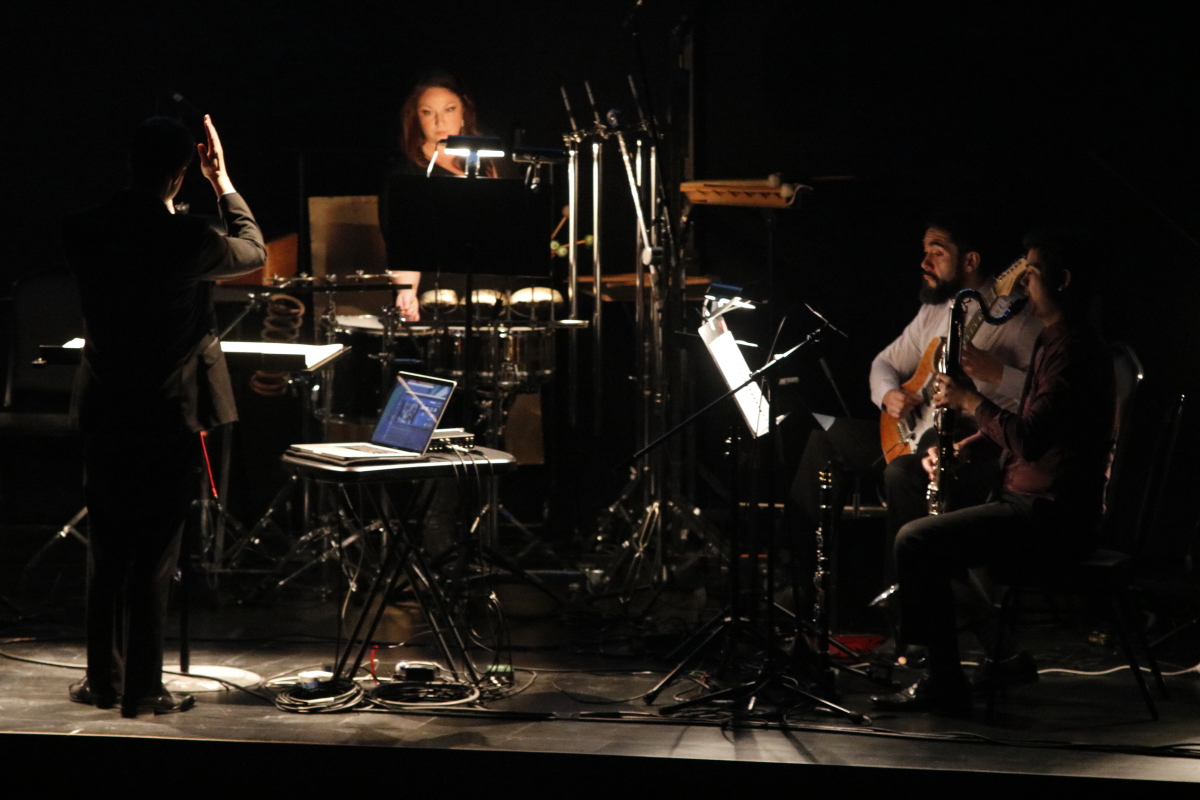
Eric Dudley conducted with subtle gestures to foster an ensemble dynamic that bristled with energy. Neuwirth’s score is unique as far as film music goes in that the image and sound sometimes do not correlate. At one point a windmill crashes to the ground, but there’s no literal effect to signify this. It was intriguing to witness the way in which our reactions were shaped by what we heard more so than what we saw, in particular when comical salon music drew laughter from the audience while characters on screen were departing for war.

Violinist Zachary Johnston, violist Christian Read and cellist Paul Zabrowarny excelled, playing cowbells as well as their usual instruments. Roughly bowed string motifs and airy harmonics created an electric atmosphere. Trumpeter Tristram Williams and trombonist Benjamin Marks delivered crisp notes before shifting into rich echoes of military fanfare. Marks even picked up a melodica to add comic effect to the already diverse world of sound, and electric guitarist Mauricio Carrasco emulated eerie air raid sirens with rising and sinking glissandos.

Neuwirth draws on a range of textures and instrumentations to create a dramatic mix of electronics, classical instrumentation and film. Maudite soit la guerre predominantly features soundscapes over melodic continuity, often with dense passages of limited dynamic range. Neuwirth’s musical theatre works frequently explore the relationship between collaboration and resistance, and that was identifiable in this performance through the overlapping textures and conflicting musical and visual themes.

The film’s director, Alfred Machin, produced this work with the intent to counteract the typically glamorised war propaganda that saturated society leading into the First World War. Neuwirth says of the film, ‘You always need to remember the past! That is the only way that we could learn something’. The Argonaut Ensemble embraced Neuwirth’s philosophy with this performance that honoured the ANZAC Centenary, reminding us of the harrowing emotions generated by war through the frame of an explorative soundscape.

Argonaut Ensemble
Maudite soit la guerre (War is Hell) – A Film Music War Requiem (2014)
2015 Bendigo International Festival of Exploratory Music
Ulumbarra Theatre, Bendigo
Friday 4 September, 2015

Delia Bartle


Inland 15.3: Your House is the Last Before the Infinite

11892235_10206642613156650_8624964347959993763_n
Alexander Garsden, Rohan Drape, and Jessica Aszodi perform Garsden’s Four suns and a whole sky on fire. Photo by Lloyd Honeybrook.

The Inland concert series explores a musical interior. Like the blend of properties at the center of a colour graph, Inland explores the gradations between notated, improvised, and electroacoustic performances. Concert 15.3 at the Church of all Nations in Carlton explored a single, focussed point of this hinterland, that of static textures developed through layering live and captured sounds.

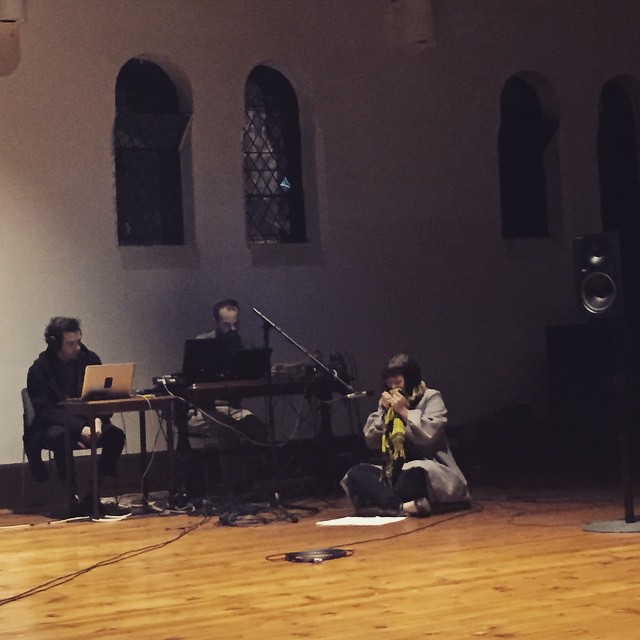
Samuel Dunscombe’s Unfinished Piece for 27 Clarinets is performed by only three clarinettists, in this case Dunscombe, Aviva Endean, and Michiko Ogawa. The electronic part quickly swells to an atmosphere of drones and squawks. The effect is like listening to a great crowd of people, with half-heard conversations and choruses arising and subsiding from the dense body of sound.

Rohan Drape is largely to blame for the perfectly balanced sound diffusion throughout the concert. In each piece, the electroacoustic part perfectly matched the live performers to the extent that, from my vantage point at the back of the church, they were difficult to distinguish. This was as true for instruments as it was for voices. The collaborative work Four suns and a whole sky on fire amplified and multiplied phonemes and words uttered by the soprano Jessica Aszodi before Drape and Garsden introduced a droning accompaniment.

Jeanette Little’s Barbaric Yawp for Uilleann Pipes was a highlight of the night and not just because it featured an instrument so little-heard in the contemporary music world. Once again, the focus was on the instrument’s polyphonic texture and Matthew Horsley carefully managed the piece’s microtonal pitch bends and shifting drones. The melody, when it arrives, is a bleating, squealing thing that resonated delightfully in the church with a little help from the sound design.

Judith Hamann’s untitled solo cello performance featured a series of expertly-diffused extended cello sounds, my favourite of which was bowed cello spike. The vibrations of the spike were so slow that they formed a rhythm of sussurating sounds accompanied by maritime creaks.

The stage faintly glowed beneath the cross of the Church of All Nations. The semicircle of speakers and microphones formed a sacred space, like prayer or a pulpit, within which the sounds of the performers were amplified. But no god was intended to hear these performances, nor does Inland espouse any particular cosmology. With the concert closely following the Supersense Festival of the Ecstatic and directly preceding the Ballarat Slow Music Festival, I wondered after the intentions of the audience members scattered around on the floor. Why do audiences so desperately want to doze? The society-wide will to relaxation is not just a symptom of our busy, technology-stuffed lifestyles, but of our increasing infantilisation as consumers who can’t be trusted to go to bed on time without the right app.

I recently photographed this ridiculous Qantas ad in an airport.

Photo by Matthew Lorenzon

Needless to say, a world of entertainment is not much use while you are asleep, much less if you are trying to get to sleep on a full stomach. But Qantas wants you to consume even when you are full and asleep. There is nothing new in this. If the pinnacle of luxury is gorging oneself and falling asleep in front of a television, then a good portion of the population lives the dream on a regular basis. This ideal of luxury also informs contemporary music. Where falling asleep in a concert was once seen as a bad thing, the ambient sound artist Robert Rich has been presenting “sleep concerts” for several decades. In contemporary art music, it seems that every few months an audience is invited to lie on cushions or curl up in pods.

Trance, transcendence, non-knowledge, or inner experience have their place and exploring these states of mind may be extremely beneficial to one’s health and well-being, but can’t this happen outside of the concert hall? Old-fashioned though these Enlightenment ideals may be, society extricated itself from the comfort of religious dogma for compelling reasons. Even though the last couple of hundred years of technological advancement may well lead to the doom of Western Civilisation as we know it, we can’t crawl back inside the womb now. I am interested to see what composers will do next, once they get bored of the ersatz-sacred bubble.

I have written several times about David Toop‘s performance at the 2013 Totally Huge New Music Festival, where he brutally interrupted his soporific, crackling sound design with deafening strikes of a snare drum. While this is one of the most appropriate responses to a society falling asleep at the wheel, I must admit that I too lay down for Jessica Aszodi’s closing performance of Morton Feldman’s Three Voices, hoping to see the light.

Unfortunately I missed Aszodi’s performance of Three Voices at the 2013 Bendigo International Festival of Exploratory Music, so I was excited to hear Aszodi’s performance this year. Once again, the projection of Aszodi’s two prerecorded parts was perfectly matched to her live voice, so that one was sometimes at a loss to tell which part she was singing. A short check of the tempo and Aszodi was away, gliding effortlessly through the hour-long performance as though on a cloud. Or perhaps that was the audience, which was utterly transfixed for the duration of a performance that requires such obvious skill and precision. Aszodi’s easy command of such an exposed work made it an otherworldly experience.

Though I finally succumbed to lying on the floor and enjoying the mesmerising refraction of light through half-closed lids, I’m taking a twenty-minute nap before concerts from now on.

Inland 15.3: Your House is the Last Before the Infinite
Church of All Nations, Carlton
24 August 2015