All posts by matthewlorenzon

Unknown's avatar

About matthewlorenzon

I'm a Melbourne-based musicologist and music-writer interested in contemporary music, music theory and philosophy.

Melbourne Festival: The Experiment

The_Experiment
Mauricio Carrusco in The Experiment. Photo by Emmanuel Bernardoux.

A rural homestead flickers on a screen. Deep blue moonlight reflects off the corrugated iron roof and lamps glow on the veranda. The house looms out of an inky-black forest. It is almost three-dimensional, a composite of 24 different images. The projection is divided into imperfectly-aligned quadrants that cycle jerkily through three frames each. These are in turn projected on two scrims, one several meters in front of the other. You could stare at this image all night, lulled by the primitive synthesizer loop and cheery, fuzzy voices of AM radio diffused through 48 speakers suspended above you. All is childhood and reverie, falling asleep in the back seat on a long nocturnal drive. The Experiment‘s opening mise-en-scène is a beautiful moment in itself, showcasing the incredible attention to detail and aesthetic unity of its creative team.

The multiple visual and aural perspectives of the opening also flag the work’s central theme: The unreliability of memory. The musical theatre work (in the sense of the European genre that introduces theatrical elements into musical performance) is based on a monologue by the British playwright Mark Ravenhill, who was in turn inspired by the Australian philosopher Peter Singer. A solo performer (the guitarist Mauricio Carrasco) recites the text in a careful monotone, trying to remember the circumstances of a series of horrific experiments he and his partner performed on children. One moment he is an accessory, the next he is the perpetrator, once more he is a concerned neighbour sneaking around the house with a video camera. Scenes are described in detail and then summarily denied as never having taken place. Once more the sound design plays on a multiplicity of perspectives. Seven microphones hang in a semicircle around Carrasco, capturing his voice from different angles and projecting them, along with pre-recorded text, in a disjointed chorus.

The piece raises a range of ethical issues, though with varying degrees of clarity and urgency. There are traces of Peter Singer’s utilitarian argument that animals with similar levels of awareness and intelligence should be treated alike. If we are comfortable performing painful medical experiments on non-human animals, then we should feel comfortable performing the same experiments on severely intellectually-disabled humans. Describing an experiment viewed through a crack in the shed door, Carrasco-as-concerned-neighbour claims he wanted to say (with the staircase wit typical of situations where one’s moral fiber is tested—in Melbourne we could substitute “tram wit”) “We are no better than animals. Is this what we are doing with what God has given us?” The neighbour upholds the idea of human exclusivity, that any human life is more valuable than one of another species. But the experimenters do not appear to be using severely intellectually-disabled children. Nor does Singer advocate the use of humans in medical experiments as much as urges us to reconsider our treatment of animals.

The dilemma of The Experiment is closer to a “trolley problem”: You control the switch on a railway track and can choose to either leave a runaway carriage to plow through five people or divert it to a track with one person on it. Most people accept that switching the trolley to the less populated track is preferable to doing nothing, even though this makes them an active participant in the moral wrong of the death of one person. By contrast, most people will not choose to push a particularly heavy person on to the track to stop the train from killing five people. This latter form of the dilemma, the “fat man” version, is that presented in The Experiment. The protagonist’s partner is suffering from an incurable and presumably fatal illness. They choose to infect their children in the hope of finding a cure for the parent, the children, and many others. Again, this doesn’t present as a compelling ethical dilemma, as the chances of finding a cure are so uncertain. The one moment that makes you stop and think is when Carrasco says “I loved my children, but I loved my partner.” This—if the situation were actually as determinate as a trolley problem—introduces a new layer of emotional and ethical tension. This is especially interesting as the “partner’s” existence is uncertain. Despite the half-cocked ethical dilemmas, Carrasco provides an absolutely compelling, understated delivery of the tortured text.

As a piece of musical theatre, The Experiment has the virtue of giving text and music their due. This virtue also turns out to be the piece’s weakness. Musical theatre often plays on the ecstasy of the syllable, breaking texts down into their phonetic elements and repeating them as a dramatisation of language’s inherent instability or on the assumption that the sounds will eventually give up their hidden aesthetic interest. The Experiment takes an attitude towards language that I like very much, which is to take the instability of language for granted and then see how many meanings or interpretations can be derived from an only mildly garbled text.

In musical theatre, music is often reduced to the parodying of musical gestures and conventions. The Experiment takes the bold step of including three distinct pieces of music for solo guitar performed without any text at all. Each piece is played on a different guitar that references the text in some way. The first, melancholic piece for acoustic guitar reflects the pathos of the narrator’s opening text. The second piece, by guest composer Fernando Garnero, is performed with a variety of tools on an electric guitar placed inside a vitrine. The tools and vitrine reference the experiments conducted upon the children. The final piece is not performed by Carrasco, but is programmed for a stunning mechanical guitar built by Nara Demasson and Ben Kolaitis. The guitar is constructed from two guitars stuck together top-to-tail with a variety of solenoids and servo motors activating beautiful copper, brass, and wooden arms, plectrums, and wheels. This sculpture reflects the twin children treated as biological machines, or perhaps the couple bound together by their past. While the decision to include musical interludes was refreshing, they jarred uncomfortably with the surrounding theatrical episodes. I wonder whether this all comes back to that fabulous opening mise-en-scène. The opening established the expectation of a primarily theatrical piece into which a purely musical performance could only intrude. Despite this formal incongruity, the team have set a new benchmark for the detailed and sensitive integration of video and sound design in musical theatre.

The Experiment
Performed by Mauricio Carrasco
Text by Mark Ravenhill
Music by David Chisholm
Guest composer Fernando Garnero
Media Artist Matthew Gingold
Dramaturg Jude Anderson
The Melbourne Festival of the Arts
The Malthouse Theatre
23 October 2015
Alexina Hawkins: Spectrum

Alexina Hawkins’s viola is a vessel for reaching out and engaging with her network of musicians and creators. Eschewing the South Melbourne Town Hall for the cavernous ceiling and broad windows of the BRIGHTSPACE gallery in St Kilda, the expansive, final concert of Hawkins’ ANAM fellowship included an improvisation on water by percussionist Thea Rossen and an exciting new work for massed violas by Samuel Smith.

Continuum II by Nicoleta Chatzopoulou begins with axiomatic statements of different types of articulation: Legato bowing, tapping the body of the instrument, tremoli. As the piece develops we are treated to glorious chorale textures decorated with harmonics, glissandi, and double-stops that resonated beautifully in the room. This piece was a lesson in the timbral possibilities of the instrument, setting the stage for the massed violas to come.

But not before the audience was gently ambushed by the percussionist Thea Rossen. Rossen began her liquid improvisation behind one of the gallery’s partitions. The singing tone of a hydrophone called from afar before growing nearer as Rossen moved through the audience. Like a ritual procession, she eventually reached a bowl of water brilliantly lit from below. Here the spell was broken as Rossen conjured a series of slapping noises from the water. One sound caught the ear: the sharp attacks produced by flicking the water with the thumb and forefingers.

Emerging from studies with Larry Sitsky and Elliott Gyger, Samuel Smith is one of Australia’s most sought-after young composers. Over the past months he has been busy composing for Ensemble Offspring, Soundstream Collective, and the Melbourne Symphony Orchestra. His piece for seven violas premiered in Hawkins’ concert joins pieces for massed violas by Peter de Jager and Brett Dean performed throughout Hawkins’ fellowship. As I claimed earlier, massed violas are incredible vehicles for contemporary music. In elsewhere; everywhere Smith wastes no time in pushing the instrument to its limits. One viola breaks into a finely-detailed solo of rapid string crossings; light whispering bowing, crunchy double-stops, sotto-voce trills, and harmonics. The solo is a piece on its own, a polyphony of timbres on one instrument with swishing up-bows like a samurai sword. Two more violists seamlessly join in, producing a fluid texture of sirens crashing into grinding, heavy bows on the lower strings.  The piece is so linked to breath and motion that I feel it could be arranged for a vocal ensemble.

Once the ensemble grows to more than three voices, the piece becomes less convincing. Four violists face each other on either side of the trio. Their antiphonal imitation is obvious and repetitious, though moments where the entire ensemble contrast with solo voices are positively sublime. At one point Smith pits a Xenakian chorus of glissandi against one tough little solo voice. Evan Lawson’s broad conducting was perfect for the massive, pitching rollercoaster of sound. Smith quits while he is ahead. The ensemble puts their mutes on to finish and I was left thinking I could have heard more, which is always a good thing.

Hawkins ended with the solo piece Light is Calling by Bang on a Can co-founder Michael Gordon. Light is Calling is an exhausted appeal to beauty after the events of September 11. The solo violin (here viola) plays sustained, plaintive tones against an electroacoustic track of reversed guitar sounds. Hawkins articulated her line with more vibrato and dynamic phrasing than Véronique Serret during the recent Metropolis New Music Festival. Serret’s interpretation produced an atmosphere of angelic serenity, but Hawkins may have opted for a more dynamic interpretation because she was not playing against Bill Morrison’s accompanying film. Spectrum, like all of Hawkins’ ANAM fellowship concerts, showcases her collaborative nous, artistic vision, and instrumental virtuosity.

Alexina Hawkins
Spectrum
BRIGHTSPACE
12 September 2015

Nicoleta Chatzopoulou, Continuum II; Thea Rossen, Improvisation; Samuel Smith, elsewhere; everywhere; Michael Gordon, Light is Calling.

BIFEM: Argonaut Ensemble, Superimpose Cycle

The Argonaut Ensemble perform Alexander Schubert's Superimpose Cycle. Photo by Jason Tavener.
The Argonaut Ensemble perform Alexander Schubert’s Superimpose Cycle. Photo by Jason Tavener.

Review by Delia Bartle

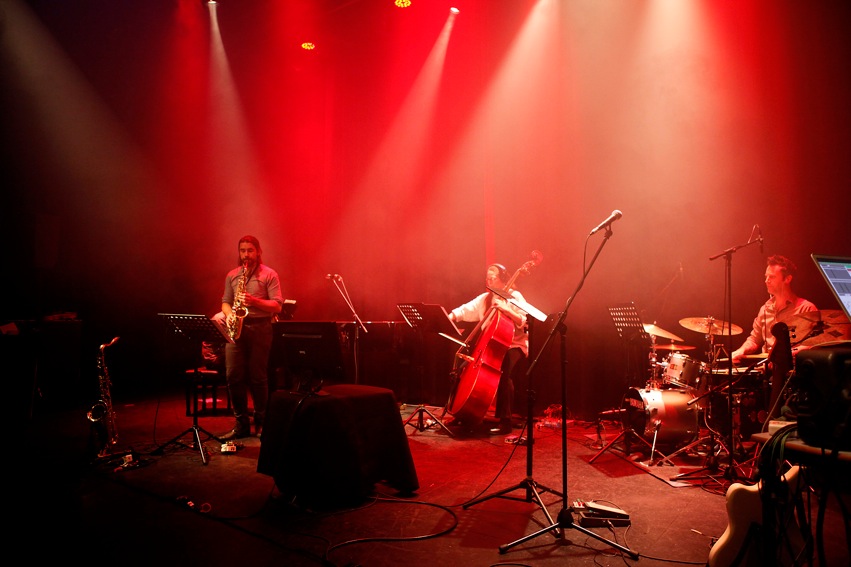
“Splits between real and faked instruments; a hyperactive zapping through styles and stereotypes” is how Hamburg composer Alexander Schubert describes his 2011 Superimpose Cycle for Jazz Quartet and Electronics. This whimsical idea was energetically realised in the work’s Australian premiere by the Argonaut Ensemble, comprising a hybrid instrumentation of piano, saxophone, violin, double bass, electric guitar, drums and electronics. Both the audience and musicians were seated on the dimly lit stage of Bendigo’s Capital Theatre, immersed in a hazy space that became home to disfigured saxophone solos, hammered piano notes and wailing guitar glissandi.

Schubert creates a dense and unpredictable cross-genre sensation by mixing traditional composition elements with the impulsive spontaneity of jazz and electronics. The musicians in Superimpose Cycle were guided by in-ear click tracks—quite a contrast to typical jazz gigs where performers are often reliant on eye contact and gesture to achieve cohesiveness. Even though the individualised click tracks created the appearance of a detached ensemble, the seven musicians maintained a palpable sense of joyous unity. Saxophonist Joshua Hyde and pianist Emil Holmström thundered vigorously through demanding passages of repeated notes, with minimal signalling and absolute synchronicity.

In the second movement, ‘Night of the Living Dead’, Anita Hustas explored the timbral possibilities of amplified double bass by alternating quick pizzicato stabs with weighty bowed tones, her smooth glissandos juxtaposed with electronics that bubbled with tension. Drummer Phil Collings joined in with a laidback jazz rhythm before launching into the complex patterns that propelled the work.

‘Infinite Jest’ exploded with a frenzy of crashing electronic waves that were initially a little confronting. As the floor rumbled with shuddering pulses, this density soon enveloped the audience in a cocoon of sonic experimentalism. Roaring and gnarly chords were driven to the forefront of this wall of sound by electric guitarist Kobe Van Cauwenberghe.

The evolving interplay between the live acoustic instruments and processed electronics was particularly intriguing. In the earlier movements, stuttering sound samples were interspersed with instrumental figures in a back-and-forth manner, like the musical equivalent of a tennis match. This divide became gradually less distinctive as the electronics instead distorted the real-time performance with reverb and effects.

Schubert wrote a series of computer processers to align with the timing sequence of the click track, so that new sound effects are implemented and withdrawn as the musicians reach certain points in the score. Heavily amplified violin featured in ‘Sugar, Maths and Whips’ with audible bow changes of a gritty, textural quality. Violinist Winnie Huang coped exceptionally with an unintentional technology glitch as the violin’s notes echoed in the sound system after a second of delay. Electronic musician Myles Mumford was on stage to control the running of the pre-programmed processors, and he explained afterwards that the unexpected delay was due to a processer adding latency where there should have been none. Although this was a computer error, it also became a functional musical feature that unknowingly embodied Schubert’s philosophy of there being little distinction between scripted sounds and indeterminate happenings.

To superimpose is to place one thing over another so that both items are still evident and identifiable. The Argonaut Ensemble achieved this by balancing myriad diverse sounds and textures as though they were coloured panes in a kaleidoscope. Beautiful textural patterns constantly rotated to create shifting overlaps of colour and sound in a thrilling performance of vibrant musicality.

Superimpose Cycle
The Argonaut Ensemble
Alexander Schubert
The Capital
6 September 2015
BIFEM 2015
Delia Bartle

BIFEM: Defunensemble, O Book of Returns

The audience arrives for Defunensemble's O Book of Returns. Photo by Marty Williams
The audience arrives for Defunensemble’s O Book of Returns. Photo by Marty Williams

Review by Simon Eales

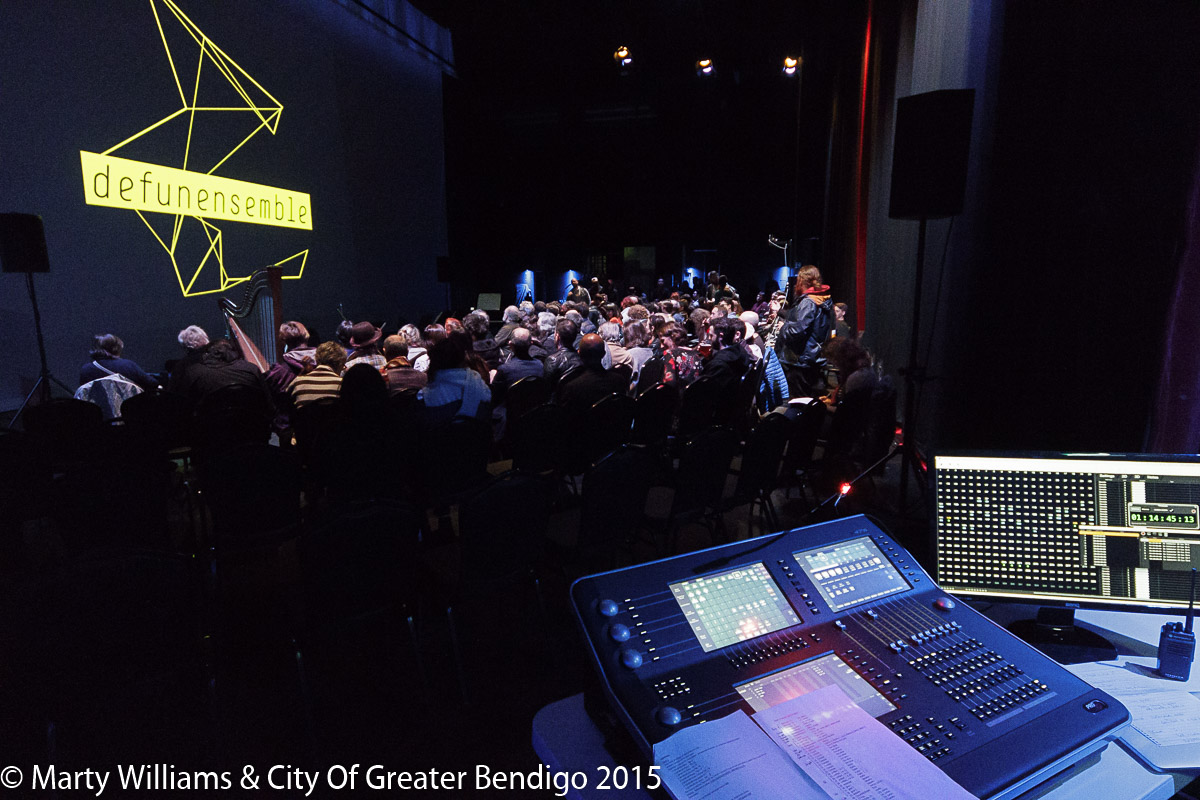
Helsinki-based Defunensemble presents a uniquely immersive experience in their debut Australian show. The audience for their Saturday night performance of Peter Ablinger’s Book of Returns (1985-2015) and Kimmi Kuokkala’s O (2011) join the performers onstage. Our backs to the house curtain, we sit beneath hanging cans, profiles and fly-bars; between legs, fly-rope and wings; lit by the low-voltage blue glow usually reserved for the stage-crew’s safe passage. It’s a remarkable atmosphere. With the Ulumbarra Theatre’s glistening newness, we’re lodged in the cockpit of some auricular sputnik.

Nowhere is this feeling clearer than in the distortional insistency of Kuokkala’s work. Before it begins, guitarist Sami Klemola—who shines in the group’s second program, All Finnish, the following afternoon—tells us that Kuokkala is known as the ‘shaman of Jyväskylä.’ Located in the lake district of central Finland, and identified as the country’s version of Athens for its cultural and educational distinction, Jyväskylä has its own mood which seems manifest in O. Klemola adds that Kuokkala’s work uses minimalism to create an atmosphere ‘of a certain kind.’ Such indeterminacy seems part of the seductive effect.

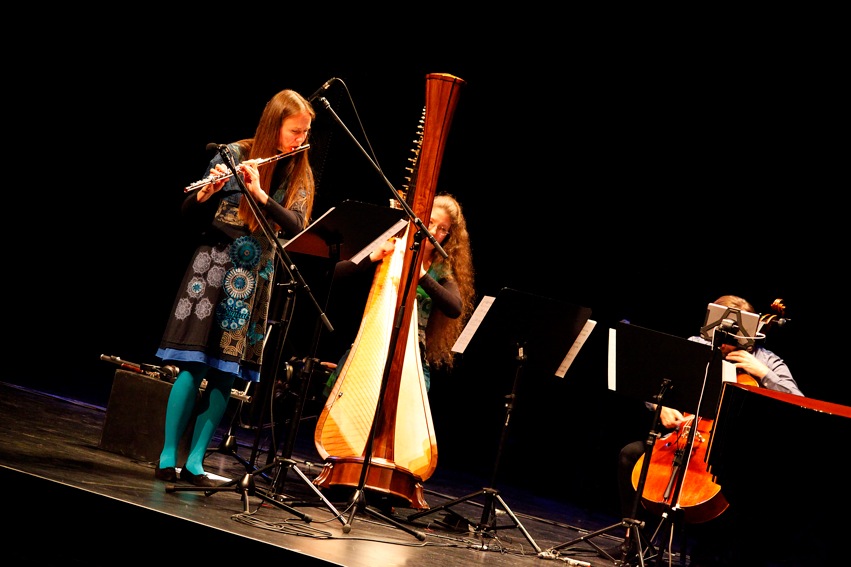
Lily-Marlene Puusepp works the top end of her harp in restrained but mesmerising rotations, accompanying Emil Holmström’s structural piano work. She rocks the instrument gently, hypnotically back and forth, letting grace notes drift into the realms of other instruments. Hanna Kinnunen switches between flute and bass flute, triggering a shift from tantalising revelation to calm. Her easy voyage through lower registers alongside clarinetist Mikko Raasakka’s stint on bass saxophone lends the piece its emotional resonance: affirmation and mystery carefully bundled together.

Markus Hohti’s performance on the cello, however, furnishes the piece with its dynamism. He takes frenetic escapades below the bridge, tearing hair off his bow. Arms in agitation, his over-bowing fills the piece with crunchy texture. It’s as if he’s plugged into a loop pedal, such are the driving waves of energy. One lasting image is of Hohti leaning into extended and aggressive spiccatto sections while Raasakka, sitting opposite, offers long and sonorous—almost doleful—counterpoint.

 Although there is no visual projection involved, O seems filmic. My mind conjures images of a scarily alien, but actually innocuous, leviathan floating and rolling through the air above. I imagine that we view it from strange angles and that the electronically generated, muffled public announcement-style sounds we hear are the inhabitants of this being speaking to us. This conjured vision is not the product of pure delusion; digital effects are a strong presence throughout. They distort the analogue instrumentation and add visceral chimes, gongs and the sound of a sword being swiftly drawn from a scabbard.

Peter Ablinger’s Book of Returns is presented first and primes us for this shamanic journey through its overtly metrical composition. It’s billed as a long-form work entirely constituted of 40-second cells of sound. The players arrange themselves in a line before us, and watch a small electronic timer behind us like hawks. In the first movement, they play individually until, when 40 seconds is up, they abruptly stop. Another player begins and does the same. When the musical baton is returned, the player picks up exactly where they left off. One of these modules involves Puusepp, not touching her harp, reciting very large numbers in hushed Polish. Another is Kinnunen reading a German philosophical tract. The effect is of a deconstructed soundscape in which multiple layers of sonic sense are created and seem to persist in unison, despite their sequential arrangement in time.

This is only the start of the fascinating formal games. Another module consists of silence. We all simply wait for the nominated duration to finish. We then get an extended section—it seems like longer than the other units—of the sounds of a city street scene. We learn afterwards that the group had placed microphones outside the theatre doors and were beaming the sounds of Bendigo into the theatre for us, live. Other elements drawing attention to the performance’s own theatricality expand the text into physical space and appeal to other senses: Hohti’s slaptick engagement with a retro tape deck, a pretend curtain call, Holmström’s strained vocal scale, and a geometrical animation projected on the scrim. Not for the first time at BIFEM, compositional experiments become fertile soil for an intensely arresting audience experience.

One senses that Book of Returns could continue developing and distorting for another twenty years and only benefit. In fact, the immediacy of its resistance to its own form almost demands that such an evolution take place. Putting these two works together seems destined, too. Ablinger’s work suggests that when form breaks, another form will always take its place. Kuokkala’s takes those breaks and provides a more sensual second option: a deeply connective shamanic journey, to which we all have access.

Defunensemble
O Book of Returns
BIFEM 2015
Ulumbarra Theatre
5 September 2015
Simon Eales

BIFEM: James Hullick, Rotation Post-Sapien

_MG_7021

Review by Jaslyn Robertson

In the centre of the stage, a bazaar of trinkets covers the piano. Our attention is first diverted, though, to a humbler setup on the floor where James Hullick begins Rotation Post-Sapien, his exploration of the sound world he’s brought with him to BIFEM. The sounds he begins with are child-like and ritualistic: the gentle tapping of a drum, rolling sticks over each other, a cymbal reverberating. Quiet groans escape his mouth. A large screen to the side of the stage gives us a simultaneous close-up of Hullick’s sound-making.

Soft moans accompany the artist’s move to the piano, inside which he places his camera so we have an intimate view of the arrangement of his materials. The inventory of objects in and on the instrument range from typical prepared piano settings, giving it a percussive sound, to hanging bells, bags of rocks and other objects outside the piano for Hullick to manipulate. While prepared piano is well established, Hullick creates a unique sound world, using it not so much as a melodic instrument but to create a natural soundscape. A golden elephant suspended above the piano strings swings gently in front of the camera. A tablet lies inside, placed so that electronic sounds can be triggered as Hullick plays.

The written score Hullick occasionally glances at suggests a pre-composed structure to the improvisation. As the work progresses, this becomes more evident as a cycling through emotions as well as an exploration and destruction of his carefully constructed environment. When he first sits at the piano, his movements are deliberately tentative, feeling out the sounds. The piano playing is initially percussive, but with a resonance that seems amplified. Now Hullick’s vocal tones transform into hissing and accentuated breathing, echoing through electronics while his use of piano and percussive objects becomes more frantic. The elephant’s circular movements are interrupted by increasing vibrations sending it swinging in all directions.

While many modern composers use pre-recorded music or soundscape to add to the texture of a solo or small ensemble performance, Hullick performs all his noises in the moment. Using only short samples and sound effects, he doesn’t impose on the highly responsive, emotional nature of his improvisation. He cleverly builds the texture with acoustic sounds as well, rolling a marble across the front of the piano into a drum, a sustained sound over which he can continue to play. The way Hullick plays the electronic sounds, and even the positioning of devices inside and next to the piano, prompt the audience to question as to the need for a strict distinction between electronic and acoustic instruments. Repeating rhythmic and melodic figures develop in the piano part while Hullick creates an electronic soundscape over the top. It doesn’t matter that he occasionally breaks his rhythm handling the two parts at once; it adds to the natural motion of the performance, something which wouldn’t be the same if he had a second performer playing the electronic component. Hullick makes a point of keeping the piece as human as possible by having complete control of all sounds–including electronic ones–at all times.

Sci-fi sound effects gradually make their alien intrusion into the environment, setting off a turbulent juxtaposition between the natural and the synthetic. Bleeps, squelches and futuristic laser noises push their way between prepared piano and bells. An indiscernible robotic voice makes the occasional foreign statement and a spacey synth melody is heard. Everything is now amplified, and the music makes its anxious descent into destruction. The mechanical mood of this section contrasts with the opening, as the introduction of a new category of sounds to music before it is understood enough to harness emotive possibilities. Technology appears to overpower the humanity of the prepared piano.

Hullick returns his attention to the piano with a changed attitude. His once careful, calculated movements seem to have been transformed by a fit of rage as he throws around objects inside the instrument. A spidery metallic device is violently tossed across the strings, dislodging screws and bells. The elephant almost swings off its chain in the entropy. Piano strings hit forcefully with mallets set off a cymbal, producing a crashing wave that dominates the space. Red lights flare across the stage as Hullick cries out, his voice piercing through the chaos of both piano and electronics.

Then, a cathartic restoration. Wailing turns into pained sighs. The stage turns blue. The computer-like female voice, once too distorted to identify, echoes ‘Time’. Hullick carefully returns to the initial soft exploration of the beginning, sussing out the altered positions of his objects as well as the changed emotional atmosphere of the room. ‘You’, chants the voice. The work ends with Hullick seated cross-legged on the floor again, turning over sticks and rocks in his hand.

Both prepared piano, electronic synths and samples are concepts that were once new but have now become commonplace, almost historical. Hullick places them in what feels like a post-apocalyptic landscape along with his raw vocals. Stripped of shock value, prepared piano and electronics–as well as sound art–gain the capacity to become more emotive, completing their rotation from something alien to overwhelmingly human. With ‘Rotation Post-Sapien’, Hullick combines and re-invents musical relics from different periods in a ritualistic exploration of human emotion.

James Hullick
Rotation Post-Sapien
BIFEM 2015
The Old Fire Station
6 September 2015
Jaslyn Robertson

BIFEM: Argonaut Ensemble, Sur Incises

The Argonaut Ensemble perform Boulez's Sur incises. Photo by Marty Williams.
The Argonaut Ensemble perform Boulez’s Sur incises. Photo by Marty Williams.

Review by Jaslyn Robertson

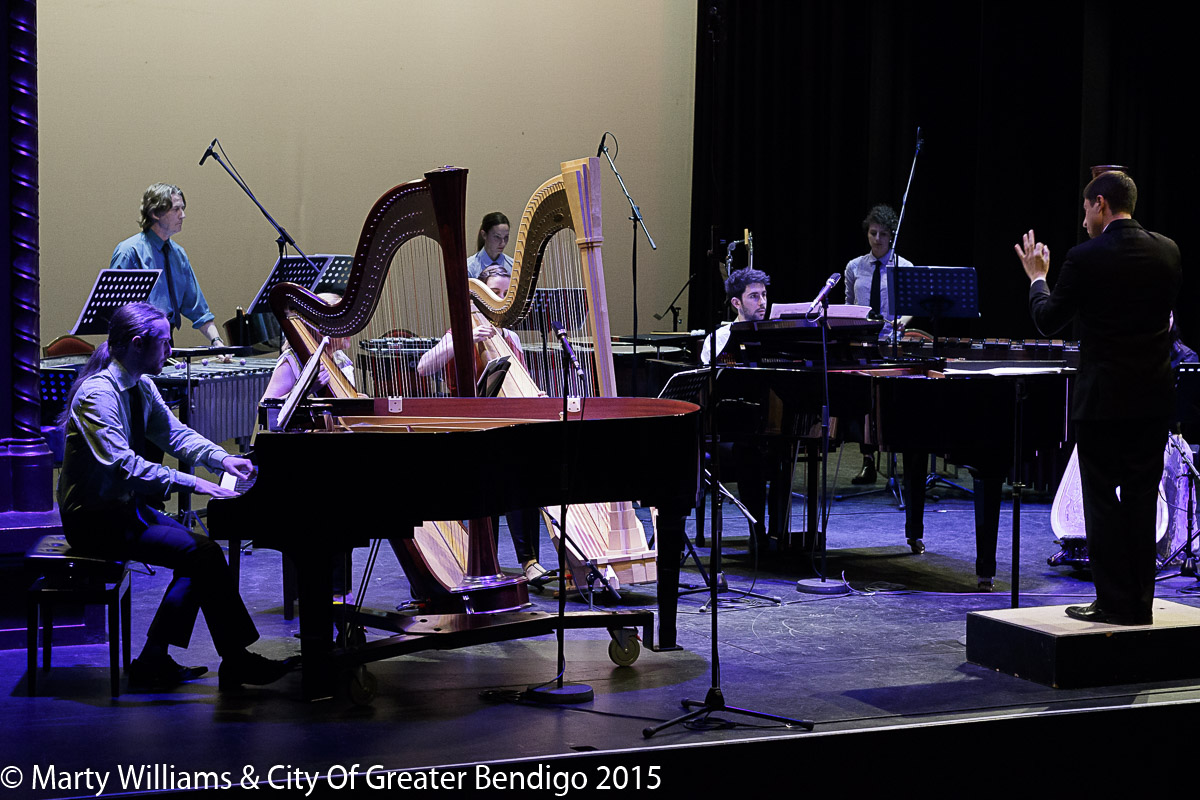
The stage layout for Argonaut ensemble’s performance of Boulez’s Sur Incises sculpts an image of the sound world to come. Three pianos at the front of the stage are shadowed by three harps—extensions of their resonant strings. Behind, three batteries of tuned percussion give physical form to that ringing resonance that hovers above the music. The lush garden of sounds Argonaut ensemble evoke in their performance of the 1998 work reflects with purity Boulez’s orchestration and texture. The eclectic instrumentation may limit performances of the work, but the collection of timbres allows for a distinctive fluidity between instruments, with harps and vibraphones becoming extensions of the piano.

Conductor Eric Dudley and the ensemble were clearly aware of the importance of decay throughout the work, and exploited this thematically. This is epitomised in the final moment of the concert, when Dudley holds the audience in silence until well after the last note dies out. There’s an ethereal harmony heard in the resonance of three separate chords ending each pianist’s run. The ringing tones of vibraphones, crotales and steel drums hang in the air in moments between dense activity. Boulez’s orchestration disguises the attack of one instrument in the decay of others, blurring the distinction between instruments. Dense piano clusters reduce to reveal a gentle harp melody or crotales take over to continue an ascending passage as a pianist reaches the top end of his range.

Alternation between precisely timed rhythmic passages and aleatoric gestures are a defining feature of the piece. At times, the music lingers in one mindset for a while, as in the fast, strict toccata of the first movement. The musicians in this performance perfected both technical rhythms and interpreted grace notes—unmeasured notes which allow for flexibility. On the latter, the conductor signals only a starting point after which each performer decides the timing of the notes, creating a gentle falling away of sound. The smooth contour of the work was not lost in these parts, a credit to the ensemble’s ability to give expression without hesitation while maintaining coherency.

The performers were not only individually virtuosic, but worked well as an ensemble. Moulding the individuality of their playing, the three pianists often worked to create the same kind of timbre, even at times sounding as one instrument. There was also a sense of timbral continuity between different instruments, with the pianists gently caressing the keys to evoke the sound of harp glissandi or playing low rhythmic passages to imitate marimba.

The ensemble lost no expressivity in this accurate performance of a technically demanding piece. The natural cohesion between conductor and all ensemble members was felt by the audience. A well-rehearsed and knowledgeable ensemble held together a piece that relies on moments of chance indistinguishable from strictly notated passages. Argonaut’s interpretation of ‘Sur Incises’ was a highlight of the festival.

Sur Incises
Pierre Boulez
The Argonaut Ensemble
Bendigo International Festival of Exploratory Music
The Capital Theatre
5 September 2015
Jaslyn Robertson

Boulez

Argonaut

BIFEM 2015

BIFEM: Defunensemble, All Finnish

Defunensemble perform at the Ulumbarra Theatre. Photo by Jason Tavener

Review by Charles MacInnes

A thread running through the festival weekend was the artistic and philosophical challenges facing composers and listeners when images and sound cohabit a performance. A panel at a Composer Colloquium had discussed this earlier in the day and it was a recurring theme in those quick and energised exchanges you have right after a concert, whispered between pieces, walking to the next venue or waiting for your coffee or wine.

Tonight, I had no idea what would unfold, had never heard Finland’s Defunensemble before and knew none of the composers or works. In contrast to many other performances over the weekend, this All Finnish concert made no use of projected images. But, like the single letters, words and sentences of a novel that unfurl and re-form to become lives and your own experiences, the performance was one of the most rich and visually potent I’ve attended. This was international exploratory music, and tonight Defunensemble nailed it.

Juhani Nuorvala’s Ruoikkohuhuilu (2014) begins with Hanna Kinnunen (alto flute) appearing in aquamarine colours out of a dark and gentle crest of pre-recorded sound designed by Anders Pohjola and Timo Kurkikangas (electronics). The flute outlines the open building blocks of chords as if glimpsed through cloud, before descending as a sallow Nordic counterpart. The crescents become glassy and shafts of whole tones are harvested, before drifting away again into the light. It stings a little as you get close, but like the tide Kinnunen returns from whence she came. This was a breathtaking and gentle prologue that kept itself just far enough away from becoming ambience.

In Ville Raasakka’s Erinnerung (2010), the harp (Lily-Marlene Puusepp), clarinet/bass clarinet (Mikko Raasakka), cello (Markus Hohti) and piano (Emil Holmström) join the flute and electro-acousticians. The players wore headphones for audio synchronisation which allowed them to take part in an extravagant internalised reminiscence. An entire lifetime is recalled in a quick succession of darting textures and contradictions. Beginning with a cubist burst of repeated tones, relationships begin to form only to disintegrate. Harp sides with reinforced piano, but then piano switches to join flute, so harp teams up with cello, while the breath of the bass clarinet intermingles with high piano and cello grinds to a stop. More solid structures build now, but these teeter and need recalibrating. Characters become more mature and the conversation less pushy; three is no longer a crowd. But the tensions of earlier times are not forgotten altogether with the clarinet’s air and cello’s scratch silenced by close-voiced piano repetitions. Hang on, was that an entire life or just one weekend?

The relativity and ambiguity of time are further explored in Perttu Haapanen’s Doll Garden (2013) for the same instrumentalists as in the previous work. The acoustic musicians at first represent the thoughts and gaps between the spelling out of the track, which is triggered via the flautist’s foot pedal. The individual keystrokes of a typewriter start off well, but hesitations and corrections increase as the paper gets wound backwards and ackspacebackspacebar and spa ace bar, leeeetterskeyyyyyyyyystart arts___ _xxxxxx xxxrepeating. With paper tearing loose and the platen cogs giving way, we enter a slow dance as the bell at each carriage end carries us round the room. When we open our eyes again, life’s become a high-speed connection and it’s oftentimes turbulent and too fast for our thoughts to keep up. We try to recall and recapture a time when sounds lived on vinyl and the words of a book carried a particular smell. But despite using a QWERTY keyboard to talk to a computer, it’s not the same machine. The bass clarinet and flute hang in the air and I’m wondering what the pact is between artificial intelligence and vintage technology.

For Niilo Tarnanen’s Kään (2014) the group pares back to harp, bass clarinet and piano, though with a new microphone position to pick up subtle piano transmissions. The ambient track begins with static prior to both harp and the low register of the inside of the piano producing pings of sound along the copper wire wrappings of the low strings. I’m deep inside circuits and I feel currents flowing hither and thither; the bass clarinet emits a few sinewy charges and there is a strange order to the random spreadings and impulses. Being so close to the components makes it hard to navigate, but I feel we are approaching a nerve centre of sorts. The switches and plucks and battery stings to the tongue are synapses to other worlds. Towards the end we sense a twisting of some giant undersea cable and catch a fleeting glimpse of the meniscus above.

The full ensemble returns for the final work in the program—Feed (2013) by Sami Klemola, who joins the group on guitar. He checks his signal through a massive Marshall amplifier; this cheeky response lets the audience know straightaway that we are in for a feast. Of everything I heard over the weekend, this piece was one of the few that showed how freedom and spontaneity can lend a work a burst of creative expression. An organised structure and well controlled timings allowed the players a permissiveness that sent shivers through the audience. The guitarist as ringleader teases and incites the others to join him. The rapid and chaotic improvisation of the opening gives way to a shock unison that morphs into a cluster and snaps off again. Squelching downbeats from the band accompany an extraordinary trade-off between guitar amp buzz and flute air. After five shots, the anarchistic figures begin again but even thicker and darker than before. After this subsides we arrive at the highlight of the work. On cue, the players launch into rhythmic unison three-note figures over and over with pauses between each set. To my ear these are not fixed notes but “any pitches”. In the gaps, guitar fills are the pin pricks of sound produced behind the pickup. As the three-note figures continue—together but always shifting in frequency and pitch—they turn into background to the guitar which now evolves into a full blown exploration of phased hisses, buzzes and scratchings.

As the final “free” section of Feed restarts, I ‘see’ it through a different lens. Like traffic from afar it seems an impenetrable wall of noise, but up close it is hundreds and thousands of tiny and equally valid movements and transactions. Even when sirens wail, each goes about its own business, all but trying to hold onto a delicate and fleeting farewell. So drew the 2015 Bendigo International Festival of Exploratory Music to a close. Defunensemble’s All Finnish was a textbook example of what makes a spellbinding concert. This team gave us discernible structural signposts, pieces with cogent emotional intent, huge spectrums of sonic variation, lively and committed playing and a flawless sound design.

All Finnish
Defunensemble
6 September 2015
Ulumbarra Theatre
Bendigo International Festival of Exploratory Music
Charles MacInnes

BIFEM: Argonaut String Quartet, 4x4x4

Review by Angus McPherson

‘Did he know he was going to make this piece crazy?’ A child’s voice comes through my ear-piece over the sounds of the Argonaut Quartet performing Christophe Bertrand’s Quatuor No.1. The ear-piece and radio are part of Soundtracks, an art intervention by St Martins Youth Arts Centre providing live commentary to Bertrand’s music by young artists between the ages of eight and twelve. Bassi, Satchmo and Anh are my commentators and they guide me through the quartet, much like a DVD commentary (though less intrusive).

Before the quartet commences, the children explain that they know three things about Quator No.1: that it was written by Christophe Bertrand, that Bertrand died by suicide at the age of 29 and that there were originally nine movements, but two have been lost. The knowledge of Bertrand’s suicide, a heavy and complex topic for such young children, obviously colours their interpretation.

The images they use to describe the music are highly evocative: the pizzicato of the first movement is the ‘pitter patter of rain’ and as it intensifies it prompts a story of being caught in an out-of-the-blue hail storm. The ending of the movement is compared to a snowball rolling downhill that seems like ‘it’s going to explode or collapse, but when it gets to the bottom it just sits there’. The fourth movement, full of droning strings and pitch slides, sounds like ‘wolves howling’ at the edge of a cold, dark forest, and the slow glissandos and microtonal shifts in the sixth movement are ‘like a baby crying’. The music of the melancholy fifth movement sounds like it ‘keeps reaching and falling down’.

Interspersed with these responses to the music, the children tell me the questions they would like to ask the composer, such as: ‘What was his first memory of a connection to music?’ as they try to put together ‘the pieces of the puzzle that would help us understand him’. In answer to the question ‘what does it mean?’ they sadly conclude, ‘we can only guess’.

There are also lighter moments. The actions of the players in the dance-like second movement resemble ‘yanking a tooth out’ and Judith Hamann’s cello technique in the third inspires a story of whisking cream to have with strawberries. Members of the quartet are compared to wound up ‘mechanical toys nodding their heads and moving their arms’. The children’s observations of the music are remarkably astute, drawn from their own experiences. Independently moving parts are compared to students packing up their bags at the end of a day at school, some are faster and some slower, some have more things to pack up, some have less.

As the drama of the music builds to its climax in the final movement, static fuzzes through my earpiece and I only catch the words ‘storm brewing’ and ‘really wild’. The end of the quartet fades away slowly, ‘like dust blown off a surface, leaving nothing’.

The concert had begun with Kimmo Kuokkala’s Kirvis, a work of bouncing bows, scratchy rustlings, ending on a pure crystalline high note.

The world premiere of New Zealander Dylan Lardelli’s Mapping, an inlay follows the Bertrand, and gradually unfolds like a landscape coming into view, recorded in precise detailed lines. The meditative sound world is made up of gentle dissonance, dull hisses, papery harmonics and warbling strings.

4x4x4 finishes with Stefano Gervasoni’s Six lettres à l’obscurité (und zwei Nachrichten) or Six Letters to Obscurity (and Two Stories). The obscure letters, one for each movement, spell the name Claire (the deliberate irony is that this also means ‘clear’ in French). The story movements are inserted after the letters ‘l’ and ‘i’. The music swings from atmospheric noises to upbeat folky passages and the movement ‘r’ stands for ricecar, Gervasoni quoting Girolamo Frescobaldi’s Recercar chromatico post il Credo for organ in an arrangement where the edges are frayed with distorted timbres and shrieks.

The Bertrand quartet with art intervention from St Martins was certainly the most affecting work on the program. While the commentary distracted from full immersion in the Argonaut Quartet’s performance, it did provide a fascinating insight into the response of children to music. Wise and empathetic, the commentators coloured my own response to Bertrand’s quartet, and added layers of meaning and depth to the experience. That said, the sudden (if altered) tonality of Frescobaldi’s ricecar in the Gervasoni provoked an unexpectedly powerful frisson, coming at the end of a weekend full of exploratory music.

Argonaut String Quartet
4x4x4
The Bendigo International Festival of Exploratory Music
Bendigo Bank Theatre
6 September 2015
Angus McPherson

BIFEM: Inventi Ensemble, Urban Gypsies

Inventi Ensemble perform Melody Eötvös' House of the Beehives. Photo courtest of the artists.
Inventi Ensemble perform Melody Eötvös’ House of the Beehives. Photo courtest of the artists.

Review by Charles MacInnes

From the initial notes of Saturday’s Inventi Ensemble concert, I was struck by the excellent quality of sound produced—the tonal integrity of the acoustic instruments was consistently the central focus and the electronic material was expertly integrated. The Stratagem Studio at Bendigo’s Ulumbarra Theatre was the ideal space for sonic and visual close-ups of the flute’s inner workings, the struggles of the Roma people near Berlin, Gauguin in Tahiti and the lives of bees. Listeners were invited into an abundant world of imagery—part projected, part imagined.

In Passages (1979) by Jean-Claude Risset, Melissa Doecke’s solo flute interacts with a quaint episodic array of late 1970s electro-acoustics. By switching between the standard flute, its head joint alone, and the piccolo, Risset uses sound to creatively outline the workings of the harmonic series in music. His pioneering research into sound synthesis is apparent as we are reminded that perception of pitch is a response to changing frequencies. The samples were unpretentious, and each event occupied its own tonal area with certainty. The music travelled through changing air streams, touched on a hard-surfaced interlude, before bouncing off more disparate tonal language which was in turn stilled by vocal light at tunnel’s end.

Urban Gypsies (2005) by Johannes Kretz for oboe, electronics and film (by Laszlo Moholy-Nagy, 1932) documents and musically narrates the lives of a group of Roma people living on the fringe of the city. Ben Opie’s mournfully pleading oboe conjures faces and words that become more forceful as images of grass and dirt give way to concrete and traffic. Disputes play out as trams and cars vie for prominence while the cries and honks of the oboe are the heart-wrenching anguish of animals being haggled over. People’s futures and pasts are also traded as the well-heeled are offered palm readings to the sound of vinyl cracklings and the oboe’s key clicks. As dice hit a beer stained card table, a tussle ensues which a plaintive child observes, perched upon a fence. A barrel of booze is rolled towards a celebration where women let down their hair and children horse around in dress-ups. The band is at full tilt and the couplings are blurred by fiddles, trills and multiphonics. With Hitler’s rise to power just a year away, I can’t help wondering what fate awaited these poor people.

Forty years earlier, Paul Gauguin made his first journey to Tahiti where, along with some of his most famous paintings, he produced a woodcut and travelogue both with the title Noa Noa. Kaija Saariaho’s 1992 work of the same name has become a standard work for flute and electronics, borrowing material from Gauguin’s text. Stage whispers are skilfully combined with quarter-tone recitations, air sounds and multiphonics. Doecke has throughly absorbed the composer’s stance on extended techniques and they are brought to life as the natural extensions of fragrant breath and song. This piece is an excellent example of how sound alone can create a rich and beautiful world of imagery.

The final work in the program, Melody Eötvös’ House of The Beehives (2015) was commissioned by lawyer and human rights activist Julian Burnside. The current ecological plight of the bee population is explored here with flute, oboe, electronics and film. With its many blackouts and white flashes, saturated tree-scapes, and close-ups of flowers, the film was a little too reliant on effects, while the music swayed between evoking Celtic chants and upbeat hocketing. The combination left my imagination little room to roam—would simpler footage and greater exploration of the harmonic and textural vocabulary create a more poetic end result?

Inventi Ensemble’s Urban Gypsies illuminated many opportunities for multi-disciplinary artists wishing to combine images with sound. Which should take precedence, and how do they interlace to form a clear artistic statement? Perhaps works that are semi-improvised, or composed re-imaginings of obscure or abstract stories, have a greater chance for audience receptivity. They, like readers, are willing to fill in the gaps, imagine the backstories and even glance away to see where else they might be transported.

Inventi Ensemble
Urban Gypsies
5 September 2015
Stratagem Studio, Ulumbarra Theatre
Bendigo International Festival of Exploratory Music
Charles MacInnes

BIFEM: The Amplified Elephants, Select Naturalis

Founding Amplified Elephants member Kathryn Sutherland demonstrates the RESONANCE table for the audience after the concert.

Review by Simon Eales

The lights are dimmed already, giving this small but regal room in Bendigo’s Capital Theatre a warm, apricot hue. The dull glow offsets two veiled television-sized monitors placed on a ledge above the five black-clad performers. We sit around what looks like an overhead projector: a large horizontal screen with an optical lens perched on a stem above it.

These performers are the Amplified Elephants, a sound art group based in Footscray whose members live with intellectual disability. Formed in 2006 as an offshoot of the sonic art collective The Click Clack Project, they have created a diverse range of projects using experimental techniques to evoke soundscapes and make performance art from new technologies, prepared traditional instruments and found objects.

This debut of their latest work, Select Naturalis, showcases a remarkable new piece of technology developed by Jonathan Duckworth in the CiART program at RMIT. The room’s central piece of equipment is in fact a large digital touchscreen tablet: images appearing on its surface are captured by the camera lodged above, and displayed in real time on the room’s two monitors. In developing the performance, the Elephants programmed a range of acoustic and digital sounds into the tablet’s software. They trigger these sounds in performance through tactile engagement with the interface.

Guided by Artistic Director James Hullick’s gentle prompts, performers improvise short solo sets. The piece builds in the first movement with Jay Euesden’s concentrated, space-activating pokes and Teagan Connors’ broad, multi-fingered glides. In the second movement, following an extended drone, Kathryn Sutherland masterfully drives the piece to peak intensity. We hear squelching, screechy and swampy sounds; an array of tropical bird-calls; excited human hollering; and a medley of straw-sucking and blowing. With one or two measured looks, Robin McGrath invites the audience to engage on a more personal level with this act of the creation.

The ensemble place and adjust hand-sized coloured blocks on the screen, which triggers trippy tie-die swirls and graphics evoking a cell nucleus and its spinning electrons. Upon tapping, the electrons shoot along lines extending mandala-like from the base of each block to synapse with the lines generated by others.

The cellular representation here, in the tablet’s graphics, thematically coheres with the piece’s other key symbols: the title, referencing Charles Darwin’s notion of natural selection; the male voiceover which challenges those readings of Darwin which promote the notion of ‘survival of the fittest’ over other less reductive understandings of how humans have evolved; and the prerecorded backing track, which forms a foundation for the semi-improvised performances. A striking example of this backing track’s effect occurs in the piece’s opening moments. Before there’s any action, we’re enveloped by a loud and low, dubbed hum from the surround sound system. It holds a tightly looped rhythm, as if an old computer program scrolling through endless options. Or, more ominously, is stuck on one option. Either way, no selection is made.

This symbolic system suggests that while genealogical science might be undeniable, we should not let it limit the infinite ways we can practice art. Perhaps more importantly, it suggests that our continued evolution, including our ability to adapt to conditions like climate change, depends on acknowledging biological capacities we may already have developed, but ignored. It’s a perspective which links this performance text closely to the raison d’etre of the group performing it. If the Elephants, as bearers of intellectual disability, are the ‘elephants in the room,’ their amplification of that position represents their way forward, which is actually a way in. As the voiceover says, ‘meta-listening,’ a biological feature perhaps developed by our distant ancestors, involves just such a process of shining awareness on the functional, and the willingly unseen or unheard. Select Naturalis seeks to metaphorise that awareness and, it seems, achieve real social affect: community, inclusion, technological progress and ever-better names for things.

Select Naturalis
The Amplified Elephants
The Bendigo International Festival of Exploratory Music
Bendigo Bank Theatre
Simon Eales
5 September 2015