All posts by matthewlorenzon

Unknown's avatar

About matthewlorenzon

I'm a Melbourne-based musicologist and music-writer interested in contemporary music, music theory and philosophy.

A musical reply to violence against women

12910250_10154051869826672_170531850_n.jpg
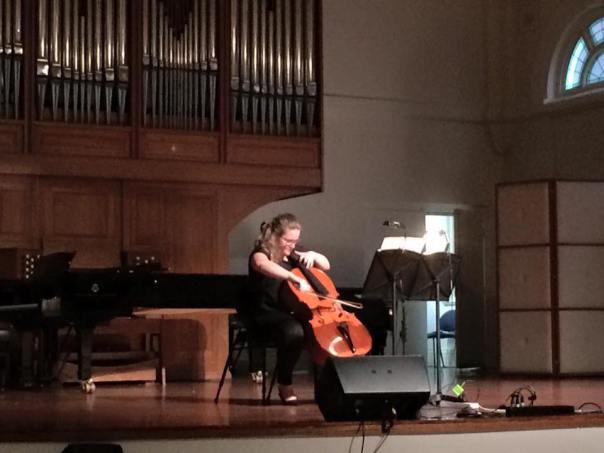
Gemma Tomlinson performs alongside the voice of Kaija Saariaho in Lisa Cheney’s When we Speak.

This year’s International Women’s Day saw institutions and individuals around Australia actively intervene in the contemporary music scene in the interests of gender equality. Today (just as a couple of years ago when gender equality was addressed on this blog) around a quarter of the composers studying, represented in concerts, and represented by the Australian Music Centre are women. As Delia Bartle wrote for Limelight Magazine, The Sydney Conservatorium’s new National Women Composers’ Development Program seeks to boost this number by providing emerging composers with two years of intensive mentorship followed by a prestigious commission. Lisa Cheney and Peggy Polias from Making Waves curated a special playlist featuring women composers including Clare Johnston, Maria Grenfell, Annie Hui-Hsin Hsieh, among many others.

In Melbourne, the composer Samantha Wolf produced a concert fundraiser for the Safe Steps Family Violence Response Centre. Entitled This Will Be Our Reply, the concert featured five thoughtful responses to the theme of International Women’s Day and violence against women in particular. Each of the five composers eschewed clichés to present an original musical response to these themes.

“Shrill, pretty, abrasive.” In Hystericus—and other (mostly) women’s words, Alice Humphries uses the language of contemporary music—its squawking, gritty vocabulary—to make the audience think about words often associated with women. In doing so, Humphries has created one of the most conflicting situations for the listener since Shostakovich’s Fifth Symphony. A listener sympathetic to grating and buzzing extended techniques may draw comparisons between criticisms of contemporary music and misogynist language. “Too loud and complex!” “But you are choosing to focus on only particular, difficult pieces of music,” the audience member might counter. Or they might offer my favourite response (misremembered but courtesy of Adorno) “maybe you understand contemporary music too well, because it is speaking about real problems.”

A misogynist audience member (keeping in mind that misogyny and a taste for contemporary music are not at all mutually exclusive) might instead bring up the Lacanian dynamic of the Master and the hysteric often associated with the relationship of the critic and the artist. No matter what explanation or interpretation the psychoanalyst gives to the hysteric’s words, they will always counter “that’s not it.” “Exactly!” The misogynist new music skeptic might respond, “It is in the nature of both contemporary music and women to be unreasonable, repetitive, and exhausting!” In her program note Humphries doesn’t offer an interpretation of her own but lets all of these subject-positions linger in the air. Whatever your interpretation the compositional experiment was extremely satisfying to the ears, with two thirds of Rubiks Collective (Tamara Kohler and Gemma Tomlinson) teaming up with the rich tone of Kyla Matsuura-Miller’s violin and Aaron Klein’s bass clarinet to run a gauntlet of musical textures and moods.

After playing on stereotypes of women’s voices, Lisa Cheney brought us the voice of a woman, indeed, one of the greatest living woman composers. Cheney’s When We Speak combines live and prerecorded cello with a manipulated recording of an interview with Kaija Saariaho. While Saariaho’s voice is usually manipulated for its sonic value, moments of Saariaho’s reflections on gender politics in the music industry are clear. Cheney’s resonant electronics part is an atmosphere of unfathomable spaciousness. Clouds of voice fragments swirl around the space along with clouds of her solo cello composition Sept Papillons. In the middle of this environment the cellist Gemma Tomlinson struggles to be heard, playing strings of extended techniques with her characteristic commitment and control. At times the live cello becomes one with the prerecorded track or has a fleeting solo moment. This piece could be heard as a solo woman struggling to be heard in the male-dominated music scene, except all of the samples are of women and the piece is composed by a woman. It could also be heard as a woman engaging or even struggling with the history of women composers and the weight of Saariaho’s legacy. The piece ends with one solution, in Saariaho’s voice: “Create something personal because that’s the only thing that counts.”

Kyla Matsuura-Miller returned to the stage to perform Jessica Wells’ Sati and Satya, a two-movement piece for piano and violin inspired by Buddhist notions of “mindfulness” and “truth” respectively. The piece relates in a very concrete way to the concert’s theme, the first movement being composed for HSC students and requiring a certain tonal restraint. The “truth” movement expands on these restrained ideas in a more personally meaningful way for the composer. The composer likens this process to the way she finds herself moderating her behaviour to suit social norms and the difference between one’s “inner” and “outer” selves.

May Lyon’s On the Inside begins with a similar duality before expanding on this theme in multiple directions. The piano trio for flute, clarinet, cello, and piano is a journey of developing harmonic and rhythmic nuance. From simple thematic beginnings the piece gathers colour, variety, and character. Beneath this fine instrumental writing is a sophisticated critique of notions of beauty and gender roles. The piece’s title, On the Inside, suggests a binary between inner and outward  beauty, but the composer is quick to point out that many conventionally “beautiful” moments in the piece have been retained because “perceived beauty is not something to be ashamed of or feared.” Instead of simply busting the binary of inner and outer beauty, the piece explores “a woman’s life, from growth to complexity (as opposed to innocence to uselessness).” Lyon also contrasts the view of a developing, rich inner life to other supposedly emancipated, developmental views of a woman’s changing social value as maiden, mother, and crone.

Samantha Wolf’s The More I Think About It, the Bigger It Gets closed the evening with an affecting theatrical gesture. Footsteps resound through the speakers while Kohler, Tomlinson, and Matsuura-Miller attack their instruments with darting gestures. Audio samples from news reports and talk-back radio describe acts of violence against women, placing the blame on women’s shoulders. The program note described the footsteps and musical gestures as representing a woman walking home at night and the fears and received rhetoric that swirl around her mind. The tension was palpable, showing yet another way in which the techniques of contemporary music can be used as critical tools for interrogating issues of gender and violence.

This Will Be Our Reply
A Fundraiser for the Safe Steps Family Violence Response Centre
Melba Hall7 March

Alice Humphries, Hystericus—and other (mostly) women’s words; Jessica Wells, Sati and Satya; Lisa Cheney, When We Speak; May Lyon, On The Inside; Samantha Wolf, The More I Think About It, the Bigger It Gets.

Do You See What I Hear?: If I am a Musical Thinker

CarmenChan_If_I_am_a_Musical_Thinker_LaMamaMusica2016_imagebyAdamCasey.jpg
If I am a Musical Thinker. Photo by Adam Casey

The latest installment in Carmen Chan’s experimental music/visual art/performance art project Do You See What I Hear? took place on someone else’s stage. La Mama squeezes its music series around the scenery and props of current productions, leaving Brigid Burke’s projector, Warren Burt’s tangle of electronic gear, Adam Simmons’ arsenal of wind instruments, and Chan’s cello intimately perched in front of an enormous screen.

The American composer Benjamin Boretz originally wrote If I am a Musical Thinker in 1981 for his graduate students at the University of Texas. The aesthetic, social, and spiritual credo is one of the most influential documents of 1980s experimental art and was here spoken by Clinton Green alongside improvised music and video.

I have to confess that I haven’t had the pleasure of reading Boretz’s text. It wasn’t part of my own graduate program and I haven’t had the opportunity to chase it up since the concert. As such, what follows relates only to what I remember from the concert and is probably a misrepresentation of Boretz’s actual words.

The text begins with a phenomenological epoché, a momentary suspension of all preconceptions about musical experience. “If I am a Musical Thinker,” the audience heard, “I want to know what it is I am thinking about.” The musicians strike up a beautiful and spacious atmosphere: whisper-soft clarinet, rubbed clay pot and the odd electronic sound. Boretz heads straight for a teleological or ends-oriented definition. Music is a medium of expression. Like Leonardo DiCaprio in The Revenant, Boretz begins If I am a Musical Thinker at the farthest reaches of his journey and then has to find his way home by an unfamiliar route (but hopefully in less horse carcasses). If music expresses, what does it express? Identity. How? In one of my favourite lines Boretz asserts that expression is not just “raw evacuation” of identity. Instead, we form our selves in relation to and through pre-formed musical conventions. Boretz posits a dialectical world of musical discourses negating one another. Against this headlong pitch into abstraction a recording of Boretz’s text is layered and amplified in a trippy web of voices.

Eager to return the individual into the mix, Boretz turns to the experience of listening to these discourses. When we listen we recompose the music we hear, reacting to it insofar as its forms are already within us. For this performance Burt has sonified the ink blot illustrations throughout Boretz’s text and turned them into a bank of different sound effects. Like ink blots, we try to match music to our ever-evolving and complex bank of musical experiences. In this way “music,” Boretz argues, “expresses us.” I understand this in the same way that something enrages us. The external object resonates with a pre-existing bias. We do not use the term “enjoy” in the same way (one enjoys something, not the other way around), though I think it would be nice to say that a piece of music “enjoys us.”

The essential musical unit is then not the musical work, but the musical occasion where this magnificent process of reflection-recomposition takes place. The reason for the musicians’ live semi-improvised performance then becomes clear. While Boretz is arguing that all musical experience follows the model of the musical occasion, an improvised performance provides the opportunity for a form to be dredged out of one consciousness and—hopefully—communicated to another. The black and white drawings and text of Burke’s projections give a hallucinatory, half-significating feel to the swirling mass of musical forms taking place before us.

Boretz opens the discussion out, making some judgements about music education. He claims that in the brow-beaten world of conservatorium education the urge to express oneself is transferred on to the need for external approval. Discipline replaces engagement. And so Boretz finds his way home a little wiser and a little bloodier, claiming that his original decision—that music is expression—is important because expression is the key to our musical salvation.

But this is precisely the problem with Boretz’s method. His return journey is only used to justify—rather than question—his original decision. This method will be familiar to anyone who has walked to a 7-Eleven for milk and returned with a jar of Nutella. When Boretz set out on his thinkspedition he already knew deep down that he wanted Nutella, so that’s what he got. Evidently he had pre-formed opinions on the hot-housing methods of some music institutions and fabricated the scenario of an unbiased phenomenological investigation to bolster them. I would like to see this text turned around. A future Do You See What I Hear? performance could start at the end, looking for the reasons behind musician burn-out. They could ask why musicians emotionally disengage from their musical experiences when placed in a highly critical environment, coming to the conclusion that they have divorced their need for musical expression from their musical practice (it all seems fairly redundant and self-explanatory this way around doesn’t it?). Then, instead of the walk of shame, they should walk straight out into the wilderness asking the tough questions: Are composing, playing, and listening really comparable experiences for the individual? How about for different people? To what extent can two people claim to have the same musical experience? Does Boretz discount experiences that we might like to call “musical,” but which do not correspond to affective states at all? These are huge questions raised by just the first sentence of Boretz’s text. I think I’ll leave them until I get back from the shops.

If I am a Musical Thinker
Do You See What I Hear?
La Mama Courthouse Theatre
15 February 2016

Australian Art Orchestra and Ensemble Offspring: Exit Ceremonies

AAO-ExitCeremoniesConcert_IMG_2681_MiaForrest.jpg
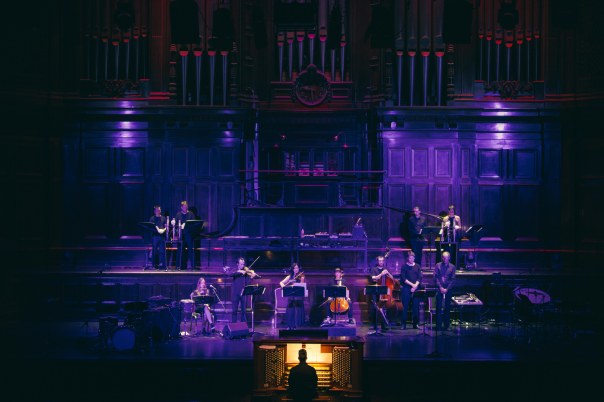
Ensemble Offspring and the Australian Art Orchestra perform Alvin Lucier’s Swings. Photo by Mia Forrest

The grand organ is a true feat of engineering. Most concertgoers won’t realise that behind the organs gracing our town halls and churches are chambers containing forests of pipes of different shapes and sizes. Some bass flues are so large you have to climb inside to clean them, while each pipe needs to be meticulously maintained and tuned. The organists who harness this incredible machinery have to contend with baffling lag times and instrumental idiosyncrasies, but the outcome is an astonishing timbral palette. Given the awesome presence of these instruments, their history, and the considerable expense involved in maintaining them, it is surprising that so little contemporary music has been written for them. One thinks of Messiaen, Ligeti, and Xenakis, but there most people’s knowledge of contemporary organ repertoire stops. The Australian Art Orchestra and Ensemble Offspring’s recent commissioning program for new organ works is therefore of international importance. The AAO and Ensemble Offspring’s performance at the Melbourne Town Hall was the first complete showing of the program, including the world premiere of a work by the “phenomenological music” pioneer Alvin Lucier.

Austin Buckett’s Aisles begins with a stunning, brassy explosion involving the whole ensemble of strings, percussion, trumpet, turntables, voice, and organ. The sound echoes off the back of the hall (or was that the live sound processing?), giving it a wave-like, viscous force. The instruments’ differing levels of decay give the wave a shimmering, multicoloured tail. The piece progresses by looping such gestures and then juxtaposing blocks of loops. The interstellar explosions are replaced by Sonya Holowell’s solo voice singing intimately into a microphone. A cavernous, spacious racket returns for a while before we finally hear the common, pitched sound of the organ. It is a high wail above the ecstatic chatter of ride cymbals played by Claire Edwardes and Joe Talia on either side of the stage. So the dynamic atmospheres of Aisles continue, a ritualistic procession as varied as it is enchanting.

Simon James Phillips’ Flaw begins with Martin Ng performing some of the quietest turntabling that you have ever heard. Breathy hums (from the organ perhaps?) are slowed down to subsonic frequencies then back into a somnambulent mid-range. Edwardes plays a shell chime and the sound is captured and transformed to sound like rain. Among this artificial pastoral scene a prerecorded bird can be heard. This meditation on technology and the natural world continues for half an hour, with swelling, arpeggiating strings and crackling speakers slowly rising and falling in the hazy texture.

Flaw and Lucier’s Swings make for an interesting juxtaposition. Simple ideas and static textures can be either numbingly boring or deeply fascinating. There is a thin line between one and the other, a line that no doubt shifts from individual to individual. Swings is based on one idea: shifting the pitch and timbre of an organ pipe by covering the open end with one’s hand. For the performance at the Melbourne Town Hall, six pipes were extracted from the bowels of the grand organ and mounted on stage, connected to the mothership through snaking black umbilical cords. The overall effect begged comparison with an H.R. Giger illustration. Four performers stood around the pipes, their hands clad in white gloves like surgeons or museum curators (scaaaary museum curators!). The strings and organ provided a steady drone as one by one the performers slowly bent the pitch of each pipe. Subtle beating filled the air. I was mesmerised as each new pipe modulated the sound of the others and the instrumental ensemble. So used to listening for pitch and rhythm, new dimensions of sound unfolded for the listener as the overall timbre became more complex with the introduction of each new pipe. At the central climax of the piece the air becomes alive with what seem aural hallucinations. Mobile, distorting, ringing ghosts of tones fill the hall. Then the sound is disassembled tone by tone. It was fascinating as an audience member to witness the construction of this sound that turned out to be so much more than the sum of its parts.

Exit Ceremonies
The Australian Art Orchestra
Ensemble Offspring
Melbourne Town Hall
6 February 2016
Austin Buckett, Aisles; Simon James Phillips, Flaw; Alvin Lucier, Swings

What to look out for in 2016

With programs taking shape around Australia, here are some gigs to keep an eye out for in 2016.

Elision

unnamed.jpg
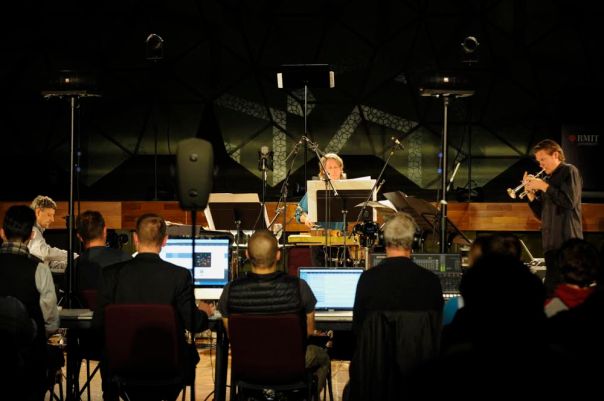
Elision performing the world-line cycle of Richard Barrett at Storey Hall, RMIT. Vicki Jones Photography.

Australia’s prodigal new music ensemble Elision will be in the country to celebrate their 30th anniversary. An exhibition dedicated to the ensemble at the RMIT Art Gallery in Melbourne, September 9-22 October, will feature concerts, talks, and film. Throughout the year audiences can expect to hear Elision perform some of the most innovative and challenging contemporary music at the Metropolis New Music Festival, the Melbourne Recital Centre, ANAM, and beyond. The season features world premieres by Liza Lim, Ann Cleare, Brian Ferneyhough, Aaron Cassidy, Richard Barrett, Matthew Sergeant, Jeroen Speak, and Claus-Steffen Mahnkopf.

Chamber Made Opera

CMO_PTSimage_photocredit_DaisyNoyes-1360x765.jpg
Permission to Speak. Photo by Daisy Noyes.

This year two new works emerge butterfly-like from their long development-coccoons in 2016.  If you missed the audacious opening of Chamber Made Opera’s 2016 season Another Other by Erkki Veltheim and collaborators, be sure to catch Permission to Speak later in the year. This interview-based work brings together performance auteur Tamara Saulwick with some of Melbourne’s favourite contemporary musicians including the composer Kate Neal (of recent Semaphore fame), the always-scintillating sound design of Jethro Woodward (Minotaur Trilogy and a million other things), and the choral harmonies of Gian Slater (Invenio) and friends.

Decibel

Perth’s resident new music ensemble Decibel are poised to present a series of concerts based around the French electro-acoustic pioneer Eliane Radigue. They’ll be premiering a commission in the WAAPA Main Auditorium at 7:30pm on 23 March, then teaming up with the clarinetist and composer Carol Robinson as part of Radigue’s OCCAM OCEAN series.

Forest Collective

Screen Shot 2016-02-21 at 5.40.17 PM.png
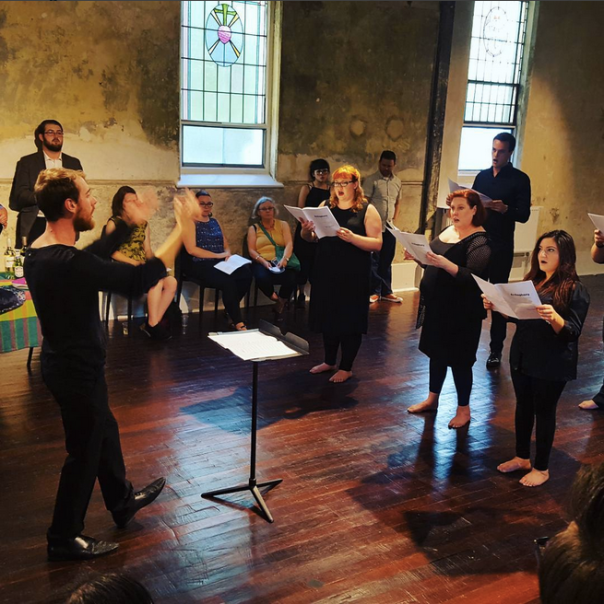
Evan Lawson conducting during the Forest Collective Launch at the Abbotsford Convent. Photo by Matthew Lorenzon

Forest Collective recently launched their season with performances by featured artists at the Abbotsford Convent. It’s just as well they started early, as they have nine epic programs to get through. The launch gave audience members a taste of what is to come, including medieval polyphony-meets-Benjamin Britten, a concert by Forest’s guest ensemble the Allotropy String Quartet, and Kate Bright singing Schoenberg’s Pierrot Lunaire. Of the nine concerts I’m particularly excited about three later in the year: Forest will team up with the University of Melbourne’s New Music Studio to perform Grisey’s final work, Quatre chants pour franchir le seuil on 17 September. Pierrot Lunaire follows at St. Stephen’s Church in Richmond from 17–19 November. The final concert of the season at the Abbotsford Convent features rarely-heard works written during the time of the Nazi regime, including music by Strauss, Orff, Eisler, Weill, Schreker, Goldschmidt, Ullman, Dutilleux, and Messiaen. From censorship to libertinage, Forest’s multimedia Metropolis concert “Sensuality in the City” will feature sculptures by Melbourne-based artist Jake Preval and the Australian premiere of Philip Venebles’ “F*** Forever.”

Ensemble Offspring

Ensemble Offspring are promising a collaborative 2016 season, beginning with Exit Ceremonies, a first time collaboration with the Australian Art Orchestra involving new works for pipe organ. Adelaide residents can enjoy Ensemble Offspring’s collaboration with the early music ensemble Ironwood in the Adelaide Hills. The ensemble will also visit the Four Winds Festival and the Peninsula Music Festival to perform Philip Glass’s epic Music with Changing Parts with fLing Physical Theatre. Ensemble Offspring continue to support young artists through their Hatched Academy, which will culminate in a weekend long mini-festival entitled Kontiki Racket.

BIFEM

The Bendigo International Festival of Exploratory Music is characteristically tight-lipped about their 2016 program, which will be announced in May. All we know is that it will be the biggest BIFEM yet, with over 90 musicians engaged for the September weekend.

Metropolis New Music Festival

I know you can’t wait until September to immerse yourself in new music, so thankfully the Metropolis New Music Festival will fill the Melbourne Recital Centre with its quality and catholic program of contemporary music in May. This year’s theme is “Music of the City,” embracing Byzantine-contemporary mashups, algorithmic sonification of Melbourne’s skyline, turntabling–meets-experimental jazz, and hazy landscape-rock. The festival’s Salon series will feature Australia’s most exciting contemporary music ensembles including Plexus, Syzygy Ensemble, Forest Collective, Press Play, and a not-to-be-missed concert by Elision in their thirtieth year. The Melbourne Symphony Orchestra concerts provide a rare opportunity to hear contemporary music writ large and will feature my personal highlight: pieces by emerging composers from the Cybec 21st Century Australian Composer Program. A new series of concerts in the foyer will open the festival to the city and there will also be a ton of Messiaen dotted throughout the program, which is always nice.

Another Other: A self-fulfilling prophecy about the death of art

Image 1_Chamber Made Opera –Another Other_Caption – Erkki Veltheim, Sabina Maselli, Natasha Anderson and Anthony Pateras_Credit – Jeff Busby.jpg
Erkki Veltheim, Sabina Maselli, Natasha Anderson and Anthony Pateras in Another Other. Photo by Jeff Busby

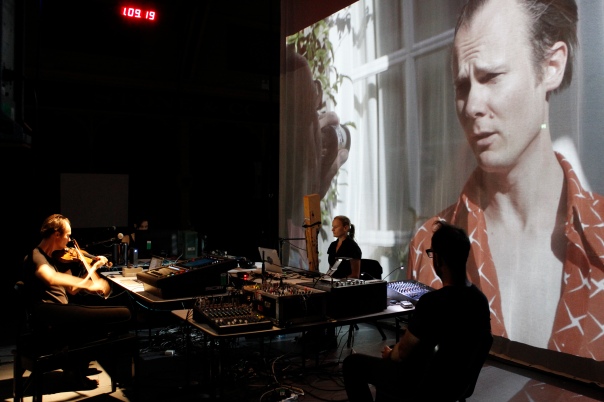
Waiting in line at the North Melbourne Meat Market, I spot the corpse. A humanoid shape lies wrapped in black plastic bags. The sound of clocks (or are they shovels?) emanate from it. A program essay by Ben Byrne tells us it is the body of art. He quotes Ingmar Bergman (The Snakeskin, 1965) who claims that art is basically unimportant, deprived of its traditional social value. Like a snakeskin full of ants, art is convulsed with the efforts of millions of individual artists. Each artist, including Bergman himself, is elbowing the others “in selfish fellowship,” in pursuit of their own insatiable curiosity. To celebrate the fiftieth anniversary of Bergman’s film Persona, Natasha Anderson, Sabina Maselli, Anthony Pateras, and Erkki Veltheim have crawled inside the film’s 79-minute skin.

The four artists sit facing each other beneath red digital clocks counting down the opera’s duration. Pateras works his Revox B77: a machine with a loop of tape and multiple heads that can be manipulated live to produce a stunning array of sounds. Veltheim nurses his violin, which he processes through a laptop running  MaxMSP. Natasha Anderson festoons her Paetzold contrabass recorder with an array of sensors and microphones. Sabina Maselli commands an arsenal of projectors and spotlights, including reels of custom-shot 16mm film.

Once inside the film’s skin, the collaborators throw out its organs of character and plot. The artists instead motivate its mise-en-scène. Maselli’s deeply-textured footage of hands, faces, and landscapes mirror Bergman’s own sumptuous images. The close-miked sounds of violin, recorder, and water echo the conspicuous detail of 1960s foley. Spoken text references monologues in the film, notably Alma’s story of a foursome on a beach. And so the ideas cycle: hands—faces—landscapes—text, interspersed with solo episodes for each performer, until the time runs out.

Image 2_Chamber Made Opera –Another Other_Caption – Anthony Pateras and Erkki Veltheim_Credit – Jeff Busby.jpg
Comparing hands. Don’t they know it’s bad luck? Photo by Jeff Busby

After the third extended shot of intertwined hands, I wondered whether the artists were labouring under a category mistake. Texture and materiality were the bread and butter of contemporary arts throughout the 1980s and 1990s, but the structures of plot and character are surely now considered as much part of the artistic “surface” than image and sound. Thanks to the fashion of basing new music on old films, there are counterexamples. For instance, Alex Garsden’s Messages to Erice I & II, which uses the familial relationships of the characters in Víctor Erice’s 1973 film El Spíritu del Colmena to structure the algorithmic relationships of four amplified tam-tams.

By throwing out plot and character, the creators of Another Other struggle to address the original film’s themes of identity, motherhood, art, and being. The film’s iconic shot of Elisabet and Alma’s juxtaposed faces is critical of traditional gender roles precisely because the characters struggle with those roles. The repeated superimposition of the artists’ faces in Another Other is less critical than narcissistic.

While stating that art’s traditional social function is dead, Bergman’s essay affirms the personal significance of art, a belief that is reflected in Elisabet’s first scene in Persona. Elisabet is an actress who stops speaking because she harbours a burning will to live authentically and shake off the role of motherhood. She laughs at a radio soap but seems affected by a piece of music. In Another Other no such distinction is made between inauthentic and personally authentic art. Veltheim plays the Chaconne from J.S. Bach’s violin Partita no. 2 while the artists’ faces are shown through a day-time soap vaseline lens. I will accept that universally authentic art is impossible, but I struggled to find even an affirmation of personally authentic art in Another Other. Unsure of the artists’ belief in their own work, I failed to commit as an audience member.

After fifty minutes I even started believing that art was dead. Thanks to the clocks high above the stage I could regret every minute left. The saddest thing was that I respect the work of each artist in their own right. But four good artists in a box does not an opera make. At the end of Another Other the artists imagine a different ending to the film. The doctor says that Elisabet’s silence was just another role that she sloughed off in the end, not a real existential crisis. She was perhaps also depressed and infantile. The doctor concludes “But perhaps you have to be infantile to be an artist in an age such as this.” I laughed. It made me particularly glad I trusted them with an hour and a half of my life.

Another Other
Chamber Made Opera
Meat Market
18 February 2016
Natasha Anderson, Sabina Maselli, Anthony Pateras, Erkki Veltheim.

Rubiks and Forest Collective: Sunrise

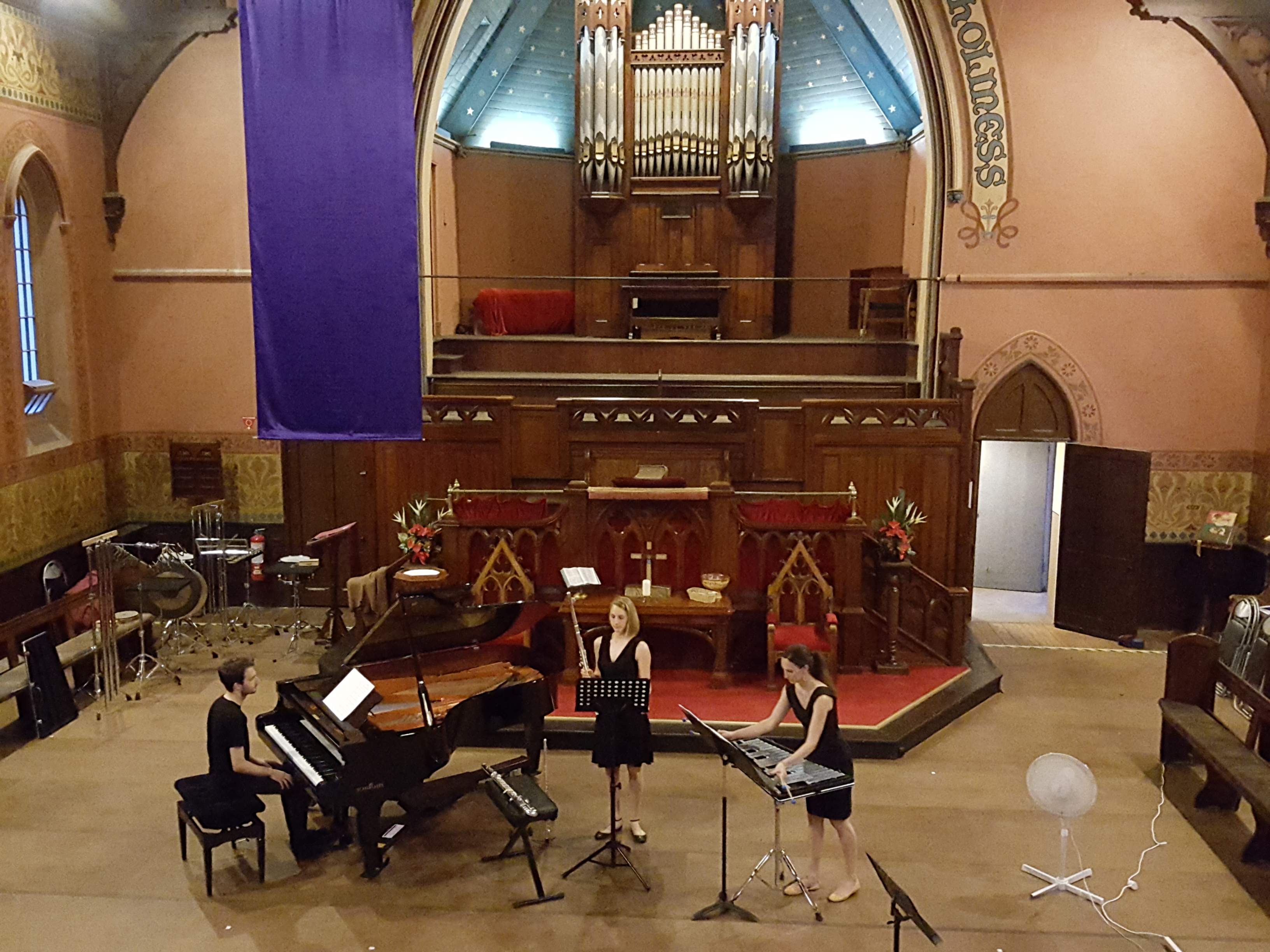
Rubiks set up for Morton Feldman's Why Patterns? on a steaming-hot December evening.
Rubiks set up for Morton Feldman’s Why Patterns? on a steaming-hot December evening.

Forest Collective teamed up with their ensemble in residence Rubiks to provide a folk-inflected final concert of 2015.

Michael Bakrnčev’s The Virtuous Woman with the Watermelon is a lighthearted piece for narrator and small ensemble based on a Macedonian folk tale. Commissioned expressly for this concert, the piece was an appropriate companion to Berio’s Folk Songs. The narrator (Stefanie Dingnis) tells the story of the ideal married couple receiving visitors, but all is not as it seems. The fussy husband constantly sends his wife back to the market to buy a better watermelon for their guests and the wife simply returns to the kitchen and polishes the watermelon until the husband declares that she has indeed found the very best watermelon in town. I’m not sure what the moral of the story is. Don’t be a demanding partner? Do make pragmatic shortcuts? “The husband and wife are a team” explained Bakrnčev after the concert, the story hinging on our guessing at the husband’s knowledge of the wife’s actions and the slow transformation of the meaning of the word “virtuous” in the story’s title. Bakrnčev accompanies the story with a mock-military march. A flute trembles stertorously over a snare drum. At one point the narrator vocalises beautifully over a cheery piano tune. Next to the Folk Songs Bakrnčev’s musical accompaniment sounded very light indeed.

There is always time for another performance of Berio’s Folk Songs. In arranging eleven folk songs from the United States and Europe (including two original compositions), Berio sought “a unity between folk music and our music.” I assume that by “our music” he means contemporary art music rather than the classical tradition more broadly. Berio surrounds the folk tunes with an atmosphere of extended techniques evoking natural environments. Thorny instrumental interjections paint a sound-world far removed from the singing tones of a modern orchestra. Does the listener really hear the spirit of ancient music brought alive to modern ears, or a fantasy of a lost world? Whether real or imagined, in 1964 Berio constructed a bridge between pre-modern tones and the overblown, underbowed techniques  of contemporary music. This bridge has since grown to a widely acknowledged superhighway between early and contemporary music. The Folk Songs may have been a striking statement in 1964, but this conduit has now passed over into ideology and is ripe for interrogation.

Today’s culturally-aware listeners are sensitive to issues of cultural appropriation. Performers need to carefully balance their preconceptions of ancient and modern music. Too “folksy” a performance and the performance will slide into parody, too straight a performance and the songs will lose much of their appeal. Stefanie Dingnis chose a relatively restrained performance style, letting the beauty of the tunes speak for themselves. Dingnis came alive in the Sicilian song “A la femminisca” with its clashing, explosive opening that cannot be mistaken for anything but an invitation to let loose. The ensemble, conducted by Evan Lawson, provided plenty of colour in their masterfully balanced accompaniment. The sensitive articulation of harpist Samantha Ramirez and thrilling execution of the piece’s signature viola solo by Anthony Chataway deserve special mention.

Listening to and watching old recordings, I wonder whether anyone could or would want to perform the Folk Songs with the same accents and dance moves today as the Songs‘ dedicatee Cathy Berberian.

The concert also included a stunning performance by Nicholas Yates of Berio’s Sequenza VIIb for soprano saxophone. The piece’s drone was provided by string players spaced around the Richmond Uniting Church. So subtle was their movement and quiet was their playing that I became conscious of the ethereal sound over a minute or so. What a beautiful effect. Yates’ agile execution of the popping, pointillist piece was something to behold! The concert concluded with Morton Feldman’s Why Patterns? performed by Rubiks Collective. Jacob Abela (piano), Tamara Kohler (flute), and Kaylie Melville (percussion) move through their sparse parts at their own rate, coming together at certain  vertiginous moments. These meeting-points become moments of great focus as the performers become aware that they are a page or so away from each other. The performers have to make so many decisions in executing their part that I was put in mind of Alistair Noble’s recent lecture on Feldman at the Melbourne Music Analysis Summer School. Noble argued that, given the tight-knit community within which Feldman’s works were composed and performed, he assumed a certain stylistic palette when composing indeterminate elements in his works. For the most part we cannot hope to—and may not want to—recover the assumed stylistic traits of the early performances of Feldman’s works, but there is certainly interesting work to be done in that direction.

Sunrise
Rubiks and Forest Collective
Richmond Uniting Church
19 December 2015

Michael Bakrnčev, The Virtuous Woman with the Watermelon; Luciano Berio, Sequenza VIIb, Folk Songs; Morton Feldman, Why Patterns?

DOMICILE

Review by Liza Lim

Forty people gathered expectantly in a quiet laneway tucked behind Melbourne’s vibrant Lygon Street. Like the stories of Polish writer Bruno Schulz in which reality hides extravagant strangeness, the door of a small terrace house opened into a ‘wunderkammer’, a veritable cabinet of curiosities in which each room contained twilight-zone performances of strange beauty, menacing wonder, as well as exquisite sensuality.

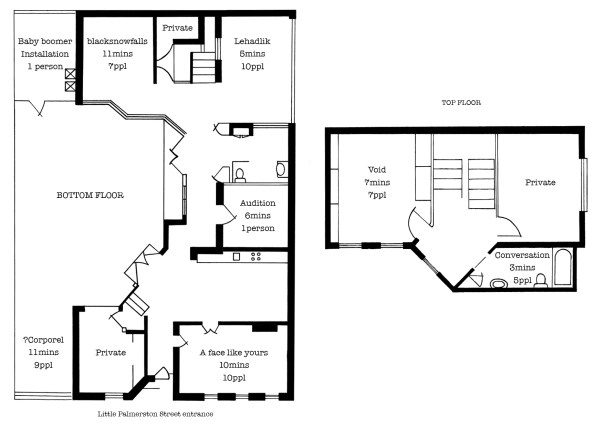
The event was DOMICILE, a programme of performances and installation pieces directed by Aviva Endean and staged with deft and imaginative flair in the house in which she grew up. The audience, provided with a plan of the house, wandered the rooms at will.

INSIDE PLAN PROGRAM.jpg
Program map courtesy of the artist.

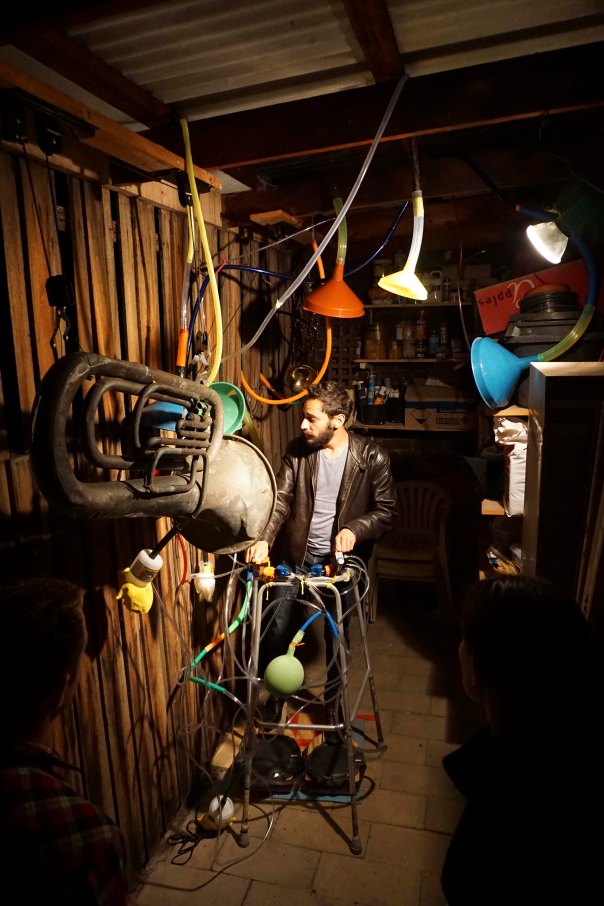
In the lounge room, a silent film, A face like yours (2015), made and performed by Aviva Endean and filmed by Christie Stott, flickered on the television. Earplugs provided allowed one to encounter a subtle internal world of sound as we mimicked the gestures and followed instructions on the screen to tap cheeks, hum, manipulate our lips etc. By way of contrast, in the back shed, one could interact more noisily with Dale Gorfinkel’s Baby Boomer (2015), a Heath Robinson-like contraption of foot pumps and balloons joined with plastic tubing to funnels, a battered tuba and a trombone, with garden irrigation switches allowing one to orchestrate changes to the wheezing combinations of sounds.

DSC04513 bb.JPG
Dale Gorfinkel’s Baby boomer. Photo by Pier Carthew.

Out in the garage, Matthew Horsley could be found performing Vinko Globokar’s classic of body percussion ?Corporel (1984). On a loop during the 75 minutes of the event, this was a feat of concentration and commitment as he repeatedly slapped the different sounding surfaces of his bare chest, face and a satisfyingly resonant head. Another kind of skin percussion could be heard in the back bedroom inhabited by Matthias Schack-Arnott. In Wotjek Blecharz’s Blacksnowfalls (2014), hands and fingernails inscribe calligraphic movements onto a timpani giving rise to susurrations and sliding moans and creating a séance-like mood. A live video feed provided an additional level of visual detail, though for the audience of seven crammed into the room and sandwiched between a bed and mirrored wardrobe, proximity to the performer was intimacy enough.

Intimacy was the watchword for other works – two singers, Jenny Barnes and Niharika Senapati soaked in bubbles in the bathtub upstairs whilst exchanging enigmatic snatches of inhaled and exhaled sounds in Georges Aperghis’ Conversation (2004). In the next bedroom, a ‘grand amour’ was enacted in Endean’s Void (2015):

a pair of lovers approach in slow motion, the microphone held in the mouth of one (Aviva Endean) setting off feedback from the speaker held in the open mouth of the other (Alexander Gellman), reaching an inevitable denouement in a strangled kiss. Another ‘up-close’ experience could be had with Angelo Solari’s Audition (2014), staged as a one-on-one encounter with singer Carolyn Connor, with all the flavour of a Monty Pythonesque interview in a correctional facility. The queue was too long for me to get to it but my 13-year old son had a ball answering questions from the script and engaging in the staring contest. His verdict: ‘cool’.

Domicile-14.jpg
Jenny Barnes and Niharika Senapati perform Conversation by Georges Aperghis. Photo by Pier Carthew.

Endean’s talents for creating an immersive atmosphere were perhaps most completely showcased in her composition Lehadlik (2015) in which the audience was invited to sit at a formally set dining table. The day’s coincidence with the start of Hanukkah provided an extra level of resonance to the work’s evocation of Jewish ritual: two lit candles were wired with sensors used to trigger recordings of incantations from the Torah, the sonic landscape enriched with Endean’s melismatic clarinet playing. The meditative ritual ended with a snuffing out of the candles through the bell of the instrument.

‘House events’ have long held an important place in experimental practice in music and performance, from concerts in Berlin apartments or New York loft-spaces to, more locally, the work of Aphids in domestic settings in the 90s and Chamber Made’s opera productions commissioned for people’s residences. The use of such spaces to shift the frame on audience interaction is a well played-out ploy, yet, DOMICILE refreshed this format through a finely tuned curatorial sensibility. The choice of repertoire, quality of performances, size and nature of the venue combined to create a very special evening that exuded hospitality and a sense of enchanted time. Adding to the sensory feast, there was even cake to share at the end. Cooked during the evening, it had suffused the house with a lemon-sweet tang that followed us out into the balmy Melbourne night.

Review by Liza Lim

DOMICILE
Fleur Ruben’s house in Carlton
Melbourne, 4, 5, 6 December 2015

Directed by Aviva Endean and presented as part of the New Music Network’s emerging artists program with support from Creative Victoria

Performers: Aviva Endean, Matthew Horsley, Carolyn Connors, Matthias Schack-Arnott, Alexander Gellmann, Jenny Barnes, Niharika Senapati

Set design, Romanie Harper
Technical design, James Paul
Artwork, Betty Musgrove

Six Degrees and Arcko Symphonic Ensemble: Eighty Plus!

Not only European composers come in generational clusters. The Australian composers Nigel Butterley and Helen Gifford were both born in 1935 and went on to become two of the country’s most recognisable compositional voices. The composers also share stylistic traits, emphasising the ritualistic and ecstatic side of the human voice in works drawing on antiquity. Both composers are well at home in atonal pitch space, even if they navigate it with differing degrees of systematicity. Players from two great champions of Australian music, Six Degrees and Arcko Symphonic Ensemble, came together to celebrate the composers’ eightieth years at the Church of All Nations.

Desperation for solo viola opens with microtonally detuned motoric rhythms. Phoebe Green, for whom the piece was written, pursued the anxious bowing with an intensity worthy of the work’s title. The piece explores not only moments of desperation but also the stupor that follows. The violist has to nimbly attach and remove a heavy practice mute in moments of creepy stasis, before launching back in to the ruminative acrobatics.

Highly-charged physicality also featured in the second solo piece by Gifford on the program.  Siva: the Auspicious One was composed for the virtuoso pianist Michael Kieran Harvey and demands positively divine energetic resources. Siva, the Hindu god of destruction and recreation, is conjured in this epic piece by thunderous bass chords, ascending scales, and hammered-out tremoli. Pianist Peter Dumsday put his entire body into the twists and turns of the work, reminding us all that he is—in his spare time—a racing-car driver. The piece raises the abstract dialectical question: Can you really destroy anything in music? Once a note is played it cannot be undone, only opposed by a new note. The violent chords of Siva: the Auspicious One seem to rail against this musical limitation, straining to bring real destruction into music but only making more music in the process.

Laudes and Forest I by Nigel Butterley plunged the audience into environments of delicious variety. Both pieces are inspired by spaces, the four movements of Laudes being inspired by four different churches and Forest I sketching a woodland scene. The dense writing never lapsed into monotony thanks to the sensitive interpretations of the performers and conductor Timothy Phillips.

Justine Anderson shined a light on the composers’ love of text and myth with two vocal works: Nigel Butterley’s Three Whitman Songs and Helen Gifford’s Music for the Adonia. The Whitman settings are gems of twentieth-century art song, nimbly bringing the tip-toeing text of “O you whom I often and silently come,” the spiralling incandescence of “Not heat flames up and consumes,” and the hallowed tones of “I heard you solemn-sweet pipes of the organ” to musical life.

Gifford’s Music for the Adonia is remarkable within the program for showing just how much Gifford’s music has changed over the past twenty years or so. Her interest in Ancient Greece provides her with a masterfully-imagined sound world that is at once raw and refined. The text for the piece is sound-based, painting with ecstatic power the Adonia, a festival where women mourned the death of Adonis.

Six Degrees and Arcko have once again provided audiences with informed and refined interpretations of some of Australia’s finest contemporary music. If only Gifford and Butterley could turn 80 more often.

Musicians from Six Degrees and Arcko Symphonic Ensemble
Eighty Plus!
Church of All Nations
11 December 2015
Nigel Butterley, Laudes; Helen Gifford, Desperation for solo viola; Nigel Butterley, Three Whitman Songs, Forest I; Helen Gifford, Siva: The Auspicious One, Music for the Adonia.

Rubiks: Things are become new

Competing schedules, fickle venues, and piles of percussion gear: There are myriad difficulties involved in organising a contemporary music concert. It can feel like a puzzle, a riddle, or even a Rubik’s cube. This was the sentiment expressed by flautist Tamara Koehler at the beginning of the first self-organised concert by Rubiks, a group of ANAM graduates who have found time in their busy international careers to come together and perform contemporary repertoire. The organisational effort was well worth it. Six players thrilled the crowd at the Church of All Nations in Carlton—fast becoming the venue of choice for contemporary music in Melbourne—with a polished program of canonic and recent works. The theme of change and transformation underpinned the program and was expertly handled by the ensemble.

Cellist Gemma Tomlinson conjured the movement and colour of butterflies in Kaija Saariaho’s Sept papillons. Saariaho explores every possible butterfly-like gesture on the cello throughout seven miniatures. Fast trills between harmonics shimmer like iridescent wings and Tomlinson’s bow-arm seems to take flight, arcing across the strings in fast arpeggios. There are high, trilling harmonics; low, susurrating tremoli; glittering, rapid alternations between open strings and stopped notes, all in constant motion and gradated change. The performer is called upon to constantly change their bow-tone, moving from heavy, slow, gritty over-bowing to fast, light, floating bows. Tomlinson managed these transitions with astonishing precision and ease.

Samuel Smith’s Things are become new was written for Adelaide’s Soundstream collective and showcases the composer’s sensitivity to the relationship of instrumental tone colour and gesture. A medley of mallets and stick-ends thump and rattle away on the vibraphone, a trio of winds woof and huff, while the strings play swelling messe di voce. The piece is a study in transformation, requiring great commitment to bring out its kaleidoscope of techniques and timbres. Rubiks were more than up to the task, providing a spirited and dynamic rendition of the piece.

Anna Clyne’s Steelworks approaches the theme of transformation programmatically. The piece combines live performance with field recordings and interviews from the Flame Cut Steelworks, the last steelworks factory in Brooklyn. Justin Beere’s pneumatic bursts on the bass clarinet, as well as Kaylie Melville’s kick-drum and the clacking keys of the flute remind us that modern instruments are machines of the industrial revolution. The voices of steel-workers ride on top of this mechanical racket, debating the merits of change. Their voices are slowed and clipped, gestures that are affectingly imitated by the instrumentalists as the entire musical machine winds down.

An explosion of energy (definitely “with panache” as instructed by the composer) concluded the concert in the form of Irish composer Donnacha Dennehy’s Glamour Sleeper II. From the multicoloured butterflies of Saariaho’s Sept papillons to the dark bouquet of Smith’s Things are become new, the concert showcased Rubiks’ searingly-precise ensemble skills and instrumental control. Rubiks are a formidable contribution to Australia’s growing community of contemporary music makers.

Things are become new
Rubik’s Collective
Church of All Nations, Carlton
28 November 2015
Samuel Smith, Things are become new; Anna Clyne, Steelworks; Kaija Saariaho, Sept papillons; Marcus Fjellström, Odboy and Erordog Episodes 2 and 3; Donacha Dennehy, Glamour Sleeper II.

Melbourne Festival: Fly Away Peter

Brenton Spiteri in Fly Away Peter. Photo courtesy of the artist.

The surreal style of David Malouf’s novel Fly Away Peter attracted Elliott Gyger when searching for a text for a companion piece to Stravinsky’s The Soldier’s Tale. The Soldier’s Tale is one of Western art music’s great false starts. An colourful ensemble of clarinet, bassoon, cornet, trombone, percussion, violin, and double bass is chain-ganged into the service of a second-rate text. Composed in the wake of the First World War, the folk-tale of a soldier selling his violin to the devil says too little about the events that had just shaken Europe. Writers and composers have since tried to give the work teeth. In 1993 Kurt Vonnegut reworked the text into a tale about the first soldier in the United States military to be executed for desertion. Gyger’s companion piece takes the same ensemble, but provides it with new music, a new text, and even a few new instruments. To Gyger, writing for Resonate Magazine, surrealism is an essential prerequisite for “the wonderful absurdities of the operatic medium.” But surrealism is also an essential strategy for dealing with the incomprehensible carnage of war. Fly Away Peter, produced by Sydney Chamber Opera for the second time as part of the 2015 Melbourne Festival, does not reduce the First World War to a dadaist romp. Instead, like a musical Malouf, Gyger carefully balances clear binaries and their fragmentation.

Clancy is torn apart half-way through the novel. The protagonist Jim Saddler rests to take tea after loading supplies for the trenches. Clancy approaches carrying a billy and mugs. Suddenly Jim is covered in blood and Clancy is nowhere to be seen. Clancy had been struck by a “minnie,” one of the German minenwerfer or trench mortars that bombarded the Western Front in the First World War. The traumatic event separates the optimism of Jim’s bird-watching days in Australia from his hardened military career in the trenches. On the surface, the novel is rife with such clear thematic binaries (as a generation of Australian high-school students will tell you): Birds and biplanes, natural and human timescales, life and death. But surreal fragmentation, disorientation, and dismemberment pervade the novel from one end to the other. The novel’s emblem is not the bird, but the minnie.

The novel’s fragmented binaries are reflected in Gyger’s music. The score is based on a grid of 21 five-note chords. The pitches of the chords are fixed in register, covering the entire range of the ensemble. Taking his cue from the libretto’s binary of earth and air, each chord is mirrored by another, inversionally-symmetrical chord, resulting in a “landscape-like” grid of pitches. The piece’s pitch profile generally moves from treble to bass as the characters move from halcyon Australia to the battlefield, an aural sensation obvious to all. But instead of simply choosing chords from the lower half of his pitch grid, Gyger reconfigures and layers the grid when Jim reaches the battlefield. The symmetrical binary established at the beginning of the piece is “turned inside out” by Gyger’s musical minnie. One can hear this device as evoking war’s effect on bodies, their dismemberment and distribution over vast areas. It can also be heard as war’s effect on the mind, or more precisely, as evoking the new understanding of human subjectivity to which the War gave rise.

The libretto by Pierce Wilcox is set out in three columns, one for each of the principal voices here stunningly performed by Mitchell Riley (baritone) Jessica Aszodi (mezzo-soprano), and Brenton Spiteri (tenor). In this way Wilcox reflects the fragmented subjectivity of the novel’s central trio. Each character is gifted their own distinct faculty of knowing the world around them. The landowner Ashley Crowther is a musician who reverts to tuneless singing when at a loss for words, Imogen Harcourt the nature photographer captures the world in images, while Jim has a unique gift for the names of birds. Like the three wise monkeys of Japanese mythology, they are the three innocent monkeys who have not yet heard, seen, or spoken evil. Only the omniscient narrative voice has access to all three faculties of hearing, seeing, and naming. The distributed subjectivity of the trio prefigures Jim’s psychoanalytic observation, made while drenched in Clancy’s blood—though in the detached voice of the narrator—: “The body’s wholeness, it seemed to him, was an image a man carried in his head.” Fly Away Peter shows how the trauma of war reveals the imperfect and multifaceted knowledge we have of ourselves and our environments.

The surrealism of Fly Away Peter is therefore found at the meeting point of intense sensation and detachment. The story is the perfect match for Gyger’s detailed and transparent compositional style. The opera opens with gorgeous birdsong transcribed for the violin of James Wannan. Moments later Jim is taken on a terrifying ride in a biplane painted with little more than a gentle drum roll. At times I found myself gliding along these surface-level depictions. But if one pays more attention to the music, Gyger’s rich harmonic landscape flies by in full colour.

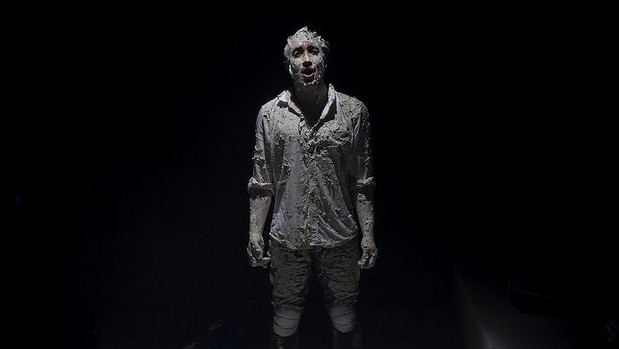
The beautiful staging by Elizabeth Gadsby is also both schematic and affecting. Dozens of blue buckets of clay are the opera’s only props. Their varied placement around the five-tiered white stage is an art installation in itself. They begin in asymmetrical patterns, but finish ranged in rows like tombstones. This minimalist staging evokes suffocating terror as the singers cover themselves in the clay.

The whole experience flits past so quickly that I feel the work will reward multiple viewings and stagings. Riley, Aszodi, and Spiteri seamlessly and effectively switch between characters and scenes in the retaking of a violin bow. Ultimately the strength of these performers hold together a challenging new work.

Fly Away Peter
Composed by Elliott Gyger
Libretto by Pierce Wilcox
Based on the novel by David Malouf
Sydney Chamber Opera
The Melbourne Festival
The State Theathre
21 October 2015