Wednesday 1 May. If you have the ability to go back in time, see Clocked Out perform Erik Griswold and Eugene Gilfedder’s concert based on the life and work of Australian painter Ian Fairweather at Griffith Conservatorium, QLD, yesterday. I hope it travels (in space, if not time)!
Friday 3 May. Queen of the pianistic avant-garde Lisa Moore performs Lang, Adams, Harris, Bresnick, Mazzoli and Reich as part of her recital at ABC Studio 520, Collinswood, SA.
Sunday 5 May. Cello and piano duo Yiannis Maxwell and Krista Low perform contemporary works by Mark Isaacs and Lukas Foss at St. George’s College, WA.
Sunday 5 May. The Astra Chamber Music Society present a tribute to the Australian composer Lawrence Whiffin at the Richmond Uniting Church, VIC.
Zephyr Quartet
A Rain from the Shadows (album launch)
Melbourne Recital Centre
26 April
More at home with a viola in his hand, Jason Thomas shakily grips the booklet of Zephyr Quartet’s new album A Rain from the Shadows. Glancing around the Melbourne Recital Centre Salon, he recites Mike Ladd’s “Dirt” in his best Radio National baritone. The quartet now seems to evoke the growing termite mounds of the Plenty Highway with rhythmic double-stops, looping violin motifs and ever more dramatic melodic interjections. Dirt is just one of the poetic responses to existing Zephyr Quartet compositions commissioned for A Rain from the Shadows. The album also includes works composed in response to poems by Iraqi-Australian poet Yahia Al Samawy, Australian Rob Walker and Mexican-American poet Gary Soto.
Belinda Gehlert’s compositions express a wide-eyed wonder at the natural world, drawing inspiration from snorkeling in freshwater sinkholes near Mt. Gambier in South Australia and expanses of dunes near the ocean. In Dunes, based on a poem by Rob Walker, the wind eternally blows millions of tiny boulders of sand over each other, eroding mountains and bones along the way. The loping, Sisyphean ostinato of the viola is contrasted with a lyrical slow section, as though we have taken a step back from Sisyphus’ microscopic work to view the shifting landscape.
Hilary Kleinig composes transformation in From Darkness to Day, drawing upon a similar line from Al Samawy’s poem Four Loaves from the Heart’s Oven. Sending a message of hope, the piece is a variation on a breath, from its first meditative inhalations to its final jubilant shouts.
Contrasting with Gehlert and Kleinig’s episodic impressionism, Emily Tulloch’s two compositions Skyroads and Air drew (unconsciously or not) on the contrasting worlds of nineties computer game music and twentieth-century timbral experimentation. Skyroads is so named because, after composing the piece, Tulloch realised it resembled the soundtrack to the eponymous 1993 shareware game. Having spent some time with the game over the weekend—purely in the interests of good journalism—I can critically and objectively verify this similarity. Tulloch’s sustained and polymetric violin lines recall a time in sound card manufacturing when timbral variation came at a premium and polyphony was an exciting new possibility. In contrast, Air develops a floating texture of string harmonics and the convoluted overtones of flautando bowing. The piece concludes with some masterful whistling over the quartet’s sustained notes.
With its vivid imagery and dramatic string writing, A Rain from the Shadows could be dramaturged and presented more theatrically. Some interest was lost in the absence of the texts from the performance (with the exception of Thomas’ recitation). The presence of the texts could encourage the quartet to further accentuate the gestural, expressive aspect of their original compositions.
Manhunter by James Rushford and Joe Talia, cover art by Michael Salerno
James Rushford and Joe Talia
Manhunter album launch (Kye Records)
Northcote Uniting Church
25 April
Breath and wind united the four acts of James Rushford and Joe Talia’s album launch beneath the pipe organ of the Northcote Uniting Church. Robert McDougall and JK Fuller contrasted mouth organs and harmonica clusters with rumbling electronic ground-basses, percussive metallic articulations and a broad chroma of static interference and distortion effects in their ambient, minimalist electronic sets.
Armed with only her own voice, an accordion, brushes, a mouth organ and a sheet of aluminium foil, Carolyn Connors proves she needs no electronics to transition from a clear vocal tone to inhuman white noise, gibbering and squeaking. Variously bounced on her knee and played with brushes, the accordion becomes yet another wind instrument motivated by Connors’ nervous agitation. The perpetuum mobile is broken only as Connors wraps a sheet of aluminium foil around her head to project her powerful (and apparently indestructible) voice buzzily through the metallic veil.
Cloaked in a red half-light, Joe Talia and James Rushford open their set with several minutes of soothing, cycling chords on a Twin-Peaks-era synth. Sublime video footage by Michael Salerno of tornadoes graces the front of their desk. Those hoping that the tension between the awesome power of nature and the keening tonal salve will continue are sorely disappointed, plunged into an hour of mumbles and crackles over a pulsing, bassy hum.
Part of the fun of a Talia/Rushford show is trying to guess what they are doing. We know not to question someone’s apparent inactivity in front of a mixing desk, but what exactly is Rushford doing as he somnambulantly manipulates a stick on a tabletop, blows into what looks like a duct-taped syrinx, or sticks some sort of barbecue tongs in his mouth?
The show ends with a slowed-down recording of Auld Lang Syne on piano and strings. Rushford sips something out of a church-hall mug and Talia stares vacantly at his mixer. Saddest New Year’s Eve Ever.
Thursday 25 April. Tomorrow night James Rushford and Joe Talia launch their album MANHUNTER at the Northcote Uniting Church, VIC. 8:30pm, $7/$10. Hailed as “A tragic cliché” by Tiny Mix Tapes, the album departs from Talia and Rushford’s clipped voltas on electronics and viola to explore a more devastatingly ambient soundscape.
Friday 26 April. Adelaide’s Zephyr Quartet are in Melbourne launching their album A Rain from the Shadows at the Salon of the Melbourne Recital Centre, VIC. The album is the result of collaboration with international and Australian poets including Iraqi-Australian Yahia Al-Samaway, Mexican-American Gary Soto and Australian Rob Walker. 7pm, $25/$35.
Sunday 28 April. Warm up and wind down with soup, mulled wine, woolly blankets and a variety of musical offering at Horse and Weasle Tabernacle Eleven, 25 Eastment St, Northcote, VIC. Featuring Ida Duelund-Hansen on double bass and voice, ColdHandsWarmHeart’s processed guitar, harp, voice and percussion, Pikelet’s piano works, John Gosper and Anna Lumb’s fashion-trapeze interlude and Prudence Rees Lee in acoustic mode. 5:45pm, by donation.
Thomas Adès, image courtesy of the Melbourne Recital Centre
Thomas Adès
Melbourne Symphony Orchestra
Shadows
Metropolis New Music Festival
20 April
Bringing jazz-inspired works by Mark-Anthony Turnage and Thomas Adès together with the sensitivity and virtuosity of cellist Steven Isserlis, the final concert in the Metropolis New Music Festival celebrated contemporary compositional finesse.
Adès opened the concert conducting Niccolò Castiglioni’s Inverno In-ver. The wintry dance suite combines post-tonal transformations with the icy orchestral colours of celesta, woodwind, chimes and glockenspiel to create tableaux of racing snow and frosty stillness. Whereas some performers will complain that the results of some contemporary works do not warrant their difficulty, Castiglioni and Adès’ music may be compared in the dazzling surface-effects produced in their complexity.
A case in point being Adès’ jazz-era burlesques for orchestra from the opera Powder Her Face. Dripping with gritty sensuality, the excerpts harkened back not so much to the foxtrots and tangos of the 1930s, but to the sophisticated, self-aware, Weimar-era opera of Ernst Krenek and Kurt Weill.
Mark-Anthony Turnage draws on later jazz styles in his tour de force for cello, Kai. Confronting the audience with a deafening wood-clap, Kai proceeds to seduce them with a homage to the romantic cello concerto. A muted trumpet introduces the piece’s theme like a distant bugle call announcing the arrival of the jazz-cavalry. Each time the refrain returns on cello it is more desperate. It is a struggle for the cello to be heard above the ensemble, leading the cellist ever closer to the bridge with an ever-heavier bow and a correspondingly hyper-emotional sound. Then the shredding begins. Isserlis covers the cello, hair and all, like a 1980s speed-metal guitar guru.
Isserlis channeled a different kind of virtuosity for four of György Kurtág’s Signs, Games and Messages, repeating each descending mode or two-note phrase as though it were a completely new thought. At times scarcely audible, the meditative whisper of the cello was almost drowned out by the hall’s creaking light fixtures.
Cybec finalist Lachlan Skipworth conjures a “solar drama” (to use a phrase of the Australian Mallarmé scholar Gardner Davies) out of the orchestra in Afterglow. Like the dying rays of the sun, a fanfare on tuba announces shimmering string colours, which build and dissipate in a dense crescendo. The chaos leaves behind a more transparent texture with a lyrical oboe line. Harp and piano can faintly be heard moving across the orchestral surface. It is as though the tuba has dipped behind the horizon of the strings and risen again as a silver moon, lighting the path of two wanderers.
What the Shadows programme gained in stylistic dexterity it lost in innovation. It is remarkable that the most contemporary-sounding work on the programme was by Castiglioni, a dead composer. By contrast, the rest of the works (Kurtág’s Signs, Games and Messages excepted) presented reworkings of bygone styles for the orchestra and large ensembles. Many works in the smaller Metropolis concerts gave a stronger sense of being not just “current” but “contemporary.”
Mira Calix, image courtesy of the Melbourne Recital Centre
Mira Calix
Looking for Cowslips
Metropolis New Music Festival
20 April
Occupying the 6pm slot before Thomas Adès’ Shadows, there was a welcome informality to Mira Calix’s juxtaposition of her own chamber works with those of four other contemporary British composers. No projections, choirs or crickets: Instead, Calix gathered an intimate council of composers, performers and listeners to consider their relationship to nature with the help of poetry from the nineteenth century and today.
“This is me,” begins the electroacoustic track of “looking for cowslips,” Calix’s work for soprano, clarinet, viola, cello, piano and electronics based on Alice Oswald’s poem. The phrase proliferates in the space before being captured like a thought by soprano Lotte Betts-Dean. In such a simple gesture the multiple identities of nature are realised in a single human being. The moment of self-awakening does not last long as the air is quickly disturbed by a tremolo on cello (Zoe Knighton) and Betts-Dean frantically calls “no, no, no, no.” Throughout the piece the harmonics, trills and pizzicati of the cello provide an internal, affective countermelody to the soprano’s narrative. Bird and insect calls form an external environment to which the soprano responds, while echoes and transformations of the soprano line reflect the permeability of the natural and human worlds.
Calix and Larry Goves reverse their usual compositional roles in their collaboration “eyepoe.” Calix takes control of the instrumental parts, while Goves is entrusted with the electronics. The piece contrasts melodic string and clarinet parts with short, prerecorded, haiku-like passages for what sounds like harp and steel-string guitar. As the piece progresses the instrumental parts become darker and the electroacoustic track more suffused with a wind-like roar, dissolving the musical into the ambience of natural sound.
The collaborative descent of “eyepoe” prepared the audience for Tansy Davies’ stark vocal setting of lines from the nineteeth-century nature poet John Clare’s autobiography. The soprano evokes cornfields and forests “troubled” by the “destroying beauty” of weeds through Davies’ hypnotic, falling chromatic lines.
The ensemble achieved a perfect balance between electroacoustic and instrumental sound in the intimate acoustic of the Salon. The result was a highly affective performance that drew the audience into the composers’ worlds of cowslips, cornbottles and sunflowers. In withdrawing her book Memorial from the T. S. Eliot prize in 2011 because of the prize’s questionable sponsors, Oswald described poetry as “the great unsettler.” Calix and company’s music provides unsettling settings of unsettling poetry, placing humanity’s relationship to nature on the salon table.
Matthias Schack-Arnott and Eugene Ughetti, image courtesy of the Melbourne Recital Centre
Speak Percussion
City Jungle
Metropolis New Music Festival
19 April
Between its origin in mid-1990s rave culture and its contemporary chain-ganging into the long, wobbly march of dubstep, drum and bass was a hotbed of virtuosity and experimentation at the heart of electronic dance music. In Australia, pioneers like Terminal Sound System have continued to develop the unique style of breakneck drum beats and earth-moving bass with an ear towards contemporary art music and the forever-plastic world of electroacoustic composition. At the same time, classical musicians like Speak Percussion founder Eugene Ughetti have drawn from drum and bass and jungle to inspire their own virtuosic playing. City Jungle is more than a collaboration between Terminal Sound System and Speak Percussion, it explores and summarises possible lines of influence between two musical worlds.
An array of cymbals, drums and vibraphones gleam under purple and red lights at the far end of the Melbourne Recital Centre’s Salon. The audience is ranged through the room on chairs, lounges and at standing tables. The intimate-sounding room is arranged not so much for dancing as for an intense, though laid-back listening experience. Terminal Sound System himself is not present, but Matthias Schack-Arnott and Ughetti provide ample visual interest with their focused, breathtakingly-coordinated attack on the battery of instruments.
At times Ughetti and Schack-Arnott provide backbeats on toms and cymbals to expansive electronic atmospherics and smooth-jazz melodies, while at other times they provide spitting, hissing, syncopated breakbeats on snares and Chinese cymbals over melodic bass lines. Moving to the vibraphone, the musicians contribute melodic hooks and ostinati of bewildering complexity to the mix. In these ways Speak Percussion complement Terminal Sound System’s electronics, filling in a part of the whole musical picture.
Of greater interest, perhaps, is Ughetti and Schack-Arnott’s ability to reproduce electronic-sounding effects in a live setting. One effect is stereo panning and phasing. Facing each other at the front of the stage, the percussionists play tremoli on two triangles, gradually muting and unmuting them to create waves of timbre that pass back and forth across the room. A similar technique is used with rolls on snare drums, except this time the players send waves of both volume and speed back and forth. As the speed of the rolls decreases their volume increases, giving the sound spatial depth, as though it were moving towards you and getting larger. Other atmospheric effects included Schack-Arnott’s playing untuned radio static and conjuring unearthly sounds from a China ride cymbal.
Sometimes complementing Terminal Sound System’s sounds and sometimes expanding on them, Speak Percussion show the permeability between contemporary percussive and drum and bass sound worlds. Already in its third outing, City Jungle is becoming a remarkably popular and effective piece of contemporary Australian repertoire.
At E21’s recent concert at St. Mary Star of the Sea in West Melbourne the choir had just begun their third thrilling medieval processional chant when, as the sun set and the church cooled, several voices of polyphony were introduced by a group of stray crickets. Insects are usually unwelcome performers in Australia, but composer and sound artist Mira Calix brings them centre-stage in her entomology-inspired composition, “nunu.”
Like a parenthesis to the crowd taking their seats, a quiet chirping can be heard to stage left of the Elisabeth Murdoch Hall. The marginal sound reminds the audience of the omnipresence of insect life (as though they need reminding). Calix enters and removes a cloth covering the sound-source, an aquarium of crickets, whereupon the bass-clarinet quintet begins imitating insect noises on the backs of their violins, through flortando trills and squeaky-high tones.
Projections of insects confined to shadowy jars fill the back wall of the stage. In the colour-saturated images an apple covered in cockroaches becomes a blood-red heart and leaves glow fluorescent green. As the camera pans across the jars the beetles, crickets and slaters are enlarged to enormous proportions. Their movements take on an almost human weight and gravity. The struggling of a cockroach on its back becomes that of an old man getting out of bed, the searching mouth of a grasshopper the very picture of hunger.
With sounds captured from the ensemble and the calls of other animals including frogs and cicadas, the sonic menagerie builds to a crescendo and fades, revealing the layered, irregular instrumental ostinati so characteristic of Calix’s music. In its spacious arrangement of diatonic triads, fourths and ninths Calix’s music resembles the “sacred minimalism” of Arvo Pärt and John Tavener. The chromaticism-tinged solo lines emerging from the ensemble recall the Brodsky Quartet’s collaborations with Björk in 1999 and 2000. The playful naturalism of her works conjures Meredith Monk’s compositions of the 1990s. Within such a minimalist stylistic frame the musique concrète of insect calls provides welcome timbral complexity and stereophonic interest.
The more complex electroacoustic element of Calix’s music was further developed in her Made of Music commission. I previously wrote about the Made of Music Project and Matthew Herbert’s Made of Music commission One Room. The Melbourne Recital Centre gives composers data extracted from the width, colour and texture of a piece of the hoop pine from which the Elisabeth Murdoch Hall is made. The composers may then sonify this data as they see fit. In Calix’s piece “he fell among roses” the hoop pine was interpreted as MIDI data that determined an electronic track. The piece opens with a rising gong sound like an enormous bubble rising out of water, with gibbering vocal fragments running off on all sides. Resembling recent work by British composer Natasha Barrett in its timbre and movement, the track would have benefited from some sort of ambisonic diffusion, perhaps even performance in the Salon rather than in the Hall. The electronics rode above an ensemble of string quartet, clarinet and piano that drove through a series of rhythmically charged scenes until the track faded to a pulsing bass, as though we were standing outside the hall while the concert continued within.
The “ento-” in “entomology,” like the word “insect,” refers to something cut into pieces or segmented. In this sense we might consider music a sort of insect and talking about music a sort of entomology. A single piece of music is also made of smaller pieces separated either in time, as in the verse and chorus of a song, or in “vertical” musical space, such as the simultaneous human and insect voices in E21’s concert. Like the thorax, abdomen and legs of an insect, the different parts of a musical composition have to work together to form a whole that “works” for the listener (or a non-working fragment, if you like). Unlike many contemporary compositions, Calix’s music is about “working.” Most pieces contrast episodes of layered irregular rhythms—like the simultaneous movement of the irregular segments of an insect’s legs—and satisfying chords in rhythmic unison. Most pieces build to a strong finish, complementing their more ambient beginnings.
Mira Calix performs her second and last concert at the Metropolis New Music Festival tonight, Saturday 20 April, at 6pm.
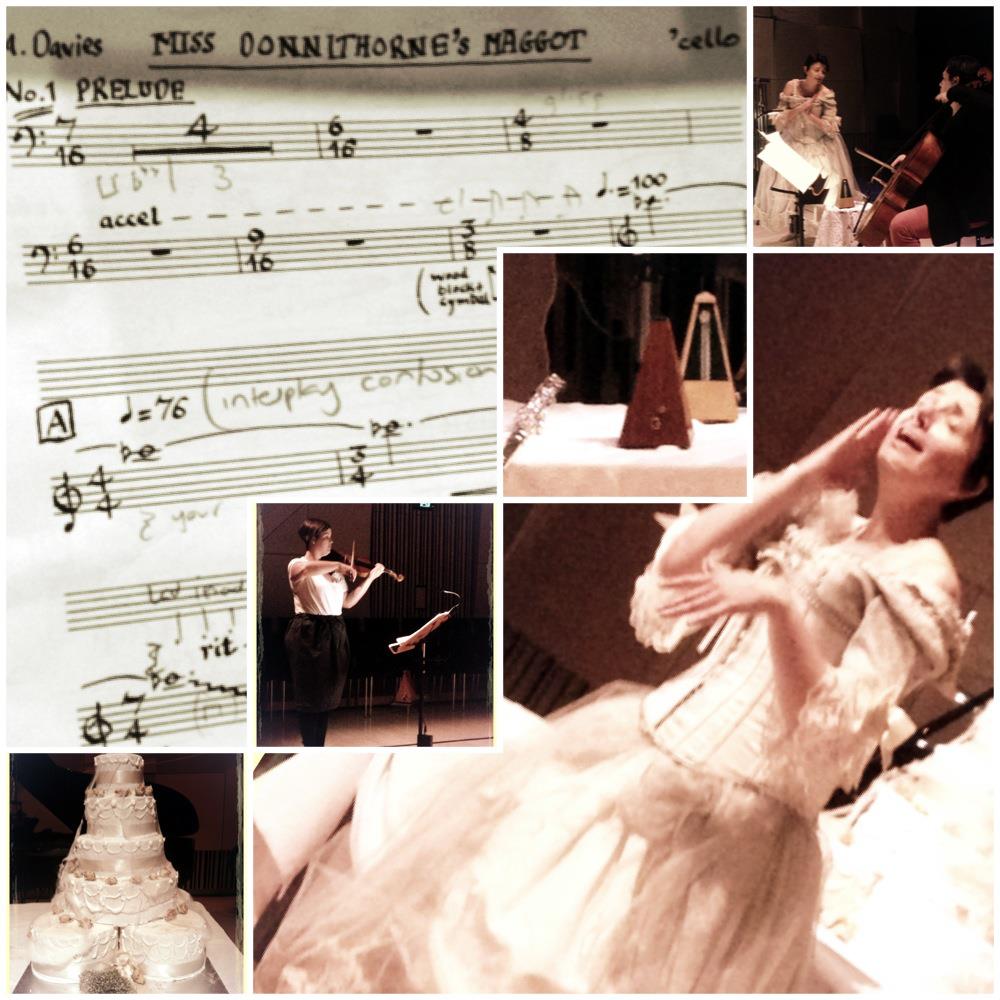
Judith Dodsworth as Miss Donnithorne. Photo by Latoyah Forsyth.
Syzygy Ensemble
Trapped in Darkness (Peter Maxwell-Davies, Miss Donnithorne’s Maggot; Barry Conyngham, The Apology of Bony Anderson)
Metropolis New Music Festival
16 April
Syzygy Ensemble’s double bill at the Metropolis New Music Festival features two one-person chamber operas with sparse instrumentation and disturbing sprechgesang in the tradition of Pierrot Lunaire and Eight Songs for a Mad King. With Syzygy’s playful humour and energy you almost forget the themes of death, decay and madness passing over the stage, onto a platform, into the seat next to you and out the door.
The affective amnesia is not all Syzygy’s fault; the themes are tressed up in thoroughly-enjoyable atonal silliness and replete with moments of tonal relief. In Miss Donnithorne’s Maggot (a “maggot” being a kind of dance, thank you very much), Peter Maxwell-Davies questionably imagines the inner workings of a deranged spinster left at the altar and still in her wedding dress ten years later. The putrefying metre-tall cake in the middle of the stage (actually, the marzipan looked in pretty good nick but for the cobwebs) does not so much represent the protagonist’s sexual organs as stand in for them. The awe, the panic, the hatred Miss Donnithorne (Judith Dodsworth) feels towards her own body is expressed towards her cake-body in such evocative lines as “for the gatehouse of my cake, all one wound of roses, is the open crimson endless petal throat of a rat. That closes.” In case you didn’t get it the first time she also makes a “v”-gesture towards her groin and shrieks “cake, cake, cake.”
Some audience members may recognise Miss Havisham from Dickens’ Great Expectations in the character of Miss Donnithorne and ask “why did Maxwell-Davies transplant Miss Havisham to Sydney?” In fact, Miss Eliza Emily Donnithorne was a real Sydney-sider who, according to the Australian Dictionary of Biography, was allegedly left at the altar by her husband-to-be in 1856 and lived as a recluse beside her rotting wedding feast until her death in 1886. Matt Murphy has since dug around in some archives and found that there is no evidence to suggest that news of Miss Donnithorne reached Dickens in time for the writing of Great Expectations (1860–61), especially considering that Miss Donnithorne’s story doesn’t appear in the media until 1890 and there is no record of Miss Donnithorne’s intended marriage, struck out or not, in the banns of her church or the civil marriage register.
The salon at the Melbourne Recital Centre is an ideal venue for chamber opera. The clear acoustic communicates the minutest vocal articulation, while the intimate space allows performers to get right up in the faces of the audience. Miss Donnithorne’s Maggot could have further exploited this opportunity. Dodsworth expressed a “bored child” sort of absurdity rather than the character’s desperation and discomfort. Anything less raises the question of why such a character would be made to writhe around on stage. I suspect this is a question more for Maxwell-Davies than Dodsworth, as there is no doubt that humour is a central requirement of the score.
The Apology of Bony Anderson is a far more sympathetic, earnest piece by Barry Conyngham based on the life of convict Charles Anderson, who was chained to a rock on Goat Island in Sydney Harbour around 1835. Bony (Christopher Richardson) enters complete with raised scars from over 1200 lashes that he received before finally being transported to Norfolk Island under the relatively benevolent watch of prison reformer Alexander Maconochie. Feeding animals better cared-for than himself he retells the story of his transportation to Australia and brutal punishment in a strong, lucid voice full of stoic acceptance and pity.
Syzygy asked that the musicians be integrated into the performance. In response director John Paul Fischbach asked “how far the musicians were willing to go.” The ensemble was placed in a position of authority over the actors, whether as servant-carers in Miss Donnithorne’s Maggot or as soldiers in The Apology of Bony Anderson. The usual nods for musical cues were transformed into wary glances and shared disgust. More direct interaction led to Leigh Harrold’s priceless forbearance of Miss Donnithorne’s sexual advances, flautist Laila Engle’s coaxing Miss Donnithorne off of the ground with a fluttering flute solo and Jenny Khafagi’s scaring the advancing woman away with a spiky, flortando ostinato. Having seen such a performance in the salon, a room in which every twitch of a musician’s face is clearly visible to the audience, I cannot imagine a chamber opera any other way.
Matthew Herbert, courtesy of Melbourne Recital Centre
One Pig is an album made entirely from sounds recorded during the 20-week life of a pig destined for the table. Remarkable in concept and powerfully brought to the stage by Matthew Herbert, Sam Beste, Tom Skinner, Yann Seznec and Hugh Jones, the concert proved disconcertingly enjoyable in its remixing of one pig’s life and death.
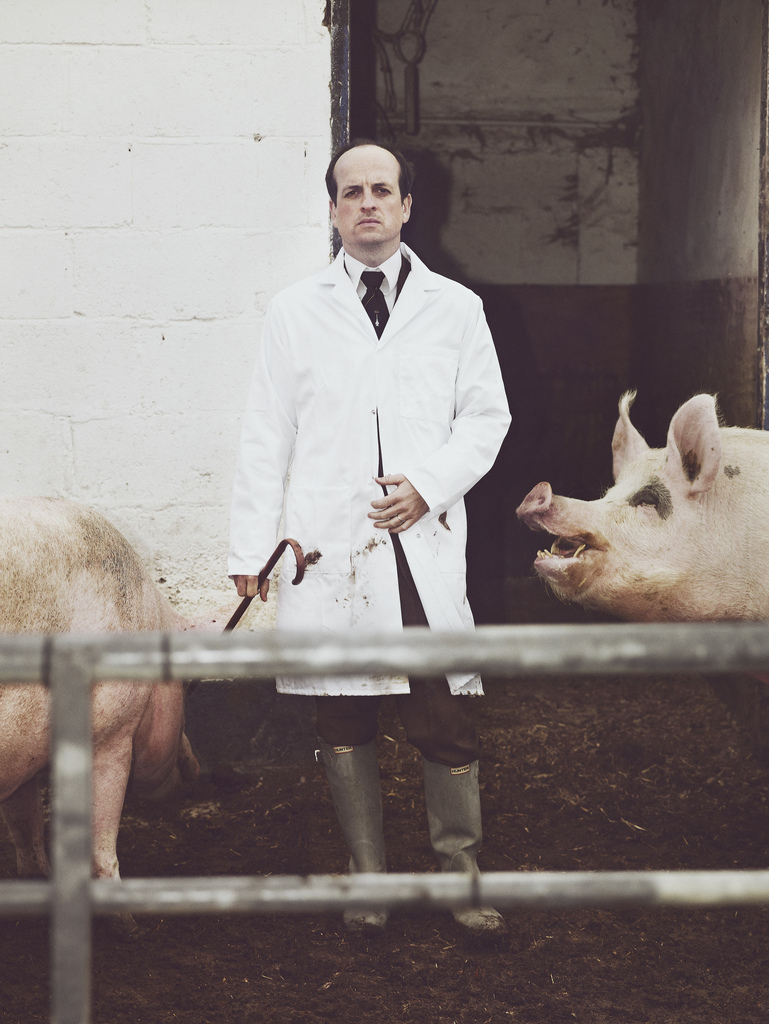
The centrepiece of the concert is a two-metre-square “sty-harp” made from four rows of cords tied to four microphone stands. An electronic drum pad, a keyboard and two laptops are stationed around the sty-harp. A musician enters and takes a handful of straw from a hay bale downstage. He rustles it into a microphone, sending plumes of dust billowing up into the spotlight. Looped and layered, the hall is set alight with warm prickling sounds. Another musician enters, adds a few loud breaths to the loop, then pulls off half the hay bale and begins spreading it around the sty. As Herbert enters the stage he contributes a snort to the ambient loop. The whole band put on white lab-coats before Yann Seznec ducks under the fence of the sty-harp and puts on a lab-coat with “SEP” emblazoned across the back, indicating the month from which the recordings we are listening to were made. He is to be “the pig,” at least for so long as it is alive in the performance.
Triggering samples by pulling, pushing and striking the wires around him, Seznec is part raver, part boxer engaged in a hopeless fight for survival. As Seznec explains on his blog, the mechanism behind the sty-harp is the obsolete GameTrak controller for the XBox and PC. The device, which resembles a retractable clothes line, uses a piece of wire on a sprung spool to track the direction and distance of a joystick from a base station. Though clever and simple, the technology became obsolete with the advent of computer vision systems like the XBox Kinect and infra-red game controllers. With two wires per GameTrak, Seznec hacked six GameTraks to provide the four wires needed for each side of the sty-harp. He connects the potentiometers of the GameTraks directly to an Arduino, enabling access to constant MIDI data from each wire. This data is then used to gesturally control different parameters of a sample, be they volume, speed, pitch, or an effect envelope.
A fascinating instrument to watch in action, the theatrical power of the sty-harp was demonstrated when all five members of the band entered the sty to slaughter the Seznec-pig. With a tight spot light on the sty, the band climbed one by one under the fence and stretched wires into the air, producing a high tremolo of static. They then lowered their wires in unison, causing the tremolo to fade out, leaving only a raw recording of the pig snuffling and oinking. At once they stripped Seznec of his white lab-coat, revealing a red coat underneath. The lights came back on the rest of the stage, revealing chef Jesse Gerner of Anada, The Aylesbury and St Ali North sharpening a knife behind a hotplate and plates of pork.
I have to confess that I am uniquely unqualified to write about meat; apart from a recent foray into seafood I have never eaten it. Jesse Gerner would do a better job reviewing a concert than I would reviewing a steak. Despite wrangling with the ethics of leather (I recently had my old tabla sent to me and such an agglomeration of twisted, cured leather can scarcely be imagined), I have never consciously excluded, or abjectified, meat from my identity. It was just a habit I never bothered getting into. It is perhaps for this reason that I was so moved by the sound of an organ animated by a mixture of pig’s blood and air that played as the thick smell of cooking pork wafted over the audience. By contrast, I was horrified at Herbert’s transformation of the roar of a falling bomb into a flute-like tone in The End of Silence.
Why would I allow the sound of the organ to resonate with me emotionally on the one hand and set up a wall to the flute-tone on the other? It could be because of a discrepancy in the value I attribute to human and non-human life, a discrepancy I would not reject outright, but would be surprised by the size of. It could also be because of the scarcity of “tone” in the concert, the sounds of pig-life consisting mainly of almost-pitchless noises. Or could it be because of the difference between a body and a weapon? The sound of a weapon implies an action that could be taken or stopped, demanding a response from the listener. The sound of a body implies a deed already done, the passive evidence of violence. This is exactly what was missing from One Pig: The sound of the weapon. Either that, or the sound was unrecognisable to me, hidden in the pitchless clangs, rumblings and rustlings of the pig’s life.



 Partial Durations