All posts by matthewlorenzon

Unknown's avatar

About matthewlorenzon

I'm a Melbourne-based musicologist and music-writer interested in contemporary music, music theory and philosophy.

Concert guide: 31 July–6 August

A curated list of upcoming concerts. See also the Australian Music Centre concert calendar and the New Music Network concert series.

Thursday 1 August. The Australian Art Orchestra present the first concert of their ElectroACOUSTIC AcousticELECTRO residency at Bennetts Lane Jazz Club, Vic, from 8:30pm. As part of the first Bennetts Lane residency under artistic director Peter Knight, the concert will feature an eclectic quintet drawn from improvisers from around Australia.

Cycle~440 continue their recent spate of semi-improvised post-jazz-rock concerts with a gig at the Sound Lounge at the Seymour Centre, NSW, from 7pm.

Friday 2 August. Siegmund Watty and Tara Venditti perform the world premières of Thomas Reiner’s Dust and Paul Moulatlet’s Momentary Pleasures amongst a programme of Beethoven, Scriabin, Schoenberg and Hakenberg at the Richmond Uniting Church, Vic, at 8pm.

Saturday 3 August. The Composer, Performer, Improvisation concert features new works by Katia Beaugeais and Ursula Caporali at Recital Hall West, Sydney Conservatorium, from 7pm.

Sunday 4 August. Song Company present their “Old Songs, New Songs, Shared Songs” programme featuring works by Wesley-Smith, Ford and Britten at   the Italian Forum Cultural Centre, NSW at 2pm.

A meandering survey Australian chamber music by Oz Chamber featuring works by Glanville-Hicks, Kats-Chernin, Hyde, Sculthorpe, Hill and Grainger. Woollahra Council Chambers, NSW, 5–7pm.

Tuesday 6 August. David Chisholm’s The Bloody Chamber based on the novel by Angela Carter opens at The Malthouse, Vic!

Aviva Endean, Intimate Sound Immersion

Aviva Endean, photo by Michel Marang.

Aviva Endean
Intimate Sound Immersion
Dane Certificate’s Magic Theatre
Thursday 25 July

What better time to visit a magic theatre down a dark, cobbled alleyway than a wet and windy winter night? The magic I sought on Thursday night was not, however, of the trick-shop kind. Nor did I seek spells or demonic powers, though all of the above found themselves, in a way, evoked in Aviva Endean’s Intimate Sound Immersion, a one-on-one encounter with one of Australia’s finest performers of contemporary clarinet repertoire.

Performers of contemporary music spend endless hours honing sounds that do not necessarily travel well to row WW of a concert hall. While instrumentalists must still be able to project a full tone to the back of an auditorium, they must also command an ever-growing repertoire of “extended techniques” ranging from barely perceptible whispers to deafening screeches, often augmenting their instruments with found objects and manipulating their sound in complex and astonishing ways. I did not know just how remarkable some of these sounds were until blindfolded and led behind the red curtain Dane Certificate’s Magic Theatre.

The performance begins with an almost imperceptible pulse by one’s ear. The sound is so low and so quiet that one is not entirely sure whether there is a draft or the building is shaking from a passing tram. The sensation grows louder and moves around one’s head, opening out the audience member’s spatial perception. Much of the performance plays on the juxtaposition of the still and the moving, the close and the distant, to remarkable effect.

The pulsing changes to a breathy sound that strikes both ears. By opening and closing two channels of a mysterious wind instrument (I suppose, not being able to see any of the tools of the magician’s trade) the listener is gripped in a rapid, rhythmic, spatial oscillation.

After this spatially-focused rhythmic intensity, the sound field is gloriously opened out by a chorus of chimes at different distances from the listener, including two small music boxes  at close range by each ear. This was an absolutely stunning moment and more could have been made of this difference between centralised and dispersed sounds, the opening of the intimate conversation out into an imaginary landscape.

After several more short timbral studies, one encounters a wandering solo of double trills and overtones on the bass clarinet. After passing through the previous sound worlds like so many mythical trials, one feels that one is “meeting” the clarinet like a creature at the end of a quest. What it says I will leave up to you to decide. The unique opportunity of hearing such a solo up close is worth the entrance fee alone, a privilege that performers, who are condemned to a life of unflatteringly-close contact with their sound, might not immediately think of offering their audiences. Just as the audience member is led into the clarinet’s chamber, they are led out. The entire process leaves one with a definite sense of having heard “something” in the warbling trills of the clarinet that one can take away into the cold Melbourne streets.

With low overheads and more spatial flexibility than perhaps any other performance medium, one-on-one performance could be the most dynamic performance genre today. Endean’s performance contributes to a small tradition of performances in Melbourne (including percussionist Matthias Schack-Arnott’s Chrysalis and Paris-based found-sound artist Pascal Battus’ Sound Massage) that exploit a 360 degree sound field usually reserved for complex speaker arrays and orchestral staging.

Intimate Sound Immersion runs until Sunday night, so get down to Dane Certificate’s Magic Theatre, if it is still there.

Concert guide: 24–30 July

A curated list of upcoming concerts. See also the Australian Music Centre concert calendar and the New Music Network concert series.

Thursday 25 July. Clarinettist Aviva Endean brings her one-on-one Intimate Sound Immersion to Melbourne after touring to Amsterdam and Berlin. Runs Thursday 25–Sunday 28 July at Dane Certificate’s Magic Theatre. Book quickly as only nine spots were left this morning.

Friday 26 July. Simone Young conducts the Australian Première of Brett Dean’s new cantata The Last Days of Socrates. Also, Mahler’s Symphony no. 5. Robert Blackwood Hall, Monash University, Vic, 8pm. Repeat performances at Hamer Hall, Vic, Saturday 27 and Monday 29 July.

At Conduit Arts in Fitzroy, Vic, Maka Khan perform on guitar, sax and drums with guest electronic artist Mitchell Mollison from 8:30pm. Sam Gillies and Kevin Penkin from Perth perform from 9:45 as Cycle~440, performing a semi-improvised set drawing on anime and game soundtracks, noise, acoustic piano and laptop sampling.

Saturday 27 July. The Queensland Symphony Orchestra present a new work by Australian composer Matthew Dewey at the Queensland Performing Arts Centre, Southbank.

Sunday 28 July. I don’t know what this is exactly, but it sounds great. The Virginia Chadwick Memorial Reef talk combines presentations of the latest research in tropical and marine sciences with music by Schubert, Rachmaninoff and Ledger. How could you not?

Ida Duelund-Hansen performs a farewell concert with James Rushford, Alexander Garsden, Judith Hamann, Elizabeth Welsh, Huw Murdoch and Rohan Drape, then Peter de Jager performs solo harpsichord works by Byrd and Dowland at the Horse and Weasel Tabernacle, Northcote, Vic, from 5pm.  Entry and soup by donation.

Concert guide: 17–23 July

A curated list of upcoming concerts. See also the Australian Music Centre concert calendar and the New Music Network concert series.

Thursday 18 July. Brisbane’s new music ensemble Topology perform with the Brodsky Quartet at the Brisbane Powerhouse at 7pm. The programme includes an arrangement of Elvis Costello’s ballet “Il Sogno,” Robert Davidson’s “Three Men & A Blonde” and Andrew Ford’s String Quartet no. 3, commissioned by the Brodsky Quartet.

Friday 19 July. Adelaide’s contemporary music ensemble Soundstream welcome renowned violist and conductor Brett Dean to perform works by Ledger, Dean, Pateras and Meale at the Elder Conservatorium of Music, 7:30pm.

Pianist Michael Kieran Harvey performs at Carriageworks, NSW, at 8pm.

Saturday 20 July. Directly or Indirectly is a night of improvised music curated by Callum G’Froerer, the mastermind behind a series of recent ANAM Fellowship concerts reviewed here. Saturday night’s concert at Conduit Arts, 8:30pm, features diverse solo sets from Dave Brown, James McClean, Joe Talia and G’Froerer.

Sunday 21 July. The Melbourne Composer’s League present Elbow Room 20-13 at the Wesley Anne, Northcote, Vic, from 3pm.

Tuesday 23 July. Adelaide’s contemporary music ensemble Soundstream welcome renowned violist and conductor Brett Dean to perform works by Ledger, Dean Pateras and Meale at the Melbourne Recital Centre, 7pm.

The Voice Alone 2: Invenio, Luminesce

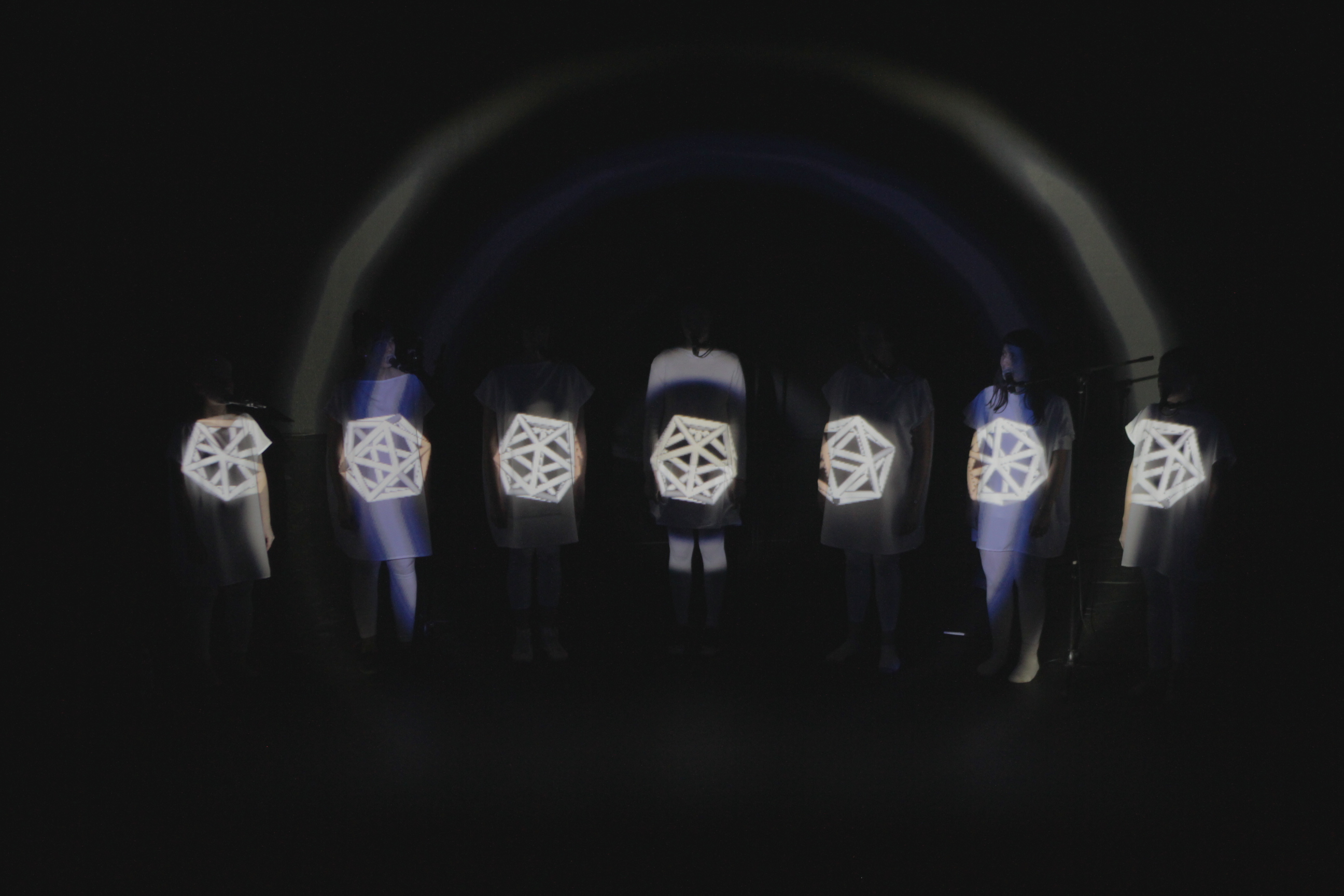
Invenio Singers in Luminesce. Image courtesy of Gian Slater.

Invenio
Luminesce
Guild Theatre, Melbourne
Thursday 11 July

Gian Slater’s compositions are kaleidoscopic musical worlds of dazzling rhythmic geometricity and ecstatic jazz-inflected polyphony. In contrast to this brilliant musical space her lyrics deal with day-to-day struggles like mustering the courage to deal with paperwork. The result is an enchanted hyper-reality where the mundane becomes the cosmic, or perhaps an internal space of solace in the face of a dull external reality. It is a world embraced by her ensemble, the Invenio Singers, who never fail to deliver an impeccably choreographed and polished performance of a good hour or so of music (in this case two) from memory.

Luminesce focuses on the abstract, musical side of Slater’s work, occasionally delving into more spikily chromatic territory than is usual for Invenio. The work is a collaboration with musician, video artist and creative coder Robert Jarvis. Using his software Voxstripe, Jarvis transforms the seven parts of Slater’s composition into visuals that are then projected onto the white-draped singers. Jarvis’ visualisations are simple and effective, like Slater’s music, using shapes and primary colours to highlight the shifting rhythms and phonemes of each singer. It’s such a magical combination of sound and light that it would seem a shame to ruin the surprise of future presentations of this work, which is currently in a “pilot” stage. In short, pastels bathe the ensemble in a glowing rainbow as they fill the room with diffuse harmonies, geodesic spheres are poetically transformed into jagged burrs as though a spiritual transformation is being enacted with each note and apertures like the insides of eyelids reveal and eclipse each singer as though under the gaze of a seven-eyed musical consciousness.

As well as being intensely satisfying for the pattern-searching brain we all share, Jarvis’ visuals highlight the polyphonic nuances of Slater’s composition, which reconciles the worlds of abstract musical composition and the extended possibilities of the vocal organs. It is remarkable that interactive technology is so familiar and affordable these days that elegant pieces such as Invenio can be produced without reliance on any technological “wow” factor, but rather trusting to the poetic integration of interactive projections into the composition. I’ll keep you posted about future showings of this hypnotic work.

Forest Collective, Shared Lines

Forest Collective. Photo by Meghan Scerri.

Shared Lines
Forest Collective
Rosina Auditorium
Abbotsford Convent
Saturday 13 July

In Shared Lines an itinerant spectacle of theatre, sculpture and music unfolds beneath the stained glass of the Rosina Auditorium. Hidden deep within the Abbotsford Convent, the hall’s art deco proscenium arch frames the proceedings like a portal into another time, a time of dance halls and dusty boarding school assemblies. The connotations are not lost on the musicians dressed with Vaudeville flair, much less the schoolgirls, maid and eccentric master of the house of Fixation, a physical theatre piece woven through and bleeding into the musical fabric of the night.

Upon entering the hall one is confronted with a pergola of cupboardry by artist Isabelle Rudolph, a musical ensemble tucked away next to a wall and an impossibly small square of seating in the centre of the room. The seating is more a provocation than an amenity, facing away from the musicians and providing an ideal view for only about five minutes of the entire performance.

It would have been a shame to have heard Rosemary Ball’s enchanting rendition of Liszt’s Oh quand je dors with only one ear, so I hovered near Rudolph’s comforting structure of wood and paint. A maid entered the stage and began miming hanging up laundry surrounded by glowing firefly puppets. The ensemble quietly repeated fragments of Oh quand je dors, this time interspersed with whispers and rattles from the string and wind instruments. Directed by Stephanie Osztreicher—freshly returned from a spell at the École International de Théâtre Jacques Lecoq—, Fixation is a tumble of action, humour and drama centred around an extract from Don Marquis’ Conversation with a Moth (powerfully delivered by Scott Jackson, especially so because we were a metre away from him at the time). The performance also served to lead the audience around the space and direct them towards Pandora, an installation by Robbie James and Ben Delves where the audience modifies the visual representation of improvisations on shakuhachi, flute and guitar by passing around an ominous wooden box. Don’t look inside!

A series of solo performances scattered the audience throughout the hall. I particularly enjoyed hearing the melodic sweeps of Chris Rechner’s Stem for clarinet (sensitively performed by Vilan Mai)  from the back of the hall and Britten’s Metamorphosen for oboe (programmatically an ideal piece for the space and playfully realised by Katia Lenzi) at close range. The concert was also an opportunity to hear Jessica Fotinos’ virtuosic performance of George Enescu’s Allegro de Concert for the slightly terrifying chromatic harp, all the more so because she had to make do with the garden variety pedal harp. Katriona Tsyrlin brought out the introverted intensity of Evan Lawson’s Keys and Locks, a remarkable solo piece that contrasts well with the composer’s ensemble extravagances.

As a curator Lawson is to be commended for coaxing the audience into participation by making it ever harder for them to experience the performance without moving, a dynamic culminating in multiple performances in multiple rooms. Concert curators desiring audience members to move about the space (a desire usually expressed in a hasty mumble at the start of the concert) would do well to take note.

The Voice Alone 1: Ellen Winhall, My Sister’s Song

This review begins a series on the solo voice that weave together themes from contemporary performances with recent debate on the music, language and physicality of the voice.

Ellen Winhall at the Richmond Uniting Church. Photo by Michael Hooper.

Ellen Winhall
My Sister’s Song
Richmond Uniting Church
Thursday 11 July

Ellen Winhall’s recital for solo voice was an object lesson in the seamless integration of finely-honed classical musicianship with extended vocal techniques. The concert was also an opportunity to hear a remarkable body of repertoire for solo voice stemming from the English choral tradition including Australian premières of works by James Weeks, David Lumsdaine and Nicola LeFanu.

Aptly sung beneath the starry vault of the Richmond United Church, the concert was centred upon the nocturnal ruminations of David Lumsdaine’s 1974 composition My Sister’s Song. Based on love poems from a Classical Tamil Anthology translated by A. K. Ramanujan as The Interior Landscape, My Sister’s Song features a refrain evoking the calm passage of late-night hours:

The still drone of the time past midnight,
all words put out.
Men are sunk into the sweetness of sleep …

As a blogger has recently argued, the Tamil word originally used for “night” in this second–third century AD poem is related not just to the late night, but to a specific three-hour period, a midnight “watch.” The passage connotes not only the lucid quality of this period, but its quantity, a quantity that is developed throughout the poem in relation to the narrator’s singular loneliness. The author might be thinking of the period of reflective wakefulness some scholars believe divided the night in two before the invention of urban and electric lighting. As Roger Ekirch argues in At Day’s Close, Night in Times Past, long, dark nights encouraged people to go to bed early for a “first sleep” and rise for an hour or so to study, pray, or even visit neighbours before their “second sleep.” I can imagine David Lumsdaine composing the long, ruminative work during such a midnight “watch,” spinning out the slow, disjunct phrases like constellations on the page. So can I imagine Winhall, only the third soprano to perform the work since its composition for Jane Manning in 1974, humming the work’s melismatic decorations to herself during a period of nocturnal wakefulness. Every twist and turn of the atonal piece—part chant, part unaccompanied recitative, part expressive solo aria—was thoroughly internalised by Winhall, whose considered and precise execution was simply astonishing.

In her remarkable performance notes published as the two-volume New Vocal Repertory, Jane Manning writes that Nicola LeFanu’s But Stars Remaining is to be “sung as from a high rock, the voice flung across a spacious valley.” Winhall evokes the kestrel and the dove of Cecil Day-Lewis’ poem with all the exhilaration of the freely-soaring animals described, before retreating to the intimacy of whispers and half-spoken text.

Winhall’s dynamism and character as a performer blazed through the technical demands of Berio’s Sequenza III, where rapid sequences of phonemes are juxtaposed with hums, vowel-shifting tones, sighs and laughter. A similar carefree virtuosity marked Georges Aperghis’ Récitation 13, which concluded the concert with a playful series of mimicked percussion sounds. The only feature impeding the audience’s enjoyment of Winhall’s performance was perhaps the ABC Classic FM microphone stand limiting the audience’s view and Winhall’s physical mobility.

With their roots in the English choral tradition, the compositions of Weeks, Lumsdaine and LeFanu present an inversion of the usual emotional dynamics of contemporary repertoire. Winhall’s programme oscilllates between troubled, inward reflection and outward jubilation. It is such a pleasure to hear music where “loud” does not immediately connote “wrathful” and “quiet” “sensual.”

Winhall’s concert was recorded for ABC Classic FM. When we hear about a broadcast date we’ll keep you posted.

Concert guide: 10–16 July

A curated list of upcoming concerts. See also the Australian Music Centre concert calendar and the New Music Network concert series.

Thursday 11 July. Gian Slater and the Invenio Singers perform Clarion/Whisper and Luminesce at Guild Hall, The University of Melbourne, at 7:30pm. Luminesce is a collaboration with video artist Robert Jarvis using voices as triggers for lighting events and is in part composed through Jarvis’ Voxstripe software. Second show Friday 12 July, 7:30pm.

Friday 12 July. Saxophonist Emma Di Marco performs four world premieres for solo saxophone by the Australian composers Michael Bakrnčev, Samantha Wolf, Christopher Healey and Paul Ballam-Cross. Recital Hall East, Sydney Conservatorium of Music, 3pm.

Syzygy Ensemble perform works by Adès, Mantovani, Saariaho, Whiteoak and Murail as part of DeClassified Music‘s Long Weekender at 7pm, Fireworks Gallery, 52a Doggett st, Newstead, Queensland, Australia 4006.

The Queensland Symphony Orchestra presents an international programme of works featuring solo flute and trombone including Lovelock, Vine and Hindemith. 7pm, QSO Studio, Southbank, Brisbane.

Saturday 13 July. Michael Fulcher and the Choir of Trinity College, Melbourne perform works by Gabriel Jackson and Eric Whitacre at 6pm, St John’s Cathedral, Brisbane.

In the Artology Remix 20 teenage artists work with Cathy Milliken, former head of education at the Berlin Philharmonic Orchestra, to reinterpret Picasso’s masterpiece Les demoiselles d’Avignon in visual art, music, literature, film and choreography. 6:30pm at the Art Gallery of New South Wales.

The Forest Collective present Shared Lines at the Rosina Auditorium, Abbotsford Convent, Vic, from 7:30pm Saturday 13 July, then 9:30pm Saturday 13 July and 5pm Sunday 14 July. Part installation, part theatre and part New Music, the show promises to be another immersive Forest Collective experience.

Sunday 14 July. Composer Damian Barbeler continues his reinterpretation of sacred hymns sung by six singers from across the Torres Strait, or Ailan Kores. The Torres Strait’s linguistic and cultural distinctiveness is explored through songs from the Eastern, Central and Western language groups at 9:30am, St Andrew’s Uniting Church, Brisbane.

Ensemble Offspring present Sizzle, an afternoon of genre-defying music and beer curated by Bree van Reyk at the Petersham Bowling Club, NSW, at 3pm.

Tuesday 16 July. An all-star ensemble consisting of Peter Knight, Joe Talia, Brett Thompson and Matthias Schack-Arnott share a night with none other than Jon Rose at the Make it up Club at Bar Open, Fitzroy, Vic. 9pm.


Concert guide: 3–9 July

A curated list of upcoming concerts. See also the Australian Music Centre concert calendar and the New Music Network concert series.

Thursday 4 July. The interabilities sound art organisation The Click Clack Project presents The NIS at the Footscray Community Arts Centre, Vic, in collaboration with the Amplified Elephants and the BOLT Ensemble at 8:15pm. Performances also on Friday 5 July at 1pm and Saturday 6 July at 8:15pm.

Improviser and composer Sam McAuliffe curates a night at Conduit Arts, Vic, from  8:30pm.

Friday 5 July. Decibel performs works by West-Australian composers Stuart James, Christopher Tonkin, Rachael Dease, Sam Gillies, Johannes Leubbers, Henry Anderson, Cat Hope and Lindsay Vickery in two concerts as part of their residency at PICA, WA, 6:30pm. Second concert on Saturday 6 July.

Saturday 6 July. Soprano Ellen Winhall performs Australian premieres for solo voice at the Richmond Uniting Church, Vic, at 8pm, including works by David Lumsdaine, Giacinto Scelsi, Christopher Fox, James Weeks, Jo Kondo and Brian Elias.

Sunday 7 July. The Song Company premiere the satirical cantata Howls of the House in collaboration with Oriana Chorale, con voci, University of Newcastle Chamber Choir and Leichhardt Espresso Chorus at Llewellyn Hall, The ANU School of Music, ACT, at 4pm.