All posts by matthewlorenzon

Unknown's avatar

About matthewlorenzon

I'm a Melbourne-based musicologist and music-writer interested in contemporary music, music theory and philosophy.

Metropolis: Speak Percussion, Between Two Parts there is an Intermission of a Hundred Thousand Years

Alexander Garsden's Messages to Erice I & II. Photo by Sarah Walker.
Alexander Garsden’s Messages to Erice I & II. Photo by Sarah Walker.

The title of Speak Percussion’s opening concert sets a playful tone for this year’s Metropolis New Music Festival. The joke was driven home to me when I heard the announcement: “Ladies and gentlemen, Between Two Parts there is an Intermission of a Hundred Thousand Years by Speak Percussion will begin in Elisabeth Murdoch Hall … .” I imagine this title came up during rehearsals, as the ensemble worked out how to switch between the three pieces, each with a different seating arrangement or in a different space entirely. Ultimately there was no such intermission. The ushers herded a willing audience around the building, leaving just enough time to consider the three composers’ distinct responses to the festival’s theme: Music and the moving image.

Speak Percussion’s artistic director Eugene Ughetti chose the composers Peter de Jager, Alexander Garsden and Jeanette Little because they are each at a pivotal moment in their careers. Each composer can comfortably forgo the term “emerging” in their biographies, though they are still “young” composers. They inhabit a no-man’s land between the important but largely unpaid opportunities open to students and the networks of commissioners of established composers.  Speak Percussion’s commissions, supported by the Australia Council for the Arts, showed each composer settling into and refining their individual style.

Peter de Jager, Fractured Timelines

DSC_9769
Peter de Jager’s Fractured Timelines. Photo by Sarah Walker.

The audience took their seats on the stage of the Elisabeth Murdoch Hall for Peter de Jager’s Fractured Timelines. The gleaming keyboard percussion instruments of Peter Neville, Matthias Schack-Arnott and Eugene Ughetti formed three sides of a square around De Jager’s piano, with each performer facing inward towards each other. So intimately close were the audience to the performers that they could follow the coordinating glances of the performers and hear the pedals of the instruments moving. Though designed to project sound out into the auditorium, the stage made an excellent chamber music setting, equalising the natural volume of each instrument.

Fractured Timelines is a multi-modal, gestural romp to heaven and back. The piece is structured as a triptych with two roughly inverted movements separated by their “collision.” The first movement moves from ethereal and whimsical arpeggios and melodies down to a rumbling nether-world with highlights of damped cymbals. Instead of avoiding recognisable thematic, tonal and modal materials, De Jager crams Fractured Timelines full of them. Speak Percussion clearly enjoyed shaping the piece’s cellular themes and different instrumental configurations, including many duo and trio passages, shared lines and runs passed between instruments. The third movement moves in the opposite direction, from the dark to the light and back again, ending with a fabulous rolling ostinato in the bass registers of the vibraphone, marimba and piano. The second movement seems less the “collision” of the two exterior movements than its aftermath. Instead of the arching development of the exterior movements, De Jager presents juxtaposed fragments of thematic material, including funereal, plodding piano chords and a whimsical vibraphone solo (I haven’t heard Ughetti play like that for, well, ever). With his thematic riches and multi-modal language, De Jager is like a modern-day Messiaen without god. Like Messiaen, De Jager gives the themes in his scores short descriptions. In De Jager’s case, these descriptions (including “creepy mountain path” and “briar”) are drawn less from sacred imagery than his life-long experience playing video games. Commander Keen is still his favourite.

Alexander Garsden, Messages to Erice I & II

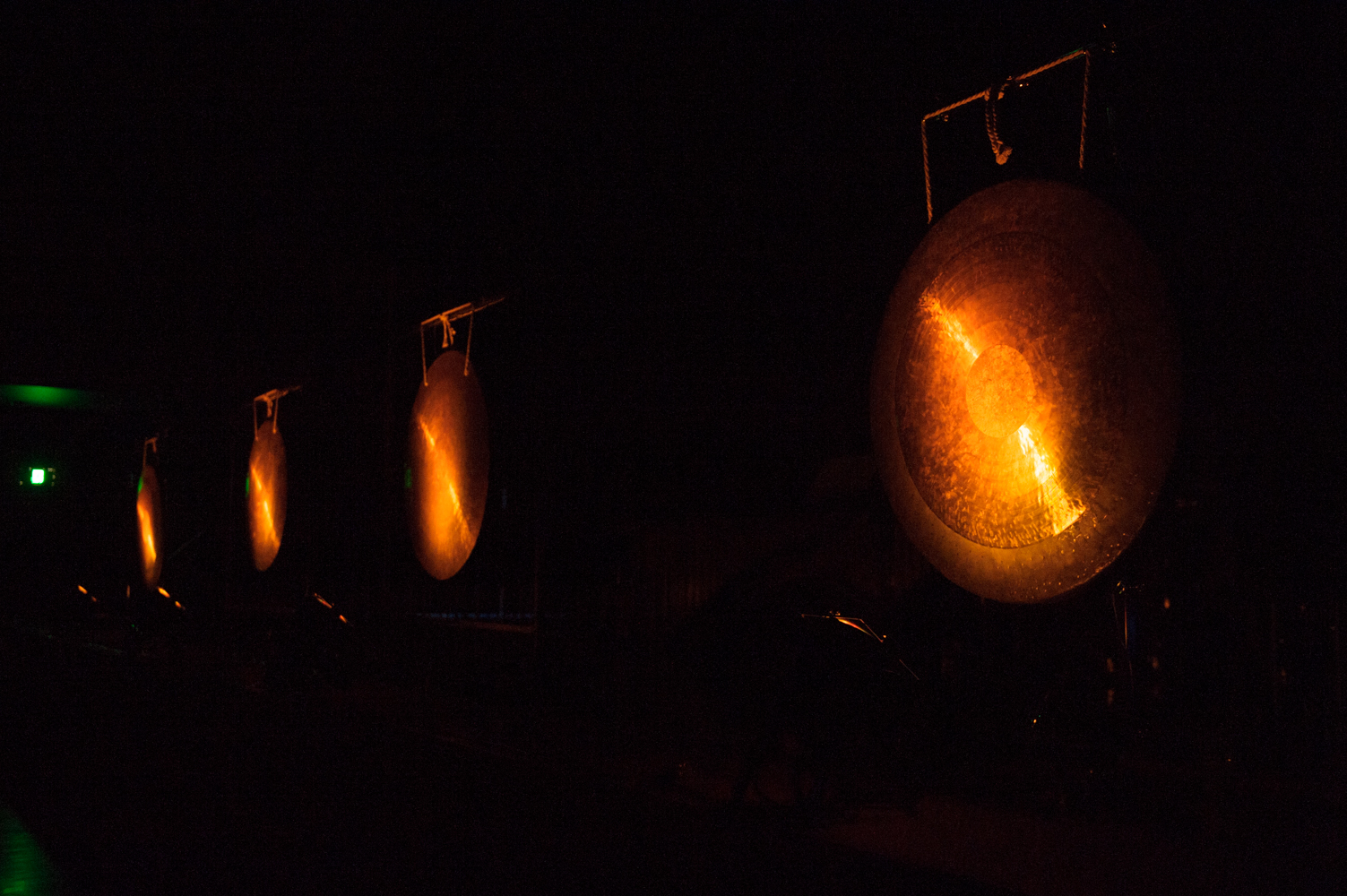
The audience retired to the stalls of the Elisabeth Murdoch Hall for Garsden’s beautiful new work Messages to Erice I & II. Four large tam-tams were arrayed along the front of the stage and lit from below by yellow-gold spot lights. Each tam-tam is fitted with a transducer (like a speaker without the cone). Garsden has made recordings of each individual tam-tam. In the live performance, he manipulates these recordings and plays them back through the instrument via the transducer. The four tam-tams stand there like bronze breastplates, or altars, their mysterious sounds emanating not just toward the audience, but filling the high ceiling of the hall with shimmering, insect-like buzzing and clear, brassy tones. The lights suddenly change to a silvery-blue as the second movement (or “process”) of the piece begins. Here the sound signals are further processed, creating an alien sound world of “washboard” vibrations and fierce roaring. Garsden motivated the festival’s theme in several ways. The algorithmic relationship between the sound-processing of the different tam-tams is related to the relationships of the characters in Víctor Erice’s 1973 film El Spíritu del Colmena. The piece furthermore makes use of recordings, which can be considered moving “sound images.” Most strikingly, the performance itself was a moving cinematic gesture.

Jeanette Little, No Optic
Jeanette Little's No Optic. Photo by Sarah Walker.
Jeanette Little’s No Optic. Photo by Sarah Walker.

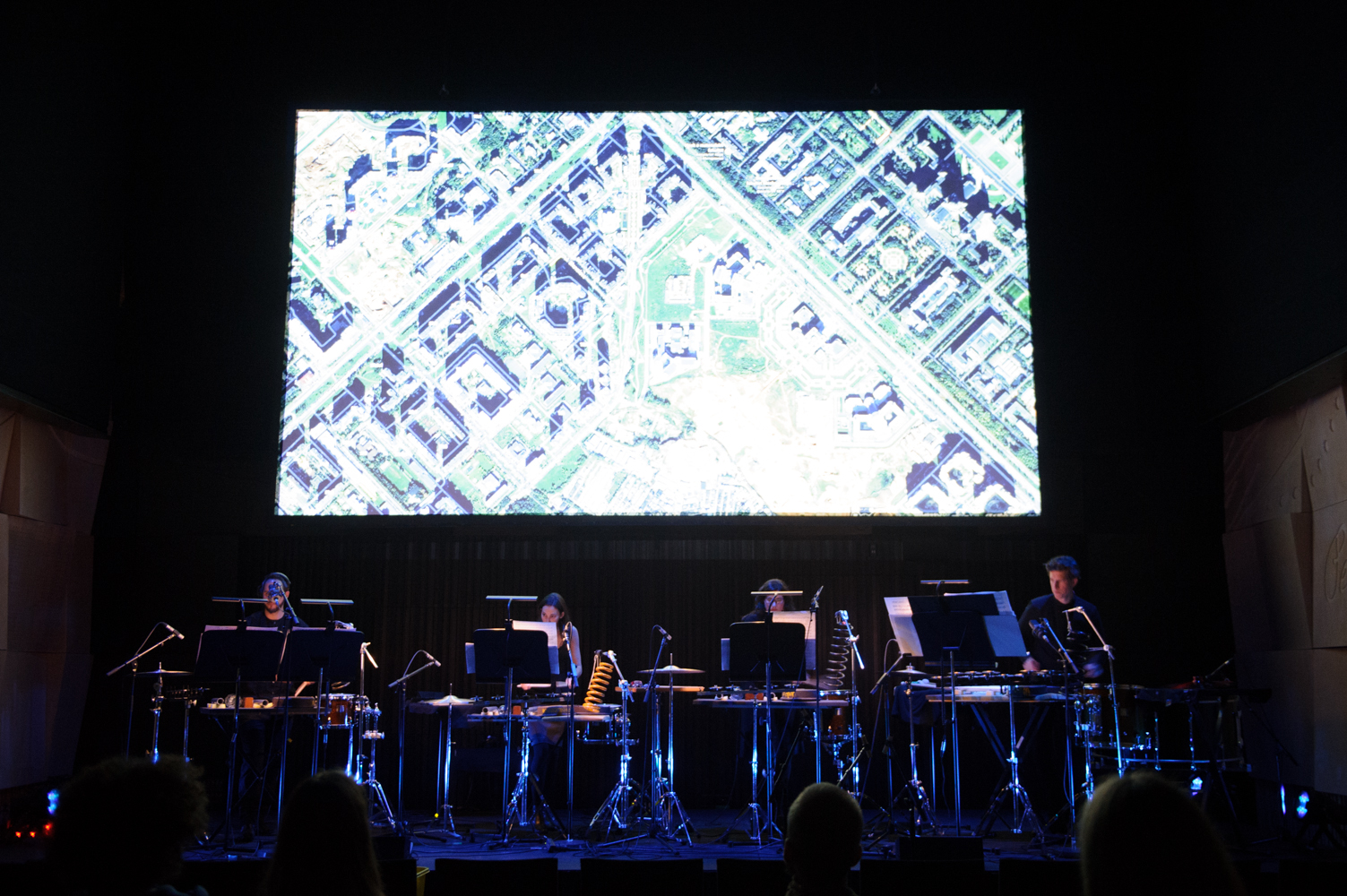
Once ushered into the Salon, we were treated to Jeanette Little’s No Optic for four percussionists and live electronics. The piece is accompanied by a video work by the Russian video artist Sasha Litvintseva. The video features a screenshot of somebody exploring high-resolution Google Maps images of various metropolises. In a reference to online and CCTV surveillance, copies of the screenshots are then dragged onto the screen, producing a multiplicity of staggered images. Scrolling cascades of images of roads and cars pass over the screen. The layering process is repeated with a video of somebody taking a photo with a smartphone. I appreciated that this was a video made almost entirely (if not actually entirely) without a camera. The moving image is now omnipresent, with almost every possible setting and activity recorded and uploaded into the cloud (or into some server farm in a desert). However, I was more amused than scared by the “electronic panopticon” (as it was described in the programme). This may be due to Little’s score, which aimed to conjure mixed feelings of “intimacy, discomfort, anxiety and opportunity.” The four percussionists, Ughetti, Kaylie Melville, Anna Camara and Matthias Schack-Arnott, stood behind four almost identical batteries of metal percussion. They produced beds of sound, like the high-pitched rattling of skewers on metal pipes. At other points the ensemble signalled important transitions. For instance, tiled videos of the interiors of trains give way to a single long-range shot of a city with a train passing through it in the distance. The performers stop suddenly, the resonance of car suspension springs ringing out into the calm. The pre-recorded materials, including loud dance music or a sacred classical-era aria, highlighted the omnipresence of recorded sound in our lives as well as recorded images.

Composers often regret the lack of opportunities available to them after their first student commissions. By commissioning three confident young composers, Speak Percussion has brought three fascinating and valuable new works into existence. This year’s Metropolis festival is full of such adventurous and intimate programmes by local and international new music stars. Be sure to grab a ticket or three.

Speak Percussion
Between Two Parts there is an Intermission of a Hundred Thousand Years
Melbourne Recital Centre
Metropolis New Music Festival
4 May 2015

Peter de Jager, Fractured Timelines; Alexander Garsden, Messages to Erice I & II; Jeanette Little, No Optic.

Ensemble Offspring and Ironwood: Broken Consorts

Ensemble Offspring and Ironwood perform Broken Consorts at the Baha'i Centre, Hobart. Photo courtesy of the ensemble.
Ensemble Offspring and Ironwood perform Broken Consorts at the Baha’i Centre, Hobart. Photo courtesy of the ensemble.

It is a truth commonly acknowledged that a fan of irrational rhythms, jarring dissonances and difference tones will also  enjoy the rasping timbres and wild gestures of baroque music. In Broken Consorts, Ensemble Offspring and Ironwood explore this subterranean passage between early and new music that passes under the full-to-bursting tone and metrical pomp of the romantic era. What explains the affinity between early and contemporary music? As the composer Damien Ricketson mused during the concert, the groups share “a mutual disregard for vibrato.” Performers of early music will retort that this description only applied in the early days of Historically Inspired Performance Practice and that today they know to use vibrato sparingly as an expressive effect. But neither adepts of early music nor contemporary music are known for their sense of humour.

In early music terminology, a “broken consort” is an ensemble constituted from more than one family of instruments. By playing contemporary and early music on early, modern and bespoke instruments,  Ensemble Offspring and Ironwood bring the notion of the broken consort into the twenty-first century. While some works in the programme were creative reimaginings of old and new works on old and new instruments, a new work by Felicity Wilcox was commissioned especially for the concert. While the reimagined early and modern works provided an engaging comparison of instrumental timbres, Wilcox’s piece went furthest towards a genuine exploration of new and early musics’ shared emphases on gesture and rhetoric.

The concert began with Matthew Locke’s Consort of Fower Parts, which Ironwood played in a historically-inspired fashion. This was the first time I have had the pleasure of hearing Ironwood perform, and I was blown away by Daniel Yeadon’s cello tone and rhetorical expressivity. From a purely early-music performance to a completely new work, Wilcox’s Uncovered Ground was a palimpsest of musical styles. The composer likens the piece to a “a chipped painted wall that partially reveals a forgotten mural.” The piece features begins with a descending figure reminiscent of the lamenting bass of a passacaglia or Monteverdi’s Lamento della ninfa. This baroque gesture is quickly replaced by modern extended techniques, including pianist Zubin Kanga playing inside the piano with a bottle. Other baroque forms can be made out beneath the whispering, scraping string sounds, including a decorative string duet and dance rhythms.

The episodic form of Matthew Locke’s Suite from The Tempest provided opportunities for creative instrumentation. Kanga’s piano was prepared to comical effect, with Blu-Tac on piano strings producing “popping” cadences. Paper in between the piano strings and bulldog clips on Claire Edwardes’ vibraphone brought the instruments closer to the brighter, buzzier baroque sound world. I was pleasantly surprised when the two ensembles stood for a spot of very convincing madrigaling.

Damien Ricketson’s Trace Elements was inspired by a sixteenth-century manuscript, the Cracow Lute Tablature. The manuscript includes musical forms that are unidentifiable within our current knowledge of sixteenth-century music. Ricketson was attracted to the idea of forgotten musical styles, as well as the fact that tablature describes the actions required for a piece to be played rather than how it sounds. Trace Elements is written in an invented tablature that can be performed by a quartet consisting of two wind and two string insturments. The performance will thus be different every time that a different combination of instruments and tunings are used. Due to the tablature, as Ricketson writes, “the underlying gestural identity remains constant.” The ensemble chose a compelling combination of modern flute and clarinet with early viola and cello. This produced startling effects as the undeniably “modern” gestures, using the full range of the instruments, were modulated by the gut strings of the string instruments.

The concert closed with Mary Finsterer’s Silva, which was composed in 2013 for Ensemble Offspring featuring Claire Edwardes on percussion. The title means “forest” and the piece reflects the eerie quiet of forest environments, with scattered fragments of Tallis’ “Spem in alium” and Schubert’s “Death and the Maiden” lighting up the space like birdsong. There were some wonderful timbral surprises, including a sumptuous combination of gut-stringed cello and modern bass clarinet. The tone of Veronique Serret’s modern-strung violin stuck out in the muted forest like an enthusiastic lyrebird. After each instrument was given some time to make itself heard, the piece closed with a beautifully rough gong chime evocative of a rusted bell in a forgotten temple.

Ricketson’s Trace Elements

Ensemble Offspring and Ironwood Ensemble

Broken Consorts

Fortyfivedownstairs

23 February 2013

Matthew Locke, Consort of Fower Parts; Felicity Wilcox, Uncovered Ground; Matthew Locke, Suite from The Tempest; Damien Ricketson, Trace Elements; William Lawes, Consort in Six Parts; Mary Finsterer, Silva.

The Sound Collectors: New Music Beauty Queen

View More: http://johnephotography.pass.us/soundcollectors2015
The Sound Collectors perform Gone, Dog. Gone! by Mark Applebaum. John E Photography

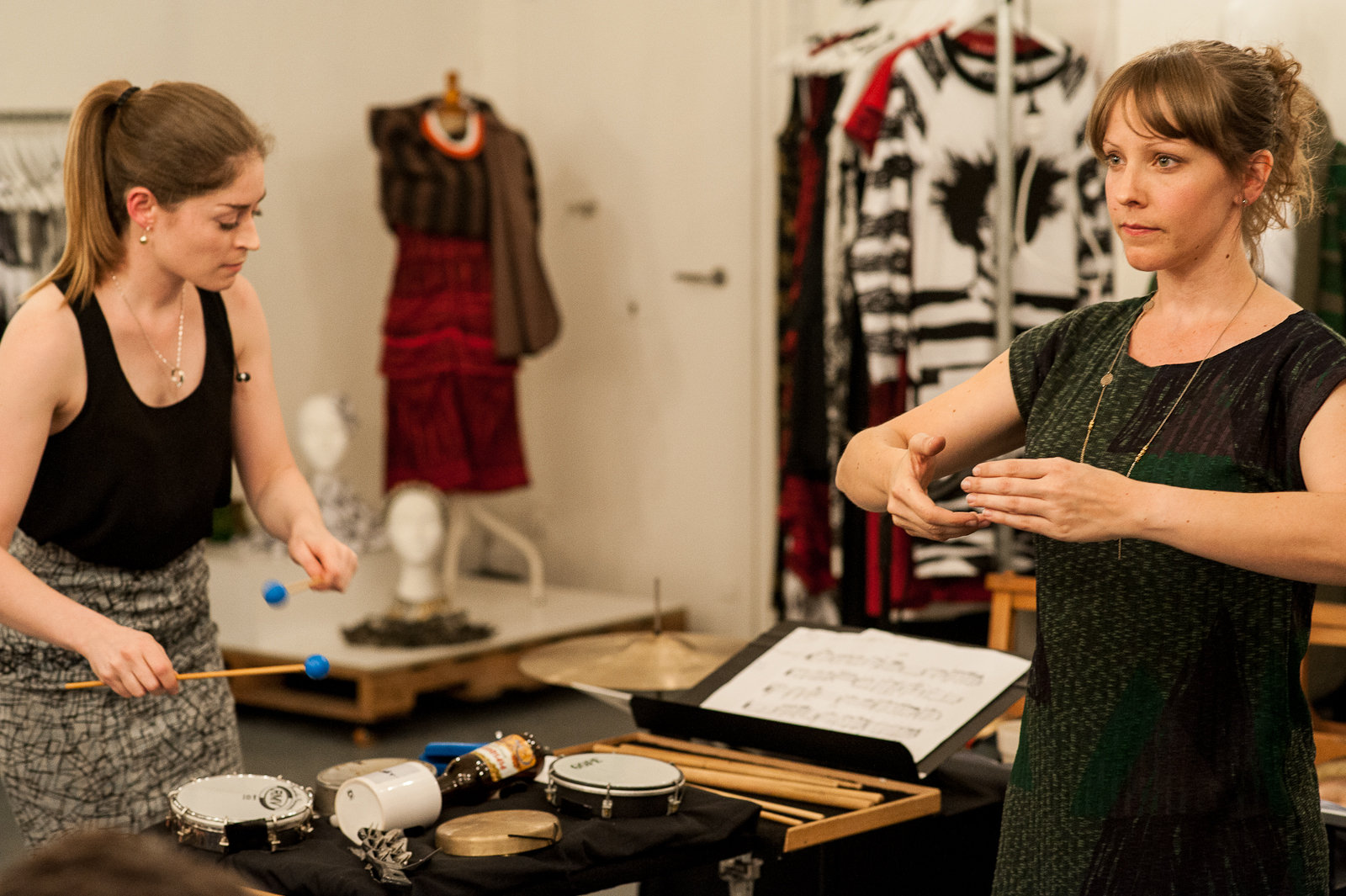
New Music Beauty Queen is an innovative musical response to an innovative fashion label. In curating the programme, The Sound Collectors Louise Devenish and Leah Scholes were inspired by the 2014 collection of the clothing store, manufacturing company and fashion label New Model Beauty Queen. NMBQ is an ethical and sustainable clothing company stocking products made from recycled fabrics. Rather than contribute to each season’s excess of new fabrics, the labels stocked at NMBQ source fabrics from auction houses and redesign them with the aid of NMBQ’s Ethical Clothing Australia-accredited screen printing facility. With their batteries of percussion instruments spaced around the bright, white basement under a sky of incandescent bulbs, The Sound Collectors achieved a thought-provoking synthesis of materials collected from text, gesture, news and politics.

NMBQ’s 2014 collection was inspired by Matilda Butters’ Press Dress from 1866. Butters was a costume designer and, as wife to the politician James Stewart Butters, a serial fancy dresser. The silk Press Dress was printed with the front pages of fourteen different Victorian papers and the mastheads of eighteen regional papers. NMBQ’s 2014 collection, which was spread around the edges of the basement, features vintage typefaces and images printed over bold, block colours. The original Press Dress was even on display by the door, looking perfectly at home alongside NMBQ’s more recent creations.

Leah Scholes and Louise Devenish complemented the collections with a programme of new and existing percussion repertoire inspired by current affairs, politics, text and gesture. Beyond the thematic similarity between the NMBQ collection and the Sound Collectors’ programme, there is a two-dimensionality to the works by Burkhardt, de Mey, Davidson, Hope, Leak and Applebaum that match the designs by NMBQ. Each piece is a linear sequence of actions, words and percussion events pressed upon silence like the symbols printed on the t-shirts and dresses around the edges of the NMBQ basement.

Simulcast by Rick Burkhardt begins with the two percussionists as news readers or radio announcers, speaking into cow bells to give their voices a distant, muffled tone. The text appears to begin with a stream of consciousness of a sales person or a journalist on a trip, walking unfamiliar streets and taking photographs. Before long the tone turns sinister. There is confusion, the speaker is trying to ask questions and is frustrated with the questions of others. Are they at a press conference? An interrogation? The piece leaves the audience as confused at the end as they were at the start, but set up the text-based and focussed dynamic for the rest of the concert.

Thierry de Mey’s Silence Must Be is a simple and extremely effective exploration of audience expectations in the relationship of sound and gesture. Scholes conducts in silence at one end of the basement. The conducting becomes more stylised, like a sort of martial art (conductors would probably like to think that they are ninjas). The gestures change from open-handed strikes to smooth, swaying lines and figures of eight. Two figures of eight move in and out of phase like sine waves. Suddenly Scholes starts from the beginning, but this time each gesture is accompanied by a sound from Devenish’s battery at the opposite end of the room. Of course that is what the gestures sound like! Just as one is becoming overwhelmed at the cleverness of it all, the percussion stops. The rest of the gestures play out in silence. The lack of sound compels one to imagine what Scholes’ gestures would sound like. Would they be high or low? Rough or smooth? How would they move?

Rob Davidson’s highly politicised music recently went viral with his choral setting of Julia Gillard’s misogyny speech. Davidson has continued in the same vein with Human Beings as Well, a piece for two percussionists and a recording of a Sky News reporter interviewing an Islamic commentator. After the interviewer asks the commentator whether he condones beheadings by extremist groups such as ISIS, he responds that Islamic people are “human beings too” and “shouldn’t have to justify” themselves against the actions of extremists. “Get over yourself” the interviewer interjects. The percussion parts bolt along beneath the tragicomic interview. Davidson mocks the sensationalism of the Sky News interview with an upbeat groove, while amplifying the intensity of the speakers’ voices by echoing them on skin drums.

The Sound Collectors perform Sub Aerial by Cat Hope.
The Sound Collectors perform Sub Aerial by Cat Hope. John E Photography

In Hope’s Sub Aerial, the performers trace particular patterns with percussion brushes and mallets on pieces of fabric with different textures. Finally, they trace shapes in the air with portable radios tuned to static. The piece is extremely quiet and was unfortunately drowned out by the overhead fans of the basement. Nevertheless, I was put in mind of a conversation I recently had with the composer Cat Hope at a conference. I, defending pitch-class set theory in the analysis of certain notated post-tonal works, made the generalisation that after one discards the rules of harmony, modality and counterpoint as guiding principles of a work “all one is left with is numbers.” I meant by this that one is left with raw, uninterpreted data. The music analyst’s job is then to find some order in the data, either the composer’s or one’s own. Hope rightfully took me to task for this generalisation, as a set of pitch-classes will not necessarily lead one to understand compositional processes or modes of listening based on curves and gestures rather than discrete pitches and durations. We were of course talking at cross purposes. I was talking about the analysis of dodecaphonic, serial and alternative serial works while Hope was talking about post-serial works and graphic scores. I think Hope would also agree that works like Sub Aerial are no less precise and repeatable than a piece that can be reduced to pitch classes. The use of graphic scores is not always about introducing greater uncertainty and scope for interpretation into a work, but is a way of creating scores that demand the same fidelity from the performer as any notated score.

Next to more recent text-based works, Graeme Leak’s … And Now for the News from 1984 still sounds fresh. As Devenish pointed out, the piece was one of the first Australian solo percussion pieces composed by a percussionist-composer. Like Davidson’s piece, the work incorporates a tape part, this time a Vietnamese news bulletin recorded from 2EA radio. The piece combines direct imitation of the rhythms of the spoken language with metrical episodes derived from the transcription.

Thanks to Devenish and Scholes’ sensitivity and precision as performers, the concert was a revelation as to the merits of text and gesture-based works. As the rhythms of … And Now for the News and the gestural curves of Sub Aerial show, there are rhythms and phrases in actions and words that a musician won’t come up with when composing at an instrument or hunched over a piece of manuscript paper. But against the backdrop of these incredibly successful attempts at mining speech and gesture, Mark Applebaum’s Gone, Dog. Gone! appears less convincing. As Scholes explained to the audience, Applebaum is interested in the musical value of gestures abstracted from their contexts and meanings. Gone, Dog. Gone!, like its predecessor Go, Dog. Go!, is inspired by a children’s book. A part of Gone, Dog. Gone! mimes every bizarre action that a group of dogs are performing in a tree during one part of the book. In Applebaum’s piece, one percussionist performs a sequence of gestures while the other plays corresponding punctuations on a table of percussion instruments. Particular gestures do not seem to be accompanied by particular sounds and the sounds themselves are so short (the battery consisting of small glass and metal objects) that their relationship to the gestures beyond signalling their overarching rhythm is obscure. From what, then, is the overarching rhythm of the piece derived? The rhythm, however chosen, seems to drive the gestures rather than the other way around. The piece was nevertheless a joy to watch as the catalogue of gestures are not too literal, leaving one guessing what they could be referring to. Applebaum’s piece was just one part of New Music Beauty Queen as a thought-provoking and thoroughly enjoyable synthesis of repertoire and context.

The Sound Collectors
New Music Beauty Queen
New Model Beauty Queen basement boutique
1 April 2015

Programme: Rick Burkhardt, Simulcast; Thierry de Mey, Silence Must Be; Rob Davidson, Human Beings As Well; Cat Hope, Sub Aerial; Graeme Leak, … And Now for the News; Mark Applebaum, Gone, Dog. Gone!

Partial Durations is a Matthew Lorenzon/RealTime joint project.

Chamber Made Opera: Captives of the City

Adam Pierzchalski. Photo by Jeff Busby.

Sarah Kriegler and Ben Grant’s Captives of the City is a political fable set in the bowels of a dystopian regime. The show has a simple message about the power of citizen journalism and artistic freedom that is cleverly and cleanly communicated through digital puppetry and stunning musical performances. The piece has been through several stages of development and reflects the Arab Spring and Wikileaks, as well as more recent events such as the Charlie Hebdo attacks.

The audience is met in the foyer of the Melbourne Arts Centre by an officious usher played by Adam Pierzchalski. Pierzchalski clowns about masterfully, disposing of a dead pigeon and checking the cuffs of audience members for recording devices. The audience is taken in groups into the basement while a video screen mounted on the wall of the lift shows security camera footage.

The basement of the Arts Centre is a warren of cages. The entire space is miked up, a sonic microcosm of the authoritarian state above. Two musicians, Mark Cauvin and Matthias Schack-Arnott, are captives of the city. They are taken in and out of cages by the usher and made to perform graphic scores by David Young. I’m not sure whether this is supposed to be a punishment, a moment of restricted freedom or indentured labour for the musicians. The standout performance for me was Schack-Arnott’s solo improvisation on a close-miked cage with knitting needles. Schack-Arnott conjures silvery tones, phasing swathes of sound and deep bass notes out of the bars.

As the performers go about their musical servitude, a magnificent rat made out of fragments of text scuttles around the walls, designed by Dave Jones and projected by Jacob Williams. The rat has moods, increasing the font size and style of its skin as it responds to the musicians. The rat is befriended by the musicians, who cleverly pick the projection off of a wall with a score and “place” it onto Cauvin’s double bass. To cut a short story shorter, the musicians break free with the help of a swarm of digital rats, who write words on the walls of the basement that became famous after the revolution in Tahrir Square:

Oh regime that is scared of a pen and a brush
you’ve been unfair to the people you crushed
if you were honest
you would not fear paint
the best you can do is fight walls
and claim victory over colors and lines

It is tempting to read Captives of the City as a liberal fable counseling artistic freedom without surveillance. However, doesn’t the piece contrast two different problems, that of artistic freedom and that of freedom of information? These are the priorities of two different denizens of the city: the musicians, who have a degree of freedom and whose art is valued in some part by the regime, and the underground activist-rats. The aims of these groups are not necessarily aligned and the slowness with which the musicians befriend the rat in Captives of the City seems to recognise this. Ultimately the musicians achieve liberation through making some particularly loud and threatening music with the pylons of the basement, an ending that only seems to highlight the political futility of their art form. As the rats overrun the city, a montage of citizens on their computers forms the shape of a giant rat. The musicians become a symbol of courage while the rats become agents of political change. As the artists write in the programme of the cartoonists killed in the Charlie Hebdo attacks: “Regardless of opinion of the ‘correctness’ of their work, there is no doubt the artists working for Charlie Hebdo were unflinching in their right to use art to make a statement about the world around them.” The world of surveillance and security moves quickly and since the performance of Captives of the City some of the most far-reaching data retention laws in the world were passed in Australia with bipartisan support, despite there being little evidence that easier access to metadata will stop attacks like those on the offices of Charlie Hebdo or the Lindt cafe.

As Helen Razer recently wrote for Crikey, the data retention laws recently passed in Australia with bipartisan support will have a chilling effect on artistic practice. As Razer writes, Australia’s fascination with censorship extends well beyond the often-cited justification of stopping child pornography: “From Piss Christ to Pasolini to the novels of Zola, artworks are treated with more revulsion in Australia than any other western liberal democracy. Adult consumers of video games were not permitted to legally play items with an R18+ rating until 2012.” The metadata retention laws will raise the stakes of artistic courage.

Captives of the City
By Sarah Kriegler and Ben Grant
Directed by Sarah Kriegler
Chamber Made Opera
Lemony S Puppet Theatre
The Arts Centre
11 February 201

Partial Durations is a Matthew Lorenzon/RealTime joint project.

ANAM: The Inextinguishable

For ANAM’s opening concert of the year Stanley Dodds, newly-appointed principal conductor of the Berlin Symphony Orchestra, led the cohort in a programme of meteorological proportions. George Butterworth’s A Shropshire Lad is a bombastic early-twentieth-century romp. Written after the Second Boer War, the work’s folk-inflected romanticism has become familiar to concert-goers throughout these two years of commemorations of the First World War. The piece is a reminder that the language of grief changes and that composers are constantly inventing new ways of expressing the extremely complex emotions associated with trauma, loss and mourning.

A case in point being Wilfred Lehmann’s Symphonic Requiem for the Child Victims of War from 1994. The score has been revived by ANAM’s librarian Philip Lambert, who heroically typeset the piece over fourteen months. Where Butterworth’s war is one of misplaced heroism, Lehmann uses the post-World War Two trope of senseless mechanisation. Menacing strings descend upon scratched cymbals and motoric snare drums. An alienating cluster of woodwinds combine with an eerie bowed vibraphone. Lehmann paints this terrifying environment so that we empathise all the more with the Symphonic Requiem‘s instrumental “protagonists”: a violin, a mandolin and a glockenspiel. The solo violin appears first, its lament accompanied by a sombre, marching orchestra. The mandolin and glockenspiel enter, playing a sort of hide and seek punctuated by cheeky portamenti. As the background becomes more chaotic, the voices are separated. The mandolin and violin “run” away among blasts from the timpani. This is a piece for current wars as much as past ones. It is about refugee children and those who don’t get to be refugees because they die before they can escape. Shane Chen performs the solo violin part masterfully, executing an extremely virtuosic cadenza before rejoining the plodding orchestral march. Everybody plays the violin’s lament from the beginning, but the violin has the last word with a bit of a jig.

After the vibrant characterisations of Lehmann’s Symphonic Requiem, it was difficult to settle in to Carl Nielsen’s “The Inextinguishable.” A bloated opening orchestral statement thankfully gives way to a mysterious and compelling cello solo (all the more compelling because of the lightning from the storm brewing outside the hall). Another bouncing, bolshy orchestral episode gives way to a thin, tense moment in the strings. Once more, the weather helped, with the storm buffeting the building from all sides. This was the perfect environment in which to hear the Symphony’s central wind octet—with extra-musical wind.

The Inextinguishable
Students of Australian National Academy of Music
Shane Chen, violin
Conducted by Stanley Dodds

George Butterworth, A Shropshire Lad; Wilfred Lehmann, Symphonic Requiem for the Child Victims of War; Carl Nielsen, Symphony No. 4, “The Inextinguishable.”

Partial Durations is a Matthew Lorenzon/RealTime joint project.

Syzygy Ensemble: Brunswick Beethoven Festival

A piano chord questions the air. A high, fragile melody responds from the cello. The cello tune is less alien than the stone-hard chord, almost speech-like as it rises and falls. The cellist, Blair Harris, has his bow right up on the fingerboard of the instrument, making a thin tone like somebody singing far away. The violin, clarinet and flute join in with a kaleidoscope of contrasting timbres. The violinist (Jenny Khafagi) and cellist lean together in vibrating, fleeting harmony. A tone like brushed steel emerges from the clarinet (Robin Henry) and flute (Laila Engle). The sonic pairings of wood and steel disintegrate in a flutter of trills. By taking the concentrated tone of the solo cello as a starting point and then introducing an array of contrasting sounds, Kerry opens out a timbral space with palpable depth. The piano part (performed by Leigh Harrold) prods the sonic perimeter, both a part of it and apart from it. The piece is Gordon Kerry’s Making Signs, my most exciting concert experience of the year so far (though it is a little early to start making claims like that). Syzygy Ensemble recently performed the piece for the second time at the Brunswick Uniting Church among a programme of works by Roger Smalley, Annie Hsieh, Luke Hutton and Brett Dean. The five members of Syzygy have honed Making Signs so carefully that the texture is thick with edges and layers, each sound delineated from its neighbours like grains of sand under a microscope. What a perfect piece for an ensemble whose name implies an alignment or union of distinct elements not through synthesis, but through Frankenstein-style juxtapositions and superpositions.

Making Signs was originally commissioned by Julian Burnside for Syzygy’s “Grammar” concert, one of a series exploring the three disciplines of the medieval trivium: grammar, logic and rhetoric. Kerry, now pushing into his fifties, has had plenty of time to think about musical grammar. He was born into the generation that reacted against Darmstadt-style musical modernism as it was taught in Australia well into the 1980s. Indeed, the piano chords at the beginning of Making Signs are from Winter Through Glass, a serialist piece from 1980 that Kerry calls his first “grown-up” composition. As the years passed, many of his contemporaries retreated into a hazy Australiana, nostalgically painting the landscape with the post-impressionist techniques of this time last century. Kerry kept his teeth, which are bared to the gums in Making Signs, at least for a little while. As the piece progresses, the audience becomes aware that they are no longer hearing a timbral kaleidoscope, but a sort of tonal grammar.

Like watching a minute hand move on a clock, one is unsure of exactly when the coupling and uncoupling of instrumental timbres takes a back seat to harmony. With the benefit of a score one can see the clear juxtaposition—indeed the syzygy—of episodes based on clear horizontal lines on the one hand and gestural effects on the other. The experience in the concert hall is more gradual, like a theme in a poem dawning on you after several readings. Once you notice it, you see how it permeates the entire structure of the work. Except for the serial piano chords, Making Signs is based on a bespoke mode not unlike those used by the composer Olivier Messiaen. Some conventional tonal chords can be carved out of Kerry’s mode and the instruments make their way through it in a style resembling traditional counterpoint. Kerry’s use of the mode is evidence that he is not immune from the reactive pathos of his generation. The piece ends with the entire ensemble see-sawing, running and leaping across the mode in a way that would not be out of place at the end of a blockbuster Christmas film. They roughly outline an F# Minor chord that resolves dutifully to a G chord, albeit tinged with augmented uncertainty and a nice raised seventh. Despite some kitsch moments, the mode gives an especially vibrant quality to the timbral kaleidoscope of the opening. However, it doesn’t seem to be the most important aspect of this jagged introduction. The piece achieves a strange alchemy by creating a continuum between two qualitatively different ways of making signs: through instrumental timbre and through harmony. And yet, both ways of making signs seem to “work” equally (even if I would argue that the first works “more” than the second).

All of the works on Syzygy’s programme were well chosen for their rhetorical power. Hsieh’s clarinet, piano, violin and cello quartet Towards the Beginning is probably the most programmatically ambitious, attempting to tell a story of cosmic birth, life, catastrophe and death. A expectant cloud of harmonics and trills coalesces into searching lines. A thunderous piano climax gives way to chaotic multiphonics and tremoli. At the end of the piece, the piano creeps back in, cowed and conciliatory. The piece was composed in 2010, before Hsieh moved away for further study. While I was not thrilled to hear another primordial soup piece, Towards the Beginning showcases Hsieh’s gift for instrumental writing. From the cosmic to the painfully individual, Luke Hutton’s Fregoli Delusion explores the disorder of the same name where one identifies multiple people as the same person. The piece is perfect for Engle’s highly characterised flute playing. In contrast to her recent performances of Jennifer Higdon’s athletic flute solo Rapid Fire, the flute of Fregoli Delusion is somewhat sombre, creeping along suspiciously and starting with skittish paranoia. Syzygy brought out the character in Smalley’s Trio for Clarinet, Viola and Piano. The opening, I am led to believe it is called “Blooded room,” features leaping rhythmic counterpoint that is inexplicably humorous. The ensemble also brought out the expansive second section and the piece’s absolutely thrilling climax where each instrument comes into its own. Brett Dean’s Old Kings in Exile, the audience was told, rewards multiple listenings. Having heard Syzygy perform the piece twice now, I have learnt to appreciate the mysterious first movement, “Night Music,” with its groaning drum skins and long, winding flute lines. The “Double Trio,” a reference to Carter’s Triple Duo, is a scintillating battle of trills. I wonder whether the piece lacks immediacy. The music never seems to leave a foreground-background frame like a marionette theatre with “incidental” percussion effects and obvious points of focus. I will have to hear it again.

Syzygy Ensemble
Brunswick Beethoven Festival
Brunswick Uniting Church
18 February 2015
Gordon Kerry, Making Signs; Roger Smalley, Trio for Clarinet, Viola and Piano; Annie Hsieh, Towards the Beginning; Luke Hutton, Fregoli Delusion; Brett Dean, Old Kings in Exile.

I discuss Gordon Kerry’s Making Signs further in the upcoming first issue of the contemporary art magazine Fine Print.

Partial Durations is a RealTime/Matthew Lorenzon joint project.

Earth Dances: Music in Search of the Primitive

Earth Dances. Cover by Peter Long. Courtesy of Black Inc.

Earth Dances: Music in Search of the Primitive
Andrew Ford
Black Inc.

Andrew Ford’s Earth Dances explores the ways in which musicians from diverse genres and backgrounds have sought to “rough up” their music. Sometimes the most simple premises are the most interesting, as Ford’s wide-eyed incursions into rock, pop, classical and contemporary art music show. Ford interleaves fascinating interviews with contemporary composers with his own essays on the body, percussion, the voice, drones and childhood.

Ford works every canonical composition you could reasonably expect into the book. The Rite of Spring gets its obligatory half a chapter, though Ford goes beyond merely discussing Stravinsky’s “sophisticated aping of violence.” Ford is more interested in the difficulties this violence posed for an early twentieth-century ballet. He discusses Stravinsky’s dissatisfaction with its ending and the work’s adherence to a balanced form that recognises the diminishing returns of extreme dynamics.

As well as canonical works, the book is brimming with idiosyncratic references that bring out Ford’s personal tastes. Earth Dances opens with the example of Elliott Carter’s A Symphony of Three Orchestras, where Carter appears to sabotage the refinement of his own work with a brutal orchestral meltdown. This example brought to mind another case of musical self-sabotage, the beginning of the Rautavaara Harp Concerto, where the giant orchestral boot crushes the fledgling opening theme several times with exceptional cruelty. Some days you have to skip it. At the opposite end of the classical-popular divide Ford discusses the appeal of anti-folk singer Daniel Johnston, as well as Robert Davidson’s viral setting of Julia Gillard’s misogyny speech Not Now, Not Ever. The book’s great strength is Ford’s dexterity in jumping from example to example, which inspires the reader to situate their own musical world between intellectual and corporeal poles.

The interviews with Richard Barrett, Martin Bresnick, Karin Rehnqvist, Liza Lim, Pauline Oliveiros and Brian Eno  present valuable variations on the book’s theme. Barrett compares his found musical materials to Andy Goldworthy’s land art. Martin Bresnick describes his Opere della musica povera, which are materially basic but not musically poor. Rehnqvist discusses her connection to Swedish herding calls, which she discovered during her conservatorium training. Lim raises the politics of the fetish of traditional musics. She recognises that

‘tradition’ quite often has a past that’s in collusion with slavery, genocide, colonialism and so on. The romance of nationalism often denies the ugly parts of history but, more worryingly, turns a blind eye to how that past continues to reach out and affect the present and shape continuing conditions of power. Cultural matters are intimately political! (146)

I like this term, “intimately” political where many would reach for “inherently” or “fundamentally,” implying an interactive duality between musical and political interests. Pauline Oliveiros discusses the practice of “deep listening” and Brian Eno recounts the adventure of American minimalism’s response to European modernism.

The book’s all-encompassing theme threatens to be its most unsatisfying feature. Earth Dances contains as many examples of musicians see-sawing between intellectual and corporeal modes of composition as it does explanations of why they do it. According to Ford, a composer may rough-up their music to serve a dramatic imperative, to serve humanist or nationalist ideologies, to shock or to reinvent their practice. One important reason is left out: to make a buck. While Ford acknowledges that the corporeal, “primitive” musical pole exists between quotation marks, defined through its contrast with Western ideals of refinement and civilisation, there is no real discussion (outside of Lim’s remarks) of issues of cultural appropriation and exploitation, of the refinement in the “primitive” and so on. To be fair, many have written that book before and I am just as interested in the formal yo-yo of music history as the West’s bloody-minded fascination with its Others. All the same, Ford could have acknowledged the thorny political issues that arise when, for instance, Paul Simon sells a bazillion copies of an album featuring recordings of black musicians in Johannesburg made under anti-apartheid sanctions.

Ford could also have made more of the contradictions between different forms of the corporeal aesthetic pole. As Bresnick’s musica povera shows, simple does not necessarily equal rough. Is American minimalism a simplification, refinement or a roughing-up of a previous aesthetic? Ford frequently returns to the idea one veers toward the “primitive” pole to make way for renewal. If so, then has minimalism led to formal recomplexification, or is it a musical apotheosis? I like to imagine a four-phase cycle with the destruction of a “rough” aesthetic making way for simplicity, from which a new phase of construction begins leading to complexity, but can such a cycle really be found in anybody’s practice?

Ford bookends Earth Dances by associating his intellectual/corporeal divide with the structural anthropologist Claude Lévi-Strauss’ book The Raw and the Cooked. In one sense, this is entirely correct. Structuralism’s gift to musicology has been the idea that music resembles and indeed interprets myth through contrasting and interconnected themes. On the other hand, The Raw and the Cooked presents precisely the opposite theory of musical development to Ford’s yo-yo. In an extended criticism of serialism and musique concrète in the book’s “Overture,” Lévi-Strauss compares music to a language because they are both based on shared, limited sets of elements. Just as all English speakers recognise the same few phonemes, we all recognise the same set of pitches related by the hierarchy of overtones. His idea was torn to shreds by successive generations of composers, critics and musicologists. The diversity of temperaments and scales around the world is enough to refute his claim, let alone the genuinely communicative and thrilling experiments of modern music that readers of this blog will be familiar with. Lévi-Strauss admitted that he didn’t like or understand the music of the cultures that he himself studied. But to Lévi-Strauss the “harmonic grid of selection” is immutable and irreplaceable. He did not believe that any amount of roughing up could make way for a new one. This is evidently a live issue, because Ford’s book came out around the same time François Mitterand’s ex-economics adviser and some-time conductor Jacques Attali used Lévi-Strauss’ idea of the harmonic grid to call atonality “musical terrorism” (and this from the author of Noise, a book that crassly equates Western art music’s formal history with the economic stages of historical materialism). It is obscene to compare musical violence to the actual taking of lives (see the interrelated but distinct political and musical priorities above). But Attali raises a valid question: Does musical destruction merely peck around the edges of musical norms, or is it a genuine step in the process of musical innovation?

Rosenberg 3.0: not violin music (book review)

Rosenberg 3.0: not violin music

Curated by Jon Rose

Blurb

Following Pink Violin and Violin Music in the Age of Shopping, not violin music presents the latest scholarship from the rarefied field of Rosenbergology. For those who have not had the pleasure of delving into the intellectual humus of the Rosenberg family tree, the Rosenbergs are a clan of physicists, mathematicians and, of course, violinists who all share the same first initial “J.” The family’s pseudonymous scholars are keen culture critics and dialecticists, ready to lament the decline of Western Civilization while decrying its inherent contradictions. The book revels in collapse and tragedy, beginning with a post-apocalyptic portrait of one Dr Rosenberg reinventing the Doric column and ending with a suicide.

The material form of the book develops this sense of cultural amnesia. It is an unwieldy book, lacking even that most basic of bibliographic conveniences: page numbers. There is no table of contents, nor even a list of contributors. Book sections can only be distinguished by their idiosyncratic typesetting. Each chapter has a different font (though Comic Sans does not make an appearance, I was disappointed to find. Even scientists at CERN use it!). The glossy, low-resolution cover betrays its origins in a print-on-demand self-publishing house. It is, in short, a dysfunctional book.

Which is precisely the point. Contributors were briefed to explore dysfunctionalism as a theme. In one chapter “Dr Robert Ostertag” gives the principle of dysfunctionalism as that “[…] a machine performing a task badly is aesthetically superior to a human performing the task wel.” The phrase is clipped because Ostertag’s responses are subject to Twitter’s 140-character limitation. The book is thus a product of the axiom that cheap-and-quick printing and cut-and-paste formatting are aesthetically superior to more manual production values.

Ostertag’s definition of dysfunctionalism only covers cases where automatism is pitted against human agency in the performance of a given task, such as in the construction of a print-on-demand book. But the cases of dysfunctionalism explored by the contributors are usually those in which a machine poorly translates or transmits human intentions (If I may add my own example, consider the joy derived from watching crappy robots fight each other compared to their better-greased counterparts). For instance, Ostertag cites an installation where Dr Rosenberg attempts to play a violin using ECG data. Another author relates the dysfunctional scenario of a Maoist TED talk by Judd Rosenberg. Plagiarism, new and old violins, jazz clubs, composition competitions and the instrumental innovations of violin metal are also evaluated as dysfunctional mediums.

The authors explore language itself as a dysfunctional medium. Academic language, theory language, art language, even mathematical language (the book is a pleasure for those on hand-waving terms with pure mathematics) all come under parodic scrutiny. One chapter is shockingly written in “Engrish,” with “l”s and “r”s interchanged. Another frequently drops articles. These caricatures of the language of people from Non-English Speaking Backgrounds are made all the more offensive by the use of pseudonyms as dysfunctional names. The pseudonym does not point the reader to any particular context. It is a reader’s dead-end. This is dangerous when a text hinges on irony, on knowing that an author “doesn’t really mean it.”

Dysfunctional names leads to dysfunctional readings, and here I cannot accept that dysfunction aesthetically trumps function. Only after clarifying with Jon Rose that the two chapters in question were indeed written by a Japanese and a Slovakian contributor respectively and that exploring dysfunctional language was an essential part of their brief was I able to read the contributions with any sort of sympathy.

There is yet the disfunctionality of culture critique that plagues the book. Lazy generalisations mar the contributors’ clever jabs at contemporary culture. One author paints a juvenile caricature of the Australian suburbs as a cultural wasteland devoid of music-making. Rosenberg is driven around the suburb of “Roselands” in a taxi and promises to double the fare if he can find somebody performing music. He resorts to door knocking after failing to find music at pubs and malls, but house after house is devoid of music-making. I call this caricature juvenile because I entertained it myself as a teenager in the southern suburbs of Adelaide. But then again, I was playing the cello every day from the back room of our triple-fronted, cream brick home, as were many other kids in the neighbourhood. I lament with the author the steady decline in public musicking since the nineteenth century, but they would better pose the question of why amateur music making is still largely delineated by class rather than shaming the working class, or indeed the economic middle class, for having apparently given up on violins. The Muslim taxi driver in this chapter is also a caricature the purpose of which mystifies me.

Several chapters in the book are quite tasteless, which is again part of the book’s design. In response to my inquiries about the book’s portrayals of class and religion, Rose stressed the point that he exercised no censorship in curating the contributions. Tasteless, too, is the Violin Museum inspiring the contributions, which features several exhibits that cannot be included among the thirty-one pages of pictures of the Museum. The museum, which actually exists, was once situated in the town of Violin in Slovakia. Rose has passed a dragnet through contemporary culture, from the high to the low and the experimental, picking up authentic Rosenberg modified violins and art works, as well as violin-themed nick-knacks and smut. After threats to the museum director’s life, the museum is currently homeless, but will soon be exhibited in Berlin, Bologna and Australia. Whatever the anti-censorship ideals behind the book, the use of dysfunctional names will lead the book to be judged on face value. The book’s irony will be flattened out.

Arcko Symphonic Ensemble: Karlsruhe-Canberra

The Arcko Symphonic Ensemble’s final programme of 2014 delved into the influence of two very different locales upon the ensemble, its conductor Timothy Phillips, and its composers. From Canberra, where a generation or two of composers and pianists have been raised by Larry Sitsky including Alistair Noble, Rohan Phillips and Joy Lee. The State University of Music in Karlsruhe, Germany, also introduced Phillips to Wofgang Rihm and Stephan Schneider.

With its refined swathes of musical texture, Noble’s cycle of three pieces entitled Glasteppich betrays a fascination with the music of Morton Feldman. Glasteppich I was written in Basel, where Noble lived for half a year while researching his searingly acute series of analyses of Feldman’s music. Noble had a folder of left-over sketch material and set about using them to make a new piece. The idea for the piece coalesced when he was examining homemade rugs made from recycled materials in Lenzburg. Inspired by the notion of weaving the different strands of his compositional output together, he imagined a rug made from a material that could be “variously transparent, translucent or opaque” (to quote the programme), such as glass. A few pointers from Beat Furrer later and Noble was ready to deploy his arsenal of weaving, layering, erosion and erasure processes in his Glasteppich or “glass carpet.”

So much for the piece’s origin and inspiration, which are as ordinary as any. Composers (including Feldman) frequently reuse and cobble together old materials. Who hasn’t had a couple of pointers from Beat Furrer? The effect in this case, however, is marvellous. Michael Kieran Harvey gave the piece all the three-dimensional complexity it asks for, with its murky bass tones; lonely, brittle, beating chords and fragments of harmonic voice-leading. I have never seen anybody reach into a piano so insouciantly to pluck out a crystal-clear high tone. There was even something smooth about the way Harvey knocked on the bottom of the piano.

Superb performances were thick on the ground, with Kim Tan’s rendition of Glasteppich II for solo flute. After Glasteppich I, Noble envisioned two pieces that would fold the material inwards and outwards respectively. These pieces became Glasteppich II and III. The in-folded piece for solo flute is extremely dense, challenging the performer’s ability to make sense of the score, which is spread over several staves. Tan’s interpretation also gave the impression of complete control, professing the work with a beautiful agility that was aided by the friendly acoustic of the Northcote Town Hall. Tonal sounds are certainly not out of bounds for Noble, and the appearance of clearly diatonic fragments made for interesting pills within the irregular fabric of the piece. “Balance” and “restraint” are the words that best come to mind to describe Noble’s first two Glasteppich pieces, words that unfortunately cannot be said of the third.

Whereas the textures of the solo Glasteppiche were consistent, Noble took some liberties with Glasteppich III for the Arcko ensemble. A large-scale form emerges when the piano returns in the middle of the piece with material reminiscent of Glasteppich I. In doing so, the audience takes leave of the virtuosically-dark texture established so far. It is hard to explain just how grim this piece is. Eerie close string harmonies meld with the punctual piano and make futile pizzicato interjections. The piece just drifts along in this listless way, with directionless, whole-tone-based chords. It is a piece that benefits from its duration, holding its particular brand of desparation together through the startling appropriateness of each sound. Well there you go, restraint again. And a ternary form can hardly be called unbalanced. It must be said that superlative performances were also the norm here, with the strings in particular placing and shaping each note within the texture like a mournful jewel.

In Wolfgang Rihm’s terrifyingly-loud Chiffre II, the composer takes silence as a positive rather than a negative space, as “to be beaten.” The ensemble strains against the confines of silence in all registers, filling the hall with infernal dotted rhythms, string-scrubbing and endless bass drum and timpani. The piano, when it is heard, sounds absolutely tiny next to the gargantuan ensemble. But whenever a breath is taken, silence flows back in like water.

Stephan Schneider’s The Message is Simple sounds like a 1990s electro hit crossed with the House of Cards theme. It is a political piece of music in a popular idiom. The piece gives the lie to its moral, which is that “There are no borders in music, there are no frontiers in art. As an artist there is no reason to adopt the notion of being protected by borders.” Why is it that a popular idiom signifies borderlessness? Is it because everybody is supposed to like it (they don’t. Even the world of popular music divides itself into limitless antagonistic subgenres)? Or is it because the only borderlessness being advocated today is that of the free-trade agreements that ensure the frictionless passage of goods (and music commodities)? As a composer, of course one may range freely among musical materials, but many electronic music artists would staunchly defend the border between their music and Schneider’s.

Rohan Phillips’ Sarabande has a lot of interesting parts, but hangs together rather loosely. This may be tied to the piece’s composition over a number of years and its inspiration from baroque dance suites with their fleeting characters. It is billed as a piece for piano and small ensemble, though the guitar part (Geoffrey Morris) has a role that at least equals the piano (Joy Lee). I particularly enjoyed the simplicity of the violin part at the beginning, with its single note acting as a pivot for the harmony around it. The cowbells are a playful feature, one of the many almost independent-sounding parts to the piece. I imagined myself lost in a sea of music, invited to listen to one part and then another. In a rare moment of inter-instrumental solidarity the French horn reaches out and continues the resonance of the timpani.

Karlsruhe-Canberra
The Arcko Symphonic Ensemble
Northcote Town Hall
13 December, 2014
Programme: Alistair Noble, Glasteppich I, II, II; Rohan Phillips, Sarabande; Stephan Schneider, The Message is Simple…; Wolfgang Rihm, Chiffre II.

Flooding in the Garden: Benjamin Anderson’s “Mixed Mediums” and Forest Collective’s “The Mingled Yarn”

youphonium
Carolyn Connors and Jenny Barnes in Youphonium. Photo Meghan Scerri.

For three balmy nights the Forest Collective filled the Abbotsford Convent with film, dance and music. The inaugural Flooding in the Garden festival included improvised extended vocals by Jenny Barnes and Carolyn Connors, dance by Elanor Webber, pop-elf William Elm and an independent film series also curated by Webber. The florid programme also included a series of contemporary notated works as part of Forest Collective’s own multi-disciplinary concert and Benjamin Anderson’s bass trombone recital Mixed Mediums.

texture of it
Elanor Webber’s The Texture of It. Photo Meghan Scerri

Moving between the distressed art-deco rooms of the Convent, each new medium was an unexpected delight. William Elm festooned the Rosina Auditorium with fairy lights and lamps for his set of puckish accordion duets. The breathtaking physicality of Webber’s The Texture of It exploded in the Chapel. The venue was lit from inside and outside the building, recreating lighting effects from different times of the day. Rays of afternoon light streamed in through the stained-glass windows, nocturnal lamp-light lit the contorted bodies of the dancers and a diffuse morning glow filled the space. An ensemble including Benjamin Harrison, Rob McDonald and Jennifer Mills performed instrumental textures in tight coordination with the dancers, leaving one guessing where composition left off and improvisation began. Later that night Webber transformed the hall into the Chapel of the Independent Film, with a series of experimental and cine-dance films exploring shape, colour and texture.

Mixed Mediums

mixed mediumsIn Benjamin Anderson’s recital, the audience was confronted with a projection of the movie-star face of General MacArthur and a recording of his 1962 speech to the Corp of Cadets. MacArthur declared the dawn of a “new age”: the space age. So too was it a new age for Australia, one defined by the move away from our traditional British defenders and towards tighter military ties with the United States. Perhaps no moment exemplified this shift more than MacArthur fleeing the Philippines to Australia in 1942. A plaque at a disused railway platform in the miniscule South Australian town of Terowie marks the spot where he famously claimed he would return to the Philippines. He quickly assumed control of the Australian Forces as Supreme Commander of Allied Forces in the South-West Pacific Area, setting up his base in Brisbane. So, this digression argues, we have at least some reason to project this speech in a hall in Melbourne today. Anderson walks in dressed in a military parade uniform and begins playing Robert Erickson’s General Speech. Erickson transcribes MacArthur’s speech for the bass trombone, focussing mainly on the pitch of MacArthur’s voice (admittedly he has to exaggerate, MacArthur’s delivery being fairly monotone). There are scored coughs and sips of water, the only relief from what is a fairly dull setting of the text. The piece was composed in 1969 and I can imagine composers today, with their greater familiarity with extended techniques, would make a more inventive transcription. It would be good to hear several different transcriptions of the speech by different composers, or perhaps transcriptions of a more recent speech by an Australian politician. As the musicologist Linda Kouvaras explored in a recent paper at the Musicological Society of Australia’s annual conference, Youtube is already rife with this sort of musical play. With General Speech, Anderson established a theme of the concert: the bass trombone as caricature. Anderson is a tall young performer with loads of character, making him the ideal performer for these works.

The parodic bass trombone reached its zenith with Andrew Aronowicz’s The Physiology of Taste. Here the bass trombone is the nineteenth-century gastronome Jean-Anthelme Brillat-Savarin as he slurps and degustates his way through his famous treatise The Physiology of Taste. The first movement, “The pleasures of the initial tasting,” consists aptly of tentative, pattering little bursts occasionally punctuated by a sucking smack of the lips. Everything about this movement is about the lips and the tip of the tongue. The second movement, “Relishing the Texture and Composition of the Delicacies” explores longer tones of different timbres, from the purest high note to the instrument’s flatulent bass. It was at this point in the concert that I questioned why I ever go to concerts by established ensembles, younger performers being often more inventive, daring and downright humourous. The third movement, “The Savours,” presents the four tastes: salty, sour, bitter and sweet. Anderson brilliantly executed the dry, shaking, stabbing “puh puh puh” of salt; a puckered and wheezing sourness (exaggerated by a nasal double mute); the cracklingly-low bitterness of espresso coffee (as Brillat-Savarin writes of Melbourne’s favourite way to make coffee: “I have also tried to make coffee in a high pressure boiling apparatus; all I obtained however was a fluid intensely bitter, and strong enough to take the skin from the throat of a Cossack.”). Aronowicz’s depiction of sweetness attempted to reflect “every refinement of temptation” with which, Brillat-Savarin writes, we must use to convince the diner, who has already satisfied their hunger, to indulge. The final movement, “The Irrepressible Urge to Gorge,” represented Brillat-Savarin’s least favourite diner, one who cannot resist overeating and getting drunk. Anderson played higher and louder in between great big gulping sounds. I imagined the waiter in the Monty Python scene (“but it is wafer-thin”) as Anderson finished with a series of tiny toots and then a burp.

In Charles MacInnes’ cirque, “stuck in traffic, an out of work clown tweets about his daily annoyances to a growing audience hungry for the next distraction and amusement.” The impression I got from Anderson’s repeated checking of his phone and restless fidgeting was more of a music student struggling to get down to their daily practice (or perhaps a PhD student writing reviews instead of their thesis).

Character pieces were only one facet of Anderson’s immense programme. Wuorinen’s trio for bass trombone, tuba and double bass ranges between low, pulsing phrases and lyrical episodes exploring the instruments’ baritone registers. The brighter double bass played by Miranda Hill cut through the mellower brass with agile lines. It is a transparent and self-contained chamber work out of place, perhaps welcomely-so, in this character-driven programme.

Elliott Hughes’ Underdogs, with regrets is about iterations of forms, inspired by Jasper Johns’ exhibition “Regrets,” in which he recreated a photograph in multiple mediums. Hughes repeated gestures inspired by Charles Mingus with several different mutes and musical variations. It was not unlike the way one mulls over and replays regrettable moments in different lights. The piece uses subtle and tasteful uses of electronics. The spatialisation of captured trombone sounds expanded slowly over the duration of the piece, subtly producing a chorus of distant-sounding, growling and erupting brass.

Martijn Padding’s Schumann’s Last Procession for bass trombone and harp slowly takes apart a loping, bluesy duet where the two instruments also play a kick drum and a hihat. The piece devolves until all that is left is the percussion and a low, drawn-out note from the trombone. I only learned afterward of the programme: the walks Schumann was allowed to take to the statue of Beethoven in Bonn while he was receiving brutal, experimental treatments at Endenich, Europe’s first psychiatric hospital.

Peter De Jager’s Timescales for solo trombone and lighting design is comfortably dense. I quite liked the choice of hyper-real purple, green and blue lighting for different moments in the piece, not unlike an updated version of Scriabin’s colour organ. In another Scriabin-esque gesture, the piece presents three formal levels depicting cosmic, human and atomic time scales, from drawn-out modal pitches to expressive harmonies to chromatic interjections. In terms of pitch and rhythmic material it was by far the most complex piece on the programme and well deserving (if not requiring) another listen.

The bass trombone rarely receives a whole recital unto itself, though as one audience member mentioned after the show: “I didn’t know what to expect, then I realised it was a music recital.” As the title “Mixed Mediums” further suggests, Anderson’s programme encompassed so much more. Costume, lighting, performative elements and even food (petit fours representing the four flavours were served at interval) contributed to this series of new works by young composers, keeping the audience thinking for the duration of the concert.

The Mingled Yarn

The Mingled Yarn. Photo Meghan Scerri

The mixed-medium theme continued with Forest Collective’s theatre-and-music programme The Mingled Yarn. The five contemporary soliloquies based by Samuel Yeo inspired by characters from Shakespeare’s plays were in turns powerful (Sam Lavery’s Caesar) and hilarious (Julia Lamb’s Juliet). Musically, the Forest Collective took a little time to get their ear in. Was this because of the abrupt beginning, where Lawson walked in and immediately started conducting? It was a clever, informal gesture in the streaming afternoon light of the backstage area of the Rosina Auditorium, but intonation issues plagued William Byrd’s “Kyrie” from the Mass for Three Voices, which was played by violin, viola and cello with occasional humming from the vocalists in the style of John McCaughey. By the time of Evan Lawson’s Winter Canticle, however, the ensemble was focussed and responding well to Lawson’s energetic and inspired conducting. the piece is a reworking of previous material, taking the emotional structure of Shakespeare’s The Winter’s Tale as a formal basis. An introductory episode of drones and vocalises gives way to an astounding rhythmic explosion. The three vocalists declare “Winter!” as febrile string phrases scurry about. The voices speak and whisper phrases from the play in an emotional polyphony, accompanied by energetic scrubbing in the strings. Lawson has learnt well from his twentieth-century heroes including Britten and Vaughan Williams; even at its  dynamic peak the ensemble is always colourful, transparent and mobile. Throughout the concert, the three female vocalists each had their time to shine. Christine Storey’s performance of Flow my Tears was a true interpretation, with an expressive reading of the text and appropriate tempo and use of vibrato. Stefanie Dingnis’ rendition of My Thoughts are Wing’d presented an uncommonly clear and sensitive voice, while Rosemary Ball’s Chant D’Ariel by Arthur Honegger was a tour de force.

The Flooding in the Garden Festival is an excellent way to spend some warm late-spring nights in Melbourne. While the diversity of the programme is appreciated, perhaps the organisation is currently a bit diffuse. A single schedule and map of the Convent would have made planning one’s evenings easier. Here’s hoping this was the first of many.

Flooding in the Garden Festival
Abbotsford Convent
11–13 December, 2014